





That there is still so much to discover about the Renaissance —and that what we know is only a tiny fraction of the story—is clearly evident in an enigmatic tondo that the Galleria Brun is presenting this year at the 34th edition of the Florence International Antiques Biennale. This painting embodies one of the most intriguing mysteries of Florentine painting from the 15th and 16th centuries: the identity of an artist known to art history only by a conventional name, “Tommaso.” It is a name in quotation marks—and thus not a verified identity—behind which lies a figure still lacking a definitive biographical profile. Yet his body of work now includes more than sixty paintings and a substantial series of drawings, attesting to an artistic output that was anything but marginal in the Florence of that era.
At the heart of Brun Fine Art’s presentation—which features a selection of works ranging from the late 15th to the 18th century for the BIAF— is a tondo measuring 85 centimeters in diameter, painted in oil on poplar wood, depicting the Madonna nursing the Child with the adoring infant Saint John. The work, brought to light by Gigetta Dalli Regoli in 2007 when it was in a private Spanish collection, belongs to the group of paintings that have helped define the style of this anonymous master, whose painting is so close to that of Lorenzo di Credi that it prompted Bernard Berenson to coin a particularly apt description: a “Doppelgänger, ” or a doppelgänger of the famous Florentine painter. It is precisely this closeness to Lorenzo di Credi that makes the tondo particularly interesting: the composition, in fact, draws on motifs and formulas belonging to Credi’s figurative style, yet combines them with an atmospheric and chromatic quality that reveals a distinct personality. The painting is not a simple copy of a model by Lorenzo: it is the result of a visual language built upon a repertoire of figures, details, landscapes, and compositional solutions that Tommaso reinterprets with great skill, varying them each time.
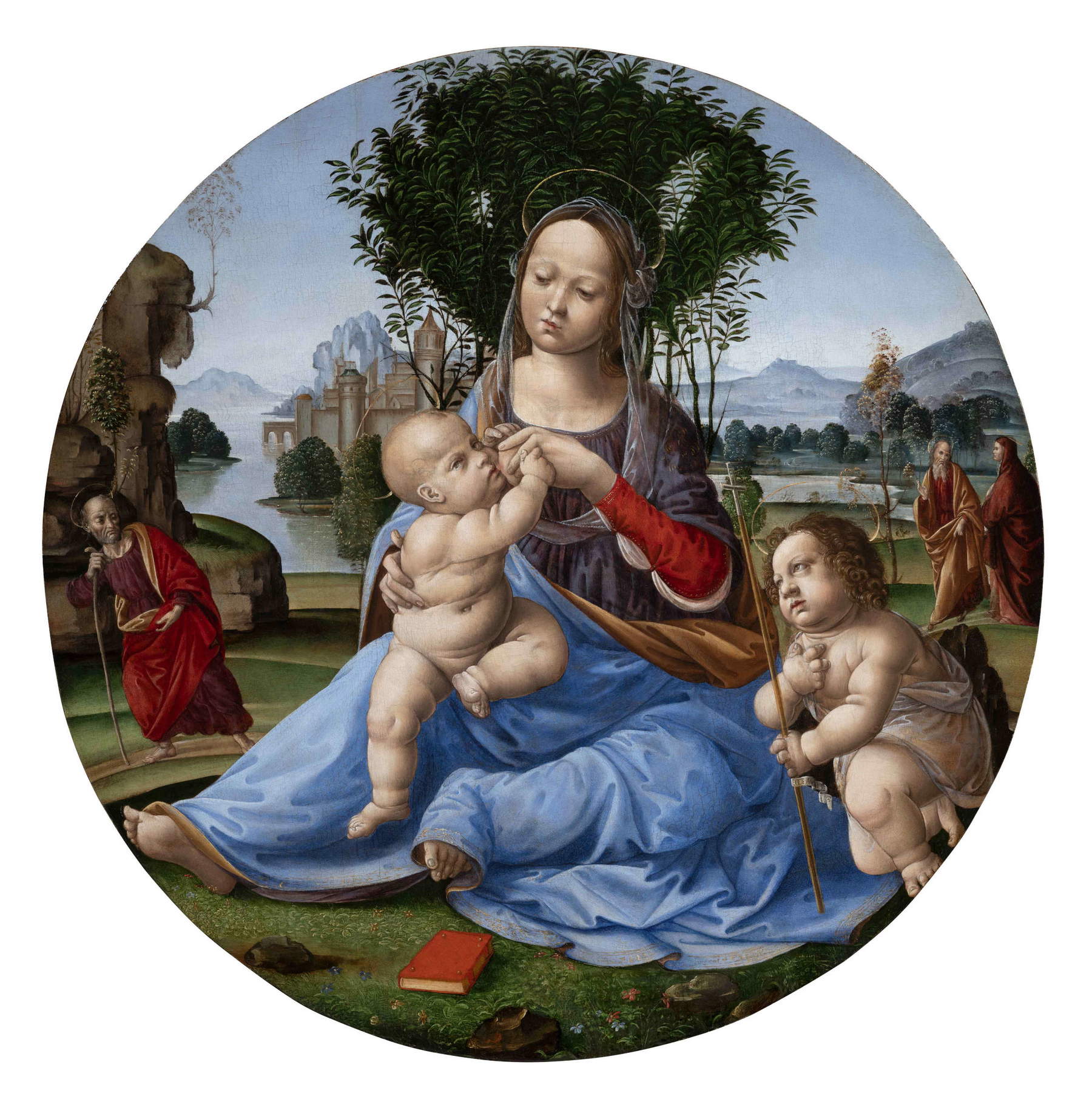
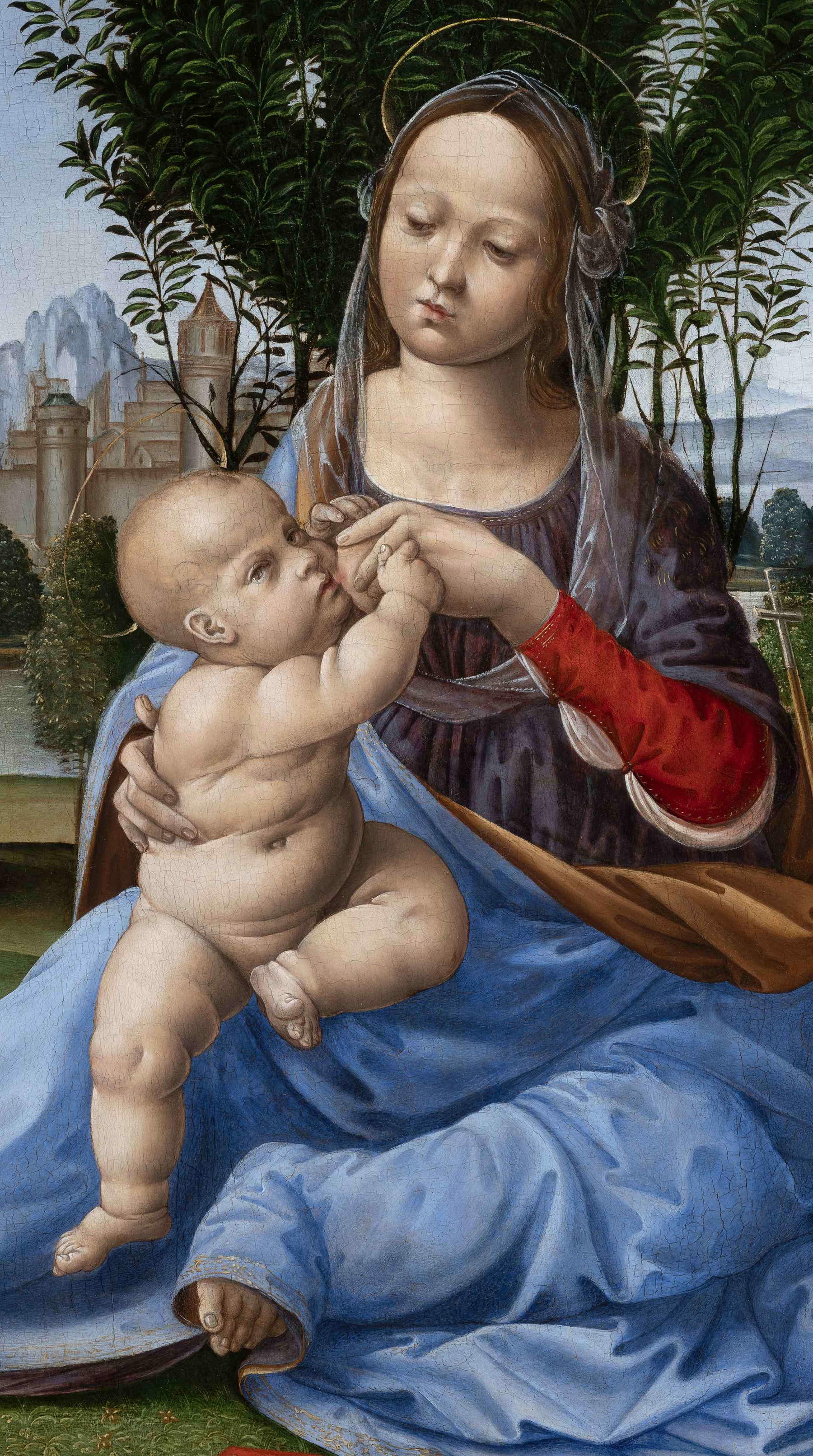
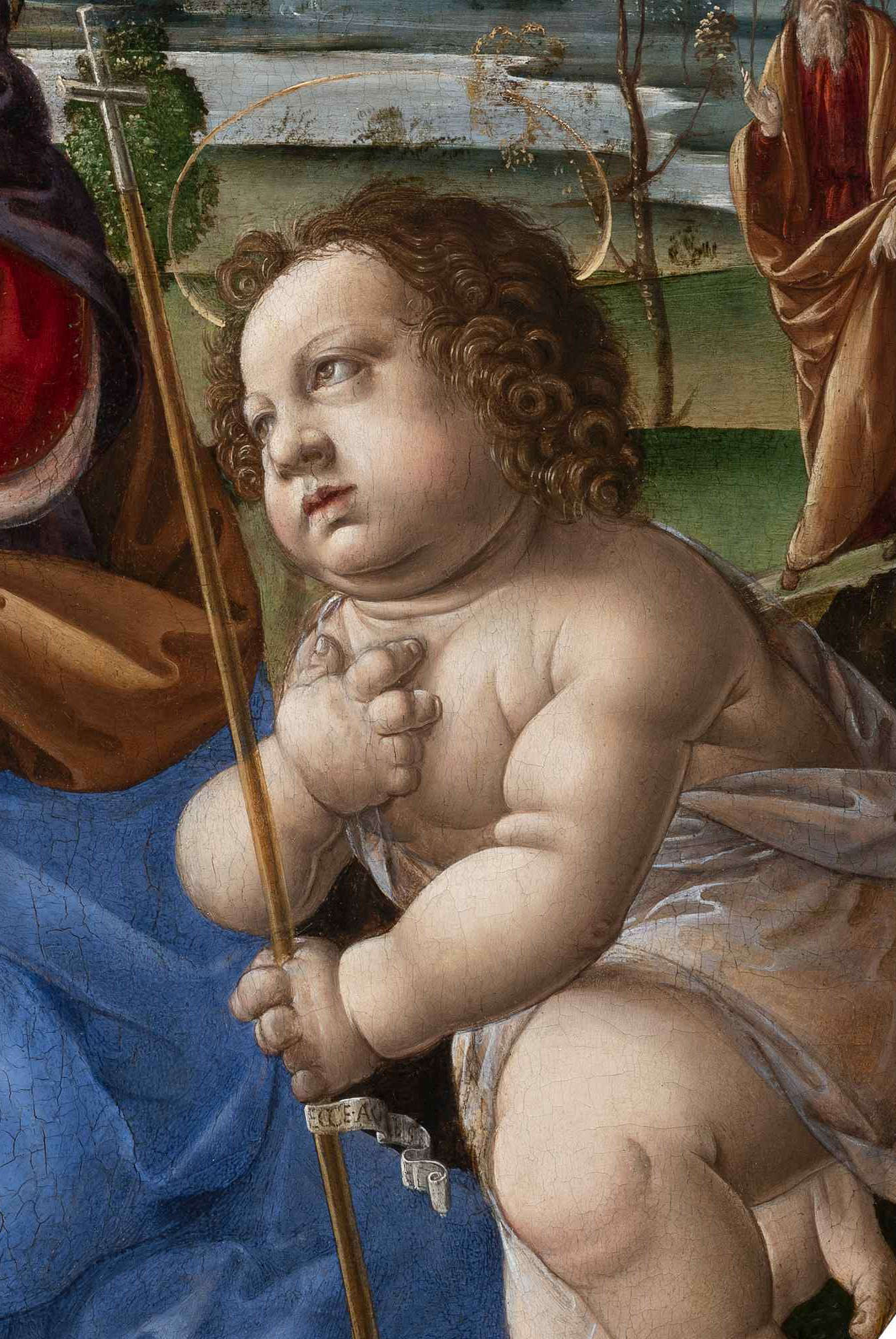
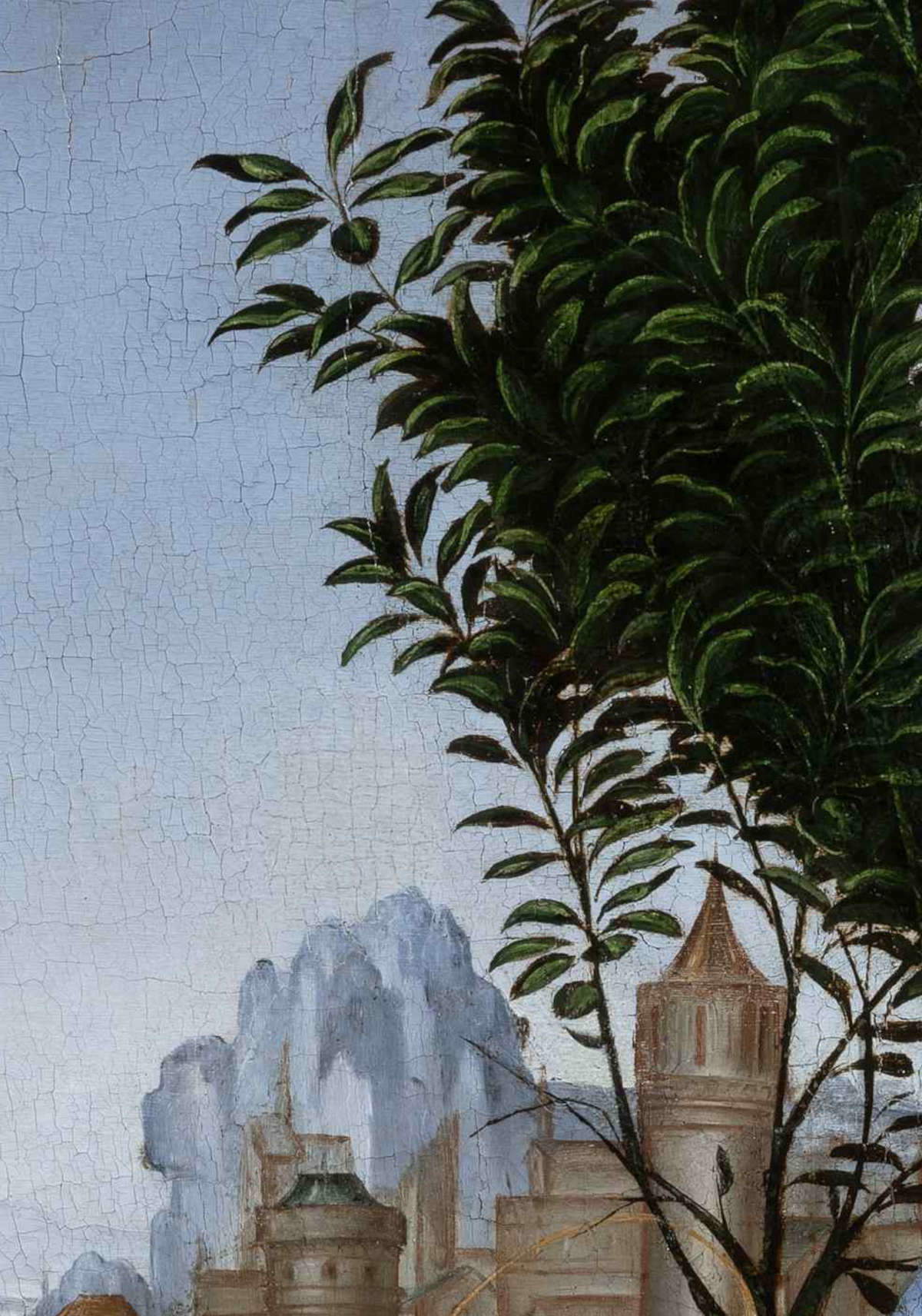
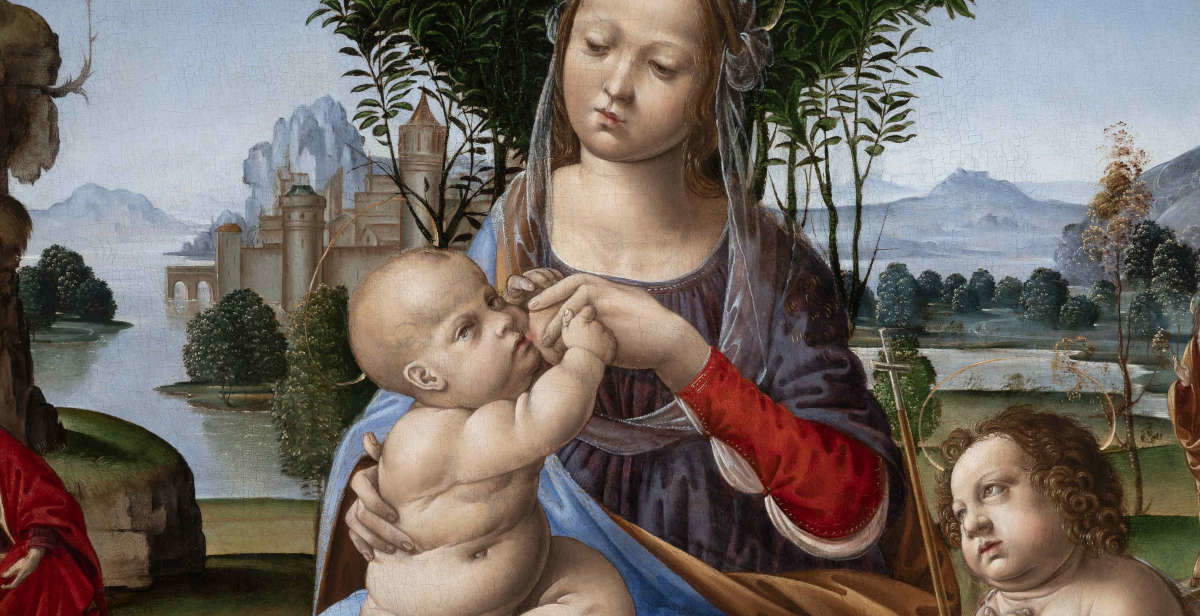
The scene takes place outdoors. The Virgin is seated on the grass and offers her breast to the Infant Jesus, who, as he draws near to his mother’s nipple, turns his gaze toward the viewer. Mary wears a purple tunic and a wide cornflower-blue cloak lined with yellow; behind her grows a lush shrub, likely a laurel tree, while a small red book lies next to the sacred group, apparently set aside as if she had paused in her reading. Saint John the Infant is kneeling a short distance away, and his figure is characterized by certain features that recur in the works attributed to Tommaso: in particular, the high, receding forehead, almost a sort of stylistic signature of the painter. The saint holds the customary processional cross with a scroll and wears a semi-transparent garment that reveals glimpses of his childlike body. Behind the main figures, the landscape opens up into the distance. A stream flows across a plain dotted with trees, while on the left a rocky cliff marks the edge of the composition. On the opposite side, a series of hills guides the eye toward a fortified city. This landscape serves more than just a backdrop: its composition helps set the atmosphere of the image through the gradual fading of colors and forms.
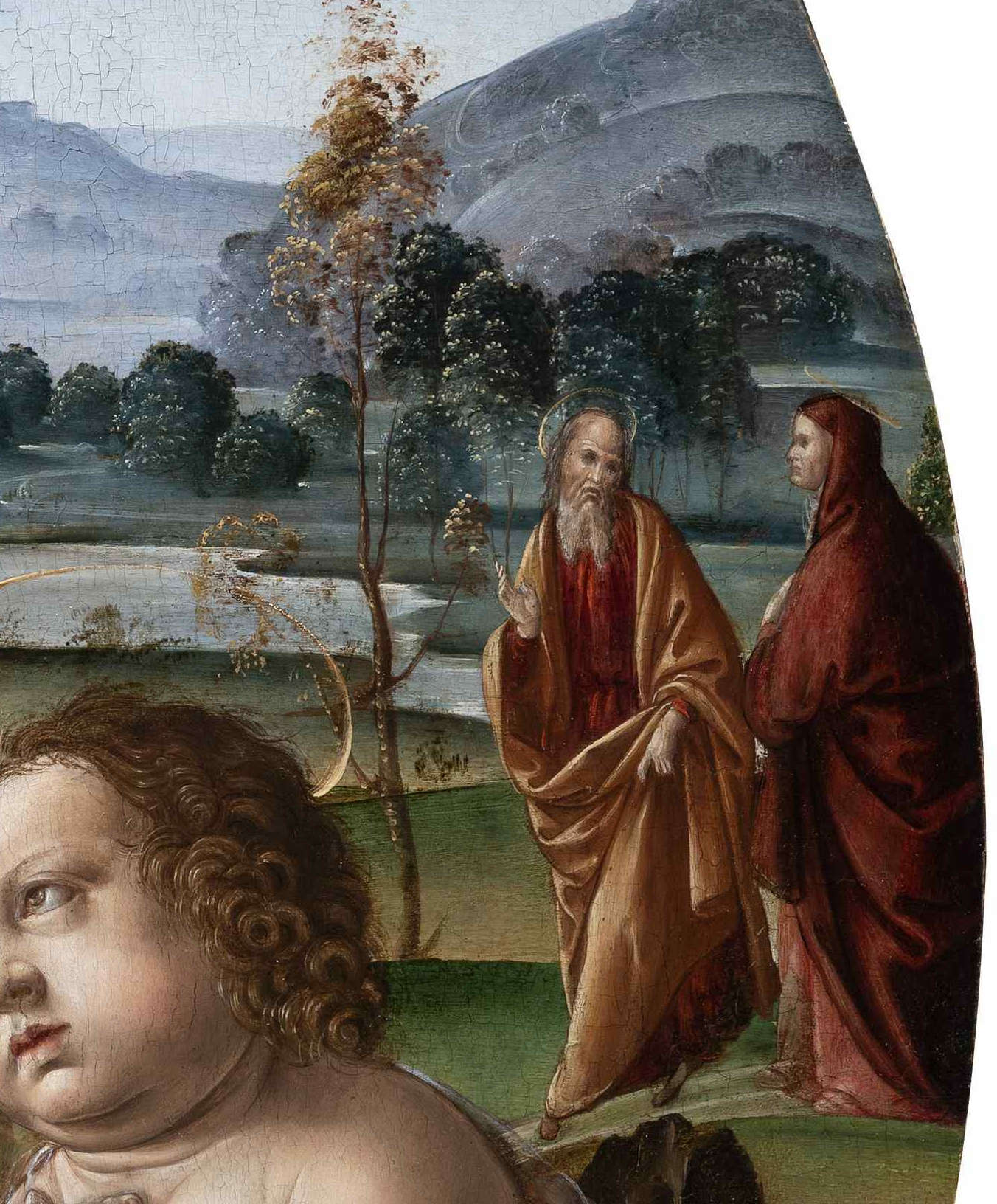
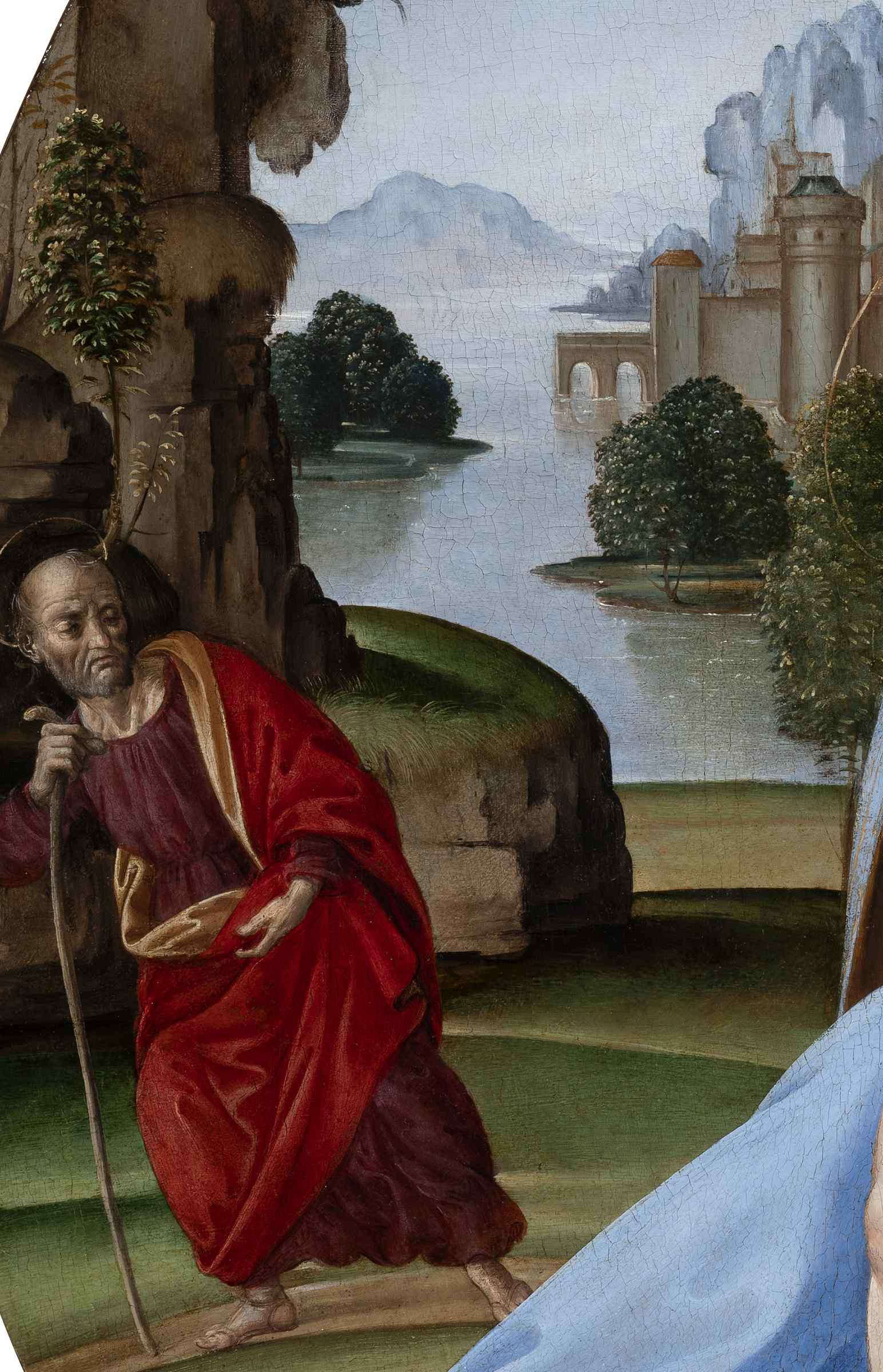
Even the small figures scattered in the background contribute to the scene: an elderly man dressed in red, leaning on a walking stick, is walking along a path and can be identified as Saint Joseph. Further away, an elderly man and woman appear to be walking while talking: they are likely Saint Zechariah and Saint Elizabeth, perhaps searching for their son, little John, who has wandered off to join the infant Jesus. These are minute details, almost marginal compared to the central group, but it is precisely this attention to small narrative elements that is one of the hallmarks of Tommaso’s painting. His compositions may revisit tried-and-true schemes, but they are constantly enlivened by details that change, combine, and take on different functions. The result is a devotional painting intended for private settings that retains a remarkable liveliness.
The tondo presented by Brun at the BIAF is particularly significant precisely because of the quality of its brushwork. The skin tones have a matte ivory hue; the Virgin’s mantle is rendered using a range of intense blues; while the waters and wet areas of the landscape seem to gradually dissolve into the light. The color palette thus manages to be both brilliant and atmospheric, rich in materials and soft in its rendering of space. This quality also helps explain why this artist, despite remaining anonymous, enjoyed considerable success in Florence between the 15th and 16th centuries. His output must have met a specific demand: that for high-quality devotional paintings, often of modest size, intended for private homes. Tommaso seems to have struck a particularly effective balance between fidelity to the models of Lorenzo di Credi and the ability to adapt them to a variety of commissions.
The critical history of the painter began in the nineteenth century, when Giovanni Morelli noticed that certain paintings then attributed to Lorenzo di Credi or his school exhibited characteristics consistent enough to be grouped under a single artist. In the 1870s, during his studies of the Borghese and Doria Pamphilj galleries in Rome, Morelli identified a group of works that he recognized as belonging to a single artist. The art historian also proposed a name: Tommaso di Stefano Lunetti, a painter mentioned by Giorgio Vasari as one of Lorenzo di Credi’s most important pupils, alongside Giovanni Antonio Sogliani. The hypothesis seemed to offer the possibility of transforming the anonymous “Tommaso” into a historically identifiable person, but the theory did not hold up when compared with Lunetti’s known works. Then, in 1903, Bernard Berenson observed that the artist’s biographical details did not align with the chronology suggested by the style of the paintings: Tommaso di Stefano Lunetti was born in the 1490s and thus belonged to a generation too young to be the author of works that displayed a training deeply rooted in fifteenth-century culture. Berenson therefore defined Tommaso as a “pure Fourteenth-century artist”—that is, as explained by the scholar Davide Civettini, who authored an extensive study on this tondo, “a painter whose training was essentially Fourteenth-century in nature and, therefore, at least one or two generations older than Lunetti.” He, in turn, put forward a possible name: Giovanni di Benedetto Cianfanini.
Cianfanini is documented as having been in Sandro Botticelli’s workshop in 1480, where he worked as an apprentice, and in 1531 he was listed among the executors of Lorenzo di Credi’s will. There were also documents attesting to his work in connection with some of the leading Florentine painters of the early sixteenth century. In 1513, he had collaborated with Lorenzo di Credi in evaluating the decoration created by Ridolfo del Ghirlandaio for the Chapel of the Priors in Palazzo Vecchio; in 1523, he received payment for gilding the frame—now lost—of a Saint Michael the Archangel painted by Lorenzo for Santa Maria del Fiore. There thus appeared to be a plausible connection, but even the identification with Cianfanini has remained without conclusive proof. In fact, there is no document, signature, or any other incontrovertible evidence that directly links the painter’s name to the body of works attributed to Tommaso.
The issue became even more complicated when scholars began using other conventional names to refer to groups of paintings that shared similar characteristics. In the end, however, “Tommaso” remained the dominant designation. The quotation marks have become an integral part of the conventional name and underscore its provisional nature. We do not know for certain who he was. We do, however, know what he painted, which models he used, and what an extraordinary familiarity he had with the artistic language of Lorenzo di Credi. One of the most evident characteristics of his work is, in fact, his ability to construct new images using a relatively limited repertoire of motifs. Figures, trees, rocks, angels, drapery, and secondary characters reappear in different paintings, but not through mechanical repetition. They are recombined, modified, and incorporated into different compositions. It is precisely this familiarity with Credi’s repertoire that has fueled the idea of a particularly close relationship with Lorenzo’s workshop: Tommaso seems to have an insider’s knowledge of the master’s inventions and uses them with a freedom that goes beyond mere imitation. In some cases, he reproduces entire figures; in others, only details: a face, a hairstyle, a garment, a laurel bush, or a small figure in the landscape.
“To draw a comparison that’s a bit of a stretch but very timely,” writes Civettini, “it is as if behind the personality of ‘Tommaso’ there were actually a sort of A.I. programmed and directed by Lorenzo di Credi himself, with a limited sample set of models stored in his mental servers, from which he could draw with the utmost freedom to produce paintings that would satisfy the requests of the current patron. In other words, one suspects that ‘Tommaso’ was in charge of a more commercial and affordable branch of Lorenzo’s workshop, which was already inclined to churn out devotional paintings of the highest quality, with colors and effects as exquisite as those of a luxury brand, though lacking the same level of originality: which would explain the nonchalance and familiarity with which our anonymous artist handles a repertoire of techniques usually reserved for a master’s inner circle.” However, this dependence does not preclude an autonomous capacity for interpretation. Indeed, the tondo presented by Brun at the BIAF shows how the artist could achieve results of exceptional quality when working on more complex compositions.
The landscape is, in this sense, decisive. The rocky cliff on the left, the tree growing almost in balance on the rock, the laurel tree behind the Virgin, the stream, and the hills are elements that recur in other works by the painter. Even the balding Saint John the Baptist can be compared to similar figures found in other paintings attributed to Tommaso. These recurring motifs do not merely constitute a recognizable repertoire; they allow scholars to trace the career of an artist who, in the absence of personal documents, can be reconstructed almost exclusively through the characteristics of his works.
The tondo in the Brun Gallery thus belongs to a recognizable body of work but occupies a particularly significant position: its pictorial quality is, in fact, superior to what one might expect from a simple, mass-produced series of devotional images. The use of color, especially in the flesh tones and drapery, shows remarkable care, while the landscape exhibits an atmospheric sensitivity that lends the space greater complexity. The choice of subject is also significant. The Madonna of Humility, depicting the Virgin seated on the grass with the Child beside her, enjoyed renewed popularity at the beginning of the sixteenth century: the theme had been taken up, among others, by Michelangelo in the Doni Tondo and by Raphael in various Marian compositions. Lorenzo di Credi had also worked on this iconographic type. Tommaso’s painting can therefore be dated to at least the first decade of the sixteenth century. Its execution appears to align with the artist’s more mature works, characterized by a more intense tonal fusion and a more nuanced interplay between light, shadow, and volume. Comparison with other known paintings helps to situate it within this phase.
It is possible that his ability to combine recognizability with variation was one of the reasons for Tommaso’s success. Lorenzo di Credi’s stylistic innovations were by then well-established and easily recognizable, while Tommaso’s work allowed him to reinterpret them with remarkable technical skill and adapt them to new demands. His images were familiar enough to be immediately recognizable and varied enough not to be reduced to identical copies. This aspect makes his position within the system of Florentine workshops particularly interesting: the anonymous painter is not simply a follower imitating a famous master, but rather a figure capable of managing his own repertoire and transforming it into a substantial body of work—one that, however, remains devoid of a documented identity.
In this sense, the Biaf tondo allows us to view Renaissance painting from a perspective different from that offered by the great names: Lorenzo di Credi remains the point of reference, Botticelli one of the possible influences on the anonymous painter’s training, but the painting also reveals the presence of artists who left behind a substantial body of work without establishing an equally solid identity. And it is perhaps precisely here that the mystery of “Tommaso” reaches its most intriguing point. His identity continues to elude us, despite over a century of studies, theories, and comparisons. Names have been put forward, hypotheses constructed, paintings grouped together, and other groups of works separated. But no identification has reached the degree of certainty necessary to definitively replace the conventional name. He therefore remains a painter without a certain biography, but not without personality. His presence emerges from the works—from the recurring figures and landscapes, the manner of applying color, the use of Credenzian models, and the ability to transform a limited repertoire into a surprisingly extensive body of work. And the tondo at the Galleria Brun allows us to encounter him precisely at the moment when his painting seems to reach one of its most refined achievements. At the BIAF, visitors encounter not only a rare Renaissance tondo. They also encounter a question that remains unanswered: who is hiding behind that name in quotation marks? For now, the answer remains elusive. But it is precisely the absence of a definitive answer that has allowed critics to trace, through his works, the traces of an artistic personality that time has failed to erase.
 |
| The Mystery of “Tommaso,” the Painter Who Imitated Lorenzo di Credi: Brun Brings One of His Tondo Paintings to the BIAF |

Warning: the translation into English of the original Italian article was created using automatic tools. We undertake to review all articles, but we do not guarantee the total absence of inaccuracies in the translation due to the program. You can find the original by clicking on the ITA button. If you find any mistake,please contact us.



























 IT
IT FR
FR DE
DE ES
ES CN
CN


