





During excavation activities carried out in a bread-making room within the Casti Amanti complex of the Pompeii Archaeological Park, the skeleton of an equid emerged. The intervention was conducted through a close synergy between archaeologists and specialists from the Applied Research Laboratory, including archaeozoologists, archaeobotanists and anthropologists, as part of a multidisciplinary approach. In this context,archaeozoology plays a key role as it allows us to reconstruct how animals were used in the ancient world, providing important information about economic and production systems and the contribution of animals to the daily life of ancient communities.
TheInsula of the Casti Amanti constitutes one of the most significant excavation sites in Pompeii, thanks to the preservation of an entire production structure consisting of an oven, warehouses, processing areas and the owner’s dwelling. The complex takes its name from the famous fresco depicting the “chaste kiss,” found in a triclinium of the house. Inside is a large bakery with attached stables, where in previous excavation campaigns other equids employed both in operating the millstones and in transporting the grain needed for bread production had already been identified.
Excavation operations constituted the initial phase of the investigation, followed by an initial study of the recovered finds. Laboratory analysis, which is still underway, will enable further information to be acquired both on the role played by the animal within the production cycle and the conditions in which it was located at the time of the eruption of Vesuvius in 79 AD. The examination of the equid will also be able to offer new elements for understanding the dynamics of the eruptive event and the reactions of the animals to the catastrophe that struck the city, helping to enrich the reconstruction of those dramatic hours.
Research continues through the study of finds and specialized laboratory investigations, in a constant confrontation between different disciplines, with the aim of giving new voice to even the most discreet testimonies and to remember how every trace of the past, human or animal, preserves a story still waiting to be told.
“Pompeii for a long time,” says Archaeological Park Director Gabriel Zuchtriegel, “represented above all the beauty of the frescoes, the possibility of studying the material culture of antiquity. It’s actually much more than that: it’s a chance to learn about the human lives that were cut short during the eruption, as in the recent display of casts of victims here in Pompeii, but also the lives of animals. In this case of an equid, a horse or donkey, which was found inside a House containing beautiful frescoes, the House of the Casti Amanti. The Domus also served as a bakery and a mill. There was a stable where, in the past, several animals were found. But recently, as part of new excavations, another animal, an equid, was also discovered that had escaped and was in another room. This means more research not only on human victims, but also on animals, to understand how animals and humans lived and worked together in society about two thousand years ago. The excavation of this equid in the Casti Amanti complex is also an excellent example of the multidisciplinary work that takes place at the site every day: archaeologists and specialists from different disciplines working together to reconstruct not only the objects, but the relationships between people, animals, and productive spaces. Analyses are still ongoing and will give us more information: the site continues to offer material of great scientific value.”
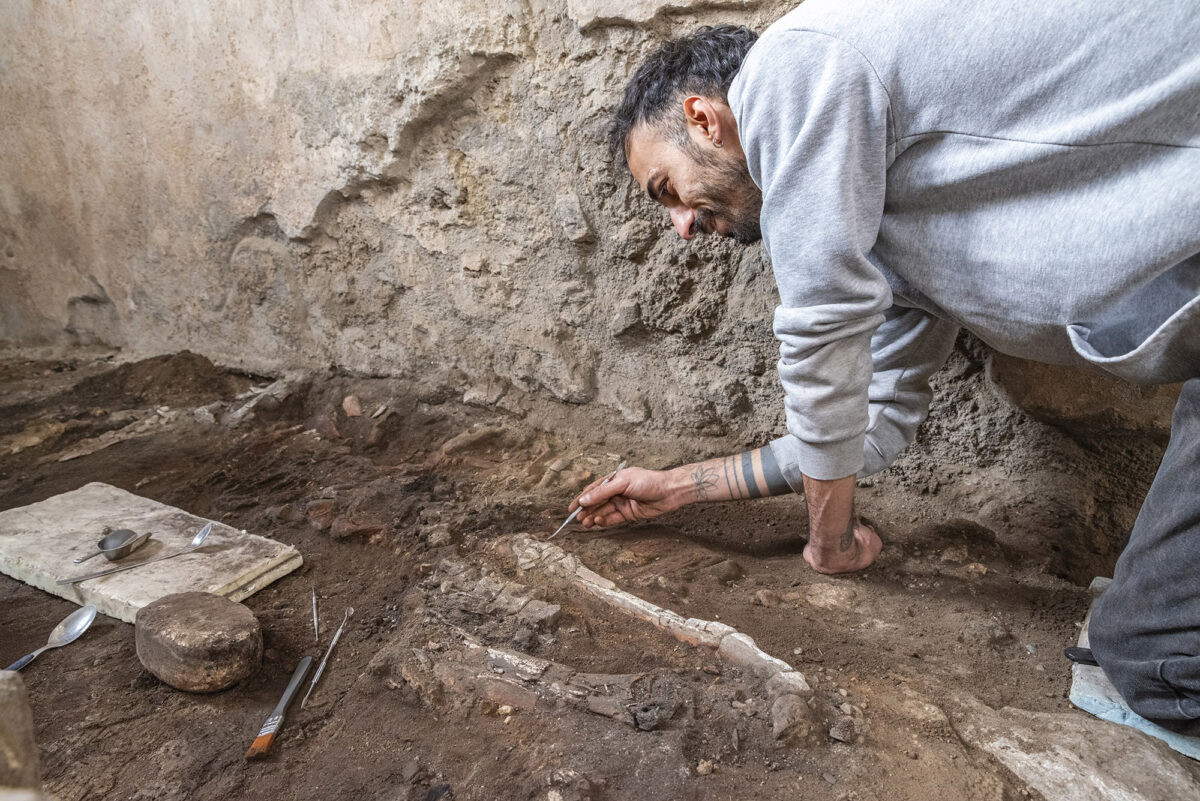 |
| Pompeii, skeleton of an equid emerges in the Casti Amanti complex |

Warning: the translation into English of the original Italian article was created using automatic tools. We undertake to review all articles, but we do not guarantee the total absence of inaccuracies in the translation due to the program. You can find the original by clicking on the ITA button. If you find any mistake,please contact us.




















 IT
IT FR
FR DE
DE ES
ES CN
CN


