





The Langhe region, and in particular the village of Canelli, is preparing to welcome a new public artwork that is set to become a permanent fixture in the town’s landscape. To mark the tenth anniversary of the inscription of the Langhe-Roero and Monferrato Wine-Growing Landscapes on the UNESCO World Heritage List, Brazilian artist Maria Thereza Alves (São Paulo, 1961) has created *Pluriversal Recapturings* (Riconquiste pluriversali), a site-specific project developed for the Moncalvina site that focuses on the relationship between contemporary art, ecology, and cultural heritage. The work will be presented to the press on Thursday, July 9, at 10 a.m., at the Palazzo della Regione Piemonte in Turin, while the public opening is scheduled for Saturday, July 11, starting at 6 p.m. in Canelli. The initiative is the result of a collaboration between the Municipality of Canelli, the Castello di Rivoli Museum of Contemporary Art, and the Association for the Wine-Growing Landscapes of Langhe-Roero and Monferrato. The project was made possible thanks to the support of the National Tourism Fund, established by the Ministry of Tourism, and the Piedmont Region, with curatorial coordination by the Castello di Rivoli. The project also holds strategic significance within the region’s cultural policies, as it contributes to the inclusion of the Municipality of Canelli among the “Sister Capitals” of Alba, Capital of Contemporary Art 2027.
Pluriversal Recapturings (Pluriversal Recapturings) was conceived specifically for La Moncalvina, a site that forms part of the Langhe-Roero and Monferrato Wine-Growing Landscapes, recognized by UNESCO as an exceptional example of the interaction between human activity and the natural environment. It is precisely this relationship that serves as the starting point for the artist’s research.
Maria Thereza Alves is considered one of the most influential figures in international artistic research on the themesof political ecology, memory, and the relationships between humans and the environment. Active since the 1980s, she has developed a multidisciplinary practice that brings together art, activism, field research, and collaboration with local communities. Throughout her career, the artist has devoted particular attention to the circulation of plant species, the effects of colonization on territories, and the need to envision new forms of coexistence between humans and the natural world. Her works take shape through a careful study of the geographical, ecological, and cultural contexts in which she intervenes, with the aim of generating new awareness regarding the relationship between memory, landscape, and coexistence.
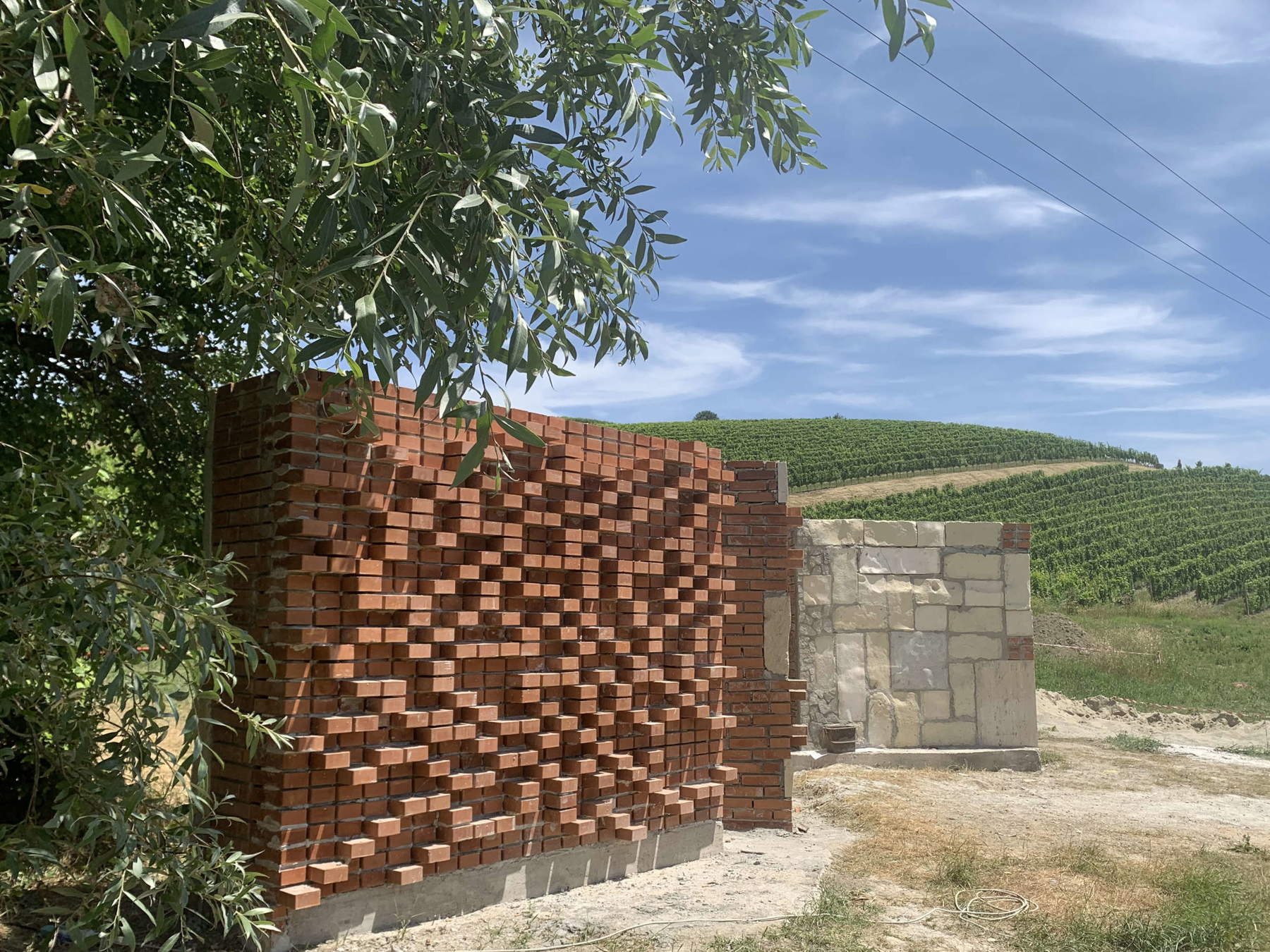
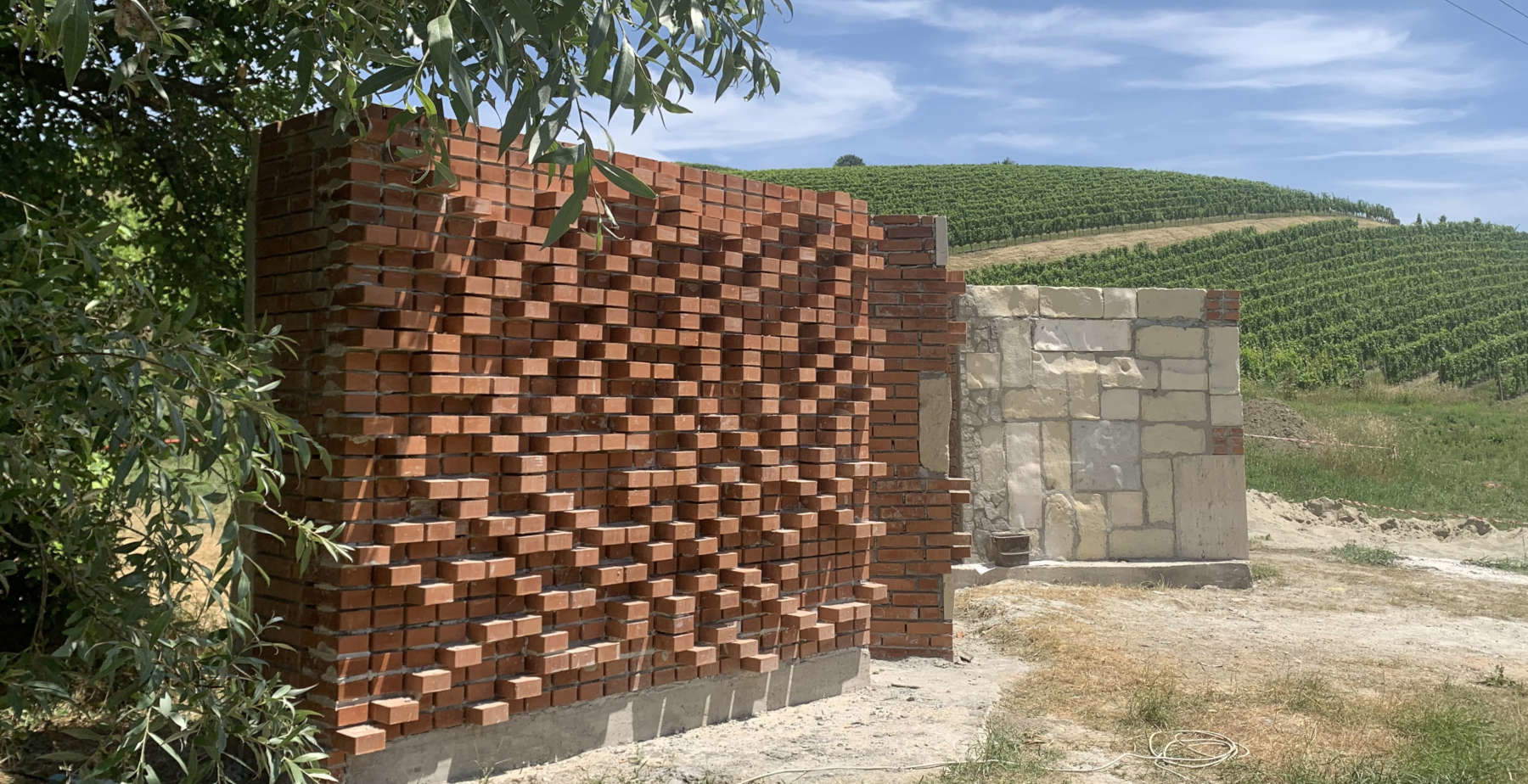
The project developed for Canelli also stems from a long research process. Alves has, in fact, collaborated with professionals, university professors, and local communities, exploring the relationships that have developed over time between the territory, the flora, the fauna, and the agricultural practices that characterize the wine-growing landscape of the Langhe, Roero, and Monferrato. From this process of study and dialogue, a work takes shape that appears as a masonry structure composed of bricks and fieldstone, enriched with inserts of various types of stone. The design of the project does not merely respond to formal requirements but was conceived to provide habitats and favorable microclimatic conditions for the numerous animal and plant species found in the area.
The work thus invites reflection on the possibility of conceiving the landscape as a dynamic system of relationships in which different forms of life coexist. Rather than a monumental element to be observed, the structure aims to become an integral part of a constantly evolving ecosystem, inviting the public to view the UNESCO World Heritage Site as a living organism capable of evolving through the interaction of natural, historical, and cultural elements.
The project is also part of a broader landscape design developed in collaboration with ecoLogicStudio. The project involves the creation of an ecological garden based on the planting of native plant species arranged in a concentric circular pattern, designed to promote biodiversity and interactions among species.
The garden was conceived as an open-ended, non-static system. Over time, the vegetation itself will gradually alter its appearance, adapting to the site’s microclimatic conditions and allowing natural processes of transformation to emerge. The project is therefore not intended as a static composition, but as an environment destined to evolve over time. This processual dimension represents one of the central aspects of Maria Thereza Alves’s research; for years, she has been developing works in which the landscape is not merely the backdrop for the artistic intervention but becomes an active part of the project, contributing to its continuous redefinition. The work aims to offer an interpretation of the territory that goes beyond the mere preservation of heritage to highlight its dynamic and collective nature: from this perspective, the landscape is the result of historical stratifications, ecological relationships, and cultural practices that continue to change over time. The artistic intervention therefore invites viewers to observe the territory not as an immutable image, but as a set of constantly shifting balances.
Born in São Paulo in 1961, Maria Thereza Alves has been exhibiting internationally since the 1980s. Her artistic practice is grounded in an exploration of local histories and realities, with a particular focus on events that have remained on the margins of the official narrative. Each project takes shape through a direct dialogue with the physical and social environments of the places where she works, prioritizing collaborative methodologies and relational practices that challenge the traditional divisions between nature and culture, art and politics, artistic research and daily life.
Throughout her career, she has participated in some of the leading international events dedicated to contemporary art, including the 2025 Helsinki Biennial, the 2024 Lagos Biennial, the 2023 Chiang Rai Biennial in Thailand, the Geneva Biennial of Art and Urban Nature, Documenta 15 in Kassel in 2022, the Pan-American Biennial in Quito, the Ural Biennial in Yekaterinburg, the Sydney Biennial, the Toronto Biennial, Manifesta 12 in Palermo, the Frestas Triennial in Brazil, the Sharjah Biennial, the São Paulo Biennials of 2010 and 2016, the Berlin Biennial, dOCUMENTA (13), the Taipei Biennial, the Lyon Biennial, the Guangzhou Triennial, Manifesta 7 in Trento, and the 1986 Havana Biennial. Among the awards she has received are the 2016–2018 Vera List Prize for Art and Politics and, in 2024, the “Napoli è Donna – Lydia Cottone Prize” in the Art category.
Francesco Manacorda, director of the Castello di Rivoli Museum of Contemporary Art, states: “Maria Thereza Alves’s work is comparable to a connective tissue between the territory perceived as urban and civilized and that perceived as natural landscape—and thus external to the human. The wall, like the garden, not only promotes biodiversity but also illustrates how such distinctions are irrelevant in an ecosystemic conception of the world where the well-being of non-human species has a direct effect on all elements of the system, including humans. This interpenetration means that, in the work, urban space is no longer a threshold but rather a shared territory for coexistence.”
“Contemporary art is a universal language that engages with a specific system of places, relationships, and times—and, above all, with the eyes of the viewer,” states Bruno Bertero, Director of the Association for the Wine-Growing Landscapes of Langhe-Roero and Monferrato. “It is no coincidence that we chose to celebrate the tenth anniversary of the designation of our Piedmont Wine-Growing Landscapes as a UNESCO World Heritage Site with a permanent, site-specific artwork: the fact that the artwork conveys the values of environmental sustainability, shared responsibility, and a balanced dialogue between people and the environment constitutes an important communicative value.”
“Contemporary culture,” adds Marina Chiarelli, Councilor for Culture, Equal Opportunity, and Youth Policies for the Piedmont Region, “has the ability to generate new perspectives, enhance local areas, and build connections between identity, the environment, and the community. Maria Thereza Alves’s work is a concrete example of how art can become a tool for interpreting the landscape and an opportunity for cultural growth for an entire region. On the tenth anniversary of UNESCO’s recognition of the Langhe-Roero and Monferrato Wine-Growing Landscapes, this initiative takes on even greater significance: it demonstrates that heritage should not be viewed merely as a legacy to be preserved, but as a resource to be enhanced through innovative forms of expression capable of speaking to the present and to new generations. The Piedmont Region continues to invest in culture as a driver of development, attractiveness, and competitiveness for its territories. Bringing together world-renowned landscape excellence, international artistic research, and local communities strengthens Piedmont’s identity and creates new opportunities for growth, tourism, and promotion for our communities.”
“The Pluriversal Recapturings project, which is now coming to fruition,” says Paolo Bongioanni, Regional Councilor for Commerce, Agriculture and Food, Tourism, Sports and Post-Olympic Affairs, Hunting and Fishing, Parks of the Piedmont Region, “brings together the public and private sectors in a shared vision: that combining contemporary art, culture, agri-food excellence, and natural and man-made landscapes means investing in a region and enhancing its value even further by generating new beauty and appeal. Tourists who choose the UNESCO World Heritage hills of Langhe, Monferrato, and Roero know they can count on an immersive experience capable of offering all of this—one that also speaks to the new audiences and markets the Piedmont Region is actively targeting.”
“The result of collaboration between the municipal administration and technical staff with other agencies, as well as the firm resolve of the Piedmont Region’s offices, Maria Thereza Alves’s work,” concludes Roberta Giovine, mayor of Canelli, “brings a breath of fresh air to our community, offering a new perspective on the future rooted in our identity and our present reality. Canelli is UNESCO because of what it already is. The artwork integrates with us and enhances who we already are.”
 |
| In the Langhe, Maria Thereza Alves creates a new public artwork to mark the 10th anniversary of UNESCO |

Warning: the translation into English of the original Italian article was created using automatic tools. We undertake to review all articles, but we do not guarantee the total absence of inaccuracies in the translation due to the program. You can find the original by clicking on the ITA button. If you find any mistake,please contact us.















 IT
IT FR
FR DE
DE ES
ES CN
CN


