





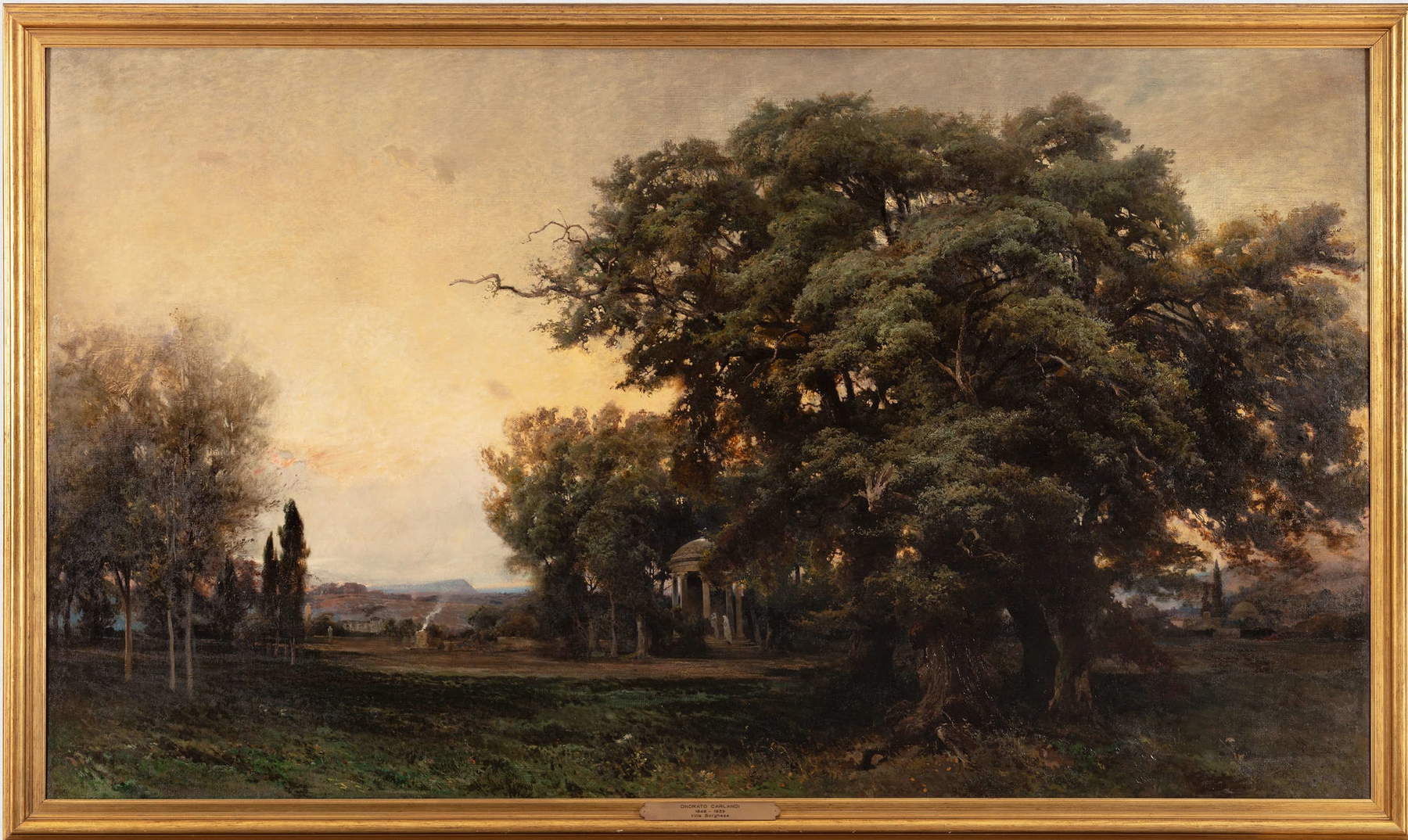
It may provoke mild, amused unease to think that the Villa Borghese painted by Onorato Carlandi is pure invention, a pagan fantasy, the shredding of a dream. It does not exist, that Villa Borghese. There is not the great, sinister, shadowy oak that Carlandi imagines in front of the temple of Diana. The altar on which the fumes of the sacrificial offering rise, those desolate expanses that can be seen as far as the eye can see toward the horizon do not exist; those officiants in peplos approaching the little temple have never existed, except in the artist’s imaginative and heated fevers. Symbolism, after all, is all here: an array of fantasies. The sick translation of an idea inspired by distant epochs. The result of a clash between the consistency of matter and the truth of art. Although perhaps it would be more correct to speak of symbolisms, in the plural: Francesco Parisi, curator with Stefano Roffi of the extremely dense exhibition on Symbolism in Italy, which occupies the rooms of the Magnani Rocca Foundation until the end of June, warns that the difficulty of a “general perimeter of Italian symbolism” depends largely on “the coexistence of polysemantic approaches that are sometimes irreconcilable, which has made the identification of a unitary canon and a shared lexicon problematic.” This is the pregnant yet elusive subject matter on which the impeccable Parisi’s exhibition attempts to bring order. To rummage through the sources, one would risk disagreeing even on the fundamentals: Vittore Grubicy, for example, distinguished between a “symbolism” firmly anchored in the observation of the phenomenal, or at most capable of expressing itself according to an “adaptation of tangible things following conventions and prejudices more or less accepted and known,” and an “ideism” that could instead safely dispense with the adherence of forms and colors in the name of overcoming any claim to objectivity. It can be agreed, however, that all symbolism, from its earliest impulses, from its first, messy, and perhaps even unconscious manifestations, grew up on the common ground of reaction to naturalist painting, and was therefore founded on a certain degree of rejection of reality, to be understood both in the sense of rejection of rules and in the sense of distancing itself from the positivist concrete, from the tangible, from the measurable. It will then be necessary to start from the recognition of certain “intonations,” the curator calls them, that link Italian symbolism to European symbolism and in which it is possible to identify the bones of the exhibition: “the recourse to myth and allegory, the centrality of the female figure as an ambivalent pole of perdition and redemption, the use of the landscape as a symbolic projection of spiritual conditions.” These are, precisely, the coordinates that are given to the visitor to orient himself in this swamp of monsters, visions, transfigurations, wanderings, desires, illnesses, decadences, liquid dreams, unhealthy fantasies, literary hypnosis, failed mirages, and mystical mysteries.
Fundamentally undisciplined subject matter, then, and perhaps one can also explain on the basis of this assumption the subject’s poor exhibition fortunes (so far there has been only one exhibition on Symbolism in Italy, the one in Padua in 2011, organized, however, by themes: the Magnani Rocca’s exhibition instead seeks, for the first time, to establish a chronology, a rigid scansion, a precise temporal trajectory). This is not the only plausible reason, however. The solution of a possible question about what symbolism was would trigger polarities, some tension: the audience may be surprised by the amount of answers that could come. Grubicy has been briefly mentioned, but one could say of Neera, that is, the writer Anna Maria Zuccari, for whom the work of art is the final fruit of a process based in the “higher court of the mind” where “the artistic transformation of passion takes place”: the work is for her the transfiguration of a personal passion that becomes universal. For another of the exhibition’s tutelary authorities, Angelo Conti, painting is “an expression of the faintest nuances of feeling. It is like music, wanting to find a comparison: yet, he would later explain, it cannot completely disregard reality, and it must ramp ”always from a direct, profound observation of reality,“ since ”the ideal is the perfume of reality.“ Domenico Tumiati would write that the task of ”neo-symbolism,“ he called it, is ”to help the spirit of those who read, of those who listen, of those who look to rise above appearances." Ugo Ojetti would have thought of a form of compromise between symbol and reality.
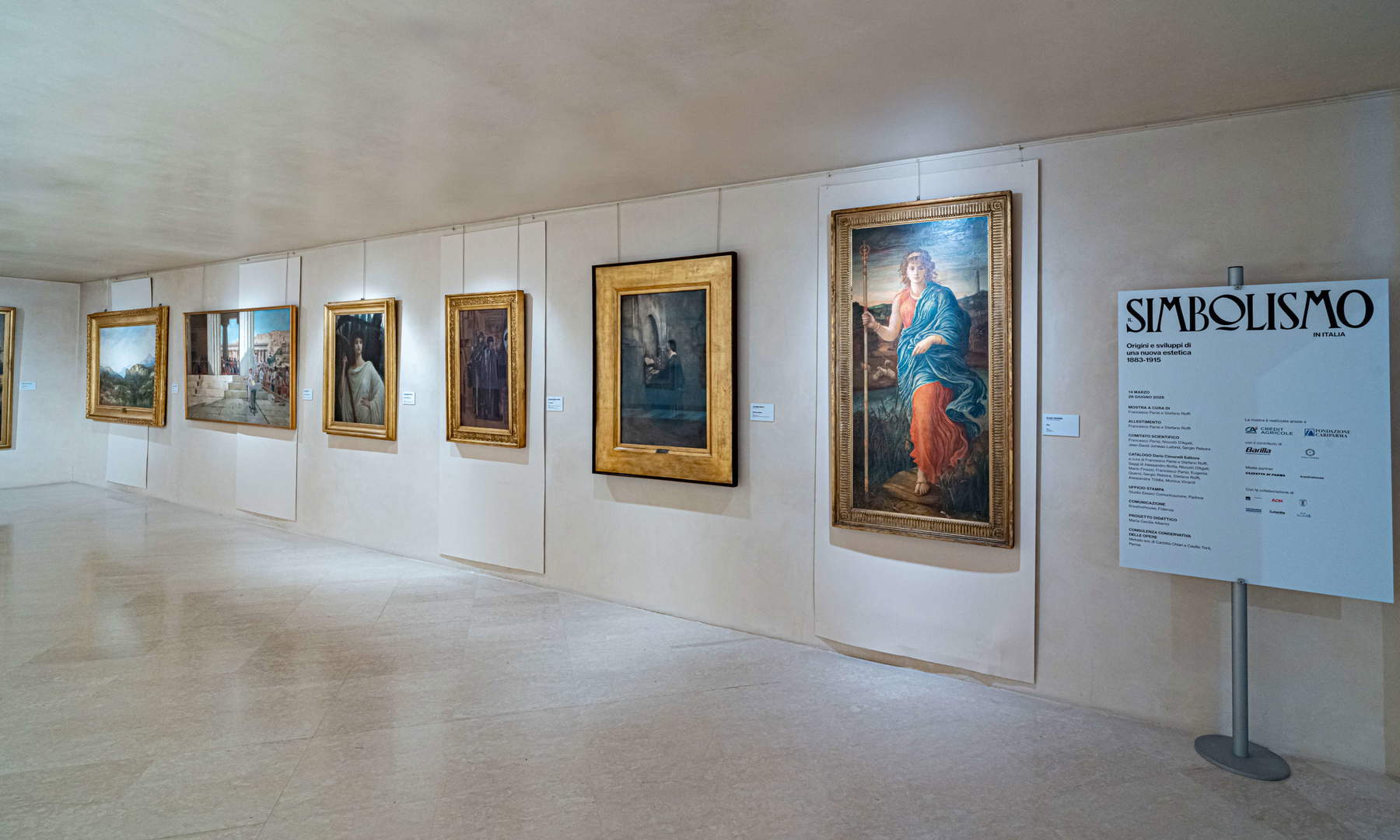
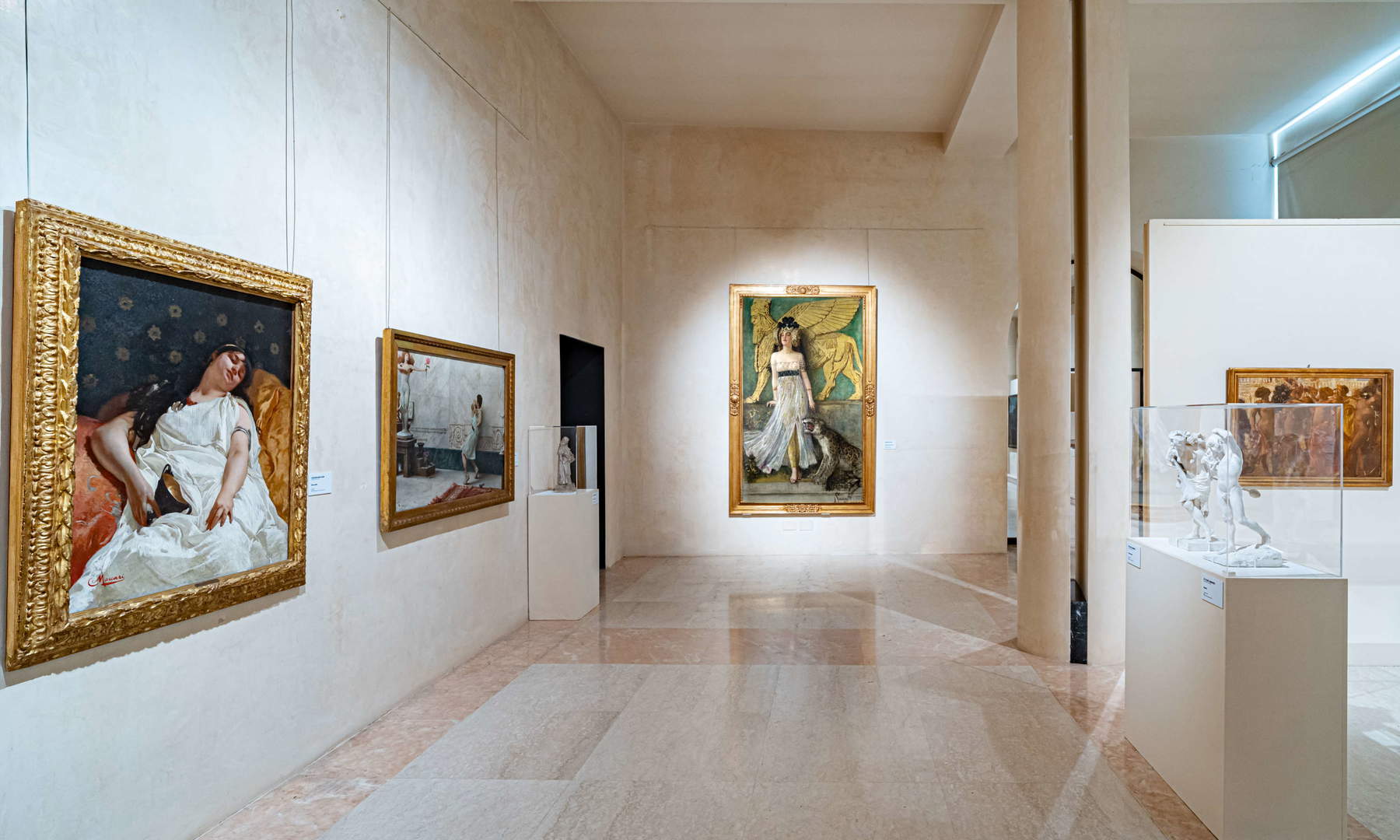
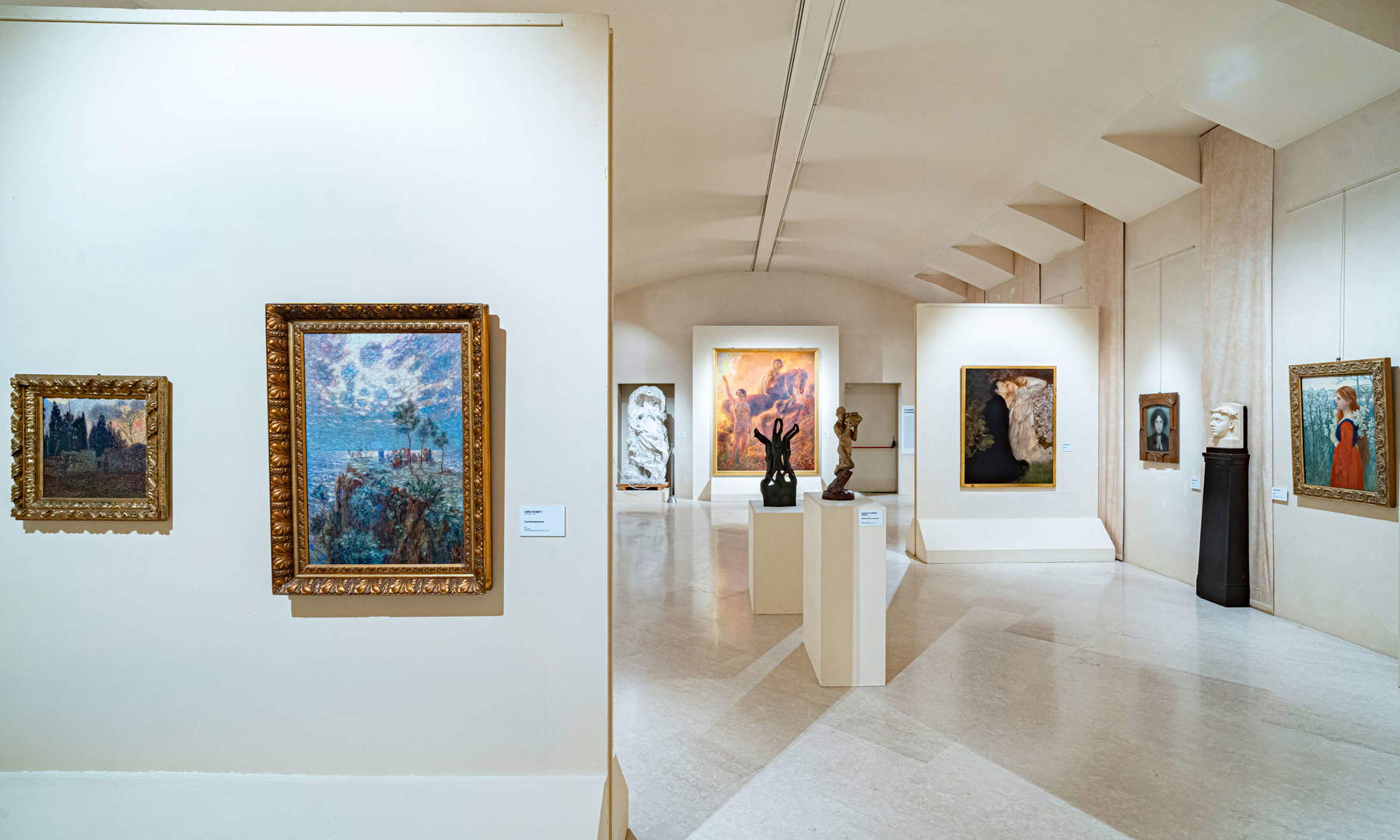
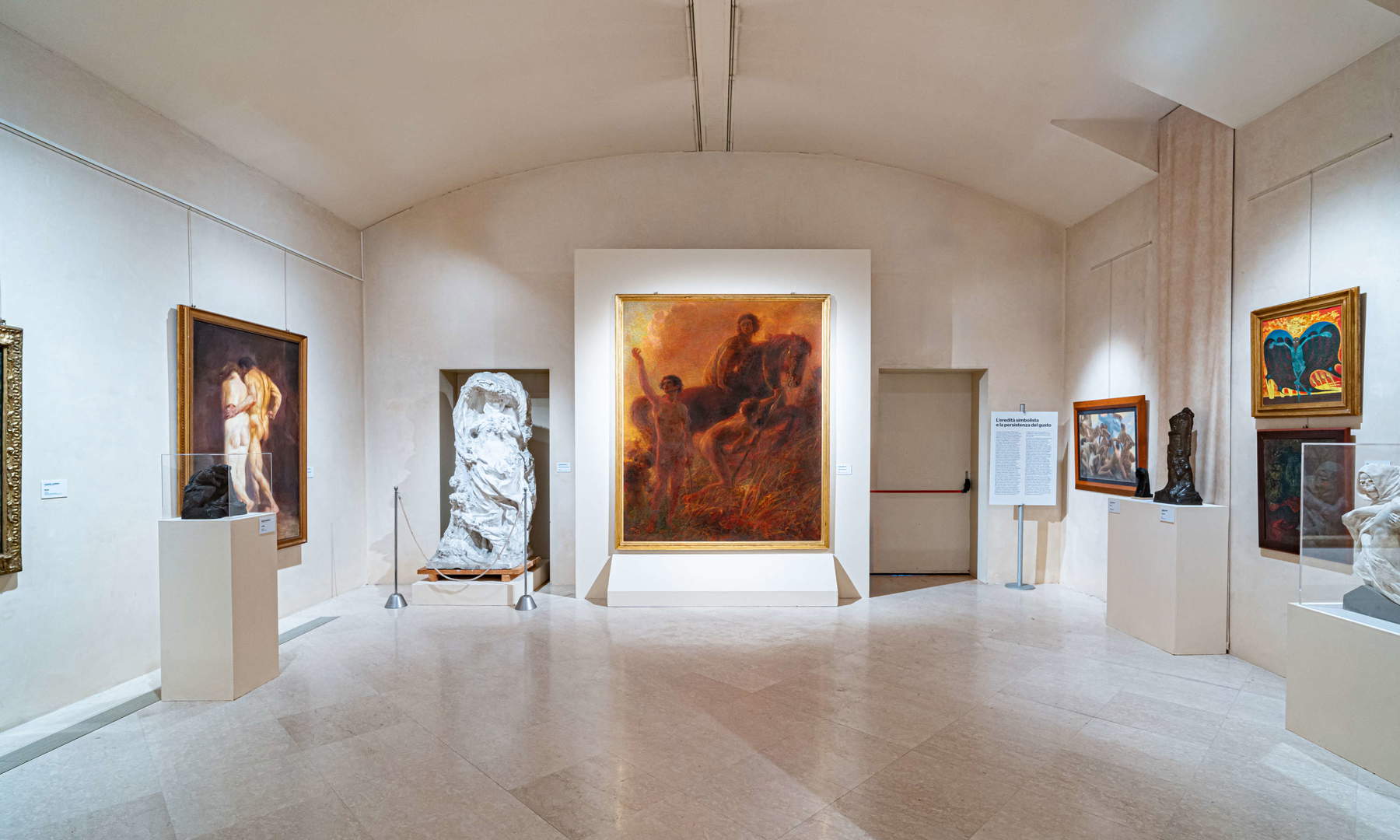
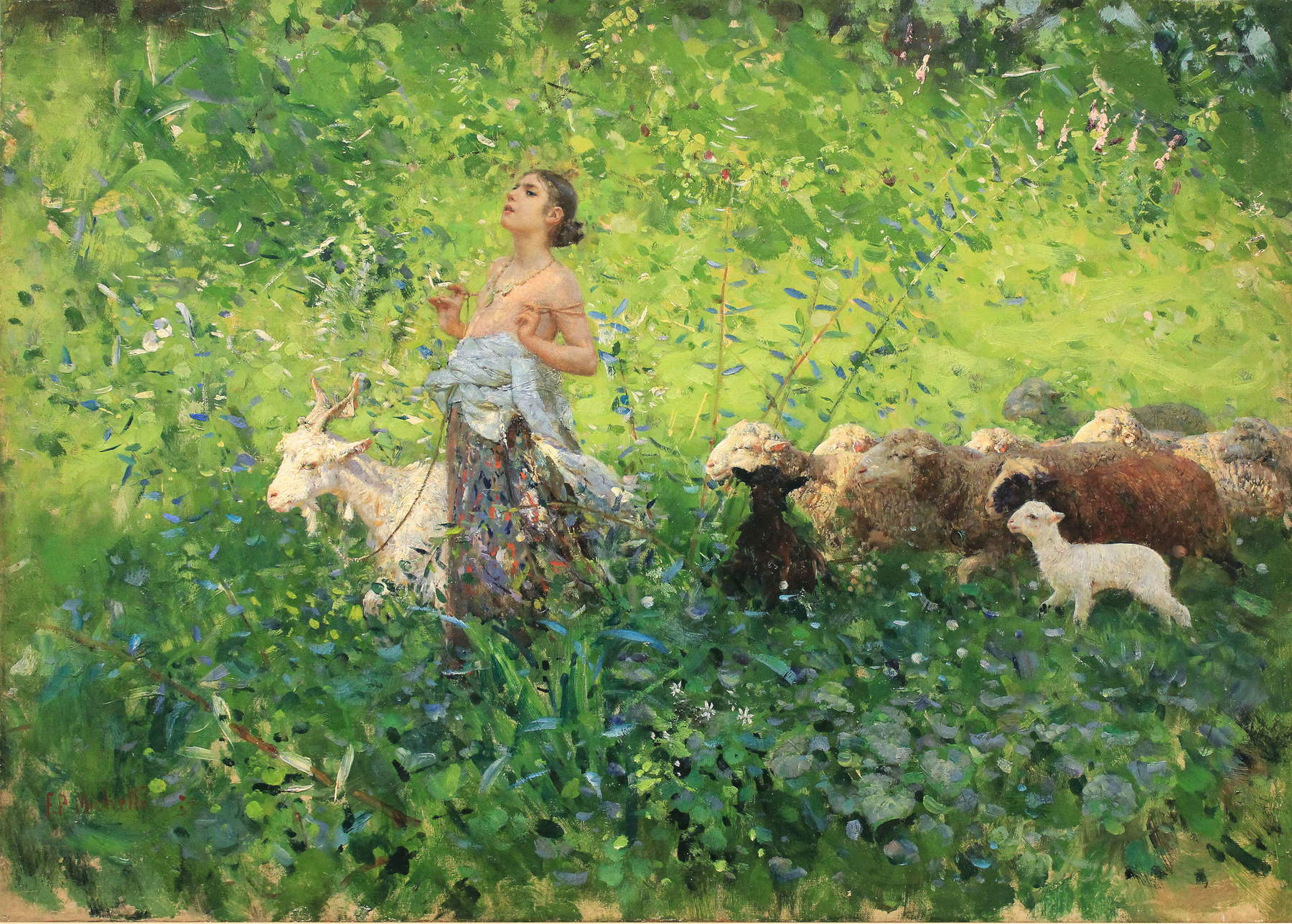
It will come as no surprise, however, to find a portrait of Gabriele d’Annunzio, the celebrated one by Paolo Troubetzkoy in bronze, as the one-point-one work of the exhibition and its catalog, and not so much because of the literary affinities that clasp the Vate to the movement with the movement (certainly, for these reasons as well), but more because of his more than established function as a theorist whose foundations are to be found mainly in his journalistic writings: one could without great difficulty drop the net even just below the surface of D’Annunzio’s youthful production and then set sail and find it filled with material useful for establishing a theory of symbolism (clearly partial, incomplete, personal, but still provided with a certain degree of organization). However, one could start from an article, a commentary on Angelo Conti’s book on Giorgione, published in Convito in 1895. A somewhat late article, then, since the first stirrings of symbolism date back to more than a decade earlier: the exhibition convincingly fixes the departure to 1883, the year of the Esposizione di Belle Arti at the Palazzo delle Esposizioni in Rome, an exhibition in which, despite the large copy of ’works always firmly anchored in naturalism and history painting, it was possible to see a cornerstone such as Francesco Paolo Michetti’s Il voto (among the few positive elements of the new, questionable layout of the Galleria Nazionale d’Arte Moderna in Rome can be counted the prominence that is finally granted to this work, which by reason of its cumbersome size is not present in Traversetolo: the wild, warm and poetic violence that D’Annunzio acknowledged in Michetti, moreover his fraternal friend, nevertheless finds a lush compendium in the 1887 Gioia di vivere ), as well as works by Nino Costa and some of the artists who would form with him, in 1886, the association In arte libertas: Costa’s Fauno - Bocca d’Arno , Carlandi’s Villa Borghese mentioned above, and Alessandro Castelli’s Il dio Pan are responsible for circumscribing the beginnings of Italian Symbolism to these early Roman experiences. In the Convito article, D’Annunzio wrote that the way the artist expresses himself, the “style,” is the only means the artist has to express the idea in his work: it is “the universal and eternal note of art,” “so that the apotheosis of a virgin, figured by Pisanello in the reverse of one of his Mantuan medals, may seem a pure dream of Hellenic art.” Symbolist painting, especially early Symbolist painting, could then be qualified as a dream of the ancient, sometimes not remembered but imagined, evoked, pursued through contemplative corridors made of forms and light (Michetti and those early landscape painters, then, those landscape painters who would have found their Ellas in the Roman countryside as D’Annunzio would havewould have found it between Luni and Populonia, but also, an interesting and seductive proposal, a Vincenzo Cabianca who in his cloisters and in his minute congresses of nuns expresses an interest, writes Chiara Stefani, “in representing an intimate and mysterious conversation between figures that move in space and almost interpenetrate with the atmosphere”), sometimes referred to by explicit allusions. And the entire second section of the exhibition is designed to show how much Symbolism had been nourished by a recourse, strongly aestheticizing and even more strongly idealized, to classical sources, which were no longer, as they had been, matter for an anecdotic of antiquity, but were, if anything, nourishment for a continuous, sensual, pathological, imaginative ecstasy.
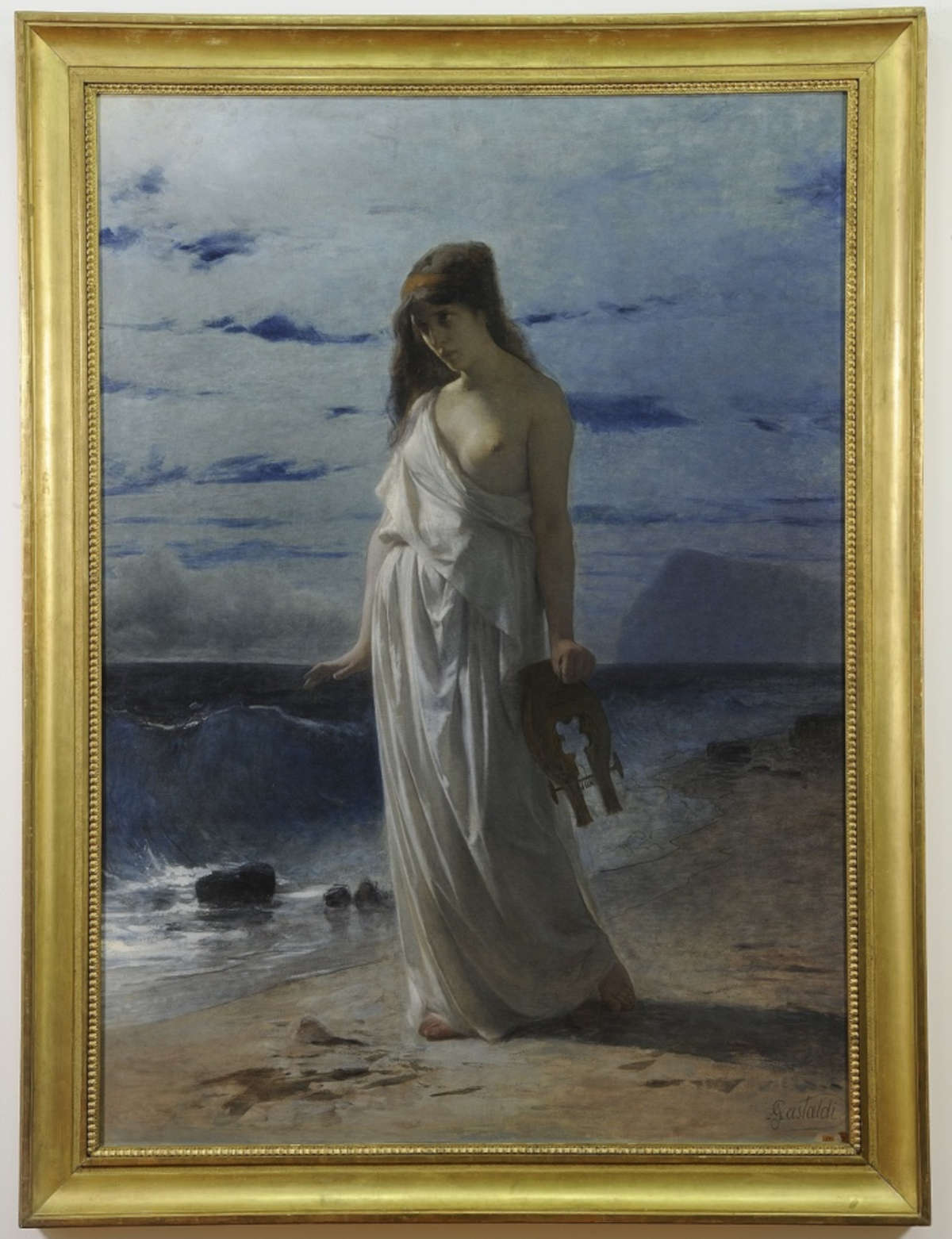
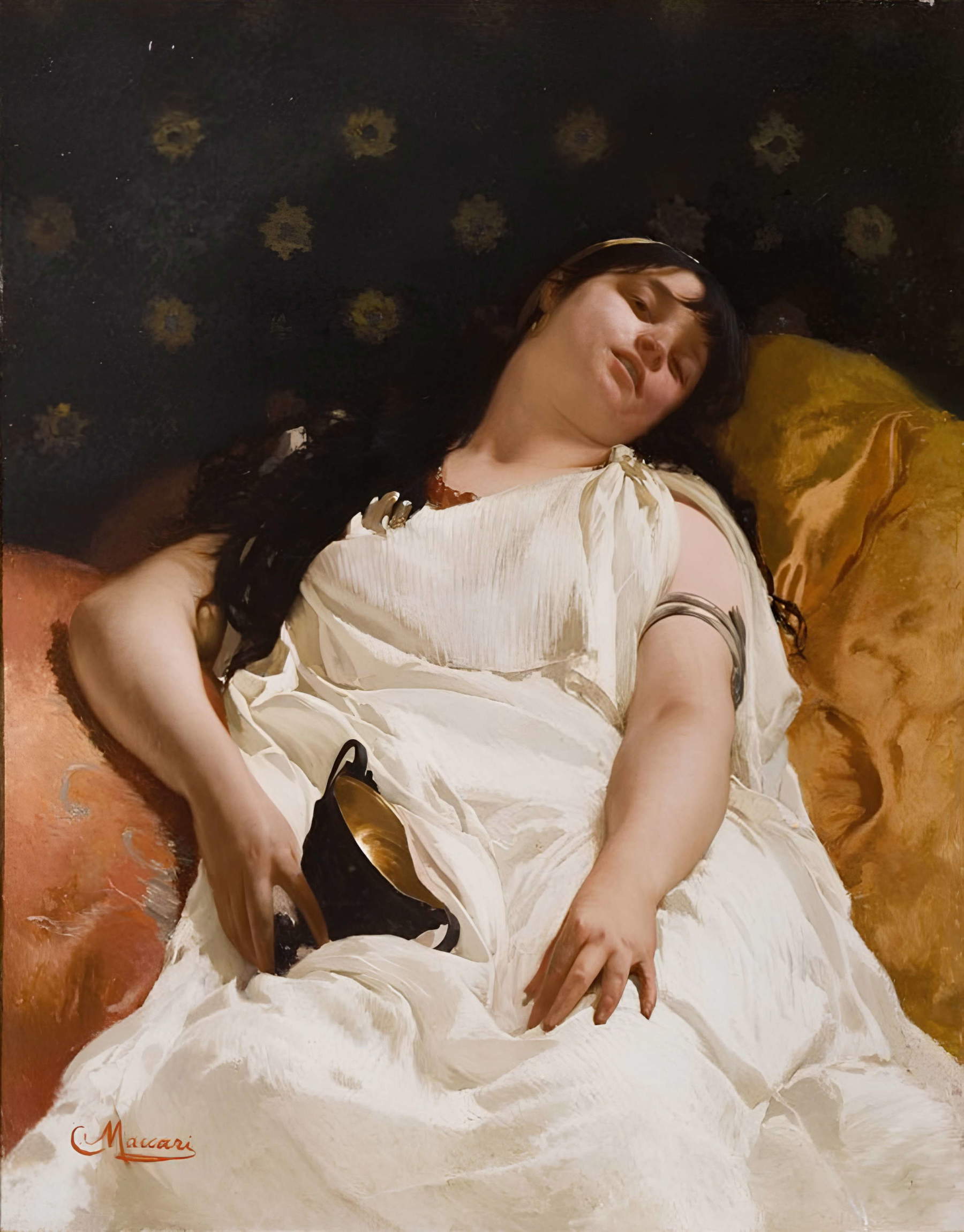
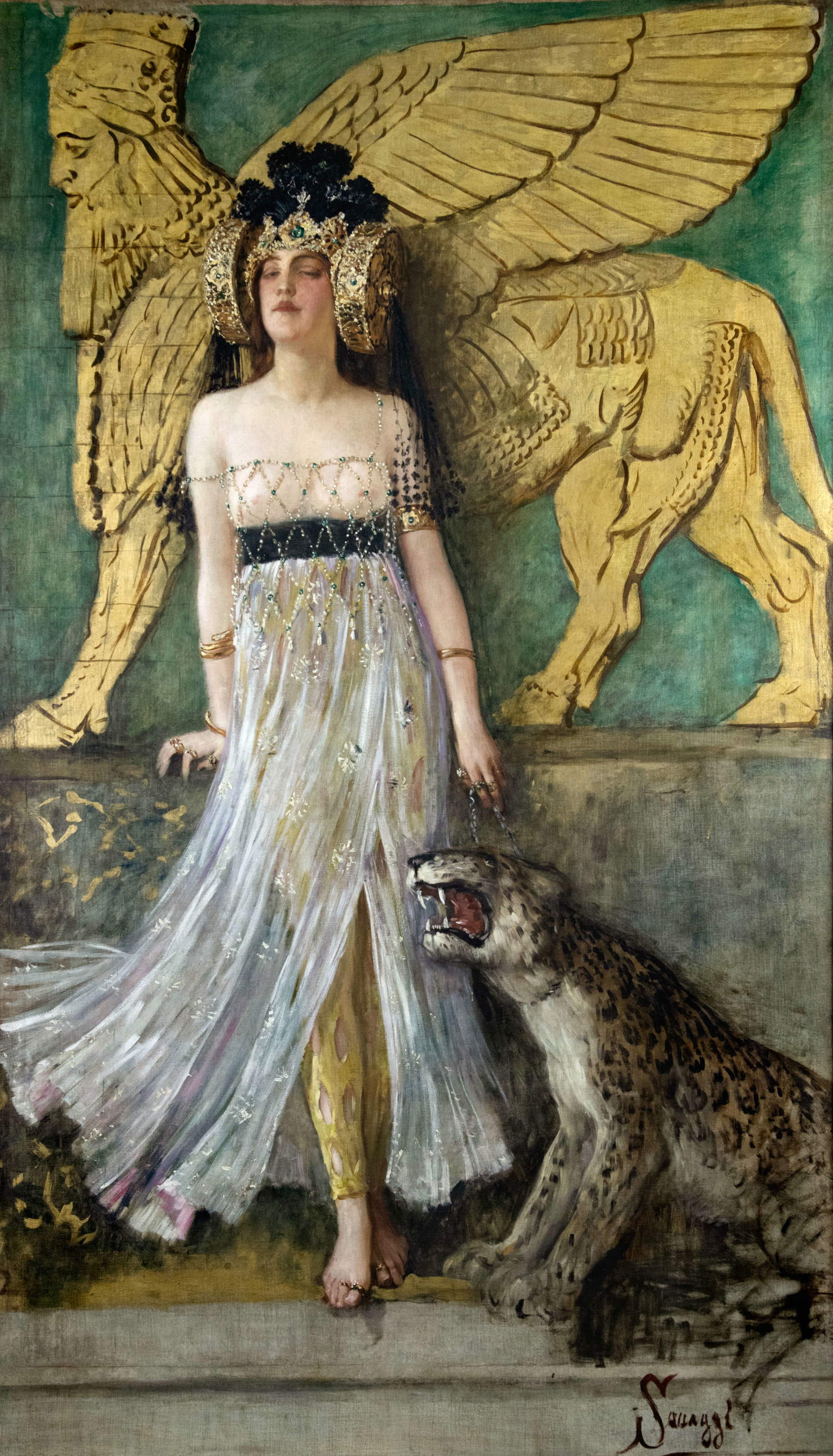
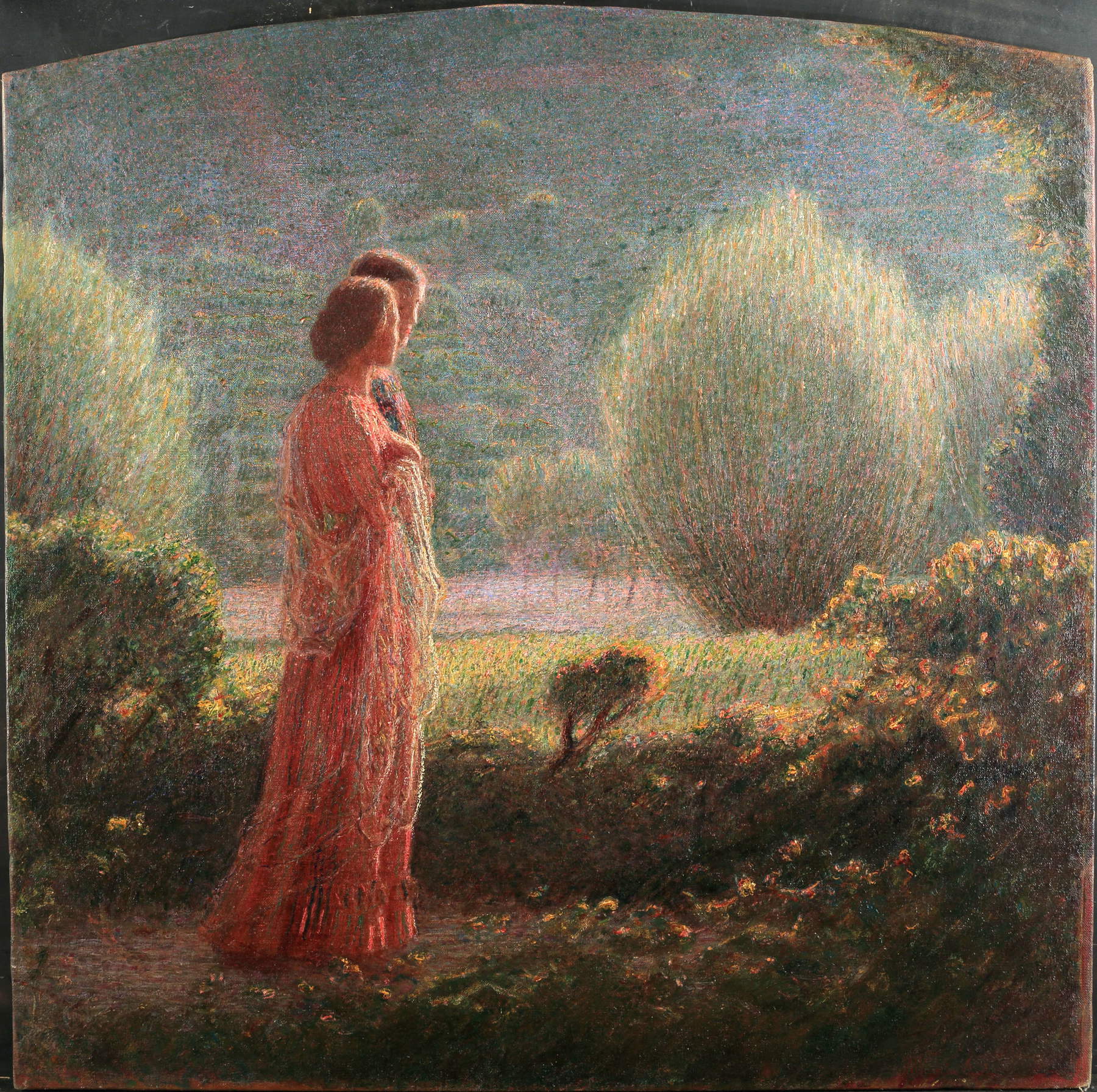
This whole part of the exhibition then translates into a fascinating sampler of sick reveries, of libidinous anticipations, of alienating and impossible illusions. Andrea Gastaldi’s Sappho wandering disconsolately on the shore of Lesbos, her hand unrealistically holding her zither by the strings and her nipple offered to the clouds, wind and salt, is the older sister, born with disobedient precocity, of Cesare Maccari’s Bacchante , unclothed and filled with’erotic allusions not even subtle in the gesture that mimics self-pleasuring, but also of Cesare Saccaggi’s imperturbable Semiramis , bejeweled hands and feet, transparencies of veils and pearls, provocative under the grim Sumerian demon, a haughty and unapproachable woman who both ensnares and repels (complete with leopard on a leash, in case gestures and glances were not sufficiently clear). Even Giovanni Segantini’s sad Christ Crucified , Luigi Conconi’s inconsolable Sinful Woman and Giulio Bargellini’s Saint Lucia already speak of secessions, vertices of a crowded niche ofsacred-themed works that share space with a concise but exciting digression on the landscape-state of mind, seem to have severed all ties with religion to seek some more universal raison d’être, a meditation on something that concerns every soul: loneliness, the torment caused by resipiscence, spiritual abandonment.
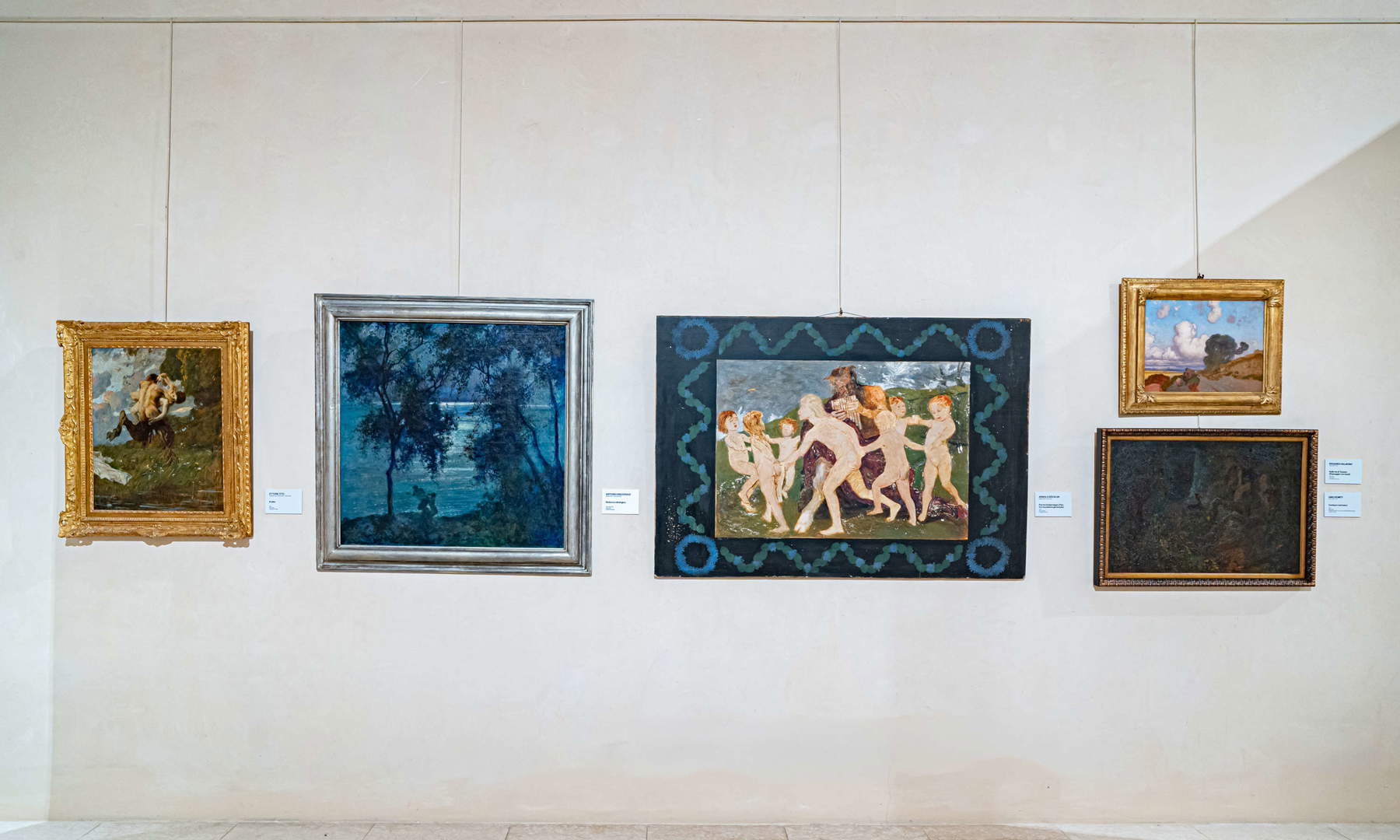
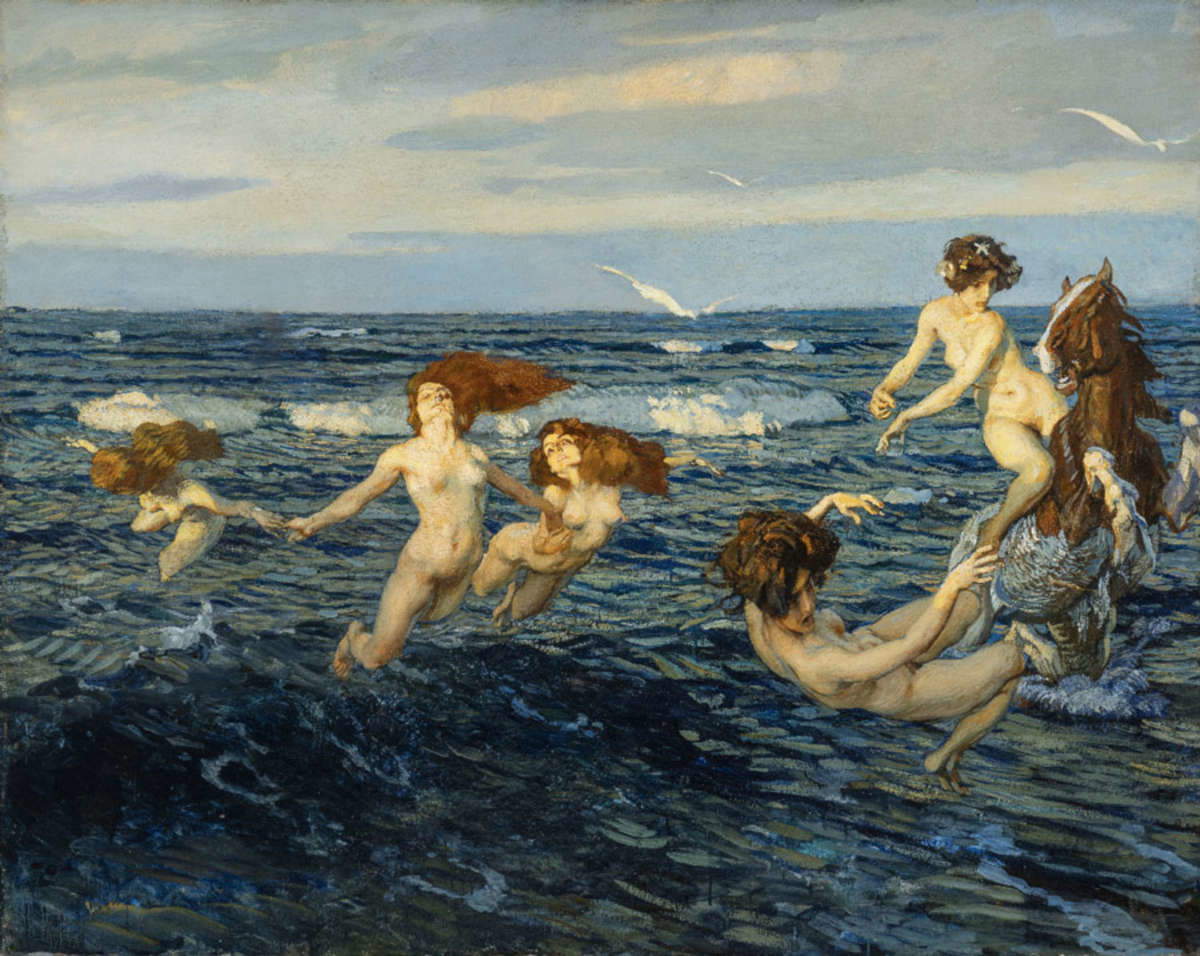
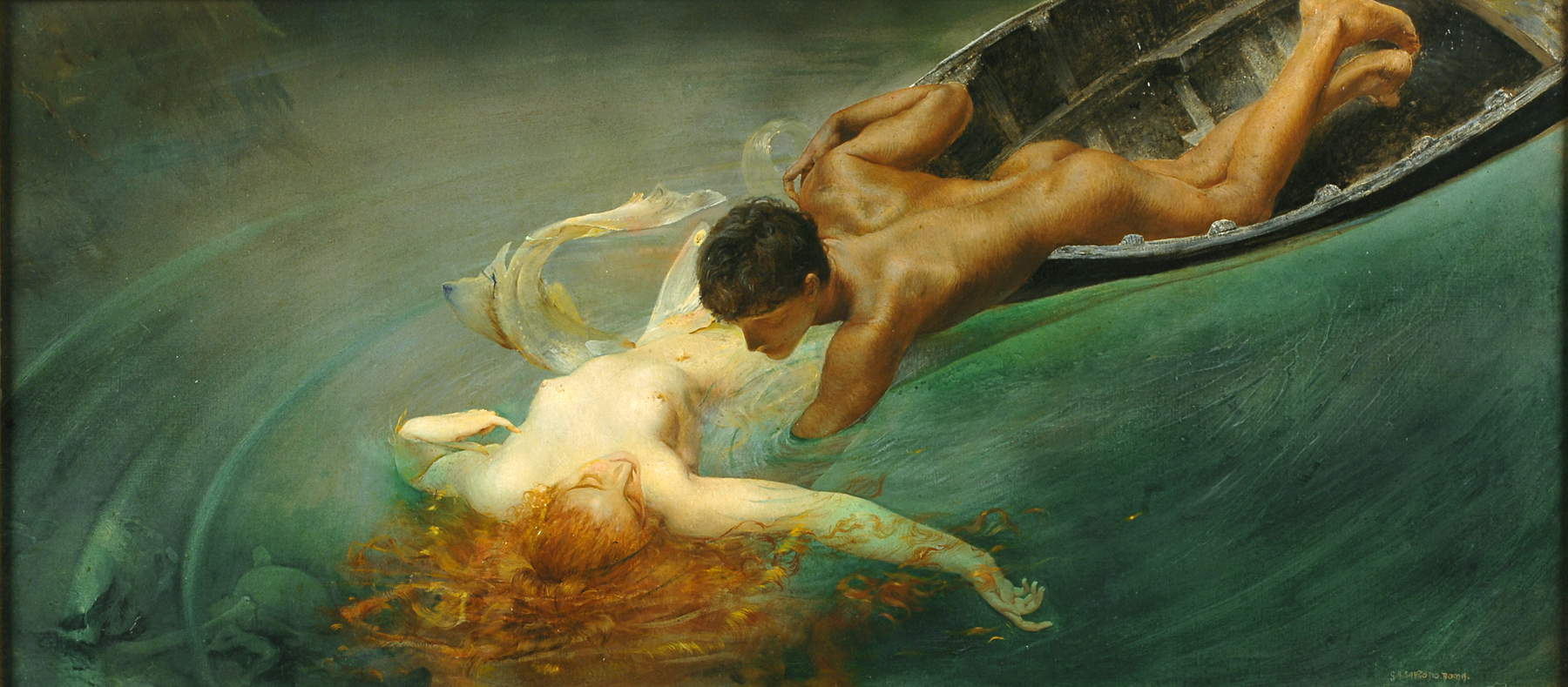
A clouded enthusiasm for the fabulous, the sacred, the magical, the mythological, the liminal, a fanaticism one might almost say, had, after all, kindled the minds of many of the artists who sought some kind of refuge, some form of hiding of the spirit that would distract them from the vulgarity of Umbertine Italy, from the endless tawdry downpour of pompier art and patriotic rhetoric, from the fumes of the smokestacks. Symbolism then also lives on myths: myths of forests and water first and foremost, to follow the exhibition, myths certainly inspired by German folklore, by the Nix, the sirens, the sea and sylvan spirits that populated the imagery of Böcklin, Klinger, Greiner, and all those artists from beyond the Alps to whom ours looked. Those creatures then began to cross the mountains to sink into the warm waters of the Tyrrhenian Sea (as does Saccaggi’s perturbing and menacing Octopus ), to guard some cliff while the moonlight makes the sea glow (as does Plinio Nomellini’s solitary and classical Lady of the Sea ), to fly over the calm expanse of theAdriatic (as do Ettore Tito’s playful and sensual Ondine ), sometimes finding consonances with the Pre-Raphaelites (Giulio Aristide Sartorio’s Sirena ) or even returning to the native waters( Glauco Cambon’sDaughters of the Rhine modeled after Wagner’s music).
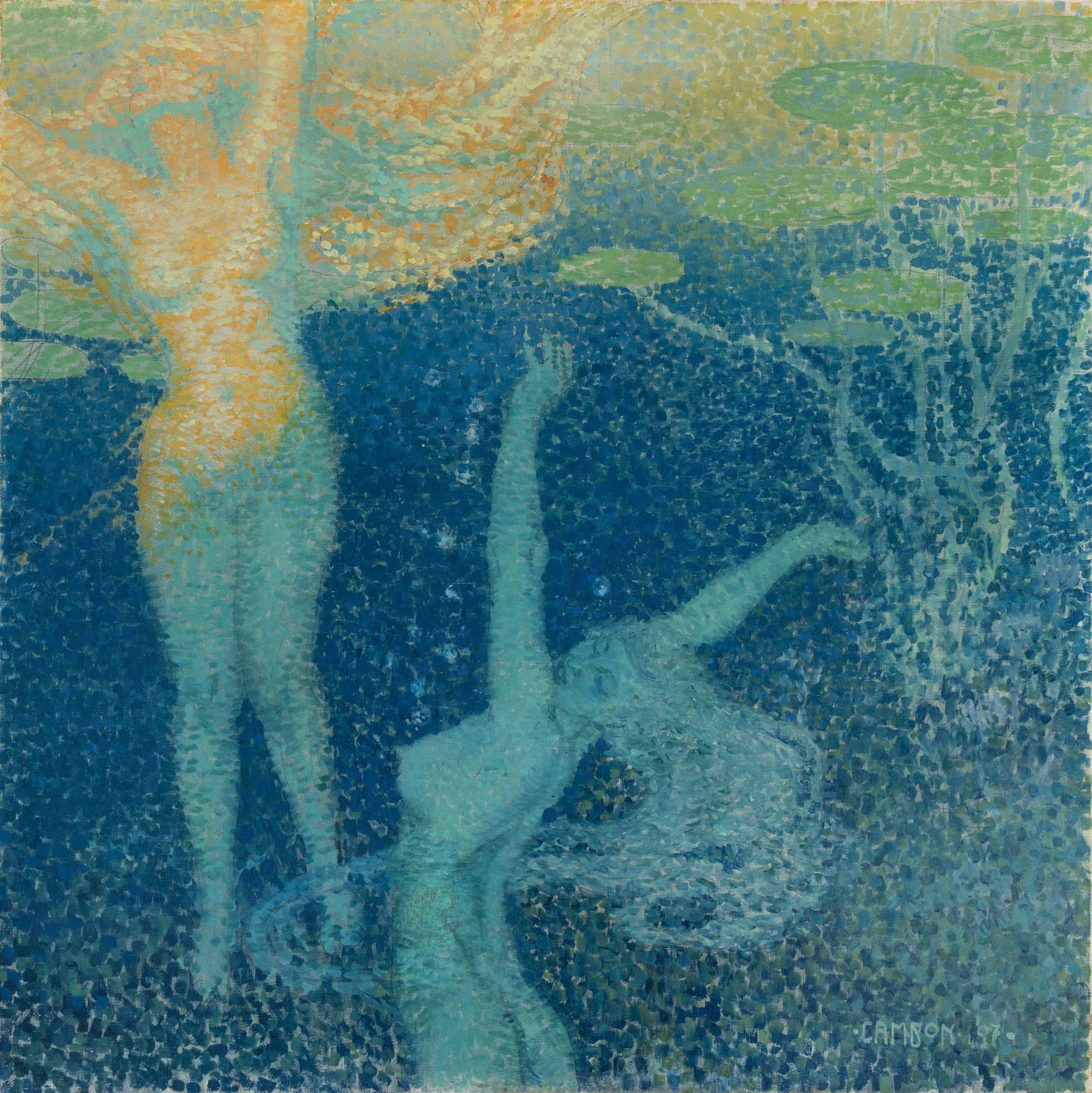
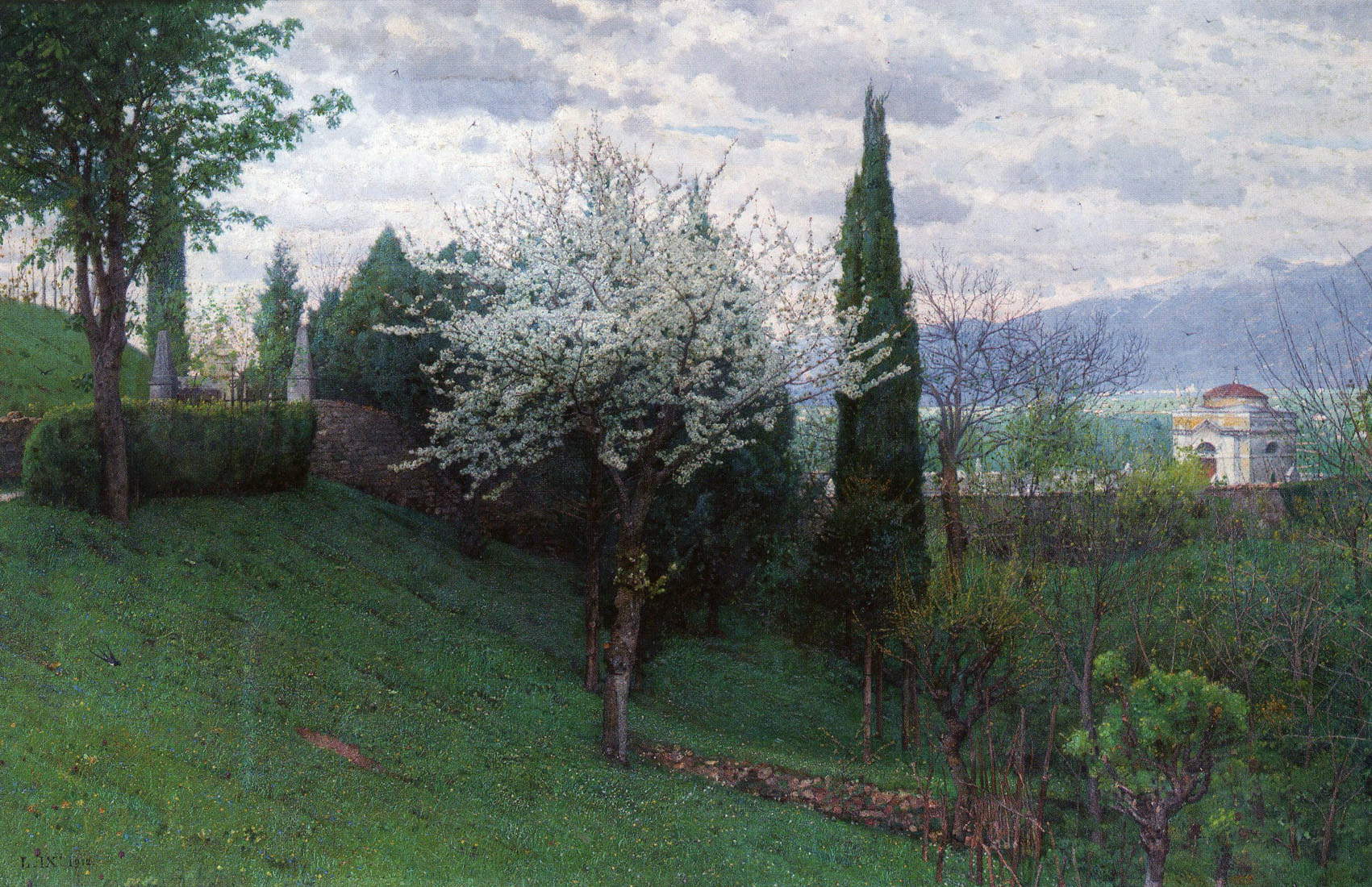
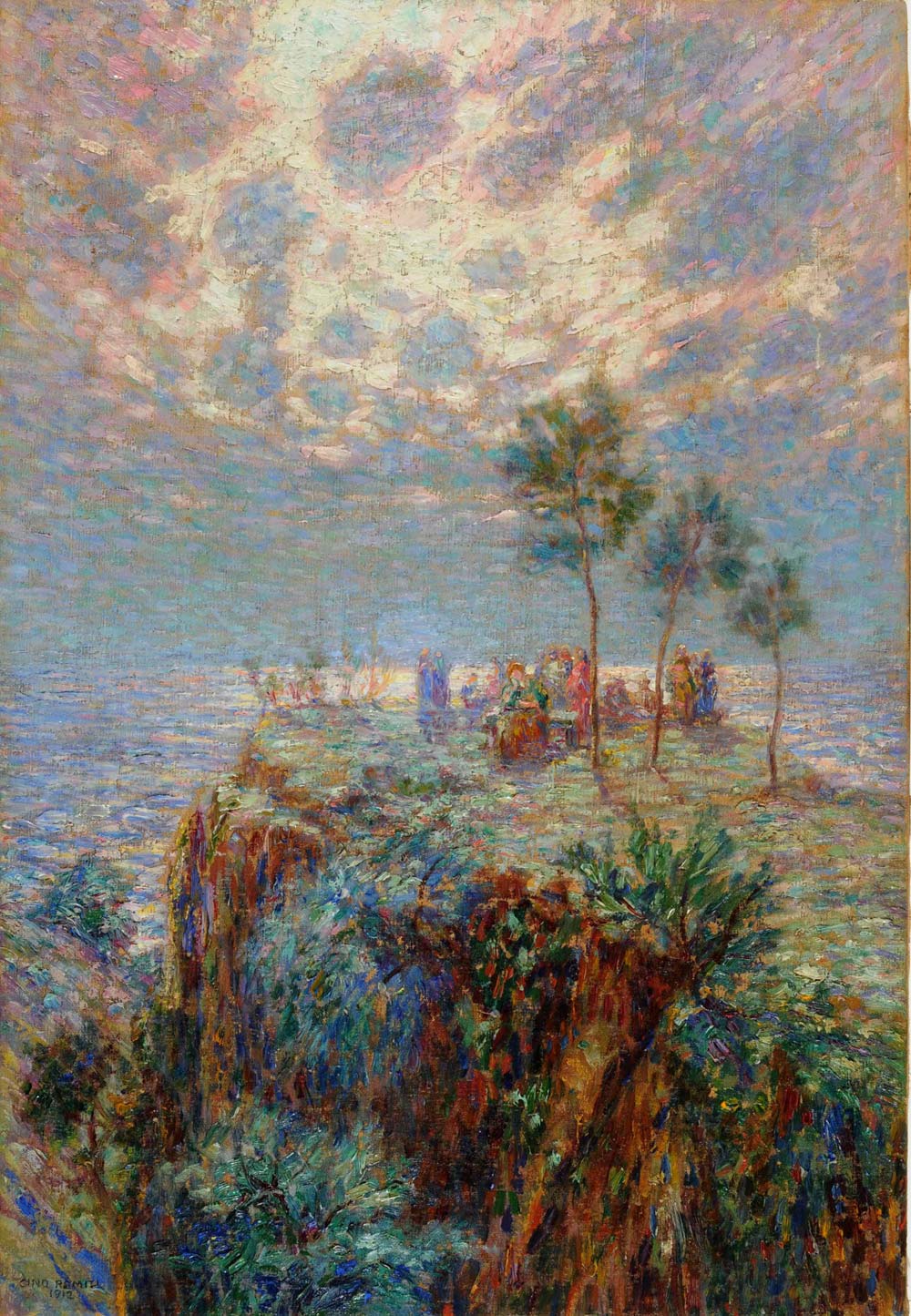
Mention was made above of the digression on landscape-state of mind, a theme on which the exhibition does not linger much longer, probably due to a saturation (the topic has had some success, even recently, evidenced by the exhibition on States of mind mood at the Palazzo dei Diamanti a few years ago) which, curiously enough, was felt, of course for other reasons, even by the critics of the time (Ojetti, for example, already in 1897 manifested a certain impatience with that “endless quotation from Amiel” which in the "articles on the paesisti returns like theora pro nobis in the rogazioni“): in any case, the question is not to be resolved in the opposition between a landscape faithful to the sensible datum and a landscape that instead becomes sentiment, but rather, Niccolò D’Agati seems to suggest, who dealt with this section by devoting an original essay published in the catalog to the subject, on the degree of mediation between theobserver and the observed, between the artist and his experience of reality, in the awareness that already in the 1960s a Telemaco Signorini was reacting to the academy by imagining a ”beauty“ that is not intrinsic to nature but is also ”in the individual who interprets it." For a Vittore Grubicy, a Pio Bottoni or a Luigi Nono, one would think, a landscape is above all intonation, spiritual extravagance, truth of private experience, invasion of the soul over things. Pio Bottoni’sAugusta Perusia is an elegy of the sunset tinged with antiquated frenzies. Luigi Nono’s Pax is pure lyricism, melancholy song, an attempt at stillness. A couple of rooms further on, where the audience finds a core of landscapes animated by invisible presences, Vittore Grubicy’s Evening in the Valley is twilight contemplation where even fog, at once physical and cerebral, resembles a ghost. For other artists the landscape-state of mind is a form of an invisible that reveals itself in the most unpredictable, bumpy, unreal manifestations. In the Contemplations of Gino Romiti, who in the early part of the twentieth century was among the Tuscans who animated the Caffè Bardi in Livorno, an unforgettable point of elaboration of an original marine symbolism that reasoned on the suggestions of that Charles Doudelet who had moved the Symbolist wind on the Tuscan coast, the afternoon light is lit up with mystical inflections. The Landscape of Benvenuto Benvenuti, also a Leghorn participant in that extraordinary cultural temperament, investigated several times by Francesca Cagianelli’s recent studies and exhibitions, is refined and hallucinatory analysis of light and color that veers relentlessly toward expressionism. And then, the landscape-state of mind is also investigated in its meaning as a haunting theater of ecstatic, mystical, spectral epiphanies: the edelweiss and the rhododendron, in Segantini’s landscapes, are not two flowers but are two evanescent figures inhabiting the gorges and plateaus, and according to similar transfigurations love in Pellizza da Volpedo lights up an alpine idyll through a couple oflovers, while Teodoro Wolf Ferrari’s fatuous fire is not a scientific phenomenon of luminescence of organic substances but, as in Böcklin a few years earlier, is an eerie, funereal female presence manifesting above the black waters of a marsh, at the foot of a mountain covered with dark, tangled woods.
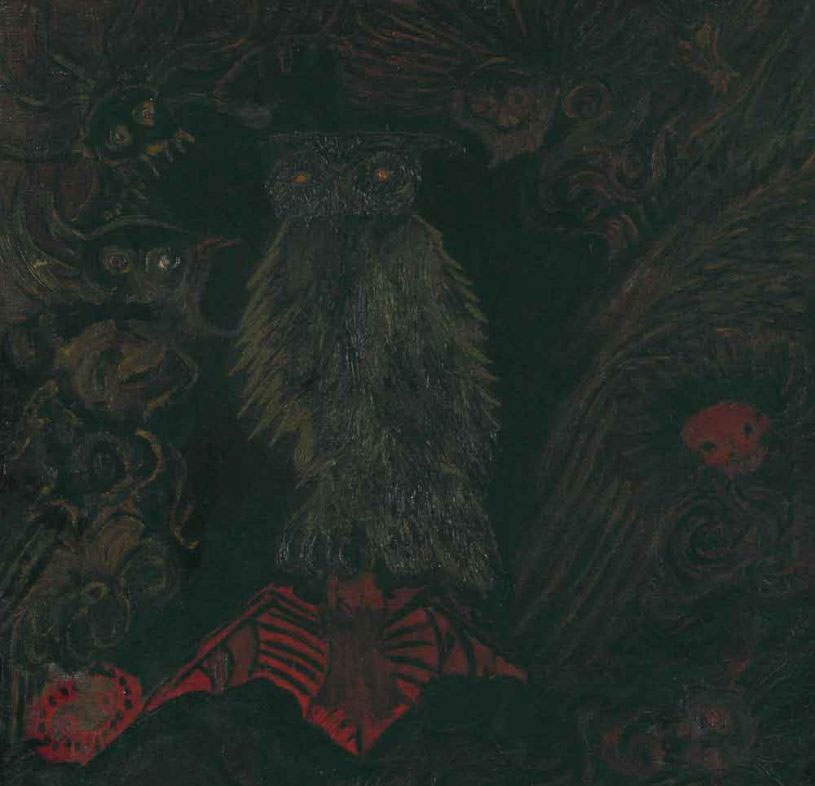
Time remains, on the exhibition’s finale, closed by a somewhat out-of-sync Victorious Youth by Nomellini (reasons of space, which always risk penalizing the exhibitions at the Magnani Rocca a little, and which here are especially evident in the concluding room, tending to theaccumulation but where nevertheless legibility is not impaired, have led the organization to allocate the last wall to the fiery, heroic canvas that the Leghorn artist presented at the 1903 Biennale: happy, however, is the conversation with the Hyades of Edoardo De Albertis, who worked in Genoa with Nomellini on several occasions) to linger on the last offshoots of the Symbolist movement, notably on the launches to Futurism (Luigi Russolo, a year before Marinetti’s manifesto, still managed to paint himself inside a deadly almond of skulls) and on the Tuscan emanations of the nourished, dispersed, unaware cohort: the milieu of the Caffè Bardi is evoked by Benvenuti’s Divisionist experiments, by Raoul Dal Molin Ferenzona’s Christological meditations, by the witch-like litanies of Gabriele Gabrielli, who, having died by suicide at the age of twenty-four, was of the Symbolists the most turbid, the most sickest, the most obsessed (his Owl is probably a translation of a poem by Baudelaire, a poet he loved and suffered from, to the point of dedicating to the Fleurs du mal a visionary, lugubrious series of gloomy floral still lifes, of which unfortunately there are no examples in the tour itinerary).
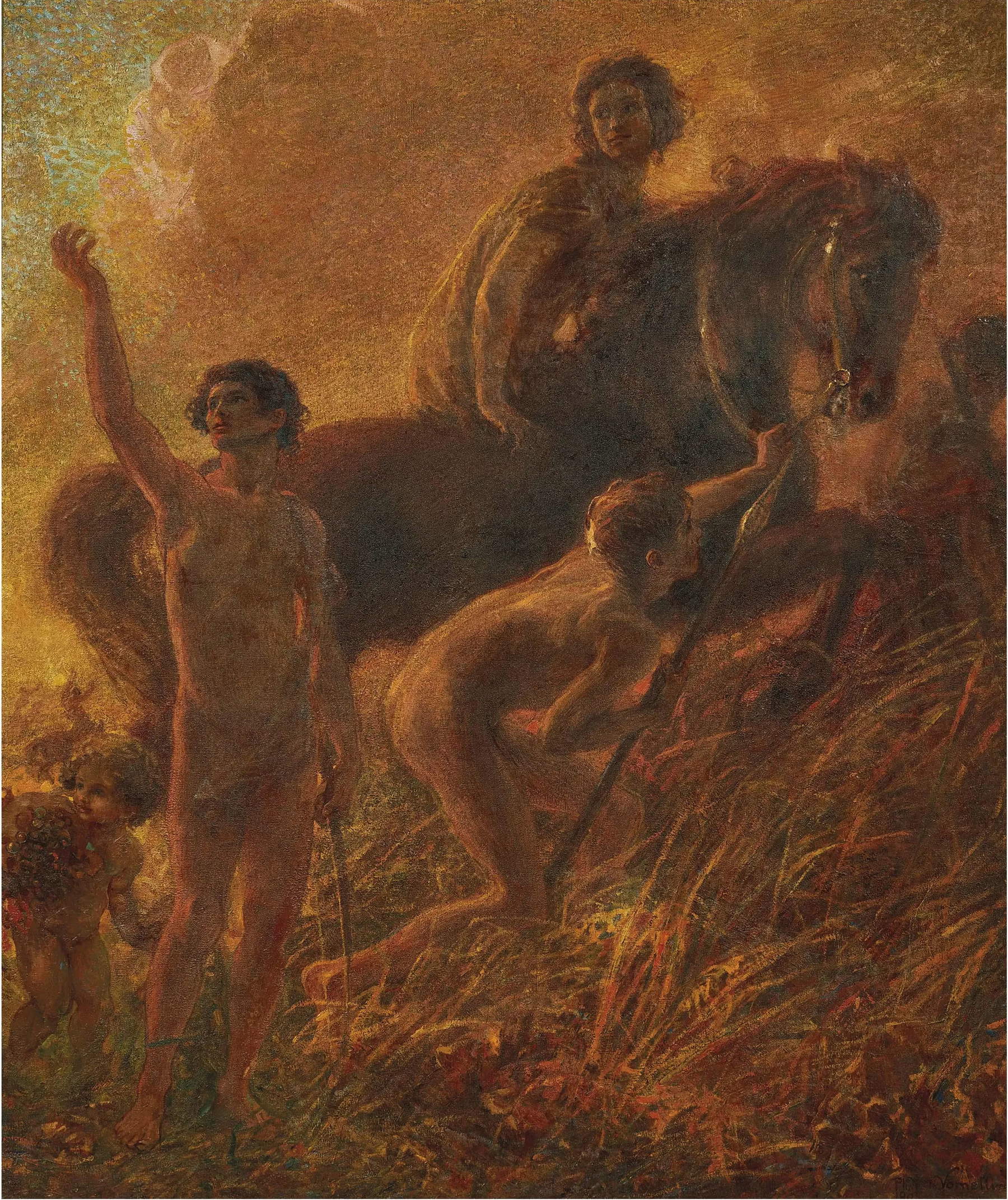
No excesses of temerity are needed to include the Magnani Rocca exhibition among the most successful of the year (and perhaps not only of the year), in terms of completeness, novelty, rigor, and originality of gaze: Symbolism in Italy is a complex, necessary and revealing itinerary through the proliferating ramifications of Italian Symbolism, a sumptuous and memorable catalog of images united by their character of epiphany, enigma, promise of the invisible, and also a compendium that nonetheless clarifies, with solemn frankness, the difficulty of giving order to that matter that had no order. Closing his overall essay, Parisi recalls that Paul Valéry, in the impossibility of fully cataloguing that continuous, inconstant, disjointed and incoherent vociferum that was symbolism, would have solved the problem by employing the image of the nebula in order to attempt to enclose within a recognizable form that indefinable movement. “The mere name of symbolism,” Valéry wrote, “is already an enigma to so many. It seems designed to incite mortals to torment their souls.” A nebula, to be sure, but also a fog, a dark, bituminous, murky haze from which one has never emerged except with some temporary glimmer, some electric light, without the linear privilege of a conclusive light, a definitive orientation. Nor could it be so, if it is true that symbolism never knew a common grammar, a discipline, an organization, but only a proliferation of transversal idioms which could sometimes happen to cross each other, to give birth to common dialects without, however, arriving at a rule, an order, a koine.
Then, before and after the World War, would come the heats of modernity, of the avant-garde, of politics to demythologize, to deconsecrate, to evaporate that fog that had already begun to thin out, to move toward an unconquerable destiny of atmospheric residue. Warmth, by now, could be felt everywhere. When, in 1909, Sartorio had brought back to the Venice Biennale his Poem of Human Life, executed two years earlier and that year bought by Victor Emmanuel III for Ca’ Pesaro, Ardengo Soffici, in his review, hadhad branded it as soggy literature, smelling of a “lezzo d’impotenza, di ciarlataneria e di bruttezza da rivoltare chi punto amo l’arte,” guilty of rhetoric, academicism and superficiality. Symbolism was already flexing toward twilight.

The author of this article: Federico Giannini
Nato a Massa nel 1986, si è laureato nel 2010 in Informatica Umanistica all’Università di Pisa. Nel 2009 ha iniziato a lavorare nel settore della comunicazione su web, con particolare riferimento alla comunicazione per i beni culturali. Nel 2017 ha fondato con Ilaria Baratta la rivista Finestre sull’Arte. Dalla fondazione è direttore responsabile della rivista. Ha scritto i libri Vero, Falso, Fake. Credenze, errori e falsità nel mondo dell'arte (Giunti editore, 2025) e Immagini del potere. Arte e propaganda da Augusto a Trump (Giunti editore, 2026). Collabora e ha collaborato con diverse riviste, tra cui Art e Dossier e Left, e per la televisione è stato autore del documentario Le mani dell’arte (Rai 5) ed è stato tra i presentatori del programma Dorian – L’arte non invecchia (Rai 5). Al suo attivo anche docenze in materia di giornalismo culturale all'Università di Genova e all'Ordine dei Giornalisti, inoltre partecipa regolarmente come relatore e moderatore su temi di arte e cultura a numerosi convegni (tra gli altri: Lu.Bec. Lucca Beni Culturali, Ro.Me Exhibition, Con-Vivere Festival, TTG Travel Experience).
Warning: the translation into English of the original Italian article was created using automatic tools. We undertake to review all articles, but we do not guarantee the total absence of inaccuracies in the translation due to the program. You can find the original by clicking on the ITA button. If you find any mistake,please contact us.






















 IT
IT FR
FR DE
DE ES
ES CN
CN


