



by Redazione 01/06/2026



Categories: Exhibitions / Disclaimer
At the Rocca Maggiore in Assisi, a major exhibition dedicated to Michelangelo Pistoletto brings art, spirituality and social responsibility into dialogue. At the center of the project is the artistic proclamation of Pope Francis as the "First Saint of Art."
The relationship between art, spirituality and collective responsibility is at the center of FRANCISCUS. Brother in Art, the major exhibition that Michelangelo Pistoletto (Biella, 1933) presents in Assisi from April 24 to October 4, 2026 in the spaces of the Rocca Maggiore. An unprecedented exhibition project that takes shape in the heart of the city of St. Francis and finds its origin in one of the most radical, symbolic and singular gestures elaborated in recent years by the artist from Biella: the proclamation of Pope Francis as the “First Saint of Art.” The initiative is part of the program of the celebrations for theeighth centenary of the death of St. Francis of Assisi and proposes an itinerary through some of the most representative works of Pistoletto’s research, putting them in dialogue with the themes of fraternity, peace, social responsibility and the encounter between cultures and religions, i.e., themes that in the more recent phases of the artist’s career he has often addressed. The exhibition is promoted by the Municipality of Assisi, produced by Opera Laboratori in collaboration with Cittadellarte-Fondazione Pistoletto and Galleria Continua, under the patronage of the Region of Umbria. The curatorship is entrusted to Michelangelo Pistoletto himself, who wanted to build an exhibition itinerary designed as an experience of reflection on the role of art in the contemporary world and its ability to generate relationships and transformations.
“For me,” says Michelangelo Pistoletto, “in this place that resounds with the name of Francis, the exhibition embraces the history of the saint by celebrating the 800th year since his death. And, at the same time, the first year since the death of Pope Bergoglio, who wanted to bring back to life, with his own life, the person of Francis. The artistic Sanctification therefore in the Rock of Assisi unites the new one of Pope Francis with the ancient one of the Little Brother of Assisi, with whom Jorge Bergoglio also wanted to unify himself in the same tomb, which in fact bears only one name: FRANCISCUS. Moreover, from the top of the Rock we see the Avenue of Olive Trees of the Third Paradise stretching into the clearing of the Forest of St. Francis.” Also contributing to the project was Father Antonio Spadaro, undersecretary of the Vatican’s Dicastery for Culture and Education, who offered his own input to the reflection developed around the artist’s latest innovative creation. “Pope Francis,” Father Spadaro explained, “has been a brother in art throughout his life spent and even after his life, for he has left, with his tomb, a sculptural architecture that, in addition to containing his body, is testimony to the thought that permeates his entire work. Beneath the silver symbol that he wore on his chest in life and shows a shepherd holding a lamb on his shoulders, the stone of the tomb is uniquely engraved with the name Franciscus, with which Jorge Mario Bergoglio acknowledges his brotherhood in the Arte Povera of St. Francis.”


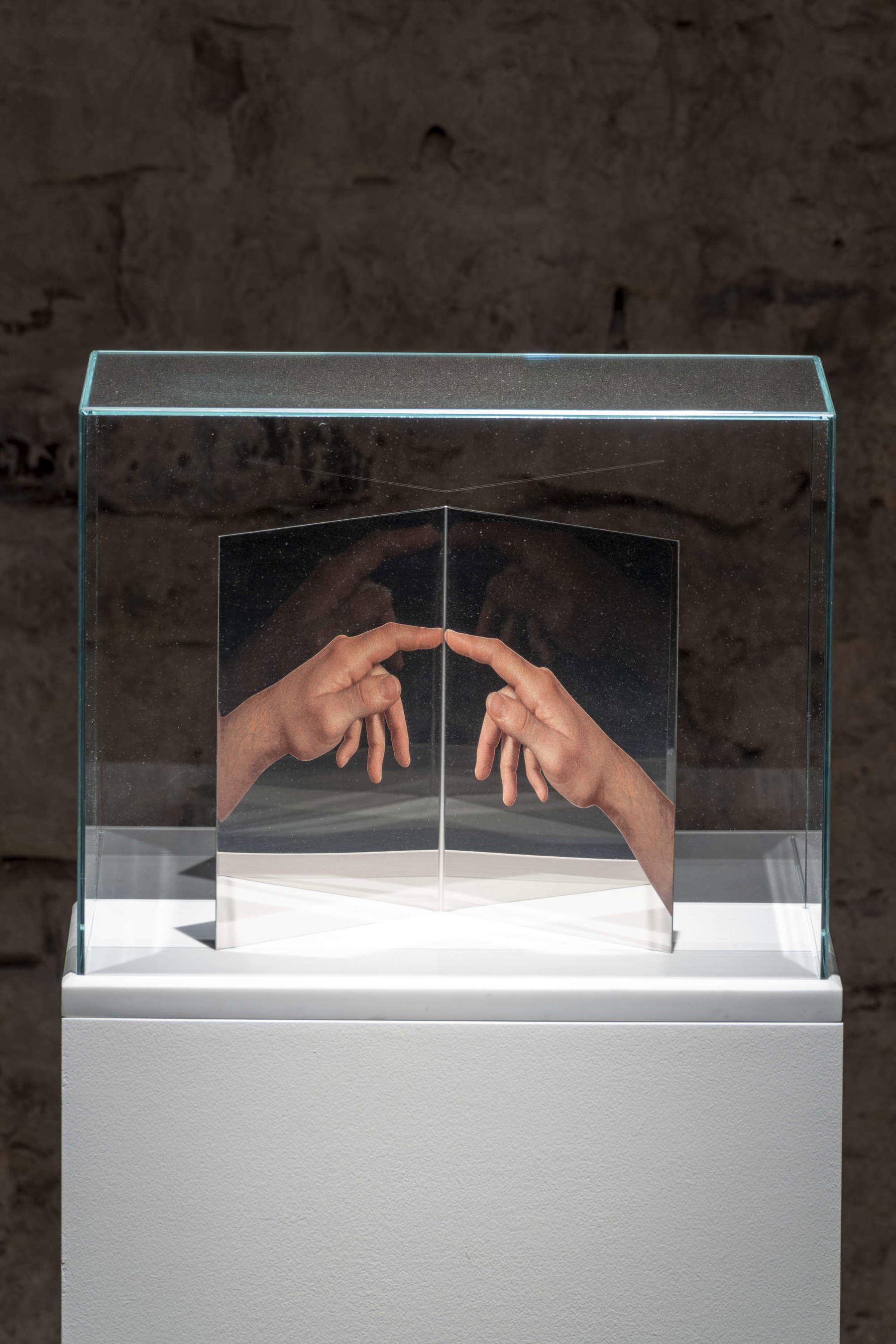
The element from which the entire exhibition starts is, as mentioned, the proclamation of Pope Francis as the “First Saint of Art.” This is a definition that does not belong to the religious sphere and does not claim to interfere with the canonical processes of the Catholic Church. On the contrary, the action wants to place itself entirely within the language and practices of contemporary art. According to Pistoletto’s vision, Pope Francis in fact represents a figure capable of transforming his own existence into a living work, making spirituality an exercise of shared responsibility and relationship with the other. The proclamation thus takes on the meaning of an artistic recognition that identifies the pontiff as an exemplary personality for his ability to translate ethical and spiritual principles into a concrete practice of life.
The new work accompanying this reflection stems from the interpretation of Pope Francis’ pectoral cross as an authentic “spiritual landscape.” In the reading proposed by the artist, the religious symbol in fact opens to a broader dimension, capable of evoking relationships based on mutual care, peace and harmony among human beings. In this perspective, the pontiff is recognized as a “brother in Art,” a figure who through his own example makes possible a different conception of creativity, understood not as individual expression but as the construction of a collective responsibility. The reference to St. Francis of Assisi therefore appears evident and constitutes one of the main threads of the entire exhibition project.
A selection of works spanning decades of Pistoletto’s artistic research is developed around this conceptual core. The itinerary includes works that have marked his career, such as The Time of Judgment, conTatto, The Third Paradise and The Flags of Religions, works that over the years have helped define an increasingly articulated reflection on the relationship between difference and coexistence, between identity and dialogue. Through these creations, the artist develops a language that seeks to relate seemingly distant worlds. Cultures, systems of thought, religious traditions and social models are involved in a confrontation that does not aim at homologation but at the construction of common spaces of understanding.
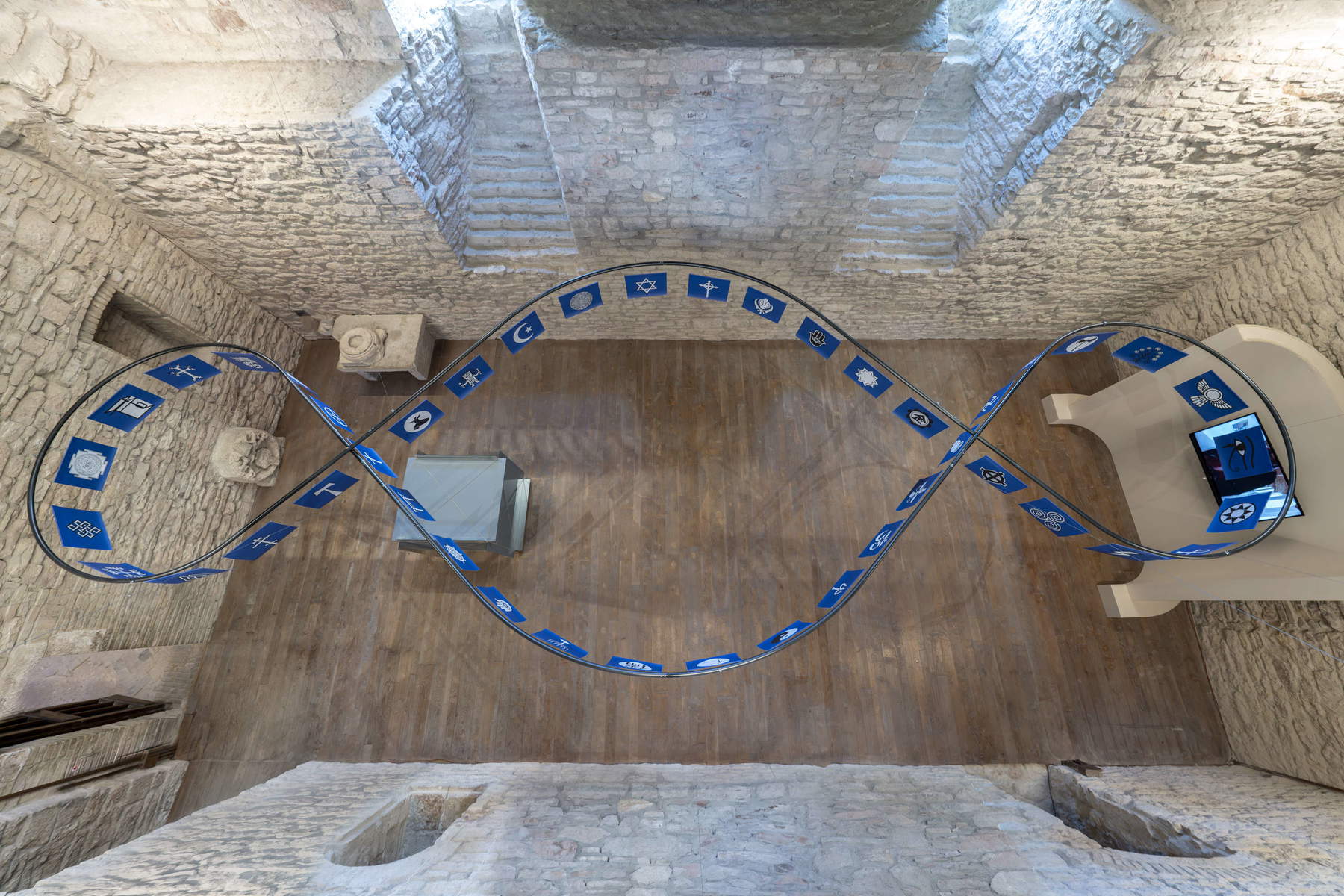
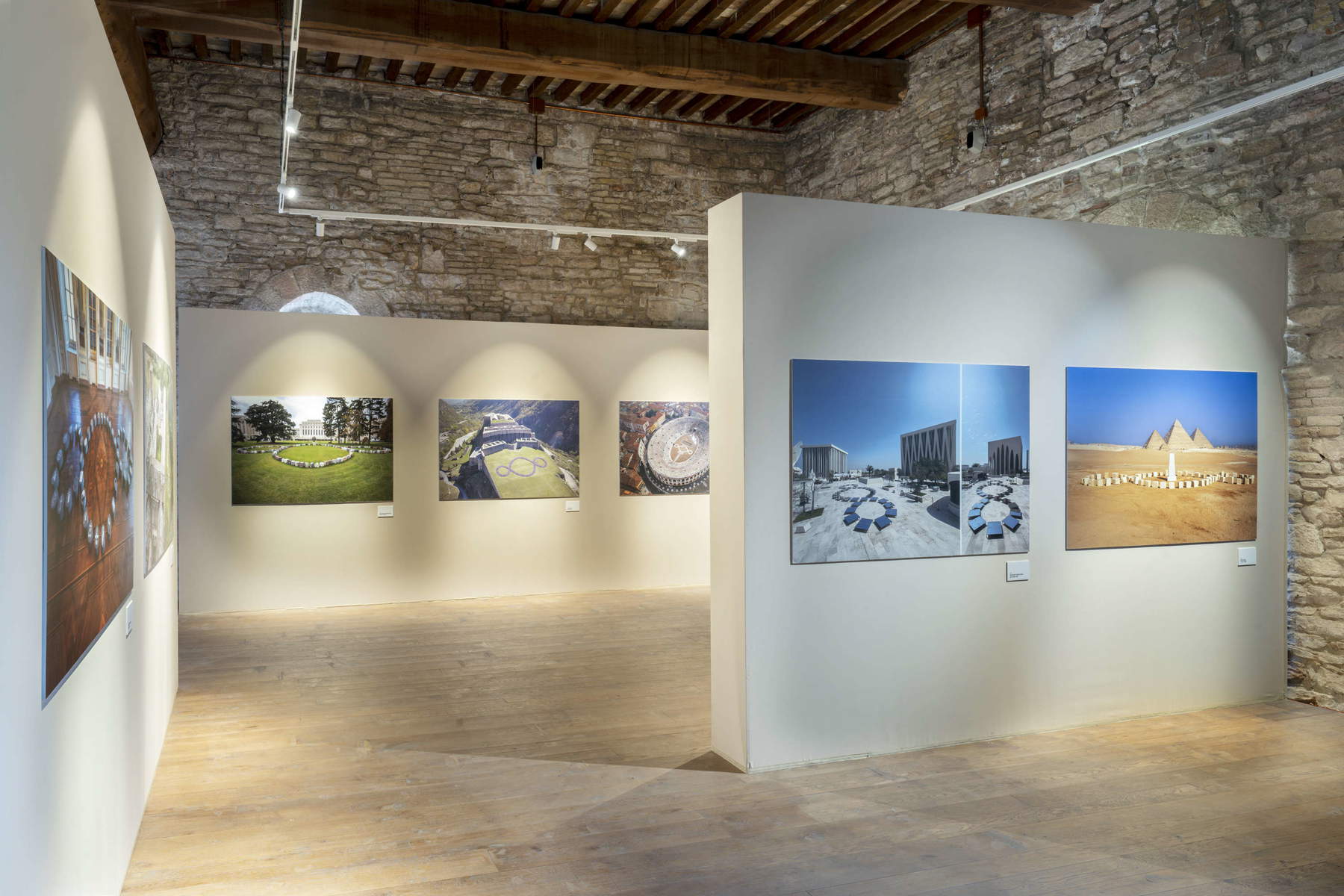
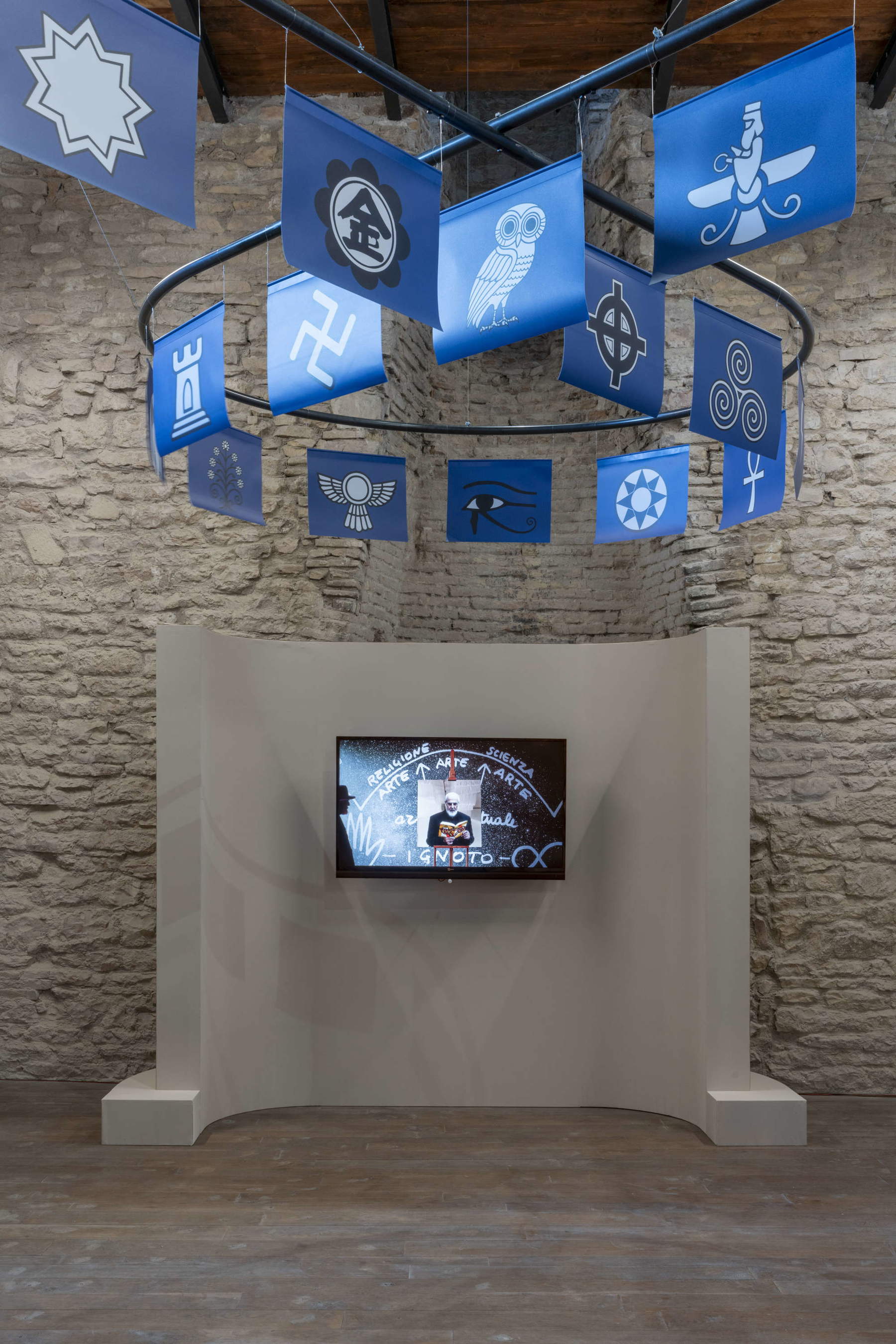
Of particular note are the works belonging to the Sign Art series, in which religious symbols and universal geometries are reinterpreted and transformed into devices open to the viewer’s participation. These include Star of David, Metroquadrate of Infinity - Islamic Star, Rotation of the Mirror - Hindu, Trinitarian Mirror of the Trinity - Christianity and Metrocube of Infinity. In these works the symbols of the great religious traditions are freed from an exclusively confessional reading to become tools of dialogue and confrontation. The geometric forms, reflective elements and open structures that characterize these works transform symbolic language into a shared space, accessible to believers and non-believers alike.
As is the case in much of Pistoletto’s production, a central role is given to the mirror in this exhibition. Since the 1960s, this element has represented one of the cornerstones of his research and continues to be a privileged tool for interrogating the relationship between reality and representation. In the works exhibited in Assisi, the mirror acts as a kind of interface. It does not merely reflect images, but directly involves the visitor, placing him or her inside the work and transforming him or her into an integral part of the artistic process. The art space thus becomes a place of active participation, in which the audience is called to confront itself and others.
At the center of the entire path then emerges the symbol of the Third Paradise, perhaps the most famous image elaborated by Pistoletto in recent decades. This sign, born as a reworking of the mathematical symbol of infinity, represents for the artist a new phase of humanity based on the balance between nature and artifice, between technological development and ethical responsibility. In the Assisi exhibition, the Third Paradise takes on the value of a shared horizon, a symbolic place where different cultures, religions and traditions can meet. The sign thus becomes the representation of a possible harmony between diversities and a perspective oriented toward the co-creation of a common future.
The entire exhibition project is configured as a journey through the history of religions and philosophies, approached not from a historical or doctrinal perspective, but as cultural heritages capable of dialoguing with each other. In this context, art is proposed as a tool for cultural mediation and relationship building. The visitor is invited to reflect on the possibility of overcoming conflicts, divisions and oppositions through practices based on mutual recognition. The exhibition does not offer definitive answers but proposes a space for confrontation in which creativity becomes an opportunity for encounter and listening. An additional element of interest is the presence of photographic and documentary materials dedicated to the history of the Third Paradise. These contents dialogue with the permanent work created by Pistoletto in the early 2000s inside the Bosco di San Francesco in Assisi.
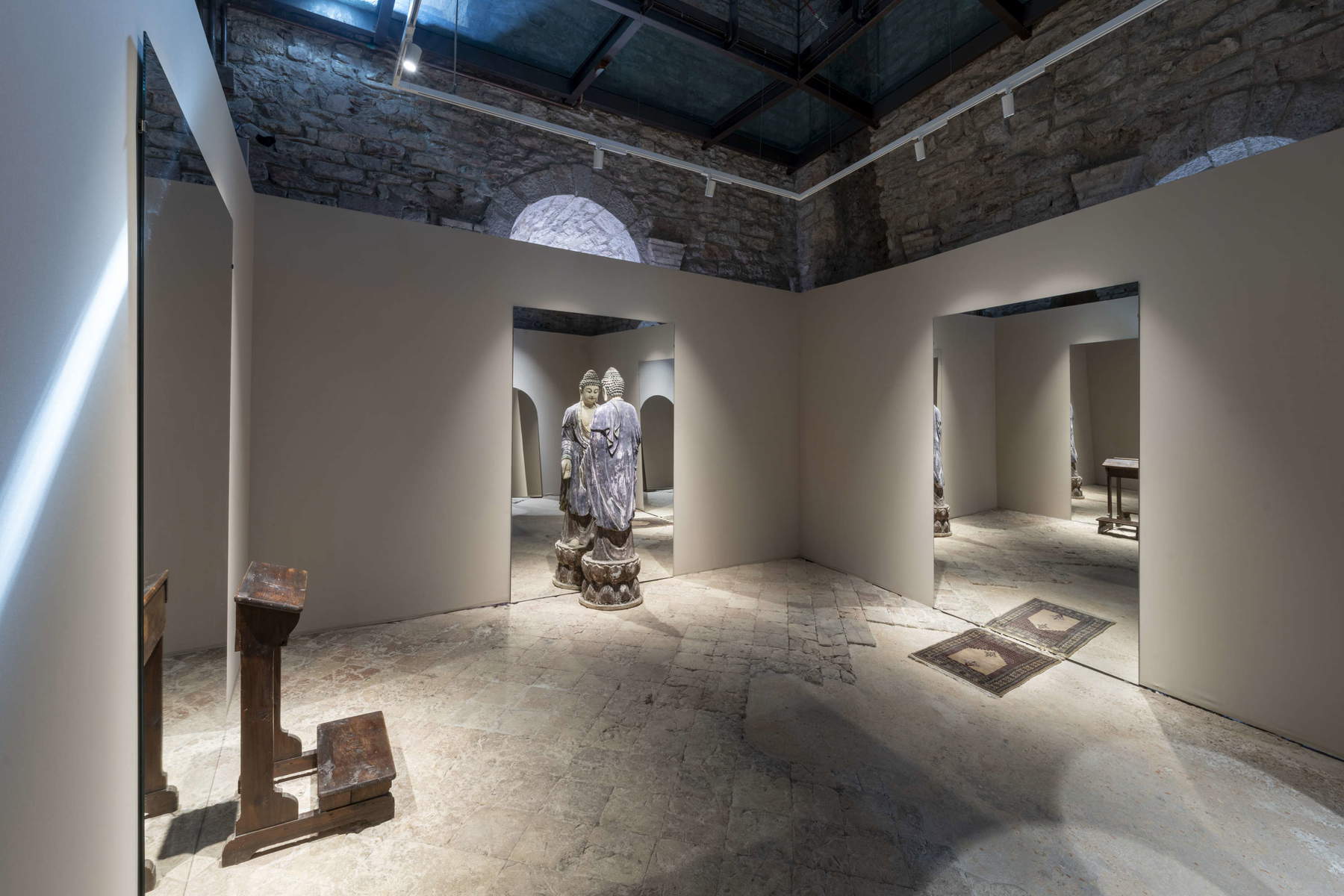
The particular location of the Rocca Maggiore also allows visitors to directly observe that artistic intervention from the Polygonal Tower, the highest point of the monumental complex. This creates a visual and symbolic relationship between the interior space of the exhibition and the exterior landscape, expanding the experience beyond the physical boundaries of the exhibition.
This connection between architecture, territory and artwork helps to build an immersive journey in which observation, meditation and reflection are constantly intertwined. Indeed, the view of the Third Paradise in the Bosco di San Francesco becomes an integral part of the exhibition narrative, strengthening the link between Pistoletto’s thinking and the city that more than any other embodies the idea of universal brotherhood. “An exhibition of great depth,” stresses Valter Stoppini, mayor of Assisi, “that relaunches Franciscan values through the art and genius of one of the most beloved contemporary artists, who has a special bond with Assisi. This is an event of great cultural importance, which enriches the celebrations and initiatives for the eighth centenary of the death of St. Francis. It is an exhibition that can speak to everyone, confirming Assisi’s role as a city of peace and dialogue, capable of sending a message of hope to the world.” "With FRANCISCUS. Brother in Art," adds Beppe Costa, president and CEO of Opera Laboratori, “we wanted to contribute to the realization of an exhibition project of great symbolic and cultural value, capable of bringing contemporary art, spirituality and the identity of the territory into dialogue. The installation inside the Rocca Maggiore represents a challenge and at the same time an opportunity: to make an extraordinary historical space usable by the public through a current and participatory artistic language. As Opera Laboratori, we are proud to have produced this exhibition and to support the Municipality of Assisi in the management and enhancement of civic museums, promoting experiences that know how to involve different audiences and strengthen the link between heritage and contemporaneity.”
The itinerary finally culminates in thevideo installation dedicated to the artistic sanctification of Pope Francis. The work documents and returns the performative gesture through which the artist proclaimed the pontiff the “First Saint of Art,” transforming the event into a collective experience. The performative dimension thus takes on an important role: the proclamation is not presented as a mere symbolic act or as a theoretical declaration, but as an action that finds fulfillment in the audience’s participation and its ability to generate reflection. Art thus returns to being a place of relationship, a space in which meaning is constructed through the direct involvement of people.
With FRANCISCUS. Brother in Art, Michelangelo Pistoletto therefore wants to propose an articulate reflection on the relationship between creativity, spirituality and contemporary society. The choice of Assisi, a city universally associated with the figure of St. Francis and the value of fraternity, gives further strength to a project that invites us to consider art not only as an aesthetic expression, but as a practice capable of affecting reality, generating dialogue and imagining new forms of coexistence.
|
| Michelangelo Pistoletto in Assisi to proclaim Pope Francis "First Saint of Art" |
Warning: the translation into English of the original Italian article was created using automatic tools. We undertake to review all articles, but we do not guarantee the total absence of inaccuracies in the translation due to the program. You can find the original by clicking on the ITA button. If you find any mistake,please contact us.