








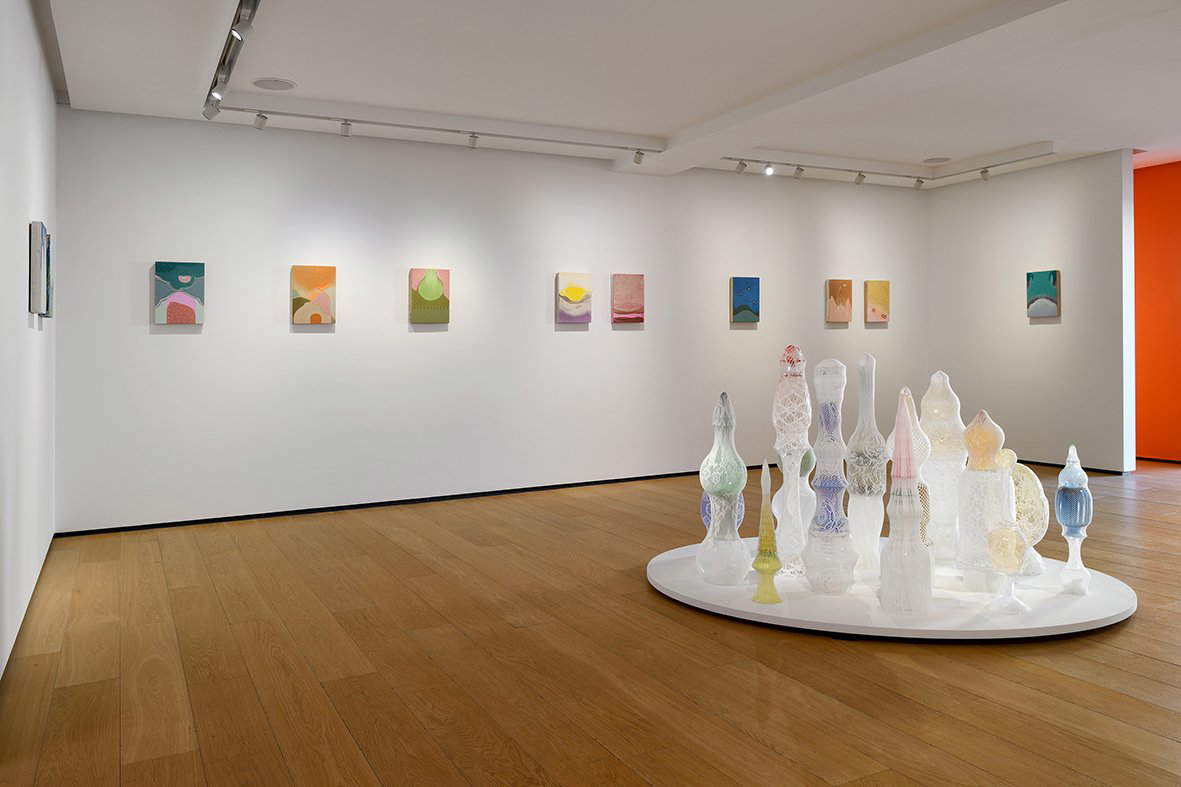
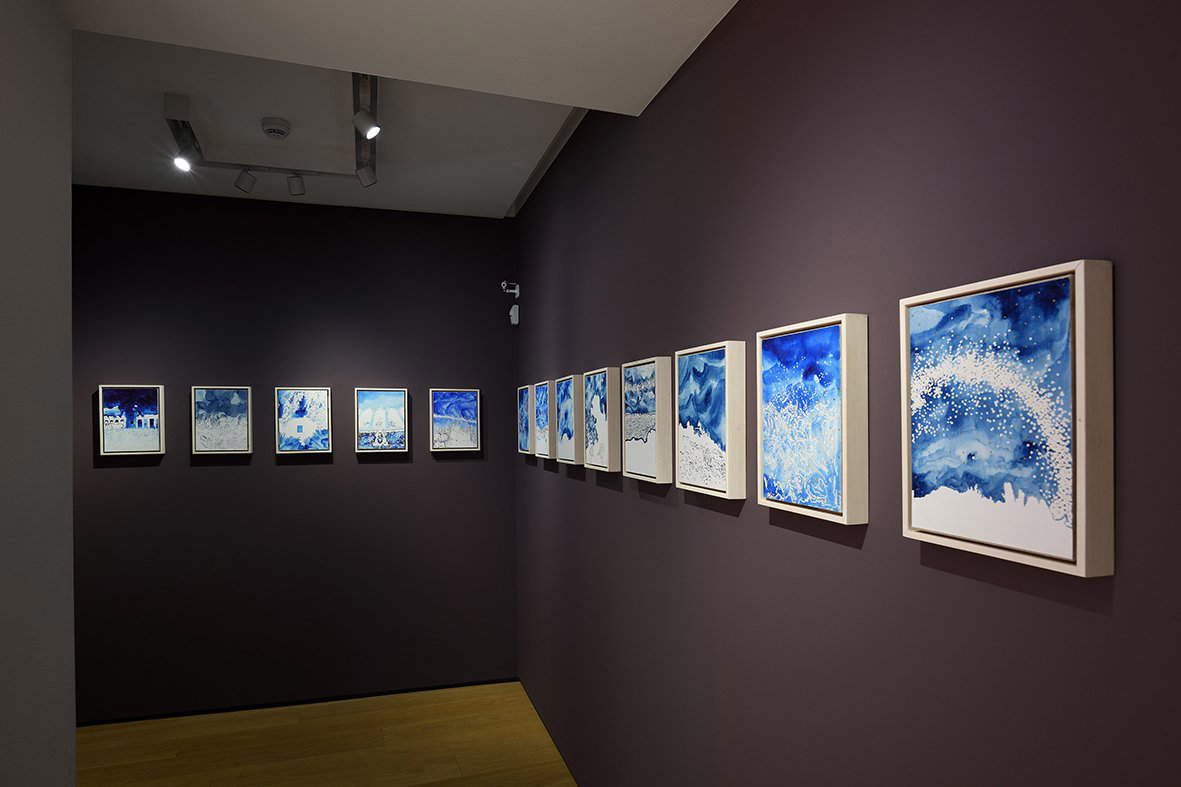
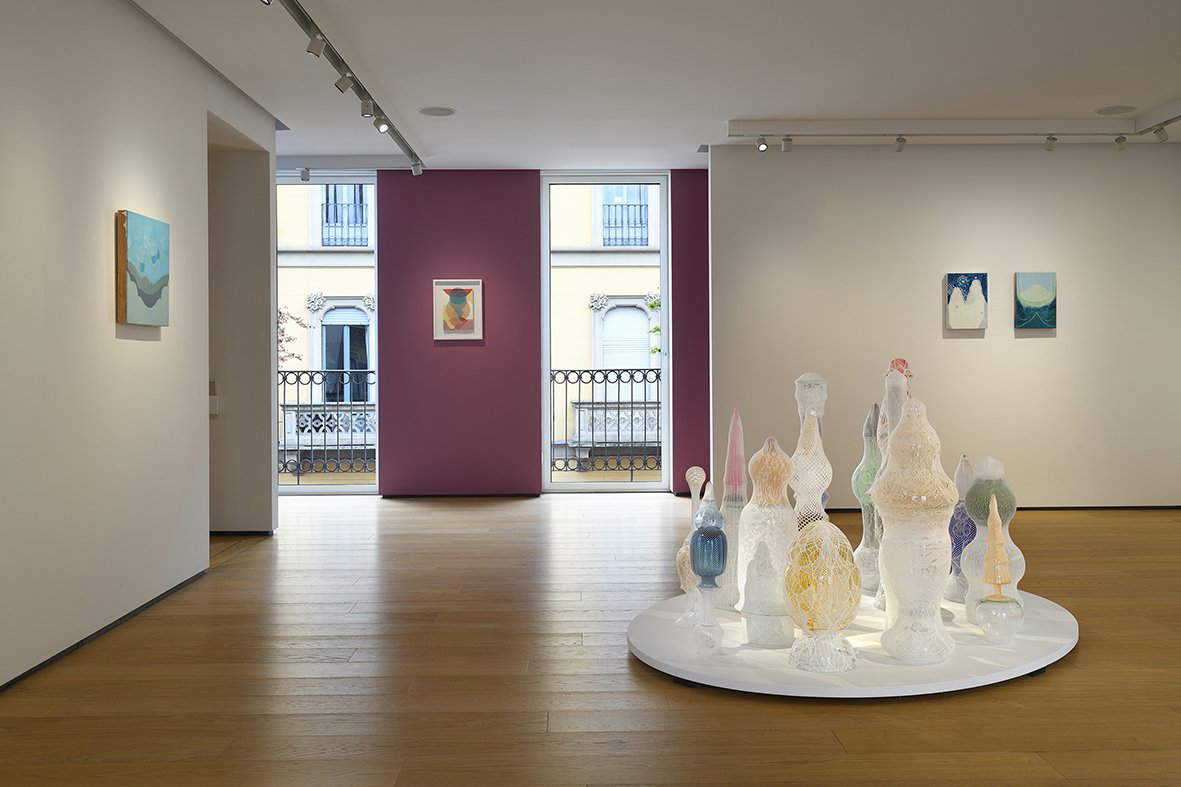
Until May 2, 2026, Building Terzo Piano in Milan is hosting the exhibition Le Fantasmagoriche, a solo show by Elena El Asmar (Florence, 1978), curated by Marina Dacci: on display are more than forty works, including sculptures and wall works on glass, panel and paper, dating from between 2008 and 2026, which are revived here as a unified intervention specifically designed for this space. The exhibition thus aims to present itself as an organic, enveloping whole, where sculpture and works on two dimensions find a space to dialogue and support each other. The result of a practice, that of Elena El Asmar, which has always been attentive to the theme of the relationship between space, memory and imagination: her works aim to translate memory into visual and narrative structures by means of drawing, painting, sculpture, installation and even words, in a process of continuous stratification and transformation. Gabriele Landi, on the sidelines of the exhibition, interviewed Elena El Asmar and Marina Dacci.
GL. Elena, how come the exhibition is called “The Phantasmagoricals”?
EEA. A few months ago, with Marina, we started a kind of written conversation, and after reading her introduction and answering her questions I told her that the word “Fantasmagoriche” kept coming back to my mind, which she had used as an adjective several times especially in relation to the work in the exhibition “Le ore terse.” So, in writing, I thought of adding the article "The" and transforming the adjective into a noun coming up with “The Phantasmagoric” to indicate not a precise object, but a set of apparitions, images, forms or states that traverse the space of the exhibition. An open plural. “Le Fantasmagoriche” is not only what is seen, but also what surfaces, resists or disappears. It is an invitation to enter a space suspended between presence and absence, visible and invisible. The term phantasmagoric refers to the ancient phantasmagorias, spectacles of projected images that evoked apparitions, shadows and optical illusions. In this sense, the title suggests works that do not impose themselves directly, but emerge as visions: traces, reflections, fragments of memory or identity that are manifested and immediately subtracted. The works can be read as sensitive apparitions, in which the real is intertwined with the imaginary, and where what seems familiar takes on an alienating quality, a place where the viewer is not called upon to “recognize” but to allow himself or herself to be traversed by images and sensations that act like ghosts, revealing what normally remains at the margins of the gaze. The title does not describe the exhibition, but activates the experience, inviting the visitor to pause in uncertainty, to recognize what has no precise name, and to be guided by a nonlinear perception, made up of apparitions, echoes and constellations of meaning.
What is imagination for you and how do you nurture it?
EEA. Imagination is a tool of knowledge, of self and of the world. It is a kind of intermediate space, a threshold where memory, experience and perception meet giving rise to a simultaneous transformation of the present. Imagination allows us to inhabit what has been experienced by stitching it to what we are and what we would like in the future to be. In some ways one could say that imagination is that engine that transforms time into habitable, usable space. In this space things are never whole but brush against each other, overlapping to construct unstable, anti-hierarchical geographies. Is there anything more intimate and political at the same time than this human capacity to dare, visualize and hope for the unhoped-for? Where power tends to fix, categorically define, construct boundaries, imagination opens, displaces, disobeys. In the attempt to break down the absolute as a category of thought, man can still find the strength to transform the world.
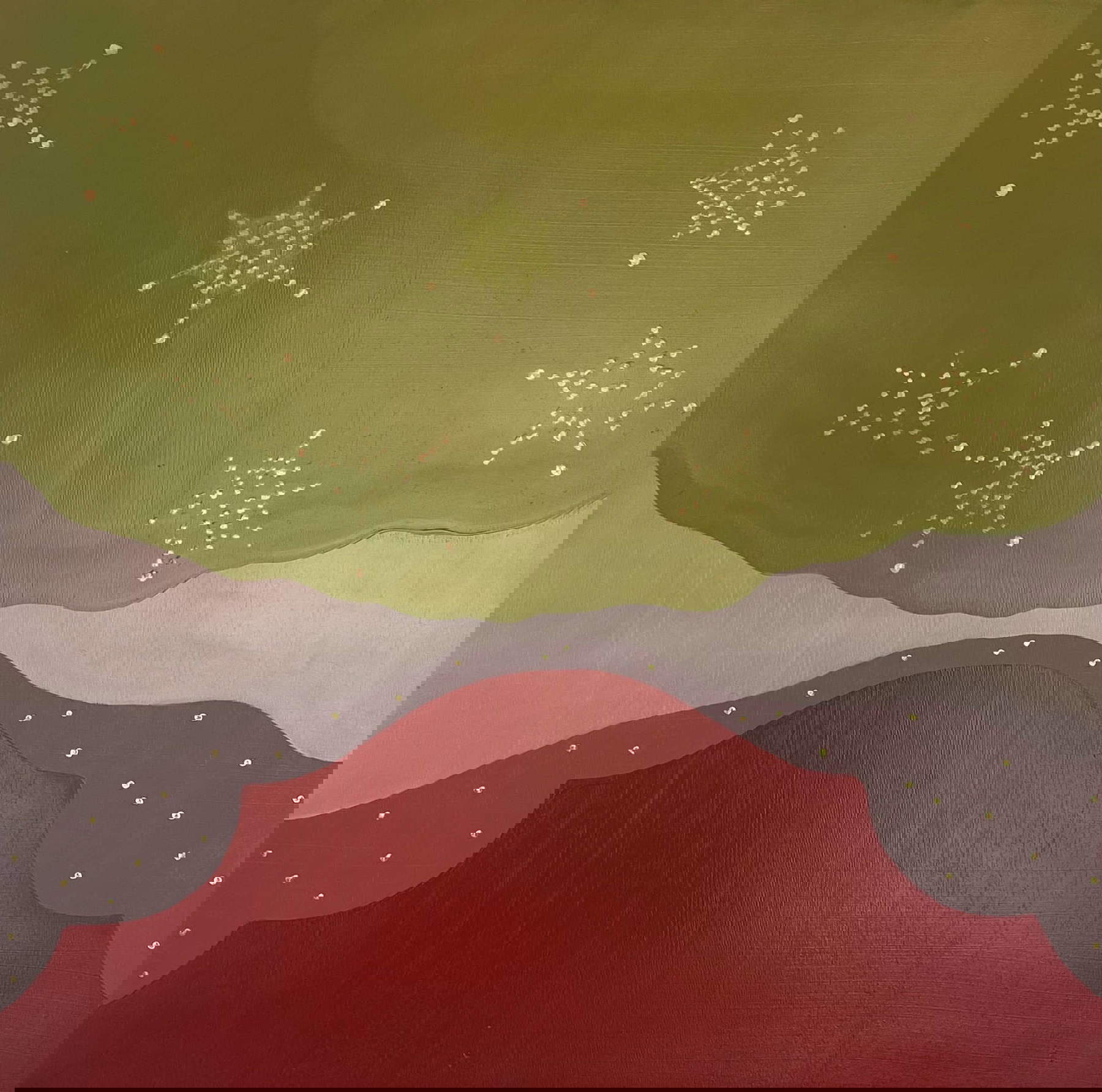
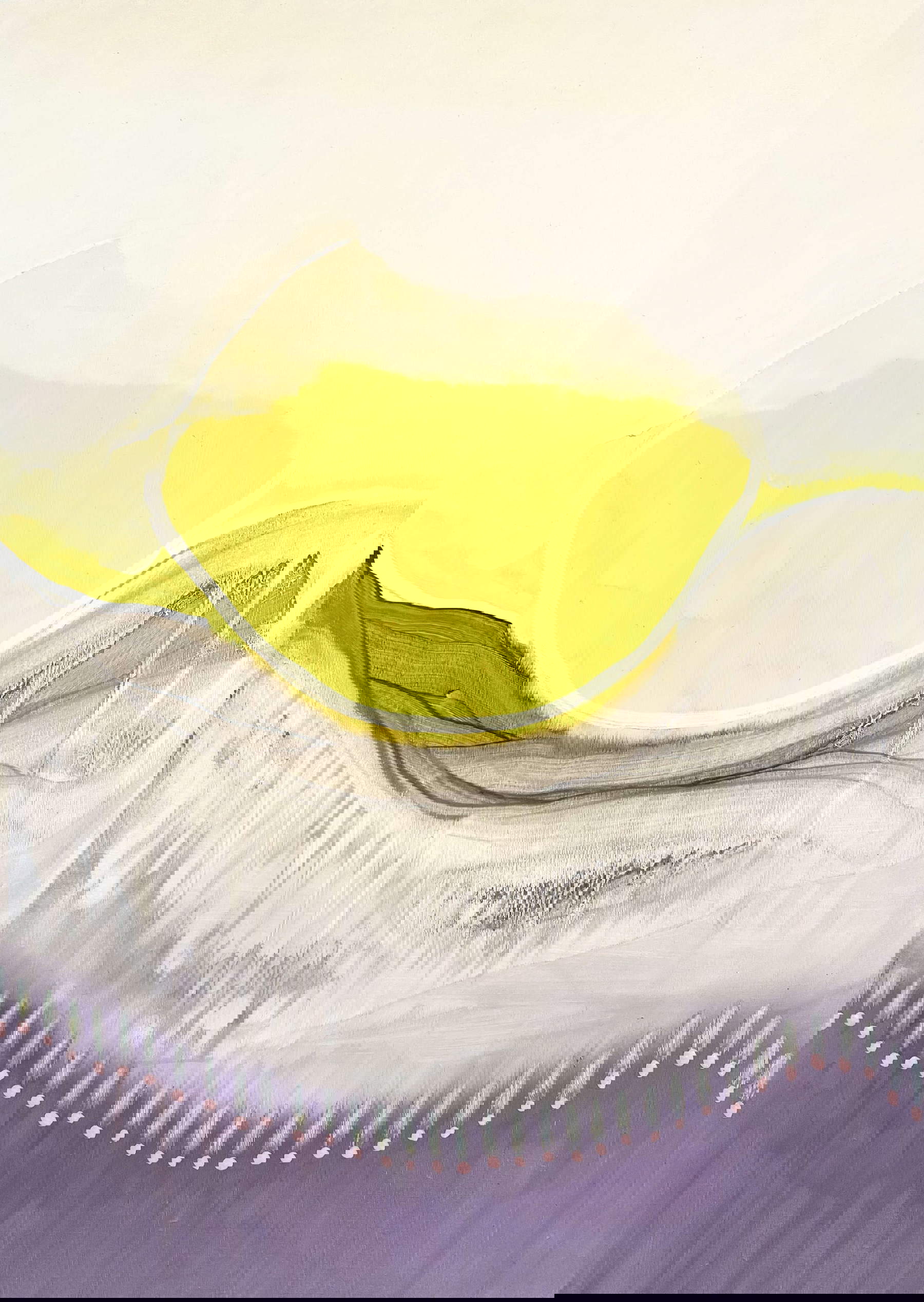
Marina, a text that Elena surely habitually frequents is Bachelard’s The Poetics ofReverie , which most likely pairs in her secret library with The Poetics of Space by the same author. In these two, precious volumes, the author penetrates deeply into the two topics he addresses through an approach that stimulates the generation of images suspended between the poetic, the psychoanalytic and the imaginative: what reverberations do you think this has in the way Elena makes her world visible?
MD. I don’t know Elena’s secret library but I have no doubt that Elena’s vision is deeply in tune with Bachelard’s thought. The landscapes/spaces that Elena physically traverses are not simply reproduced, but sedimented in a solitary, domestic space. Here, in that typical posture of drowsiness, they are remembered, re-imagined and finally returned through a specific pictorial and sculptural formalization. It is precisely the concept of rêverie that drags his work toward the theme of immensity. As Bachelard suggests, the dreaming subject leaves the surrounding world to enter a dimension where time resets and space extends to infinity. Looking at Elena’s Studio Portraits one gets exactly this impression: navigating through sidereal spaces. In this process, space becomes the generator of a poetic image that lives in close relationship with the word. Elena writes, and a special communion with the poets’ images enters her texts, and they then become an integral part of her artistic making. Her desire is that the echoes of her memories may resonate in the experience of those who approach her work, translating into the visual arts what Bachelard referred strictly to poetry.
Elena, in this exhibition you present a new variant of “The Exercise of the Far” that is white and at the same time composed of transparent and colored glass. How did you arrive at this new definition?
EEA. In its first version of “The Exercise of the Far” made in 2010 for Madeinfilandia, the sculptural group was covered with white elastic medical nets, so in a way, on a chromatic level, it was a bit like coming ’home’. For the exhibition, we imagined the space on the third floor of the Gallery Building as a unique world in which wall works and sculptures were somehow a continuation of each other, an uninterrupted portrayal of them. Hence the need to include, among the transparent glass elements, objects that modulate transparency and light through color. The blue of a vase dialogues with the color that is then found in some of the paintings, as well as the greens, yellows, grays and pinks.
I would ask you to talk about the cycle of pictorial works that go under the title Studio Portraits...
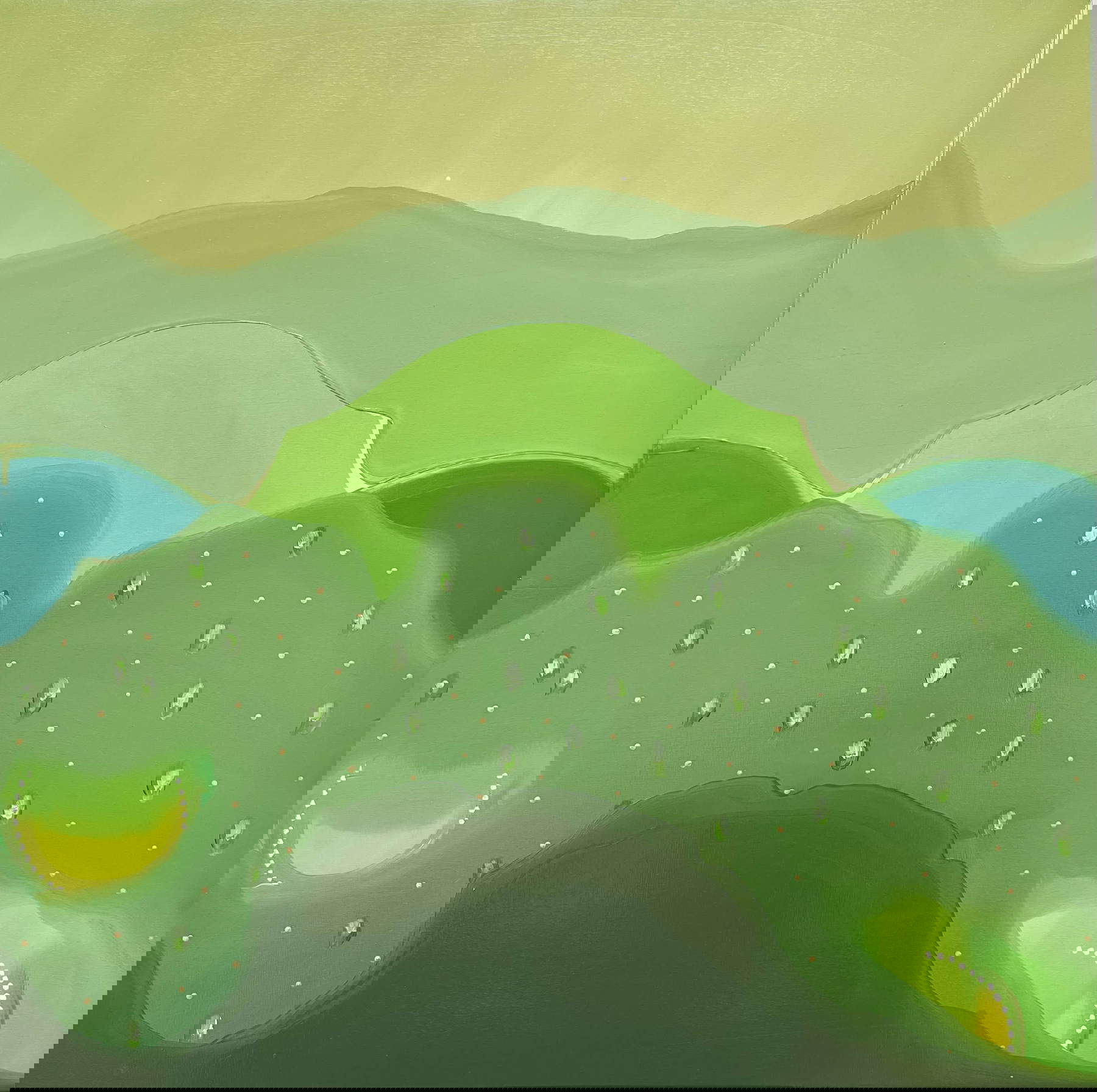
EEA. The Studio Port raits shown in the exhibition are acrylic and oil paintings on wood panel and are literally studio portraits. Those elements that I collect and often use to make my sculptures, become actual subjects thus going on to lose their original function, beginning to behave as portions of the landscape. They are no longer things to be used but, thanks to painting, surfaces to be traversed with the gaze as if within them they contained a distance, a depth, a possibility of orientation. The studio thus becomes no longer a closed space but an expanding geography constructed by the shifting sense of minimal presences. The landscape formed in the gaze becomes available to be continually reinvented, a fragment can become a horizon and a detail can open up as a territory. When things stop coinciding with themselves that metamorphosis takes place that activates the internal vibration of the things we look at and ourselves.
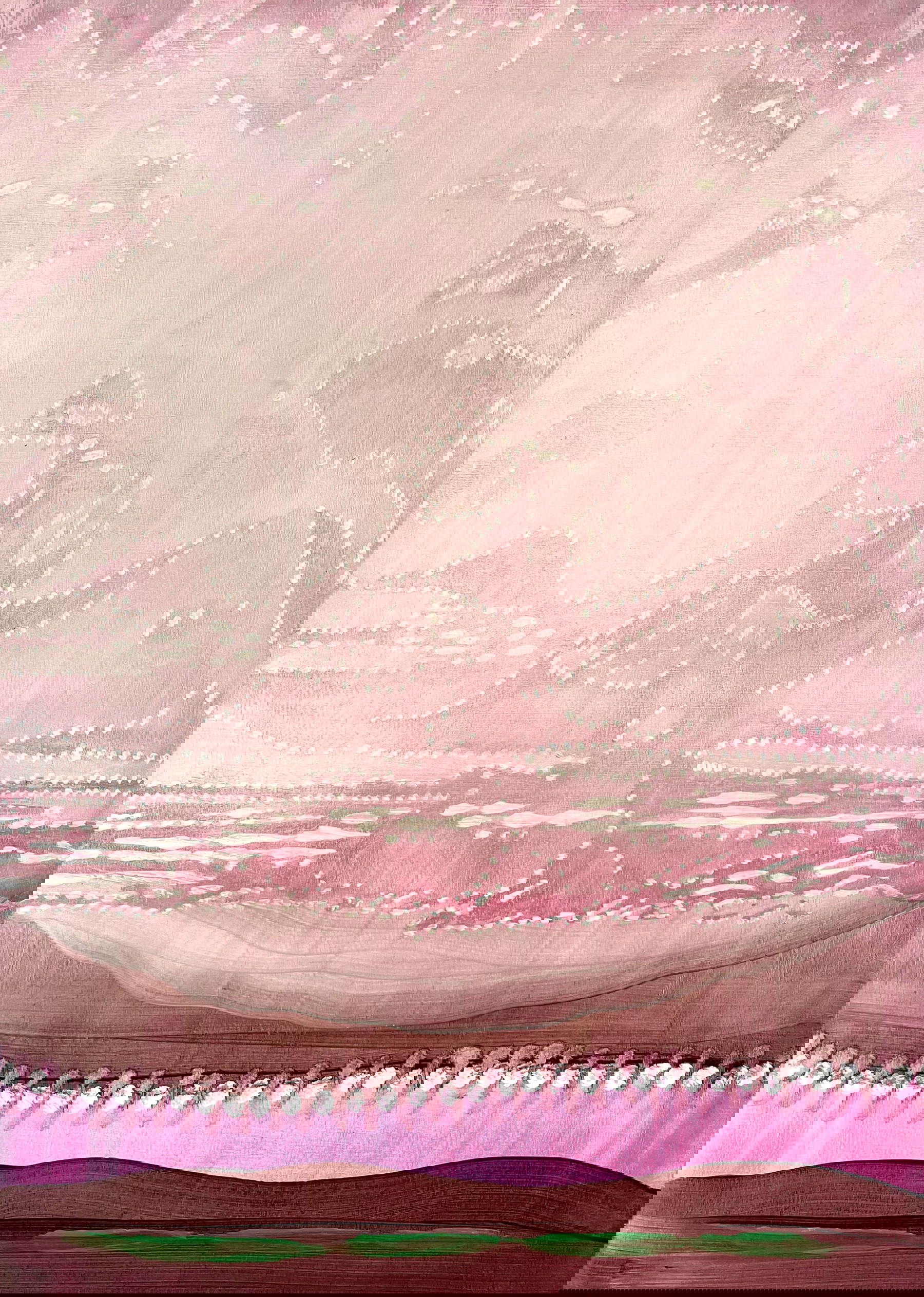
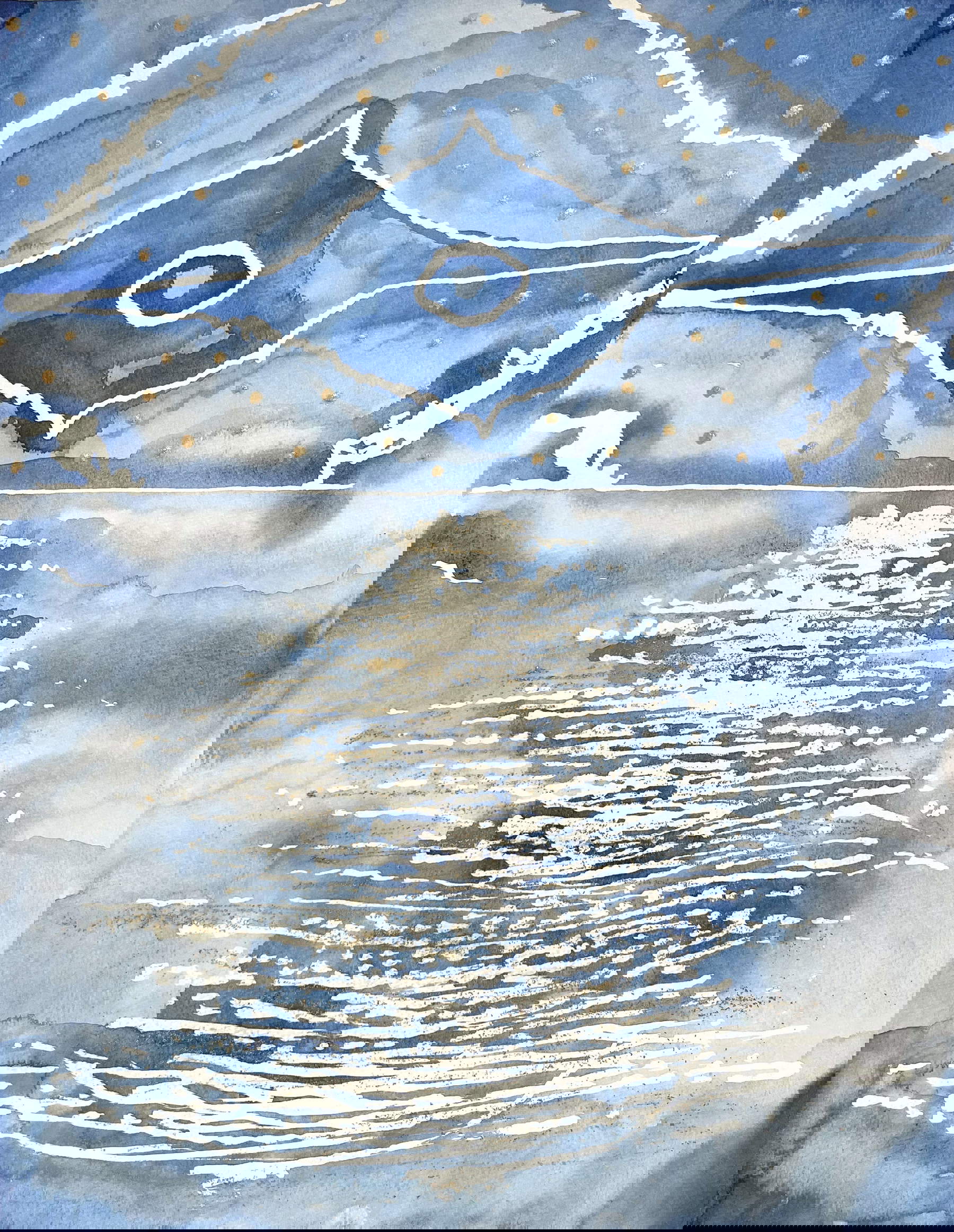
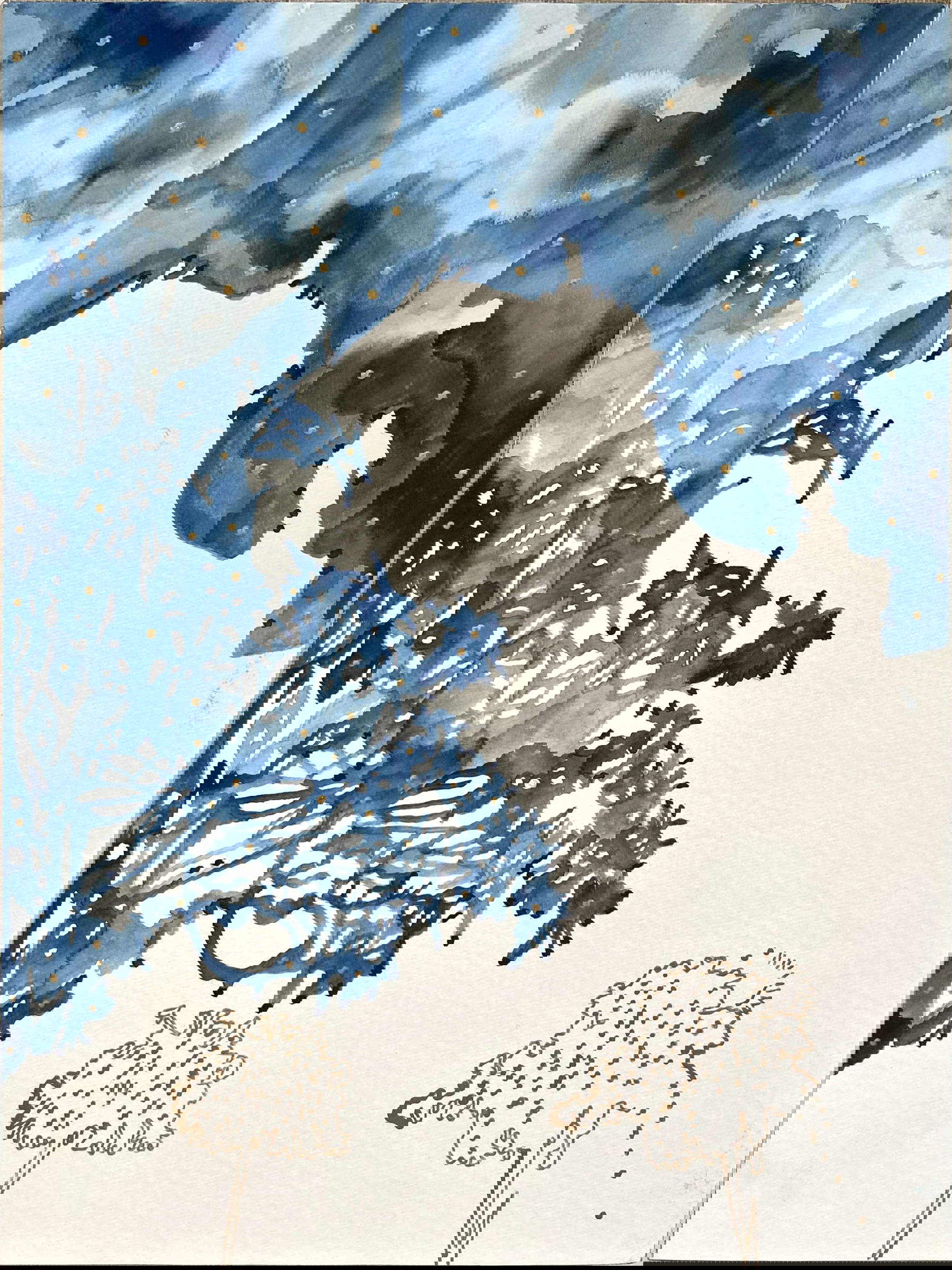
Marina, Elena’s work acts in different dimensions: in addition to the sculptural installation dimension, there is a strong pictorial dimension in this exhibition, which is divided into two parts, that of the Studio Portraits and that of the watercolors. The latter rhymes with precise places of which Elena gives us back an image reminiscent of those sketched in words by Gaston Bachelard. What ties Elena to these places?
MD. The exhibition was conceived as a single, large installation: a habitat in which the visitor can circulate by grasping the different facets of a path. The antechamber of the main room houses the watercolors, which represent the first passage of this vision of space/landscape : they are experiences lived in a physical and sentimental way, explored and returned “from a bird’s eye view.” Here we find the pivotal elements of his relationship with matter-water, earth, air-along with visions of architecture that fade toward what does not yet exist, but “could.” Entering the main room, the large central sculptural installation(The Exercise of the Far) acts as a window to the world: through it our gaze filters, recodes and re-imagines. The paintings that surround it -theStudio Portraits- constitute a kind of reversal of the sculptures; they are installed on the wall with a precise rhythm, almost as if they were notes on a pentagram leading toward that sidereal dimension we were talking about. Finally, I think of The Terse Hours, a work that is both the beginning and the end of the exhibition. A reminder precisely of rêverie. The work appears, at first glance, to be immaculate glass. On closer inspection, it is possible to discern a landscape etched on glass that, in the silence and semi-darkness of the room, the artist has imagined from observing a detail of a chair in her room.
Marina, I personally believe that Elena’s work unfolds before our eyes as a landscape of which it is impossible to grasp the whole: there is always something that escapes that is hidden from our eyes eager for knowledge. How do you see it?
MD. I think Elena’s work suggests a way of being in the world that is not “factual,” but contemplative. Letting go on that wave and, as I was telling you, getting in touch, letting what surrounds us emerge, expand, resonate in our inner self by entering into ourselves.
Elena, Marina, you have known each other for a long time and there are many occasions here where you have worked together: how would you define the bond that unites you?
EEA-MD. Fantasmagoric! And we say it in unison.

The author of this article: Gabriele Landi
Gabriele Landi (Schaerbeek, Belgio, 1971), è un artista che lavora da tempo su una raffinata ricerca che indaga le forme dell'astrazione geometrica, sempre però con richiami alla realtà che lo circonda. Si occupa inoltre di didattica dell'arte moderna e contemporanea. Ha creato un format, Parola d'Artista, attraverso il quale approfondisce, con interviste e focus, il lavoro di suoi colleghi artisti e di critici. Diplomato all'Accademia di Belle Arti di Milano, vive e lavora in provincia di La Spezia.Warning: the translation into English of the original Italian article was created using automatic tools. We undertake to review all articles, but we do not guarantee the total absence of inaccuracies in the translation due to the program. You can find the original by clicking on the ITA button. If you find any mistake,please contact us.












 IT
IT FR
FR DE
DE ES
ES CN
CN