




by Redazione 02/06/2026



Categories: Market / Disclaimer
At Sotheby's London auction a masterpiece by the late Lucian Freud, Sleeping by the Lion Carpet, with an estimate of £25-35 million.

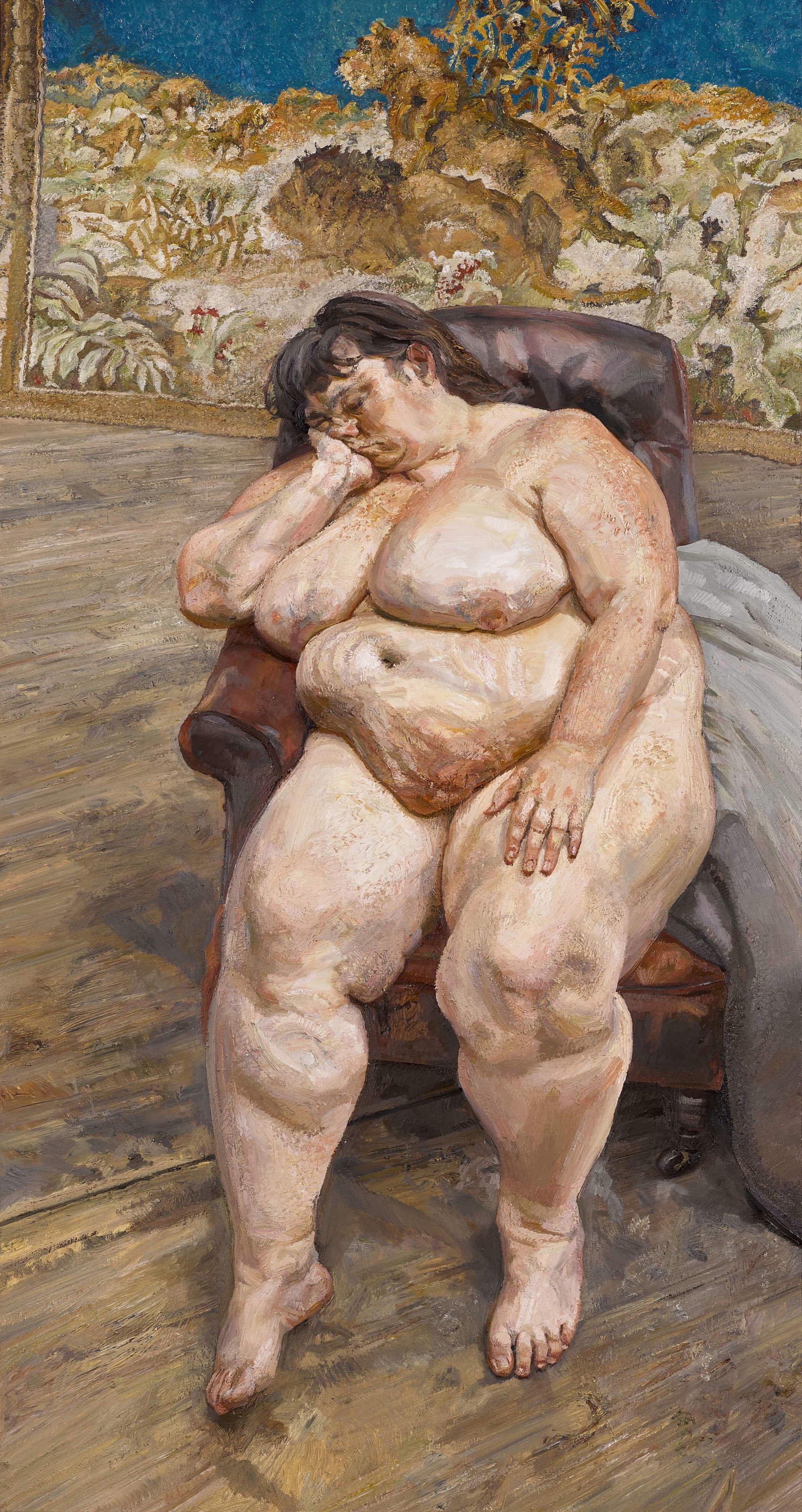
In June, Sotheby’s auction house in London will bring to market for the first time one of the most famous and discussed paintings from the late phase of Lucian Freud (Berlin, 1922 - London, 2011): Sleeping by the Lion Carpet. The work, made between 1995 and 1996, will be offered with an estimate of between £25 million and £35 million, or about €29-40.5 million, and comes from the prestigious Lewis Collection. The painting represents the culmination of the cycle dedicated by Freud to Sue Tilley, model, a central figure in one of the most important series of twentieth-century portraiture. Between 1993 and 1996, the artist made four large canvases depicting her, investigating the human body with a radical, direct approach devoid of idealization. Sleeping by the Lion Carpet is considered the final and most ambitious work of this journey and one of the absolute pinnacles of her production.
The work, already widely exhibited in international museums, has never before appeared on the public market. It was in fact acquired directly from the artist’s flagship gallery, led by Bill Acquavella, and has remained in Joe Lewis’s private collection ever since. Oliver Barker, president Europe of Sotheby’s, speaks of the work in extremely enthusiastic terms: "If figuration is the beating heart of the Lewis collection, Freud is its lifeblood. From their first encounter with his works, the Lewises have always had an instinctive understanding of what makes Freud a giant among artists. The zeal, conviction and almost hunter-like precision with which - over the decades - they have pursued his major works have been breathtaking to watch. And with this painting-the apotheosis of Freud’s most ambitious series-they have secured the supreme jewel. Intimate and monumental in equal measure, drawing on the great traditions of the past yet radically new and inventive, rich in emotional and pictorial complexity, Sleeping by the Lion Carpet is a masterpiece in every way. It is, quite simply, one of the greatest portraits of the 20th century, if not of the entire history of Western art: ’the Mona Lisa of the modern era.’"


Tom Eddison, head of contemporary art at Sotheby’s London, also highlighted the scope of the work: "This massive nine-month work represents the most ambitious and comprehensive expression of Lucian Freud’s vision, where vulnerability and monumentality come together. It is undoubtedly his masterpiece. In Sleeping by the Lion Carpet, Freud molds flesh with a sculptural intensity at once relentless and deeply human, confronting us with the raw truth of the human body, charged with an extraordinary presence. Rarely do we see on the market a painting of such extraordinary power and profound importance."
The cycle devoted to Tilley occupies a central position in the evolution of Freud’s poetics. The woman, employed as a social worker in London and introduced to the artist through performer Leigh Bowery, became one of the painter’s most important muses in the 1990s. “Leigh liked to fix people’s lives,” Tilley recalls. “He didn’t like me working in the employment office and thought it would be nice for me to do something different. He knew he had to put the idea in Lucian’s head so that he would think it was his idea. I was invited to lunch and had to be vetted. Leigh told me what to wear and I, as usual, completely ignored him! So we had lunch at the River Cafe. It was very pleasant. Then, without even realizing it, I found myself getting painted. Leigh had come to my house the day before to practice undressing me.”
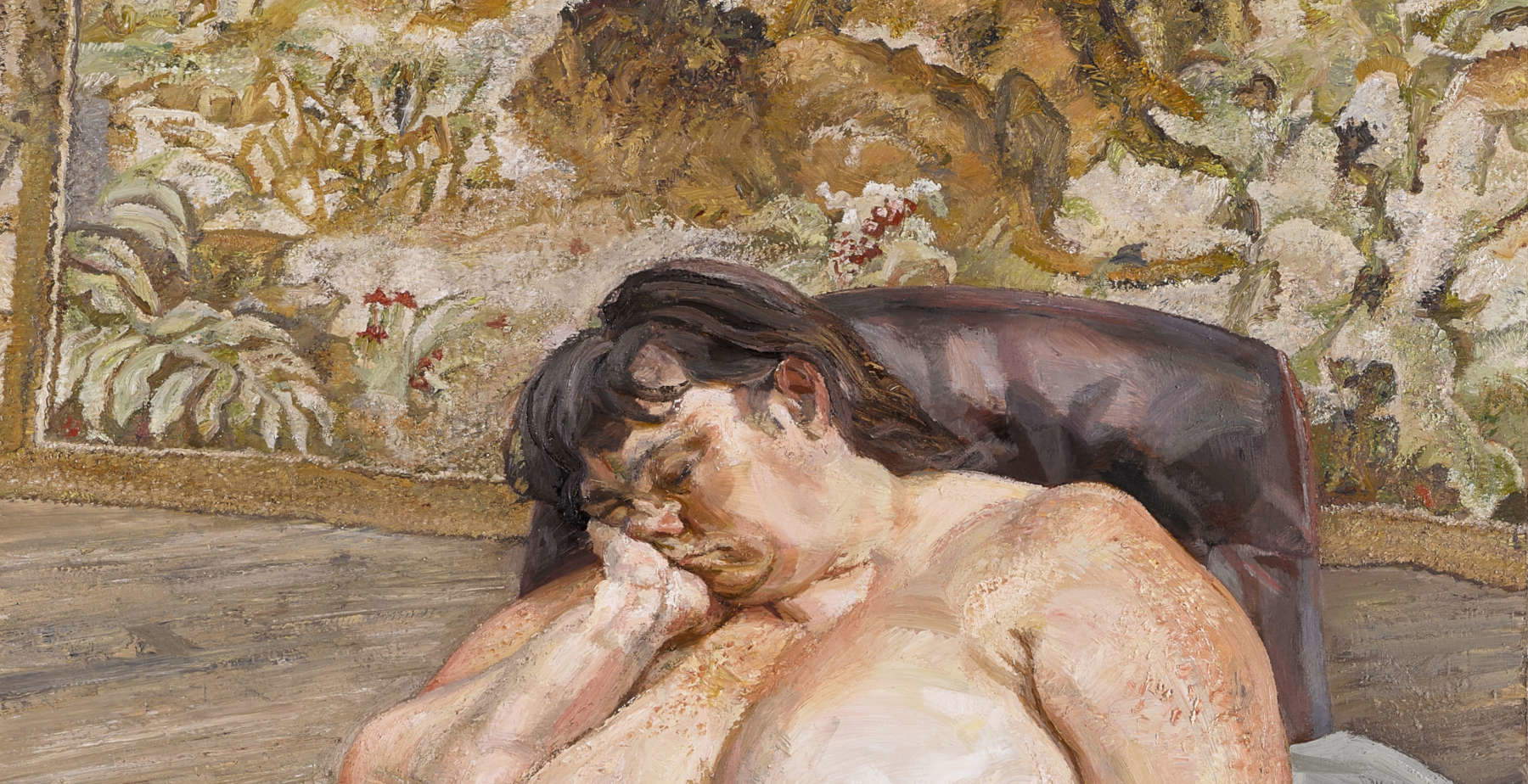
The relationship between artist and model, built on long studio sessions, is the basis for the construction of images of extraordinary psychological and physical intensity. The posing sessions for Sleeping by the Lion Carpet lasted about nine months. Freud imposed the constant presence of the model, convinced that her presence was essential to the pictorial rendering. Light, color and even the rendering of the floor were influenced by the presence of Tilley’s body in the space. The artist himself claimed that he could not work in her absence, asserting that every element of the painting was in direct relation to her physical presence. The result is a visually striking image: Tilley is depicted asleep in an armchair, with her body occupying almost the entire surface of the canvas. The anatomical rendering is characterized by an almost clinical precision that avoids any form of idealization. The skin is constructed through complex chromatic layers, which render the material density of the human body.
A distinctive element of the work is the carpet depicted in the upper part of the painting, which introduces an intense and bright chromatic note in a context dominated by earthier tones. This seemingly minor detail takes on a structural role in the composition, creating a visual contrast that amplifies the presence of the subject. Freud would personally locate the carpet in a London market, using it as a decisive compositional element to balance the painting’s color structure.
The construction of the image also reflects Freud’s deep knowledge of the European painting tradition. The artist was known for his systematic study of the great masters of the past, from Titian to Pieter Paul Rubens, via Diego Velázquez and Édouard Manet. This assimilation does not result in direct quotation, but in a radical reinterpretation of the human figure, removed from all classical idealization. The result is a painting that is in constant dialogue with art history, while affirming an autonomous and contemporary vision of the body. Freud’s ability to restore the human body in its most concrete and vulnerable dimension continues to influence generations of contemporary artists, from Marlene Dumas to Jenny Saville, who have recognized his work as a fundamental point of reference.
The historical and collector value of the work is further reinforced by its provenance. The painting was part of the collection of Joe Lewis, one of the most important collectors of figurative art of the second half of the twentieth century, who has built up over the years a significant nucleus of works belonging to the so-called School of London. His collection includes works by artists such as Francis Bacon and Freud himself. Prior to the sale, Sleeping by the Lion Carpet will be on public view in Sotheby’s galleries on New Bond Street, where it will be presented alongside other works from the Lewis collection.
 |
| A masterpiece by the late Lucian Freud goes up for auction at Sotheby's: estimated £25 million |
Warning: the translation into English of the original Italian article was created using automatic tools. We undertake to review all articles, but we do not guarantee the total absence of inaccuracies in the translation due to the program. You can find the original by clicking on the ITA button. If you find any mistake,please contact us.