





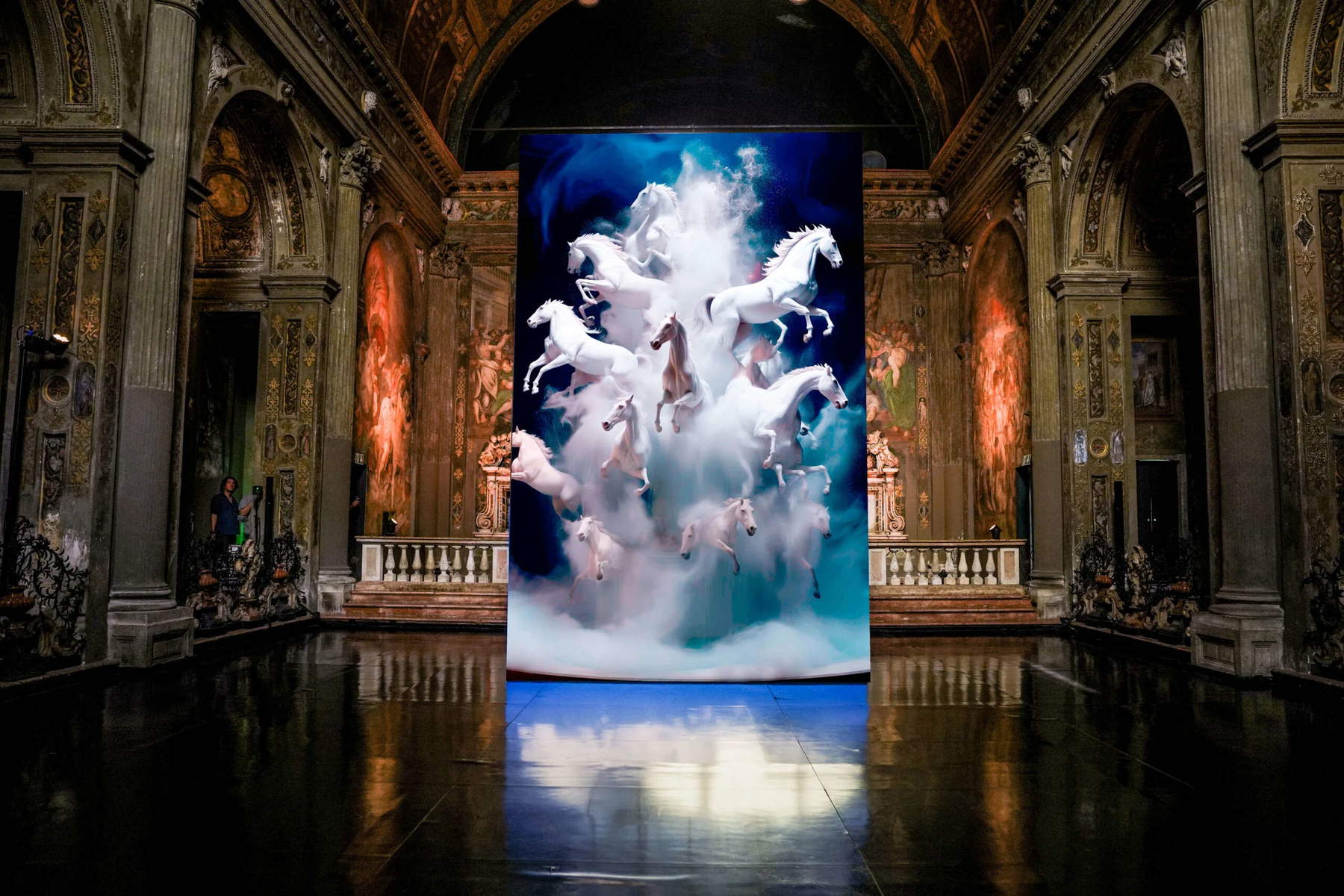
After two years of contraction, the global art and collectibles market returned to growth in 2025, marking a significant turnaround although still immersed in an uncertain international context. This is what emerges from the ninth edition of the report The market for art and collectibles prepared by Deloitte Private Italia, which was presented on April 13, 2026 in Milan at the Deloitte Auditorium, on the occasion of the launch of the program of initiatives hosted in the Deloitte Gallery inside the deconsecrated Church of San Paolo Converso, where Liturgica, a site-specific work by artist Giuseppe Lo Schiavo, is on display. The most striking data concerns the growth in turnover of the main international auction houses, which in 2025 record a 14.8 percent increase over 2024, recovering ground after the negative two-year period 2023-2024. However, this recovery is part of a scenario defined as “two-speed,” characterized by complex dynamics and influenced by global geopolitical tensions.
Indeed, the first half of 2025 was marked by a climate of high uncertainty related to the introduction of U.S. duties, which slowed transactions and affected prices, especially in the premium segment. A slowdown consistent with the negative trend of the previous two years. In the second half of the year, however, the softer application of U.S. trade policies fostered a recovery in international trade, with positive effects on the art market as well. Contributing to the growth were in particular some major sales of private collections, especially in the United States, which supported the overall recovery of the sector. In parallel, the positive trend in so-called passion assets, a category that includes goods such as design, watches, and collectible wines, continues. In 2025 this segment recorded 16.3 percent growth over the previous year, confirming its central role as an alternative asset, often characterized by greater liquidity than painting.
The report highlights how the market today is traversed by two main forces, which are interdependent on each other. On the one hand, the so-called cross-pollination, i.e., the integration of traditional art and collectibles segments within the offerings of large auction houses. On the other is the polarization of demand, which is increasingly focused on works of certified quality and with traceable provenance, while the volume of transactions in the lower and middle price ranges is also growing.
Another key element concerns the generational change taking place. Millennials and Gen Z are redefining traditional market mechanisms, affecting both buying patterns and the motivations behind collecting choices. By 2025, between 30 percent and 40 percent of new buyers at major auction houses belong to these very generations, a sign of a progressive shift in the profile of collectors. This phenomenon is intertwined with the generational transition of the large collections accumulated during the 20th century, particularly by baby boomers, who today represent the main pool of quality works placed on the market through inheritances and estate transfers. A dynamic that is redefining supply and influencing the strategies of operators.
New generations are also distinguished by a different cultural approach to art. Art philanthropy is playing an increasingly important role: in 2025, 54 percent of collectors consider this important, up from 50 percent in 2023. Even more significant is the finding that 67% of young people indicate support for artists as one of their main motivations for purchasing. This is a signal that highlights the overcoming of a purely collecting logic in favor of a more active involvement, close to patronage.
The modes of purchase are also changing rapidly. Digital platforms are taking on an increasingly central role: in 2025, more than 81 percent of Christie’s lots were sold online, and 52 percent of high net worth individuals made purchases through digital channels, up sharply from the 30 percent recorded in 2023. A development that confirms the growing integration between the art market and technology.
Geographically, the United States remains the leader in the painting market, concentrating 64.1 percent of global sales, followed by London with 20.7 percent. The unsold rate also improves, standing at 11.4 percent in 2025, down from 14.5 percent the previous year, a sign of greater market efficiency and a better match between supply and demand.
In Italy, the report identifies some factors destined to positively affect the sector. These include the reduction of VAT on art transactions from 22 percent to 5 percent as of July 2025, a measure that intervenes on one of the elements that over the years have penalized the country’s competitiveness compared to other European markets. Added to this is the Italia in Scena Bill, approved at the end of March 2026 and recently published in the Gazette, which introduces interventions for the enhancement of cultural heritage, simplifies the management and circulation of works and promotes the involvement of private entities.
According to the report, these measures are bound to have a significant impact on the mobility of works, the activity of operators and the attractiveness of the Italian system internationally, helping to strengthen its position on the global stage.
Ernesto Lanzillo, Deloitte Private Leader, points out that “the growth of the art market in 2025 reflects a profound transformation where quality, authenticity and traceability become decisive competitive factors. In addition, the growing awareness among collectors of the intrinsic value of art as a tool for identity, brand reputation, legacy, asset resilience and social impact suggests that the art and collectibles market will continue to find its own balance.”
Barbara Tagliaferri, Art & Finance Coordinator Deloitte Italy, on the other hand, draws attention to another critical aspect: the management of generational transition. "The results contained in the Highlights section of the Art & Finance Global 2025 Report,“ she says, ”highlight that art has become a central asset, a tool of identity and a lever of cultural impact. Despite this, families are still unprepared to manage its generational transition. In six years, the share of collectors who intend to plan for the future of their collection, without having done so yet, has more than quintupled, rising from 7 percent to 36 percent. Wealth management has an opportunity today."
The report also points out that more than half of collectors, or 51 percent, intend to bequeath their works to family, reinforcing the idea of art as a deeply personal asset. However, this choice entails complex implications for heirs, who find themselves managing not only cultural and emotional values, but also financial and logistical responsibilities that require specific skills.
Professionals in the field also point to the ambivalent nature of 2025. Pietro Ripa, private banker at Fideuram, highlights how the first half of the year was affected by concerns about U.S. tariffs. “The first half of the year characterized by a strong concern about the introduction of the U.S. administration’s duties has seen a slowdown in transactions and sales prices, especially in the premium segment,” he says. “A slowdown in line with the slowdown in the 2023-2024 biennium. On the other hand, the second half of the year saw a softer application of customs tariffs, which clearly benefited international trade and also art trade: the market also benefited from important sales of private collections with a growth in total sales of +14.8 percent over 2024.”
On the other hand,Roberta Ghilardi, Art & Finance Senior Manager at Deloitte Private, highlights the growing role of passion assets and the importance of next-gen: “Passion assets are growing by 16.3%, confirming their centrality as alternative assets with a relative liquidity higher than painting. The next-gen enters the market with a different agenda: sustainability, identity, impact. The success of the market will depend on the ability of auction houses to assemble quality catalogs and understand where the tastes of young collectors-who now account for 30-40% of new buyers-will land, and whose emphasis on narrative, social impact and sustainability could be the real growth engine of the next decade.”
The report presentation was enriched by the speeches of Clarice Pecori Giraldi, Art Advisor and Director Apollo Group, Denis Curti, Founder Still Fotografia, Andrea Rurale, Director Intensive Program in Art Markets and Finance SDA Bocconi, Cristiano Seganfreddo, Publisher Flash Art, Margherita Solaini, Head of Italy Phillips Auctions, Gianluigi Vignola, CEO Ademy Ltd.
|
| Art market, global rebound in 2025 after two years of crisis |

Warning: the translation into English of the original Italian article was created using automatic tools. We undertake to review all articles, but we do not guarantee the total absence of inaccuracies in the translation due to the program. You can find the original by clicking on the ITA button. If you find any mistake,please contact us.


























 IT
IT FR
FR DE
DE ES
ES CN
CN


