




by Redazione 12/06/2026



Categories: News / Disclaimer
For the first time, the world of culture is mobilizing united across Italy to demand rights, employment stability and professional recognition.

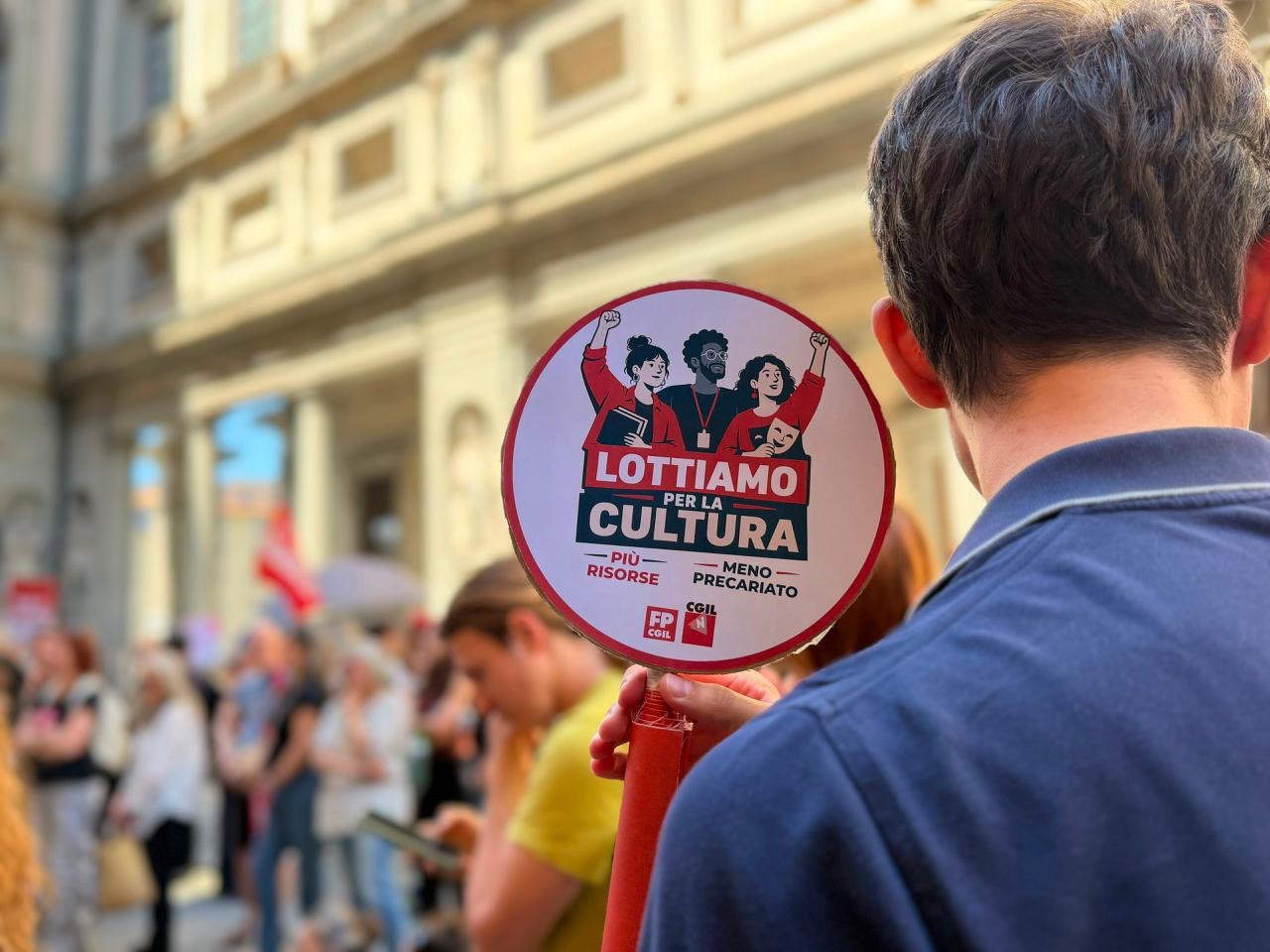
Today Italian culture stopped for a day to demand more rights, adequate wages and greater employment stability. Workers in the cultural sector mobilized for the first national strike of the entire cultural sector, promoted by FP CGIL and NIdiL CGIL with the support of the association Mi Riconosci? A mobilization that involved professionals with different contractual forms, from civil servants to temporary workers, from collaborators to VAT numbers, united by the demand for greater protections, employment stability and professional recognition.

The day of protest represents the culmination of a journey built over more than a year by trade unions and sector associations, committed to giving voice to a labor reality often characterized by fragmentation, precariousness and insufficient wages. “Italian Culture does not exist without the people who produce it every day. Yet, workers in the Culture sectors too often operate in unacceptable conditions due to repeated cuts in public funding: structural staffing shortages that facilitate the processes of outsourcing and precarity, underpayment, improper or nonexistent contracts, structural precariousness, and the absence of social security and social protections for those who are precarious. It is a paradox that a country like Italy, which owes an essential part of its identity and value in the world to Culture, treats in this way those who build and preserve and enhance that wealth every day,” with these words FP CGIL and NIdiL CGIL proclaimed in a note the first national strike in the culture sector.


Central to the full-day strike are five main demands: Recognition of the professional and economic dignity of cultural work through adequate contracts and stronger collective bargaining; the structural overcoming of precarity through the reinternalization of outsourced services and the stabilization of precarious workers with an extraordinary recruitment plan in the Ministry of Culture and public institutions; the full application of health and safety regulations even for those working under atypical or discontinuous contracts; and finally, the establishment of a discontinuity income for all cultural professions characterized by intermittent forms of work. Added to these points is a stark political denunciation: “it is unacceptable that the government chooses to cut funding for Culture in order to fuel the arms race. We choose Culture, Labor, Peace,” the confederal categories comment.

The mobilization had concrete effects in numerous Italian cities. Garrisons and assemblies were held from Rome to Milan, from Naples to Turin, from Venice to Bari, to Genoa and Cagliari. And the list of cultural venues participating in the strike is constantly being updated: in Florence, the State Archives and the administrative offices of the Uffizi Galleries remained closed; in Venice, some pavilions of the Biennale did not open to the public; in Milan, the Braidense National Library reduced its activities in the afternoon, while in Rome the Imperial Forum Museum, the tourist call center and several information points were closed. In Brescia cinemas remained closed, while in Ravenna the cultural principals of the Baptistery of the Arians, Mausoleum of Theodoric, Ravennantica and National Museum were closed.
Satisfaction from the FP CGIL and NIdiL CGIL unions: “Today, for the first time, women and men workers in the cultural sector, united, stopped throughout the country against cuts, precarity and low wages.”
“The culture sector in Italy has been underfunded for too long, unrecognized in its professional specificity, with continuous recourse to precarity. A fragmented, invisible and often blackmailable sector. This mobilization serves to break that silence: it serves to say that a country that does not respect those who produce culture does not deserve to call itself civilized,” said Roberta Turi, NIdiL CGIL national secretary.
“This strike is a first step, not an end point. Workers in the cultural sectors went on strike and mobilized to ask the government for another cultural policy for the country after years of cuts. We need more resources and investment to enhance the many professionals who are engaged every day in preserving, enhancing, restoring, making accessible and producing cultural heritage,” commented Giordana Pallone, Fp CGIL national secretary. “We call for resources and staff hiring for the Ministry of Culture, all public institutions and cultural services committed to performing an essential function that they guarantee with continuous openings and that it is no longer sustainable to receive allocations as if they were ancillary activities. We call for public investment to counter the continued use of outsourcing and contracting, with application of improper contracts, growth of precariousness that in some areas becomes structural, and the generalized decrease in wages, rights and protections of women and men workers in culture.”
“Today is only the beginning of a path of mobilization,” the unions conclude. “The world of cultural work - civil servants, administrative workers, collaborators, and self-employed workers - has shown that it can unite beyond the contractual fragmentation that the counterparts have so far used as a divisive tool. New mobilizations will follow.”
|
| Culture mobilizes: industry's first national strike for adequate wages and greater stability |
Warning: the translation into English of the original Italian article was created using automatic tools. We undertake to review all articles, but we do not guarantee the total absence of inaccuracies in the translation due to the program. You can find the original by clicking on the ITA button. If you find any mistake,please contact us.