





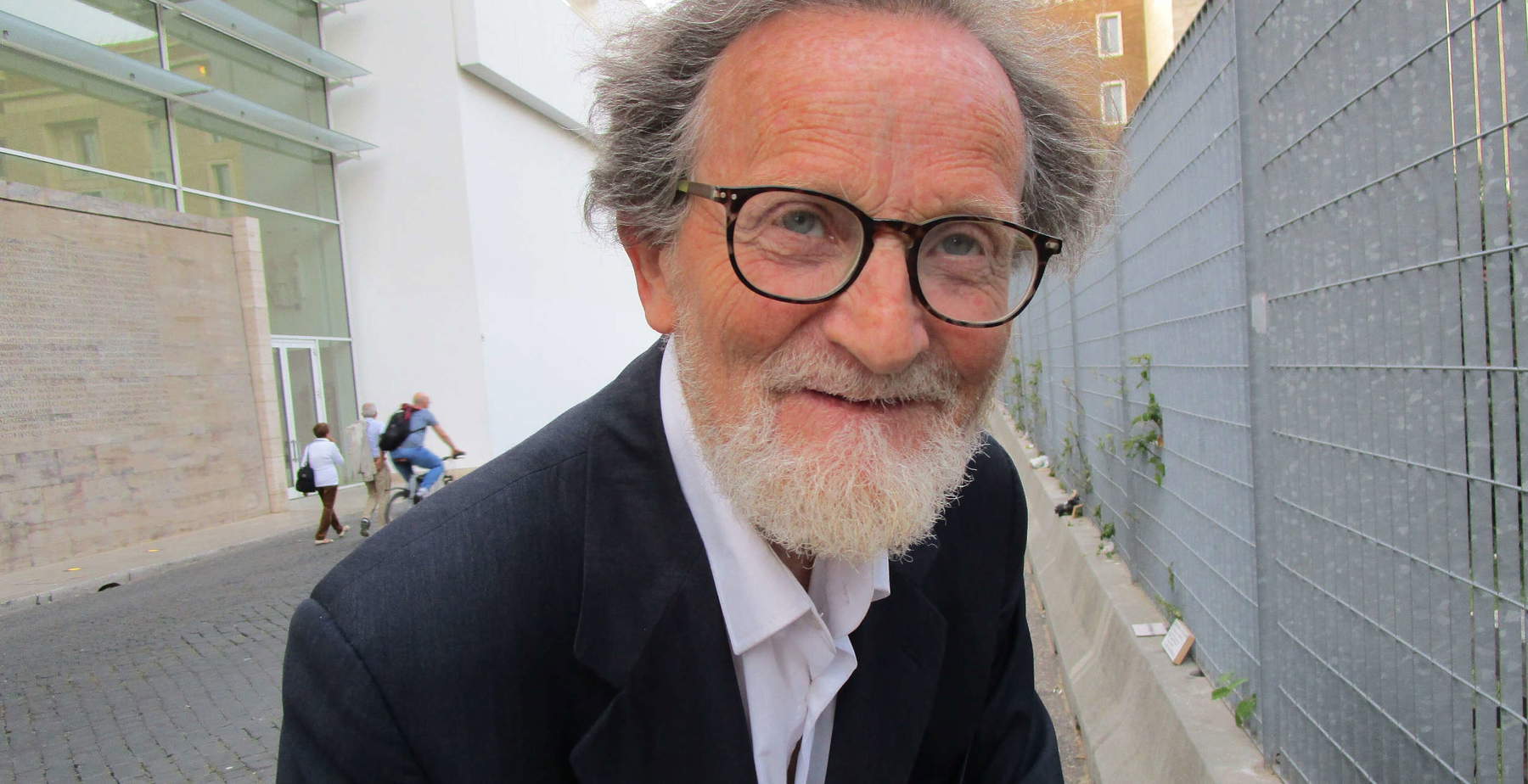
Fausto Delle Chiaie, considered Rome’s first true street artist and one of the pioneers of public art in Italy, passed away in Rome on July 4 at the age of 82. Born in Rome on January 23, 1944, he dedicated his entire career to bringing art out of museums and galleries, transforming the streets of the capital into the primary setting for his artistic exploration and direct dialogue with the public. For decades, his name was inextricably linked to Via dei Cappellari, in the heart of Rome, where he displayed his works every day directly on the pavement, in front of Andrea Bottai’s workshop. Over the years, that stretch of street, just a few steps from Campo de’ Fiori, became an open-air museum capable of intriguing thousands of passersby, tourists, collectors, artists, and critics, transforming a simple gesture into one of the most original artistic experiences on the contemporary Italian scene.
His improvised and spontaneous installations, compositions made from recycled materials, and poetic assemblages arranged on the ground established a distinctive artistic language that defied the traditional logic of the art world. Even before the term “street art” became firmly established in the international artistic lexicon, Delle Chiaie had already chosen the street as the natural setting for his work, deliberately foregoing institutional mediation and entrusting his work to the casual gaze of passersby.
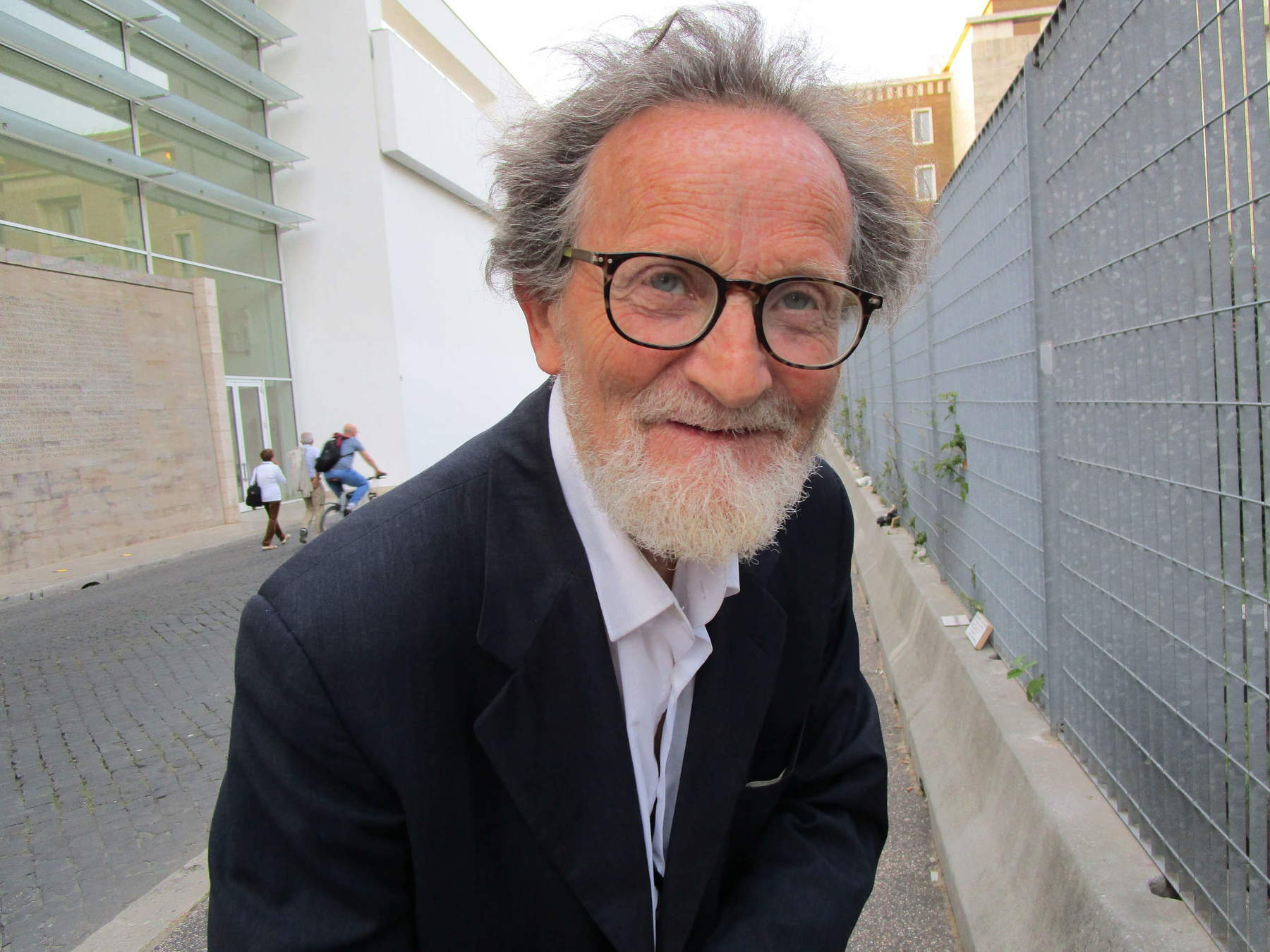
Influenced by Pop Art, Informal Art, and Arte Povera, Fausto Delle Chiaie had attended the Scuola Libera del Nudo at the Academy of Fine Arts in Rome. His early works date back to the 1970s, a period in which he began to develop an artistic vision that would gradually move away from traditional exhibition formats. The decisive moment in his artistic exploration came in 1986 with the drafting of the Infrazionista Manifesto, a text in which he defined the concept of “infra-action.” According to this vision, the artwork takes shape through an action that is simultaneously placement, exhibition, and donation. The artist places one or more works directly on the ground, in art venues or public spaces, and then walks away, allowing the place, time, and audience to complete its meaning.
In the Manifesto, Delle Chiaie described the Infrazione as a gesture capable of making visible a history observed only superficially, defining it as an artistic cry of alarm against historical distress and the blindness toward the simple and the humble. For the artist, the “Infrazione” arose from the deprivation of the ability to see, act, think, and do, becoming a metaphor for the need to restore vitality to everyday experience. This concept translated into actions that were often silent yet extremely radical. Delle Chiaie would, in fact, introduce his works—without prior notice or authorization—into museums, galleries, and public spaces, personally choosing where to place them. The work thus became part of the space, temporarily altering its perception and inviting the public to question the very meaning of artistic exhibition.
The importance of this work has also been recognizedby the online Treccani Encyclopedia, which considers Fausto Delle Chiaie’s infractionist actions to be isolated episodes of early street art in Rome and fundamental references in reconstructing the origins of urban art in the capital. In 1987, the artist began presenting his multifigurative works to the public by arranging them along the slope leading up to the Pincio. Here, too, audience participation became an integral part of the project: the public was not merely an observer but assumed the role of temporary custodian of the works, while Delle Chiaie supported himself through spontaneous donations left by visitors.
That practice represented a choice that was as much artistic as it was existential. By foregoing traditional commercial channels, the artist established a direct relationship with those who encountered his works, relying on people’s voluntary participation to provide the financial support necessary to continue his work.
The originality of his approach was also recognized by Achille Bonito Oliva, one of Italy’s leading art critics, who summarized the value of his work by stating: “Fausto Delle Chiaie creates a democracy of the gaze.” This definition highlighted the artist’s ability to eliminate all barriers between the artwork and the public, making art accessible to everyone without social or cultural distinctions.
Between 1987 and 1989, Delle Chiaie chose the Galleria Sciarra as the primary venue for his outdoor exhibitions, later moving, in 1989, to Piazza Augusto Imperatore, another symbolic location reflecting his constant presence within Rome’s urban fabric. While always maintaining strong roots in the capital, his work also expanded throughout Italy and abroad. Between 1982 and 1984, he staged performances and installations in Brussels, and in 1993 he participated in Antwerpen, in Antwerp. In Rome, he took part in *Molteplici Culture* in 1993, in *Aperto* at the Trevi Flash Art Museum in 1995, in initiatives at the Rialto Social Center in 1998, and in the group exhibition *Scala Mercalli* in 2008 . *Il terremoto creativo della Street Art Italiana* (The Creative Earthquake of Italian Street Art), hosted at the Auditorium Parco della Musica, was one of the first exhibitions dedicated to the history of street art in Italy. Since October 4, 2008, one of his installations has been part of the exhibition itinerary at the Castello di Rivara.
Over the years, Delle Chiaie’s story has also been chronicled in numerous documentaries. Among these is *Dormitorio – Fausto Delle Chiaie*, a short film directed by Flavio Sciolè that documents an installation created at RialtoSantAmbrogio in 2001. In 2010, Gabriele Centin and Matteo Alemanno produced *Robaccia rubbish*, a documentary chronicling a typical day in the artist’s life. The film was screened at the Ara Pacis during the presentation of the book *L’Arte? Rubbish!*, published by Electa, and later at the 2011 Venice Biennale in the Spanish Pavilion. In 2013, Paolo Buatti directed the documentary *Il museo chiude quando l’autore è stanco*(The Museum Closes When the Artist Is Tired), while that same year, Zerozerocento Produzioni, in co-production with Rai Cinema, released *Ho fatto una barca di soldi*(I Made a Boatload of Money), directed by Dario Acocella. Presented at the Rome International Film Festival, the documentary film followed Delle Chiaie over the course of an entire day, alternating between portraying him as an artist and as a man. An abridged television version aired on Rai 5 in May 2014. Also in 2014, journalist Domenico Iannacone dedicated the report *La bellezza incomprensibile* to him, which aired on Rai 3 as part of the program *I dieci comandamenti*. The television profile helped introduce his work to an even wider audience.
His artistic vision has also found a place in the world of fashion. Rossella Jardini, former creative director of Moschino, incorporated some of his works into the spring-summer 2017 collection of the line bearing her name, translating his artistic language into the realm of fashion design.
In 2018, the Museum of Contemporary Art in Rome dedicated the solo exhibition *Il museo a cielo aperto per sette giorni* (The Open-Air Museum for Seven Days) to him at MACRO Asilo, as part of the experimental MACRO Asilo project. That same year, Delle Chiaie published *Fuori catalogo*, a book in which he personally recounted his artistic journey. The book, published by Kellermann Editore, was conceived and edited by Pino Giannini, with photographs by Paolo Buatti. Also in 2018, the artists Dora García and Cesare Pietroiusti dedicated the book *Ospiti di questo museo* to him, edited by R. Bargellini and A. Poggianti and published by Valigie Rosse. The book, structured as a dialogue on contemporary art through his own experience, was presented in a national preview at the Premio Ciampi L’Altrarte in Livorno.
In 2019, Palazzo Merulana in Rome hosted his solo exhibition *All’ombra del bambù*(In the Shadow of the Bamboo), while between September 2020 and June 2021, the Museo Nazionale Concordiese in Portogruaro dedicated the solo exhibition *Lì per Lì* to him, curated by Boris Brollo and Alessandro Maganza. In 2021, Domenico Iannacone returned to tell his story in the episode “Io sono qui” of the show “Che ci faccio qui,” confirming the strong interest sparked by his personal and artistic journey.
At the same time, concern for his financial situation was also growing. In March 2021, writer Pino Giannini launched a public petition on Change.org calling for the artist to be granted benefits under the Bacchelli Law. The initiative gathered over 27,000 signatures and the support of numerous prominent figures in Italian culture. The request was granted on July 17, 2023, when the Council of Ministers officially announced the granting of the benefits provided for by the Bacchelli Law, thereby recognizing the value of the artistic and cultural contribution made by Fausto Delle Chiaie throughout his long career.
In recent years, museums have also increasingly recognized his work. Among the works that have entered public collections is *Social Distancing*, created in 2022 and now housed in the Farnesina Collection of the Ministry of Foreign Affairs and International Cooperation.
With the passing of Fausto Delle Chiaie, Italian art has lost a figure who defies easy classification, one capable of anticipating artistic practices that would only become central many years later. His choice to make the street the primary setting for art, to eliminate any distance between artist and audience, and to entrust his works to the serendipity of chance encounters represented a unique experience on the national scene. For generations of Romans and visitors, Via dei Cappellari will remain the place where one could stumble upon—almost by chance—his creations lying on the asphalt. A museum without walls, without admission tickets, and without set hours, where art lived in the moment of an encounter and in the willingness of those who chose to stop and look.
 |
| Farewell to Fausto Delle Chiaie, the pioneer of Roman street art |

Warning: the translation into English of the original Italian article was created using automatic tools. We undertake to review all articles, but we do not guarantee the total absence of inaccuracies in the translation due to the program. You can find the original by clicking on the ITA button. If you find any mistake,please contact us.


















 IT
IT FR
FR DE
DE ES
ES CN
CN


