





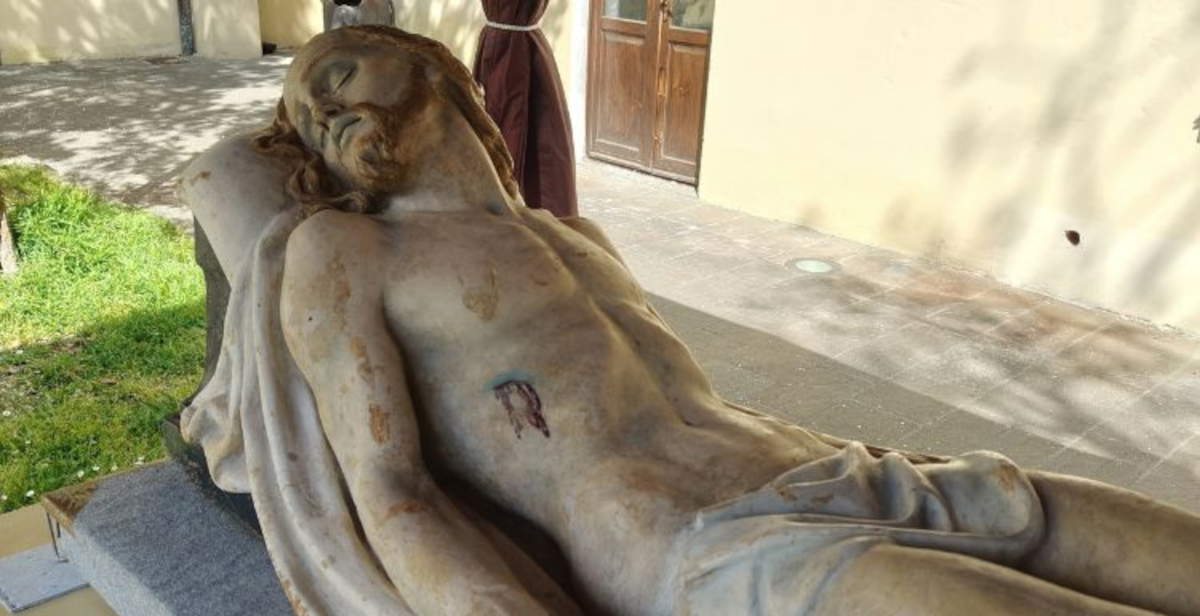
Presented today, March 25, 2026, atOfficina Creativa LAB - Conventino Fuori le Mura in Florence was the restoration of the sculpture depicting the Dead Christ, a painted plaster cast from the Pieve di San Martino in Sesto Fiorentino that was severely damaged by the flood that hit the area in March 2025. The initiative is part of the Florentine New Year’s Day program and represents a moment of public restitution of the conservation intervention carried out on the work, which is considered important for the community of the Pieve and for the artistic heritage of the territory.
The presentation was held in the Masaccio Room of the Officina Creativa LAB - Conventino Fuori le Mura and offered an opportunity to illustrate the recovery process that involved the sculpture after the damage caused by the flood event. The conservative restoration work was carried out by the company Valentini Ventura Restauro d’opere d’arte, which followed all phases of the work completely free of charge. The operation made it possible to restore structural stability and legibility to the work, which had been compromised by water and materials deposited during the flood. The restoration was conducted under the direction and high supervision of art historian Graziella Cirri of the Soprintendenza Archeologia, Belle Arti e Paesaggio, together with restorer official Francesca Leolini, who supervised the different phases of the intervention. During the meeting, the main methodological aspects and criteria adopted in the conservation process were explained.
The presentation was attended by Graziella Cirri, who elaborated on the characteristics of the intervention,Don Daniele Bani, parish priest of the Pieve di San Martino in Sesto Fiorentino, and Daniela Valentini, a restorer involved in the recovery of the sculpture. The meeting, organized by Artex, highlights the joint work between conservation institutions, restoration professionals and the local community, committed to safeguarding an asset linked to the religious and artistic history of the area.
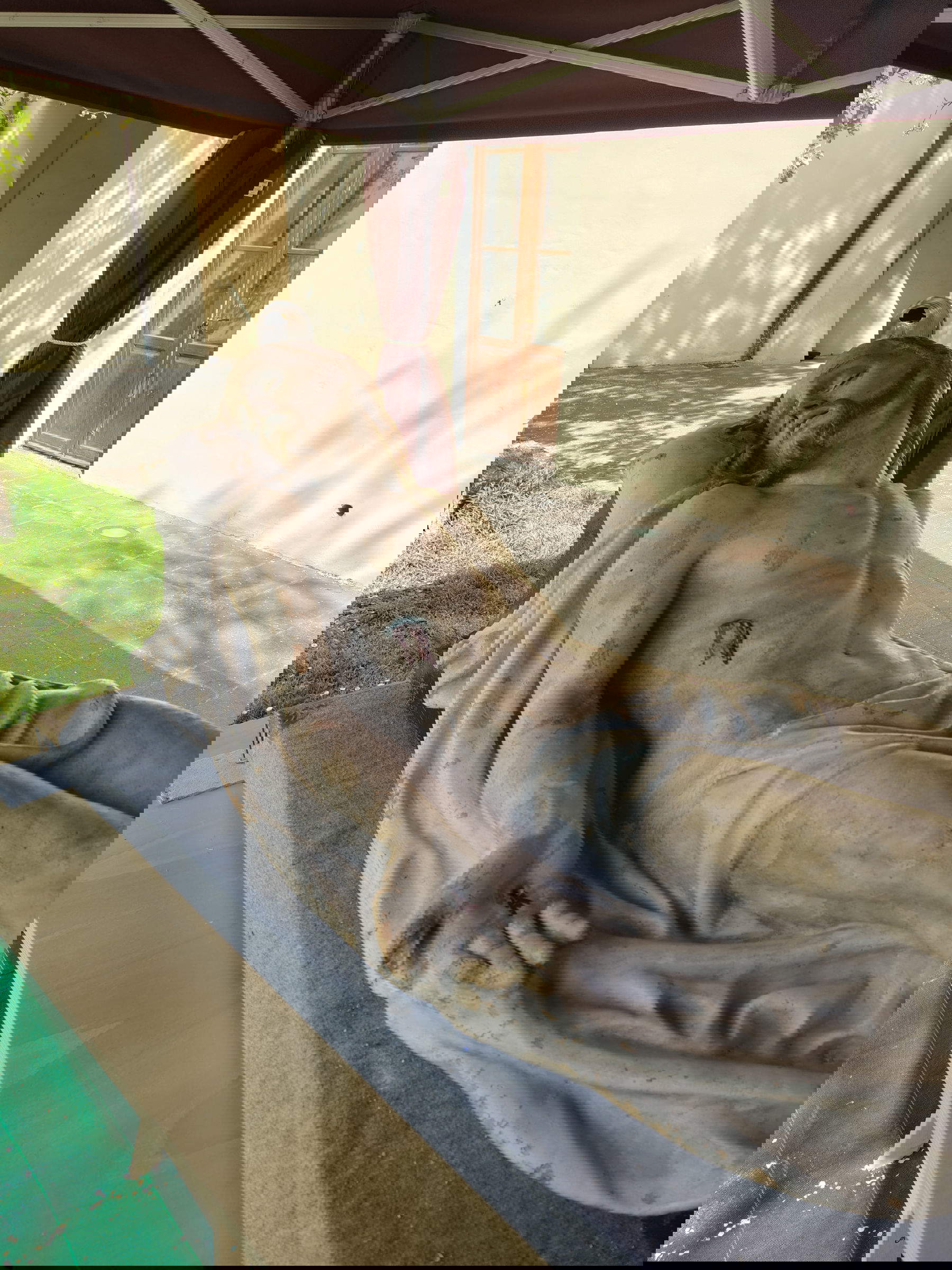
The restoration also made it possible to acquire new elements about the work’s history. As art historian Graziella Cirri explained during the presentation, investigations conducted during the intervention allowed the author of the sculpture to be identified in the sculptor Ferrante Zambini (Reggio Emilia, 1878 - Florence, 1949). An artist from Emilia, Zambini worked for most of his life in Florence and created the Dead Christ in 1930.
The figure of Zambini remains little known today, but some of his works are preserved in the Uffizi Galleries, where a series of drawings and a small bronze sculpture are located. The attribution that emerged during the restoration thus contributes to reconstructing the history of the sculpture preserved in the Pieve di San Martino and at the same time draws attention to a sculptor active in the Florentine artistic context of the twentieth century, whose production appears still partly to be investigated.
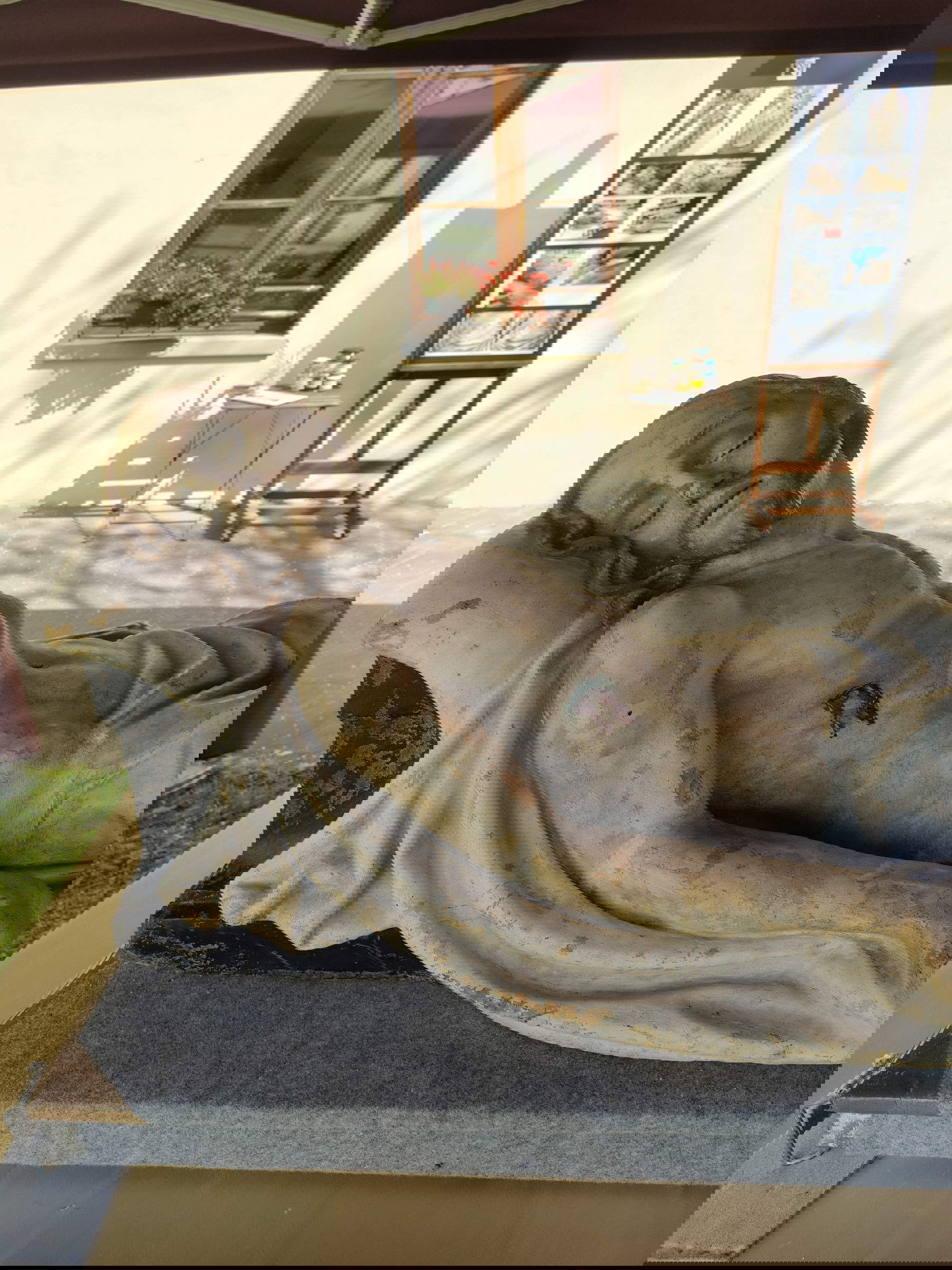
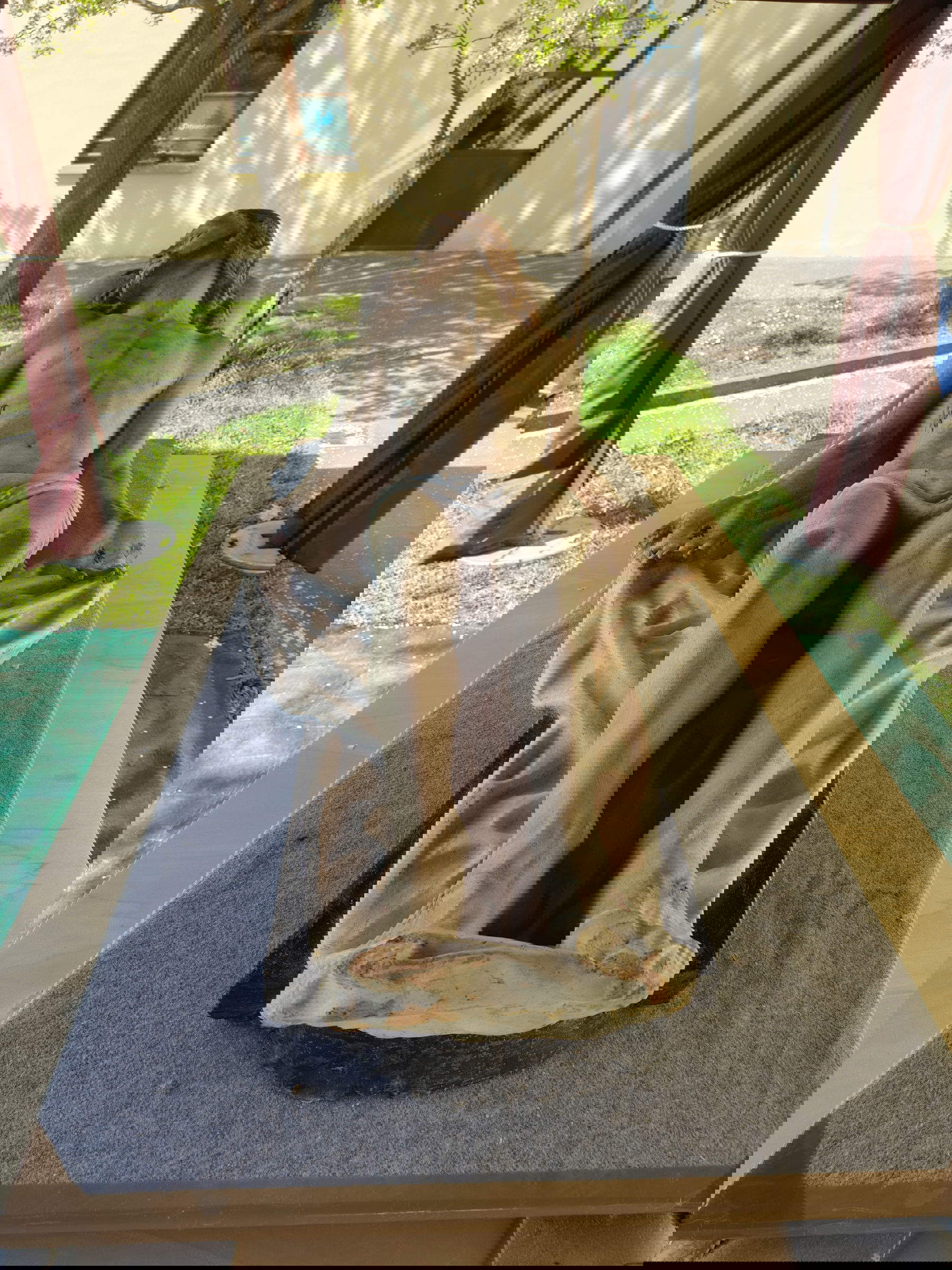
“The sculpture,” as restorer Daniela Valentini points out, “had sustained significant damage, in fact, in addition to being soaked in water and sprinkled with mud, it was split in half, precisely at the height of Christ’s belly, thus also investing the arms. Missings were noted probably, already pre-existing at the time of the damage such as: gaps near the toes and hands, which in agreement with the Superintendence, were not reintegrated because there were no traceable elements to be able to reconstruct them in their entirety. After a thorough and delicate cleaning operation to remove the mud, all the elements of the sculpture were reassembled and then the joining lines of the recovered fragments were grouted. There were also widespread presence of numerous abrasions and losses of the paint film, which were reintegrated, with underpainting veils compared to the original, restoring chromatic unity to the work as a whole.”
“Cultural assets in churches are closely linked to devotional and liturgical use,” stresses Graziella Cirri, Art Historian Officer of the Soprintendenza Archeologia Belle Arti e Paesaggio, “Commissioned for a function they can later be ’forgotten’ for the most diverse reasons: change of taste, internal changes in the church, adaptation to the new liturgy. The ’rediscovery’ of these assets sometimes by chance, sometimes for reasons of study, more rarely following a calamitous event can be an opportunity to protect and enhance these works. The Deposed Christ of the Pieve di San Martino in Sesto Fiorentino, ’rescued’ from water and mud, restored and studied-after a few decades of oblivion-will once again be available to the public and the faithful. The restoration has allowed us to understand the value of the work, ’unveil a signature’ and also learn some details about the personality of the artist who made it.”
“It is truly a moment of great joy and gratitude to see the Christ, which was saved from the flood a year ago, return intact and restored so well,” says Don Daniele Bani. “It will be placed in the chapel of the Pieve dedicated to St. Joseph, on the side altar. This will allow a public usability of the work, which had instead been placed in storage in the flooded premises for a long time. The use of the Dead Christ statues was mainly liturgical and devotional, linked to the rites of Holy Week until the Second Vatican Council. The main objective was to arouse in the faithful a sense of strong participation in grief (the ’com-passion’), visually explaining Christ’s human sacrifice and the certainty of his death as a premise for the Resurrection. Having lost this ’practical’ and spiritual function, the work had precisely been removed from the church and placed as if in ’archive’. To be able to exhibit it, even with the traces of the flood, truly becomes a precious occasion of the historical memory of our faith and our city.”
“The presentation to the public of the restoration of the Dead Christ at Officina Creativa LAB, particularly on Florentine New Year’s Day,” says Sara Biagiotti, of Artex’s management, “represents an important opportunity to enhance the work of Florentine master artisans, who every day work to shape art or to preserve it, allowing us to preserve that heritage made of works, traditions, history and techniques that characterizes our culture. The presentation of the restoration is intended to offer the community and scholars a moment of reflection on the value of protection and conservation of the artistic heritage, especially in relation to calamitous events that put its integrity at risk.”
 |
| Florence, name of author emerges from 2025 flood-damaged Dead Christ restoration |

Warning: the translation into English of the original Italian article was created using automatic tools. We undertake to review all articles, but we do not guarantee the total absence of inaccuracies in the translation due to the program. You can find the original by clicking on the ITA button. If you find any mistake,please contact us.






















 IT
IT FR
FR DE
DE ES
ES CN
CN


