




by Redazione 09/07/2026



Categories: News / Disclaimer
A study coordinated by the Universities of Pavia and Padua analyzed the DNA present in official samples of the Shroud, reconstructing the biological traces that have accumulated over the centuries without altering current understanding of the cloth’s dating.

A new study on the Shroud of Turin, based on the sequencing of DNA found on the famous cloth, has been published in the scientific journal *Scientific Reports*, part of the Nature publishing group. The research represents a new contribution to the study of the Shroud and offers a detailed reconstruction of the biological traces that have accumulated over the centuries.


The research project was carried out between September 2022 and December 2025 by the Universities of Pavia and Padua, under the coordination of Professors Alessandro Achilli and Gianni Barcaccia, with the involvement of numerous Italian and international institutions. The study focused on the official collection of samples taken on the night of October 8–9, 1978, by Professor Pierluigi Baima Bollone.
The Shroud— a linen burial cloth bearing the front and back images of a man with evident traumatic injuries—continues to be the subject of studies involving various disciplines, ranging from history to biology, religion, and the conservation of cultural heritage.
The new study focuseson the metagenomic analysis of DNA isolated from organic residues of various origins present on fragments of the fabric. The researchers highlighted a complex state of preservation, characterized by the presence of numerous environmental contaminants and traces left by the many human interactions the shroud has undergone throughout its history.


The DNA analysis of the official 1978 samples collected by Professor Baima Bollone provides a detailed mapping of the biological traces accumulated on the Shroud over the centuries and has made it possible to identify genetic lineages compatible with populations of Western Eurasia andthe Mediterranean region, along with a wide variety of environmental contaminants. Taken together, these data provide a sort of “genetic fingerprint” of the Shroud, the result of human contact, environmental conditions, and the historical events that have affected the cloth over the centuries.
The study is part of the broader field of sindonology and contributes to expanding our knowledge of the cloth’s conservation history. However, the results do not alter the current evidence regarding its dating: the radiocarbon dating conducted in 1988 by laboratories in Oxford, Tucson, and Zurich remains valid, placing the fabric between 1260 and 1390 A.D., a timeframe consistent with the oldest known depiction of the Shroud, the Lirey votive medallion, which dates from between 1350 and 1418 AD and is housed at the National Museum of the Middle Ages in Paris.
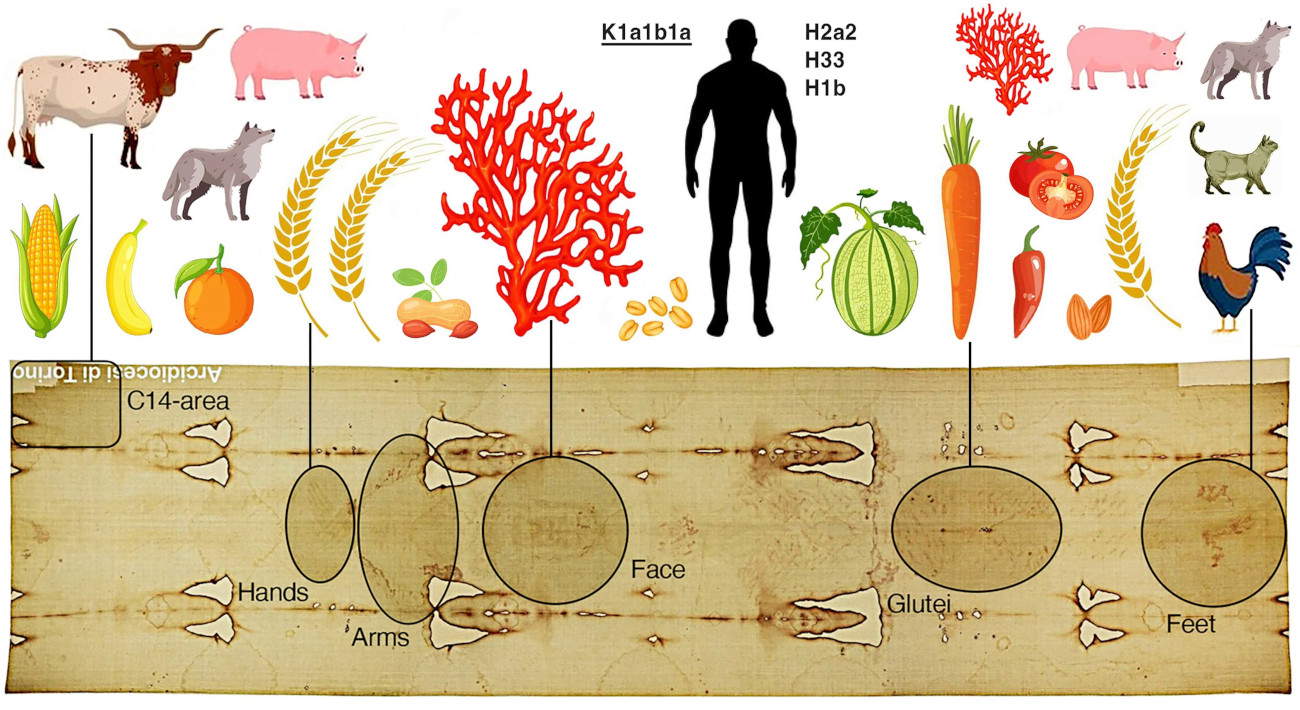
The Pavia team responsible for DNA extraction at the University of Pavia’s Ancient DNA Laboratory commented on the challenges and significance of this research. “Despite the difficulties associated with the type of sample analyzed—both in terms of quantity and quality—we were able to extract DNA and obtain genomic sequences from seven of the available fragments,” stated Nicola Rambaldi Migliore. Alessandro Achilli states that he “identified a predominant (mitochondrial) genetic lineage that is characteristic of Ashkenazi Jews, but which corresponds exactly to that of Prof. Baima Bollone, who collected the samples in 1978,” emphasizing that “the presence of keratins and other skin proteins, identified through proteomic analysis, would confirm that the procedures for collecting the fragments were not sterile—for example, gloves were not worn.” Antonio Torroni points out that “contamination at the time of collection has unfortunately obscured many of the earlier genetic traces; however, other human DNA lineages have also been identified, including a profile common in Western Eurasia and a less common profile, but one prevalent in the Middle East, particularly among the Druze; unfortunately, it is not possible to date these lineages.” Regarding the new radiocarbon analyses of two threads from the Shroud’s reliquary—which date them to between 1451 and 1799, consistent with documented restoration work following the 1532 fire at Chambéry Cathedral—Professor Achilli emphasizes that “this finding would be further confirmed by the presence in the two analyzed threads of proteins typical of silk fibers, which may have been used during the restoration.”
The team from the University of Padua interprets the results of the metagenomic analyses they conducted in their entirety. Andrea Squartini states that they “found a rich microbiome, including microorganisms typical of human skin and communities of archaea, bacteria, and fungi associated with saline environments.” “We detected DNA from red coral endemic to the Mediterranean, along with genetic traces of cultivated plants (carrot, wheat, corn, bananas, peanuts), and domestic animals (cattle, pigs, chickens, dogs, cats), indicating multiple biological sources of environmental contamination,” stated Giovanni Gabelli. Gianni Barcaccia emphasizes that “we have observed that the faunal and, above all, floristic composition is consistent with contamination that occurred in relatively recent times—no earlier than the Late Middle Ages—and with biological exchanges following the voyages of Marco Polo and Christopher Columbus.”
Barcaccia concludes that “this genetic evidence complements—rather than replaces—the forensic investigations and the historical and radiometric data already available, offering molecular insights into the dynamics of preservation and contamination, while also highlighting the intrinsic limitation of the metagenomic approach: the analyzed DNA represents an overlap of biological signals accumulated over time and therefore requires caution when attributing historical events or geographical origins to individual genetic samples.”
|
| New Study on the Shroud's DNA: Biological Traces Accumulated Over the Centuries Have Been Reconstructed |
Warning: the translation into English of the original Italian article was created using automatic tools. We undertake to review all articles, but we do not guarantee the total absence of inaccuracies in the translation due to the program. You can find the original by clicking on the ITA button. If you find any mistake,please contact us.