





The famous historical photograph of Mussolini hanging upside down in Piazzale Loreto, turned into a poster and displayed in the window of an art studio in downtown Volterra (Pisa), has become the center of a political controversy. The image shows the bodies of Claretta Petacci, Benito Mussolini, and Giuseppe Gelormini hanging at the end of the Fascist era and, according to the artists, was deliberately chosen as a provocation. The Pisa chapter of the Futuro Nazionale party, however, has called for the removal of the work and sanctions against those responsible, interpreting the display as “communist-inspired incitement to hatred.” At the center of the controversy is Prompt Dsgn Studio, a space located on Via Roma in Volterra, which displayed the poster in recent days and, following the outcry, publicly explained its intentions. The statement released by the studio describes the image as a historical document—specifically, an archival photograph of Piazzale Loreto—and links the decision to a desire to create a deliberately provocative work. Prompt Dsgn states that “the poster is displayed provocatively to shake people’s consciences at a historical and social moment in which far-right parties are already in government and are gaining ever more support and becoming increasingly uninhibited in their public assertiveness.”
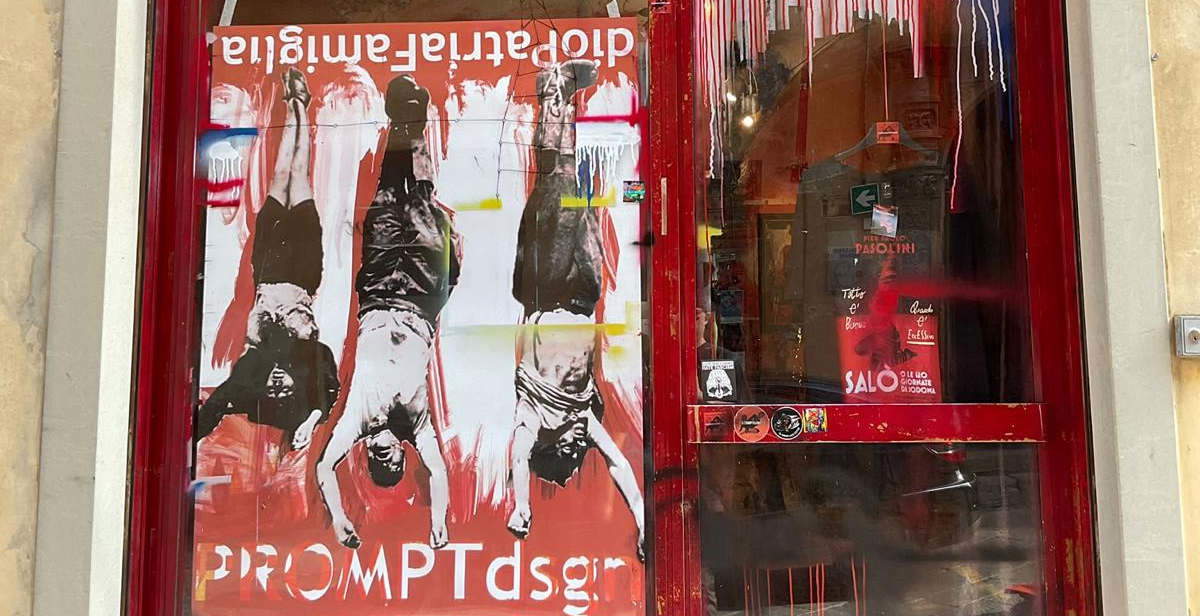
The photograph was displayed in the window of Prompt Dsgn Studio, a space on Via Roma previously used for exhibitions: the controversial poster was therefore not an image that happened to appear in public space, but rather an intentional intervention within the studio’s activities. Prompt Dsgn itself clarifies, in its statement, that the photograph was used in a deliberately provocative manner. The authors include it in their manifesto “Theory of Desecration, or Theory of Feeling,” which is also linked to the cultural association and international artistic movement ULTRAVANTGARDE. In the manifesto published online, Prompt Dsgn emphasizes the themes of individual freedom, the questioning of dogmas, and the relationship between the individual and the collective.
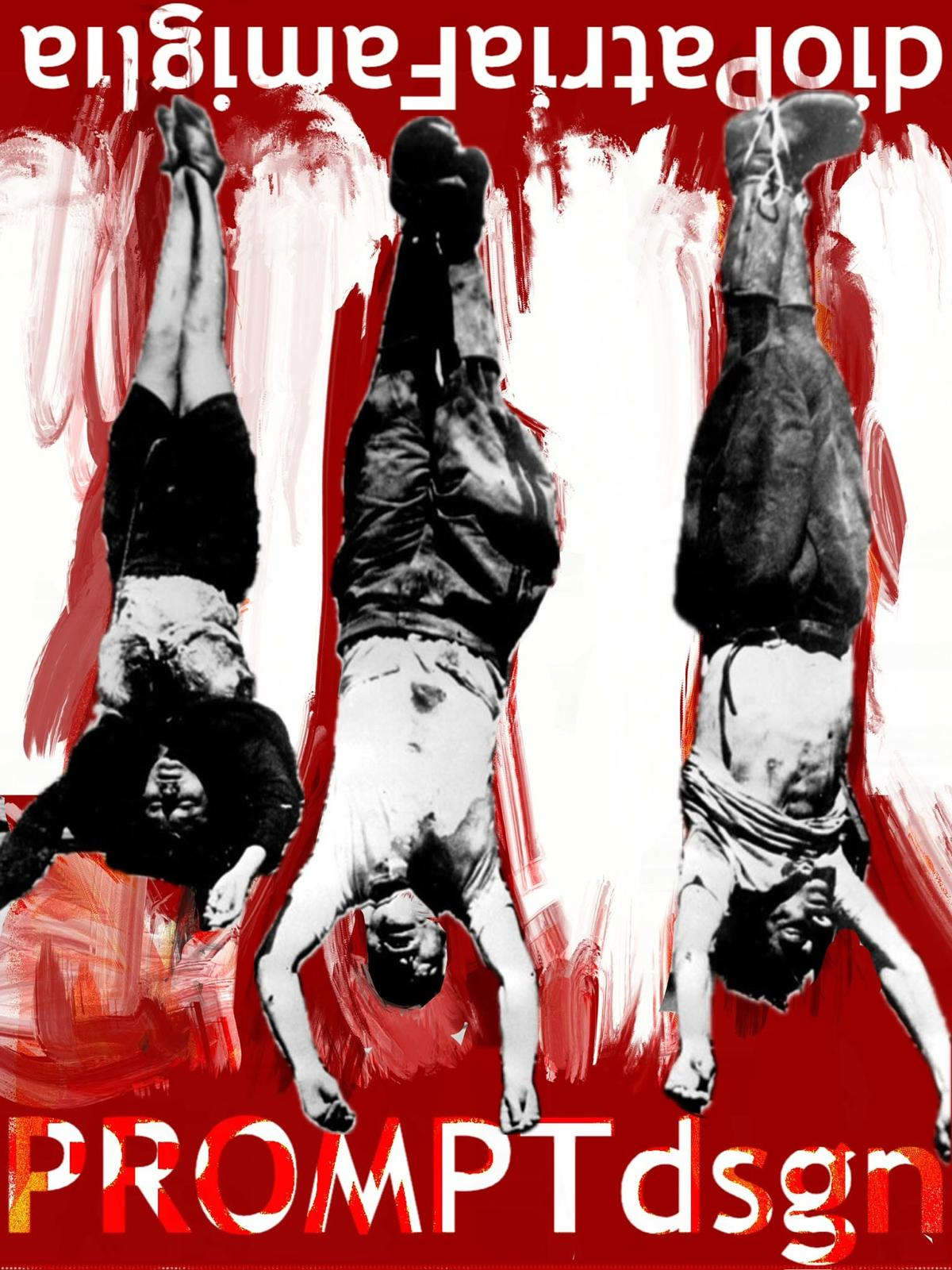
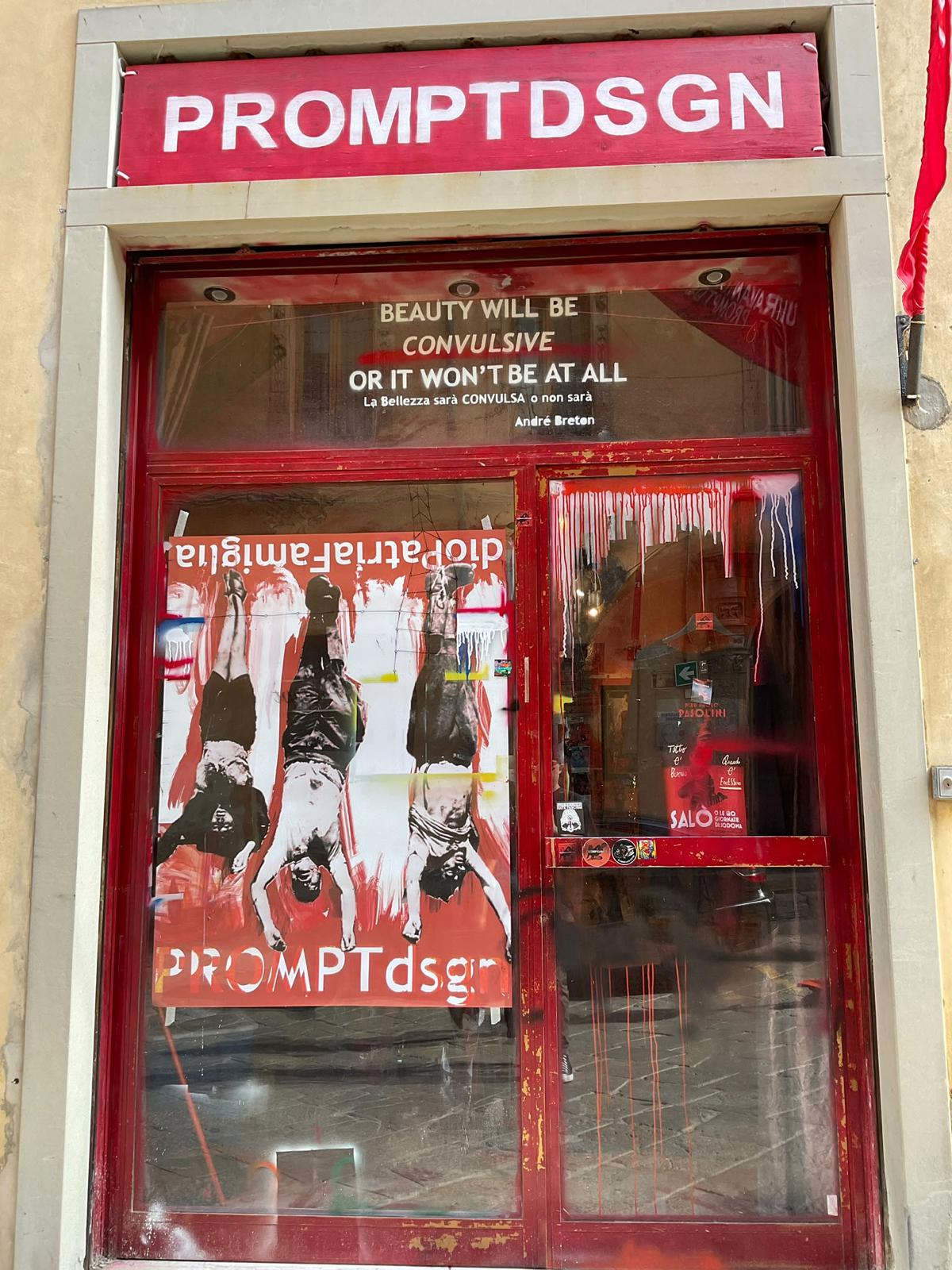
It is above all the choice of image, however, that has transformed the intervention into a political issue: the photograph of Piazzale Loreto carries with it an immediately recognizable and highly charged historical reference. Furthermore, in this specific case, the authors explicitly link its meaning to the contemporary controversy surrounding the Italian far right and the public circulation of Futuro Nazionale’s ideas. Prompt Dsgn explains that it sought a form of polemical identification with the vision associated with the far-right party’s claims, while at the same time clarifying that it considers its poster to be an artistic, philosophical, and cultural expression—apolitical and secular—and that they wish to distance themselves from any historical or contemporary faction.
The protest against the poster was initiated by Mario Palmieri, the provincial leader of Futuro Nazionale. In a statement released by the movement, Palmieri argues that what is on display “is not art, but pure communist-inspired incitement to hatred” and considers it “unacceptable that such provocations are permitted on a central street frequented by thousands of tourists and families.” Futuro Nazionale’s demand is twofold: to remove the poster and to punish those responsible. “When the goal is to attack the right, references to the twenty-year Fascist era suddenly become ‘committed art’ and do not cause a scandal,” Palmieri concludes in the statement, asking the Volterra municipal administration to clarify whether it was aware of the display and whether it intends to take action.
The discussion, however, quickly shifted to the line between artistic expression, political provocation, and public communication. It is precisely on this point that the two positions diverge: Prompt Dsgn argues that the poster was designed to provoke a reaction. In its response, the studio states that the decision was made at a time when far-right forces have gained an increasingly prominent presence in politics and public debate. Meanwhile, Prompt Dsgn has added another detail to its account: according to the studio, the matter was brought to their attention by Volterra’s mayor, Giacomo Santi, on September 25, by which time the poster had already attracted the attention of the local press. The authors also take issue with the way their work has been reported by some local media outlets, complaining that the studio’s address and images in which the sign is recognizable were published without first seeking their position on the matter.
Prompt Dsgn, in its response, states that it perceives the demand for removal and sanctions as intimidating and, in turn, points out the risk that the suppression of an expression of dissent could lead to a restriction of freedom of expression. At this time, it does not appear that the authorities have established any criminal liability regarding the poster.
The central issue therefore remains the use of the image of Piazzale Loreto. Prompt Dsgn does not use the photograph to document a historical event in a strictly expository sense: it is removed from its original context and repositioned in a storefront window in downtown Volterra, accompanied by a message that the authors intend as a contemporary provocation. And it is precisely this shift from memory to the reactivation of the image in the present that makes the poster the subject of controversy. In its theoretical manifesto, Prompt Dsgn presents the practice of “desacralization” as a way of challenging established beliefs. The text emphasizes the need to break free from dogmas and to rethink the relationship between the individual and the collective; therefore, according to the studio’s statement, the installation in the Via Roma storefront appears to follow the same logic: using a highly charged image to compel those who encounter it to confront a memory and the way that memory is utilized in the present.
The controversy thus also fits into the broader debate on the relationship between contemporary art and politics, even though, in the case of Volterra, the starting point is very concrete: a famous photograph from 1945, reproduced on a poster, displayed in a storefront window, and deliberately used as an image capable of evoking the conclusion of the most traumatic event in 20th-century Italian history. For now, the issue remains confined to the meaning of an image and the right to use it in public space as a tool of artistic expression. The photograph of Piazzale Loreto, brought back into circulation in Volterra more than eighty years after the events it documents, has thus ended up sparking a new episode of conflict surrounding the memory of fascism and the way in which that memory is invoked in contemporary political debate. And perhaps this was precisely the aim of the provocation.
 |
| Volterra: A Photo of Piazzale Loreto Becomes a Work of Art and Sparks a Political Controversy |

Warning: the translation into English of the original Italian article was created using automatic tools. We undertake to review all articles, but we do not guarantee the total absence of inaccuracies in the translation due to the program. You can find the original by clicking on the ITA button. If you find any mistake,please contact us.























 IT
IT FR
FR DE
DE ES
ES CN
CN


