





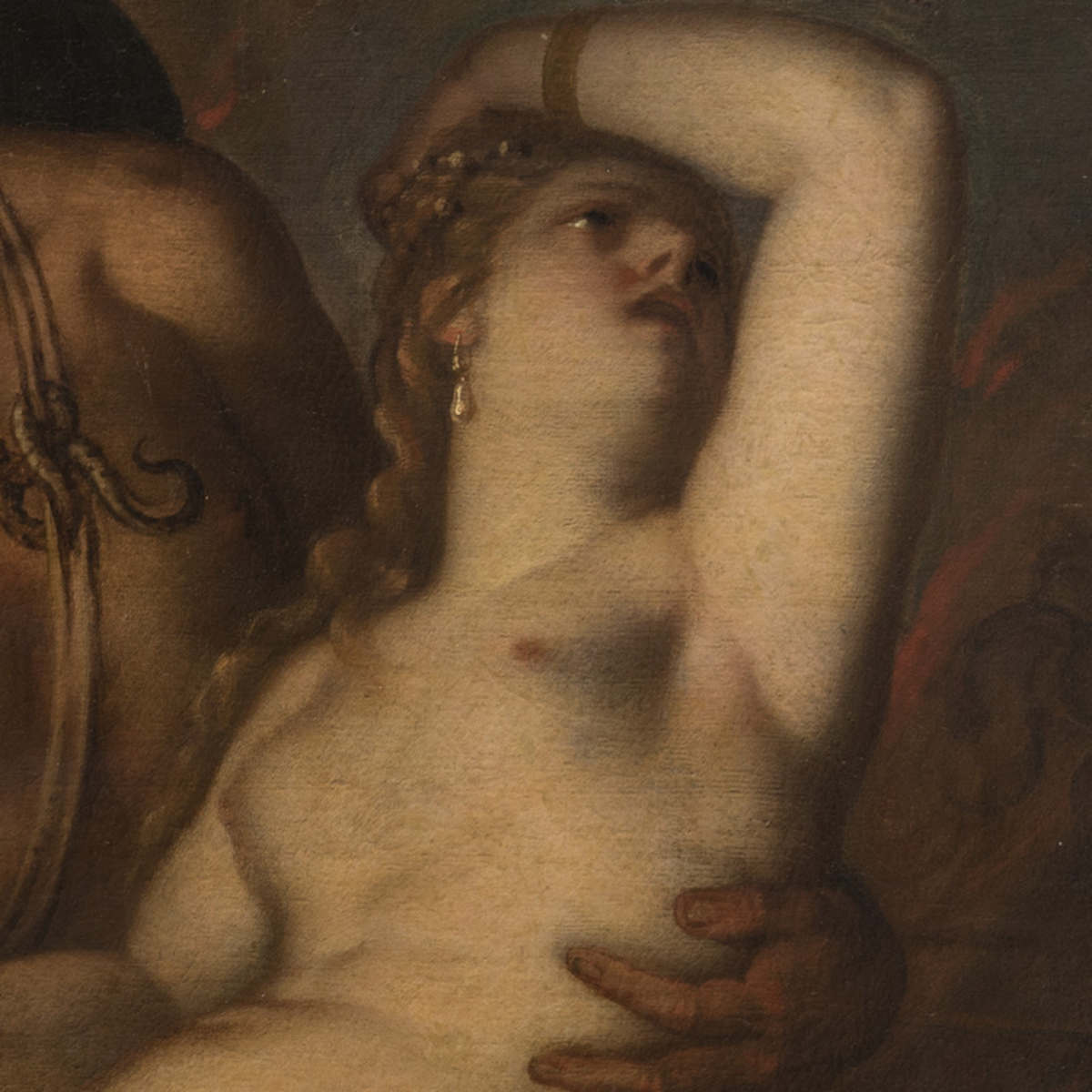
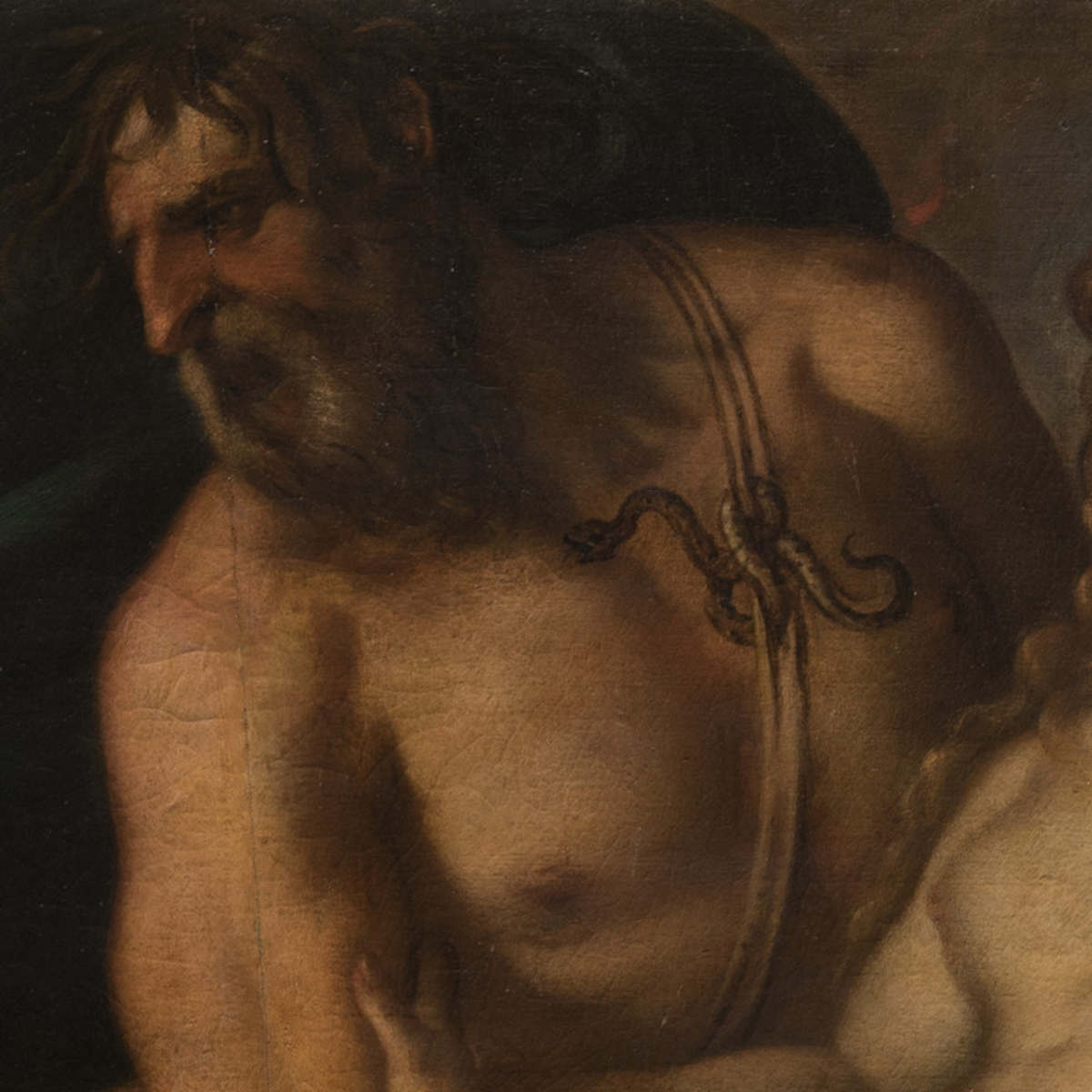
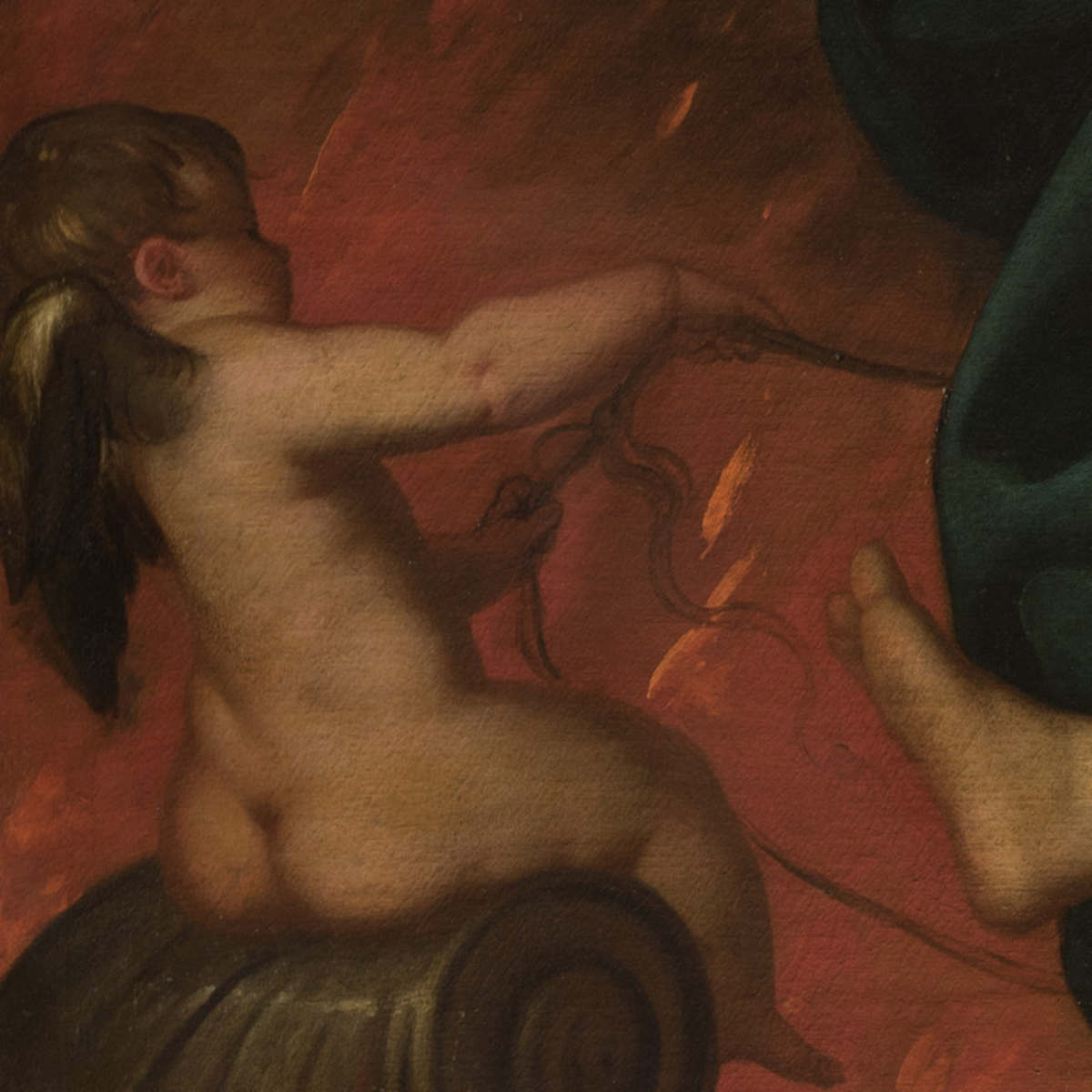
The changing of the seasons exists because Hades, the Lord of the Underworld, wanted a woman to love. But what young woman would agree to leave Earth to live in the Underworld forever? The solution was abduction, a recurring plot device in mythological tales, where people certainly didn’t have too many qualms. Alessandro Varotari, known as “il Padovanino” ( Padua, 1588 – Venice, 1649), captures in his work—now housed at the Gallerie dell’Accademia in Venice —the very moment of Persephone’s abduction: He focuses the scene on the two main characters and adds a couple of unusual elements compared to the typical visual narrative of the myth of Persephone and Hades: the young Eros seated at the helm of the chariot, and the flames and volcanic debris evoking the Underworld in the background. Generally, the scene is set in a verdant landscape, where Persephone is with her fellow maidens, incredulous and frightened spectators of what is unfolding before their eyes. Here, however, the setting of the scene is already hellish; the atmosphere is gloomy, while the naked bodies of the Lord of the Underworld and his future bride are bathed in the light of the flames, which illuminate their forms and suggest the heat of the fire on their skin. Hades grips the younger Persephone tightly, sinking his fingers into her side in a hold reminiscent of Bernini’s famous sculptural group: the muscles and nerves, strained by the effort, clearly reveal the physical vigor of the gesture. Persephone, desperate and frightened, tries to wriggle free from the arms of her captor—which are too powerful for her—and twists her body in a way that seems to defy the god’s grip; she kicks, jabbing her foot inside his bent knee, and with her hand tries to push his arm away. To no avail. She raises an arm above her head in a gesture of desperation, turns her face to the side, her gaze lost elsewhere, as if she were still searching for an escape from a fate that is now sealed. At the helm of the great horse-drawn chariot—whose horses are faintly visible in the twilight—is the little winged Eros: he, too, is caught up in the excitement of the moment, busy with his task as a driver, while, in the background, the fire illuminates the darkness with red and orange flashes.
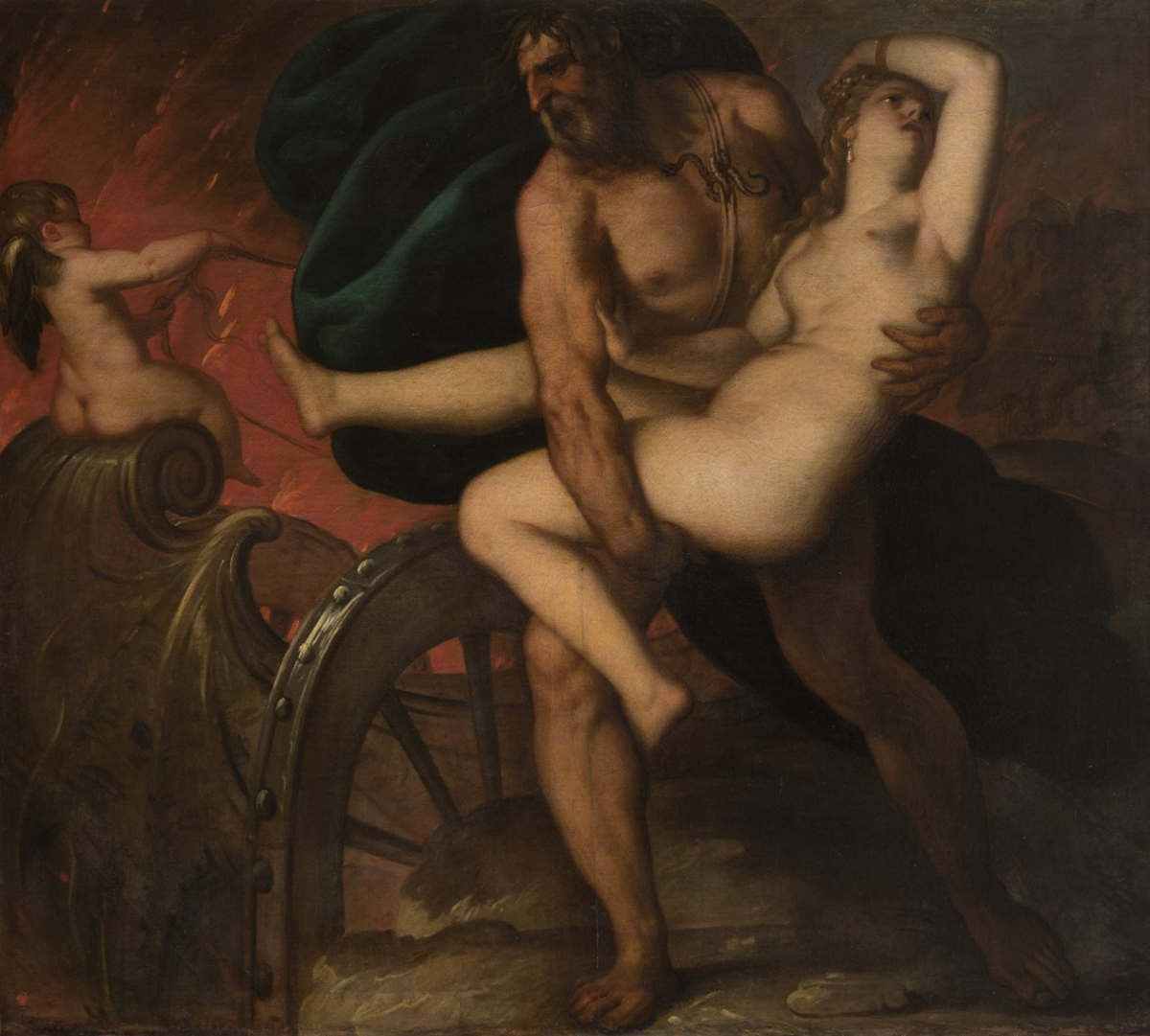
What is evident is Padovanino’s connection to the great tradition of 16th-century Venetian painting, particularly that of Titian, in his depiction of Persephone’s body. The color palette is characterized by a predominance of warm tones, which stand out againstthe almost pearlescent complexion of the abducted young woman. This color scheme is further enhanced by the sensuality of the nudes, expressed through an ideal of classical beauty, in which the physicality of the bodies—though set within a scene of intense narrative tension—becomes an exercise in elegance and pictorial refinement.
The Abduction of Persephone is recounted by Ovid in Book V of *Metamorphoses*. The daughter of Zeus and Demeter, goddess of agriculture and fertility, was one day gathering flowers in a meadow with her companions when Hades, the Lord of the Underworld—her uncle (he was, in fact, the son of Cronus and Rhea and thus the brother of both Zeus and Demeter), who—having fallen in love with her after being struck by an arrow of Eros—seized her and dragged her on his chariot toward the realm of the dead, making her his bride and queen of the Underworld.
Her daughter’s disappearance plunged her mother, Demeter, into despair, and she began a relentless search until she finally learned the truth with the help of the nymph Cyane. She therefore decided to shirk her duties: the fields ceased to be fertile, the seeds stopped sprouting, and the earth gradually lost its ability to produce fruit. Faced with this situation, Zeus decided to intervene by demanding the girl back from Hades, but an obstacle arose: during her stay in the Underworld, Persephone had eaten a few pomegranate seeds, the fruit associated with the realm of the dead. According to the laws of the Underworld, anyone who ate the food of the dead could never return permanently to the world of the living. Persephone’s fate, therefore, had to be divided between the two realms. A compromise was thus reached: the young woman would spend six months—corresponding to the pomegranate seeds she had eaten—on Earth with her mother, and the other six months in the Underworld with Hades. Persephone’s return to Earth thus coincides with the rebirth of nature. When the young woman is reunited with Demeter, the goddess resumes her role as guardian of the fields’ fertility: the earth blossoms anew, seeds sprout, plants grow, and nature returns to its lush splendor. This is the time of spring, followed by the abundanceof summer. When, however, the time comes for Persephone to return to Hades’ realm, Demeter is once again separated from her daughter, and nature feels the effects of her absence. The vegetation withers, the fields gradually become barren, and the earth seems to lose its vitality. Thus come fall and winter, which precede the young woman’s return and, with her, the rebirth of nature.
The myth of Persephone therefore not only recounts the origin of the cycle of the seasons but also serves as a reflection on the relationship between life and death, between loss and rebirth. The maiden’s descent into the Underworld and her periodic return to Earth represent , in fact, a circular and unceasing movement: disappearance is followed by return, barrenness by fertility, and winter by spring. A cycle that renews itself every year and that, through the myth of Persephone and Hades, transforms the rhythm of nature into a universal metaphor for existence.


The author of this article: Ilaria Baratta
Giornalista, è co-fondatrice di Finestre sull'Arte con Federico Giannini. È nata a Carrara nel 1987 e si è laureata a Pisa. È responsabile della redazione di Finestre sull'Arte.
Warning: the translation into English of the original Italian article was created using automatic tools. We undertake to review all articles, but we do not guarantee the total absence of inaccuracies in the translation due to the program. You can find the original by clicking on the ITA button. If you find any mistake,please contact us.
























 IT
IT FR
FR DE
DE ES
ES CN
CN


