




by
Federico Giannini  @federicogiannini1
19/04/2026
@federicogiannini1
19/04/2026



Categories: Works and artists / Disclaimer
In Lorenzo and Jacopo Salimbeni's frescoes decorating the Oratory of San Giovanni in Urbino, the symbolic medieval world endures as reality begins to assert itself, transforming dreamlike visions into history and flesh. But there is still time for dreams. Federico Giannini's article for the column The Ways of Silence.

Medieval man dwells within a tangle of symbols, lives by visions that lie between the earthly and the divine, conceives the universe according to an order that is not our own. In the mind of medieval man drowns all geometry; there are no straight lines. Curious, if one thinks that the same human being who had conceived asceticism toward the absolute had been, at the same time, so pragmatic that he had given himself the tools of calculation, the engineering toolkit to get as close as possible to that higher dimension that for him was truer than reality. Medieval man, however, is a man of symbolic thought, Le Goff told us, is a man who had the vocation of a dreamer until the Church came to regiment his dream activity, suspended between a God the source of beneficent dreams, a human body the processor of suspicious dreams, and a devil the instigator of dangerous dreams. Yet, unwilling to have the most inscrutable, most private, most unpredictable, and most fruitful of human activities censored, medieval man, perhaps far from ever having been a refoulé, continued to dream: perhaps first away from the gaze of clerics and monks, and then more openly when the desire to dream overcame all resistance, all reticence, all fear, all censorship, and the dream then overflowed, began to express itself finally in the open, in the streets, in the squares, everywhere. If human beings can dream, then they can also have the audacity to make the most extreme insubordination and can imagine. And if he can imagine, he can also turn to the exercise of reason and can invent forms that did not exist before.
Rather than paintings, the figures that populate the walls of the Oratory of St. John the Baptist in Urbino, the frescoes by Lorenzo and Jacopo Salimbeni that survived the time of medieval man’s last dreams, resemble the remnants of that dreamlike activity. Of course: it is also true that reality had never stopped scratching the walls of churches, oratories, and palaces, that it had always found a way to creep in among theplasters left to dry, to crawl among the saints, Christs and Madonnas and to rain down from the starry skies of times, that even the crudest, most practical and disenchanted reality had inspired those worlds that projected medieval man into another, distant, hallucinatory, imaginary dimension. Nevertheless, even reality had not been able to avoid expressing itself through signs and symbols. Here, in this oratory, it is as if she had come to exert some form of control, not even too larvae, over a territory that had never really been hers. It is a bright night, quilted with stars, delicate, pleasant, filled with visions, but you can already hear the crackling of a fire.


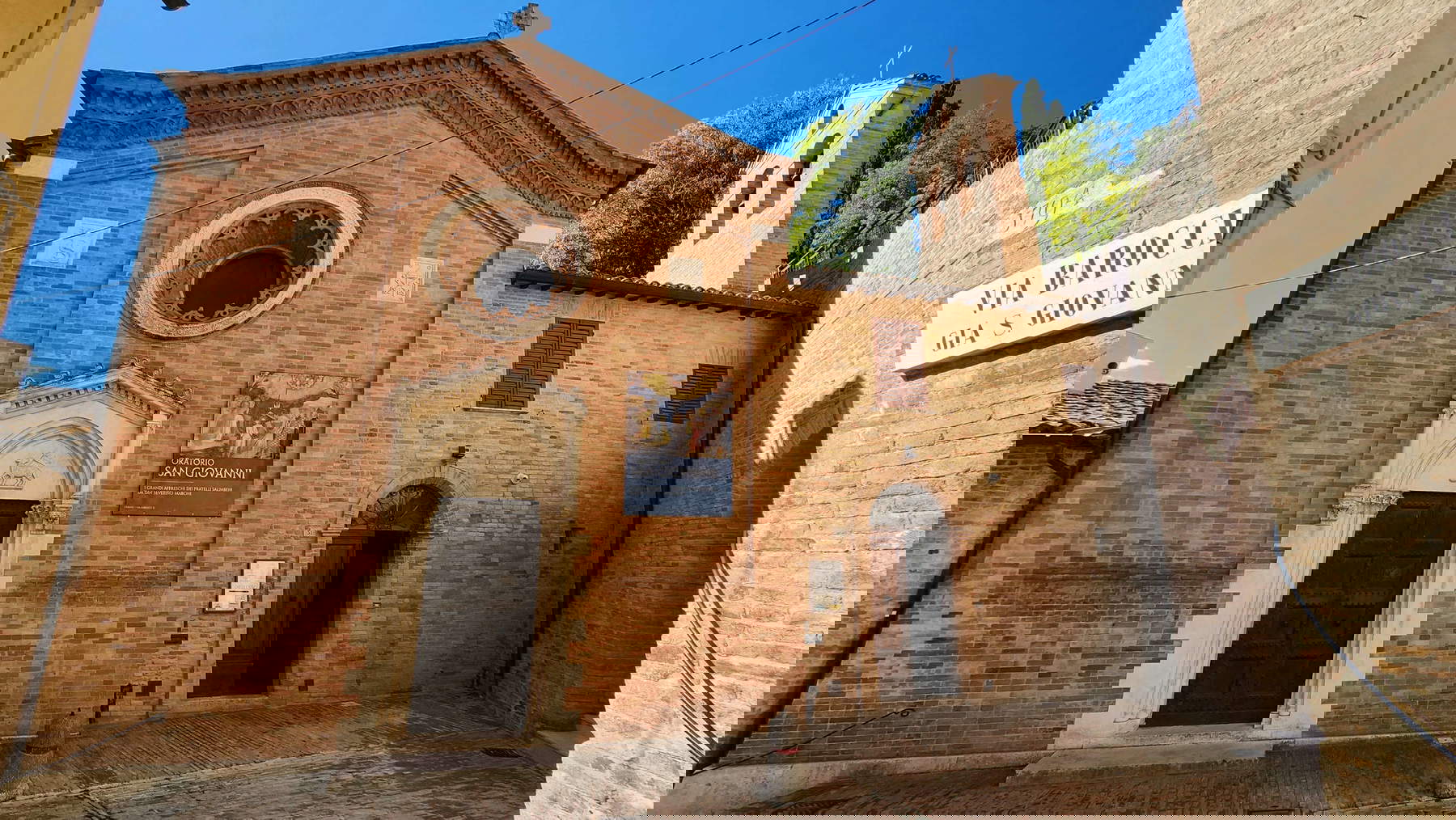
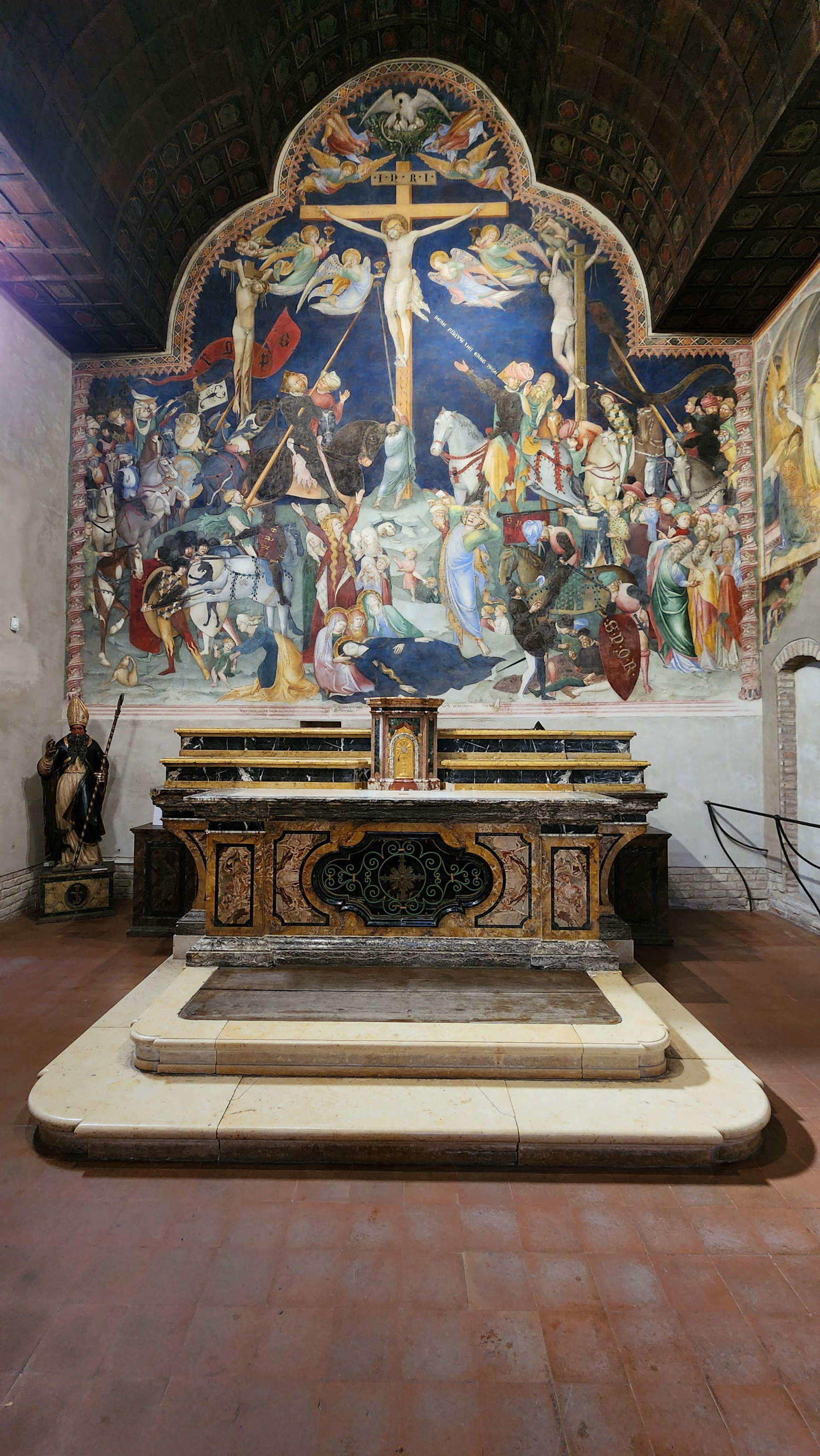
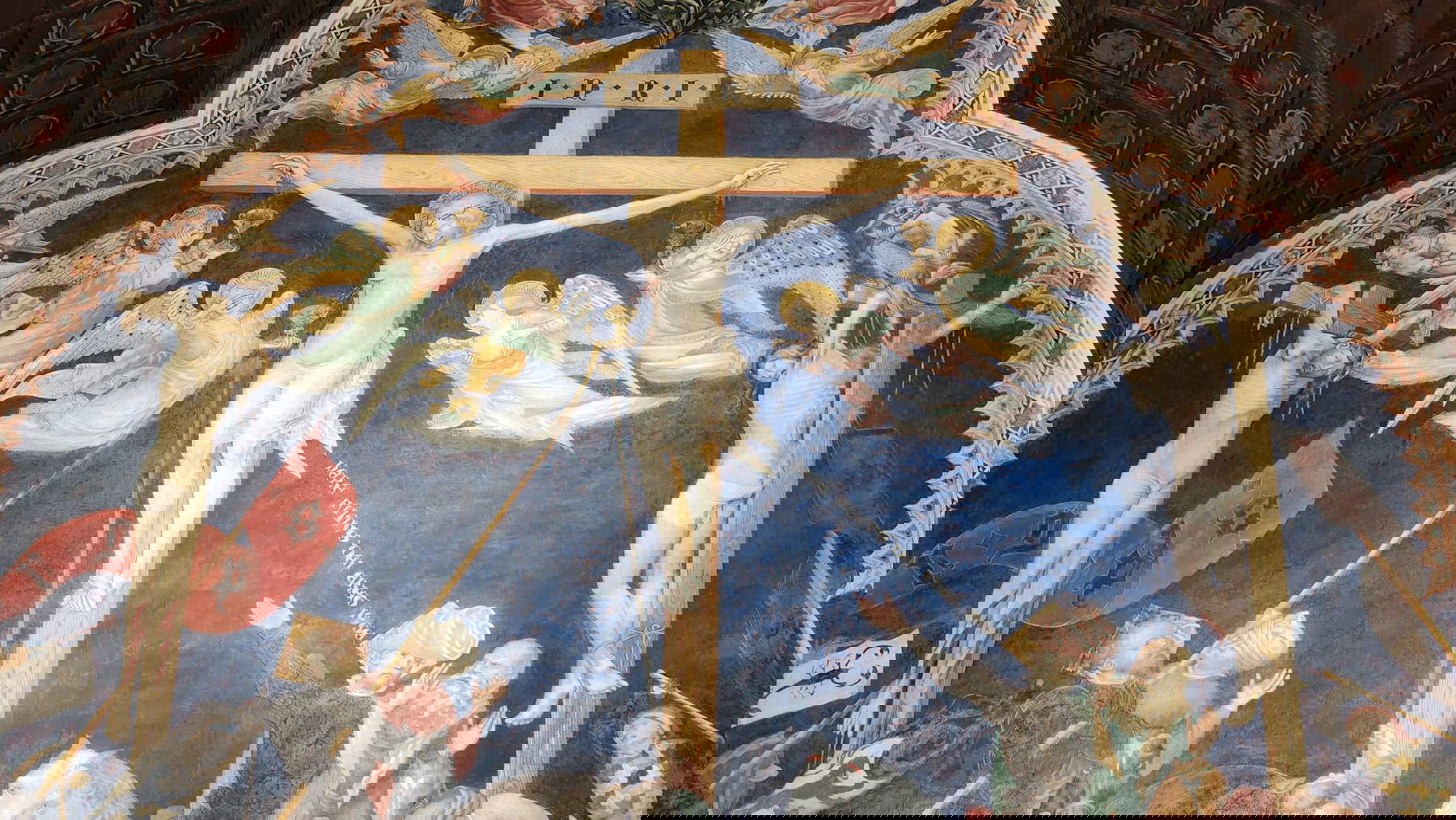
Lorenzo and Jacopo Salimbeni’s frescoes are stubbornly persisting in an excellent state of preservation, which is not so often the case in medieval churches in the Marche region. A capricious and rare circumstance, considering that these figures have been here since 1416. Upon entering the oratory, the guide ascribes to the frescoes the lofty and perhaps not undue title of “masterpieces of the International Gothic,” and lists, as in an inventory, as in a litany, with methodical promptness, all the scenes, all the subjects, focusing on the figures surrounding Jesus crucified and the two thieves on the back wall, the Pharisees on the right, on the left the Romans with their anachronistic banners that look as if they had been stolen from a knightly tournament and seem all but the insignia of an imperial army, St. Longinus looking questioningly at the Jews and pronouncing his vere fiulius Dei erat iste as if in a comic strip, the Virgin fainting at the foot of the cross supported by the pious women, Magdalene leaning out of her way, and then on the side walls the stories of St. John the Baptist with the usual iconographic sample, theproclamation to Zechariah, the visitation, the birth of the Baptist, the preaching, the baptism of the crowds on the banks of the Jordan, the baptism of Christ, the sermon before King Herod, the beheading and the deposition executed by another painter, a certain Antonio Alberti of Ferrara, the pious patchwork ofsacred images on the left wall with the figures of the Salimbeni brothers and the late appendices of a story that did not stop being written when Lorenzo and Jacopo finished their work, barely a year after they began, working as if they were one man, one painter, their hands indistinguishable in the stubborn homogeneity of the whole cycle.
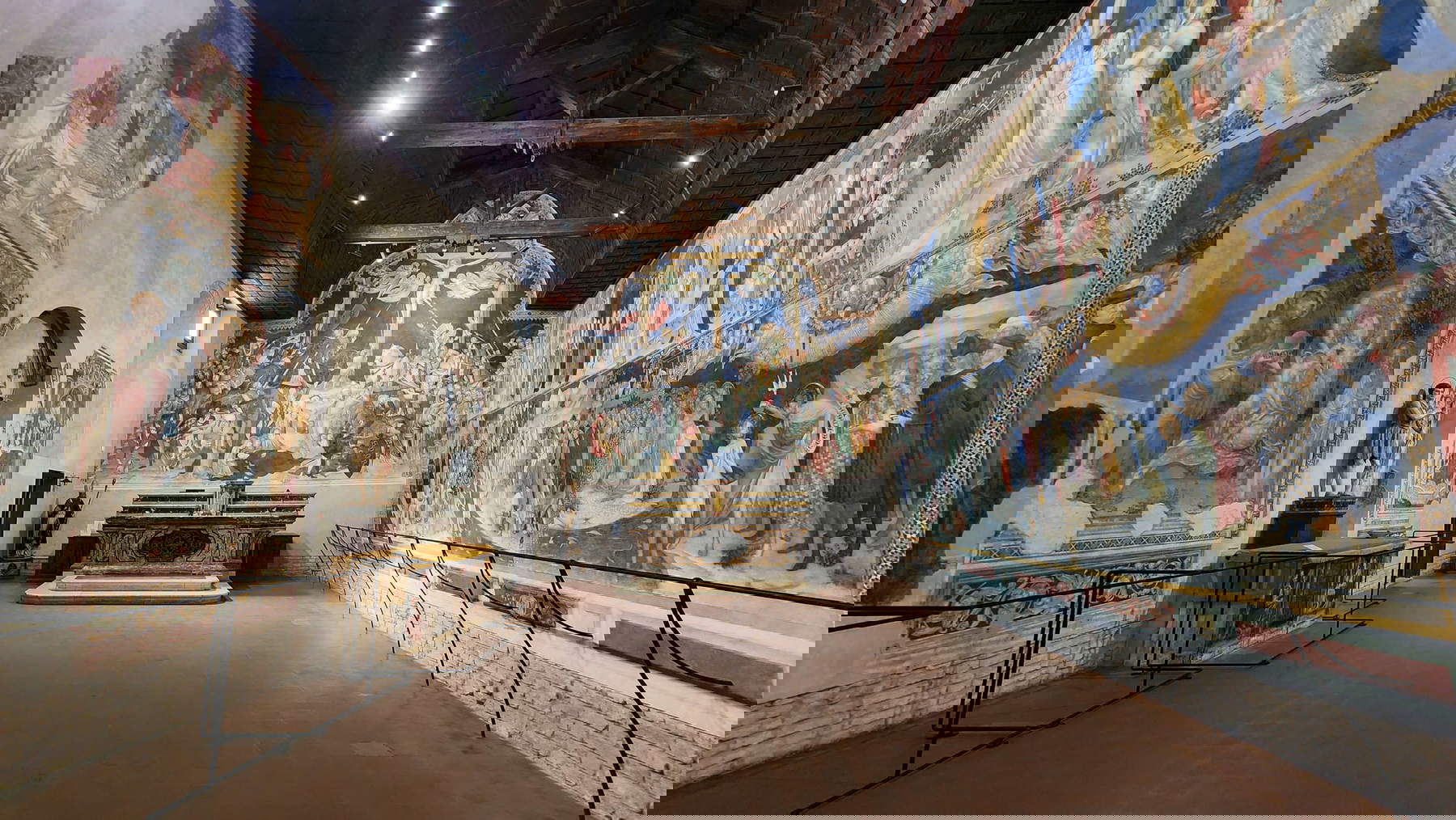
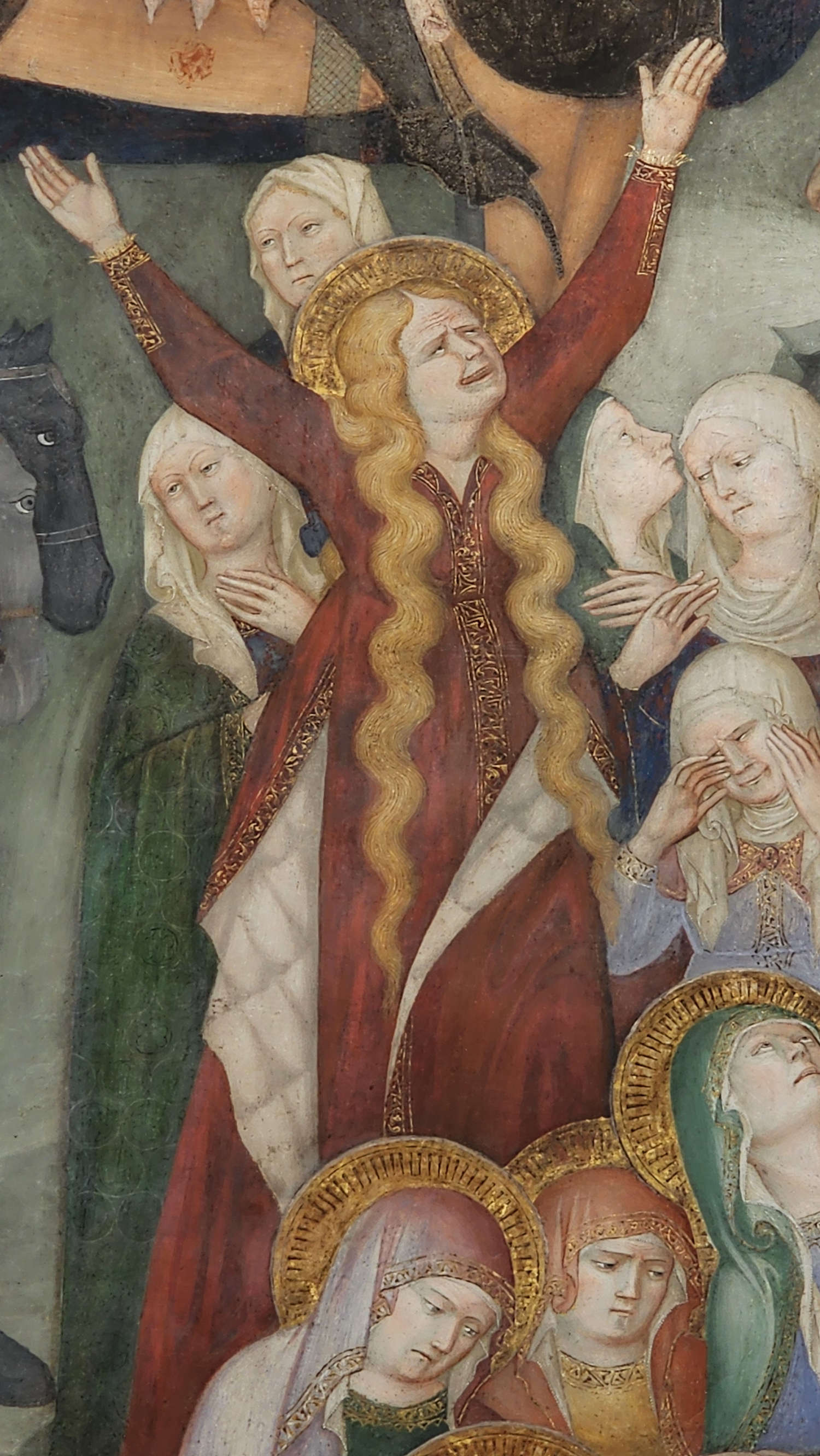
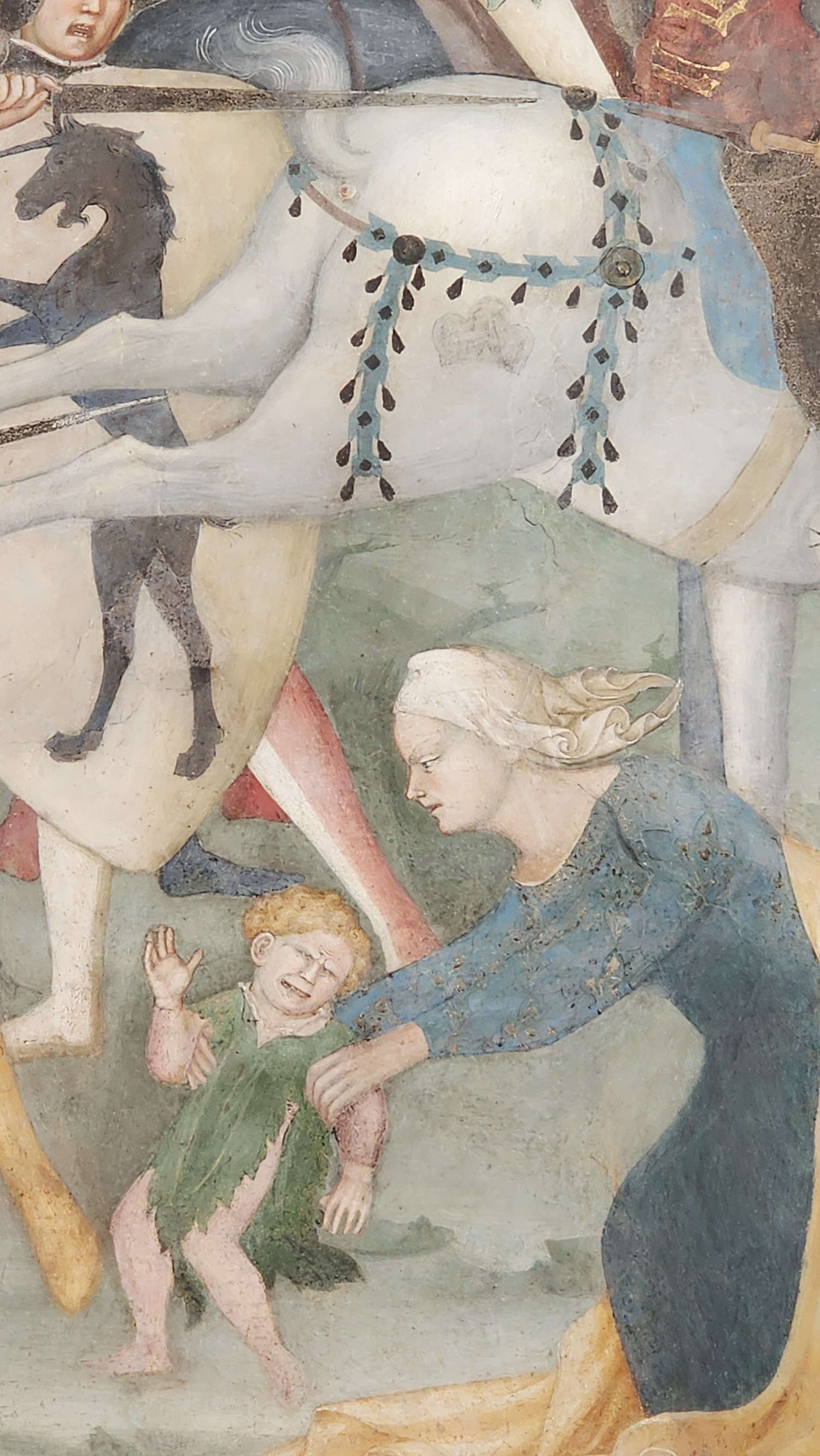
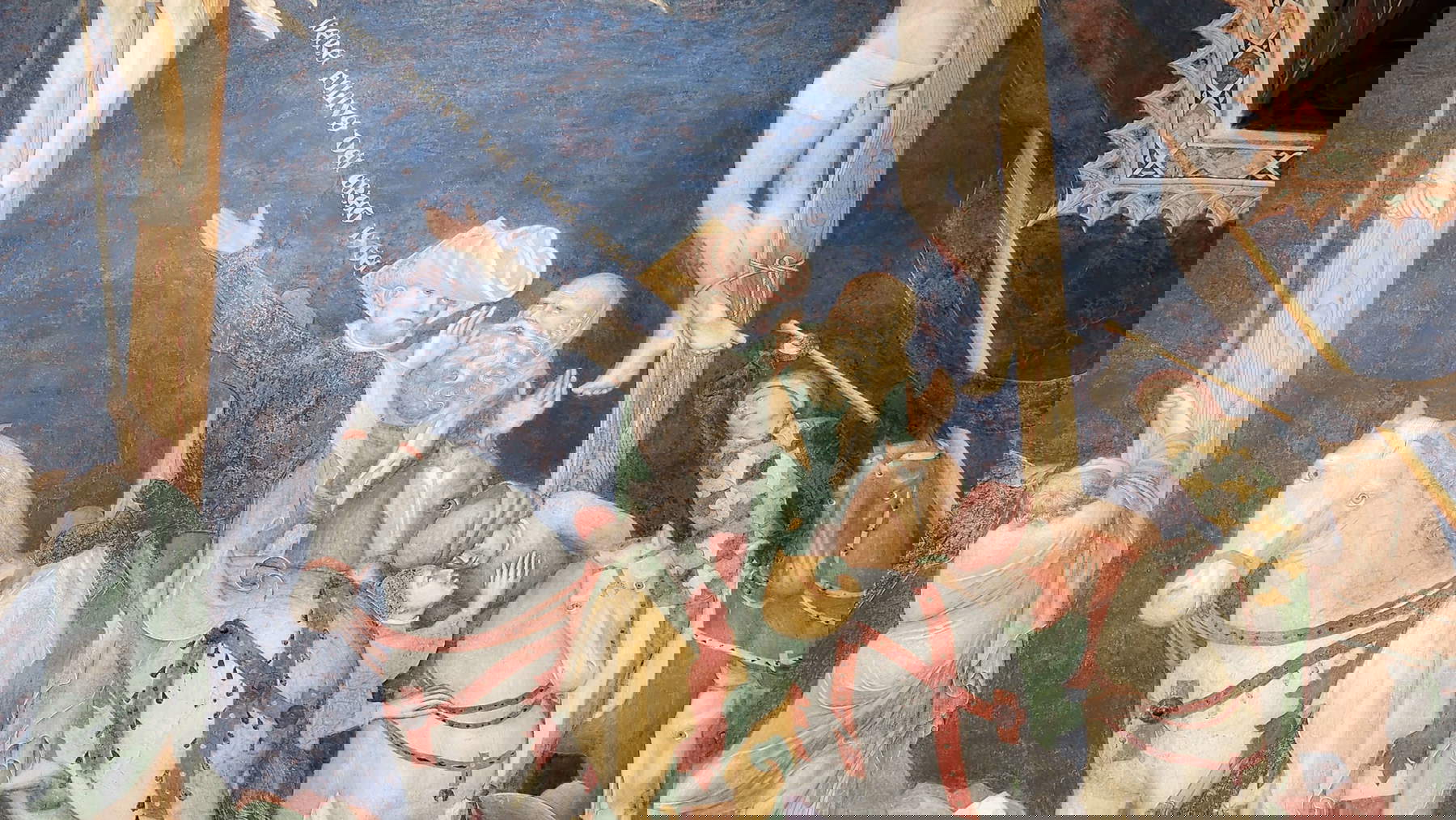
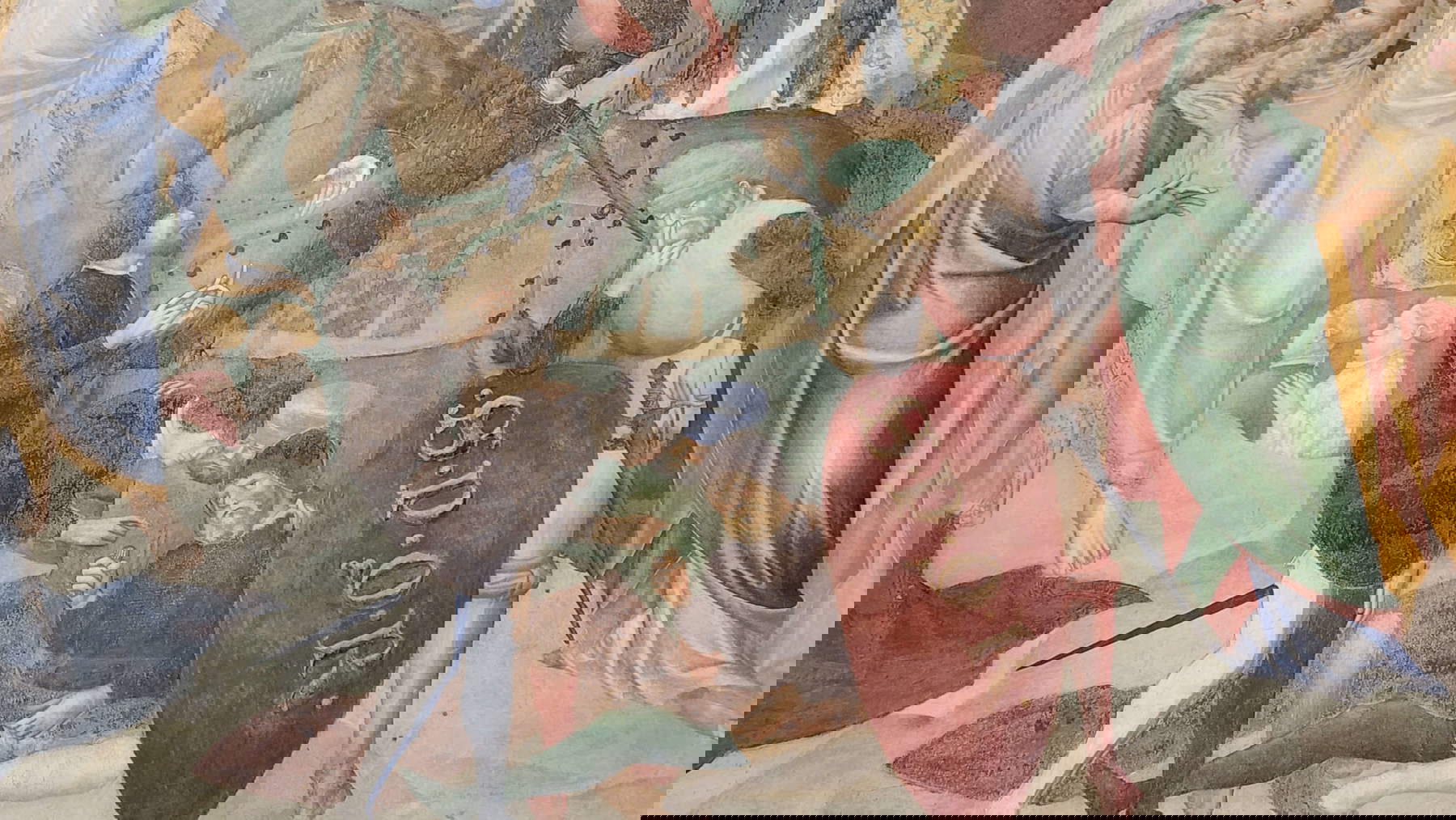
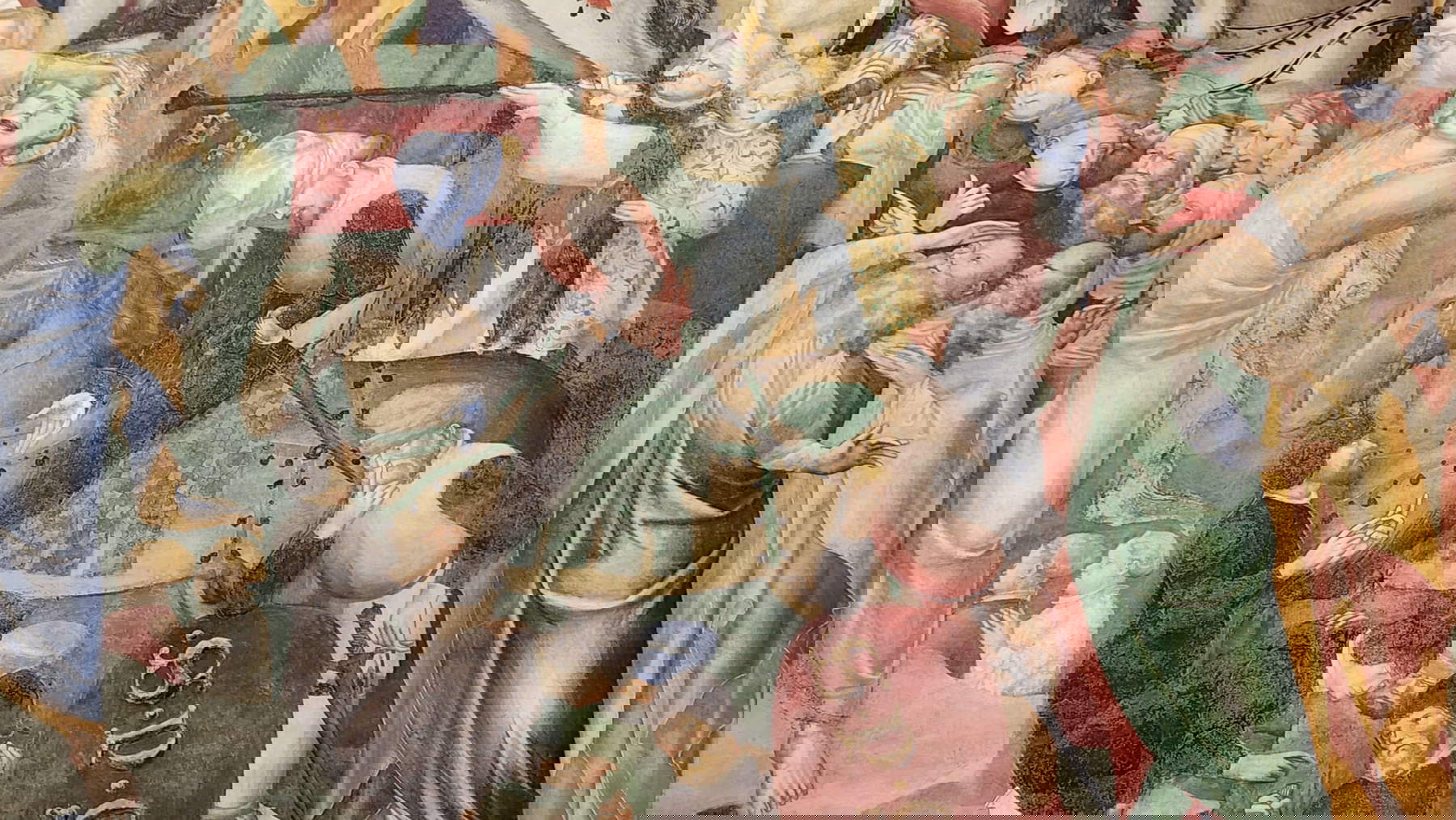
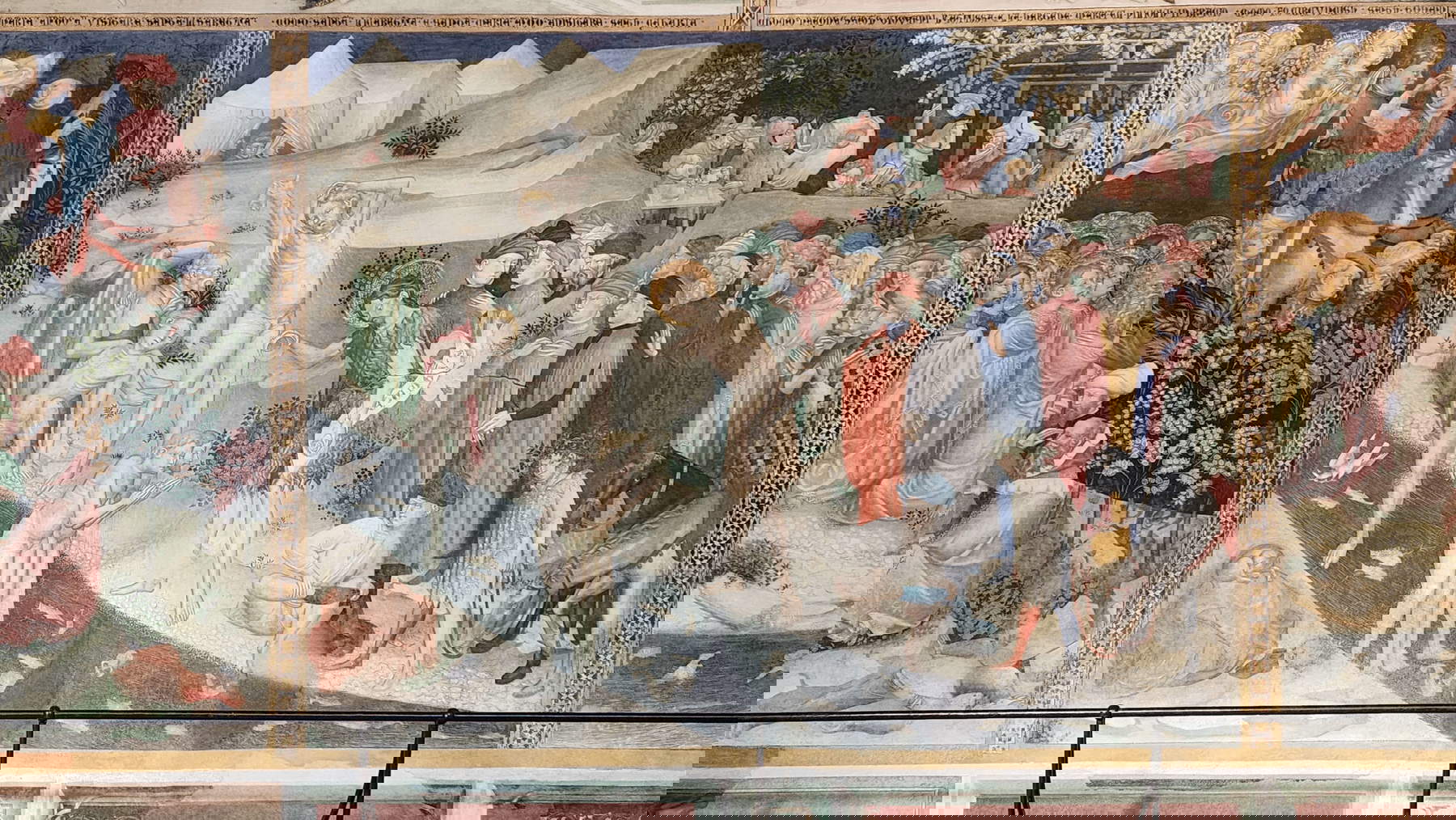
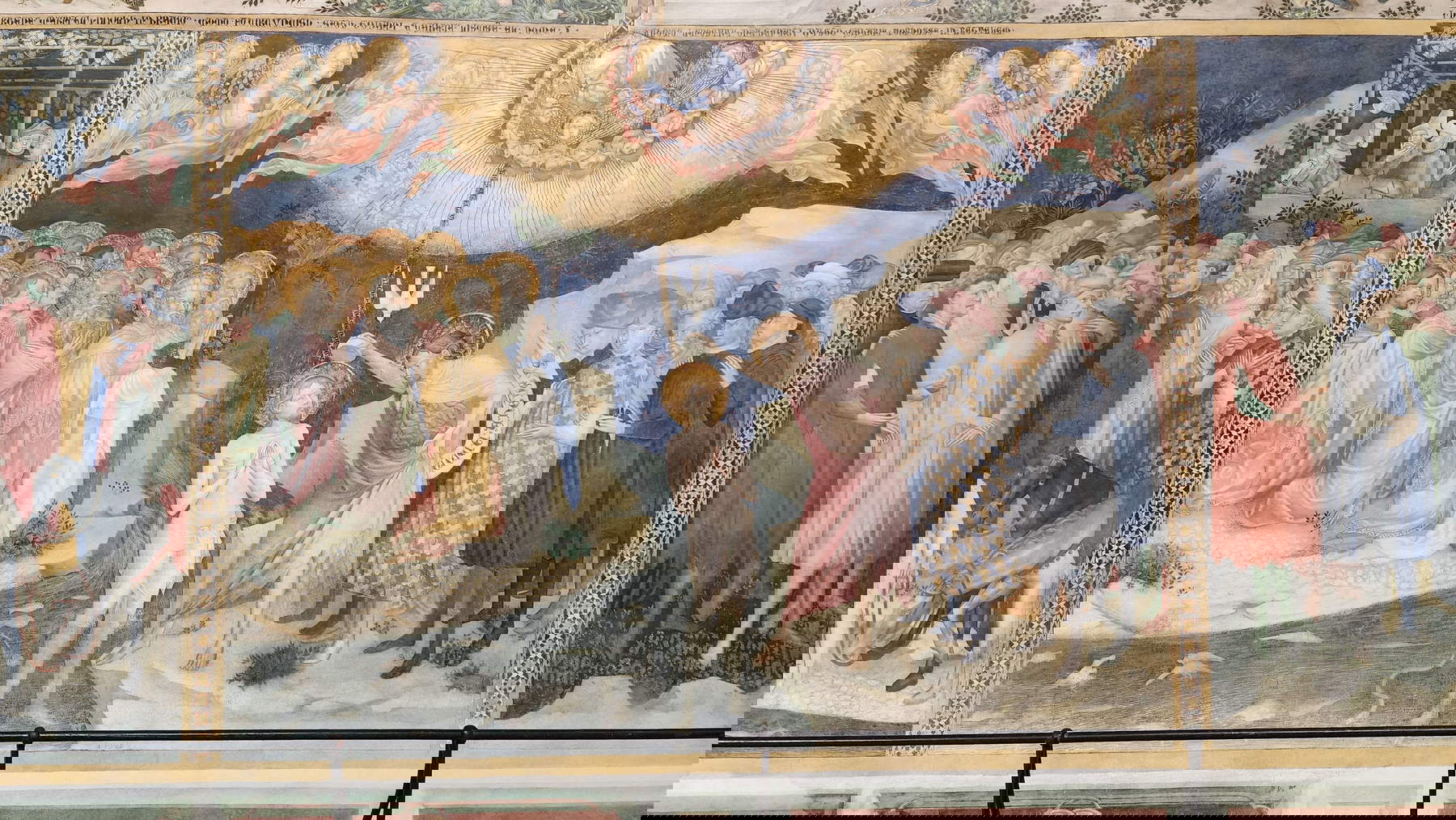
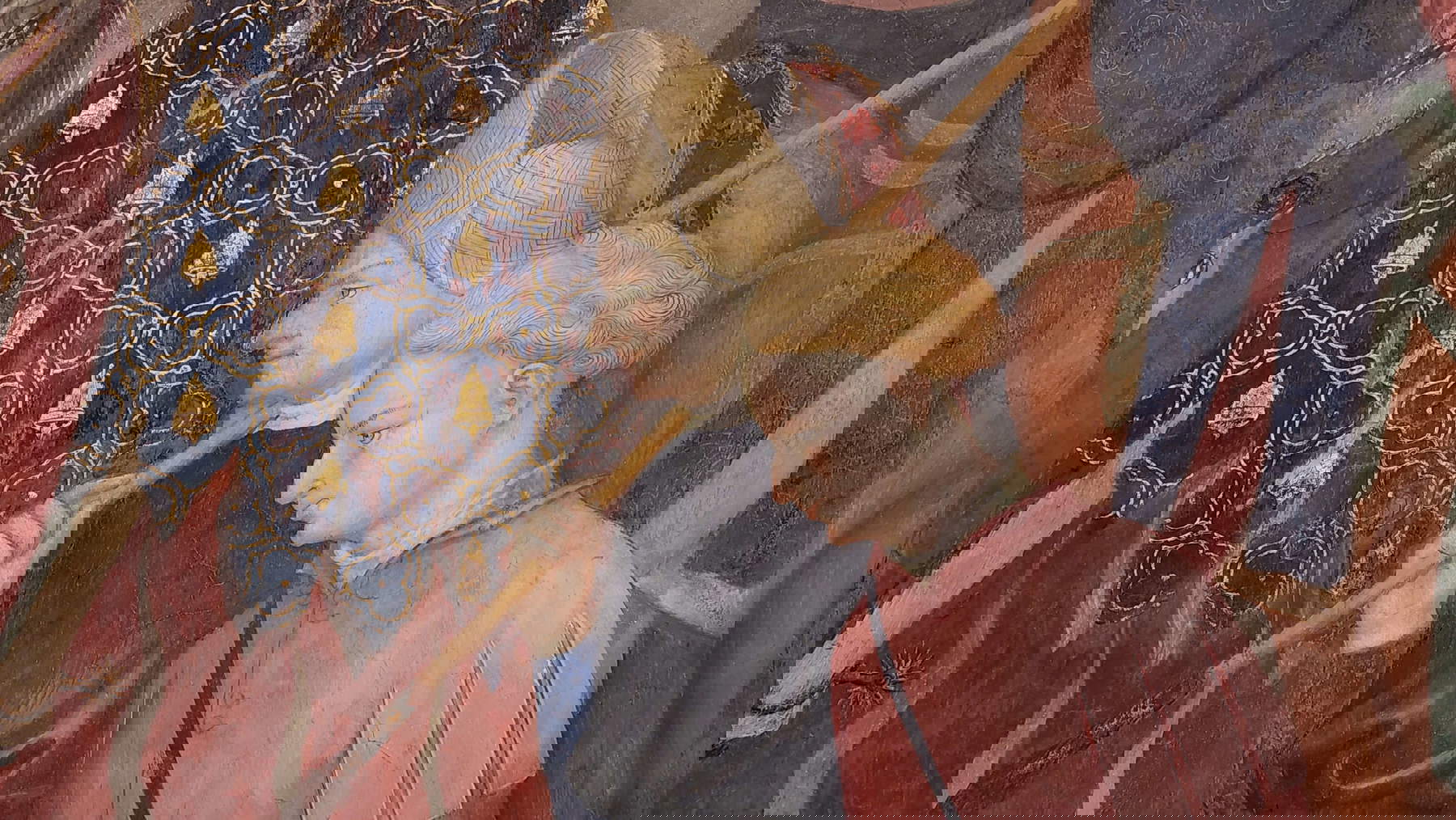
There are, in the midst of these figures, all the signs of decay. All the signs of a passage, irreversible, from cyclical time to the time of history. Mauro Minardi, author of the most complete and up-to-date study of the Salimbeni brothers’ opera omnia, has rightly noted that these scenes are overflowing with portraits. The confraternity of the Baptist of Urbino quite clearly had requested that its members, laymen, appear as the comprimariums of the sacred story. Prior to these frescoes, says Minardi, “Lorenzo did not, according to the data in our possession, engage in similar prerogatives,” while here “he did not merely differentiate precise faces in the anonymous masses of heads that form the spectator processions, where [...] several heads marked by hooked or curled noses and hare lips emerge in an intermediate degree of physiognomic penetration.” No: there are also extraordinarily, unquestionably, studiously characterized portraits. There are, in all likelihood, the priors of the confraternity, the patrons, the affiliates of a consortium that perhaps used sacred history as a means of exhibition, as well as of self-legitimation, of social affirmation. It was not a sodality of disciplinarians, this company of St. John. Its brethren did not walk the streets of Urbino barefoot, dragging shackles and chains to their feet, whipping their backs or beating their chests to the point of tearing wools and linens and soiling their habit with the blood of their wounds. Rather, Minardi says, the images that this Johannine societas had demanded for its frescoes seem to transcend, and even with a certain insistence, into an ostentation of earthly luxury and love of life’s pleasures, almost seraphic and indiscreet in its impudence, in its unembarrassed cordiality.
It is an existence that, with an almost deliberate gesture, begins to evade the tangle of reverie to become unashamedly carnal. The restlessness of the dream is as if disciplined, brought back to a stern order by this dominance of textiles, by this overabundance of brocades, of Damask silks, of chaperons of the most up-to-date fashions, of rich caparison, of decorated linens. Attending the baptism of Christ is a very elegant young man in his groin, fresh from a falcon hunt. Crowded along the banks of the Jordan is a compact assemblage of courtiers, all intent on their appearance, and yet pervaded by a shadow of doubt. Under the disguise of King Herod, one wanted to recognize a concealed portrait of Guidantonio da Montefeltro, Count of Urbino, who is probably being honored here with a tribute that touches on the territories of blasphemy. On the figures of Lorenzo and Jacopo Salimbeni, therefore, reality descends. And he decides to start his assault from here, from this outpost on the hill of Urbino, from an alley closed at the back by the facade of the oratory of San Giovanni. A battle that, of course, no one knew he was fighting. It is, if anything, tension within a complex continuity.
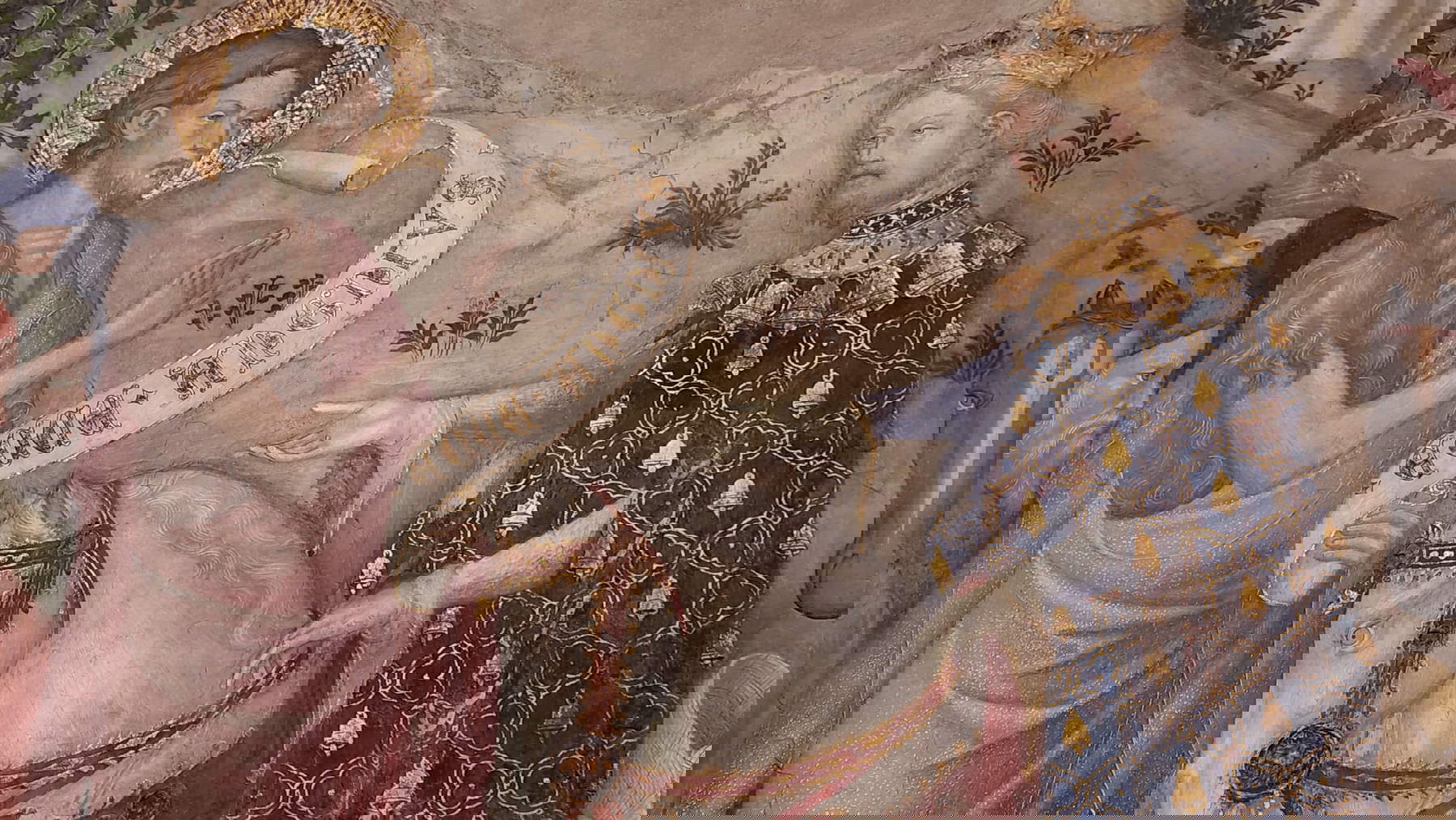
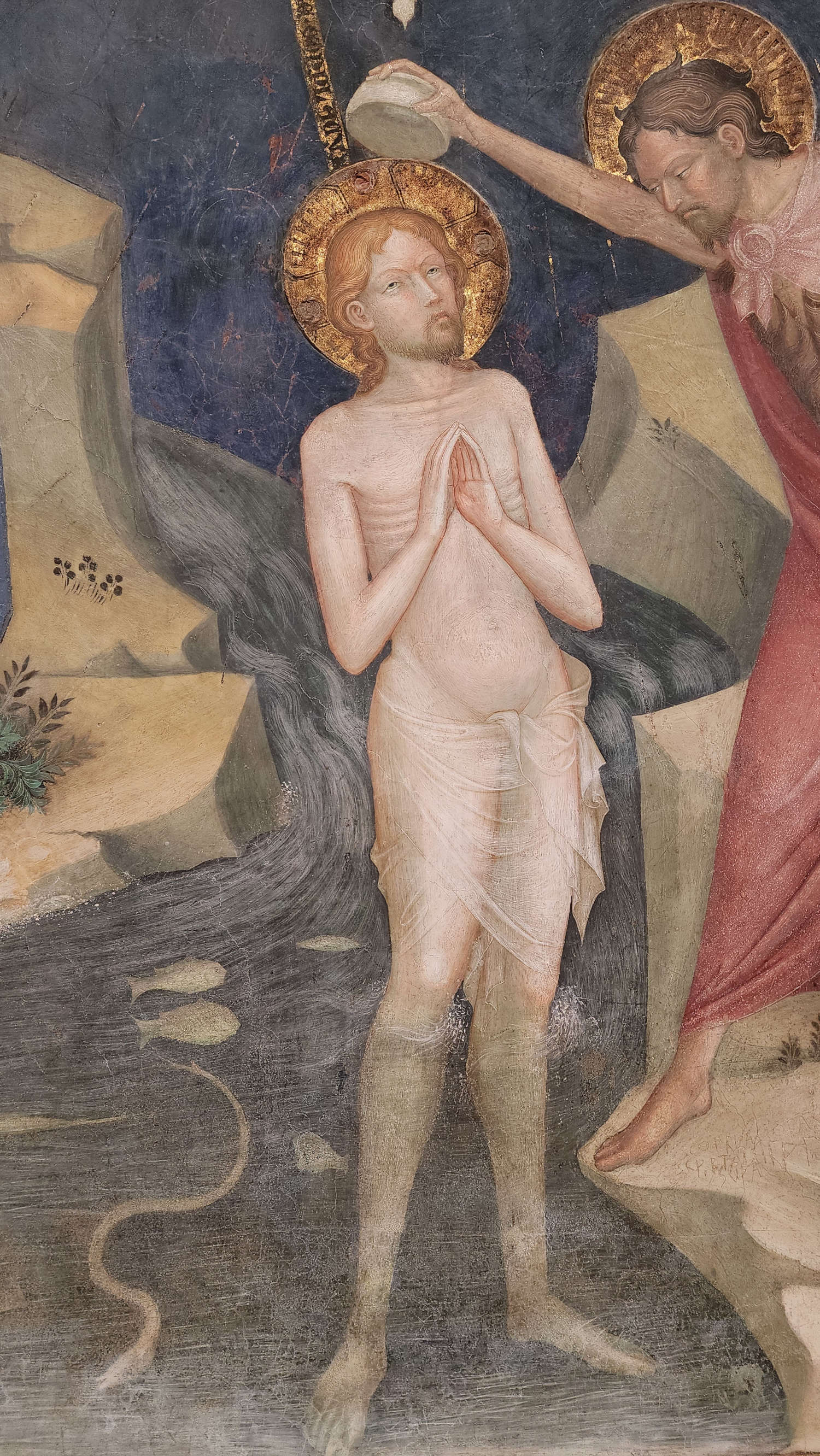
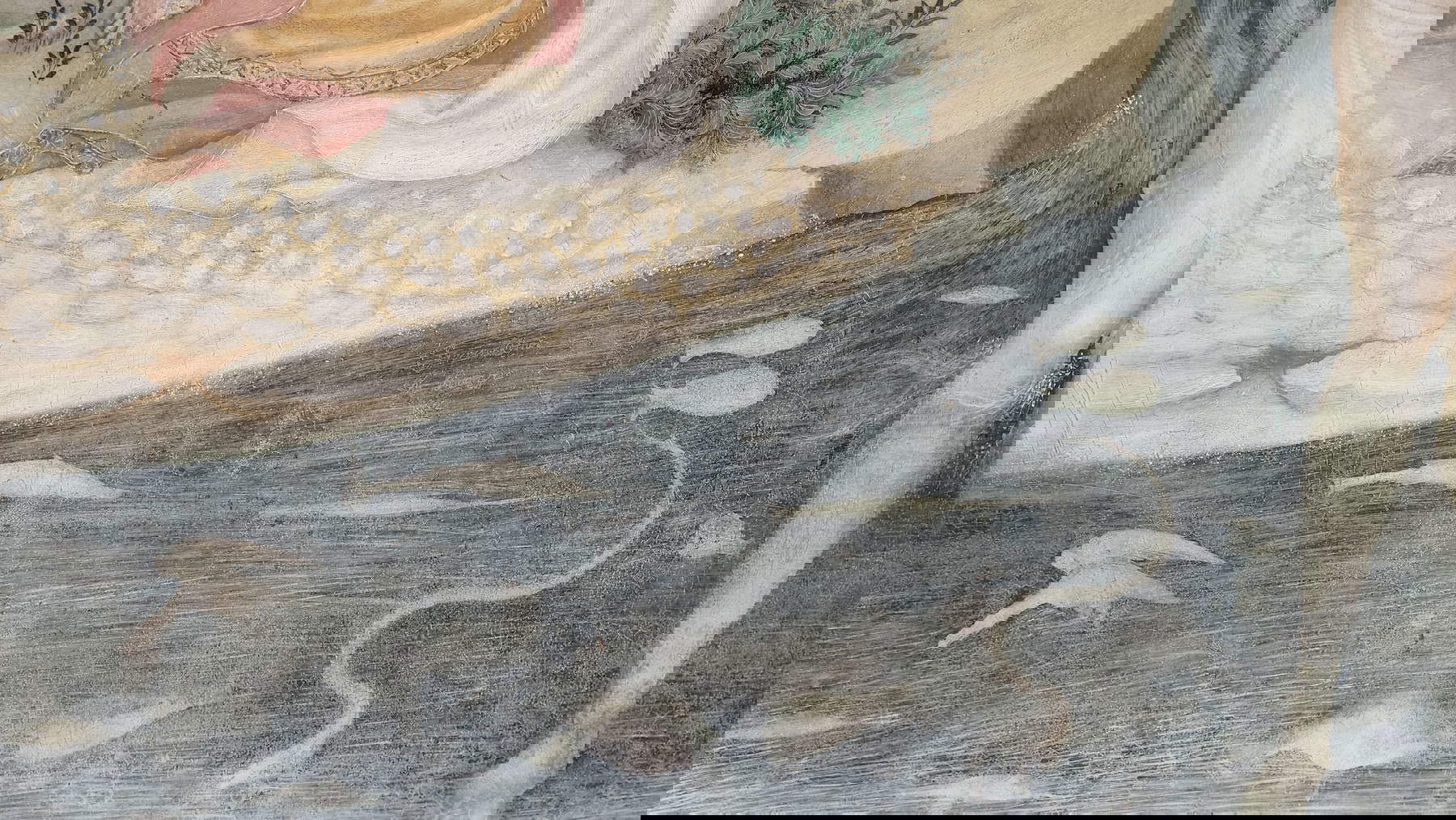
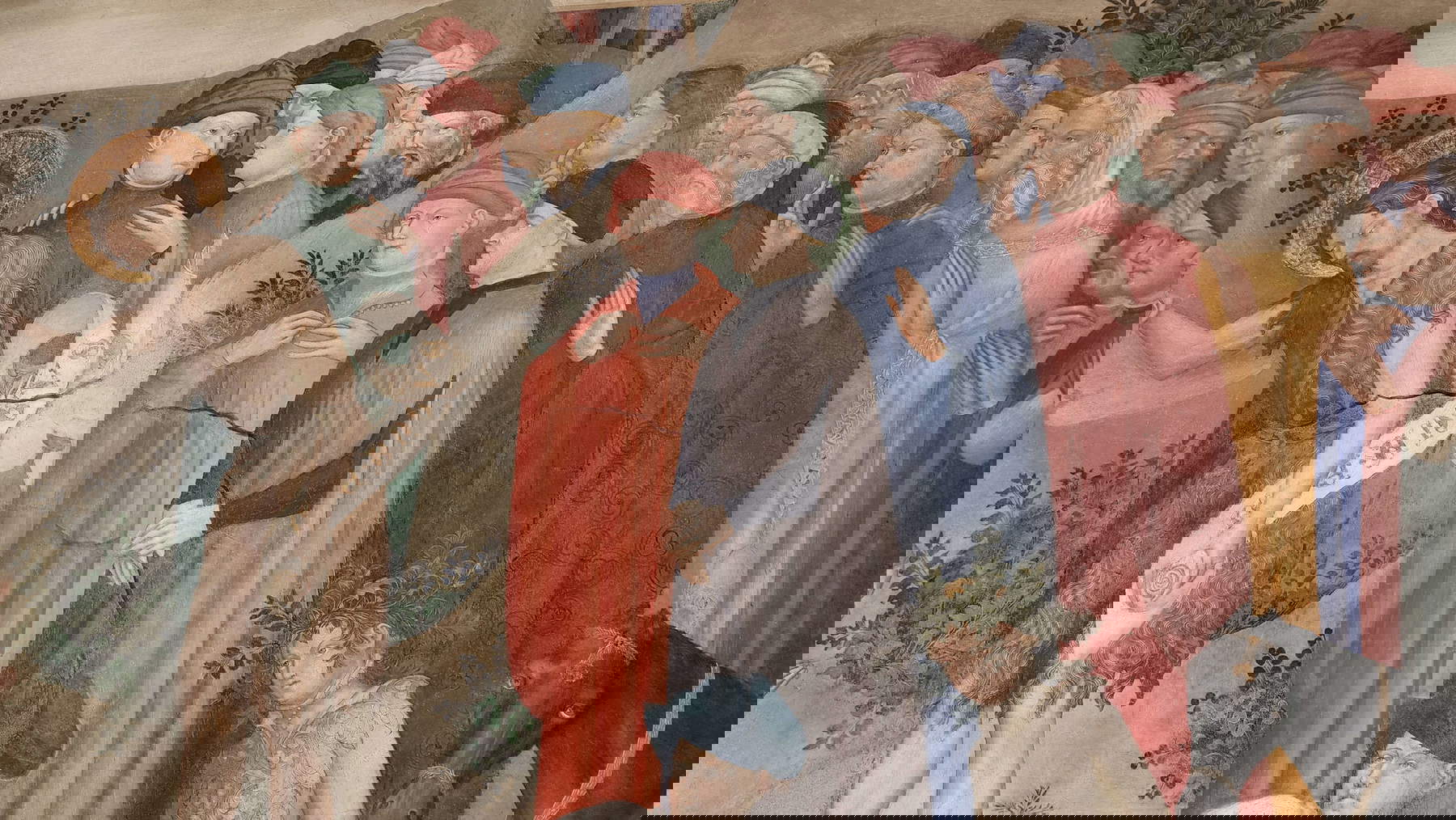
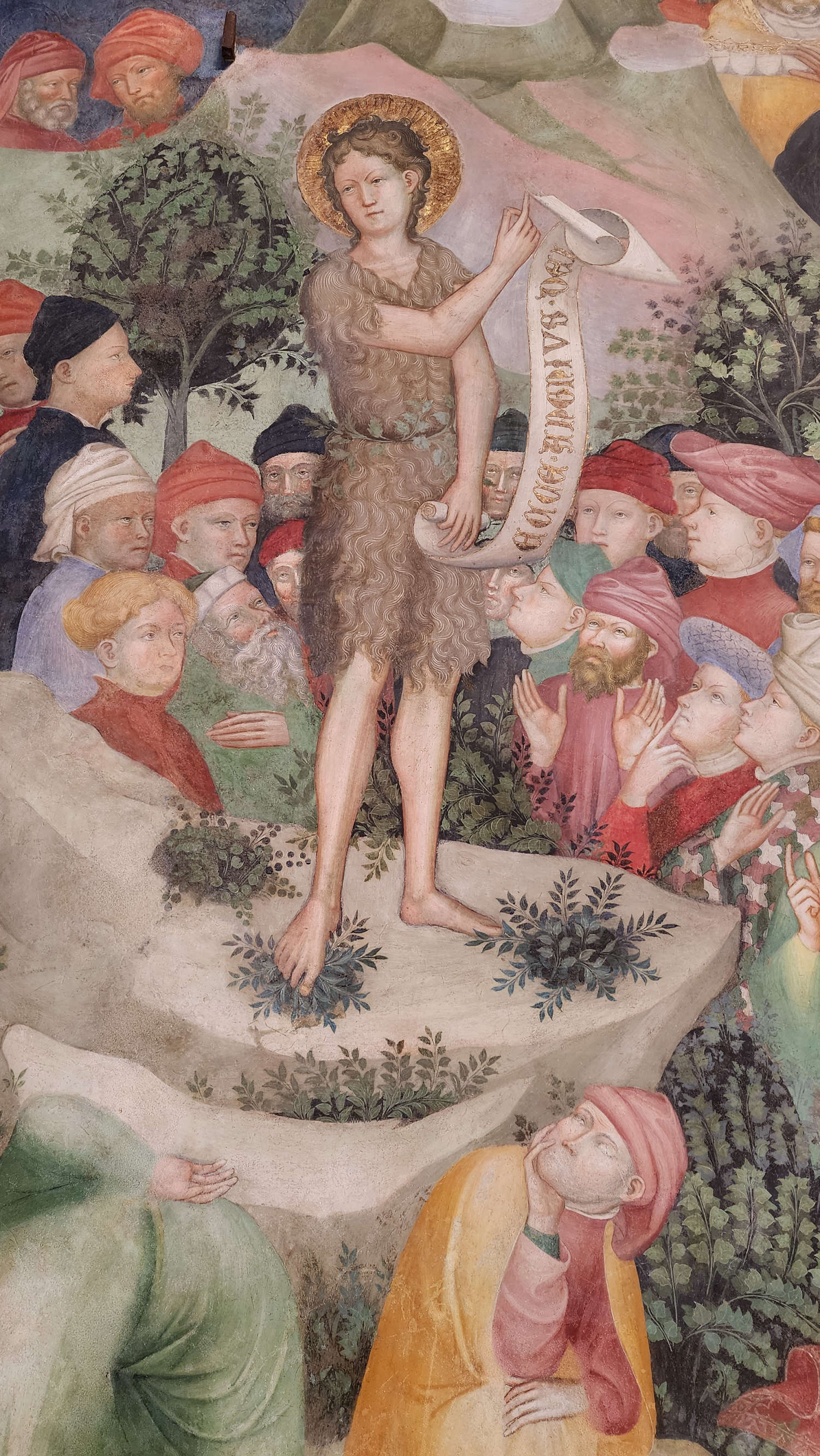
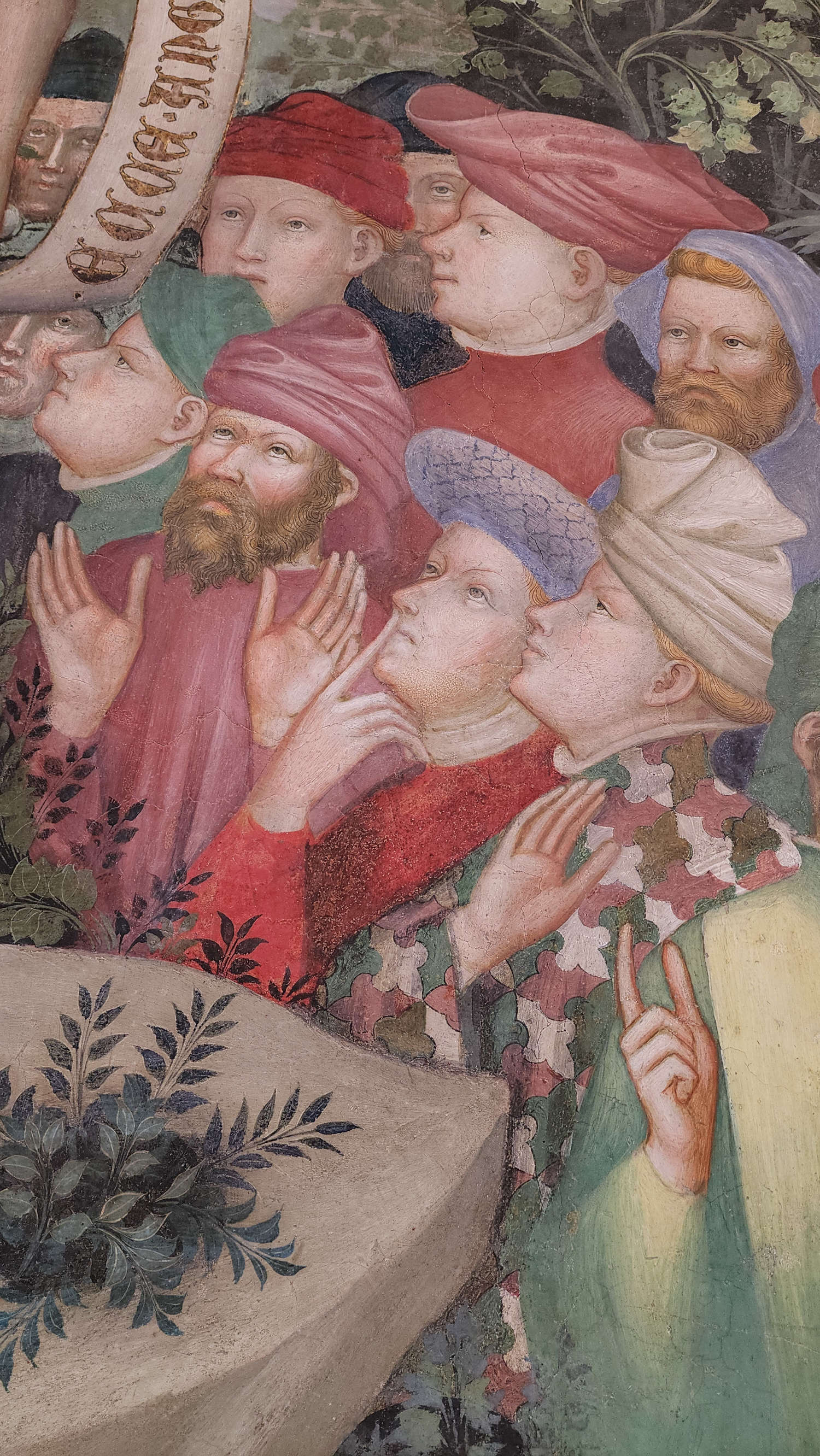
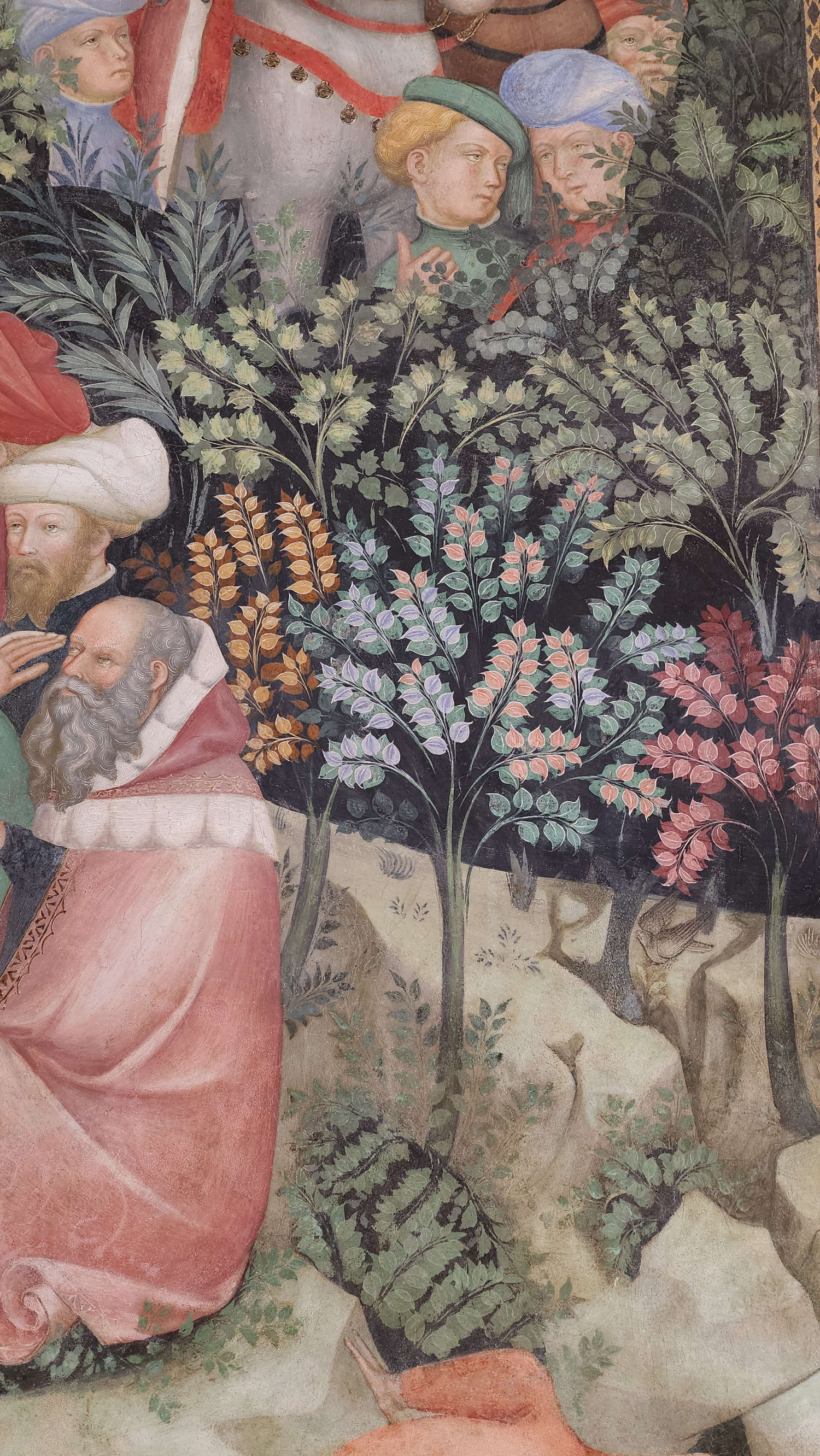
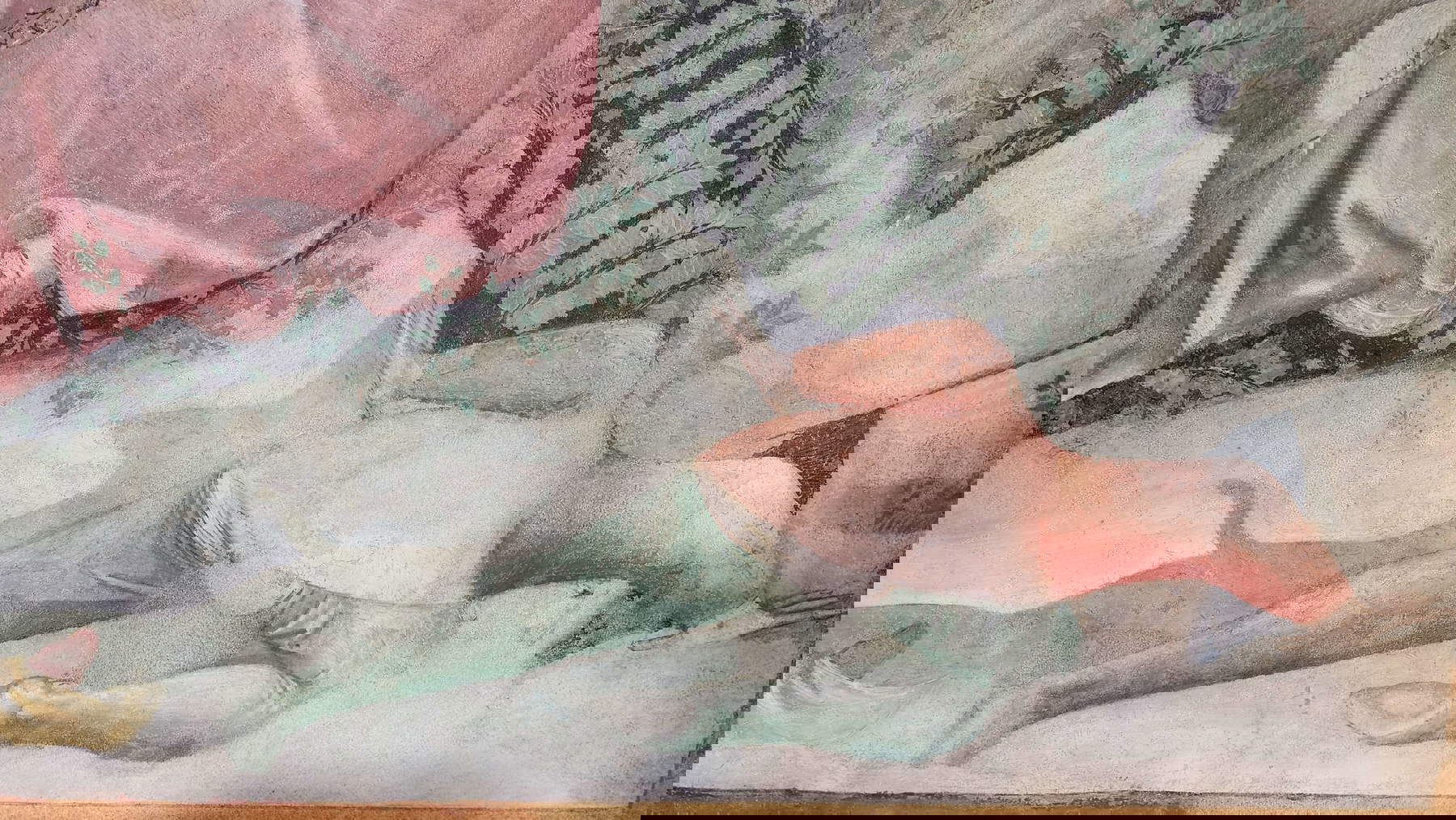
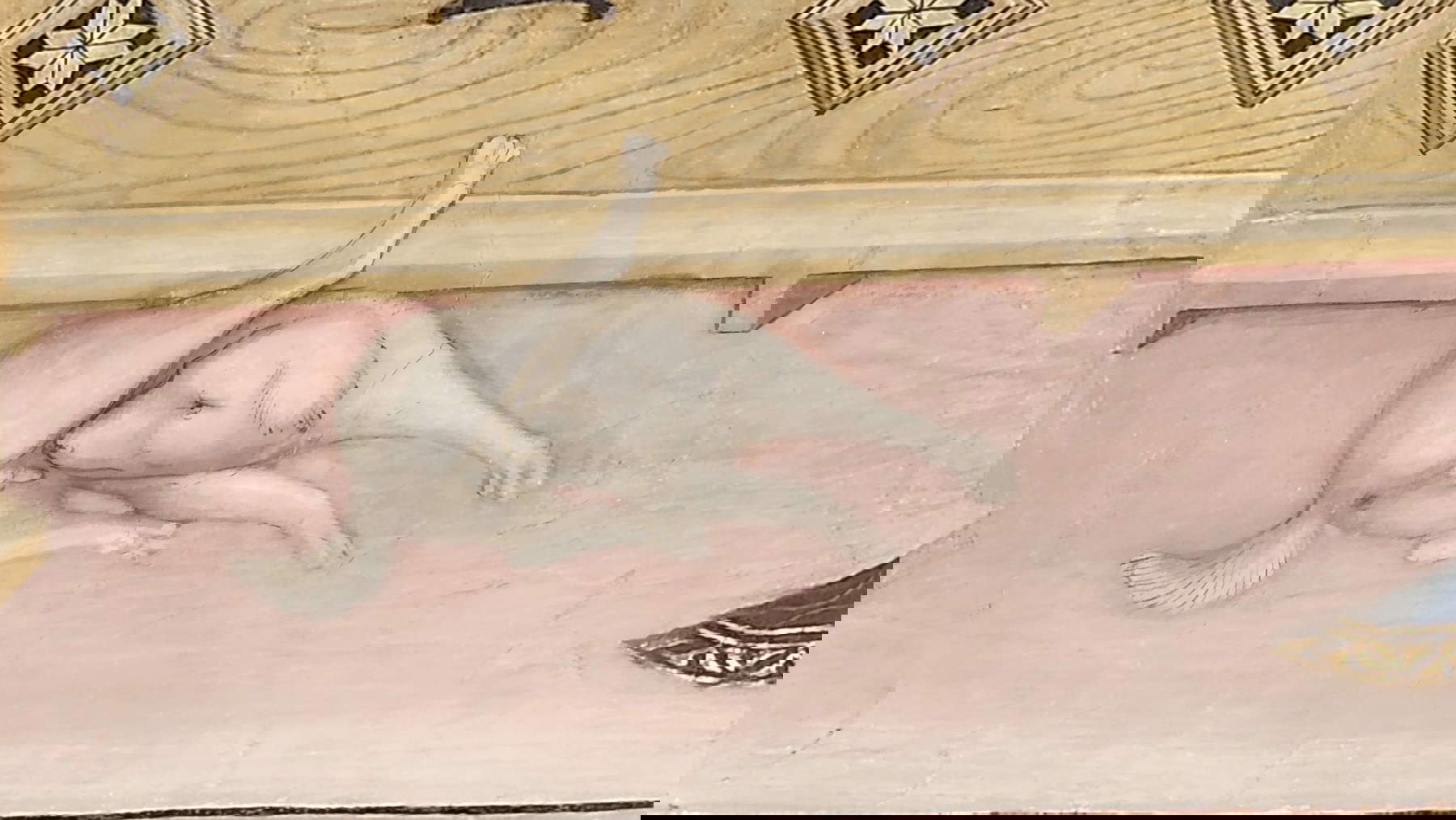
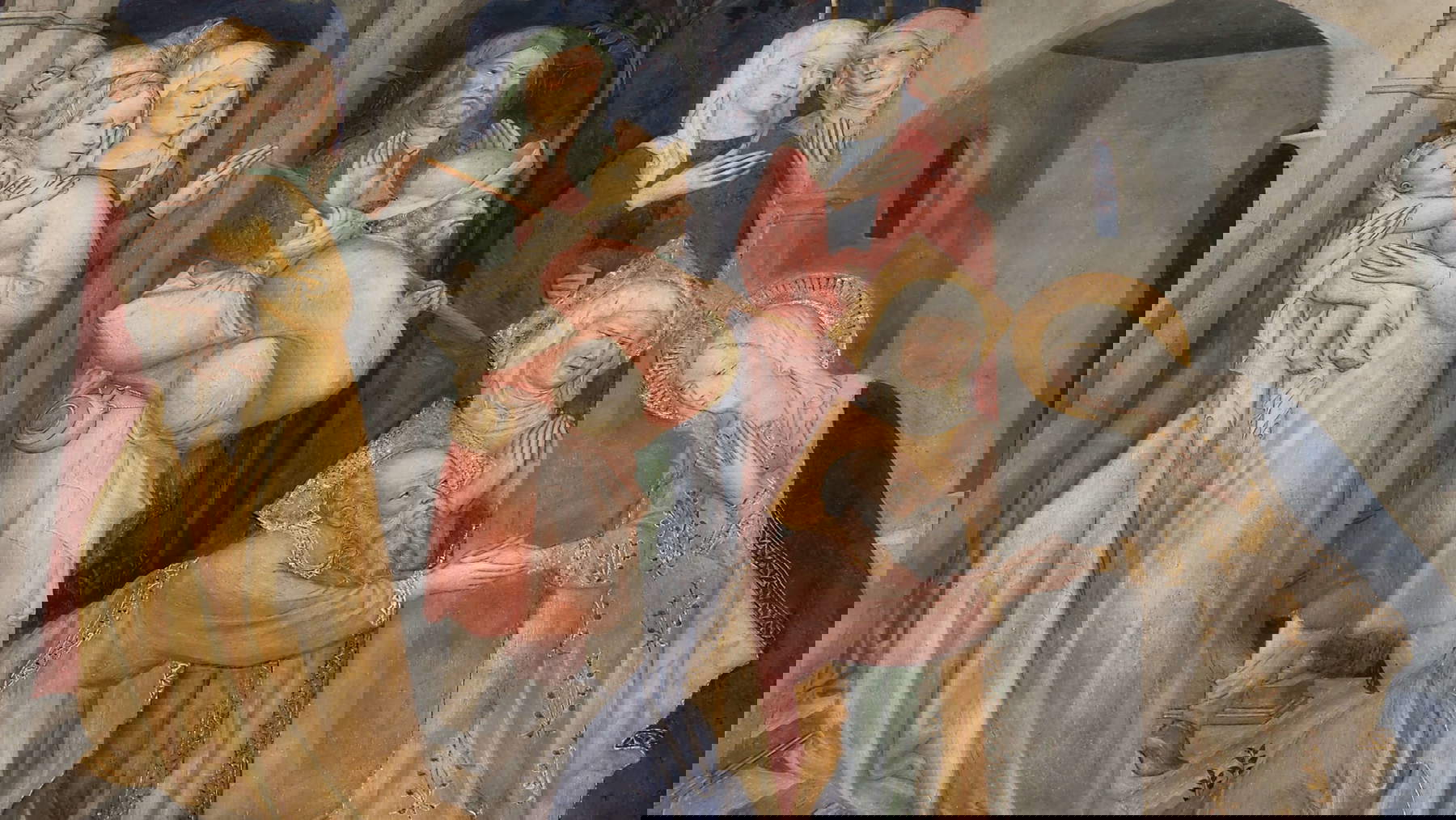
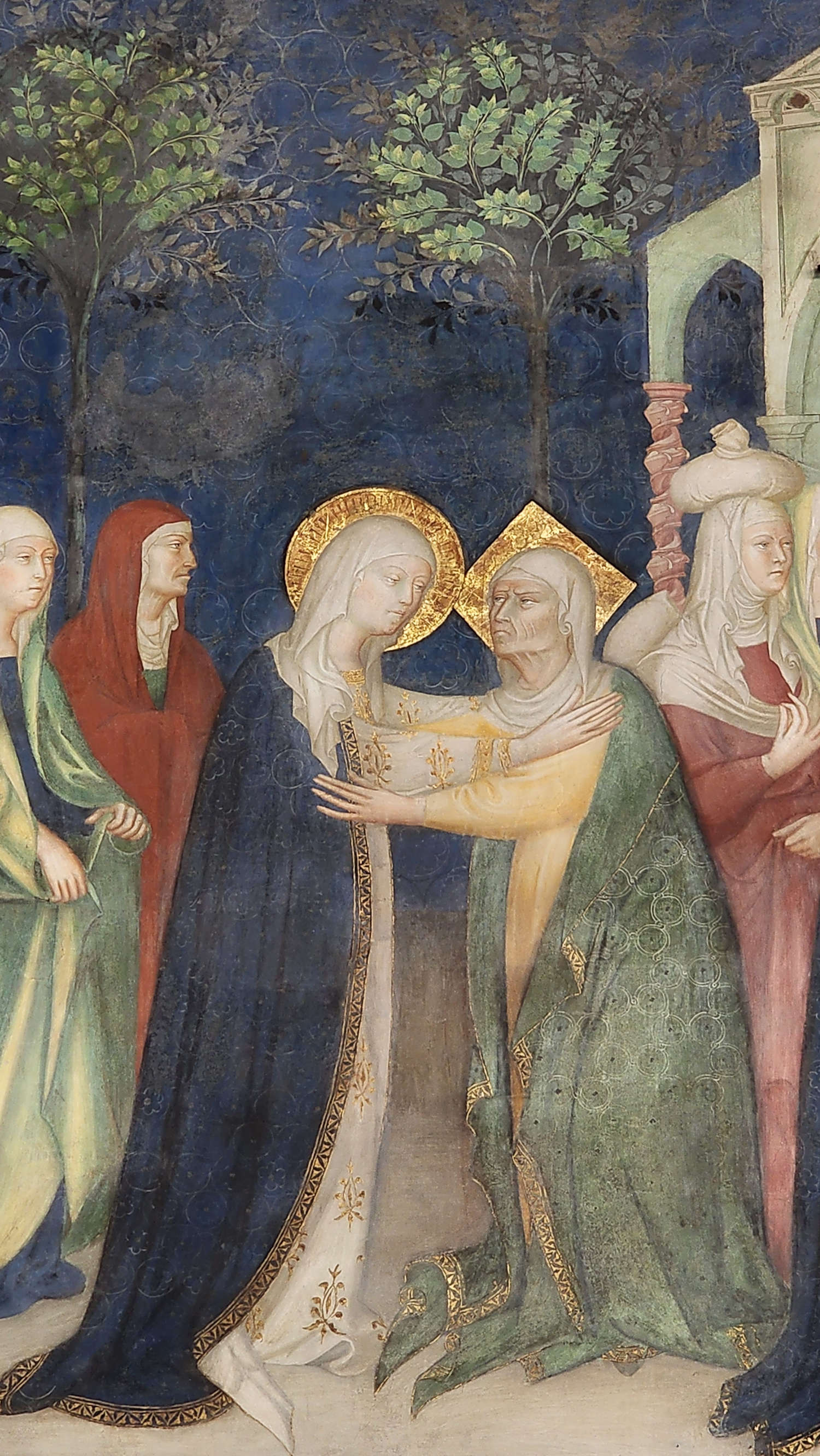
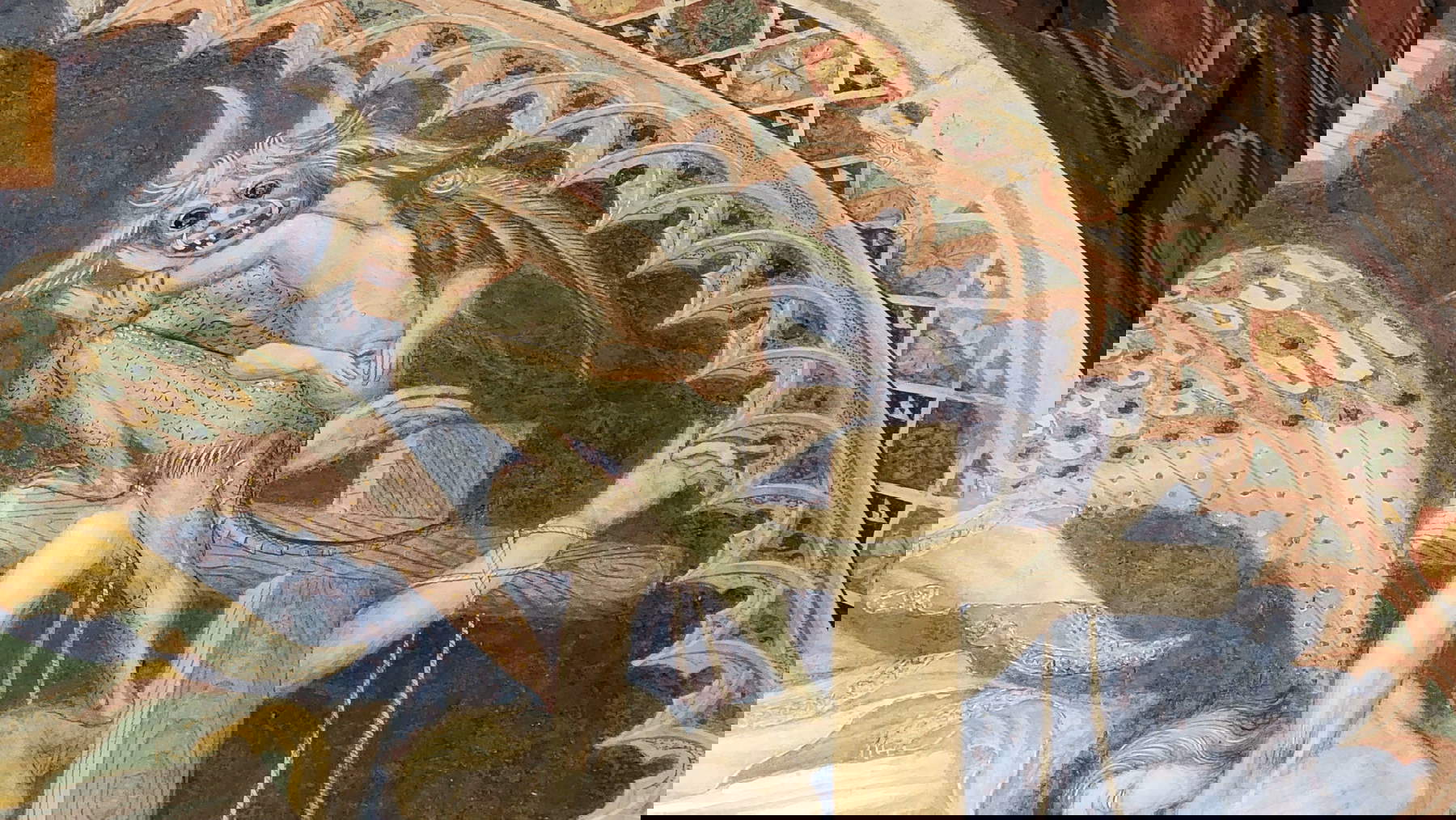
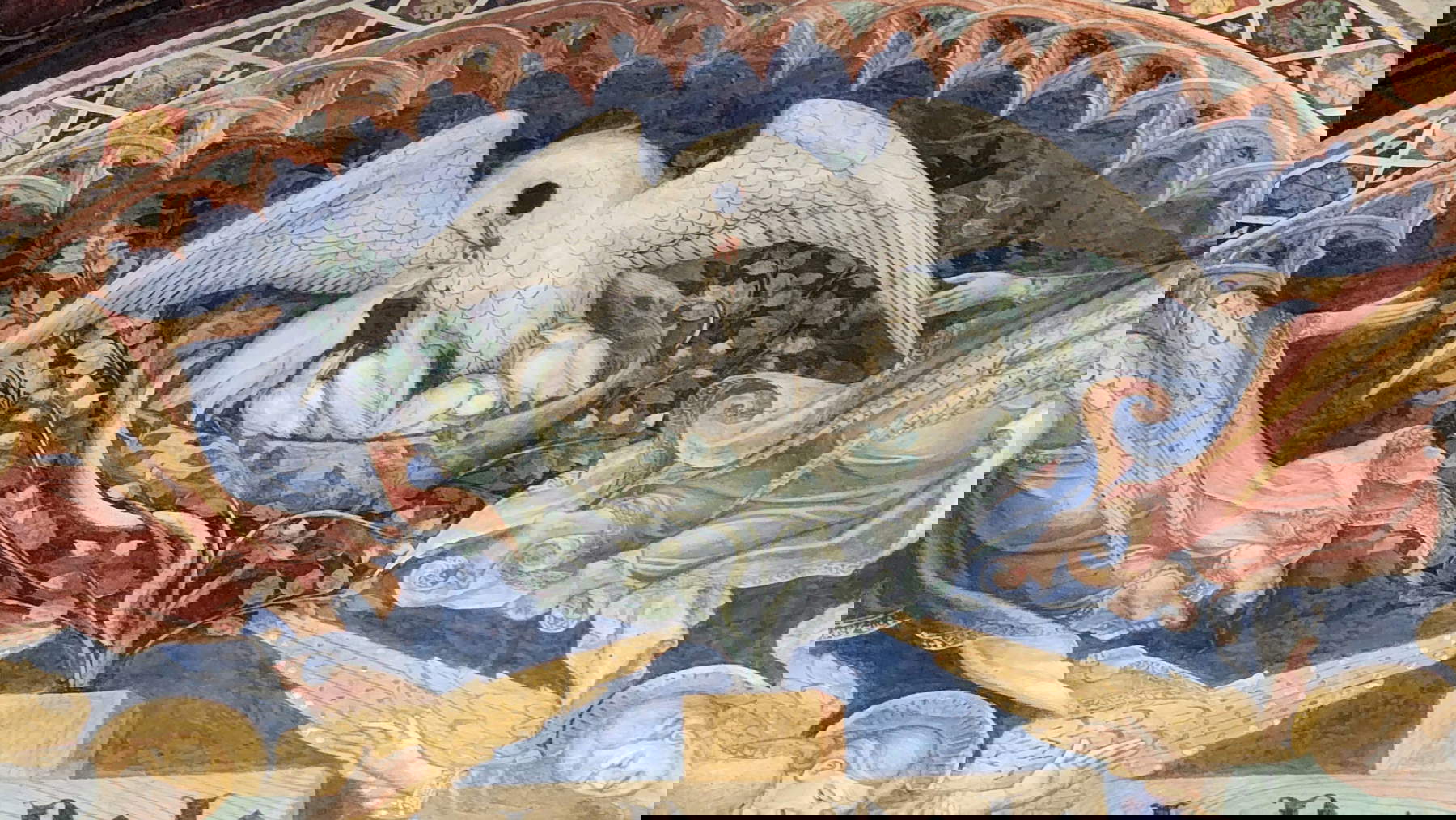
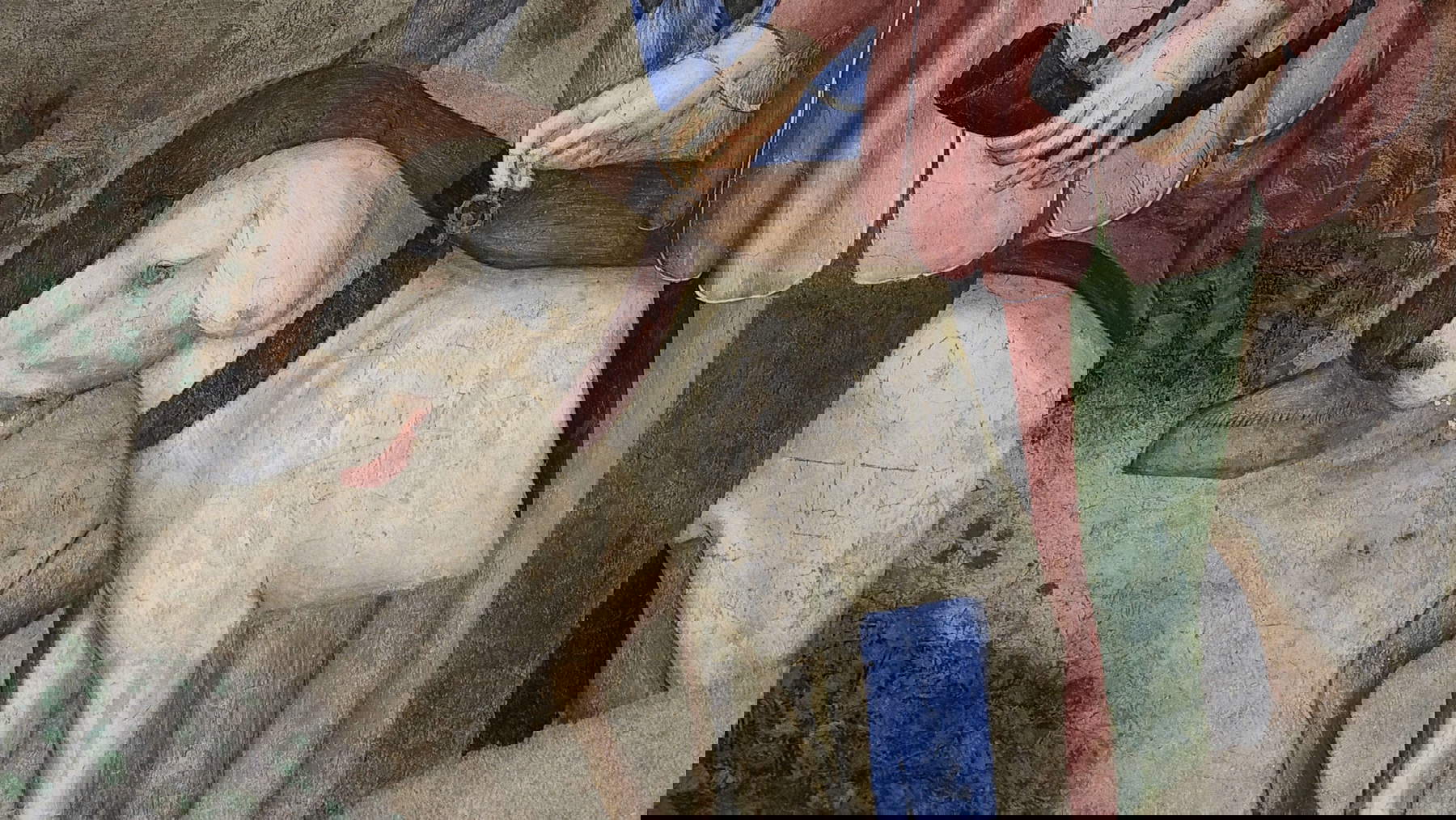
Perhaps at the time no one noticed anything, no one would have perceived ruptures, despite the fact that the two brothers are, moreover, constantly reminded of a need for truth that finds its manifestations everywhere. There is, as usual, a Magdalene who retains her rusticity despite the fact that she is dressed in a tunic lined with soft, white fleece and finely edged with golden minutiae and wears, under her tunic, a transparent blouse. There are horses described with the zoologist’s punctiliousness, just in case there had been zoologists in early fifteenth-century Urbino. There are lively, believable portraits, thick eyebrows, beards not perfectly shaved, straw hats, expressions of sincere astonishment. There is even a dog indulging in a bidet just below Saint Elizabeth waiting to welcome the newborn Baptist into her hands. Yet there is also a time, a space that tenaciously eludes any attempt at framing, any temptation to open itself to history. It is easy, of course, to find signs of a kind of resistance in all those shreds of dreams that end up tearing the real apart. Even physically: the devil ripping the thief’s soul out of his twisted and torn limbs on the cross, one of the most uncomfortable and disturbing figures in all fifteenth-century painting. “Wild hinterland of the Salimbeni sensibility that sometimes loves to fish in the gruesome,” Minardi would say. Or in the pelican that nests on the top of the cross and rips open its chest to feed its young. And then, all those unlikely fish that populate the waters of a flat Jordan, complete with a swooping bird, caught in an improbable undertow, emerging from the waters with its prey clutched in its beak. The plants that look like translations on a herbarium wall, the stuff of botanical illustrators rather than observers of the real thing. Even the dog licking his balls, one might argue, is an intellectual finesse, a license, a reminiscence, admittedly mediated by the frescoes that at the time populated churches and palaces throughout northern Italy, of Gaston de Foix’s Livre de Chasse , a 14th-century illuminated codex on hunting techniques of the time. And yet, as a finesse brought back perhaps from a painting in a country oratory, then again brought back to the realm of reality. Skirmishes, one would say, between the ferocity of the real and the indocile reaction of the fantastic, between the need for exactitude and painted bestiary reminiscences, between necrological observations from life and imagined memories. All stuff, moreover, common in early fifteenth-century painting, often inserted to fill in gaps, out of pure ornamental taste. It is not, however, by observing the nuances that one feels that comfortable discomfort that one is usually given to experience, more or less consciously, in front of any self-respecting “masterpiece of international Gothic”: as happens in so much early fifteenth-century painting, one ends up with the impression that everything fades back into dream.
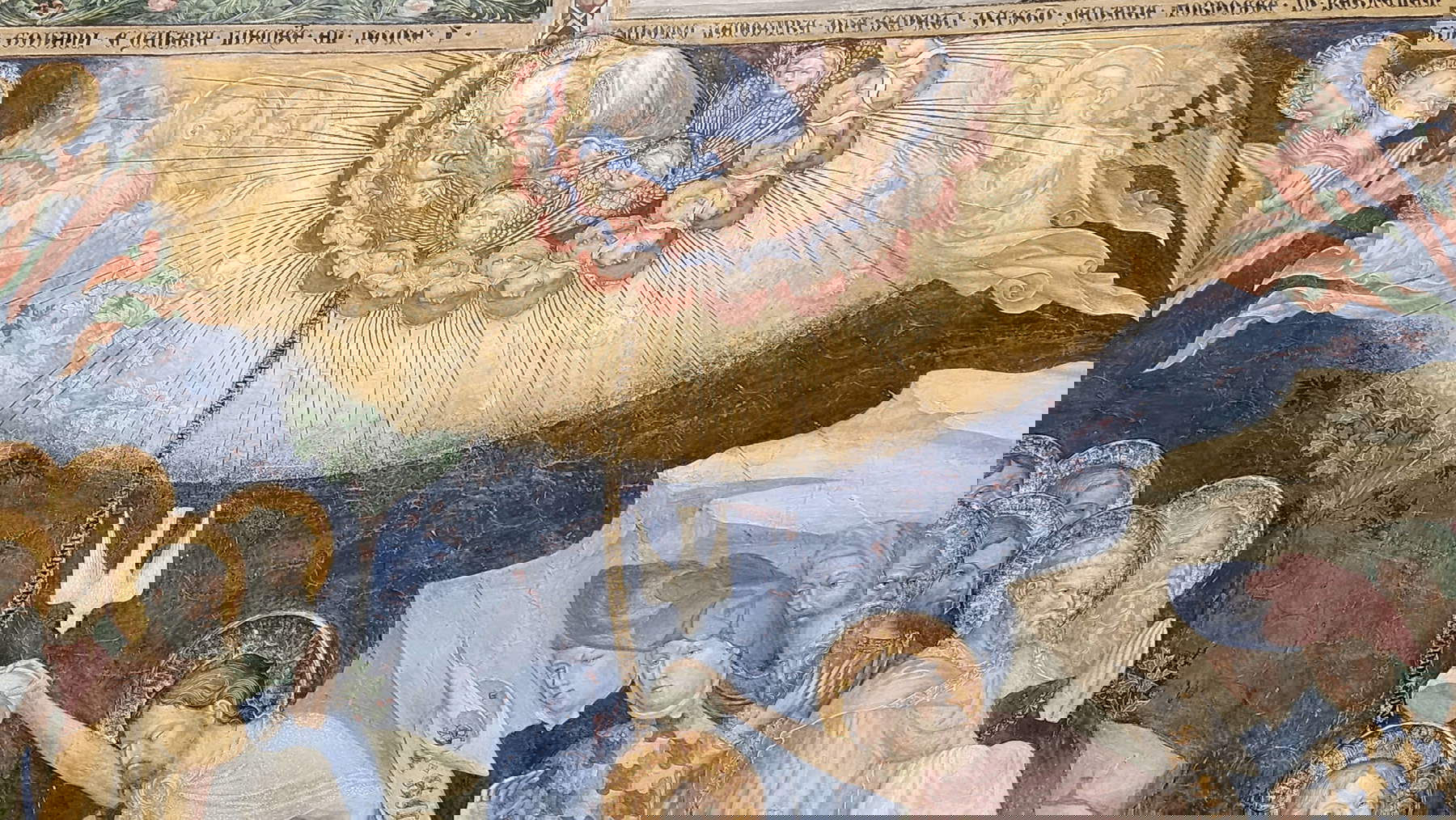
One still moves in an abstract world, within a system made of visions, within a narrative that follows a deeply unreal, transfigured, abstract score. Abstraction of colors, first of all: the colors we see today are no longer those of six hundred years ago, of course, but they are sufficiently diaphanous, sufficiently counterintuitive, sufficiently unnatural to be able to present themselves as a statement, a manifesto. Abstraction of forms, on closer inspection: we are spying inside houses without walls, inside threadlike architecture, in front of smooth, perfectly polished mountains, beneath divine apparitions that take the form of flying saucers made of light and cherubs. It is a kind of enormous nativity scene. A nativity scene where there are no laws of science. A manger that is contrived, invented, remembered, dreamed. Abstraction of time: the struggle produces a big imagined jumble, a jumble that is, however, at least partly sub specie aeternitatis, a raging mess where history tries to enter at all costs, tries to make its way in, but does not yet have the capacity to impose itself.
Before time is fragmented, broken up, packaged there is still a dream illiteracy that holds, and it holds without having the knowledge, because there is no rupture. There is a transition, but only we can tell. That oneiric illiteracy dominates the visions, continues to inhabit the halls, the classrooms, the aisles heedless of the reality that creeps in under the pertuosities and begins to make its draft felt through the open windows. It continues, undaunted and unconcerned, to show its signs and symbols, trying in turn to discipline reality without even bothering to think that, perhaps, it is already late.
Warning: the translation into English of the original Italian article was created using automatic tools. We undertake to review all articles, but we do not guarantee the total absence of inaccuracies in the translation due to the program. You can find the original by clicking on the ITA button. If you find any mistake,please contact us.