




by Redazione 27/05/2026



Categories: Works and artists / Disclaimer
A monumental 15th-century painting by Luchino da Milano, commissioned by the Banco di San Giorgio, survives in Palazzo San Giorgio: a work that transformed the holy knight into the political symbol of the Republic.

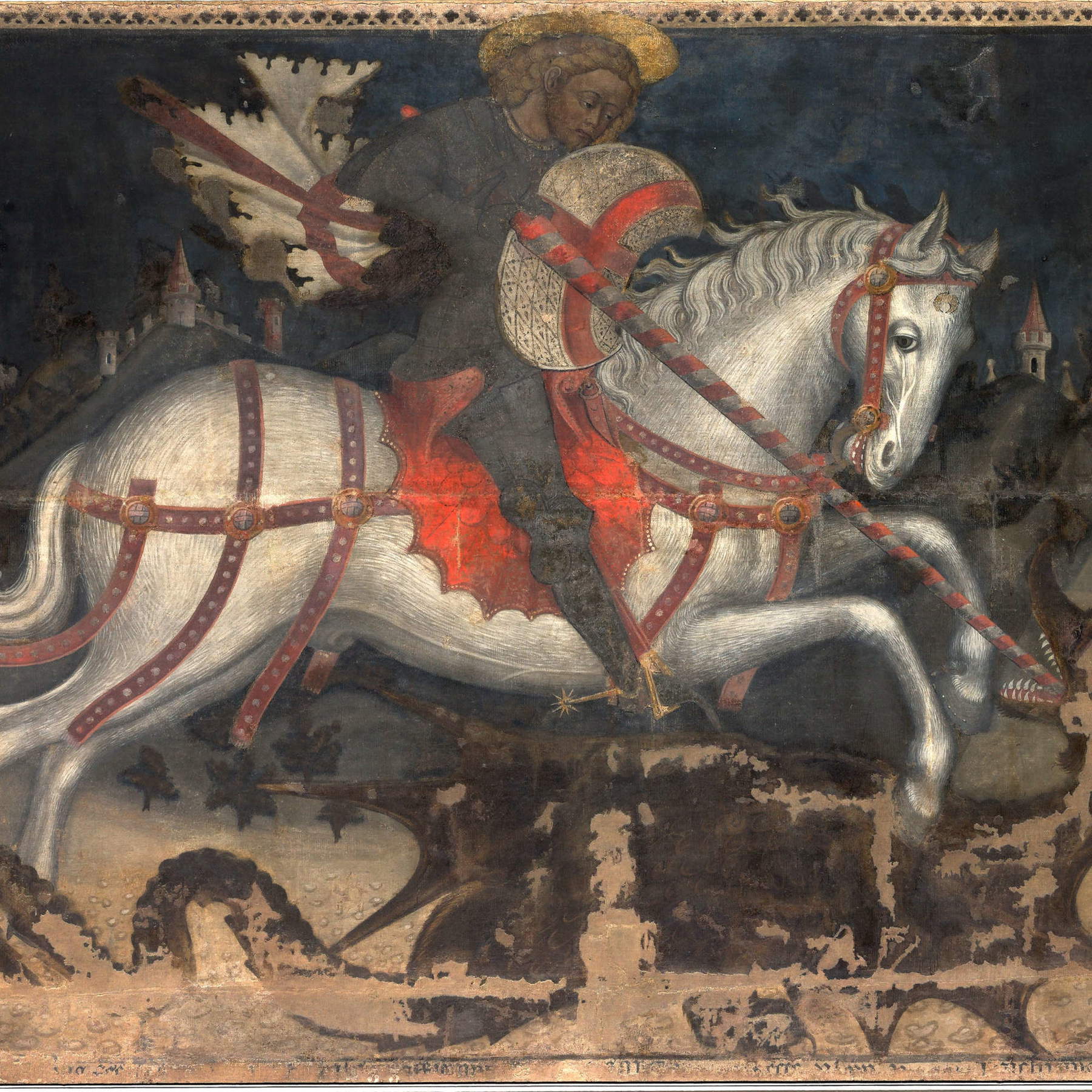
In the oldest part of Genoa, within the walls of Palazzo San Giorgio, a canvas survives that no other documents attest to, signed by a painter of whom almost nothing is known. It is Luchino da Milano’s Saint George Slays the Dragon, dated 1444, an oil on canvas of considerable size (almost two meters high by more than three meters wide), now preserved in the Sala delle Compere. A work that bears the weight of an isolated signature in the history of art, of a precise commission and of a city that had recognized in that saint much more than a heavenly protector.

The scene is one consecrated by tradition: the knight riding his steed, wrapped in a broad cloak and dressed in armor, holds his shield to defend himself as he plunges his spear into the dragon’s jaws with a resolute, almost impatient gesture. In front of him the princess watches, standing with an expression that does not betray terror, almost detached from the danger around her. In the background is an articulated architectural landscape, with walls and buildings giving depth to the composition. From a window of a palace on the left two figures look out to watch the fighting: anonymous onlookers mirroring the viewer, witnesses to an event that already belongs, at that moment, to the dimension of civic myth.


Luchino da Milano (a name that appears in the news only for this one work dated 1444: more about him we do not know) signs the canvas at the bottom, as if to leave a trace of himself in something whose importance he understands. And the importance was real. The very size of the painting, out of the ordinary for the time and context, together with the care given to the framing and the author’semphasis on the banner, have led scholars to believe that the original purpose of the artifact was as a banner. Not an easel work, not an altarpiece for a church, but a banner, something to be carried or displayed in public, something to be seen by many and from afar.

It had been commissioned by the Banco di San Giorgio, the powerful credit institution founded in 1407 that took its name, and insignia, from the holy knight. That choice was no accident. Genoa was a maritime republic, one of the most powerful in the medieval Mediterranean, a city that had built its wealth on sea routes, overseas colonies, and trades reaching as far as the Black Sea. A city that needed strong, recognizable symbols capable of holding together the collective identity of a community scattered along the coasts and ports of half the world. The Bank of St. George was both a financial instrument and a backbone of the Republic’s public identity: exalting its eponymous saint meant exalting itself, its authority, its legitimacy.
However, Saint George was not only the patron of a bank. He was also the patron saint of the Republic, along with St. John the Baptist and St. Lawrence (saints of ancient medieval origin who would be joined only in 1625 by St. Bernard of Clairvaux). But George had a special position, almost a symbolic precedence. Giorgio Stella’s Annales Genuenses , written in 1405, even before the official founding of the Bank, opened with a dedication to the three patron saints of the city and explicitly remembered him in his meaning as the standard-bearer, banner-bearer, of the Genoese, who had adopted its insignia long ago. The red cross on a white field was the sign of Giorgio, it was the sign of Genoa: an overlap of identity so profound as to be inseparable.
From sixteenth-century documents, explains historian Valentina Borniotto, “we can reconstruct the relevance that the day dedicated to St. George, celebrated annually on April 24 (sometimes on the 23rd), had for the city and how it was considered a civil and ecclesiastical holiday with an obligation to abstain from work.” The overlap, then, was concrete and daily. The Statutes of the Fathers of the Commune of 1568 are explicit: since the following day was dedicated by the Church to celebrate the glorious knight and martyr, “confalone and standardo della militia della Città e Repubblica nostra,” every artisan and worker had to abstain from work and keep stores and workshops closed. The saint was inscribed on the city’s economic calendar. Not celebrating him would have meant ignoring something that affected everyone.
That devotion was not just religious sentiment: it had definite narrative roots. Giorgio’s fortunes in Genoa stemmed largely from the Legenda aurea of Jacopo da Varazze, the Genoese Dominican friar who in the late thirteenth century had codified the saint’s legend in a tale with a fairy-tale feel, which later became one of the most popular and influential texts of the European Middle Ages. The story was simple and powerful: George, a knight originally from Cappadocia, arrives in the city of Silena in Lycia, where a terrible dragon terrorizes the population. The citizens, to appease the monster’s fury, are forced to offer him two sheep each day; when the sheep run out, it will be the turn of humans, chosen by lot. To the princess destined for sacrifice, George counters with the strength of faith and weapons, kills the dragon, and frees the city. It is an image of protection, of courage, of the victory of good over evil, an image that lent itself, with extraordinary versatility, to be read both in a religious key, in a fairy-tale key, and in a civic and military key.
The Banco di San Giorgio soon realized that versatility was an asset. Archival papers made known during the nineteenth century document how as early as the 1450s the institution had commissioned the painter Antonio da Bologna to make a banner with the effigy of the saint, destined for the Genoese colony of Caffa, on the Black Sea, which was threatened by the Turks. The document also records the name of Gaspare dall’Acqua, commissioned to decorate the banner and decorate the armor, with specific charges for the use of gold and silver. In 1456 another master, Giovanni Giorgio da Pavia, was paid by the Casa delle Compere for an additional banner intended for Father Abeodato Boccone, a religious chosen to preach an “almost crusade” in support of the colony besieged by the Ottomans, with the purpose, the documents state, of “kindling and spurring the multitudes.”
We do not know the subject of this artifact, but, explains art historian Gianluca Zanelli, “taking into account that the commission still came from the Bank of St. George, it must have been a further depiction of the knight, whose role as protector of the Christian militia entrusted to him during the period of the Crusades was evoked, a function that certainly suited the political situation in which the colony of Caffa found itself at that time.” The name of the holy knight, his attribute as protector of the Christian militia, was, moreover, perfectly suited to such a context: George had been the support of the Crusaders during the siege of Jerusalem, appearing to the Christians “clothed in white arms” with a red cross, as narrated by Iacopo da Varazze. That same cross stood out on Genoese ships and fortresses scattered around the Mediterranean and Black Sea.
Luchino da Milano’s 1444 canvas thus fits into a tradition of systematic commissioning, lucidly oriented toward building and consolidating an iconography of power. That the painter is otherwise unknown makes the work even more significant: it was not the fame of the master that made that painting important, but the quality of the commission and the weight of the subject. The Banco di San Giorgio was looking for an effective image capable of worthily representing the institution’s eponym in the place that was its headquarters, at the center of the Republic’s economic and political life.
Palazzo San Giorgio was, and still is, a building laden with layers of history. Seat of the Bank from the fifteenth century until the fall of the Republic of Genoa, the palace had also housed, in a famous episode in literary history, Marco Polo, who had been a prisoner there in 1298 after the Battle of Curzola, and there had dictated to Rustichello da Pisa the account of his travels. A palace that was at the same time a prison, a bank, a seat of power and a space for representation. The presence of Luchino’s St. George in the Sala delle Compere was not decoration: it was a declaration of identity, a political and religious profession of faith at once.
However, that profession of faith did not end in Luchino’s painting. As early as the 1580s, thus some forty years after Luchino da Milano executed his canvas, the Banco commissioned Carlo Braccesco to paint a fresco with the image of the patron saint on the facade of the Customs House. Raffaele Soprani, in 1684, still described that work in enthusiastic tones: “painted above the façade of the Customs House on a very large site, in which with exquisite dissegno he represented a Saint George on horseback in the act of slaying the voracious Dragon, painting beyond diligent; stupendous in design; reasonable in coloring, co’i lumi di finissimo oro, & very well ordered as to the expressiveness of the historia, which in testimony to the valor of Charles sudetto after the course of a hundred and fifty years has so well withstood the ravages of time, that even today it maintains itself very well, & gratifies not a little the eyes of those who are pleased to look upon it.”
Over the centuries, other Genoese artists would continue to enrich the palace’s spaces. The spread of the image of St. George in Genoa was pervasive, one might say. It was an extraordinary heritage that branched out through the centuries, nurtured by private and public devotion together, supported by an institutional patronage that understood how art was a first-rate identity-building tool.
Luchino da Milano’s canvas remains, in this panorama, a crucial node. Precisely dated, signed, preserved in the place for which it was conceived, or in a space closely connected to it, it offers direct evidence of how the 15th-century Genoese lived out their relationship with the holy knight. It is not a work that can be reduced to the biography of its author, since almost nothing survives of that author. Instead, it is a work about his patronage, his time, and his city. A city that looked to the sea, that had planted its flags on the shores of the Mediterranean and the Black Sea, that had built an identity around a dragon-slaying knight, and that in that identity continued to recognize itself, generation after generation.
Warning: the translation into English of the original Italian article was created using automatic tools. We undertake to review all articles, but we do not guarantee the total absence of inaccuracies in the translation due to the program. You can find the original by clicking on the ITA button. If you find any mistake,please contact us.