





Echo and Narcissus. A young woman and a young man bound by myth. Two lives that intertwine, leading to a sad and tragic ending. Falling in love with an unrequited or impossible love is a source of anguish and death for them, yet neither has ever ceased to exist: we can still hear her voice today, and we can still smell his scent. It has surely happened to everyone, especially in the mountains, to speak certain phrases or words aloud and immediately hear those same phrases and words repeated by an echo, or to see the fragrant daffodil blooming in pastures, meadows, or fields. But for what strange reason have the two young people depicted in John William Waterhouse’s famous 1903 painting of the same name, *Narcissus and Echo*, housed at the Walker Art Gallery in Liverpool, been transformed forever into the echo that resounds through the mountains—the acoustic phenomenon that occurs when sound waves bounce off an obstacle—and into a beautiful, intensely fragrant flower?
We, the observers, are there, on the other bank of the stream, witnessing the scene and immersed in the coolness of the wooded landscape, beneath the shady canopies of the trees that give off a pleasant scent of resin. We feel the softness of the tender grass beneath our feet; a few longer blades tickle our skin; the gentle, placid soundof water flowing slowly among the large boulders, and an intoxicating scent of wild daffodils—yellow and white—that sprout proudly in upright clumps near the water. A few unblossomed water lily leaves float quietly on the surface of the stream, which takes on greenish hues due to the reflections of the surrounding vegetation, and one can also sense the humidity typical of the forest from small mushrooms sprouting at the base of the tree trunks, accompanied by moss.
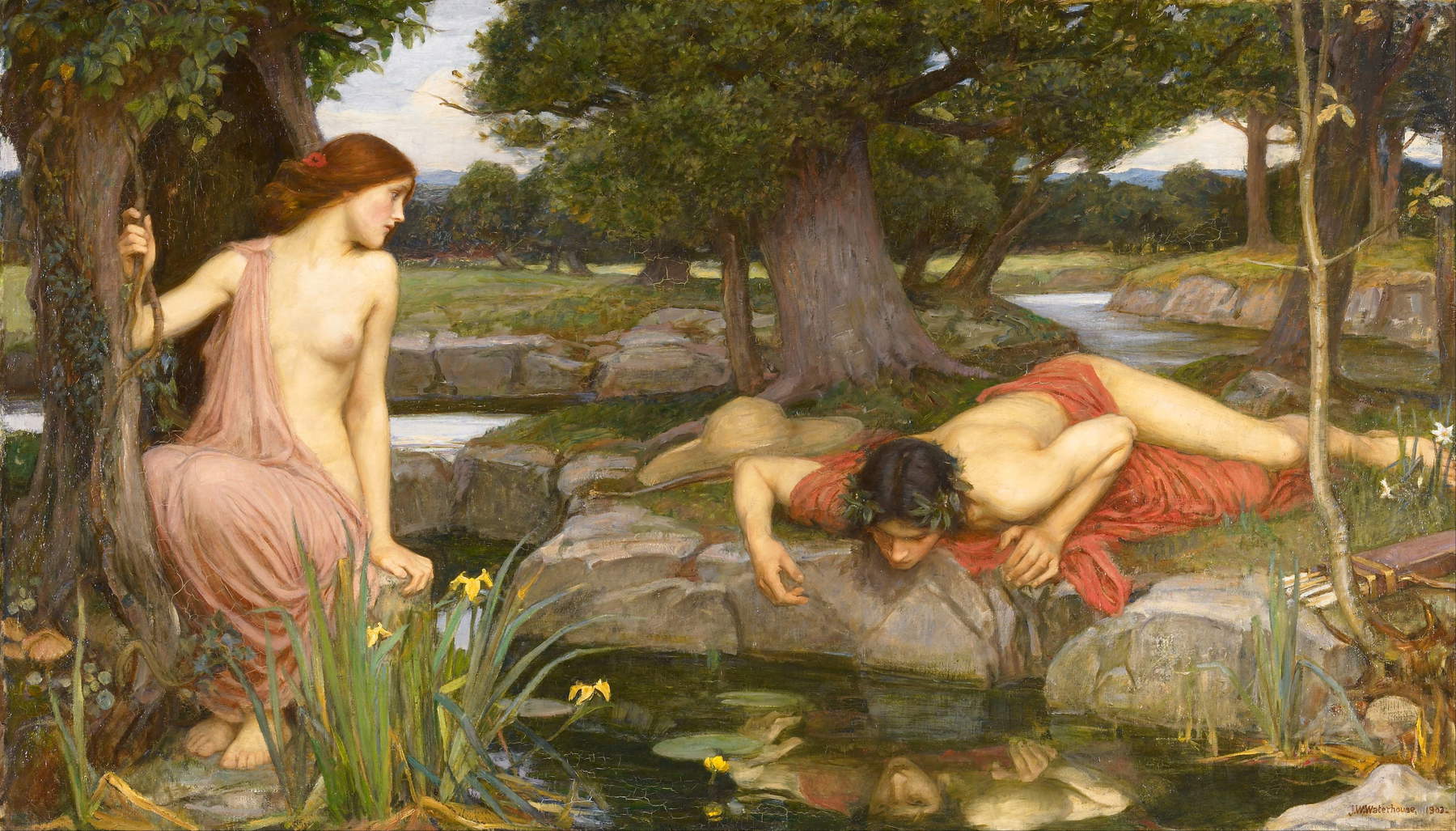
To our left, a beautiful young woman with delicate features and smooth, ethereal skin sits on a large boulder by the riverbank, resting one hand on it; her bare feet, too, feel the coolness of the stone. Her other hand clutches a vine from the tree beneath which she sits. Her long, copper-colored hair, elegantly gathered and fastened with a small red flower, harmoniously highlights the whiteness of her face and body, which is draped only in a soft, pale pink cloth that falls from her shoulder to her feet, leaving one breast exposed. Her gaze is fixed on the young man we see in front of us, who, however, seems completely oblivious to the girl watching him from across the way, as he is too absorbed in looking at his reflection in the water. He is lying on the grass, his stomach pressed against the ground, wrapped in a reddish drape that leaves his back and one leg exposed, his face turned toward his reflection; he does not take his eyes off the water even for a moment, as he tries to move one hand, only to realize in that instant that the reflection of his hand moves in exactly the same way. And that the handsome young man he sees reflected in those greenish waters also has black hair and a crown of leaves encircling his head. Next to him, one can make out a quiver still containing arrows.
Waterhouse, one of the greatest Pre-Raphaelite painters of Victorian England, possesses the extraordinary ability to freeze the scene at a precise moment and to draw the viewer in with a close-up perspective, as if the viewer were a character present in the scene without being seen. He is present here as well, alongside Echo and Narcissus, but can do nothing to alter their fates. It was typical of Pre-Raphaelite art to depict ancient myths, as in this case, as well as to portray women with long, red hair contrasting with very fair skin; set the composition ina poetic atmosphere, favoring universal themes such as love, desire, and seduction, and paying meticulous attention to the details of nature—elements that are particularly prominent in this painting.
The reason for the eternal transformation to which Echo and Narcissus are destined, however, lies exclusively in the myth. John Milton, too, in his *Comus*, seeks explanations from the maiden, addressing her directly with tender sympathy: “Sweet Echo, sweetest nymph,” thereby lending her an intimate and melancholic dimension.
The myth is recounted by Ovid in the third book of *Metamorphoses*: the son of Cephissus and Liriope, Narcissus was conceived amid the waves, the result of the river god’s violent assault on the beautiful naiad. Admired by young men and maidens for his beauty, he was so arrogant that he rejected anyone who tried to seduce him. One day, at the age of about sixteen, while he was trying to scare away some deer to hunt them, the woodland nymph Echo saw him and fell in love with him instantly. The beautiful nymph, however, had been punished by Juno because, to allow the nymphs with whom Jupiter was betraying her to escape, Echo would entertain the goddess with long conversations: As punishment, Juno had therefore condemned the nymph to never speak first and to always repeat the last words spoken by her interlocutor. It finally happened that the nymph managed to approach the young man, who at that moment had separated from his faithful companions, and without revealing herself to him, she immediately began to respond to him in the manner to which she had been condemned. Deceived by this echoing voice, he suddenly exclaimed, “Let’s meet here,” and she, who had been waiting for nothing else, replied, “Let’s be together!” She then emerged from the woods and threw her arms around his neck, but he, fleeing, brutally rejected her, telling her to take her hands off him, not to embrace him, and that he would rather die than give himself to her! Rejected, she then covered her face with leaves out of shame and hid in the woods, in remote caverns. That brutal rejection , however, became a constant torment for her, causing her to waste away and pine for him to the point that only her voice remained, while her bones turned to stone. Narcissus, on the other hand, had previously been punished by Nemesis, the goddess of vengeance, because of his contempt for all those who desired him: the goddess had granted the prayer of a young man who had fallen victim to the son of Cephissus and Liriope, who had wished that he would fall in love but never be able to possess anyone he loved. Weary from the heat and the exertions of the hunt, Narcissus one day found relief at a spring in the middle of the woods, and, lying down to quench his thirst, he fell in love with the image of himself he saw reflected in the water, gazing at, praising, and thus desiring a bodiless image, which at first he did not recognize as his own reflection. When he realized this, he was devastated. Exhausted by love, he was consumed by grief. His body was never again what it once was, but Echo, every time she saw him—and despite the bitterness of the memory—would grieve and echo the lamentations of her Narcissus. Until death overtook him on that green meadow where the spring was located; he was welcomed into the Underworld, but he never ceased to gaze at his reflection in the waters of the Styx. All the nymphs wept, and with them the woodland nymph Echo. Narcissus’s body vanished, but in its place a flower was found— the narcissus.
“Echo and Narcissus” is a myth about unrequited love—that of the nymph rejected by the young Narcissus, who was too vain and arrogant—and about an impossible love, because it is directed toward a bodiless image: that of Narcissus, who is incapable of loving anyone other than himself. In both cases, these are loves that are not—and cannot be—reciprocated, and that lead to pain, wasting away, heartache, and ultimately death. They are, albeit in opposite ways, harmful forms of love, because in one case there is too much love, and in the other, there is none at all.
But they are also loves that end up ensnared in the webof illusion: on the one hand, the echo of the nymph’s voice creates an illusion in his heart, because he believes his love is reciprocated by Narcissus before the brutal rejection; on the other, the young man’s reflection deceives him into thinking he has found love, but in reality, this is not the case.
It is also a myth that features a succession of punishments and metamorphoses, which transform the very essence of the two young people; yet it is precisely these changes—into another state of being—that render them eternal. A voice and a flower.


The author of this article: Ilaria Baratta
Giornalista, è co-fondatrice di Finestre sull'Arte con Federico Giannini. È nata a Carrara nel 1987 e si è laureata a Pisa. È responsabile della redazione di Finestre sull'Arte.
Warning: the translation into English of the original Italian article was created using automatic tools. We undertake to review all articles, but we do not guarantee the total absence of inaccuracies in the translation due to the program. You can find the original by clicking on the ITA button. If you find any mistake,please contact us.


























 IT
IT FR
FR DE
DE ES
ES CN
CN


