



by Redazione 04/07/2026



Categories: Ancient art / Disclaimer
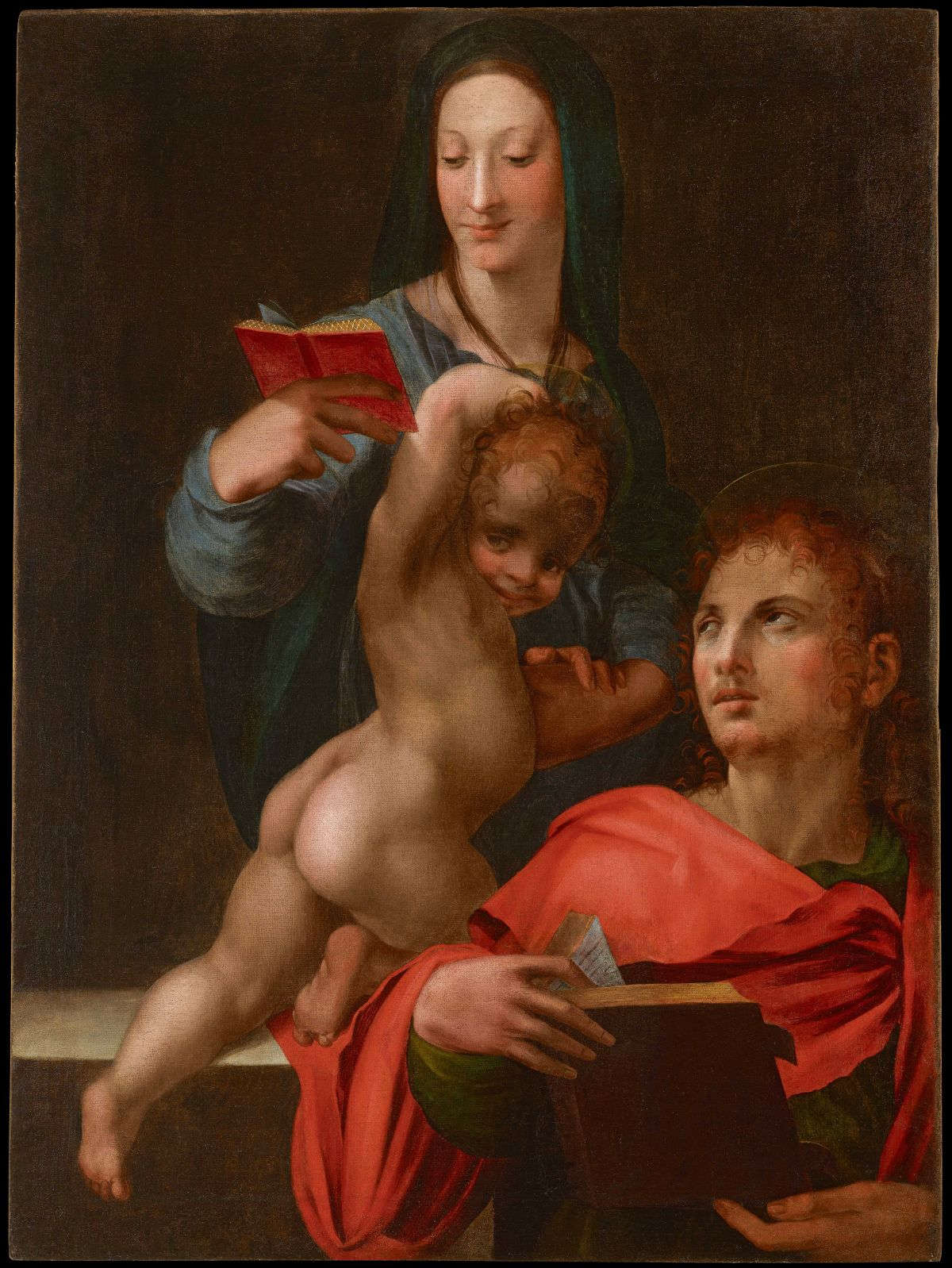
A long-standing attribution has been overturned by a study published today: the *Madonna and Child with Saint John*, recently acquired by the Metropolitan Museum of Art in New York and long attributed to Rosso Fiorentino, appears to have a different attribution, now ascribed to Alonso Berruguete and Carlo Portelli.

The *Madonna and Child with Saint John the Evangelist*, acquired earlier this year by the Metropolitan Museum of Art in New York, may not be by Rosso Fiorentino : according to scholars Luigi Agus and Alessandro Nesi, it may in fact be a painting by another great 16th-century painter, the Spaniard Alonso Berruguete ( Paredes de Nava, 1488 – Toledo, 1561), who was active in Italy for many years. The two art historians have published their arguments in the essay *Not Rosso Fiorentino but Alonso Berruguete: The Madonna and Child with Saint John the Evangelist from the Metropolitan Museum*, published today by *Quaderni di Maniera*.
The painting has a particularly convoluted critical history, dating back to 1953, when the scholar Giuliano Briganti had the opportunity to examine the panel at the renowned gallery of the Roman antiquarian Alessandro Morandotti, located inside Palazzo Massimo alle Colonne, and described it as an “ambiguous Madonna-maiden, vertically set within a rigorous serpentine curve, the creation of a mind desperately intent on constructing complex formal symbols yet touched by the arcane grace of a bewildering imagination.” At the time of his initial analysis, Briganti did not hesitate to attribute the work to the young Rosso Fiorentino, proposing a date close to 1520 and placing it in close connection with a Madonna from the Hermitage, which was also considered at the time to be by the Florentine master. Briganti’s description remained etched in scholarly literature for decades. According to the scholar, that female figure was accompanied by a boy of “provocative” and “subtly perverse” grace—details that helped define the magnetic charm of the panel, an oil on canvas mounted on wood measuring approximately 86.5 by 64 centimeters.


As early as 1969, however, the authoritative voice of Roberto Longhi had expressed strong doubts regarding the attribution to Rosso. Longhi, scrutinizing that Madonna and focusing on the Child, had discerned in the painting’s language a stylistic matrix much closer to Hispanic culture, directing his analysis toward Pedro Machuca. Although this suggestion had not fully gained acceptance in academic circles, it demonstrated that the work did not perfectly conform to the traditional canons of Rosso’s oeuvre. Later, in 1973, Valentino Pace introduced a new point of comparison by publishing an unpublished panel that had arrived at the Musée des Beaux-Arts in Tours in 1947. Pace interpreted that version as a copy, likely derived from the Machuca or from Rosso, describing it as divergent in its spatial composition and attributing it to Carlo Portelli, identifying it as his debut work. This theory was later taken up by Philippe Costamagna, who hypothesized that Portelli had added the figure of St. John the Evangelist in his own hand, although, due to the poor quality of the French painting, the hypothesis was later set aside in favor of a more generic definition of a copy executed by an anonymous Florentine artist.
The issue entered a new phase in 1987 thanks to Eugene A. Carroll, who linked the ex-Morandotti canvas and the panel from Tours, considering them both replicas of a lost painting by Rosso Fiorentino created for a friar of the Servites, described by Vasari as a “Madonna with the Head of St. John the Evangelist in half-length.” Carroll hypothesized that the Saint John depicted in the Roman work had subsequently been erased and covered by the cushion, though traces of the original drapery remained visible. This perspective was later expanded upon by David Franklin, who suggested that the face of St. John might have been derived from a terracotta bust of Christ by Baccio da Montelupo, an artist who collaborated with Rosso, while Antonio Natali identified, as a possible iconographic model for the evangelist, the Dying Alexander preserved in the Uffizi.
In any case, research did not stop at these hypotheses and has reached a new and more radical understanding thanks to recent studies by Alessandro Nesi and Carlo Meoni. Building on Longhi’s pioneering insight, the scholars have decisively proposed attributing the painting, now in New York, to Alonso Berruguete, noting that the Virgin’s facial features—described almost as an “African mask”—are comparable to the stylistic choices made by Rosso in other works, yet at the same time fully consistent with the Spanish artist’s approach. This new theory is further corroborated by the discovery of a previously unpublished replica, which appeared on the antiquities market in recent years and was purchased by a collector from Palermo. This painting, an oil on canvas measuring 95 by 63 centimeters, despite having undergone extensive repainting on the Child’s face prior to an auction in 2024, aligns almost perfectly with the Metropolitan Museum’s example, suggesting the use of the same preparatory cartoon.
The use of a preparatory drawing does not appear to be an isolated practice for Berruguete, who seems to have adopted a similar method for the companion piece to the Madonna and Child now in the Uffizi, historically known as the “Madonna Crespi.” The story of the Madonna Crespi itself confirms that Berruguete’s works already enjoyed a certain degree of fame in the sixteenth century, having been the subject of replicas, including smaller-scale ones, such as the one preserved at the Galleria Rizzi in Sestri Levante. Upon examining the Palermo work—which will be the subject of further study following its restoration—one notices an iconographic detail absent from the other examples: on the book held by Saint John the Evangelist there is, in fact, an inscription that clearly refers to the opening words of the Gospel of John, offering a far more complete theological interpretation.
One element that unquestionably unites the three examples is the extremely unique pose of the Child, characterized by a contortion of the limbs and a face that appears almost by surprise behind the raised arm. This compositional choice precisely echoes the putto-telamon depicted next to the Erythraean Sibyl on the ceiling of the Sistine Chapel, a detail that allows us to chronologically place Berruguete’s invention at a time following his first stay in Rome in 1510. During that period, Berruguete forged close ties with Michelangelo, gaining access to the Vatican construction sites thanks to the mediation of influential ecclesiastical figures, as documented in Buonarroti’s correspondence, in which he expressed to his brother a desire to facilitate the young Spaniard’s apprenticeship. Further evidence of the artist’s identity lies in the embossed decoration on the book held by the Virgin, a motif created with gold leaf and hot stamping that Berruguete was able to observe in the Flemish works of the time, as well as in the works of Giovan Francesco Bembo, an artist with whom the Spaniard shared a Florentine residence beginning in 1509.
“Therefore, the Metropolitan’s Madonna and Child with Saint John the Evangelist,” writes Nesi in his essay, “is the work of Alonso Berruguete and does not correspond to the one that Rosso painted, according to Vasari, for ‘Maestro Giacopo, friar of the Servites.’ But is the painting an original by Alonso, or is it a copy like the one now in Palermo? Or: is the entire work original, or is St. John the Evangelist—with his facial features bearing little resemblance to Berruguete’s style and that poorly executed fold of the cloak that then flows beneath the Child’s knee—a later addition? Unfortunately, the Metropolitan has not been generous enough to provide us with the X-ray of the work that we requested (or perhaps the much-touted attribution of the work to Rosso no longer seems so indisputable to them?), which could have resolved the dilemma, but to me that scarlet drapery—so rigid and outlined by shadows—brings to mind the chromatic and chiaroscuro techniques typical of Carlo Portelli, visible, for example, in the well-known Immaculate Conception at theFlorence Academy or in a Deposition preserved in the Vatican Pinacoteca, which, in my view, he painted on behalf of Baccio Bandinelli.”
The analysis conducted by Luigi Agus and Alessandro Nesi, therefore, refutes the traditional attribution to Rosso Fiorentino. While Rosso was moving toward formal experimentation during those years—an evolution that would lead him to masterpieces such as the Spedalingo Altarpiece—Berruguete maintained a constant and almost obsessive fixation on Michelangelo’s models, which literally reemerge in every figure of his works. The painting at the Metropolitan, therefore, is nothing less than a masterful expression of Alonso Berruguete’s artistic vision, leaving open the possibility that, in the New York example, the figure of St. John the Evangelist may have been added at a later date by Carlo Portelli, whose color technique and incisive shading seem to resurface precisely in the scarlet drapery enveloping the saint.
Far from being concluded, this matter now awaits further confirmation from reflectographic analyses that could finally clarify whether Portelli’s intervention was limited to the figure of the saint or whether the entire work must be reinterpreted in light of this artistic collaboration between Berruguete and his contemporaries.
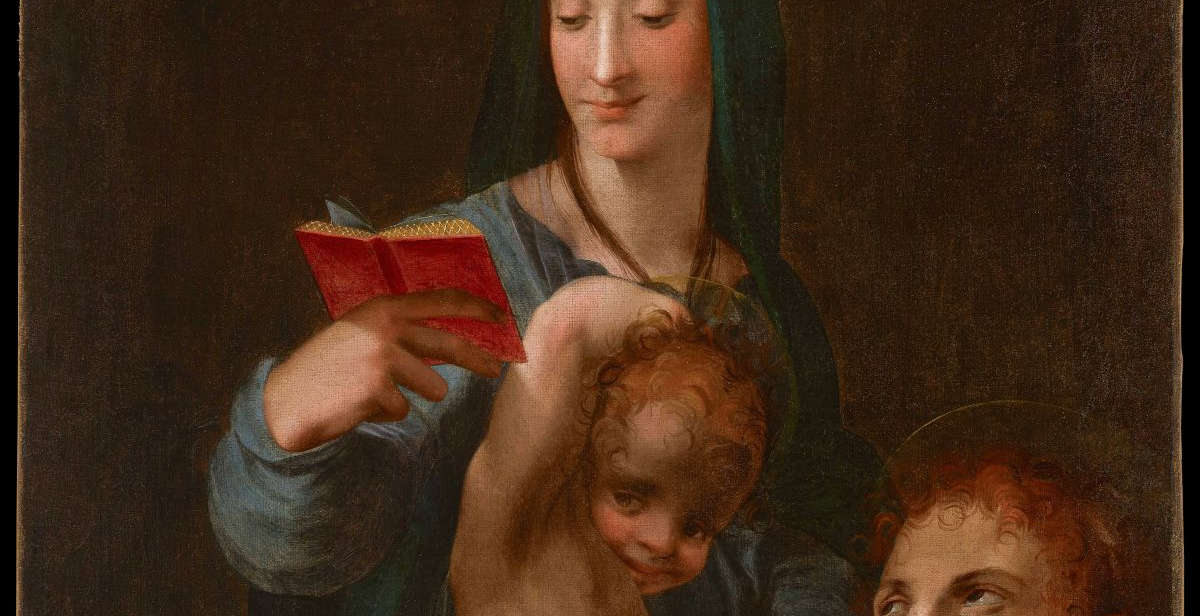 |
| The Madonna recently acquired by the Met is believed to be by Alonso Berruguete, not Rosso Fiorentino |
Warning: the translation into English of the original Italian article was created using automatic tools. We undertake to review all articles, but we do not guarantee the total absence of inaccuracies in the translation due to the program. You can find the original by clicking on the ITA button. If you find any mistake,please contact us.