





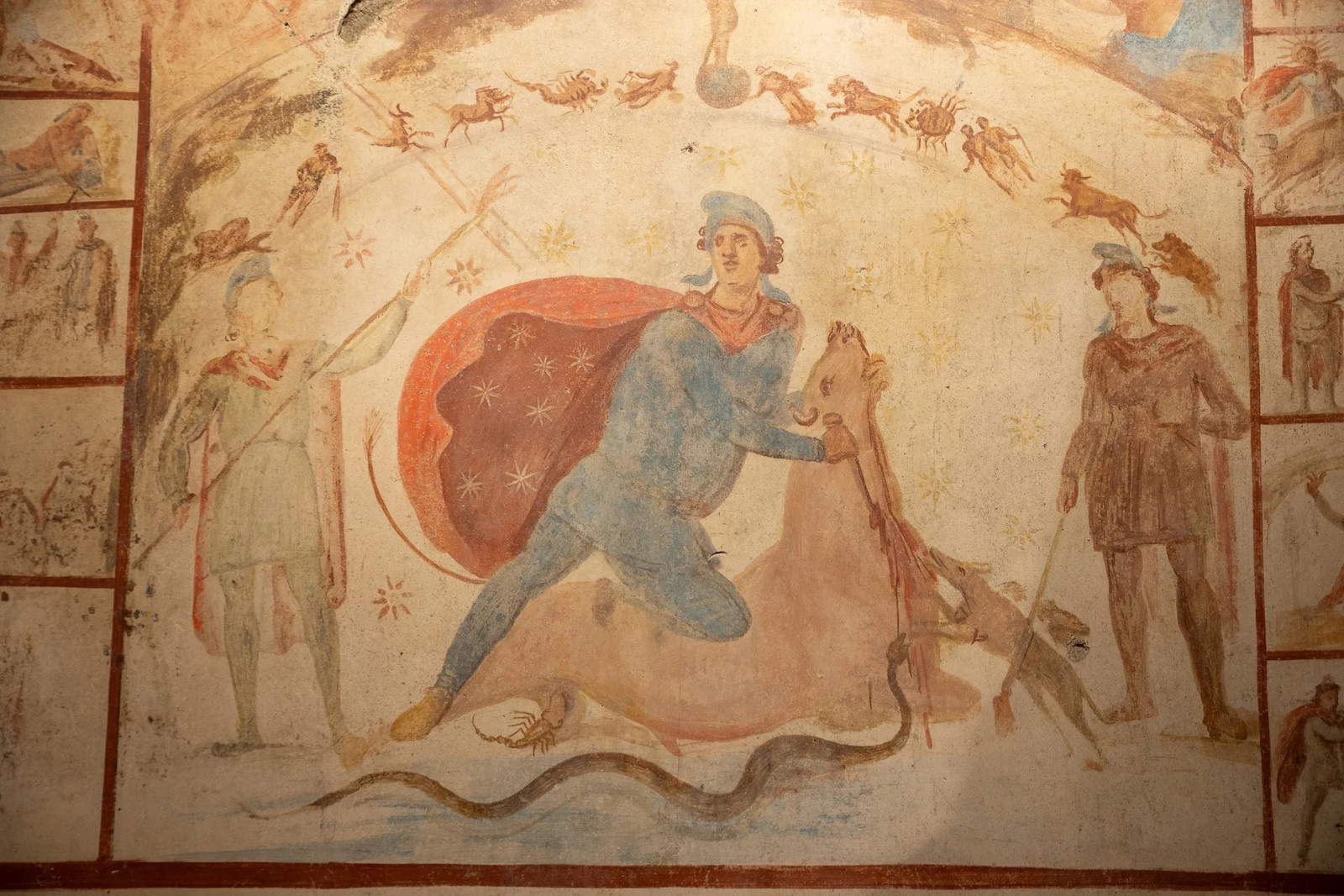
The Barberini Mithraeum, one of the most fascinating sites in underground Rome, will reopen to the public on October 3, 2026. The sanctuary of the ancient cult of Mithras, hidden beneath the Palazzo Barberini, houses one of the most significant depictions of the tauroctony—the scene depicting the god in the act of sacrificing the bull. The Mithraeum will be open to the public every Saturday, with guided tours at 10 a.m., 11 a.m., and 12 p.m. The tour allows visitors to enter a place of worship that remains deeply connected to its original function and to explore the history of the sanctuary, the architectural features of the Mithraeum, and the complex symbolism of the cult of Mithras.
The earliest records of archaeological finds in the area now occupied by Palazzo Barberini date back to the 16th century, when the Quirinal Hill was the site of villas belonging to some of Rome’s most prominent families. The reopening of the ancient Via Alta Semita and the restoration of the area’s water supply—which took place during the pontificate of Sixtus V between 1585 and 1590—in fact encouraged the construction of new residences around the papal villa on the Quirinal Hill and, consequently, a series of excavations and earthworks. A new era of significant archaeological discoveries began after 1871, when Rome became the capital of the Kingdom of Italy. The construction of Via Nazionale and Via Quintino Sella profoundly transformed the urban landscape between the Quirinal and the Viminale, bringing to light rooms, artifacts, and structures that had been unknown until then.
It was precisely in this context that, in the summer of 1936, during construction work on the Savorgnan di Brazzà building, the so-called Barberini Mithraeum was discovered. The building, designed by Marcello Piacentini and Gustavo Giovannoni and now home to the Armed Forces Officers’ Club, stands in the area east of Palazzo Barberini, between the palace and the Salita di San Nicola da Tolentino. The sanctuary was originally part of a larger building complex. Its location, in the southern part of the Horti Sallustiani, appears to have been particularly well-suited to the needs of the community that frequented it: secluded enough to ensure a certain degree of privacy, yet close to gathering places. The Mithraeum was also located outside the boundaries of the pomerium, the sacred and legal boundary of ancient Rome. Its location could therefore also have held symbolic significance, situated in a border zone on both the political and religious levels.
Another important factor was the availability of water. The proximity of a large cistern, several nymphaea, and—further away—the Baths of Diocletian ensured a necessary resource for the ritual practices associated with the cult of Mithras.
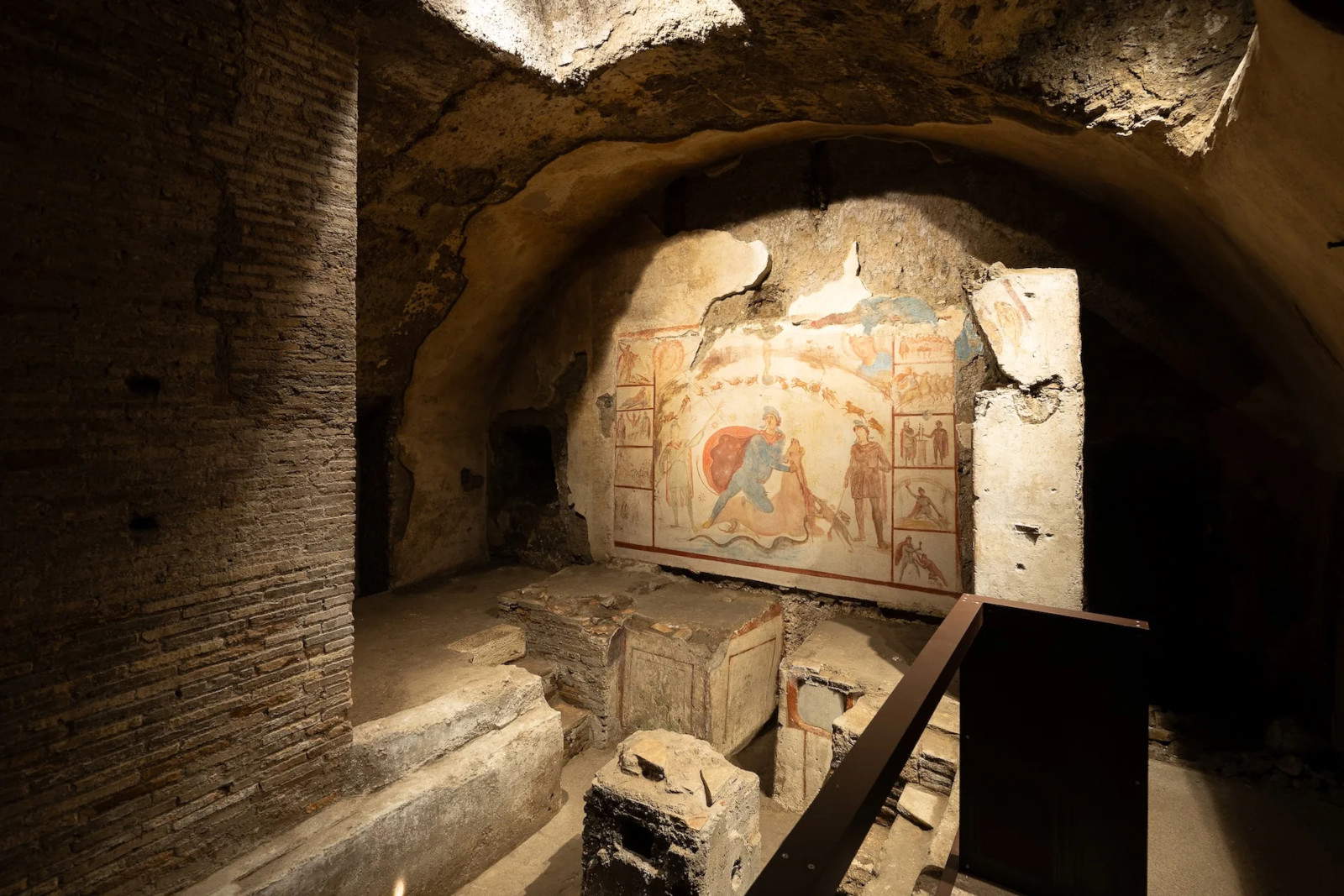
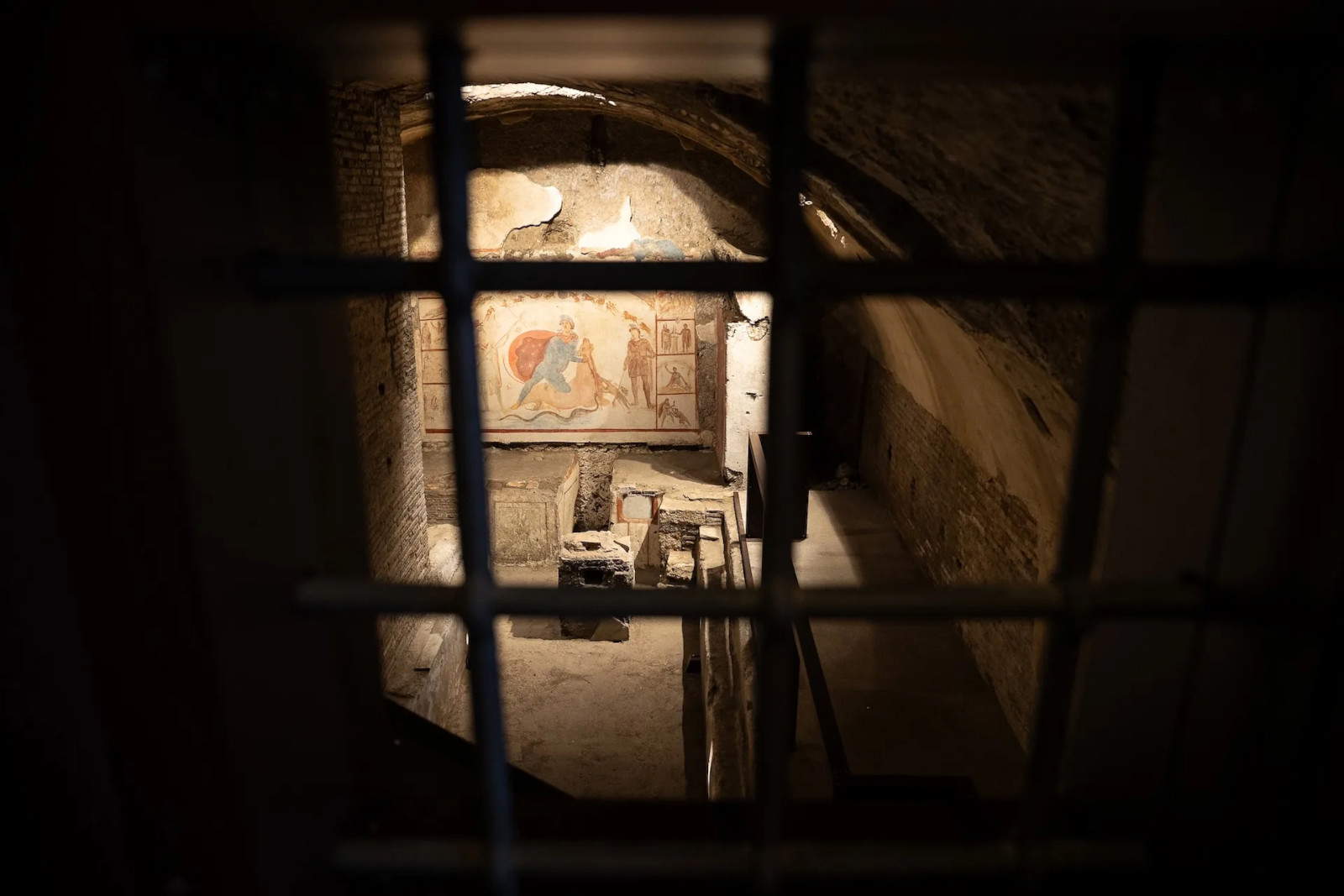
Mithras is a deity of Indo-Iranian origin, associated in the original pantheon with Varuna, with whom he represented the two aspects of the sky: the diurnal and the nocturnal. The cult of Mithras, which developed during the Roman era, belonged to the mystery religions and had distinctive characteristics, beginning with the choice to perform rituals indoors. These places of worship are today called mithraea, from the Latin *mithraeum*. They were generally relatively small spaces, designed to meet the needs of the community and adapted to the characteristics of the terrain. A fundamental element of their architecture was the reference to a cave. According to mythological tradition, Mithras was born in a cave and had captured a sacred bull, leading it to another cave to perform the animal’s sacrifice. The speleum thus became, for his followers, a representation of the mythical space in which the fundamental episodes of the god’s salvific story had taken place. For this reason, many mithraea sought to reproduce the appearance of a cave through the layout of their rooms and the use of materials.
Inside the Mithraea, the layout of the space was designed to meet the needs of the ceremonies. The main hall was generally rectangular and featured benches along its two longer sides where participants in the sacred banquet—one of the central practices of the cult—took their seats. The building’s orientation relative to the sun and the cardinal points could also carry symbolic significance. The internal layout of the Mithraeum itself was linked to the cult’s complex cosmology: according to one interpretation, Mithras ideally presided over the central corridor, flanked by the figures of the two torchbearers, Cautes and Cautopates.
Cosmic symbolism also recurs in numerous decorative elements of the Mithraea, where references to the zodiac and astrology appear. The entire space could thus be interpreted as a scaled-down representation of the cosmos, in which architecture, images, and rituals all contributed to constructing the meaning of the cult. At the center of the Barberini Mithraeum’s decoration lies the tauroctony: the depiction of the sacrifice of the bull is one of the fundamental elements for understanding the complex symbolism associated with Mithras and is today one of the main attractions of the sanctuary.
With its reopening, the Barberini Mithraeum is once again accessible to the public through a tour that allows visitors to descend beneath modern Rome and explore one of the spaces where a community once secretly celebrated its rites dedicated to Mithras.
|
| In Rome, the Mitreo Barberini—the sanctuary of Mithras hidden beneath the Barberini Palace—reopens to the public |

Warning: the translation into English of the original Italian article was created using automatic tools. We undertake to review all articles, but we do not guarantee the total absence of inaccuracies in the translation due to the program. You can find the original by clicking on the ITA button. If you find any mistake,please contact us.






















 IT
IT FR
FR DE
DE ES
ES CN
CN


