





I fear that, at this point, it is no longer possible to identify the external agent responsible for Aldo Cazzullo’s nucleotide recombination. The mutagen that was able to transform this staid and routine columnist for the Corriere—who, until recently, was found in bookstores at most with a few sluggish, chaste, and harmless forays into Piedmontese topics— into a sort of Alberto Angela of the printing press, a Bruno Vespa for the progressive middle class, a Teseo Tesei of national solemnity—ready every fall to storm the anniversaries of our nation’s history aboard his 260-page leeches. Is the 200th anniversary of the Unification of Italy coming up? Cazzullo has already flooded bookstores in historic centers and hypermarkets with his book on the Risorgimento. Are we marking the 100th anniversary of our entry into World War I? There he is, immediately booked as the headliner for all of Italy’s cultural festivals to draw jubilant crowds of substitute teachers on vacation with his tale of our grandparents’ war. Have exactly seven centuries passed since his father, Durante, met with the misfortune of not emerging alive from the Comacchio marshes? Give Cazzullo time to find a phone booth, and he’ll emerge dressed as the impeccable Dante scholar. It’s difficult, therefore, to trace the reasons for this genetic mutation: the fact is that lurking within Cazzullo’s set of alleles was the variation of the popularizer in disguise. In disguise because Cazzullo then plays it down: “I’m not a popularizer,” he chirps at the end of his book on the Renaissance, “I’m not a popularizer; there isn’t a common folk listening and a scholar explaining—I’m just a storyteller.” Evidently, for the sake of self-justification, it matters little that, whenever a new book is about to come out, Cazzullo pops up on every possible medium—by land, sea, and air—to give half-hour interviews on every topic under the Italian sun, one year dressed as a biblical scholar, the next in the habit of a Franciscan tertiary, and the one after that possessed by the demon of Burckhardt—each time as if he were the supreme authority on the chosen subject.
Before some molecular biologist or exorcist expresses an intention to deal with Cazzullo, one can pick up his book on the Renaissance, released roughly a month ago and since then consistently at the top of the season’s bestseller list: there isn’t a newspaper, no podcast, no television program that doesn’t feature a cameo by Cazzullo, summoned to spout all the most hackneyed academic platitudes about the Renaissance in order to convince Italy’s surveyors and administrative clerks—slumped on their couches—to buy his book. Of course, in his media appearances, Cazzullo does nothing but repeat ad nauseam what’s written in the book, so we can start right here, with *Quando l’Italia rinacque*. Our Renaissance. We won’t bother tallying up all the blunders—and in this sense, the book is a sort of minefield: for example, Ghiberti, who “won the famous competition for the door of the Baptistery, later called the Door of Paradise” (no: the competition was for the north door; the “Door of Paradise” was awarded to him by direct commission more than twenty years later), Jacopo de’ Pazzi, who on April 26, 1478, “gathered his brother Francesco and the other conspirators at the family villa” (no: Francesco was his nephew), and Michelangelo’s fresco of the Battle of Cascina, which “did not come to pass” (no: it was never actually painted; in fact, it is likely that Michelangelo had not even finished the preparatory work). One could limit oneself to these examples, and that might suffice as an exercise in pedantry (after all, this is how the demand for precision is perceived today—or at least that’s how it’s perceived by an audience that, evidently in Cazzullo’s mind, is assailed by unbearable headaches if they come across a concessive clause in the text or have to line up two dates).
But let’s even suppose that asking for a little more rigor regarding commissions, family ties, dates, and figures is the obtuse, professorial stubbornness of the usual library old-timers. The defense attorneys will argue that Cazzullo is, after all, a storyteller, and that storytelling—since the dawn of time, or at least since cave dwellers gathered around the fire to listen to what the clan chief had to say (who certainly could not consult a specialized bibliography)— is a narrative genre rooted in collective memory, shared heritage, and oral tradition; therefore, what matters is not the exact date or the precise sequence, but the concept. And besides, says the advocate, if one wants the exact date or a detailed reconstruction, one can always look elsewhere; there is an endless body of scholarly literature on the Renaissance, and even Cazzullo, once his story is finished, offers some guidance as needed, so that his reader is spared the trouble of searching on his own. But let’s suppose there are hordes of voracious, omnivorous Cazzullo fans who, dissatisfied with this master of parataxis’s popular novel about the Renaissance, will bring the printing presses of half of China to a standstill by demanding reprints of *The Civilization of the Renaissance in Italy*. What about everyone else? What about all those for whom the last time they dealt with the Renaissance was in their junior year of high school, and who therefore lack any means of protection (and, at this point, it’s safe to assume the same applies to readers of the Dante-scholar Cazzullo, the biblical Cazzullo, the Franciscan Cazzullo, the classical scholar Cazzullo, the feminist Cazzullo, the military historian Cazzullo, the historian of the First Republic Cazzullo, the historian of fascism Cazzullo, the historian of the Risorgimento Cazzullo—and who do not have a firm grasp of the subject)? What about the indolent reader for whom it is far too much of a struggle to navigate Cazzullo’s subject-verb-predicate-period sequences? I’m not a biblical scholar—how can I trust Cazzullo when he speaks to me about Genesis if I realize he’s so stubbornly vague on the Renaissance? Again: the error regarding the date or the artistic patronage, says the defense attorney, slips away like flakes of dry skin peeling off the eyebrows. The one about Ghiberti, for example, is a side note that the reader will have forgotten just two pages later. What matters are the concepts.
The problem, the prosecutor counters, is that to find these concepts, one must first carefully sift through a modest concoction crammed with episodes, anecdotes, and whispers that fill most of the book. By the end of *Quando l’Italia rinacque*, the reader will learn, for example, that Savonarola had luxury goods burned in the public square, that Leonardo da Vinci organized parties for the King of France, that Raphael was polite and kind to everyone, and that he even happened to paint a piece for Città di Castello (or, rather, for the “city of Monica Bellucci,” as our author titles the chapter on the early years of the man from Urbino), that Michelangelo was surly and stingy, and that Ariosto detested traveling but let his imagination run wild. The bulk of the book is like this: a docile review of the biographical anecdotes studied in high school, packaged with the bare minimum of syntax and the laziest use of adjectives in Italian publishing, so works of art are always “wonderful” or at most “splendid” (or both at once), the faces of the figures are always “beautiful,” the patrons are always “rich” or “extremely rich,” and so on. Of course, the reader may also forget that Cazzullo is serving up a sort of Renaissance soap opera —a styrofoam Renaissance—that retains only the appearance of the historical period without its substance, a sort of distillation of all the TV dramas that have aired in recent years, from *The Borgias* to *Leonardo da Vinci* to *The Medici*—the ones that Cazzullo’s readers have probably overlooked because they have a TV at home but never watch it (at most, if they really have to turn on a general-interest channel, just *Otto e Mezzo*, *Propaganda Live*, and Gramellini’s talk shows). He can forget about this serialized novel, because what matters are the ideas. And yet, says the prosecutor, we’re lacking even in ideas, and that’s worse than getting a few dates wrong.
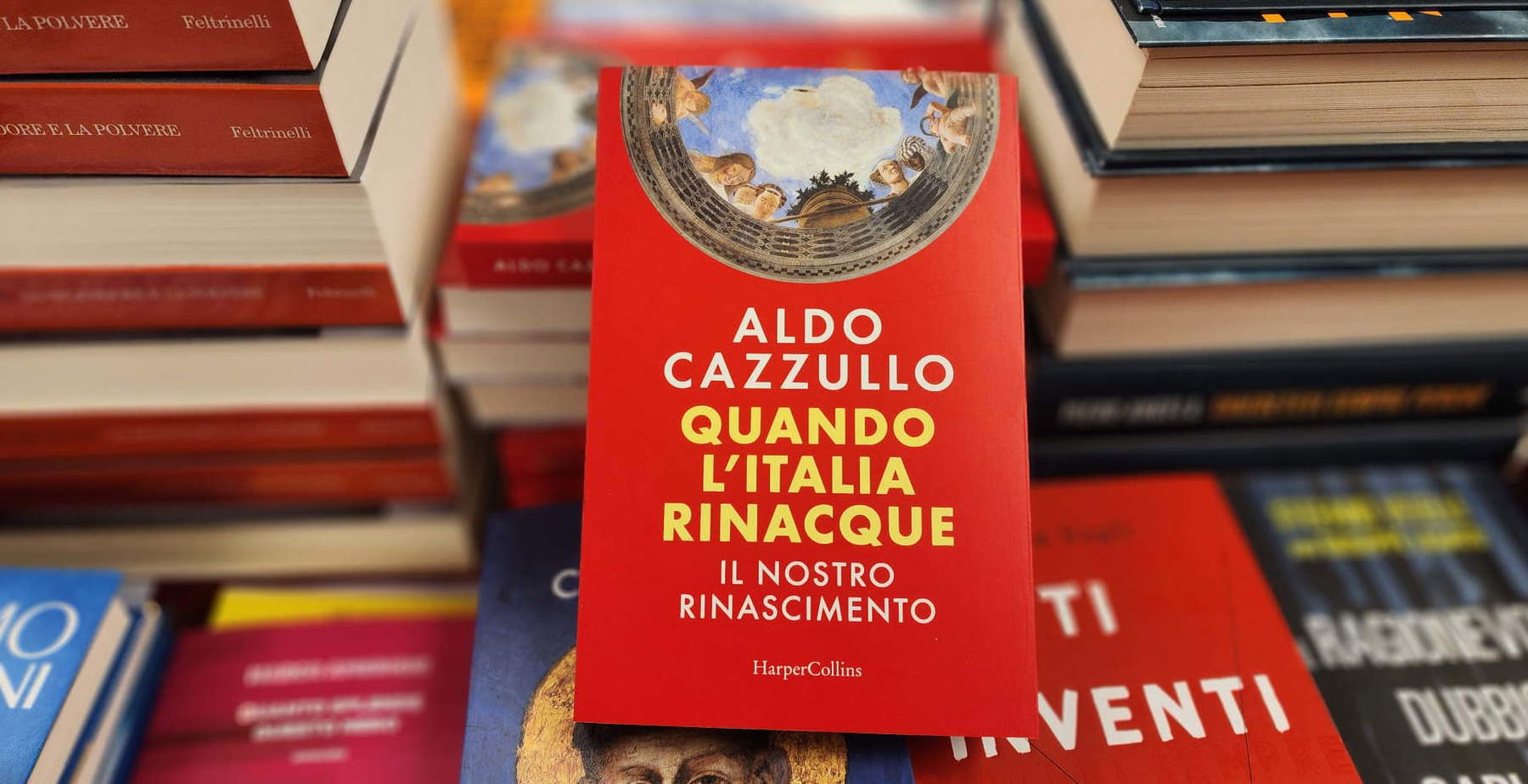
Let’s take a few ideas from the book, starting with a passage in which Cazzullo asserts, with barely concealed patriotic pride, the indisputable Italian origins of the Renaissance: “Humanism and the Renaissance are the true gift that we Italians have given to humanity. Our great contribution to universal civilization, without which nothing—not even the current technological revolution—would have been possible. The time when Italy was reborn was the time when Italy set itself a mission: to build a bridge between the classical era and the Christian era, between the Rome of the Caesars and the Rome of the Popes. Of course, Italy was not a unified state, and would not become one for a long time yet. But when Raphael wrote to the Pope imploring him to save the vestiges of ancient Rome, he called it ‘the mother of Italian glory and greatness.’ It is an Italy rediscovering itself. “It does not arise from nothing, nor does it perish into nothing.” This is an example of the ordinary, predictable, conversational rhetoric that permeates most of the few pages that Cazzullo does not devote to recounting individual episodes. Setting aside the idea of the existence of a sort of national mission (attributed, moreover, to a collective entity, the “Italians,” which becomes the unlikely custodian of a complex historical phenomenon that, moreover, unfolded across a politically fragmented territory where, if an idea of “Italy” existed at all, it resided only in the minds of a very few), and setting aside the anachronism of an “Italy rediscovering itself” (as if there were an “Italy” that had, moreover, found itself again—which would imply there was a period when it had been lost), all of which is material suitable only for national mythologies, one might pause to consider the value of that supposed mission: indeed, the Renaissance did not invent a dialogue between classical culture and Christianity; the Middle Ages, too, had always cultivated a dialogue with antiquity. With some extreme oversimplification—which nonetheless introduces at least a slightly higher degree of complexity and historical accuracy than that expressed by Cazzullo’s simplistic take—one could tentatively observe that what had changed, if anything, were the nature, the awareness, and the scope of that dialogue—that the attitude toward classical culture had changed. In the Middle Ages, for example, no one had ever stopped studying Plato: for Petrarch, however, it was the foundation of a moral philosophy; for Marsilio Ficino, it was a worldview. In the Middle Ages, there were countless artists who continued to take the reliefs on Roman sarcophagi as models, but while for Giovanni Pisano the ancient world was a formal repertoire to be reinterpreted, for Donatello it had become a tool for discovering the natural. To get there, however, we would need to explain to the reader that history is best understood by tracing its transformations rather than by reading labels; but I seriously fear that doing so would make the reader feel uncomfortable—as if they were not as well-prepared as they thought.
In short, it seems that Cazzullo has been entrusted with the task of smoothing over any discussion of the Renaissance, of flattening out every rough edge, and of lending publication-worthy dignity to the popular national image of the Renaissance— the one that roughly corresponds to Italians who know how to dress well and furnish with taste, to the Italian Constitution—which is the most beautiful of all—and to Italy, which possesses the lion’s share of the world’s cultural heritage. If anyone attempts to find traces of other histories in Cazzullo’s book, at best they will encounter gross downplaying: the contribution of the Byzantine masters, for example, is limited to the transmission of “Greek authors who in the Middle Ages were known only indirectly, through brief quotations or Latin and Arabic translations.” It is true that, broadly speaking, Greek culture was neglected until the mid-fourteenth century, but the Byzantine masters did not merely act as couriers for humanism; their contribution went beyond mere logistics: they disseminated a philological method, fostered dialogue with the East, taught the Greek language at universities and in private, and strengthened knowledge of the Greek philosophers; without this contribution, the class of humanists—which Cazzullo regarded as a sort of Italian gift to the rest of the world—would likely never have emerged. Another—and perhaps even more pernicious— flaw in Cazzullo’s book is the idea that the three great artists of the time (Leonardo, Michelangelo, and Raphael—more than half the book is a sort of condensed summary of their biographies)—had not studied, and that they made up for their lack of literacy with curiosity. It’s almost as if to say that if you have unparalleled talent and voracious curiosity, then that’s all you need to be a genius: now, without getting into the details of their education—which was, in any case, far above the average for the time (Leonardo, toward the end of his life, owned a library of more than two hundred volumes, a rarity in an era when books were luxury items, Michelangelo was well-versed in Dante and Vitruvius, Raphael was the son of a literate artist—a rare occurrence—and although the details of his education are unknown, one must imagine that he grew up in an exceptionally stimulating environment), one could say that artists at the time entered an apprentice workshop immediately and studied diligently, even if they focused on what fell within their field of expertise, and generally continued until they came of age or, in any case, until they achieved independence. It was not, of course, a university education, since the workshop was a place of primarily practical knowledge—a knowledge that favored hands-on experience and consequently taught, above all, a craft: and yet it is difficult to imagine an apprentice in a Renaissance workshop as some sort of curious laborer, a craftsman limited to manual labor, a tradesman who was not expected to have at least some basic knowledge of theology, mythology, and literature—if only to encounter them fleetingly amid the shadows of what he was sculpting or painting. And again, another example from Cazzullo’s book: the idea of a Renaissance that proceeds “in waves”: “There are the precursors, Dante and Giotto. There is the great explosion of the early fifteenth century: Masaccio, Ghiberti, Brunelleschi, Donatello, and Beato Angelico. Then, after a less dynamic period, there will be the great wave at the end of the century, when the young and prodigious talents of Leonardo, Raphael, and Michelangelo emerge.” As if nothing had happened in between: clearly, if your stated sources in the visual arts are, for the most part, the books found on the shelves at highway rest stops, it’s only natural to overlook the significance of a Perugino, an Antonio del Pollaiolo, a Verrocchio, a Botticelli, or a Piero di Cosimo, and end up thinking that not much happened between Beato Angelico and Leonardo—or, at most, that that period was “less dynamic.”
The Renaissance, writes Cazzullo toward the end of his magnum opus, “is a very long and very rich historical period,” and at the end of these nearly three hundred pages of prose reminiscent of a fifth-grade exam, the question creeps in—with natural suspicion—as to the identity of the audience for whom the book seems intended, perhaps for reasons the reader himself is unaware of, or that the book nonetheless attempts to please and appease, assuming that the reader already knows the history Cazzullo is recounting and needs, at most, a refresher that spares him the trouble of thinking. And since there is, essentially, no interest in surprising the reader, in provoking them, or in putting them in a position to think, Cazzullo’s book is a sort of long verbal coquetry aimed at an audience that must have mistaken popularization for ease—and consequently, the book seeks to spare them any effort whatsoever. A modest consumer product with a license to be vague, designed for an audience that, upon reading about an “opulent” city rather than a “rich” one, would likely be forced to rummage through a dictionary—and is thus spared the trouble—an audience for simplified crossword puzzles, an audience of twelve-year-olds seeking validation and gratification, an audience that needs to be reassured with the idea that they’re different from the rabble who watch TV dramas on RaiUno (even though the subject matter is the same—always Leonardo, always the Borgias, always the Medici, always Michelangelo—only presented in written form and less entertaining), to be consoled with the perception that they’re cultured enough to have a view of the Renaissance entirely similar to that of the most popular bookstore author, to be reassured with the image of a “Styrofoam” Renaissance accessible to anyone. A reader perhaps imagined even before a real reader exists, but by constantly portraying him as so uncultured, so ill-equipped, it’s likely that over time he’ll actually become just that. And maybe the reader won’t even get pissed off if they’re treated like the recipient of a little essay written on a school trip to Florence—on the contrary: they’ll probably end up thanking him. With Cazzullo, the Renaissance has become a bedtime story.

The author of this article: Federico Giannini
Nato a Massa nel 1986, si è laureato nel 2010 in Informatica Umanistica all’Università di Pisa. Nel 2009 ha iniziato a lavorare nel settore della comunicazione su web, con particolare riferimento alla comunicazione per i beni culturali. Nel 2017 ha fondato con Ilaria Baratta la rivista Finestre sull’Arte. Dalla fondazione è direttore responsabile della rivista. Ha scritto i libri Vero, Falso, Fake. Credenze, errori e falsità nel mondo dell'arte (Giunti editore, 2025) e Immagini del potere. Arte e propaganda da Augusto a Trump (Giunti editore, 2026). Collabora e ha collaborato con diverse riviste, tra cui Art e Dossier e Left, e per la televisione è stato autore del documentario Le mani dell’arte (Rai 5) ed è stato tra i presentatori del programma Dorian – L’arte non invecchia (Rai 5). Al suo attivo anche docenze in materia di giornalismo culturale all'Università di Genova e all'Ordine dei Giornalisti, inoltre partecipa regolarmente come relatore e moderatore su temi di arte e cultura a numerosi convegni (tra gli altri: Lu.Bec. Lucca Beni Culturali, Ro.Me Exhibition, Con-Vivere Festival, TTG Travel Experience).
Warning: the translation into English of the original Italian article was created using automatic tools. We undertake to review all articles, but we do not guarantee the total absence of inaccuracies in the translation due to the program. You can find the original by clicking on the ITA button. If you find any mistake,please contact us.























 IT
IT FR
FR DE
DE ES
ES CN
CN


