




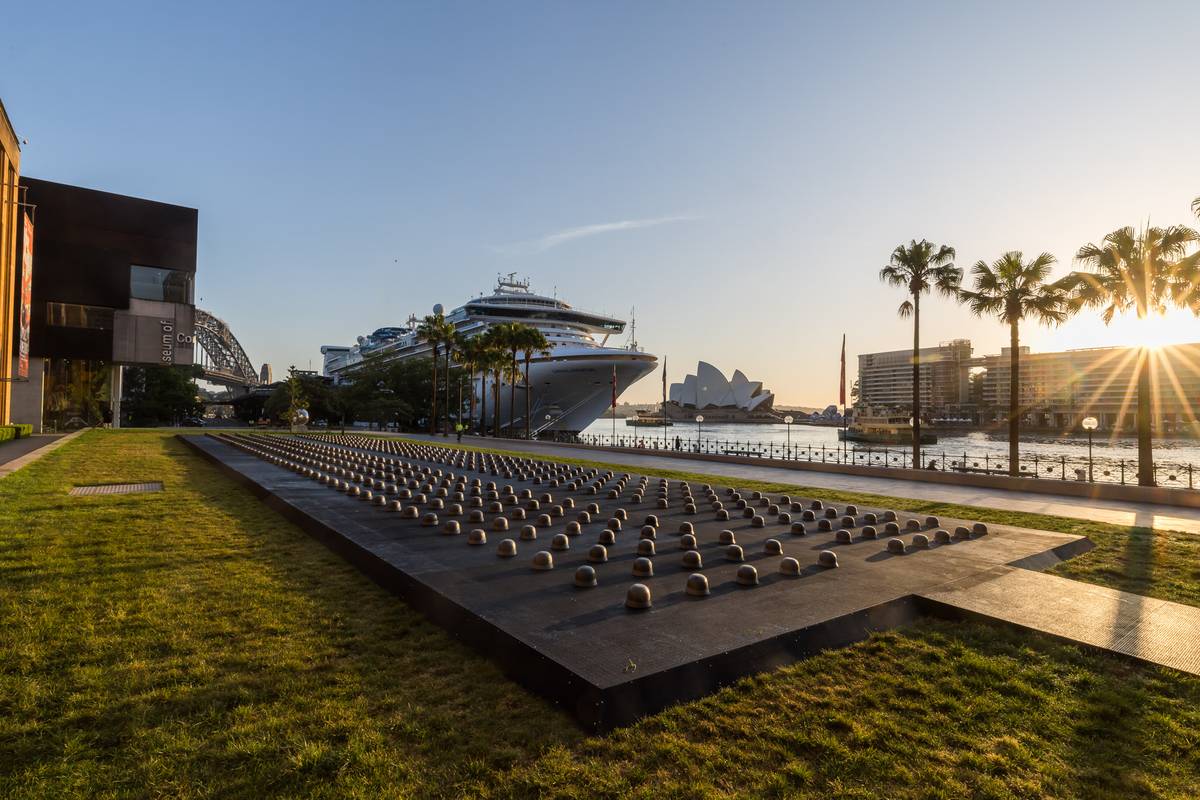
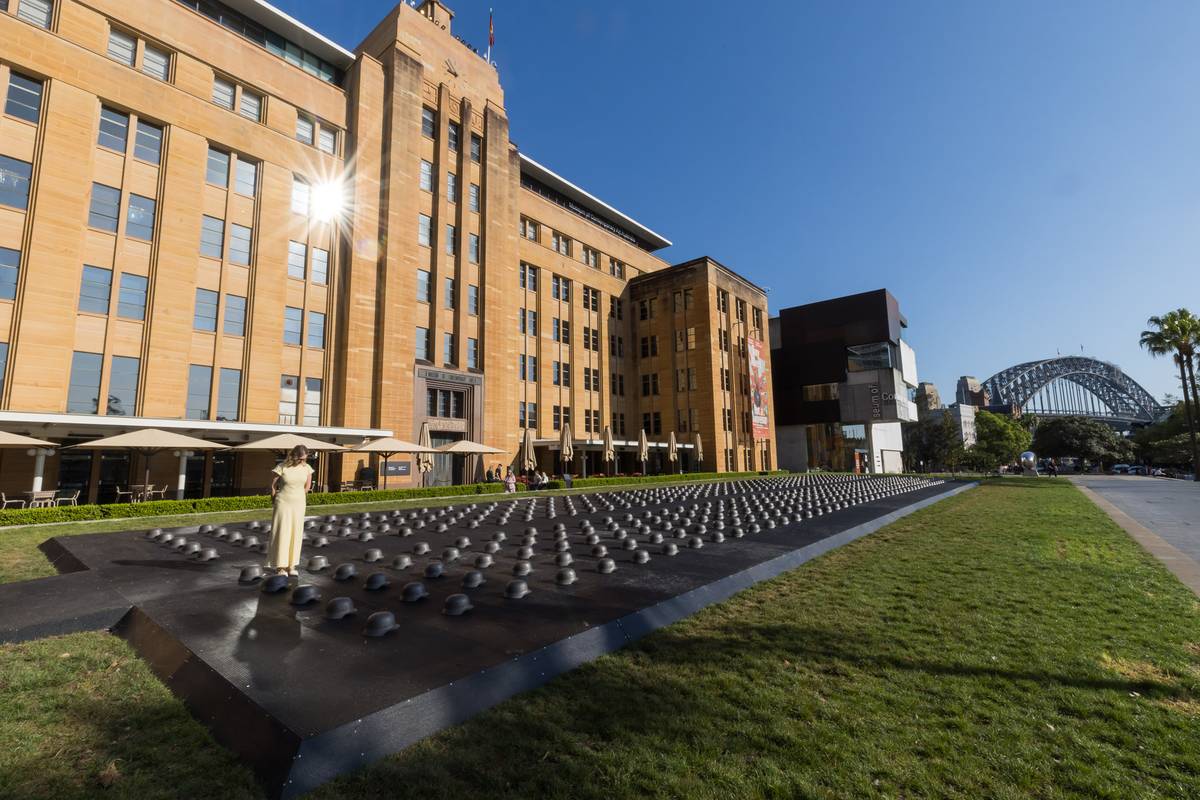
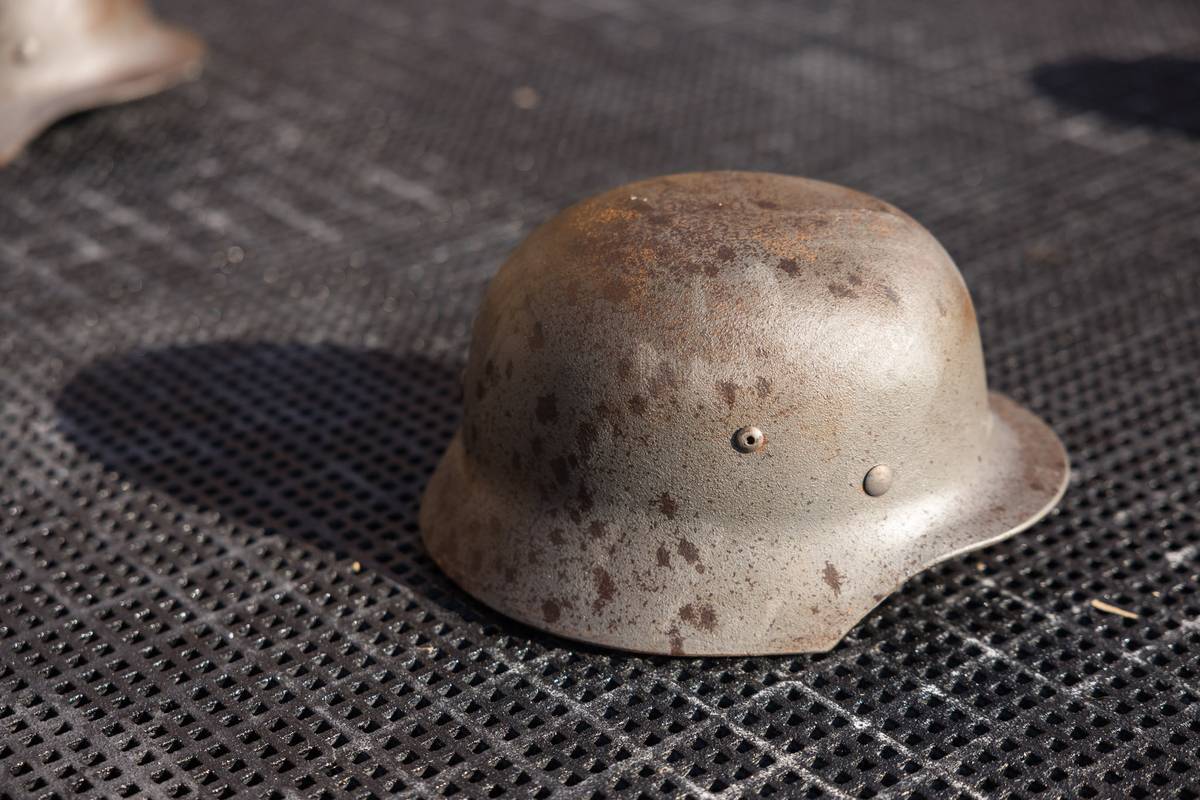
Five hundred military helmets—all identical only in appearance—span forty meters across the lawn in front of the Museum of Contemporary Art Australia in Sydney. Made of cast iron, they faithfully reproduce various models of 20th-century combat helmets and, arranged side by side, form *Mushrooms*, Ai Weiwei’s new public installation. The work was commissioned for the Museum of Contemporary Art Australia’s Neil Balnaves Tallawoladah Lawn Commission and will be on view from September 25, 2026, through April 2027. The public is not merely invited to view it from the outside: a central path allows visitors to walk through the installation, navigating among the hundreds of helmets and observing their differences.
It is an image that brings a recognizable and tangible object of war to the forefront, yet removes it from its original purpose. The helmets no longer protect soldiers: they have become a multitude of sculptures, placed in front of the museum and overlooking Sydney Harbor. In the transformation carried out by Ai Weiwei, the object designed for survival in combat thus becomes the starting point for a reflection on the fragility of life and the human cost of conflict.
The idea for *Mushrooms* stems from a specific incident. In 2022, the German government donated 5,000 helmets to Ukraine—a gesture that drew criticism because Ukraine had expected a more concrete act of support from Berlin at the outset of Russia’s war of aggression. Ai Weiwei took this event as the starting point for a new work in which combat helmets take on the meaning of symbols of resistance and survival, and their large-scale repetition makes the collective dimension of war visible, while the presence of each individual object evokes the person who might have worn it.
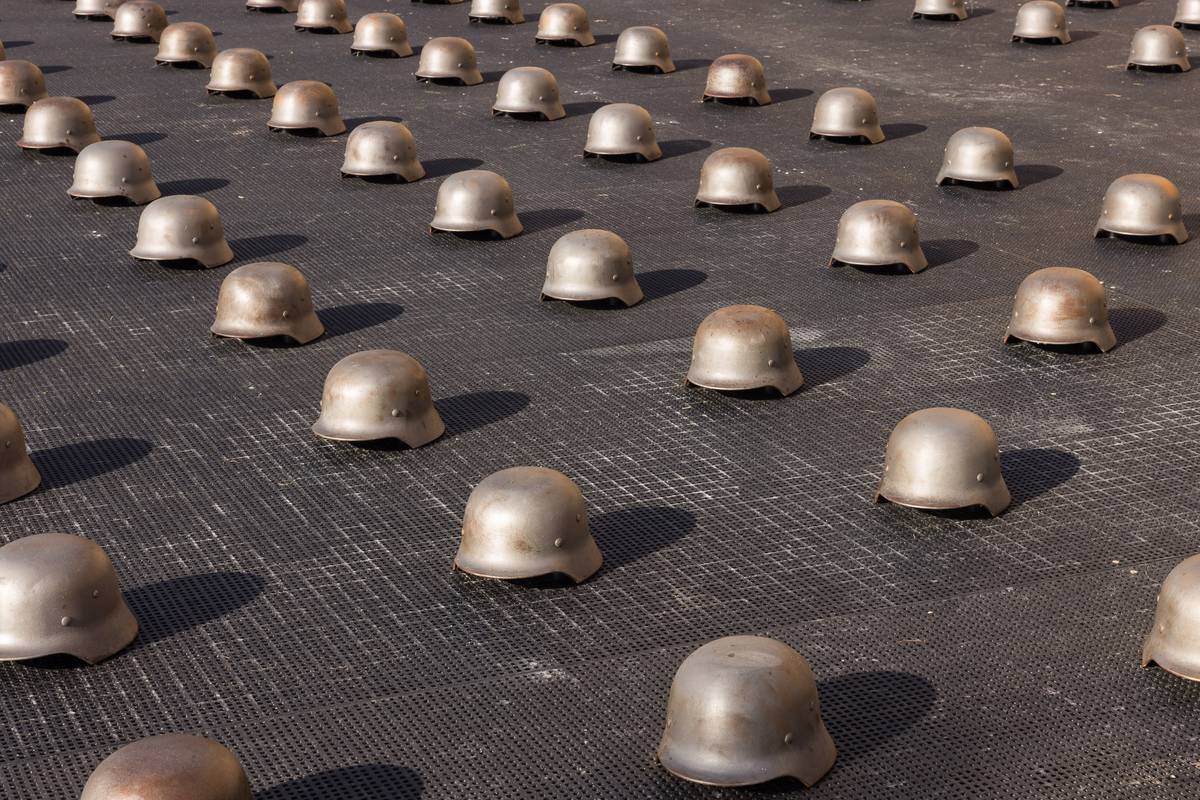
To create the 500 sculptures, the artist enlisted several artisans tasked with producing replicas based on models of 20th-century military helmets. Each piece was cast from a single mold and is a 1:1 replica of the original. Not only was the external shape reproduced, but each sculpture also retains the internal padding of the model that inspired it. The decision to reproduce different models thus introduces a series of variations within the installation’s vast mass. From a distance, the 500 helmets may appear as a compact whole; walking through them, however, visitors can discern the differences between the individual sculptures and compare the shapes of the various military models.
Ai Weiwei accompanies the work with a reflection on the present. “In the era in which we live, the 21st century,” the artist states, “wars have not ceased. We continue to live in a time when war and peace constantly swap roles, shaping the identity of our era. I hope this work will prompt people to reflect on war and peace.”
The issue of war is, after all, no stranger to Ai Weiwei’s recent work. Over the course of more than forty years, his practice has spanned sculpture, film, architecture, writing, and social media, often questioning the relationship between the individual, power, and authority. In recent years, the artist has also created works inspired by his own travel experiences in conflict-affected regions of Ukraine. “Mushrooms” thus forms part of a trajectory in which public art also becomes a tool for bringing political and social issues into everyday life. Ai Weiwei’s body of work includes numerous pieces in which objects and materials are stripped of their usual function to take on new meanings.
Ai Weiwei has already had a significant presence in Australia as well. In 2017, he created *Law of the Journey* for the 21st Sydney Biennale in 2018 and has exhibited at various institutions across the country. With *Mushrooms*, he now returns to engage directly with the Australian public space, this time through a commission designed specifically for the lawn of the Museum of Contemporary Art Australia. The Neil Balnaves Tallawoladah Lawn Commission is, in fact, an annual series dedicated to the creation of large-scale sculptural works by contemporary artists, installed outside the museum. The commission is supported by the Balnaves Foundation and was established to celebrate the life and legacy of entrepreneur Neil Balnaves, who passed away in 2022, and his philanthropic commitment to the arts.
The series was inaugurated in 2025 with *Ancient Feelings* by British artist Thomas J. Price, and the idea is to bring contemporary works to the Tallawoladah waterfront so that the public can encounter them even outside the museum’s interior spaces. Each year, an artist is invited to create a work specifically for this setting, offering a direct encounter with contemporary sculpture in a public space. With *Mushrooms*, the second commission in the series, the museum’s lawn thus becomes the site of a sculptural presence that cannot be separated from the theme from which it originates. Five hundred helmets, created as replicas of military models, transform a symbol of war into a work that visitors can physically walk through.
|
| Ai Weiwei fills the lawn of the Sydney museum with 500 combat helmets: it is his new artwork |

Warning: the translation into English of the original Italian article was created using automatic tools. We undertake to review all articles, but we do not guarantee the total absence of inaccuracies in the translation due to the program. You can find the original by clicking on the ITA button. If you find any mistake,please contact us.

















 IT
IT FR
FR DE
DE ES
ES CN
CN


