



by
Federico Giannini  @federicogiannini1
03/06/2026
@federicogiannini1
03/06/2026



Categories: Exhibition reviews / Disclaimer
What does Chiara Camoni's Italian Pavilion at the Venice Biennale 2026 look like? Imaginary archaeology, community and shared practices: "With you with everything" builds an evocative landscape of remarkable poetic intensity that nevertheless risks archaeologism and overload. Federico Giannini's review.

A sense of tacit and calculated disorder governs Chiara Camoni’s exhibition at the Italian Pavilion. It is the impression shared by every visitor who has just entered the Tese delle Vergini to test Con te con tutto, a “call to gathering,” as its curator, Cecilia Canziani, intended it to be, “an invitation to build a different way of being in the world through encountering and sharing with other forms of life.” It is an adventitious, confused, chaotic, unconscious, one-sided encounter, but it is an encounter nonetheless, and it is already something: one perceives, at the very least, a strong consonance with the theme of this Venice Biennale, with its imagery, with the practices that Koyo Kouoh has tried to bring out in the international exhibition. Induced to silence by the force of the sculptures that Chiara Camoni has collected in the first of the two Tese, visitors walk within an archaeological landscape, wander among the mother deities summoned by this elegant artist, by this tenacious bricoleuse who has the ability to see the soul of trees, earth, flowers, woods, and mountains. In an article published two years ago in Art and Dossier, Cristina Baldacci recalled that Chiara Camoni used to wake up early in the morning to indulge in long walks through the Apuan forests, where she lives and works, and collect the organic materials, grasses, woods, stones, loam, leaves that she then uses to assemble her sculptures. These ideal sisters of his(Sister has named some of the works born from this fruitful accumulation) descend from a kind of encounter that the artist tries, with dogged craft, to reproduce in all his exhibitions. A fundamental characteristic of his work, “which alludes to art as sisterhood,” says Baldacci again, “is the doing together, a practice that Camoni initiated from the very beginning, in 2001, when he started drawing with his almost 90-year-old grandmother, while she was not yet 30.” So we are not talking about curatorial superstructures, as is often the case (not that this exhibition shies away from that: Cecilia Canziani has built a solemn philosophical scaffolding that fishes from a whole shrine of feminist philosophy, from the ever-present Donna Haraway to Chiara Zamboni, from Karen Barad to Silvia Federici, although the references do not scratch the crust). No: Chiara Camoni’s is existential practice. A practice that, one might venture, lies on the borderline between sculpture and performance, a practice that needs an audience that becomes the very element of the work, since the poetry of this Italian Pavilion springs first and foremost from what one feels rather than from what one sees. And perhaps, it will be thought, this is also the risk of an exhibition immersed in the deep cavities of an archaeological excavation that reminds us, certainly, of an ancestral rituality, of the origins of aa festival, to a celebration that deals with divinities and the dead, even instilling a little fear, but in the end comes to welcome and reassure after having intimidated, as if this descent into the obscurities of a distant and pagan civilization (and, again: that’s something) rather resembles a homecoming. After all, it will be said, one moves into the territory of that recourse to archaeological evocation that is the foundation of so much contemporary Italian art, and not only Italian, and every tension ends up being resolved in a recognizable imagery.
Chiara Camoni’s works have a noble lineage, after all, and depend on that line of Italian and European sculpture which, at least since the middle of the last century, has measured itself against the impossibility of preserving a traditional idea of representation of the human being: thinking of a possible genealogy, it is necessary to go back to those sculptors (Marini, Martini, to a certain extent Giacometti and Campigli when he passed from two to three dimensions) who manifested a sincere interest in archaic forms, in the idea of a human figure conceived above all as a symbolic presence, in a modeling that did not intend to overshadow elements of the process, in a strong relationship with the plastic of antiquity, beginning first and foremost with the Etruscan. Marino Marini used to say that he was an Etruscan (for him it was something more than a kinship: he really felt like an ancient), and Chiara Camoni could reiterate, if she has not already done so, a similar claim to antiquity. One can continue, in this attempt to unearth references, with those artists of later generations who have extended the reasoning by imagining sculpture almost as a choral presence, as an element of an environment or a group, as an object liable to contamination (Mimmo Paladino, Antony Gormley, Magdalena Abakanowicz come to mind). Chiara Camoni’s sculptures are daughters of this line and another branch, coming from a purely female art with references to folk art, collective practices, shared authorship, theencounter with the community, traditional cultures (think, therefore, of Maria Lai, Marisa Merz, or, in some ways, especially for the relevance attributed to manual labor and the relationship with the material, even Nedda Guidi or Anna Maria Maiolino).


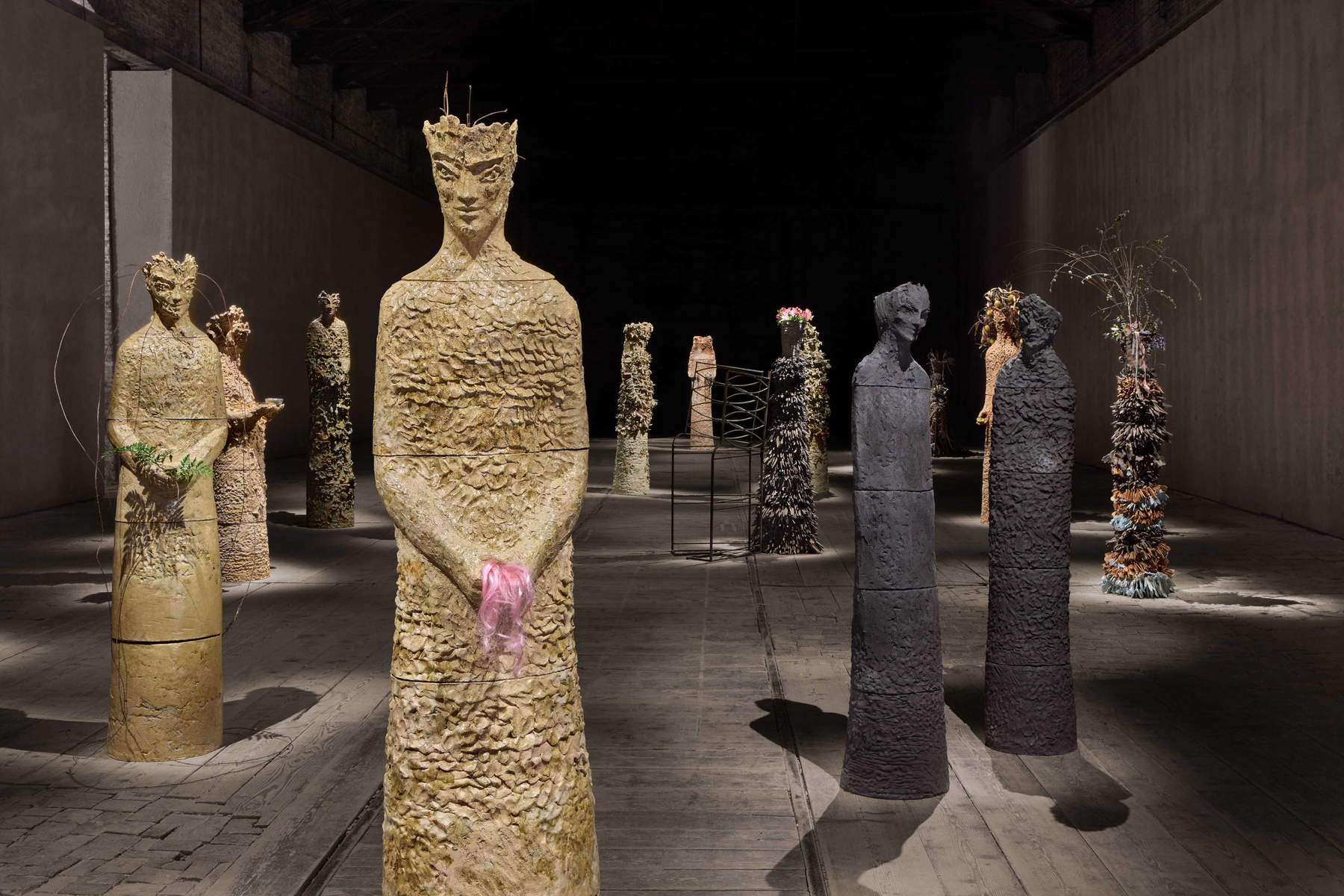
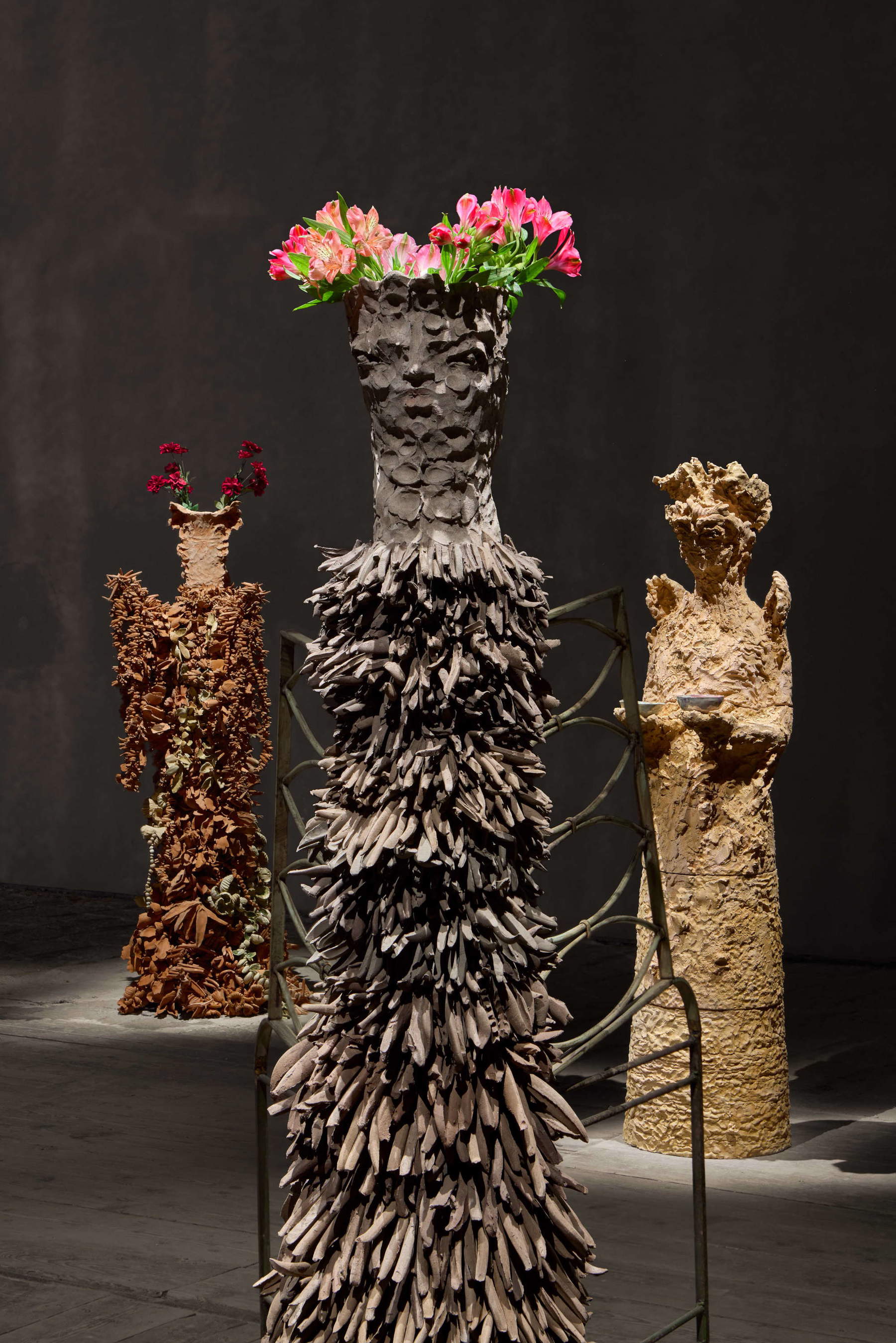
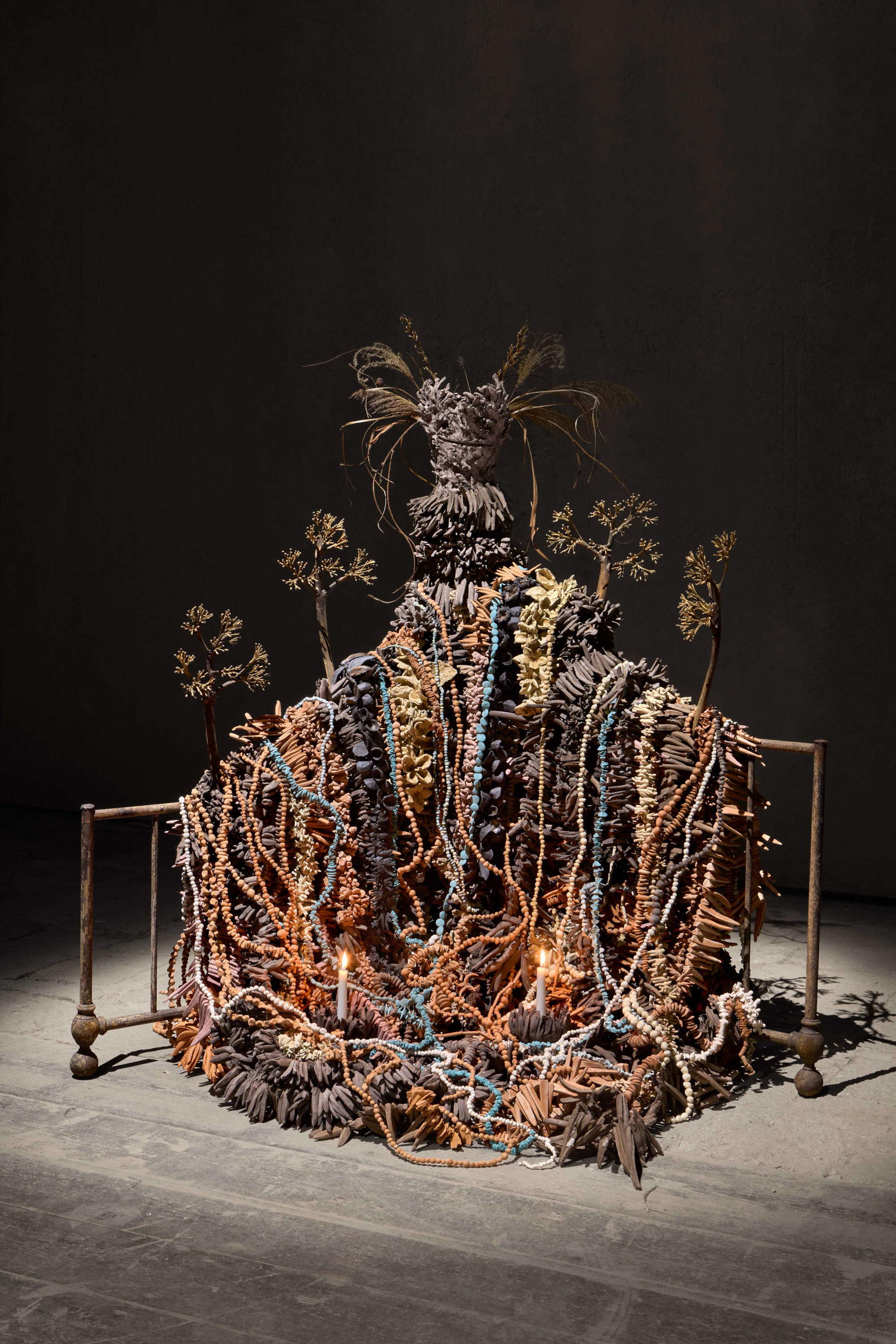
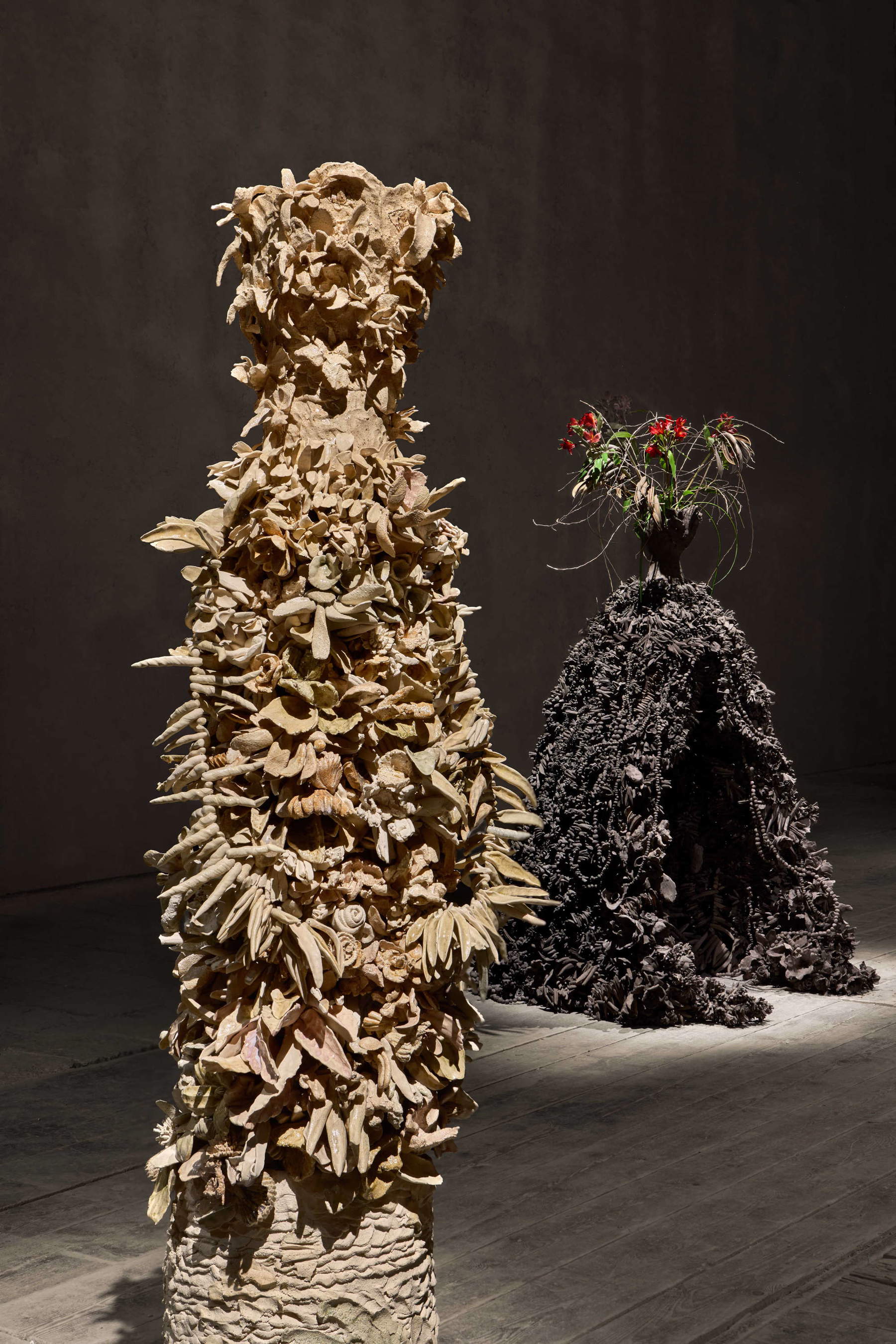
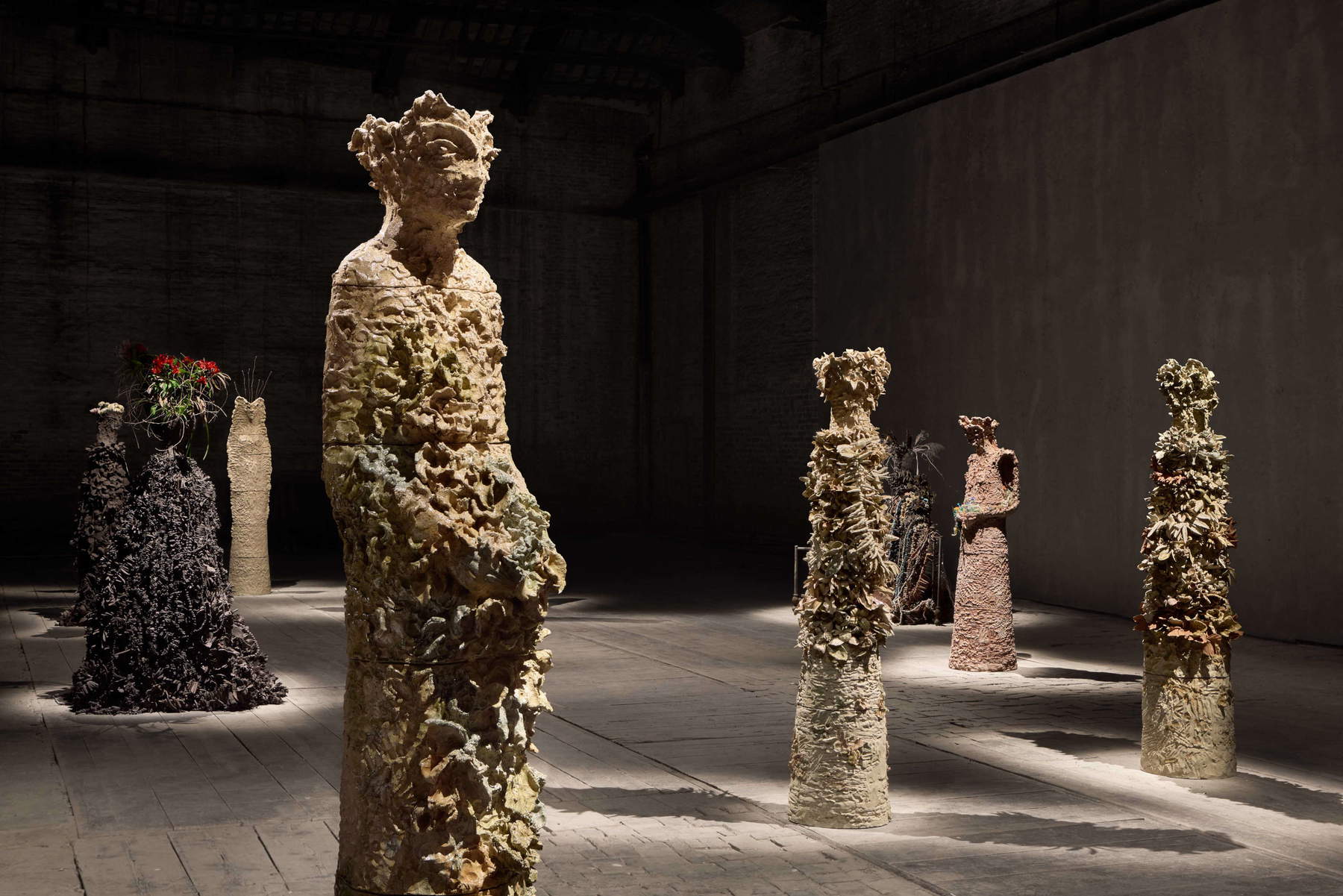
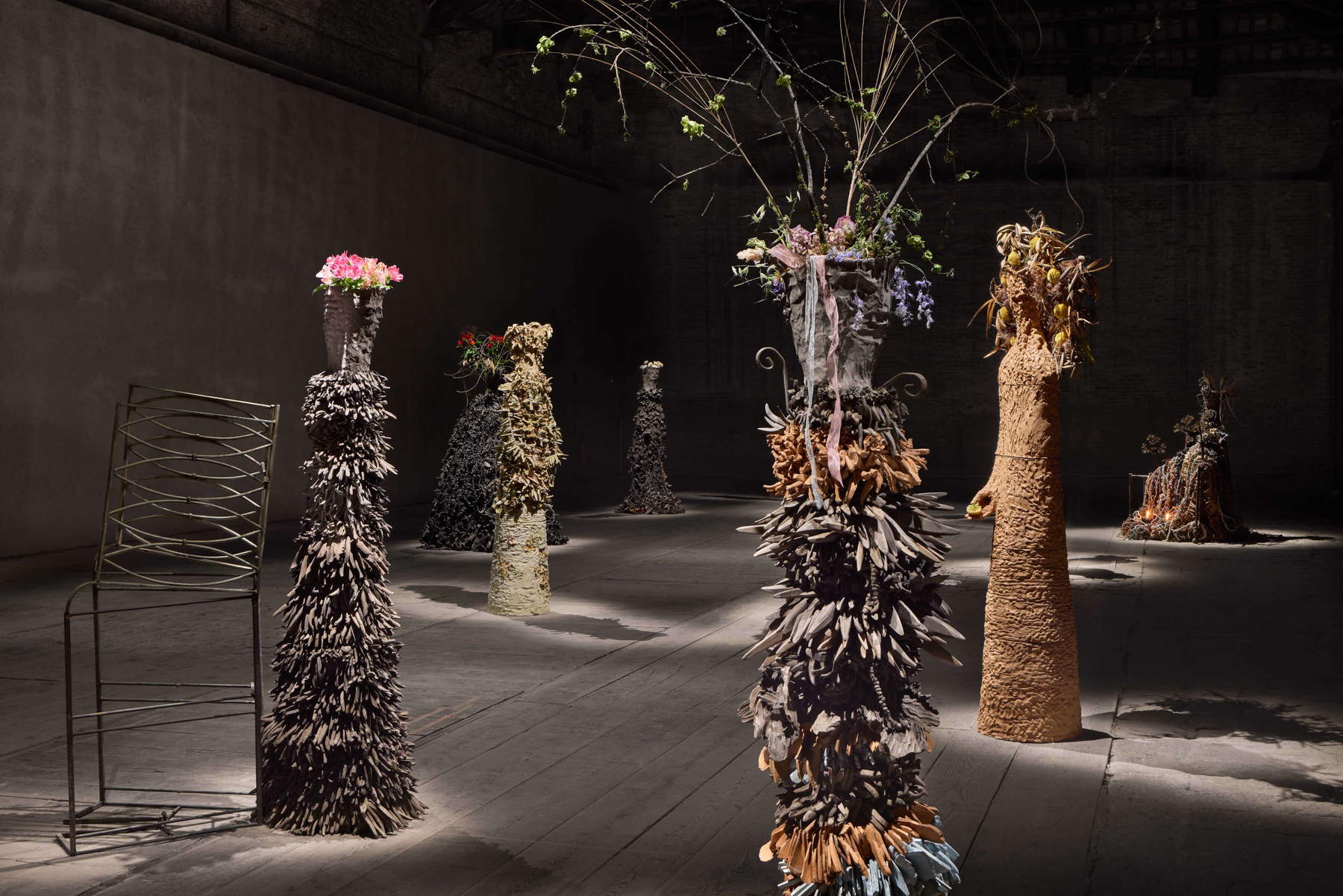
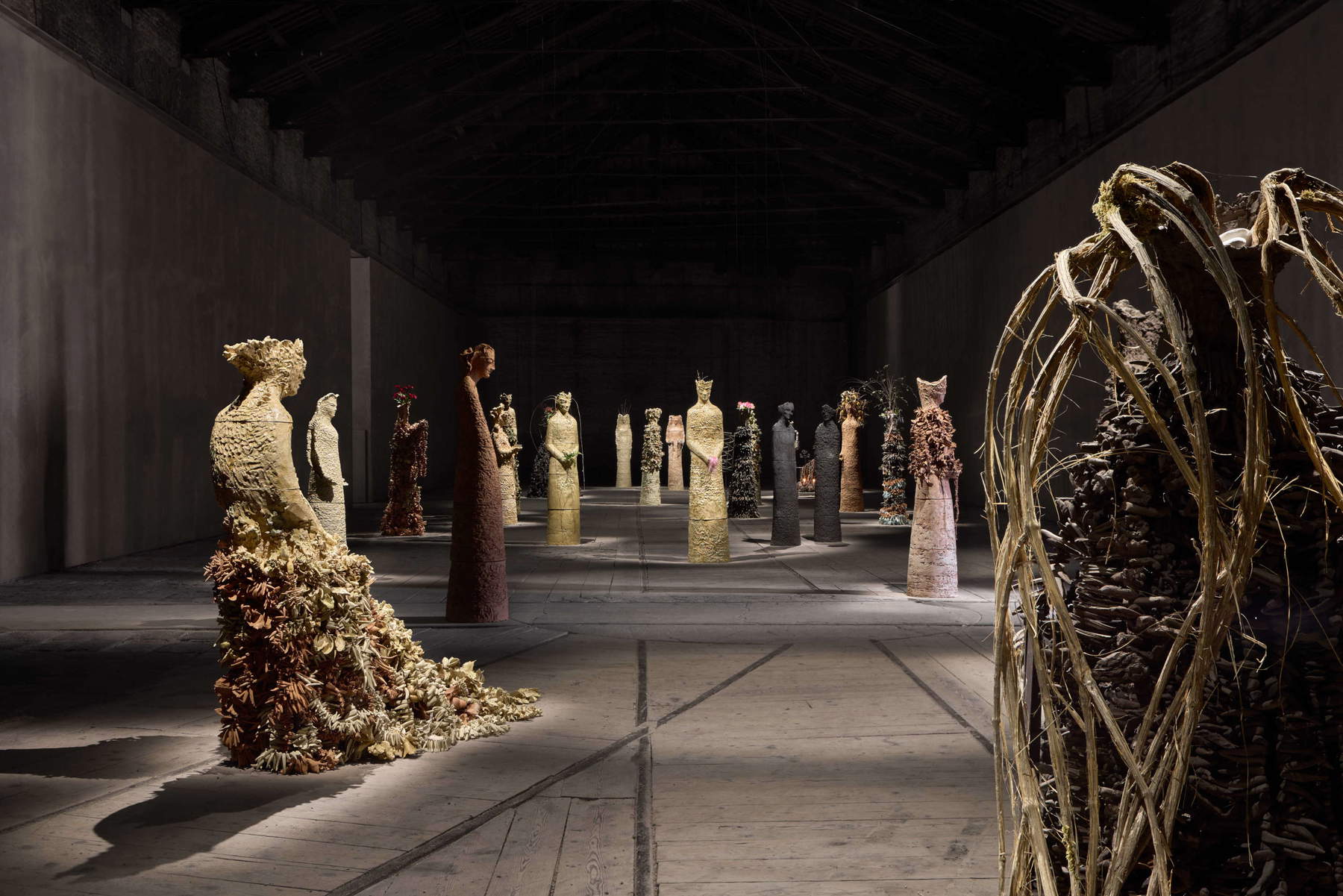
It has been said, then, that the exhibition appears as an archaeological landscape, the kind, however, that the Biennale visitor is used to seeing more inside a shed than inside a forest where pagan rites were officiated two thousand years ago. The Sisters, the Columns, the Daimons seem to emerge, one might think, from a common, recognizable repository; they belong to a kind of repertoire of contemporary fossils, to the products of that family of ’artists who work with clay, ceramics, natural materials, who keep processes visible, avoid virtuosity, produce figures that seem to spring from matter (sculptors such as Mark Manders, Rebecca Warren, Ali Cherri come to mind, and just to keep on the best-known names), to a territory that Chiara Camoni inhabits with spontaneity and consistency. However, the danger of déjà vu appears to be offset by the evocative vigor of her sculptures, fresh and impassive korai of grass and terracotta, wild and disturbing, primitive and bare inhabitants of a dirty and dissolving world that theartist agonizingly tries to keep alive, deities who seek a commonality with mortals, who try to come closer to us in the clever artifice of the statues’ shadows, Chiara Camoni’s dazzling intuition, shadows that intertwine, overlap, mingle with those of the visitors. Yet one struggles to repress the thought that the exhibition walks along a path of soothing meekness, made of already interpreted relics, of archaeologism, of codified ritual imagery, of a certain predictability in symbols, in vocabulary, in atmosphere: ritual, nature, community, ancestral and archetypal femininity, encounter, participatory practice, non-denominational spirituality, craft wisdom. So, perhaps the most persuasive section of the exhibition ends up being the one set up in the second brim, i.e., the least applauded, perhaps because it is less prone to complacency, and thus able to allow itself the luxury of risking something more, since it is better prepared to activate, especially through reuse, that sense of community and encounter of which the project wants to be the bearer (reuse that, moreover, also abounds in the sculptures of the first brim: one of Chiara Camoni’s Sisters curiously bears two ceramic paterae that are, in fact, two plates by Fausto Melotti, reused for the occasion).
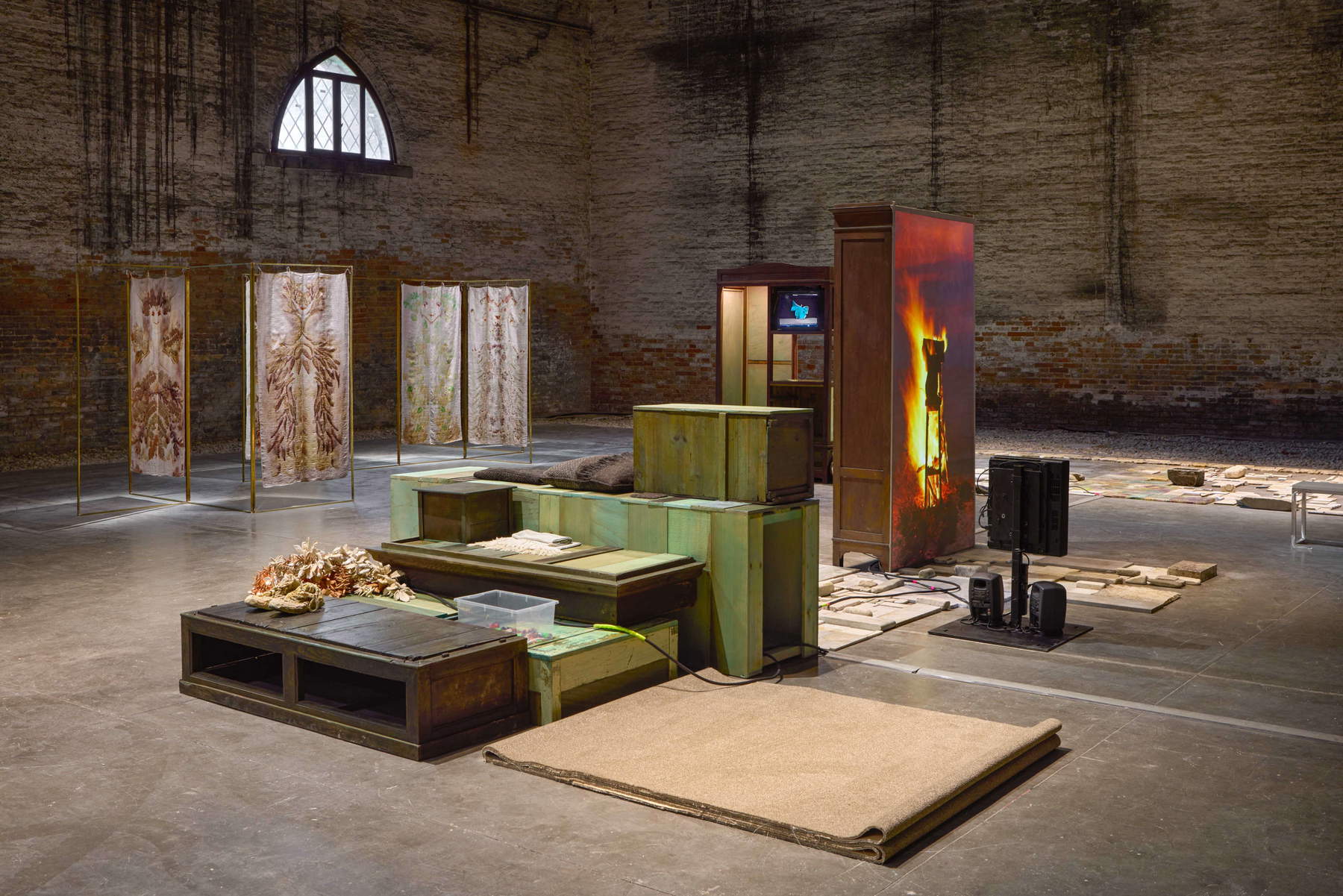
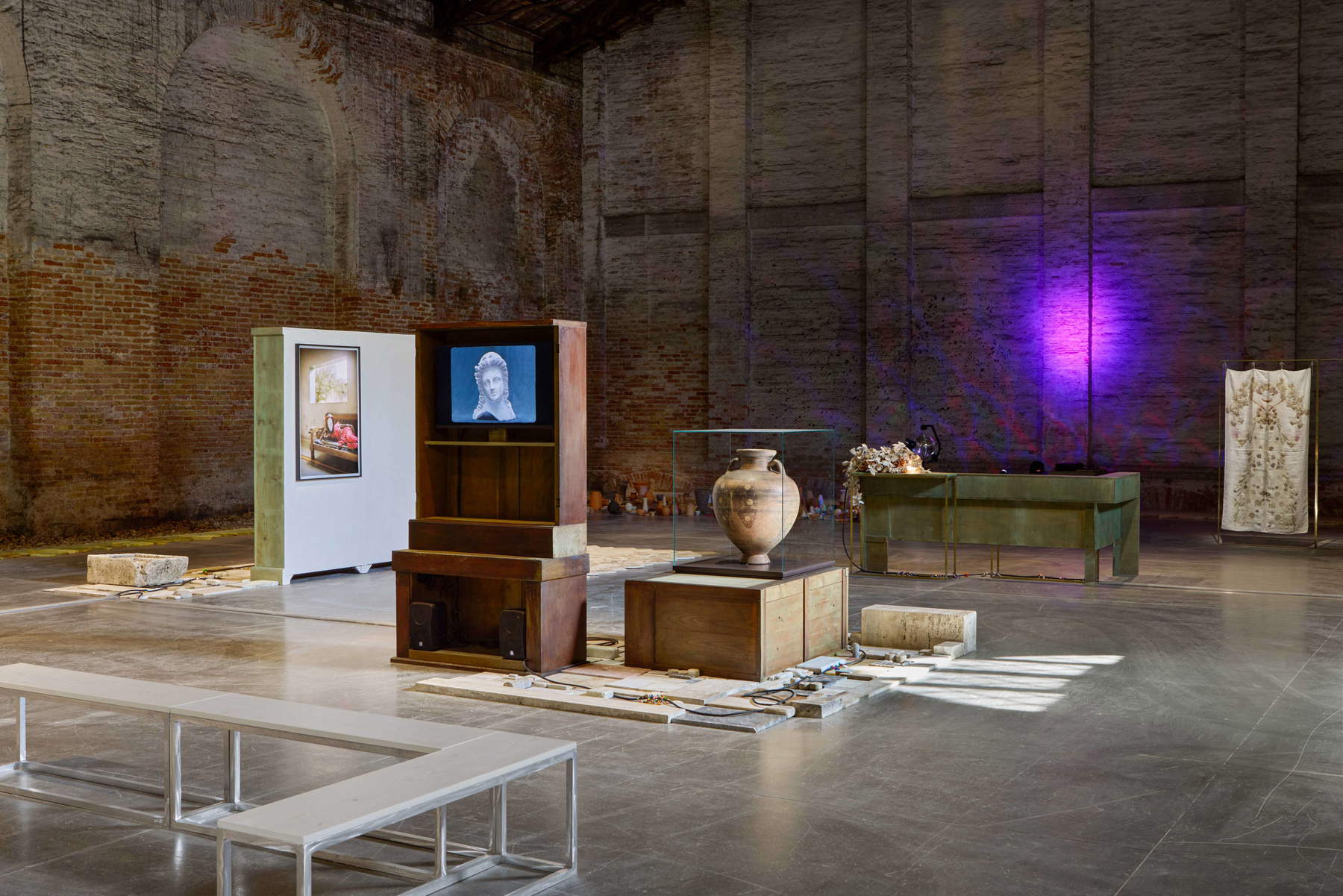
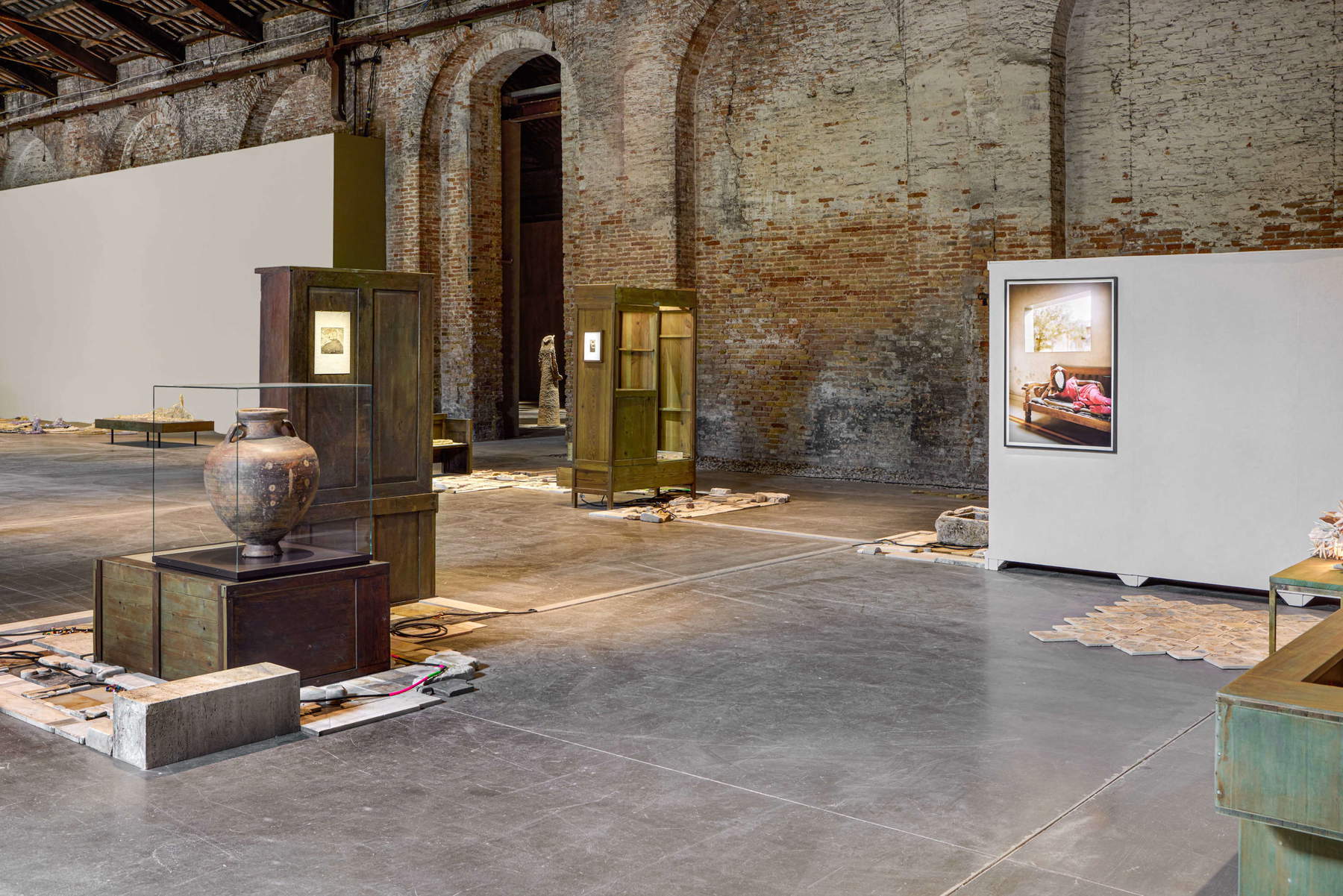
In this second space, the exhibition intends to oppose, one senses from the statements, the human dimension to the spiritual and ancestral dimension of the first, and to do so it establishes to invent, we read, “a world under construction composed of natural elements, artifacts and recycled objects that continue and expand the artist’s reflection on matter.” Camoni resolves this attempt to fabricate an architectural proposal that gives physical concreteness to the idea of an encounter with an environment in which a sampler of exhausted furniture, elementary forms, decorated screens, and lying parallelepipeds becomes a temporary dwelling (so we seem to guess from the titles of the works, of these essential architectural structures: Little House, Tent, Bench, Small Table with Jars and so on), “punctuation of works” (so the artist likes to think of it), of a series of works by artists of the past and present (so thus continues the substantial, meditative, materic anachronism of the first brim), from Alberto Martini to Marisa Merz, from Fausto Melotti to Luca Bertolo, from Felice Casorati to Alessandra Spranzi, from Luciano Fabro to Bettina Buck and several other artists with whom Chiara Camoni, it is easy to imagine, finds resonances, affinities, closeness, connections, chords, assorted reverberations. The second brim is a house, then, but it is also a square, since a section of this huge, dispersive, chaotic environment accommodates seats where the audience pauses and turns toward the wide-open door to the garden, an expedient imagined to find an easy binder in the dimension of time, which intervenes in Chiara Camoni’s discourse with its vegetal clothes that change with the passage of days, weeks and seasons.
It is thus this space a kind of concrete translation of the artist’s thought, her making, as well as the intimate and relational tonalities of her practice: citation and reuse are therefore the tools with which Chiara Camoni officiates at this liturgy of her encounter, temporary convocations of material already experienced and new material, of her own material and the material of others, of material that has never been found together and from the juxtaposition of which new kinships may be born. The seemingly random encounter of objects then implies an idea of momentary fellowship, of closeness in chaos and randomness that, one can imagine, should be transmitted from the objects to the visitors and, more generally, to everything that lives outside this pavilion (one grasps here more than elsewhere that “sharing with other forms of life” of which curator Canziani speaks). It comes to mind, with a parallel that is perhaps far-fetched but can render the idea, Lucio Fontana who with his Attese wanted to invite the relative to sink into what surrounds him, to venture into the real. Only, instead of cuts, Chiara Camoni works with matter, with co-creation, with the invocation of the feminine, with the complicity between audience and artist, with citationism, with the co-presence of the human and the sacred.
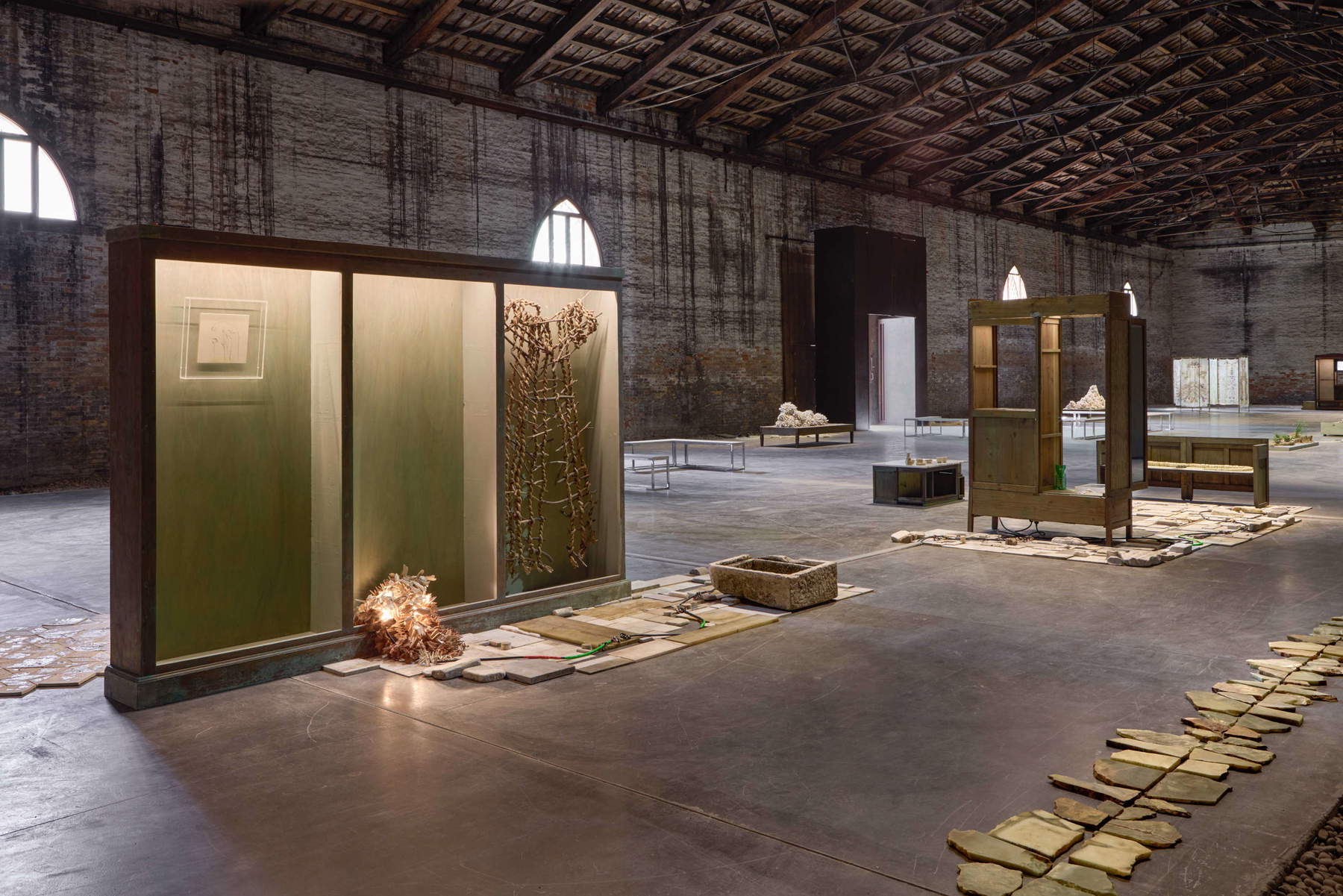
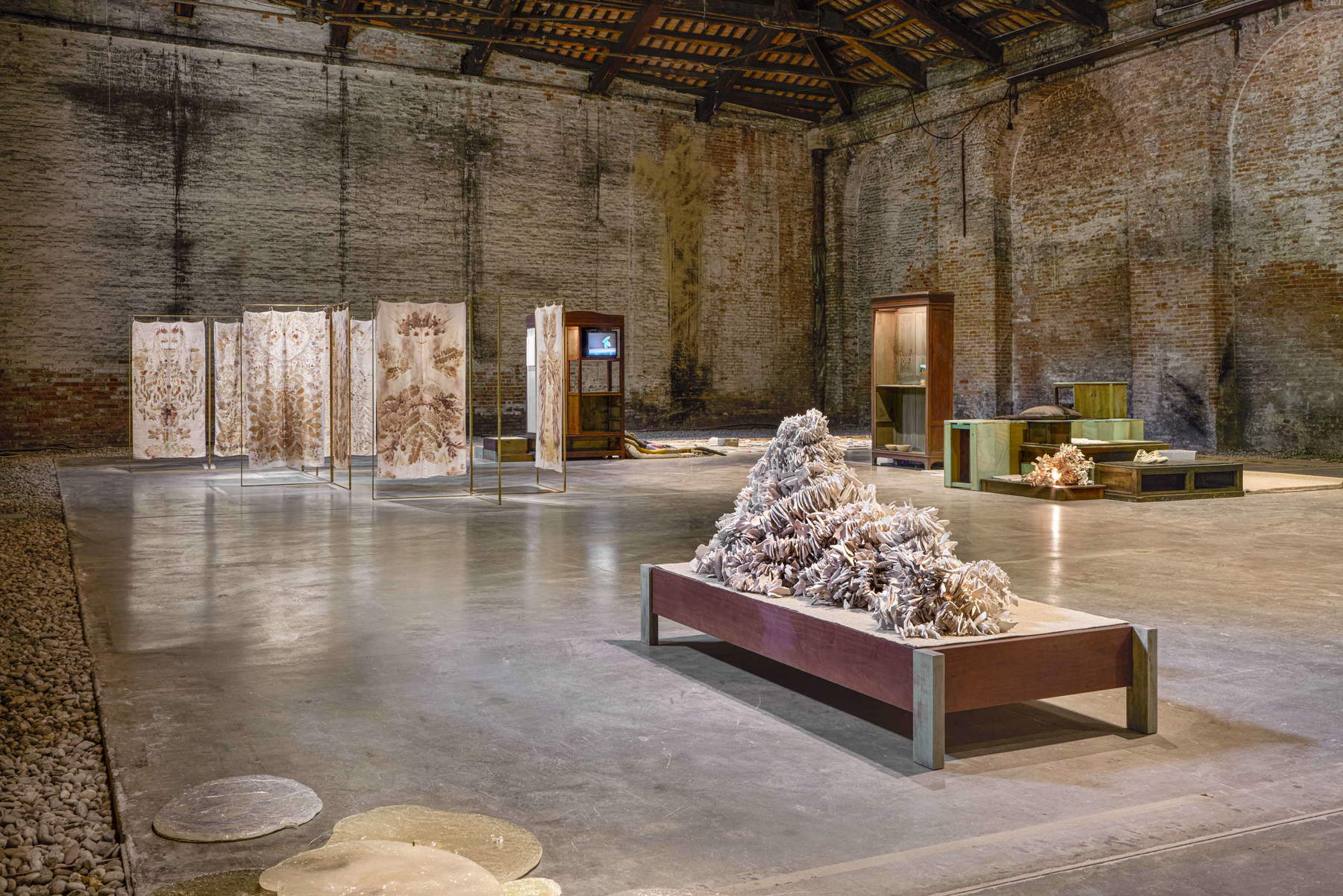
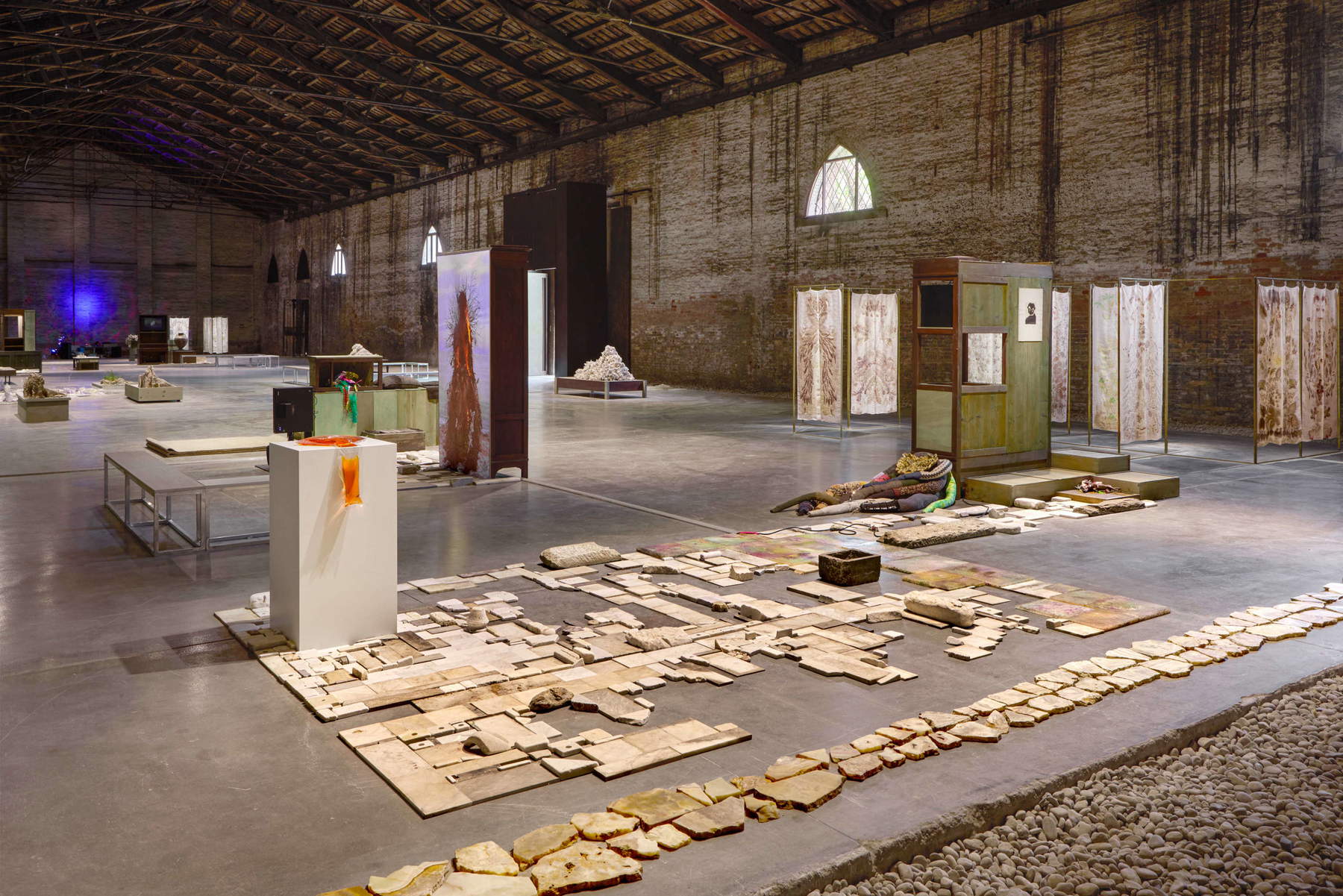
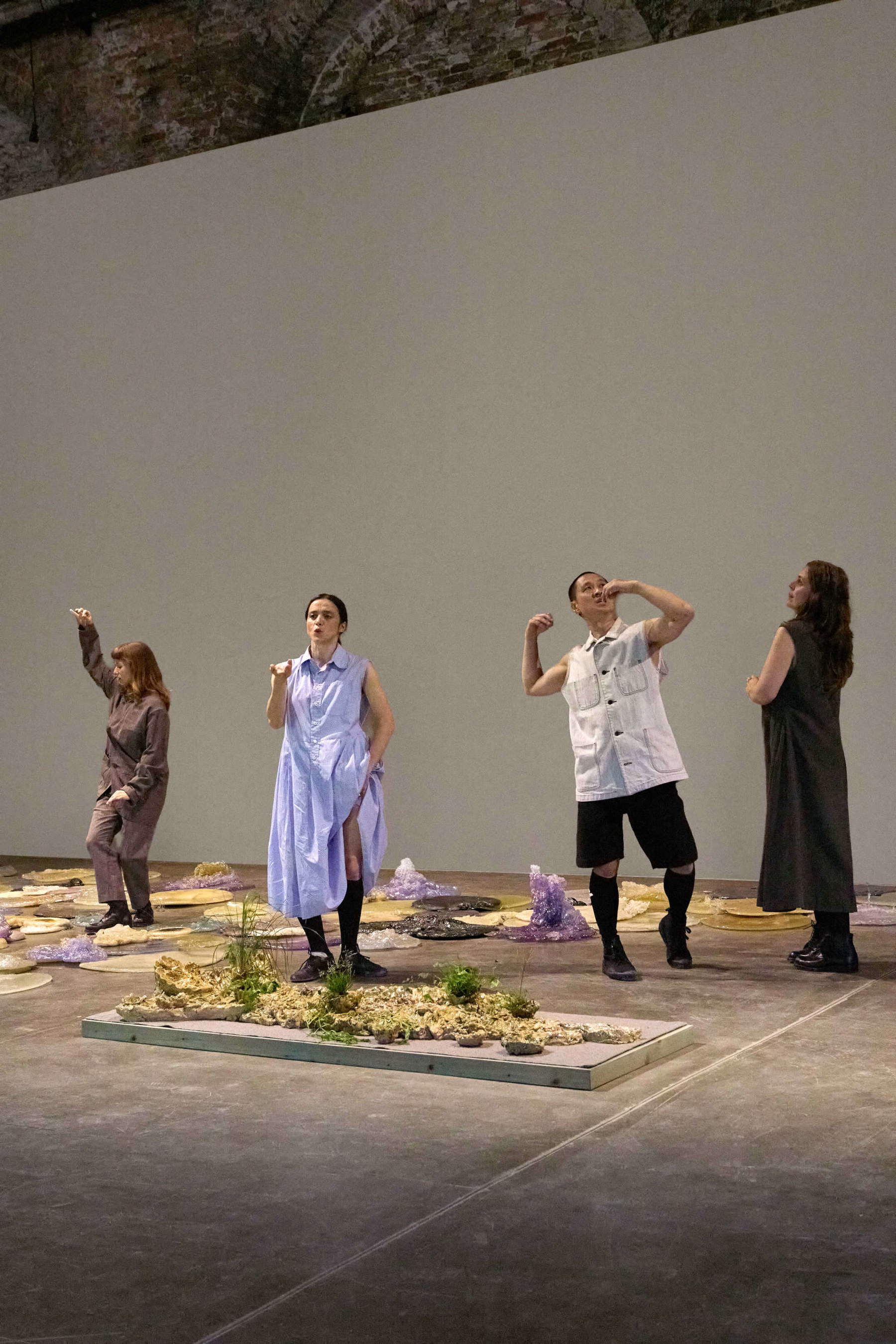
The value of Con te con tutto then depends more on concrete practice than on theoretical frameworks, more on the bundling that can generate a fundamentally coherent work than on philosophical justifications: the risk, however, is to speak of intimacy and encounter in a context such as the Biennale, which is by its very nature superficial, hostile, inhospitable, exhausting, tiring, which is a place that generates saturation rather than relationship and where any attempt to slow down seems to be condemned to dissolve into an elaborate estrangement. The same was true of the Italian Pavilion two years ago, when Massimo Bartolini invited his audience to listen (incidentally, one might add that, just as Bartolini’s exhibition was a sort of re-edition of his solo show at Pecci in Prato the year before, so Chiara Camoni’s Italian Pavilion might itself be a re-edition of her solo show at HangarBicocca, although this time the dependence is not as marked): then one demanded concentration, now one demands contact. And after staying inside the Pavilion for some time, one almost has the feeling that that sense of calculated disorder begins to prevail, to overrule, to suffocate the visitor in a cacophony that repels more than it welcomes (there is not even a lack of dance time, when performers arrive to stage a kind of predictable and gratuitous Tino Sehgal-style choreography in the midst of Chiara Camoni’s assemblages): it is then natural to wonder whether that “multiplication” of readings, voices and presences sought by the artist and evoked by the curator has not gone too far and ends up summarizing more the qualities of jumble than those of plurality.
There is, however, a profound coherence, although not immediately recognizable (or so it seemed to be understood by staying to listen for a while to the comments of those who felt a sort of hiatus between the first and second part of the exhibition), that links the Chiara Camoni shaman to the Chiara Camoni constructor of environments (what, after all, are Sisters and Columns if not sculptures in the form of architectural elements? But other persistences could be found), and it is probably in this continuity that one needs to find the unexpected, the unsettling, the perturbing, that is, those qualities that, paradoxically, should facilitate the encounter. When one leaves the Italian Pavilion, the Venice Biennale begins again, with all its flow, all its repertoire.
Warning: the translation into English of the original Italian article was created using automatic tools. We undertake to review all articles, but we do not guarantee the total absence of inaccuracies in the translation due to the program. You can find the original by clicking on the ITA button. If you find any mistake,please contact us.