





The Pavilion of the Sultanate of Oman at the 2026 Art Biennale presents Zīnah (Adornment), a project entrusted to Haitham Al Busafi, who plays the dual role of artist and curator. Commissioned by the Ministry of Culture, Sports and Youth, the installation is housed at the Arsenal Artillery and will be open to the public until Nov. 22, 2026.
The work is based on a reinterpretation ofal-zaanah, an Omani tradition related to the adornment of horses with silver elements. In the cultural context of reference, the practice takes the form of a system of mutual recognition between rider and horse, in which both are adorned in the same way. This gesture implies a relationship of symbolic equivalence, in which the horse is interpreted as an extension of the rider and shares the value attributed to the human person.
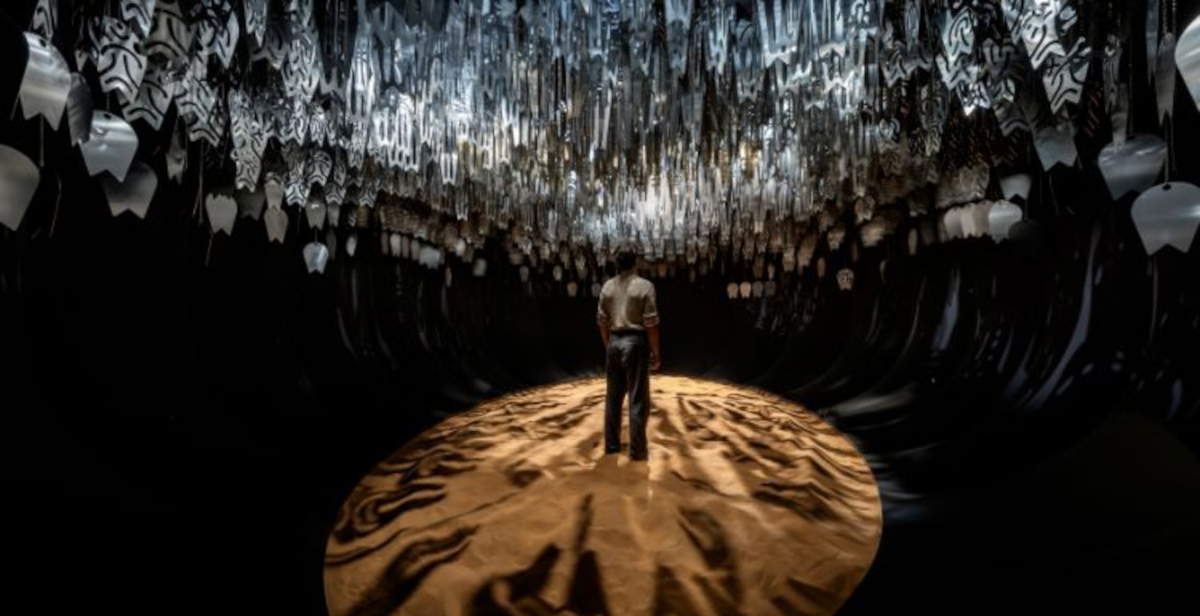
Inside the Arsenal Artillery, Zīnah presents itself as an immersive environment built on a sequence of traversal and revelation. The audience enters through an initially obscure passage before the space gradually unfolds. Beyond this threshold opens an environment covered with sand from the Omani desert, over which a suspended structure composed of metal forms inspired by al-zaanah unfolds.
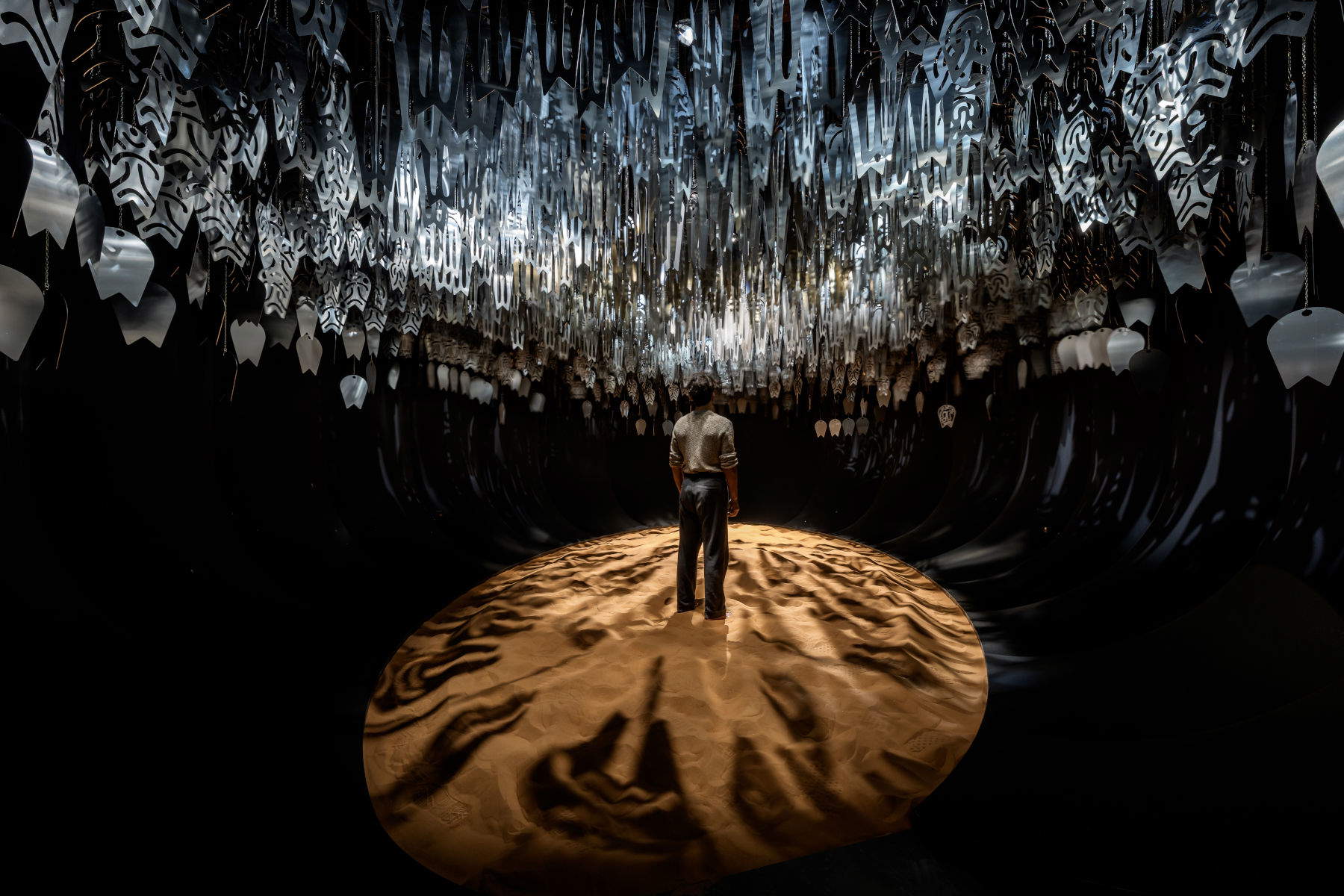
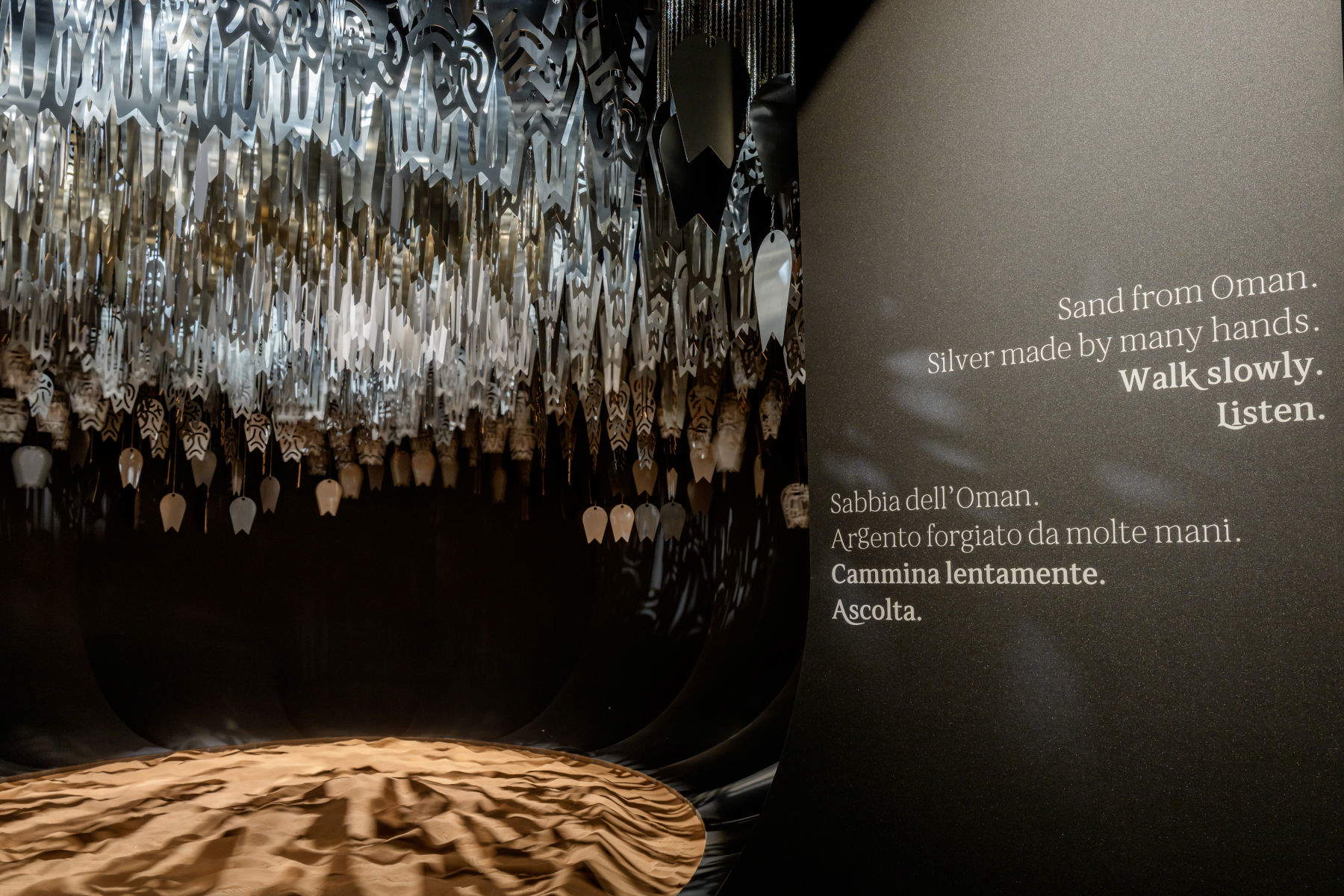
The installation introduces a participatory dimension in which the movement of visitors becomes an active element of the composition. Indeed, walking on the sand generates a sound response, activating the suspended metal components that oscillate and produce sounds. The whole device recalls the original acoustic dimension of traditional practice, in which the contact between silver elements, moving together with the horse and rider, produced a continuous sound, determined by rhythm, weight and proximity.
The project is developed through an iterative process of material experimentation and spatial definition. The focus from the outset is on the perceptual sequence of the experience, that is, how the visitor traverses the space, changes his or her direction and gradually alters his or her perception of the environment. Suspended forms, derived from the observation of al-zaanah, are reworked abstractly to investigate the behavior of metal under different tensions and to construct a soundscape responsive to movement on sand. The work thus takes on the configuration of an open system, in which sound, structure and presence are redefined by continuous interaction with the audience.
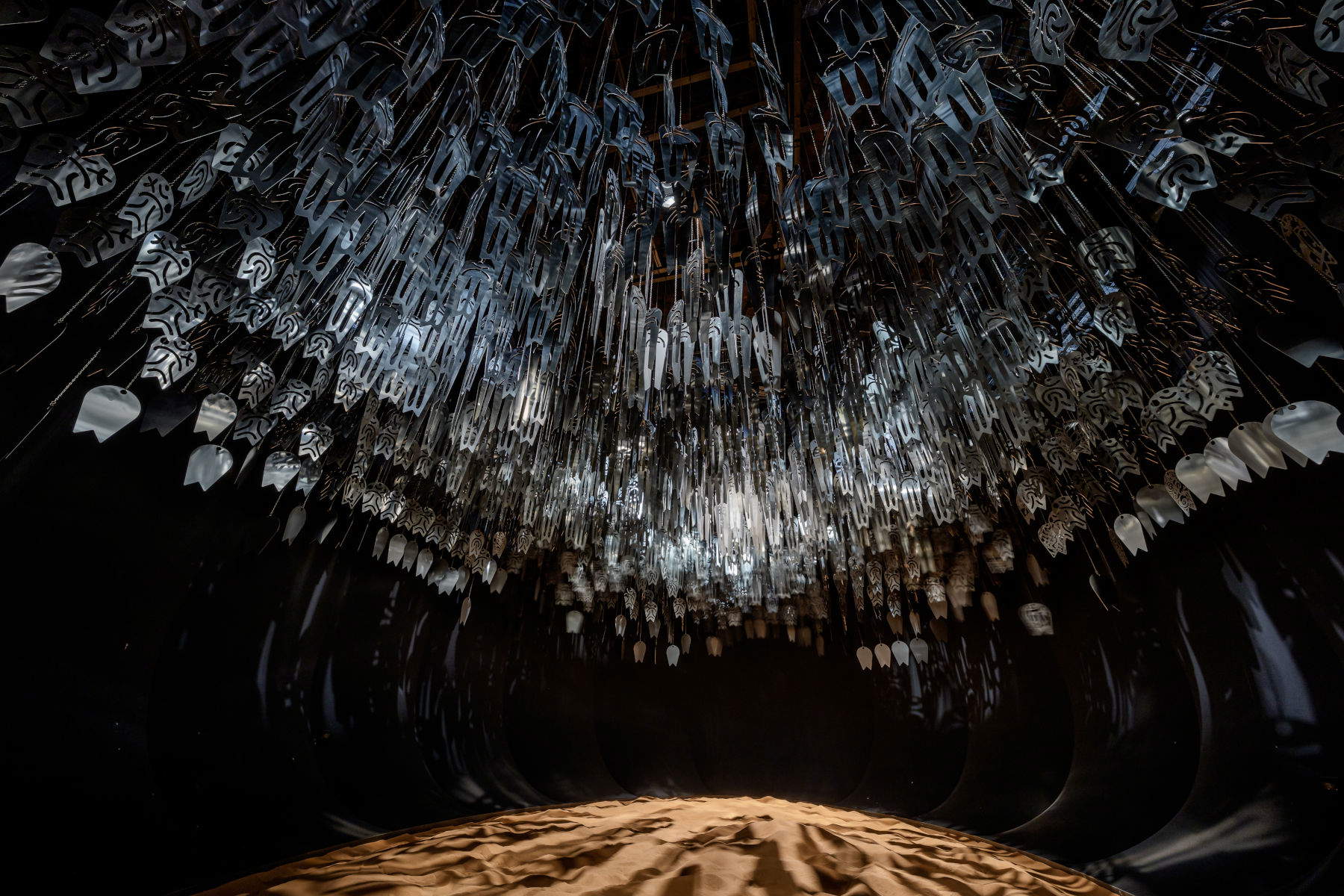
A further level of the project concerns the collective dimension of production. A workshop held in Muscat with students and young artists contributed to the creation of the work through the transposition of ideas related to relationship and recognition into engravings applied to the suspended metal surfaces. In this way, the structure incorporates a plurality of authorial contributions, which add to the initial design without interrupting its formal coherence. Zīnah thus presents itself as an open device, built according to a strict logic but completed only by interaction with the audience. The work requires the presence and movement of visitors to activate its sound components and to define its overall balance.
The project fits into the theme of the Biennale Arte 2026, In Minor Keys, which calls for overcoming forms of spectacularization in favor of modes of expression based on resonance. With this in mind, Zīnah articulates a response through elements such as friction, weight, reverberation and breath, all of which can be traced back to the tradition ofal-zaanah and its sonic dimension. Also presented as a tribute to the recently deceased curator Koyo Kouoh, whose vision for the Biennale advocated artistic practices oriented toward resonance rather than spectacle, the installation proposes an interpretation of the minor key as a relational frequency constructed through proximity, attention and sharing of space.
“In a world that privileges speed and spectacle, this work is directed toward something quieter: the act of recognizing another being, human or not, as deserving of beauty, dignity and presence,” says Haitham Al Busafi, artist and curator.
“Oman is presenting a contemporary art proposal rooted in its own cultural specificity, but at the same time in dialogue with current aesthetic and intellectual reflections,” says H.E. Sayyid Saeed bin Sultan Al Busaidi, Commissioner and Undersecretary for Culture of the Ministry of Culture, Sports and Youth of the Sultanate of Oman. “The project aims to promote dialogue, broaden interpretive possibilities and affirm culture both as an engine for development and as a platform for national creative expression within an ever-changing global context.”
 |
| At the 2026 Art Biennale, the Oman Pavilion becomes a participatory soundscape |

Warning: the translation into English of the original Italian article was created using automatic tools. We undertake to review all articles, but we do not guarantee the total absence of inaccuracies in the translation due to the program. You can find the original by clicking on the ITA button. If you find any mistake,please contact us.


























 IT
IT FR
FR DE
DE ES
ES CN
CN


