




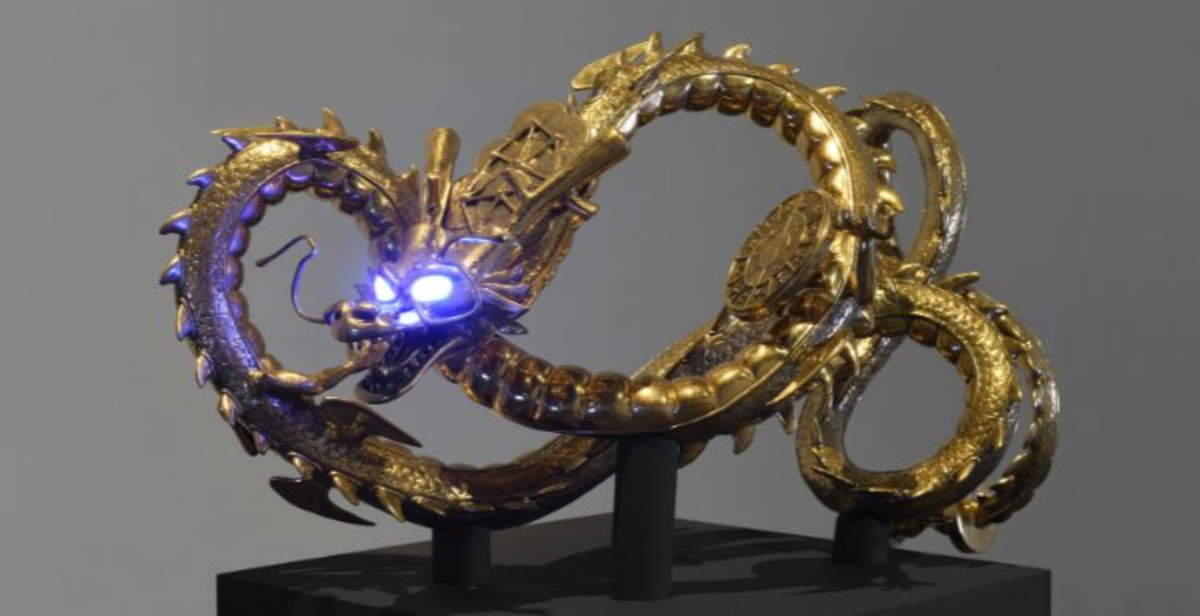
From May 4 to 17, the Verona Chapter Library will host Luca Pozzi ’s work Arkanian Shenron (2020) in the Monumental Hall, a multi-platform installation that is part of an exhibition itinerary dedicated to the interweaving of contemporary artistic languages and scientific reflection. The sculpture, inspired by the figure of the dragon present in the manga Dragon Ball, is presented as a device that relates different levels of reality, between material dimension, information processes and digital infrastructure.
The intervention is shaped as a tribute to theoretical physicist Carlo Rovelli, a central figure in the studies of quantum gravity, on the occasion of his 70th birthday. The project is part of a reflection concerning the role of information as a structural element of physical phenomena, particularly in the relationship between quantum mechanics and general relativity, a theoretical field traceable to Loop Quantum Gravity. The installation is included in the program of the Chapter Library, which proposes initiatives aimed at the enhancement of knowledge between different eras, through the adoption of heterogeneous expressive languages traceable to art and visual culture.
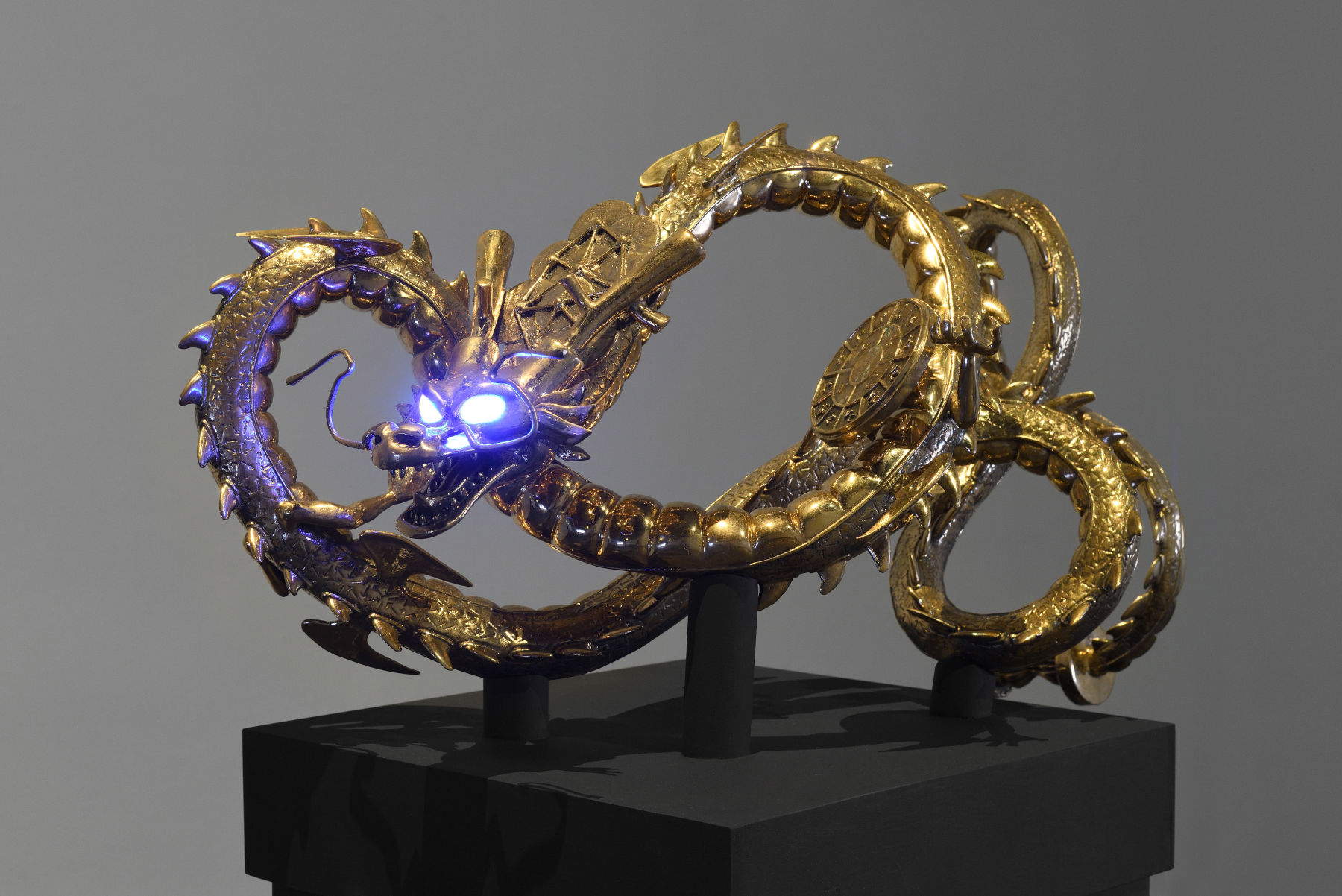
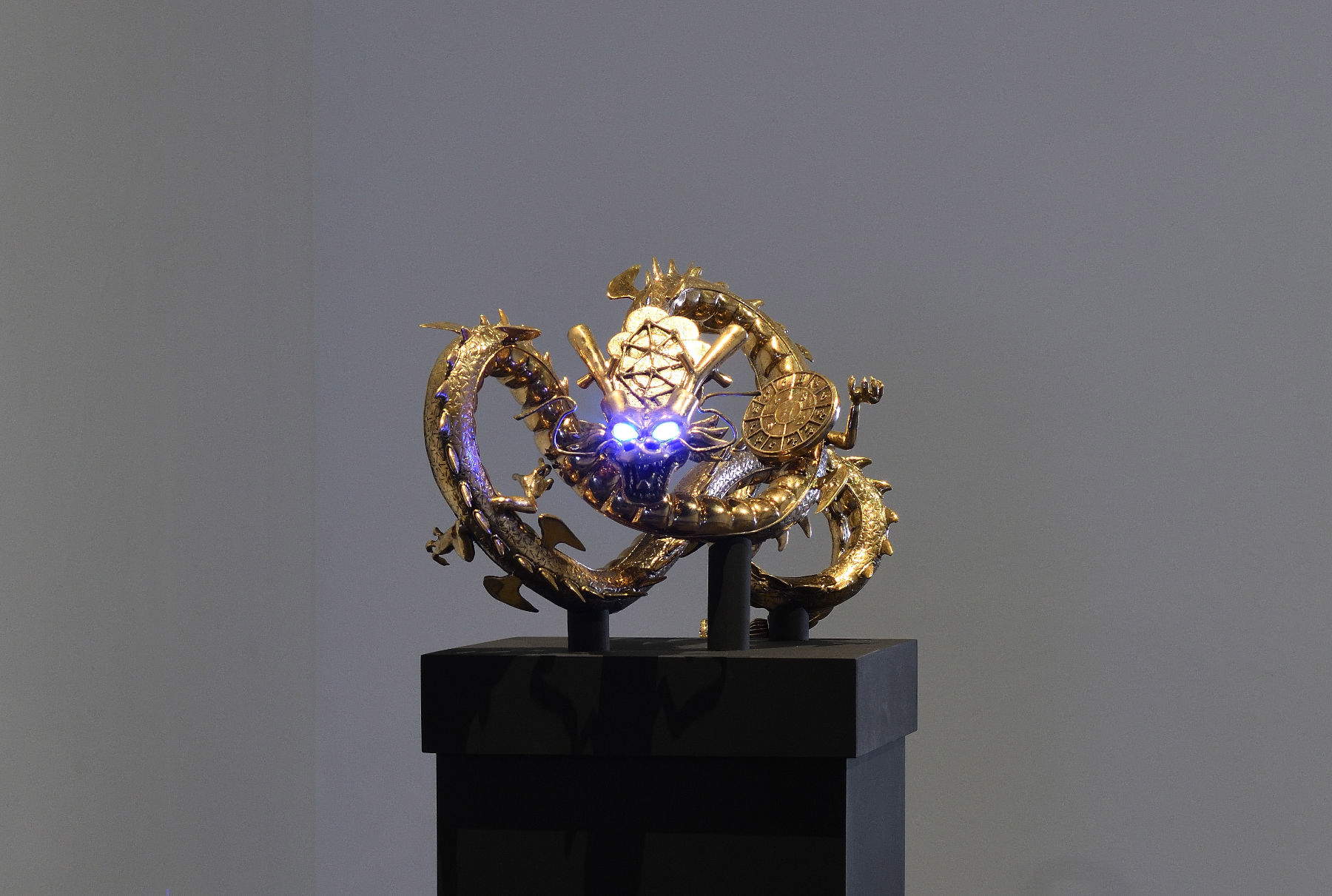

Arkanian Shenron is presented as a system that simultaneously traverses multiple ontological levels. The bronze sculptural structure represents the macroscopic dimension of the work, while the technological and digital components refer to the subatomic level of quantum interactions and the immaterial level of the network, respectively. The work is described as a form of technological animism, in which physical objects and information processes are interconnected through data detection and translation systems.
Integrated within the sculpture is a particle detector developed in collaboration withINFN, National Institute of Nuclear Physics. The device makes it possible to intercept the passage of muons, charged particles originating from high-energy cosmic events from the stratosphere and traceable to deep-space explosion phenomena. Each interaction between particle and sensor is recorded as a point physical event.
The interaction between the work and the environment is manifested through a light signaling system: each time a particle passes through the structure, a pair of blue LEDs located in the front, corresponding to the eye area of the sculpture, emits a light signal. This visual response makes an otherwise invisible phenomenon perceptible, translating a physical event into an observable signal.
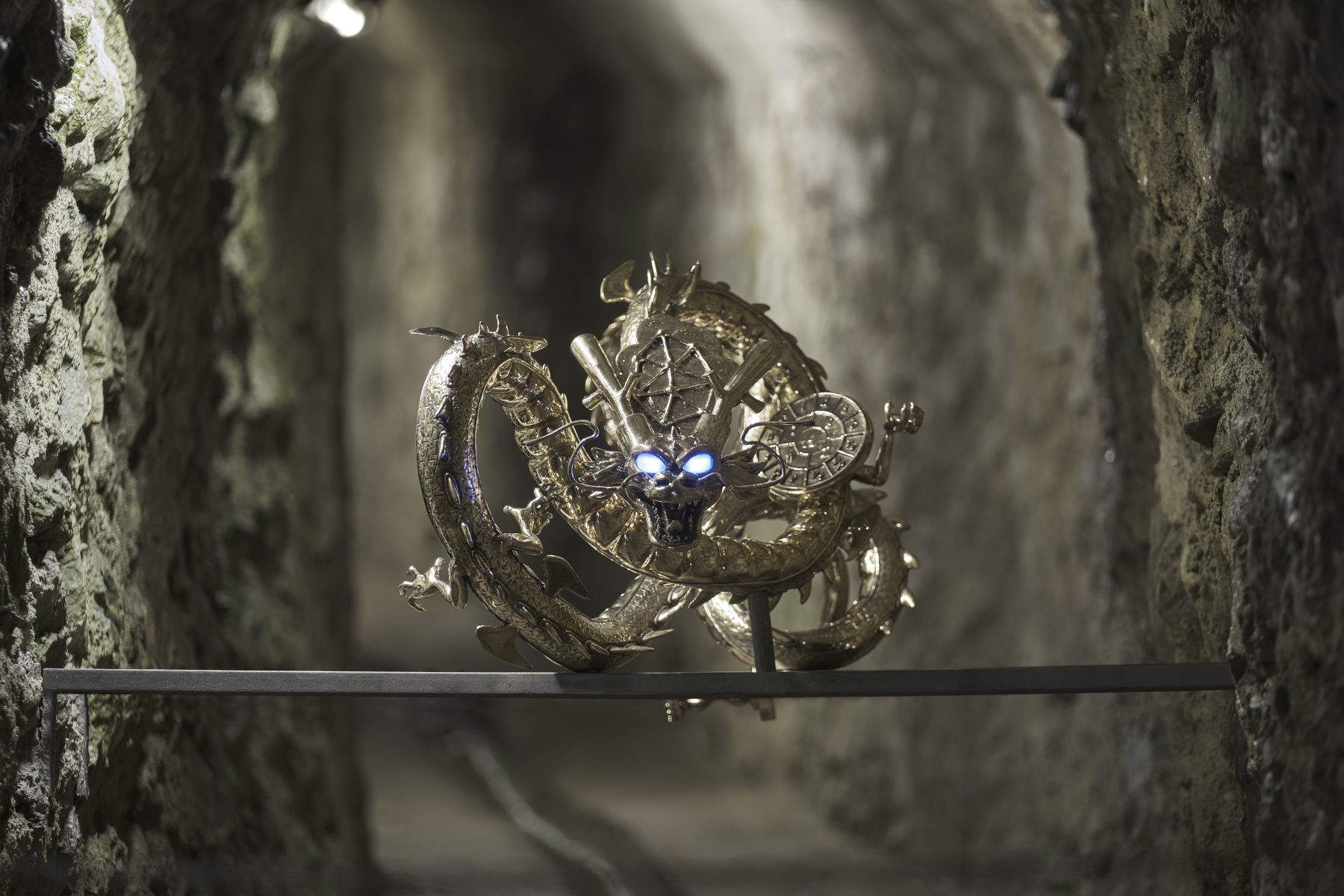
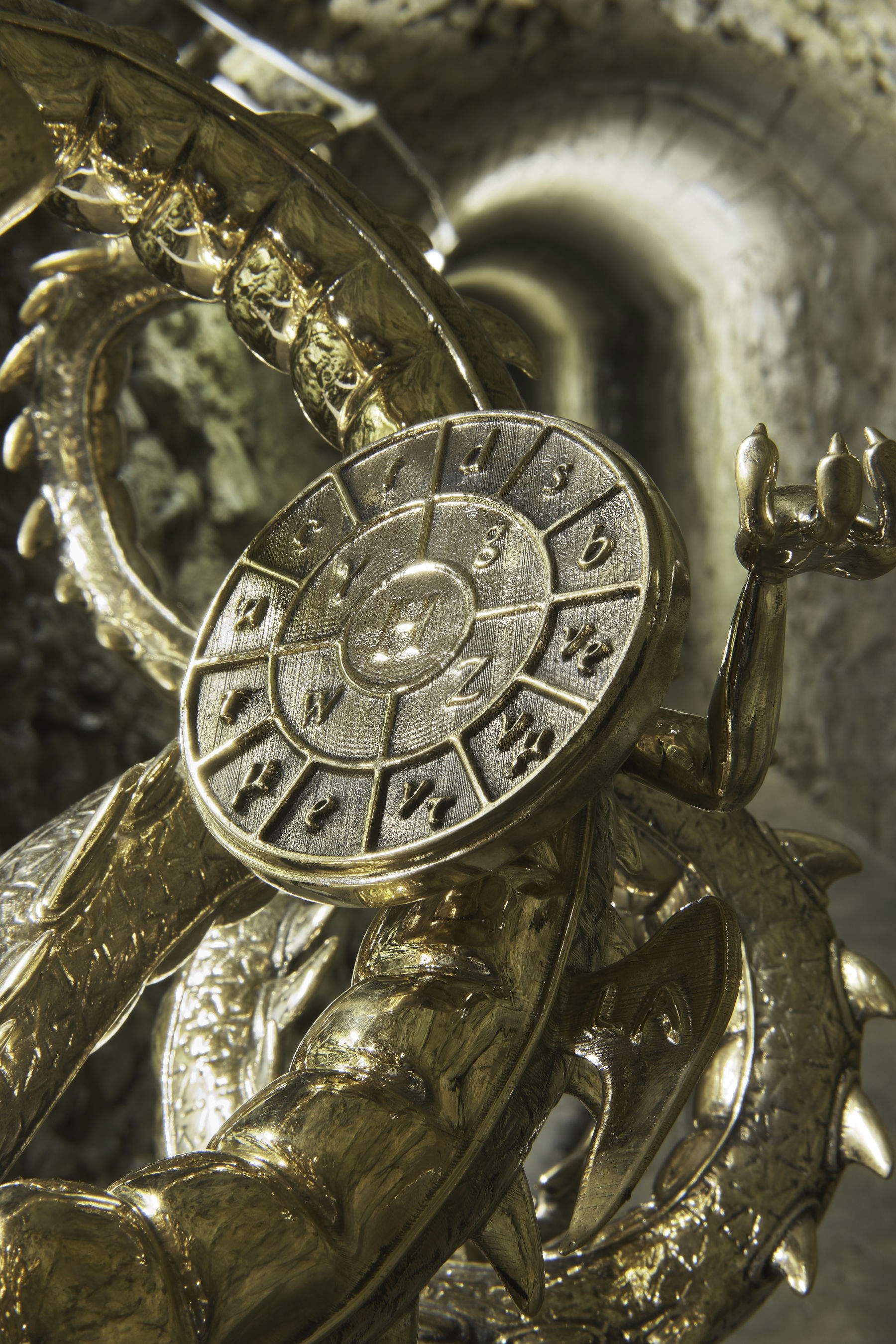
The work’s internal information system also integrates an algorithmic component that processes recorded events. A rudimentary artificial intelligence associates each detection with a word extracted from philosophical texts by Bertrand Russell, configuring a translation process between physical data and language. Upon reaching the sixteenth detection, the system generates a poetic composition in the form of a contemporary haiku. The text is automatically published on the work’s Telegram profile and disseminated through a three-dimensional avatar that performs the declamation in the web environment.
Iconographically, the figure of the Shenron is constructed as an assemblage of heterogeneous references. The wings recall Piero della Francesca’s Madonna del Parto, while the upper crown is associated with the concept of Spin Foam , a theoretical element of Loop Quantum Gravity. The body structure refers to noncommutative geometry, while the tail is interpreted as a symbolic representation of the architecture of an IBM quantum computer. The work is read as a reflection on distant correlations and the possibility of an information network capable of connecting separate events in space and time. In this perspective, the distinction between analog and digital is progressively relativized in favor of a model in which information constitutes the primary level of observed reality.
 |
| Luca Pozzi brings to Verona a dragon inspired by Dragon Ball and quantum gravity |

Warning: the translation into English of the original Italian article was created using automatic tools. We undertake to review all articles, but we do not guarantee the total absence of inaccuracies in the translation due to the program. You can find the original by clicking on the ITA button. If you find any mistake,please contact us.


























 IT
IT FR
FR DE
DE ES
ES CN
CN


