





The Kunsthaus Merano presents from June 14 to October 11, 2026 Animacies, a collective exhibition project curated by Lucrezia Cippitelli and Simone Frangi that addresses the theme of European-Asian relations through a critical reinterpretation of Western and colonial interpretative systems. The exhibition, articulated through installations, painting, sculpture and photography, brings together works by seven artists from contexts that have often remained on the margins of Western narratives about the Asian continent, such as Bangladesh, Indonesia, Mongolia, the Philippines and the Fiji Islands.
Animacies constitutes the third and final annual installment of The Invention of Europe. A Tricontinental Narrative, a three-year program developed at the Kunsthaus over the period 2024-2027 and curated by Lucrezia Cippitelli and Simone Frangi. The project aims to question a unitary and monolithic vision of Europe, proposing instead a reflection on the established narratives that have defined its history and identity.
The title of the exhibition refers to the concept of “animacies,” theorized in 2012 by Sino-American queer scholar Mel Y. Chen in the volume Animacies: Biopolitics, Racial Mattering, and Queer Affect. The term, which is difficult to translate into either Italian or German, denotes a shared condition of agency, vitality, mobility, and awareness that can belong to different entities. From this perspective, Chen showed how matter, traditionally considered inert or lifeless, can instead exert a relevant influence on social relations, power structures and cultural dimensions. The exhibition takes this approach to challenge established binary oppositions, such as those between animate and inanimate or subject and object, by proposing a relational model in which humans, animals and objects turn out to be involved in common dynamics.
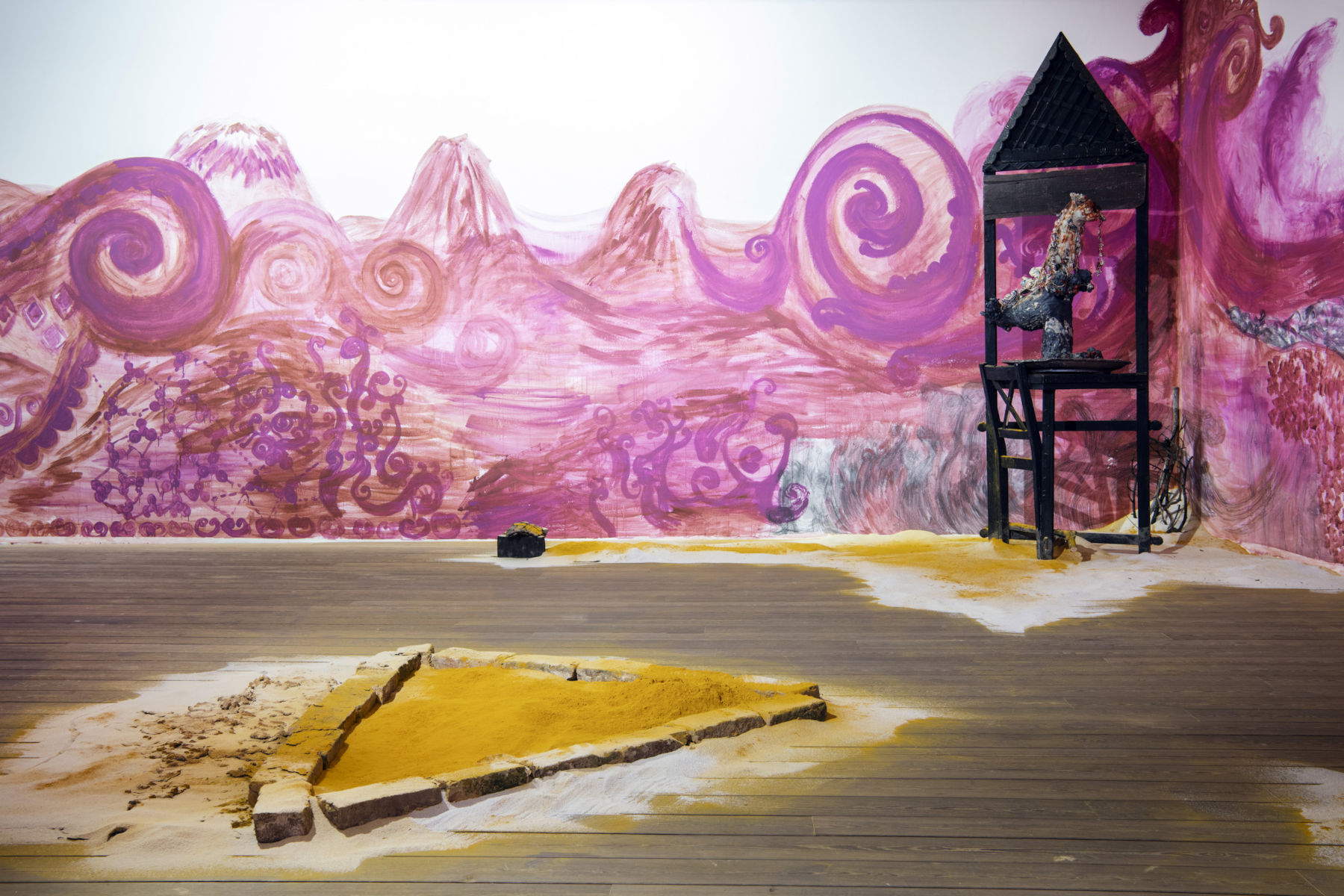
According to this perspective, textiles, plants and food take an active role and become tools capable of transmitting memory, generating transformations and creating connections. The selected works thus address the cultural, political, symbolic and spiritual implications of matter, using it as a key to observe power relations, discrimination and forms of injustice.
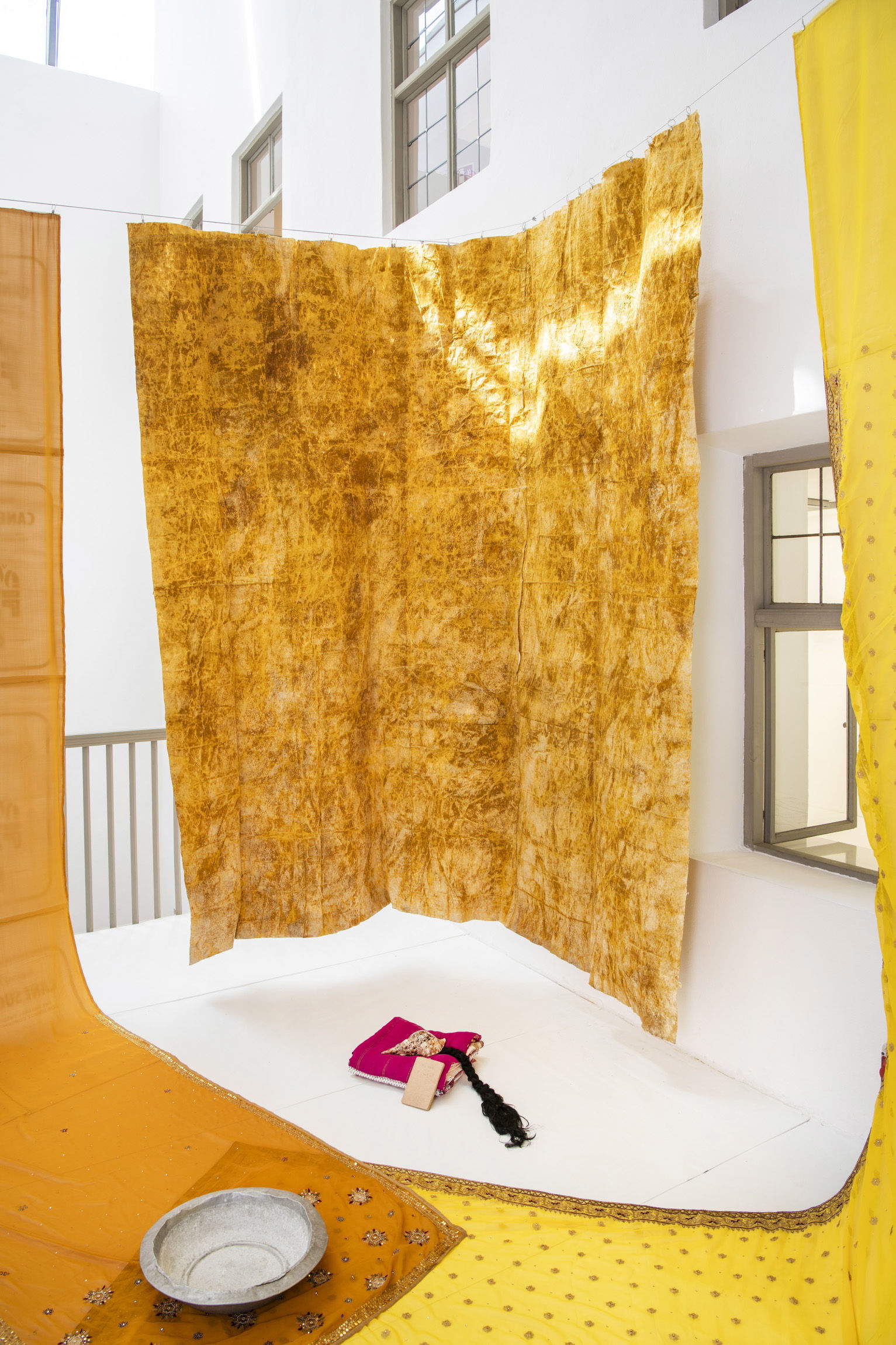
The exhibition itinerary opens with works by Shivanjani Lal, born in Fiji in 1982 and living in Sydney. The artist uses textiles and everyday objects to evoke the vicissitudes of the Girmitiya, laborers and workers forcibly relocated from India to various British colonies, including Mauritius, the Caribbean and Fiji, during the 19th and early 20th centuries. In the 2024 installation Mere Porvaj [I Am Remembering], Lal pays special attention to women’s labor, which is often excluded from official narratives, opening up a reflection on memory and the subjects given the right to be remembered.
Plants also assume a central function in the work of the Mai Ling collective, founded in Vienna in 2019. The installation Not Your Ornamentand the video Becoming Stickiness, both from 2023, address the racist and sexist stereotypes that have contributed to the construction of an image of Asian femininity as a decorative element. At the center of the works appears kudzu, a plant native to East and Southeast Asia, traditionally used in the textile, food and medical sectors. Introduced to Europe and the United States in the late 19th century with ornamental functions, the species is now considered a pest in many Western areas. The collective enhances its characteristics of resilience and transformation, interpreting it as a connecting element between migratory experiences and shared care practices.
The exhibition also features three new works by Chathuri Nissansala, born in Colombo in 1983 and living in Amsterdam. The works are brought together in a single environmental installation that addresses themes related to intergenerational trauma, colonial and ethnographic violence, and issues of gender identity, with particular reference to Sri Lankan history and the conflicting legacies that result. At the opening of Animacies, the artist will also present a performance.
Plants and memory return in the works of Jennifer Tee, who was born in Arnhem in 1973 and lives in Amsterdam. The exhibition features sculptures, installations and collages. In the 2023 series Tampan Tulips, the petals of tulips are transformed into textile elements with a strong symbolic value. The work recalls on the one hand the Asian origins of the flower, which has become an emblem of the Netherlands since the 17th century, and on the other hand the decorative motifs of Indonesian ceremonial textiles called “Tampan,” which are characterized by the presence of ships that are transformed into trees of life, symbols of the journey of the soul. The ship and the tulip also evoke the migration route taken by the artist’s family, which came to the Netherlands from Indonesia by sea in the 1950s, interweaving private dimension and collective memory. Jennifer Tee’s participation in the exhibition is supported by the Embassy and Consulate General of the Kingdom of the Netherlands.
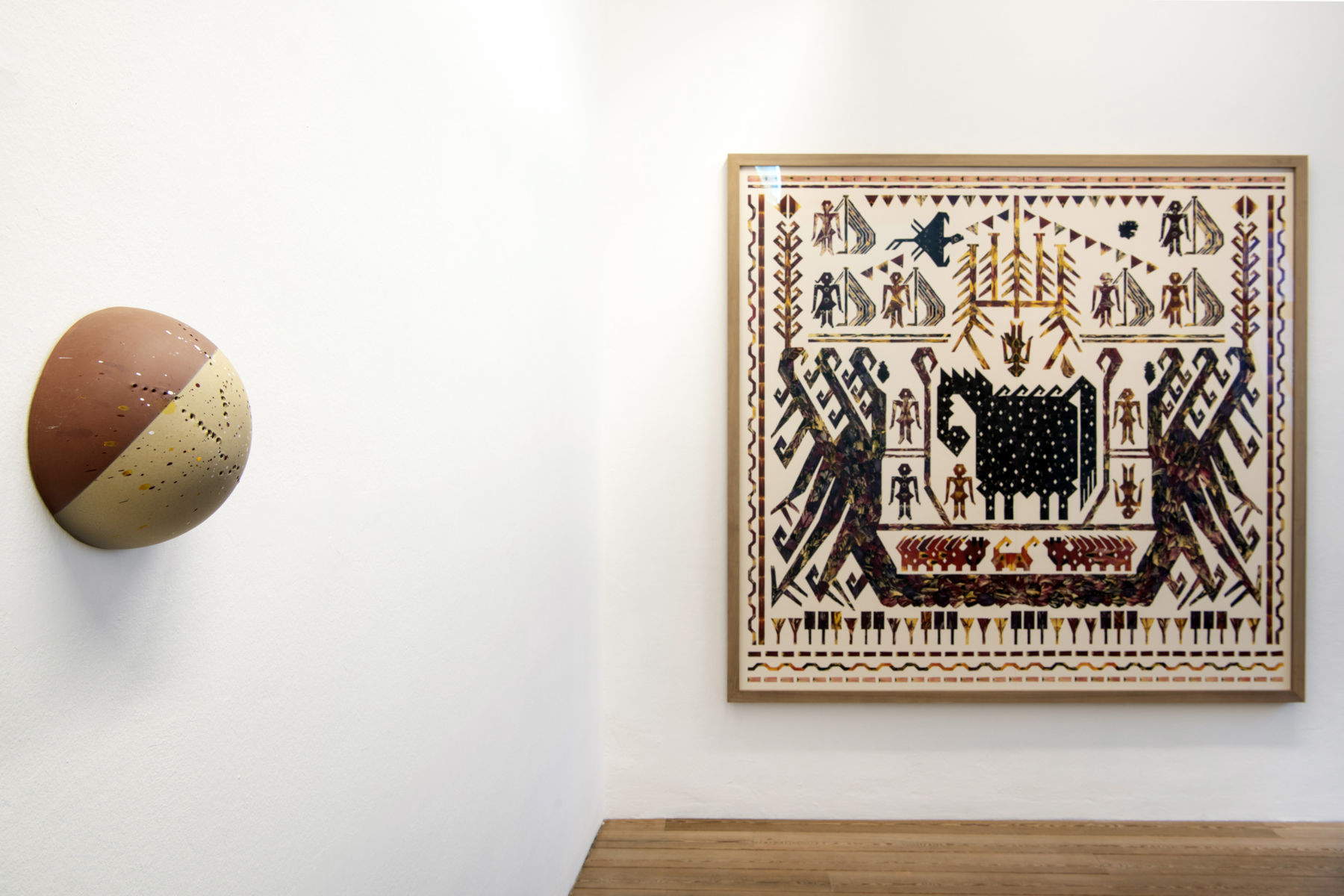
The third floor of the Kunsthaus houses Redeem, a project initiated in 2020 and still ongoing by Ashfika Rahman, born in 1988 in Dhaka, where she currently lives. The installation consists of a large embroidery on fabric and stems from research conducted from archival materials and a collaborative project dedicated to the religious conversions of the indigenous Santal and Oraon communities in Bangladesh. Through the use of embroidery, locally collected materials and chromatic symbols, the work addresses themes related to belonging, processes of transformation and the complexity of relationships within the communities involved.
Mongolia, on the other hand, is the starting point for the zoomorphic sculptures in the 15 Faces series, created since 2024 by Bekhbaatar Enkhtur, born in Ulaanbaatar in 1994 and living in Turin. The works take their cues from myths and traditions of the Asian country. The artist linked the origin of his research to the memory of a domestic altar dedicated to a deity, an experience that led him to question the possibility that a sculpture could be considered a living being with a soul.
“This experience,” said the artist, “ignited in me a deep reflection on how, in that context, a simple sculpture could be treated as a living being, endowed with a soul.”
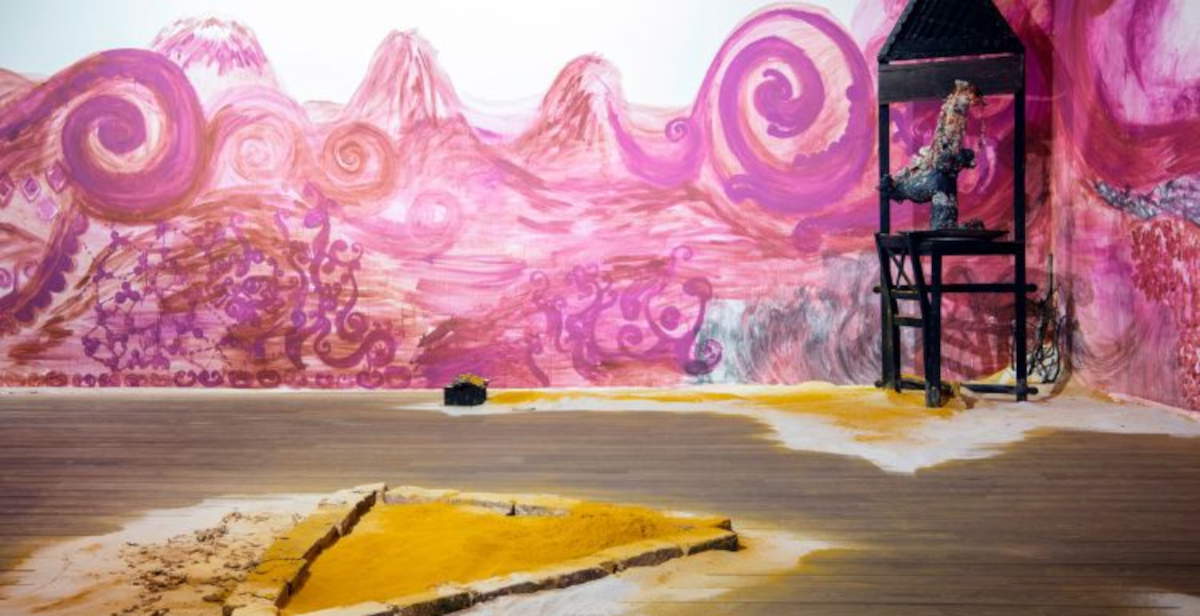
The tour concludes with a site-specific mural by Elia Nurvista, born in 1983 in Yogyakarta and active between Indonesia and Berlin. The work belongs to the Long Hanging Fruits series, developed since 2020, and takes its starting point from the history of palm oil, a product widely present in contemporary food. The artist reconstructs the story of the oil palm, which originated in Africa and was introduced to Indonesia during the Dutch colonial period, to reflect on the environmental and social consequences related to industrial cultivation.
 |
| Merano, an exhibition rethinks Europe-Asia relations beyond colonial readings |

Warning: the translation into English of the original Italian article was created using automatic tools. We undertake to review all articles, but we do not guarantee the total absence of inaccuracies in the translation due to the program. You can find the original by clicking on the ITA button. If you find any mistake,please contact us.



























 IT
IT FR
FR DE
DE ES
ES CN
CN


