



by Redazione 30/03/2026



Categories: Exhibitions / Disclaimer
From April 2 to May 16, 2026, New York gallery Cavin-Morris presents "Aliosso," the second solo exhibition dedicated to Italian artist Simone Pellegrini. The exhibition brings together a series of drawings that explore an ambiguous and layered visual language between archaeology, symbols and open narratives.
From April 2 to May 16, 2026, Cavin-Morris Gallery in New York presents Aliosso: Simone Pellegrini, a solo exhibition by Italian artist Simone Pellegrini. The exhibition constitutes the gallery’s second monographic presentation dedicated to the artist and opens with a scheduled opening on Thursday, April 2, from 6 to 8 p.m.
The project brings together a series of drawings that develop a research centered on ambiguous forms and a system of signs that is not tied to an unambiguous meaning. Pellegrini describes the outline of his works as a device open to interpretation: an element that functions as an access point for those who observe and decide to enter the inner world evoked by the images. A similar reflection also emerges in the dialogue between the artist and Paolo Campione published in the volume Simone Pellegrini - An Anarchic Geography, created on the occasion of an exhibition project at the Museo delle Culture Lugano.
“The outline of my works is never attributed to anything specific. Rather, it serves as a target for interpretation, open to anyone who dives into this inner world,” Pellegrini says.


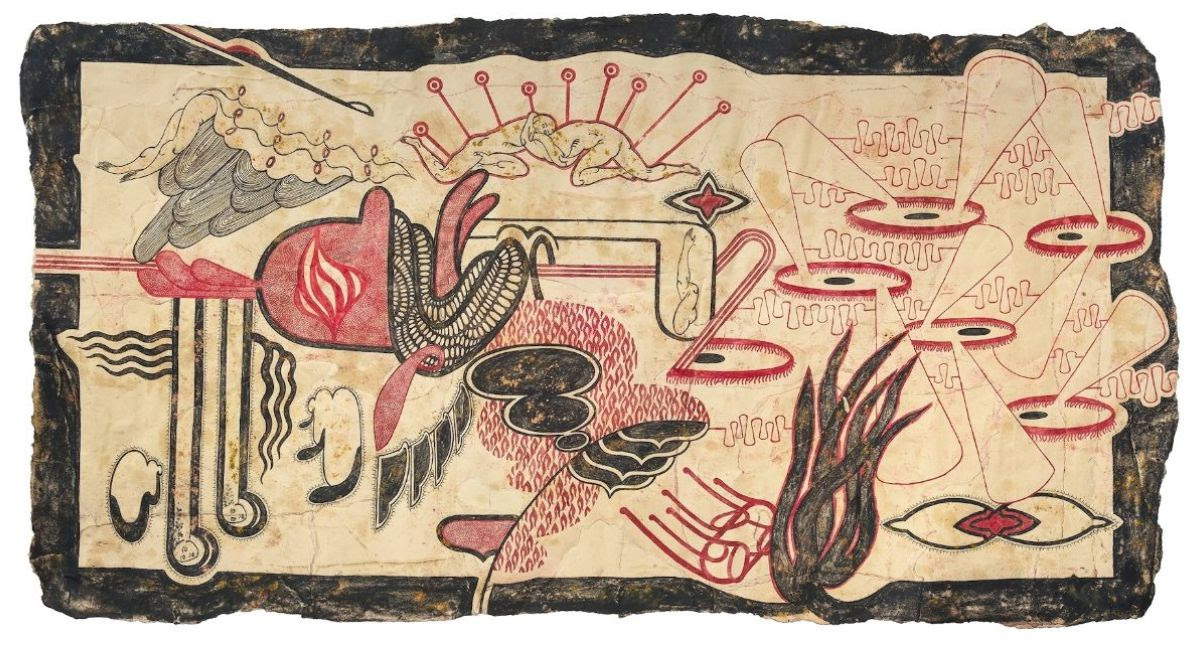
The origin of such imagery is also linked to a biographical dimension. Pellegrini’s mother worked as an archaeologist, and during his childhood the artist had the opportunity to frequent the excavation sites where she worked. The idea of layering, central to the artist’s research, also derives from this experience. The layers of the earth do not always follow a linear temporal logic: soil movement, erosion caused by rain and wind, or deeper phenomena related to igneous activity change the arrangement of buried objects over time. Monuments and minor artifacts, everyday elements and objects of symbolic value can change position and spatial relationships.
Within Pellegrini’s drawings such dynamics become a compositional principle. The forms, often recognizable but never fully defined, are arranged like fragments of an imaginary cartography. The works thus take on a hybrid character: on the one hand they recall maps or diagrams, on the other they retain the formal freedom of drawing. The images suggest a possible history of human imagination constructed through seemingly random juxtapositions of symbols and figures.
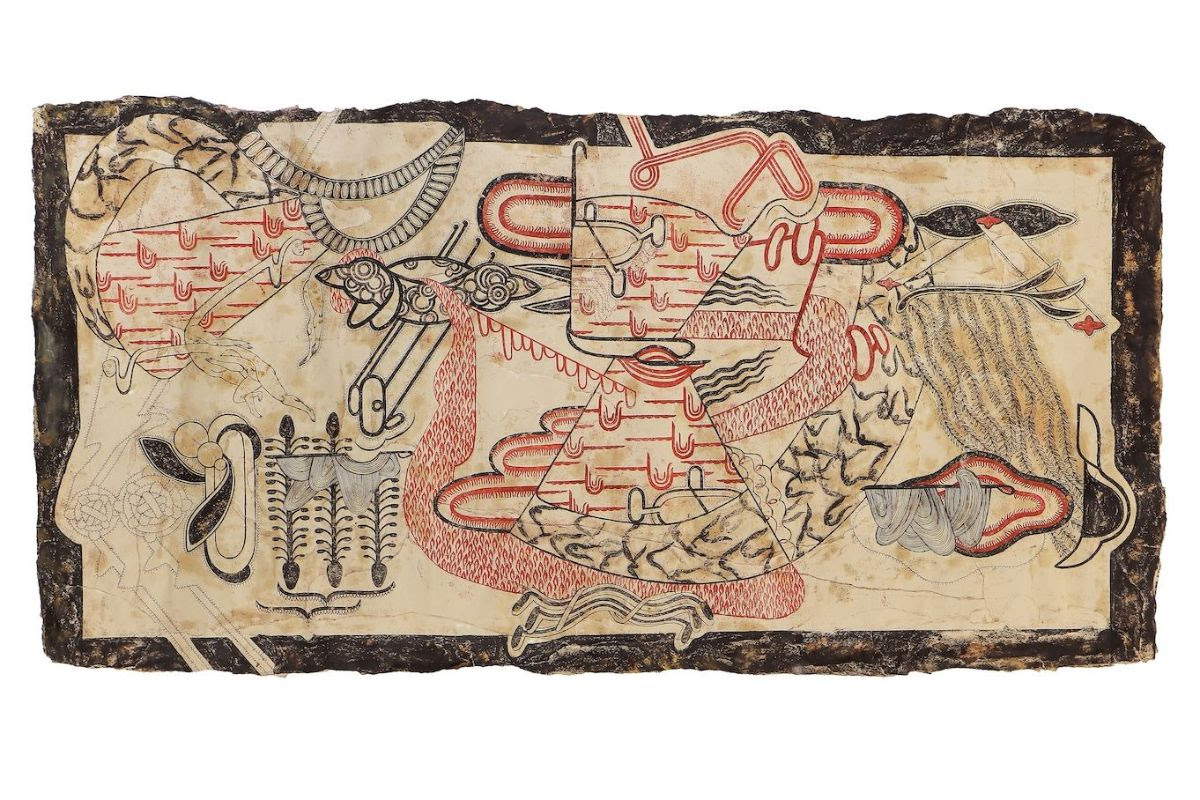
In this context, ambiguity represents a structural element of visual language. The sign system developed by Pellegrini does not fall under asemic writing in the strict sense. In asemic writing, the sign renounces a specific meaning; in the Italian artist’s works, on the other hand, each element suggests the presence of a possible meaning, even if not made explicit. An often evoked comparison concerns the practice of working on paper adopted by Mexican artist Martín Ramírez. Both construct surfaces composed of assembled fragments of paper, which become the support for highly symbolic signs. In Ramírez’s case such signs refer to complex and recognizable narratives; Pellegrini prefers to suggest a multiplicity of stories without defining a precise plot.
The forms in his drawings are thus located in a space that precedes or exceeds verbal language. The artist considers them as images capable of activating dreamlike structures in the gaze of the viewer. The result appears as a layered communication system, sometimes compared to signs traced on the walls of a symbolic cave, a metaphor for the inner dimension of the human mind.
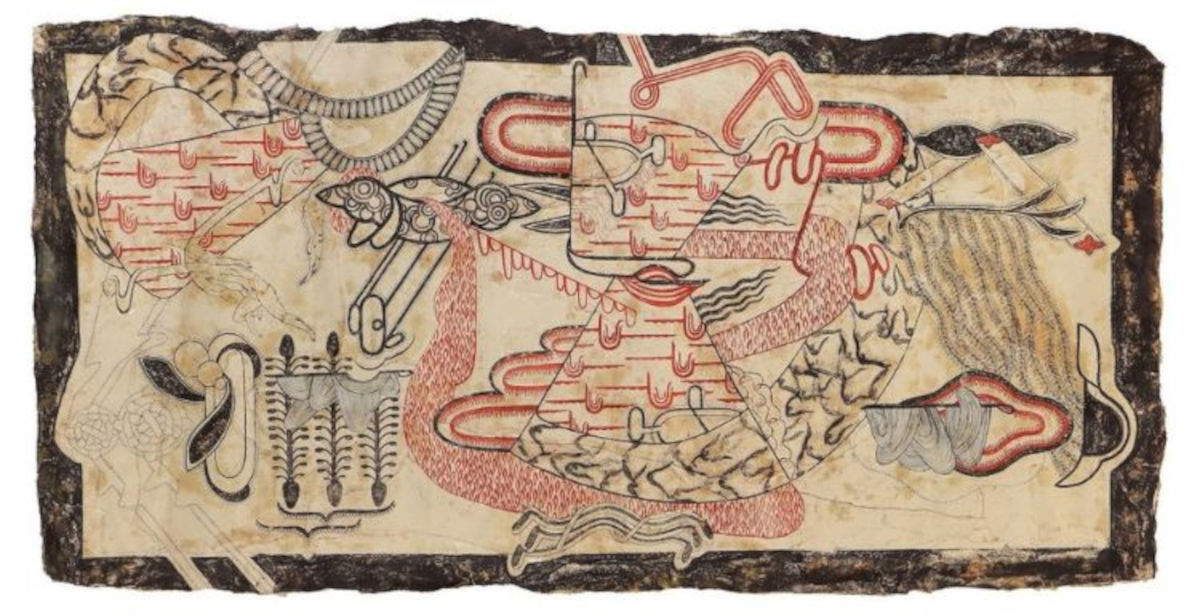 |
| Simone Pellegrini on display in New York: drawings as maps of the imagination |
Warning: the translation into English of the original Italian article was created using automatic tools. We undertake to review all articles, but we do not guarantee the total absence of inaccuracies in the translation due to the program. You can find the original by clicking on the ITA button. If you find any mistake,please contact us.