





The Gallerie d’Italia in Milan’s Piazza Scala welcomes, from May 29 to October 18, 2026, the exhibition Arnaldo Pomodoro: A Life. The great works of the Intesa Sanpaolo Collections and Arnaldo Pomodoro Foundation. A tribute that Gallerie d’Italia - Intesa Sanpaolo and Fondazione Arnaldo Pomodoro dedicate to Arnaldo Pomodoro (Morciano di Romagna, 1926 - Milan, 2025), one year after his death and on the occasion of the centenary of his birth.
Curated by Luca Massimo Barbero, associate curator of the Bank’s Collections of Modern and Contemporary Art, together with Federico Giani, curator of the Arnaldo Pomodoro Foundation, the exhibition aims to retrace the entire artistic career of one of the most important artists of the second half of the 20th century and of Italian contemporary art. A narrative, therefore, of more than sixty years of creative activity, from his formative years and early experiences in the 1950s to the most recent experiments of the new millennium. Through a selection of forty-five works from the collections of Intesa Sanpaolo and the Fondazione Arnaldo Pomodoro, the public is taken on a chronological journey through the fundamental stages of the sculptor’s poetic and artistic research. The itinerary allows both to admire the most representative works of his production and to delve into lesser-known works, flanked by archival documents to offer new interpretative perspectives. Further enhancing the imaginative power of Pomodoro’s work is contributed by the layout, inspired by the most significant display solutions devised by the artist throughout his career.
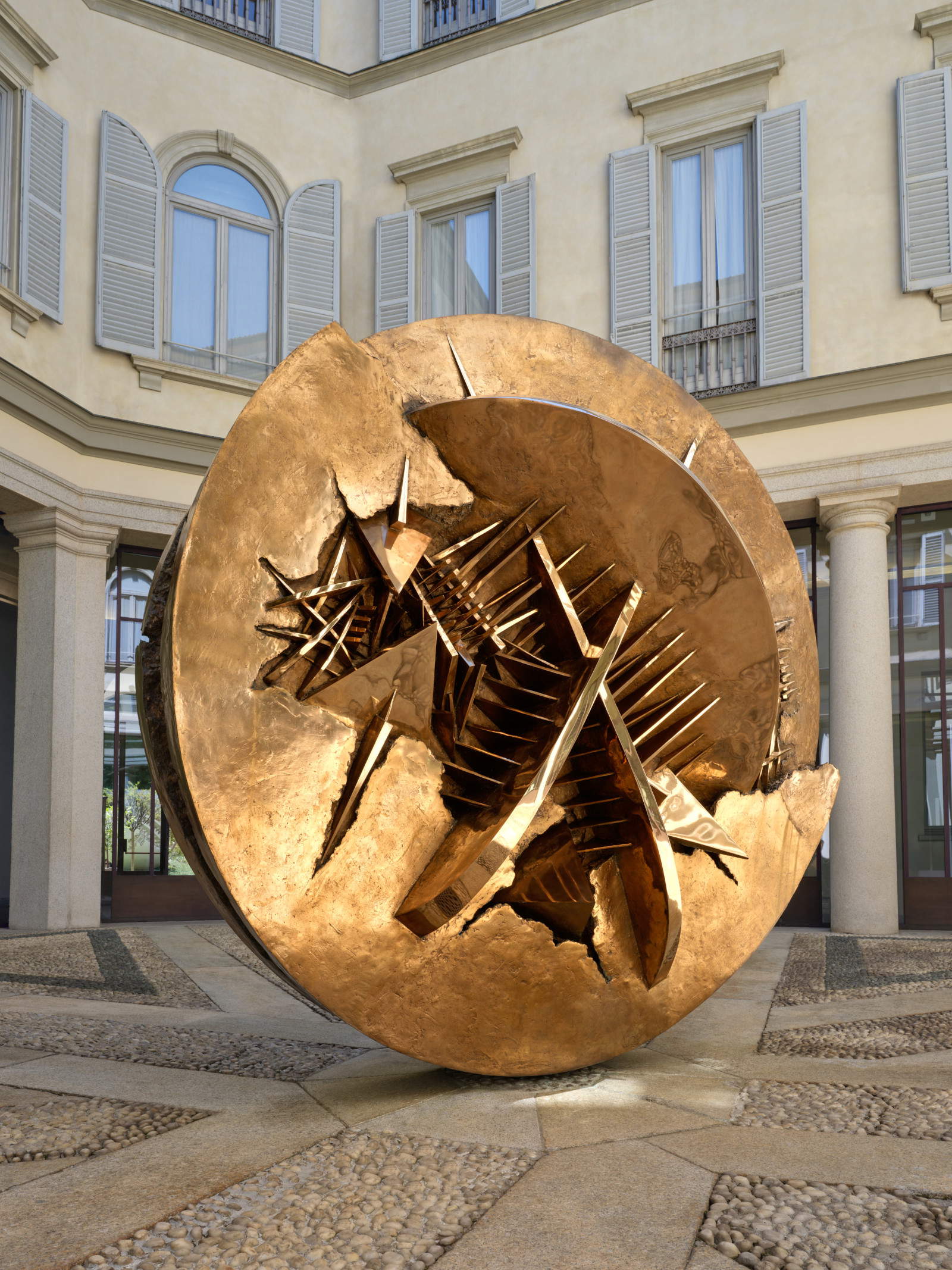
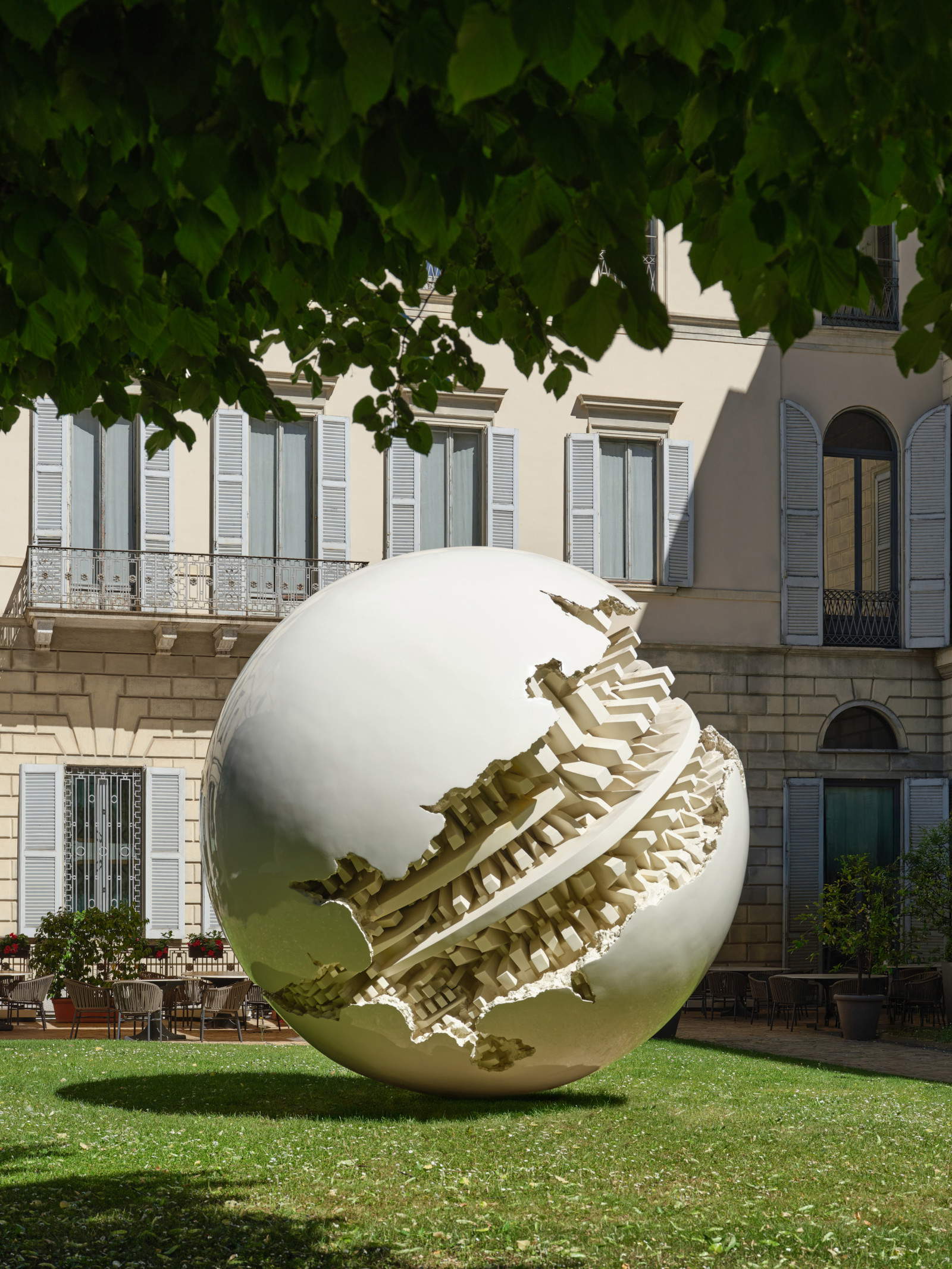
The exhibition unfolds in the spaces of the Gallerie d’Italia in Milan, involving the Salone Scala and adjacent rooms, the Salone Manzoni, the Cantiere del Novecento and the rooms of Palazzo Brentani, concluding in the octagonal Cloister and the Giardino di Alessandro. In the latter, two of the artist’s famous monumental works, Disk in the Form of Desert Rose No. 1 (1993-1994) and Large Sphere (1966-1967), are on permanent display.
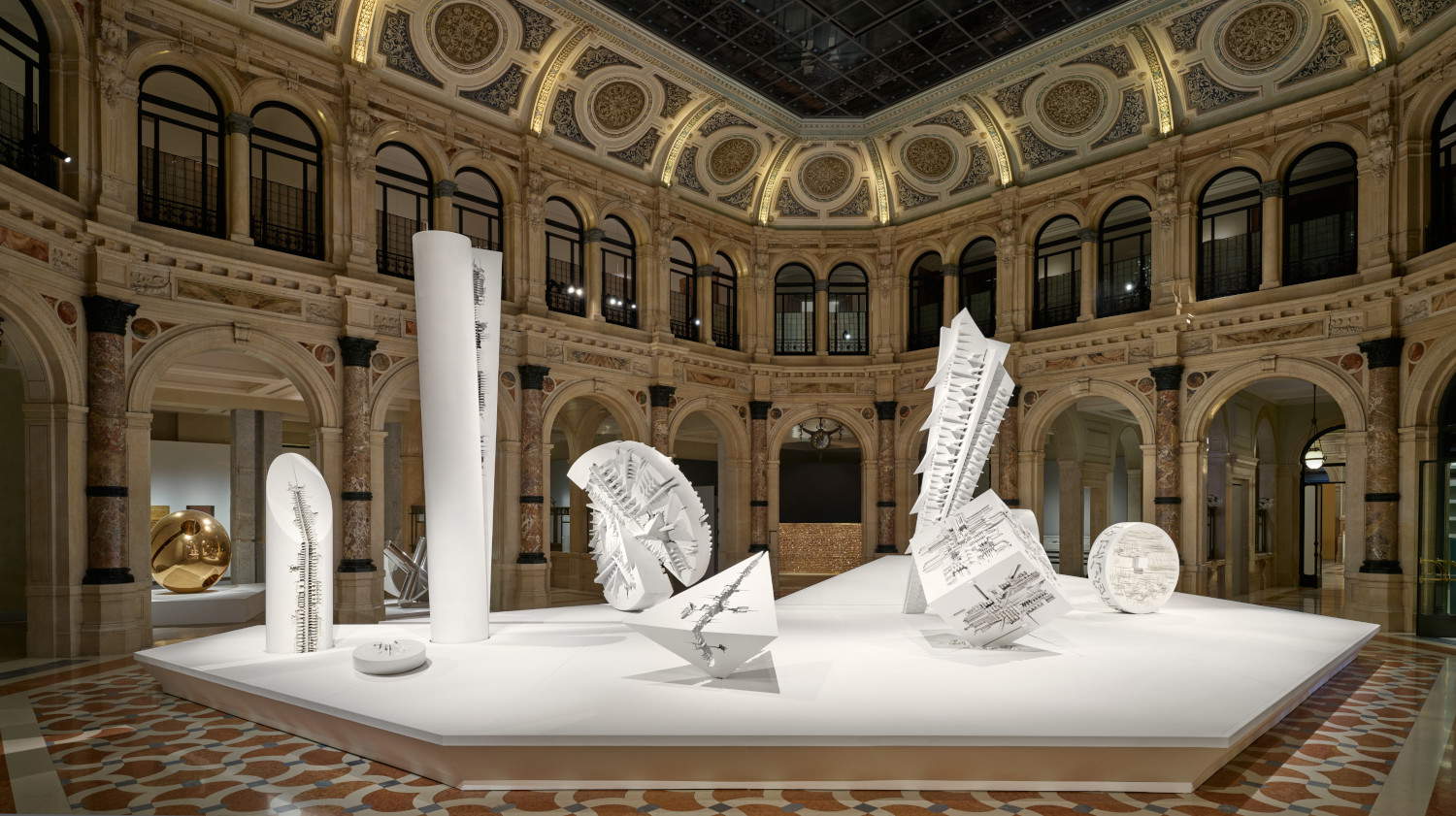
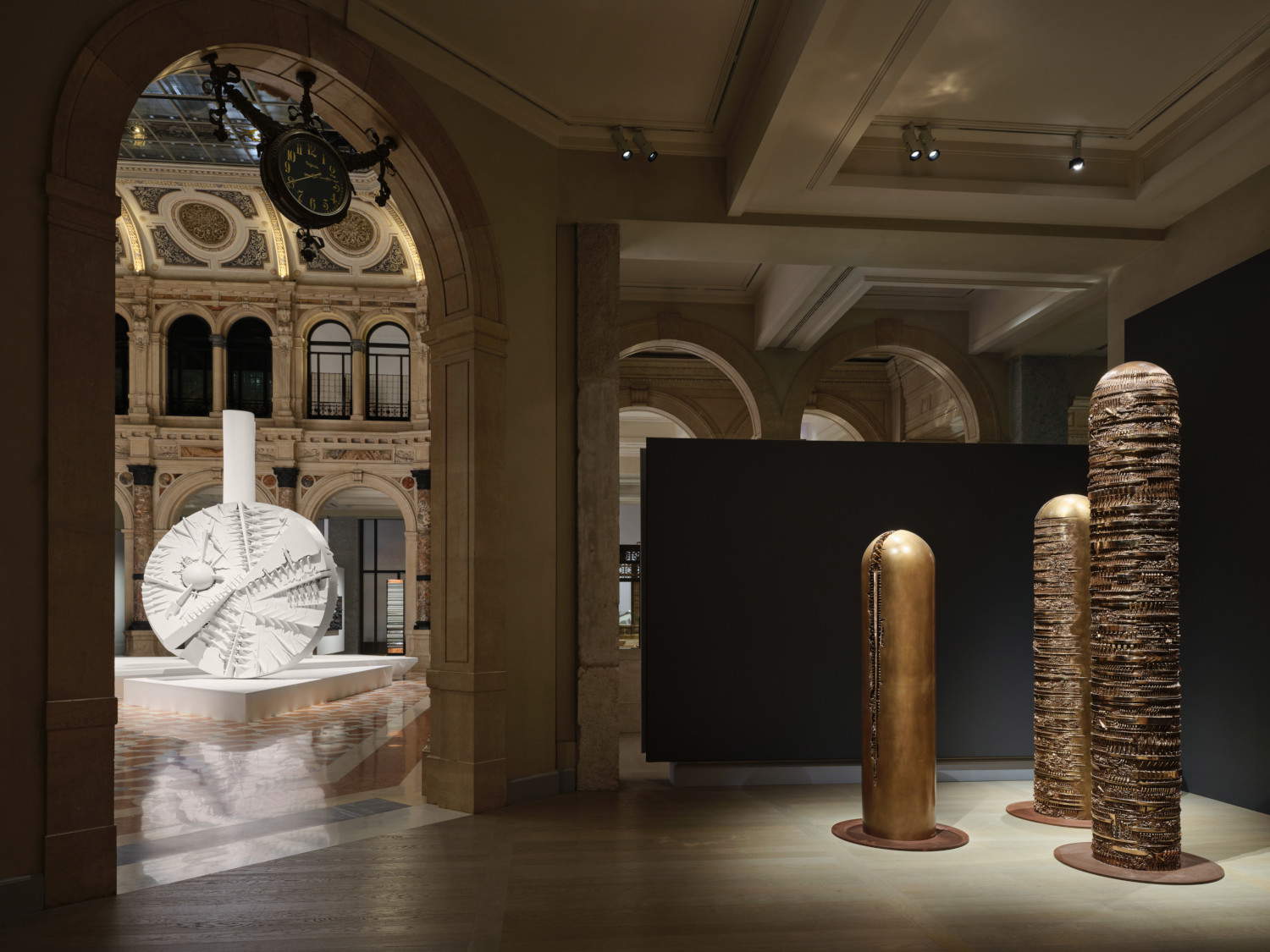
The exhibition itinerary begins in the Salone Scala, where a large platform, conceived as a kind of stage, hosts a series of sculptures made of white fiberglass, a material that creates contrast with the rich decoration of the surrounding environment. The works on display, made between the 1960s and the 2000s, constitute a significant nucleus dedicated to the themes of movement and instability, central elements in Pomodoro’s research. They include Cubo (1964-1967) and Movimento di crollo (1970-1971), a group of broken columns that evoke the sense of transformation and crisis in the contemporary world. Also featured are Gyroscope (1986-1987) and Wing Stroke (1984), the latter conceived as a tribute to Umberto Boccioni and described by the artist as a “traveling, open, inventive and unpredictable bird.” Completing the itinerary are Rotative of Babylon (1991), Wheel (1995) and Wedge with Arrows (2006), works that evoke the idea of a force capable of penetrating the depths of the earth, the origin and support of life itself.
Finally, the six rooms overlooking the Salone Scala take the public through the most significant passages of Arnaldo Pomodoro’s artistic evolution, offering a comprehensive overview of his creative experience. The rooms devoted to the formative years document the artist’s beginnings in the climate of Milan’s informal season of the 1950s. A selection of bas-reliefs made between 1955 and 1960 testifies to the progressive definition of Pomodoro’s expressive language and his constant research into materials, which led him to experiment with silver, cement, lead, tin, copper, zinc, iron, hydronalis and bronze.
The early 1960s, on the other hand, marks the deepening of the forms of Euclidean geometry and the transition to three-dimensional sculpture. This path is represented by works such as The Wheel (1961) and The Cube (1961-1962), one of the first Traveler’s Columns, and the famous Sphere No. 1 (1963), the first of the series of spheres that will contribute decisively to the artist’s international renown. Between the end of the 1960s and the beginning of the following decade, minimalist experimentation emerged, developed during the period of teaching on college campuses on the West Coast of the United States. Expression of this phase are the monumental Rotante massimo (1969-1970) in bronze and Forma X (1968-1969) in steel, works characterized by opposing but complementary forms.
In the transition between the 1970s and 1980s, Pomodoro returns to confront the themes of writing and communication. To this season belong both the series of Immagini (Images ) and Cronache (Chronicles), conceived as a sort of personal correspondence dedicated to artist friends such as Gastone Novelli and Ugo Mulas, and the series of Aste cielari (Sky Auctions), an evolution of the Colonne del viaggiatore (Traveler’s Columns ) transformed into modern and visionary antennas projected into the future. The research continues with the investigation of increasingly dynamic and articulated surfaces, such as those in Papyrus (1985-1986), which gradually expand until they occupy the surrounding space. This process finds significant expression in Papyrus for Darmstadt (1988-1989), a scaled-down version of one of the many environmental interventions made by the artist between the 1980s and 1990s.
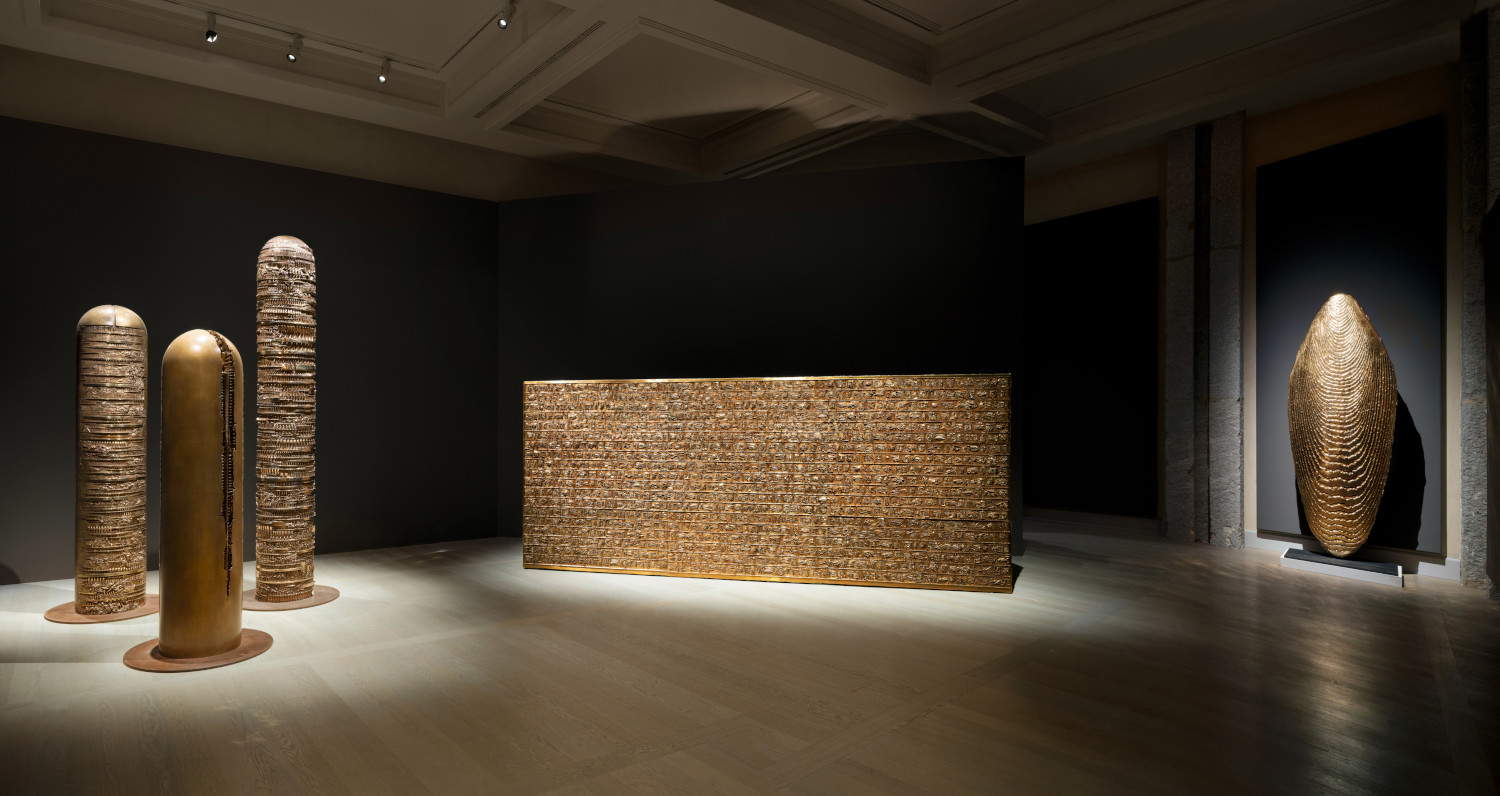
Even in the early 2000s, Pomodoro continued to confront the themes that had characterized his early creative experiences, particularly that of writing. Thus were born Columns A, B and C (2010), totemic structures entirely covered in dilated and continuous writing that, in the Continuum series (2010), takes on the character of a potentially infinite and hypnotic propagation.
The last room overlooking the Salone Scala offers the public an immersion in the artist’s archive. Catalogs, magazines, newspaper articles, posters, correspondence, sketches and original photographs have been selected to create a dialogue with the works on display and foster new associations and interpretations of Pomodoro’s complex creative universe.
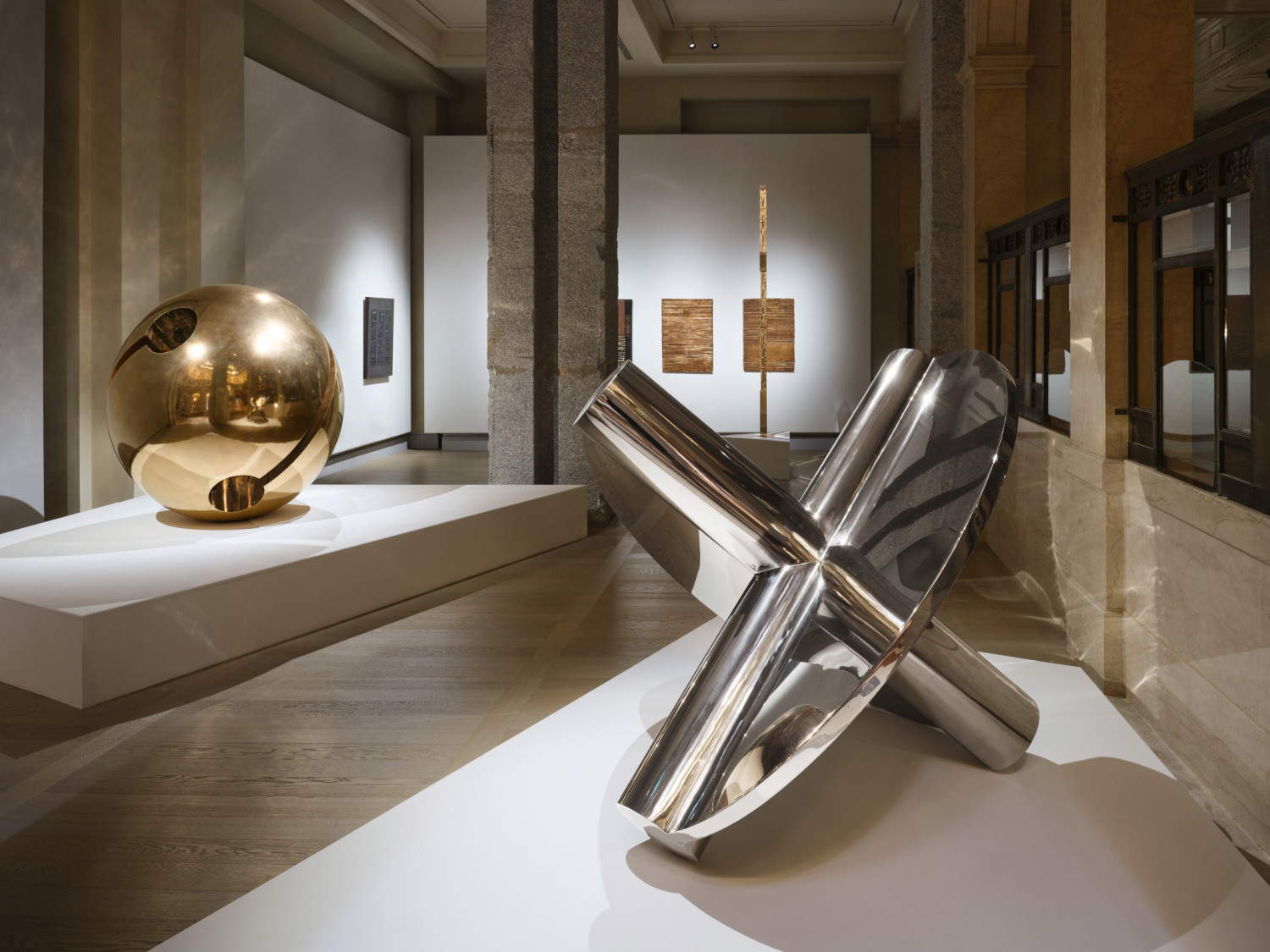
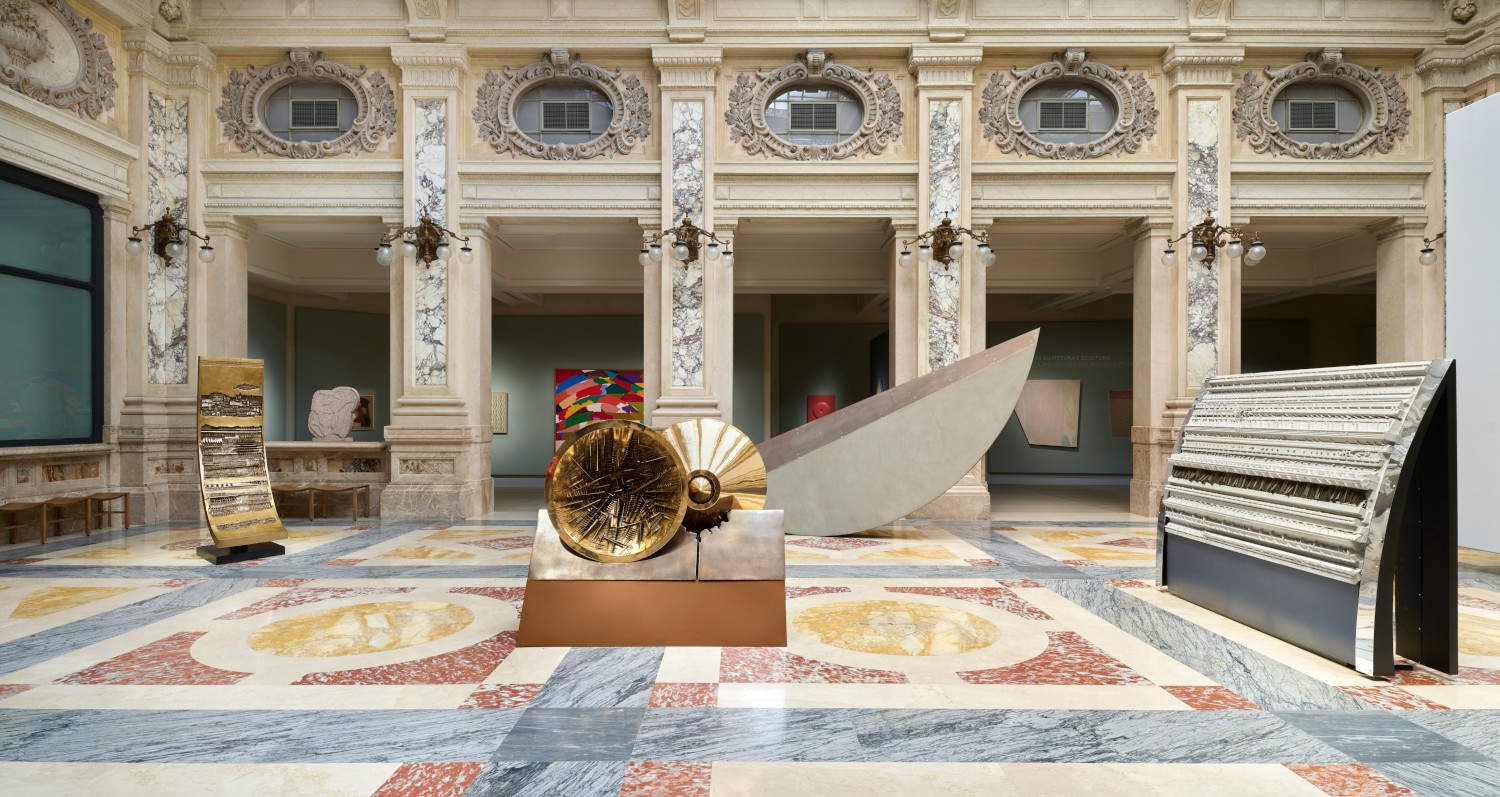
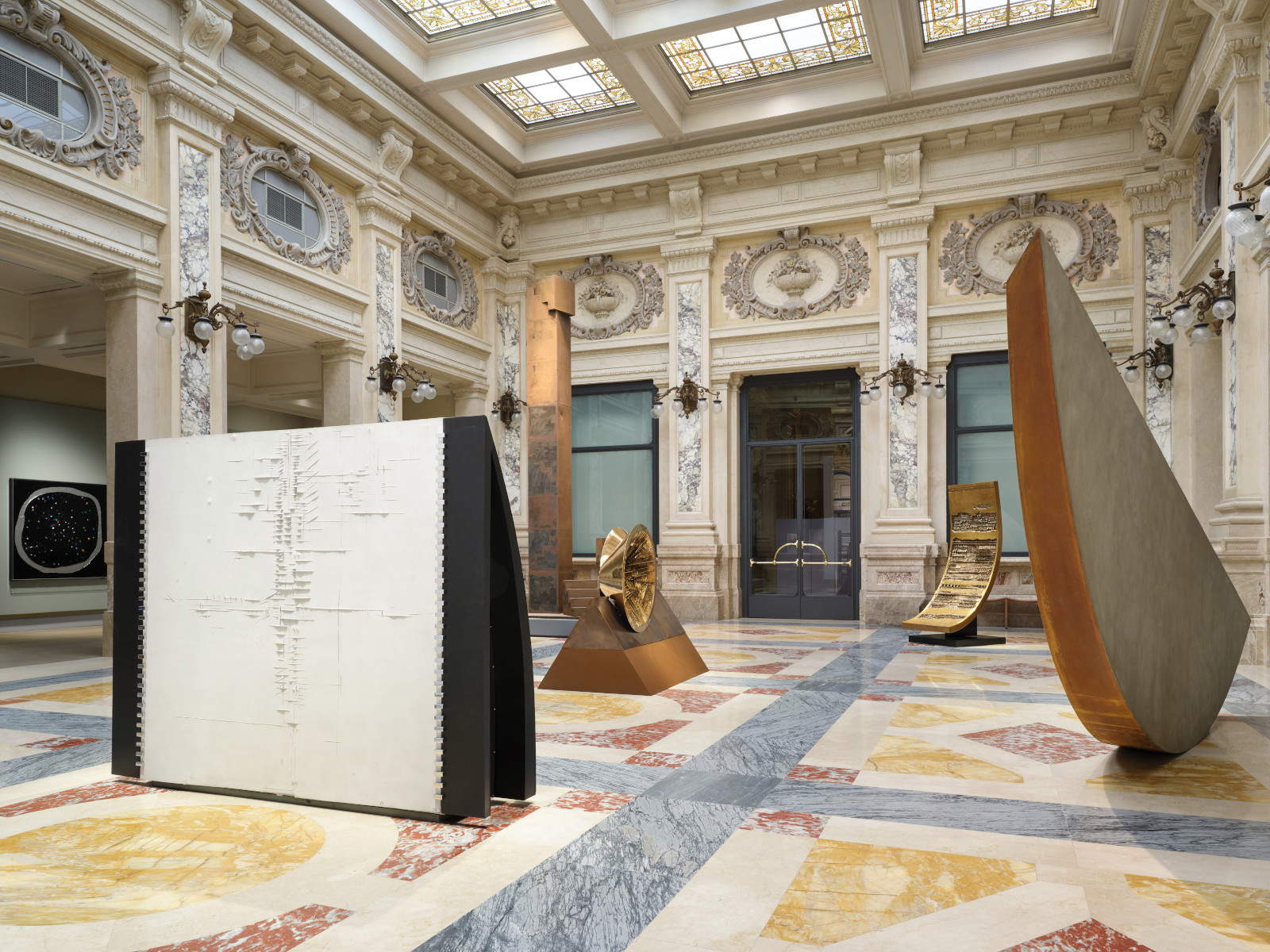
The exhibition route also extends into the spaces of the Cantiere del Novecento. The Salone Manzoni presents a group of works from the 1960s in dialogue with the permanent display of the Intesa Sanpaolo Group’s Collections of Modern and Contemporary Art. Works such as The True Pearl of Transparencies (1960), Radar No. 1 (1961-1962) and The Great Listening (1967-1968), linked to the themes of communication, technology and the artist’s interest in the U.S. context, confront the main thematic sections of the Cantiere - Sign, Space, Surface, Variable Geometries, Imprints, Traces, Memories and Ideas of Space. At the same time, they establish an ideal dialogue with the works of artists considered by Pomodoro to be fundamental points of reference, such as Lucio Fontana and Alberto Burri, with fellow researches such as Gastone Novelli, Achille Perilli, Piero Dorazio and Pietro Consagra, and with exponents of the next generation, including Nicola Carrino, Alighiero Boetti, Giuseppe Spagnulo and Mauro Staccioli.
Symbolically guiding the visitor to the conclusion of the itinerary are three Columns (2010), placed in the rooms of Palazzo Brentani. These works lead to the two large monumental sculptures permanently exhibited in the spaces of the Gallerie d’Italia and recently undergoing restoration: the Disk in the form of Desert Rose No. 1 (1993-1994), placed in the octagonal Cloister, which recalls the slow but incessant generative process of the mineral world, and the Sfera grande (1966-1967), made of fiberglass and derived from the first large sphere conceived by the artist. The latter represents one of the most emblematic and significant works of Pomodoro’s entire production and is part of the Luigi and Peppino Agrati Collection.
The exhibition will be accompanied by a program of guided tours and workshop activities aimed at schools and audiences of all ages, organized by the Educational Department of the Arnaldo Pomodoro Foundation in collaboration with the Educational Services of Civita Exhibitions and Museums.
Completing the exhibition project is the exhibition catalog, published by Società Editrice Allemandi, which includes an extensive iconographic apparatus and critical insights edited by the exhibition curators.
|
| Tribute exhibition to Arnaldo Pomodoro at Gallerie d'Italia in Milan one year after his death |

Warning: the translation into English of the original Italian article was created using automatic tools. We undertake to review all articles, but we do not guarantee the total absence of inaccuracies in the translation due to the program. You can find the original by clicking on the ITA button. If you find any mistake,please contact us.






















 IT
IT FR
FR DE
DE ES
ES CN
CN


