





It is one of the most important paintings from the final phase of Joseph William Turner’s career and one of the artist’s extremely rare masterpieces still in a private collection. Titled “Rome, Viewed from the Aventine,” the work was created in 1836 and is now the focus of international attention thanks to Sotheby’s, which has brought it back to Rome for a special exhibition at Palazzo Rondinini from September 29 to October 1. Following the exhibition in Rome, the painting will be offered at Sotheby’s auction in London on December 9, with an estimate of approximately 50 million pounds. If it reaches that figure, the work could set a new record for Turner. The painting already holds one record: when it was sold at auction by Sotheby’s in 2014, it fetched 30.3 million pounds—equivalent to 47.6 million dollars—becoming the artist’s most expensive painting ever sold at auction, a record that remains unbroken to this day.
The exhibition in Rome also holds special significance for the history of the work. It is believed that *Rome, Seen from the Aventine* was conceived, studied, and transferred to canvas right here in Italy, to be completed later in London. Its exhibition at Palazzo Rondinini thus marks a return to the city that inspired its creation and played a central role in the artist’s career.
The history of the painting is closely linked to that of several important British collectors. The work was commissioned from Turner by Hugh Andrew Johnstone Munro of Novar, his close friend, patron, and one of the most important collectors of his generation. Munro was also an amateur artist and had accompanied Turner on several sketching trips; upon the painter’s death, he would also become his executor. Later, the painting caught the attention of Archibald Primrose, 5th Earl of Rosebery and future British Prime Minister, who considered it the ideal wedding gift for his marriage to Hannah de Rothschild, then regarded as the wealthiest woman in the country. Primrose purchased the work in 1878, during the sale of the Munro collection, for 6,142 pounds—a sum significantly higher than that achieved by the other works offered at the same auction. Since then, *Rome, Viewed from the Aventine* has changed hands only once. In 2014, when Sotheby’s put it up for auction again—coming directly from the Rosebery family—the painting fetched 30.3 million pounds, setting the record for a work by Turner.
The long continuity of family ownership helps explain another exceptional feature of the painting: its extraordinary state of preservation. The canvas retains its original support and frame, and in its 191-year history, it has never undergone re-lining or restoration. Even details of the artist’s working process remain visible: Turner’s fingerprints, marks left by the palette knife, and a few bristles from his brushes that became embedded in the wet paint.
*Rome, View from the Aventine* represents one of the high points of Turner’s relationship with the Eternal City, but also one of the most significant expressions of his artistic exploration in the final years of his career. Often considered the first “modern” painter, Turner challenged the artistic conventions of his time through an increasingly free exploration of light, color, and atmosphere. His painting would exert a strong influence on the Impressionists and, later, on the abstract art movements of the 20th century. For Munro, the commission was intended to depict a view of contemporary Rome capable of uniting the city’s everyday life with its millennia-old grandeur. Turner, however, transformed the request into a personal vision, built upon five extremely detailed studies he produced during his second stay in Rome, between 1828 and 1829. The artist did not, therefore, limit himself to faithfully reproducing the landscape. As Julian Gascoigne, a specialist in British paintings at Sotheby’s London, wrote, he worked with “the precision of a surveyor and the sensitivity of a poet,” transforming his observations into a highly evocative image of Rome.
When *Rome Seen from the Aventine Hill* was presented at the Royal Academy in 1836, it immediately became one of the most talked-about works in the exhibition. Public and critical reactions were mixed, but some observers recognized its innovative power right from the start. The Morning Post, in an article published on May 3, 1836, called it “one of those astonishing works with which Mr. Turner dazzles the imagination and silences all criticism,” going so far as to consider it a work capable of “transcending all praise.”
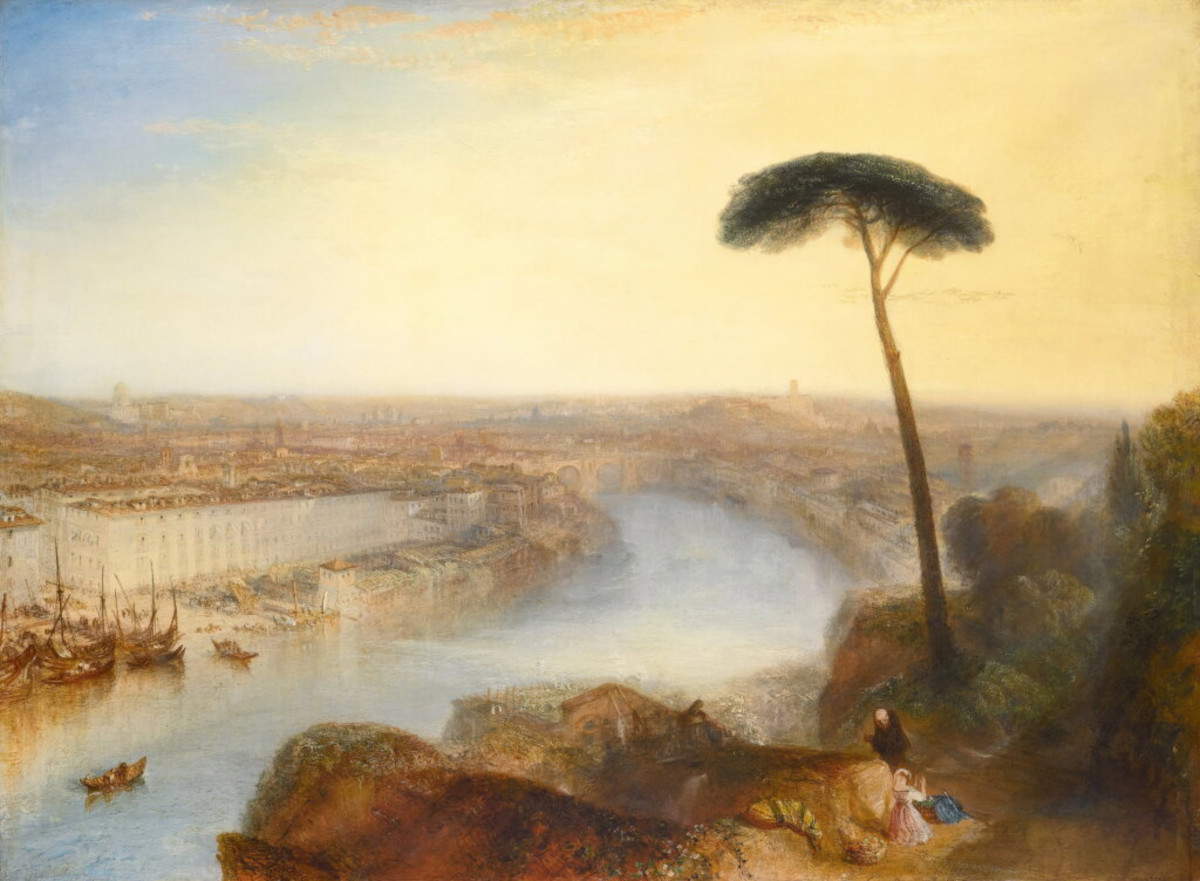
In the painting, Rome appears bathed in the golden light of dawn. The city retains its ancient monuments, yet at the same time takes on a luminous and almost modern appearance. At the center of the composition stands the ancient Aemilian Bridge, while along the horizon, some of the city’s most iconic landmarks can be recognized: St. Peter’s Basilica, the Forum, the Palatine Hill, the Circus Maximus, and, in the background, the Colosseum. A large pine tree dominates the city skyline, while along the Tiber, the Ripa Grande embankment and the Hospice of San Michele convey the bustle of daily life along the river. However, the view is not merely a celebration of Rome’s beauty: the painting also highlights some of the themes that run through Turner’s work, such as freedom, national identity, and cultural rebirth.
In the first half of the nineteenth century, Rome continued to represent a sort of ideal destination for European artists—the city considered the cradle of Western civilization and the center of European artistic culture from the Renaissance to the Enlightenment. Turner chose to depict it in the wake of the profound transformations brought about by the Napoleonic Wars: a city once again teeming with life, animated by artists, merchants, and travelers. And the chosen vantage point is no accident. The Aventine Hill, from which Turner observes the city, has in fact always been linked to the history and ideals of freedom of ancient Rome.
After nearly two centuries, *Rome, Viewed from the Aventine* thus returns to the city that fueled its imagination, before heading to Sotheby’s new auction in London this December, where an estimate of approximately 50 million pounds brings one of Turner’s most famous paintings still in private hands back into the spotlight.
“Few paintings capture Turner’s genius with the same vividness and completeness as this extraordinary vision of Rome’s timeless beauty,” Gascoigne emphasizes. “Created at the height of his artistic maturity, it is a work of extraordinary ambition, beauty, and innovation, capable of defining not only Turner’s greatness but also the very evolution of modern painting. Turner’s influence is immeasurable: nearly every artist who has picked up a brush since him owes something to his vision, and his impact on the development of modern art remains unparalleled. Similarly, few cities have influenced art and culture as much as Rome.”
|
| Sotheby’s is auctioning a Turner worth 50 million pounds: the masterpiece is set to break a new record |

Warning: the translation into English of the original Italian article was created using automatic tools. We undertake to review all articles, but we do not guarantee the total absence of inaccuracies in the translation due to the program. You can find the original by clicking on the ITA button. If you find any mistake,please contact us.

























 IT
IT FR
FR DE
DE ES
ES CN
CN


