





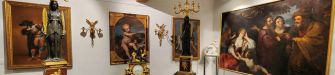
The Hall of the Giants at the “Giovanni Marongiu” Civic Museum in Cabras was inaugurated this morning, marking a major expansion that brings the museum’s exhibition space to approximately 1,500 square meters. The new space is intended to house the famous Mont’e Prama Giants statuary complex in the future, reinforcing the museum’s role as a key institution for promoting Sardinia’s archaeological heritage.
To celebrate the opening of the new hall, the Mont’e Prama Foundation has organized the exhibition *Tyrrhenòs and Sardò. Etruscan Princes and Nuragic Warriors: The Story of Two Peoples and the Sea That Unites Them, organized in collaboration with the National Archaeological Museum of Florence and the Municipality of Cabras, and coordinated by Villaggio Globale International. The exhibition offers a scientific exploration of the relationships between the Etruscan aristocracies and Nuragic civilization during the Villanovan and Orientalizing periods, reconstructing the ties that united the two shores of the Tyrrhenian Sea between the 10th and 7th centuries B.C. Through artifacts from major Italian museums—including a significant selection on loan from the National Archaeological Museum of Florence—the exhibition highlights a dense network of commercial, cultural, and artistic exchanges that contributed to the formation of the ancient Mediterranean.
During the opening ceremony, Alfonsina Russo, director of the Department for the Promotion of Cultural Heritage at the Ministry of Culture, spoke, highlighting the value of collaboration among institutions in promoting Italy’s archaeological heritage. Fabrizio Magani, Director General of Archaeology, Fine Arts, and Landscape at the Ministry of Culture, also expressed his appreciation for the project, emphasizing the role played by the Superintendencies in the research and promotion of archaeological heritage.
The exhibition takes visitors on a journey along the routes of the Tyrrhenian Sea, illustrating how Sardinia andEtruria were linked by intense maritime and trade relations. Nuragic artifacts found in Etruscan necropolises and Etruscan materials discovered in Sardinia document, in fact, a constant dialogue between the two civilizations—one far more complex than one might imagine. Among the most significant works are the famous bronze Nuragic ships, symbols of the maritime connections between the two shores of the Tyrrhenian Sea, including the specimen from the Tomb of the Duce in Vetulonia, considered one of the most important finds of its kind.
Also of great significance is the comparison between the monumental sculpture of the Giants of Mont’e Prama and the earliest examples of Etruscan statuary, represented by the statues from Casale Marittimo and Vetulonia. The dialogue between these works highlights surprising affinities in the representation of the human figure and offers a new perspective on the cultural relations that developed in the Mediterranean during the first millennium B.C.
The narrative concludes with the Battle of the Sardinian Sea in 535 B.C., the naval engagement that pitted the Greeks of Phocaea against the Etruscan-Carthaginian coalition. The latter’s victory reshaped the political balance in the Tyrrhenian Sea and marked the beginning of Carthage’s gradual dominance over Sardinia. Through this journey, the exhibition aims to restore the image of a Sardinia that was anything but isolated: an island at the center of Mediterranean trade routes, a key player in a network of cultural, economic, and artistic relations that made a decisive contribution to the history of ancient civilizations.
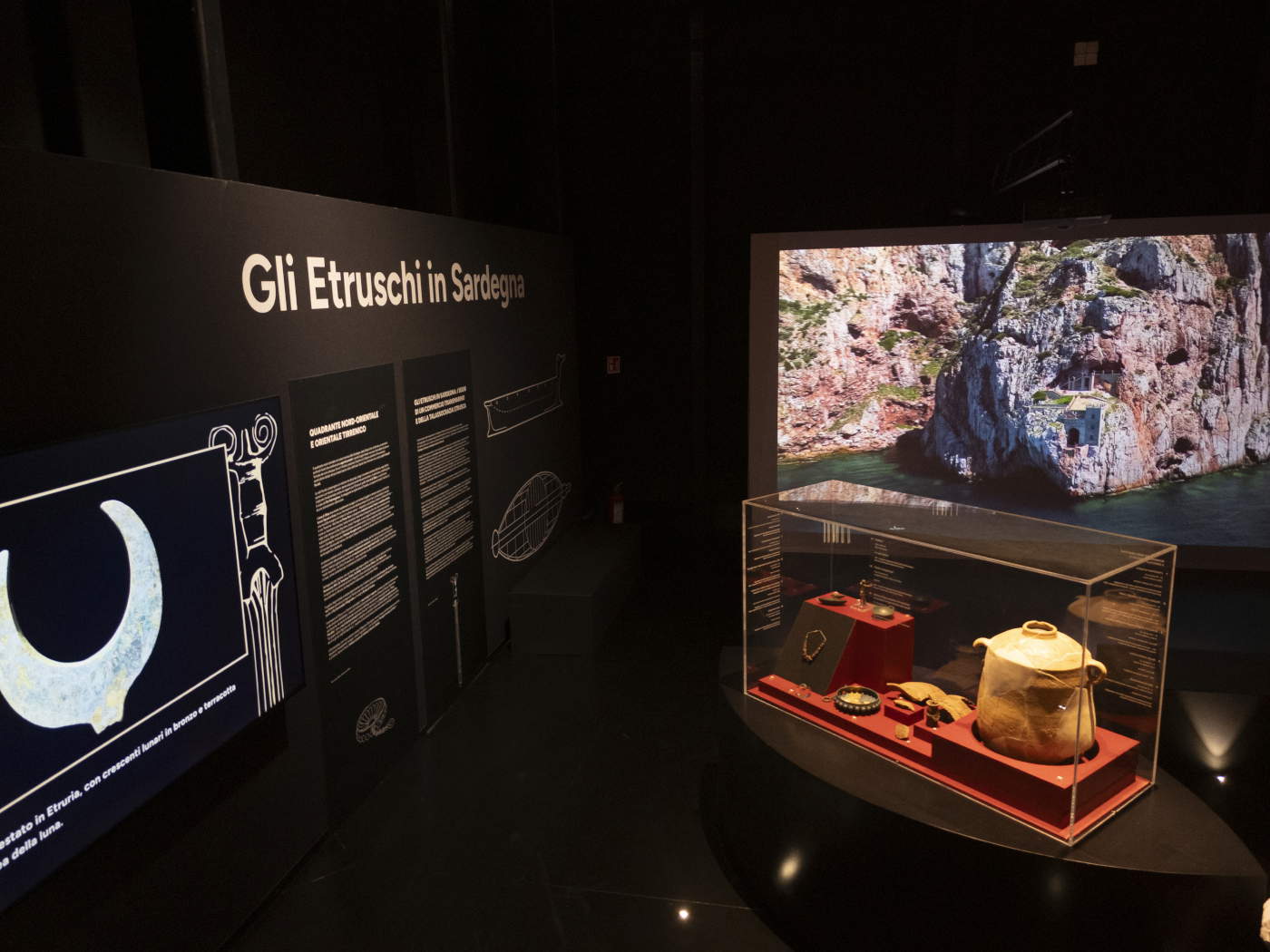
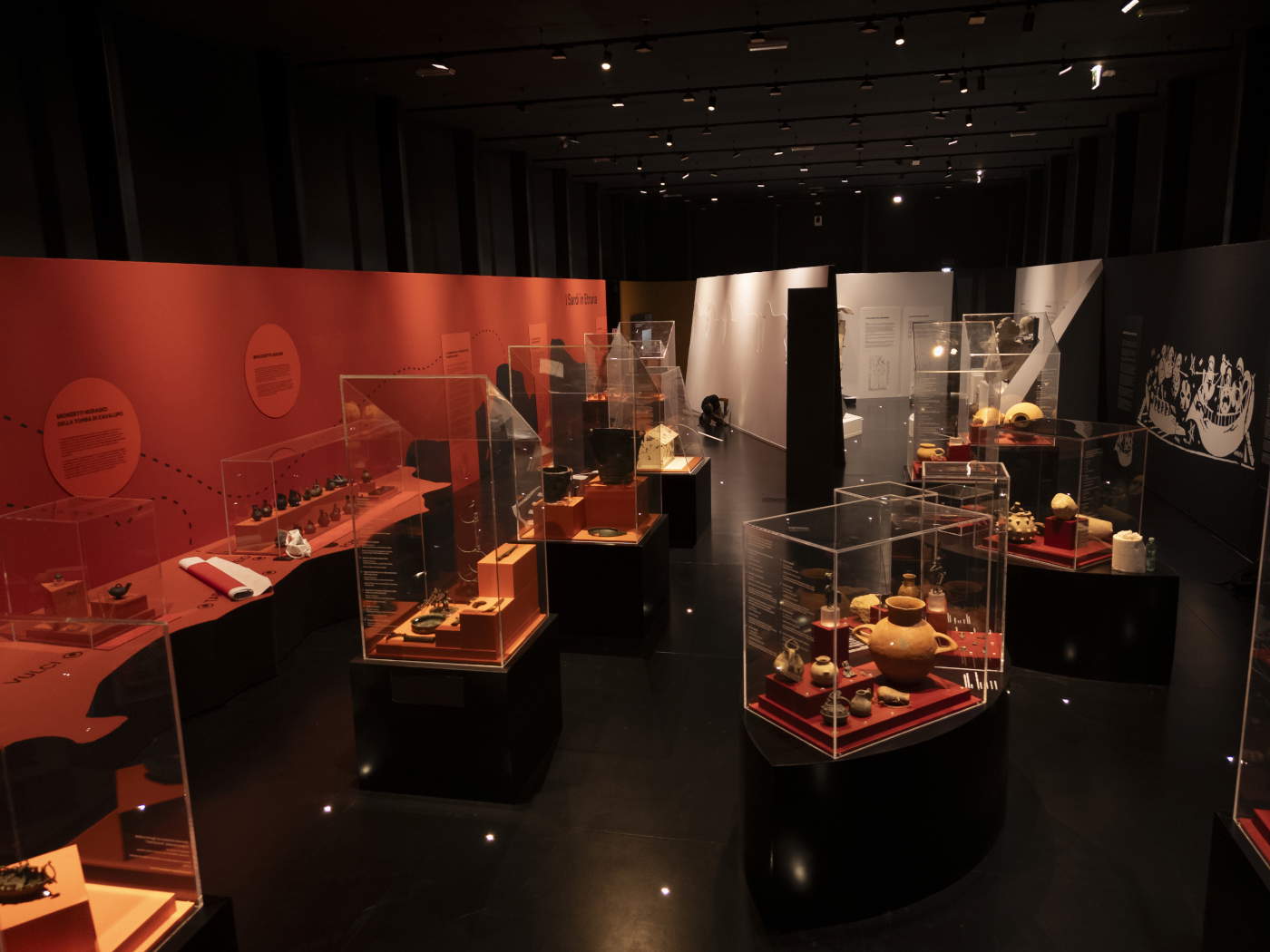
“Following the opening of the temporary exhibition, which brings all the Giants together in Cabras for the first time,” declared the President of the Mont’e Prama Foundation, Anthony Muroni, “we have the honor of inaugurating the future Hall of the Giants with a new exhibition of immense scientific and cultural interest that will shed light on the ancient ties between the Sardinians and the Etruscans. This space places our institution at the center of international cultural programming. With the opening of the new Hall of the Giants, the museum will have an exhibition space that will allow us to organize programs capable of meeting the needs of the general public.”
“We have reached a moment we’ve been waiting for years: after so much work, the Hall of the Giants is finally opening its doors to history,” commented the Mayor of Cabras, Andrea Abis. “As mayor, I am immensely proud to express my satisfaction with this milestone, which marks a new chapter in the effort to highlight the cultural heritage of Sinis. The House of the Giants, which will eventually house the entire Mont’e Prama sculptural complex, will now host an exhibition dedicated to the encounter between the Nuragic and Etruscan peoples—two groups that played a fundamental role in shaping the ancient history of the Mediterranean.”
“Sardinia and Cabras are at the forefront of a cultural program with national and international reach,” emphasized Regional Councilor for Culture Ilaria Portas. "Today’s exhibition opening adds another piece to this far-reaching project. It is an extraordinary showcase of incalculable scientific and cultural value. Indeed, through the dialogue between the Etruscan aristocracies and the Nuragic communities, this exhibition rewrites the narrative of our past, demonstrating that Sardinia was a land at the center of a dense network of exchanges and connections. The exhibition’s opening also coincides with the opening of the long-awaited new exhibition space that finally brings together the monumental complex of the Giants of Mont’e Prama into a single, comprehensive exhibition itinerary.” “Investing in culture in this way,” added Portas, “means kickstarting a driver of economic and tourism development that brings great value and growth to the Sinis region and the entire island. The public is now offered an expanded museum area of approximately 1,500 square meters, capable of attracting a form of cultural tourism that is slower-paced, more mindful, less consumer-driven, and of higher quality. As a Region, we will continue to support these outstanding initiatives, convinced that our historical identity is the most precious resource for building the economic and social future of our communities.”
The scientific value of the exhibition was highlighted by its curators, represented by Paolo Giulierini—co-curator alongside Raimondo Zucca, Daniele Federico Maras, and Giorgio Murru: “The exhibition offers a unique opportunity to compare, through extraordinary artifacts, the Etruscan and Sardinian aristocracies at a time when the ruling classes identified with one another through shared lifestyles. Never before had the Sardinian Sea served as such an extraordinary link between the two coasts; it is no coincidence that the exhibition’s image is a Nuragic boat discovered in Vetulonia, in Etruria.”
“Thanks to this encounter between Florence and Cabras,” concluded Daniele Federico Maras, Director of the Museum, “the ancient alliance between the Etruscans and Sardinians returns to the forefront—an alliance that, thousands of years ago, overcame physical, linguistic, and cultural barriers and laid the foundations for Mediterranean and European civilization. An exhibition-event like the one now opening is a sign of the identity-defining role of a national museum, which, by stepping beyond its own walls, helps promote culture even beyond regional borders and offers new perspectives on cultural heritage to an increasingly diverse and integrated audience.”
|
| Cabras inaugurates the new Hall of the Giants with an exhibition dedicated to the relationship between the Etruscans and the Nuragic people |

Warning: the translation into English of the original Italian article was created using automatic tools. We undertake to review all articles, but we do not guarantee the total absence of inaccuracies in the translation due to the program. You can find the original by clicking on the ITA button. If you find any mistake,please contact us.














 IT
IT FR
FR DE
DE ES
ES CN
CN


