




by Redazione 12/06/2026



Categories: Museums / Disclaimer
Starting June 11, the Capodimonte Museum and Real Bosco di Capodimonte opens the new Porcelain Gallery with sixteen rooms and more than 1,500 works on display. The project, supported by the Ministry of Culture and private patrons, brings together one of Europe's most important ceramic nuclei.
Starting June 11, the Capodimonte Museum and Real Bosco di Capodimonte directed by Eike Schmidt opens to the public the new Porcelain Gallery, an itinerary divided into sixteen rooms that makes visible a selection of one of the most important ceramic nuclei in Europe. The collection includes about seven thousand pieces of porcelain and earthenware, mostly from the Bourbon collections and subsequently increased through acquisitions and donations from the Unification of Italy to the present day. More than one thousand five hundred artifacts are on display in the new layout, while the total count also includes all the repetitive elements of the large table services.
For the adaptation of the rooms, the Ministry of Culture allocated one million one hundred thousand euros, while more than seven hundred thousand euros were raised thanks to the contribution of private patrons earmarked for the layout designed by Federico Forquet. A short catalog edited by Angela Caròla-Perrotti and published by Paparo is also being published on the occasion of the opening. The initiative is promoted in collaboration with the Campania Region through Scabec with Campania Artecard funds. Visitors can also take advantage of a free audio guide in Italian and English, to which additional language versions and tools intended for educational purposes will be added in the coming months.


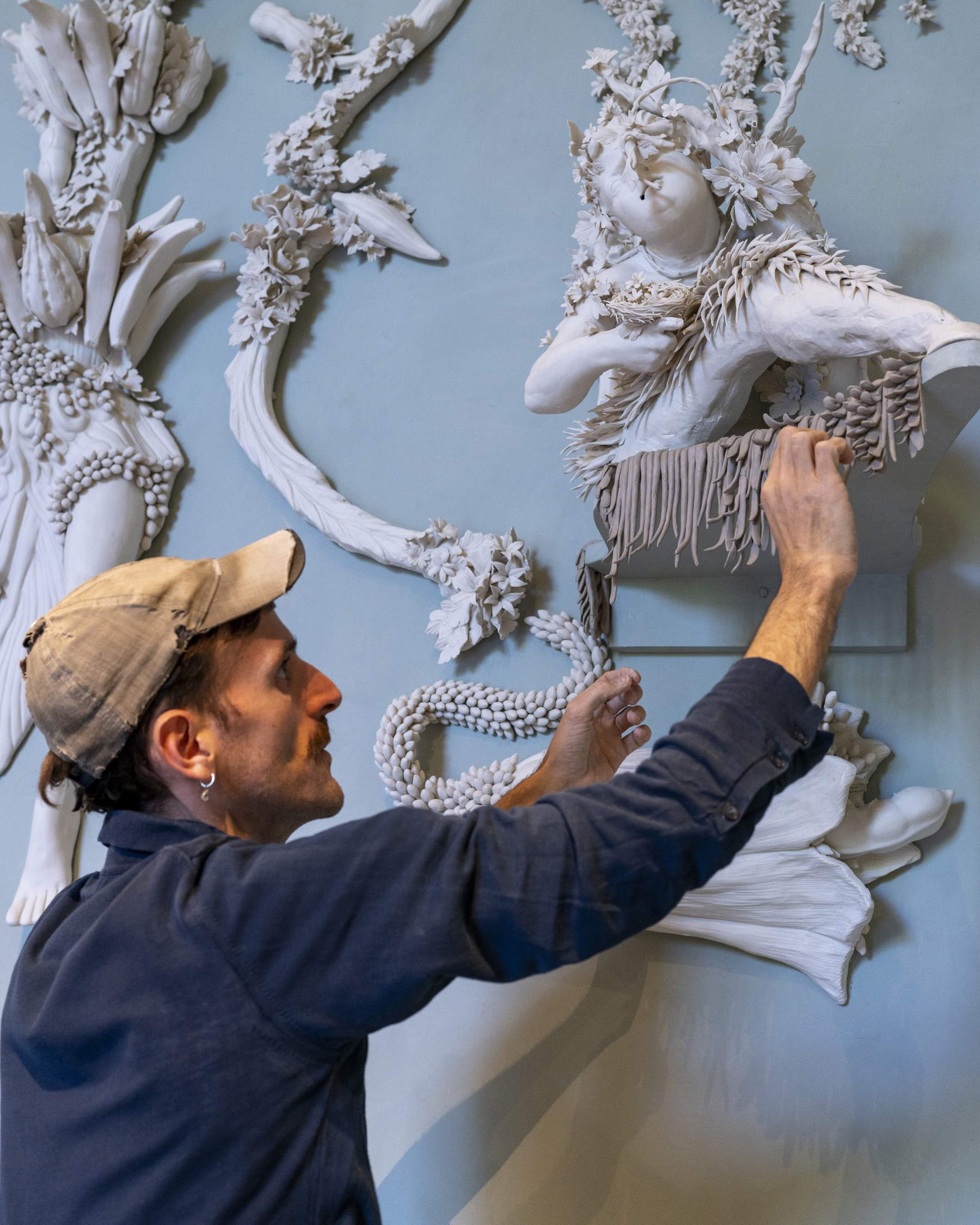
The entrance to the itinerary opens in the atrium of the main floor with Beata Fragilità del Bosco Amato (2024-2026), a site-specific installation by Diego Cibelli made of biscuit porcelain and acquired thanks to the support of Gianfranco D’Amato and Brunella Trimarco, president of the Tridama Foundation. The work is presented as a large garland composed of hundreds of phytomorphic, anthropomorphic and zoomorphic elements, as well as fruits and vegetables that recall the cuccagna tree. The work is part of Capodimonte’s custom of maintaining a dialogue with the contemporary, as evidenced by the previous presences of artists such as Alberto Burri, Sol LeWitt, Mimmo Paladino and Christiane Löhr.
The new exhibit is ideally connected to the project initiated in 1872 by Annibale Sacco, director of the Royal House of Savoy, who decided to bring together at Capodimonte the porcelain and earthenware that belonged to the Bourbons and were distributed in the various royal residences. The itinerary also incorporates the famous Porcelain Drawing Room from the Royal Palace of Portici. The history of Capodimonte porcelain has its roots in 1743, when Charles of Bourbon founded a manufactory within the Royal Wood. The business was relatively short-lived and ceased in 1759, when the sovereign became king of Spain and moved to Madrid, also bringing with him numerous specialists engaged in production.
The exhibition tour begins with the room devoted to European porcelain, in which specimens from the Meissen manufactory, the oldest in Europe, are displayed, which came to Naples as gifts from Augustus III of Poland to his daughter Maria Amalia on the occasion of her marriage to Charles of Bourbon. Also featured are works from the imperial manufactory in Vienna, founded in 1718. Among the pieces on display is the déjeuner given by Maria Carolina of Habsburg-Lorraine to her husband Ferdinand IV of Bourbon, with family portraits in silhouette and views of Naples and Vienna. Also placed in the same room is the Genius of Peace, one of the Viennese manufactory’s best-known works. Two fuseau vases produced by the Sèvres manufactory between 1810 and 1811, on the other hand, feature portraits of Napoleon Bonaparte and Marie-Louise of Habsburg-Lorraine and were intended for Caroline Bonaparte, Queen of Naples. Among the most important works of the Royal Factory of Naples also appears the plateau decorated with a miniature reproducing Annibale Carracci’sHercules at the Crossroads, a painting belonging to the Farnese collection.
The room dedicated to Charles of Bourbon preserves some of the earliest examples made by the Royal Factory of Capodimonte, including the shell-shaped basin modeled by Giuseppe Gricci. The space also houses two works by South Korean artist Yeesookyung, who uses fragments of broken ceramics to create new sculptures. The assembled pieces come from the factory’s discards recovered in the 1950s during work conducted in the building that housed the factory.
Large paintings of biblical and Roman subjects, 19th-century neoclassical sculptures and a circular table dating from the early 19th century, featuring a top decorated with a mosaic from the excavations at Herculaneum, coexist in the Camuccini Hall. The Hall of Earthenware documents production in so-called “English-use clay.” On display are four amphora vases from the Del Vecchio manufacture, made between 1812 and 1818, whose handles reproduce theFarnese Hercules preserved at the National Archaeological Museum in Naples. Artifacts from the Giustiniani manufacture and Baron Giuseppe Malvica’s factory in Palermo also find a place there. The Hall of Antiquity collects porcelain inspired by archaeological discoveries at Herculaneum and Pompeii, including vases with Herculaneum dancers and the biscuit group with four kneeling priestesses bringing offerings to Isis.
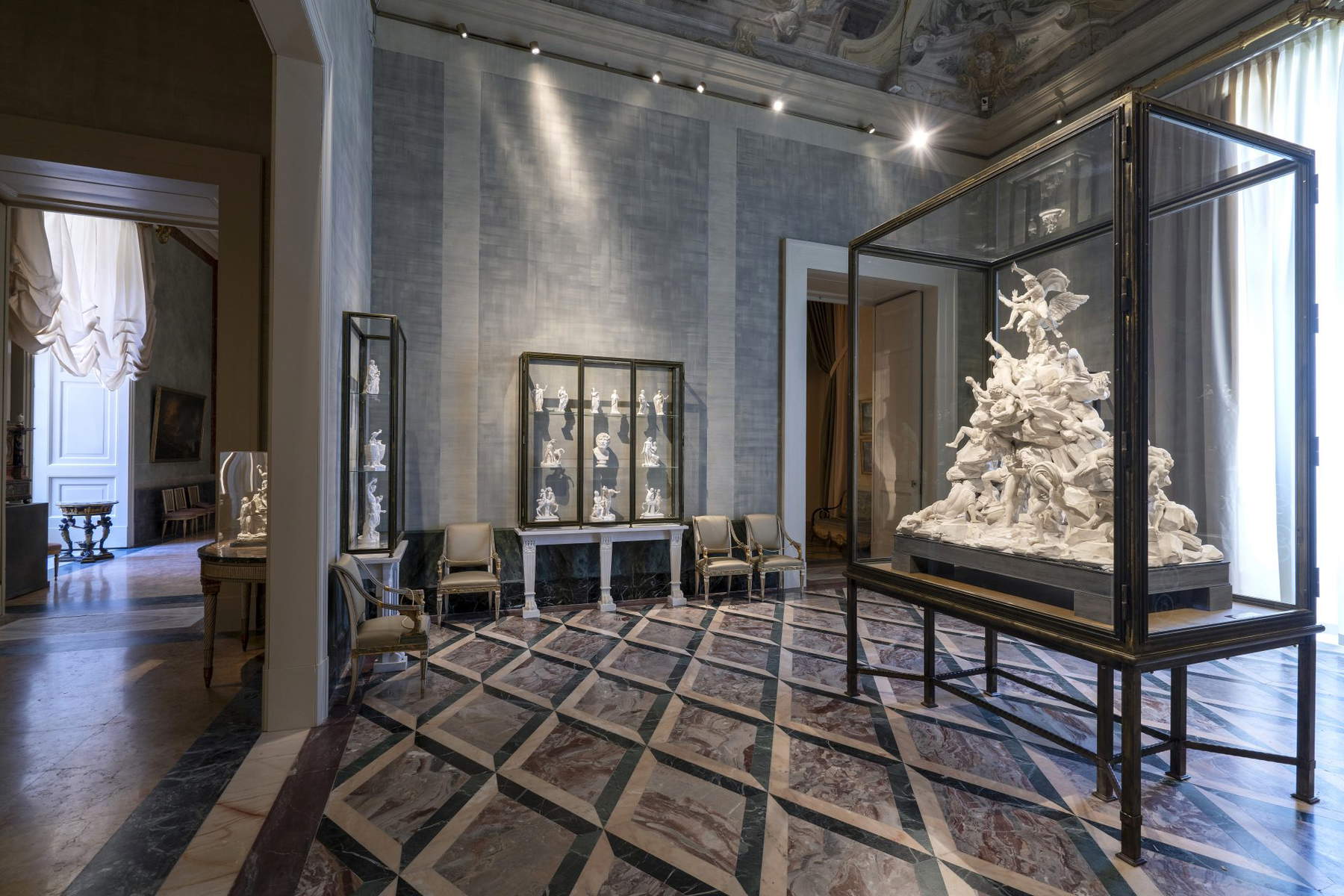
The Tagliolini Room is dedicated to biscuit porcelain from the Ferdinandea manufactory. The Trionfi di Bacco e Sileno (Triumphs of Bacchus and Silenus ) by Filippo Tagliolini are displayed there, while the next room contains the Caduta dei giganti (Fall of the Giants), executed between 1785 and 1790 and considered the most famous and largest work made in porcelain in Naples in the 18th century. In the same room are the heads of Seneca and Agrippina and the group with the Diana of Ephesus, a recent acquisition by the Ministry of Culture for Capodimonte and presented to the public for the first time.
The Nature Room houses the service with birds, originally composed of 306 items and now preserved in fifty surviving examples. Numerous species are depicted, including exotic varieties such as parrots and toucans. In the same room is located the service decorated with fruits and vegetables made by Raffaele Giovine and donated in 1819 by Francis of Bourbon to his father Ferdinand I. The yellow Sèvres service, consisting of 112 pieces decorated with motifs related to Dionysus, also finds space.
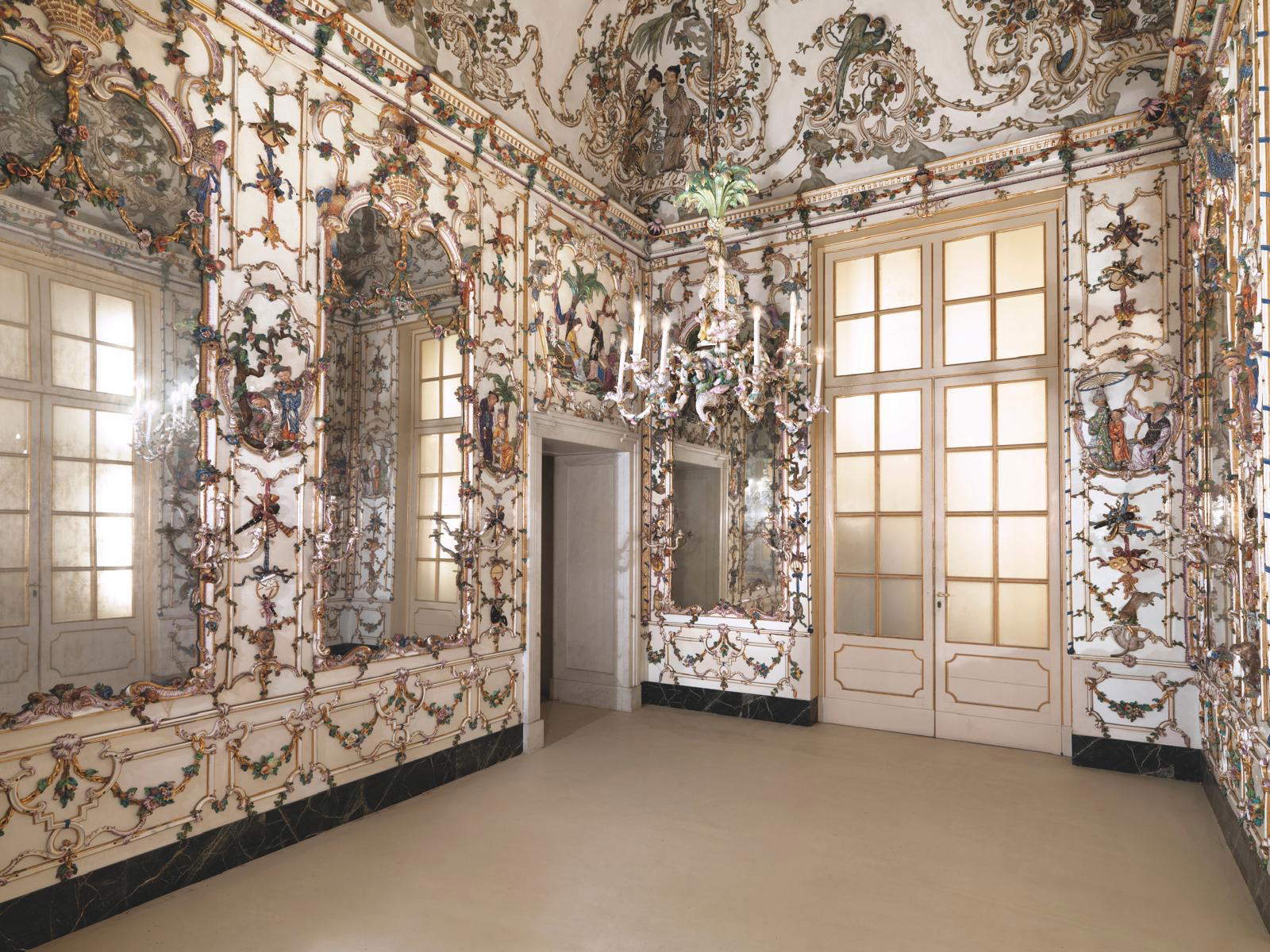
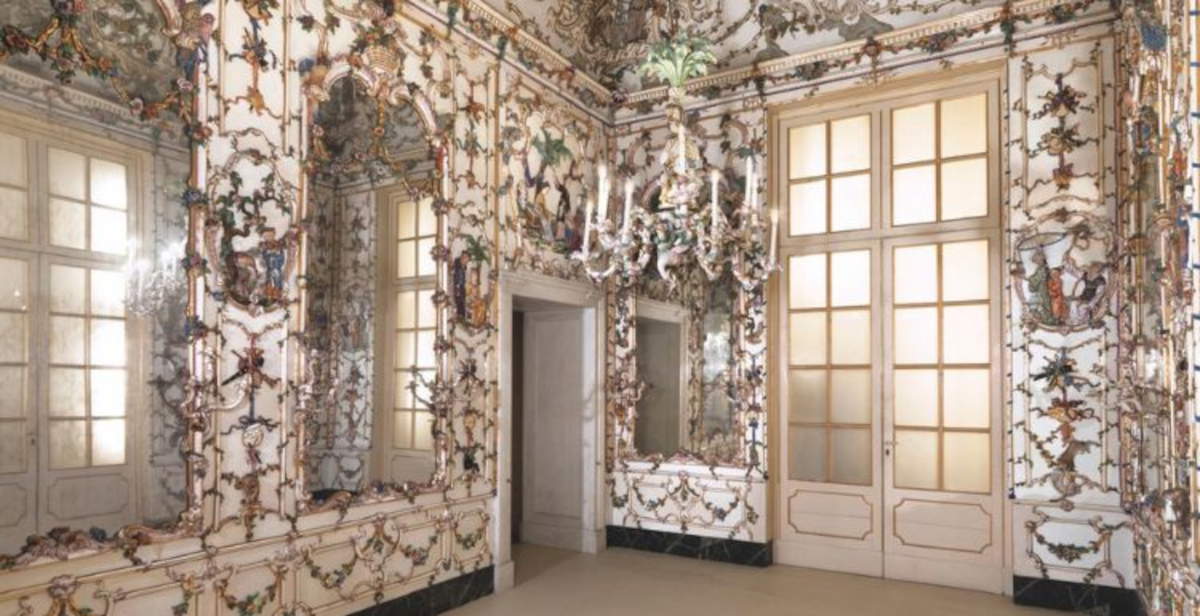
One of the best-known stops on the tour is the Porcelain Salon, designed for Maria Amalia of Saxony and originally placed in the Palace of Portici. The panels were made between 1757 and 1759 in the Royal Factory of Capodimonte and transferred by means of twenty-six gigs. The salon arrived at the museum in 1866. Rococo decorations include floral motifs, exotic animals, fantastic figures and Chinese inscriptions, some of which contain celebratory verses dedicated to the sovereign.
The small room dedicated to the Royal Factory of Capodimonte displays the altar set intended for Charles of Bourbon’s private oratory in the Royal Palace of Portici. Also on display are theImmaculate Conception and the Pietà by Giuseppe Gricci. The latter represents the only terracotta model of a porcelain preserved in the museum’s collections and was acquired in 2025. The Hall of Bourbon Portraits displays the Vesuvius eruption plateau service, commissioned by Francis of Bourbon and given to Ferdinand I in 1822. The Murat Room houses the Chariot of Venus from the Poulard-Prad manufactory and the service that belonged to Caroline Murat.
The Kingdom Views Room reconstructs a court table from the late 18th century. In the center is arranged the porcelain dessert executed around 1785 with figures modeled by Filippo Tagliolini. In the showcases the Service of Views of the Kingdom, consisting of more than four hundred items, is displayed in its entirety. Later renamed the “Goose Service,” it represented the main service intended for official banquets and displayed views of Naples and southern Italy appreciated by visitors.
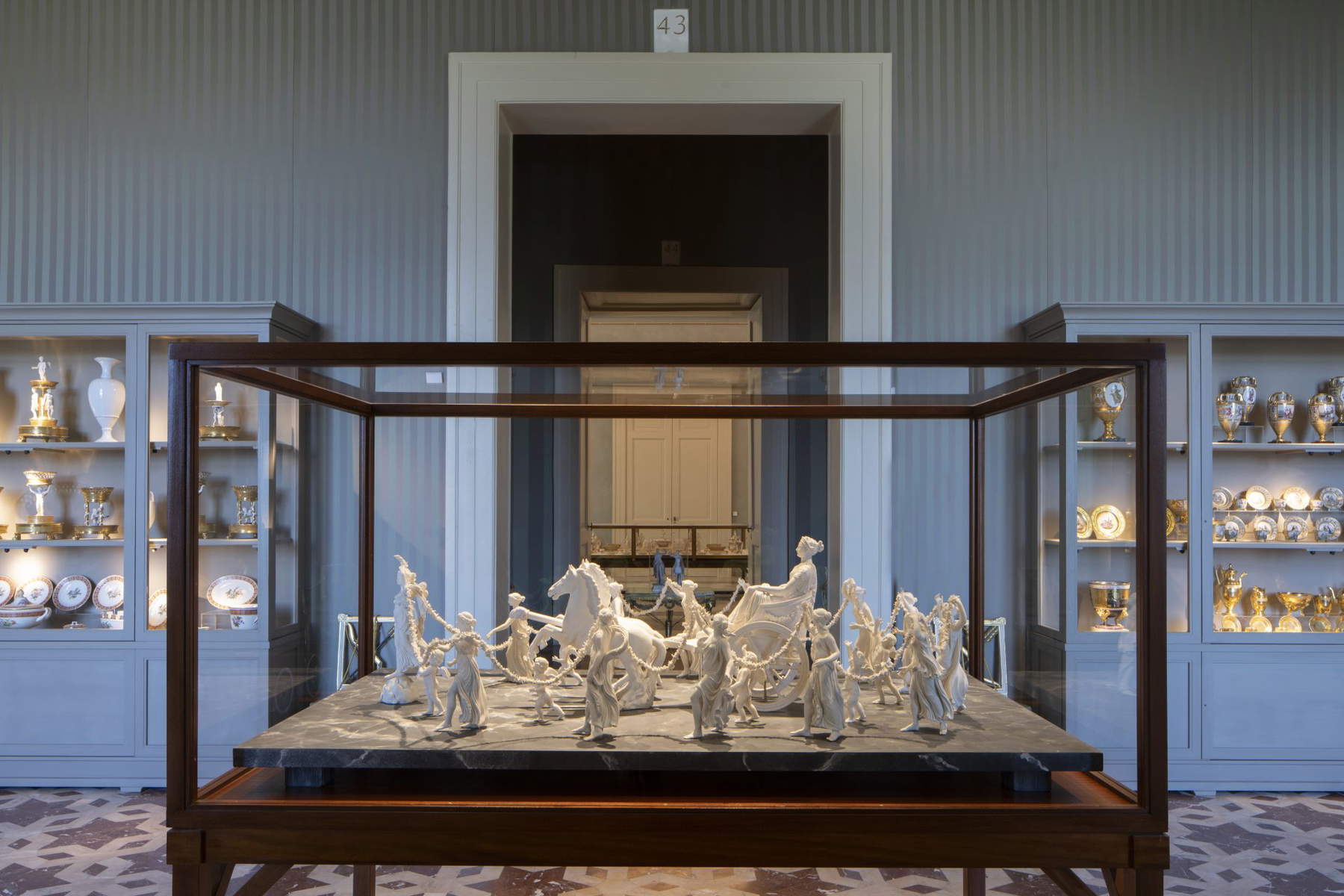
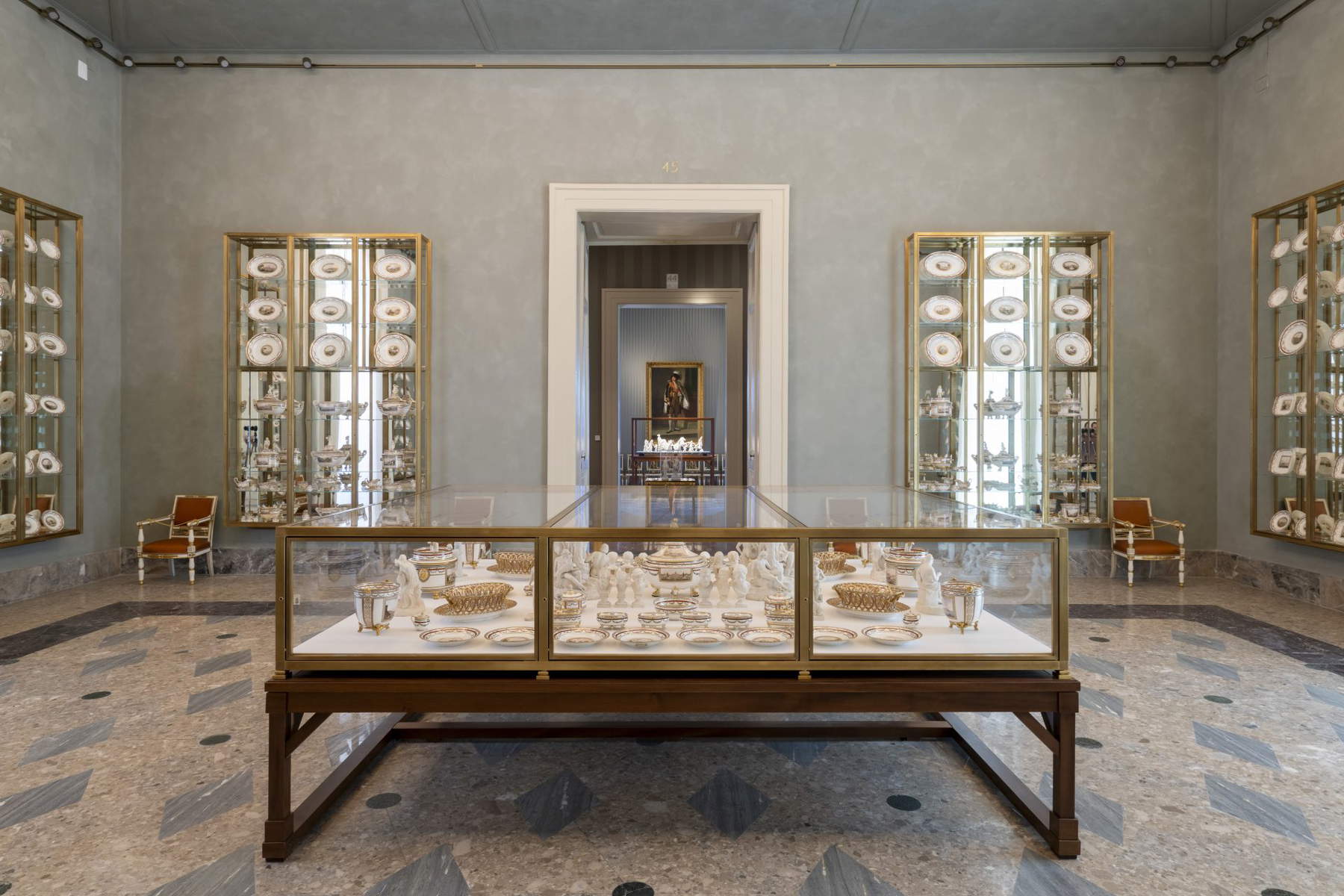
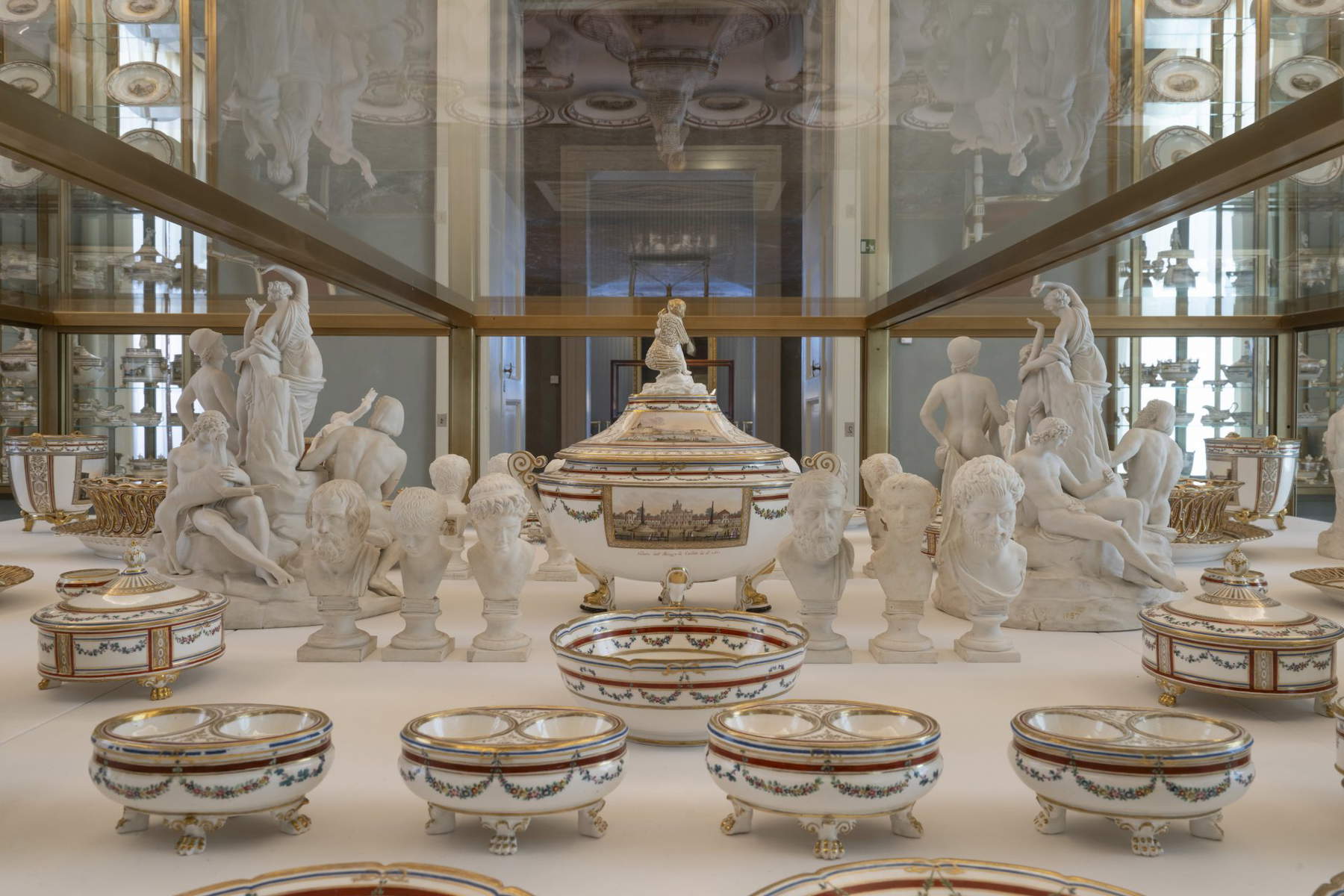
For the decoration of the rooms, Federico Forquet drew inspiration from the marble floors, painted vaults and some historical furnishings. The display cases in the Room of the Views of the Kingdom have mirrored bottoms that also allow one to observe the back of the porcelain and the identifying inscriptions on the plates. Several patrons contributed to the creation of the display, including the grandchildren of Marella Agnelli Caracciolo di Castagneto, Jean and Irene Amic, Franck Giraud, Gonzague de Luze, Annette de La Renta, the Giulio and Giovanna Sacchetti Foundation, and Barbara Ward Orefici. One room is dedicated to the donation made in 2023 by architect Don Aslan Sanfelice Forcella of the Dukes of Bagnoli. The nucleus includes about one hundred porcelains mainly from the Real Fabbrica Ferdinandea and other Italian and foreign manufactures. Thanks to the donation, two vases from the Caserta manufactory and three plates from the famous Farnese service have entered the museum’s collections.
From June 23, educational workshops Play with the Goose aimed at children aged seven to 11 and families will also begin. The activity will include visits to the new rooms and a workshop based on setting a royal table through three-dimensional reproductions of the Kingdom View Service. Appointments are scheduled for June 23 and 30 and July 7 at 11 a.m. Participation is free with an admission ticket and reservations are made by e-mail.
At the same time, the Friends of Capodimonte Ets Association is promoting the first edition of the Ernesto Cilento Scholarship, supported by Grazia Maria De Ianni Cilento in memory of her husband, a porcelain collector. The initiative, with an annual endowment of ten thousand euros, is intended for young graduates in the humanities and includes a two-year professionalizing internship within the association’s organizational structure.
“For the first time in the history of Naples, the extraordinary porcelain collections of the Museo e Real Bosco di Capodimonte are visible to the public-a grand exhibition that recreates the magnificence of life in the Bourbon Royal Palace,” emphasizes Director Eike Schmidt. “This is an important step in the very history of the museum, which next year will celebrate its 70th anniversary, also marking the beginning of the refitting of the second floor with the royal apartments. In 24 months of exciting teamwork, which included the research project, we developed the idea that has now taken shape: no longer just a section dedicated to porcelain but an immersive experience under the great ornate vaults of the Reggia among priceless furniture, rare objects, stuffed animals, brilliant silks. The drawing room of Maria Amalia of Saxony once again shines and enchants us with its oriental motifs. Compared to the initial project, the rooms were increased from ten to sixteen, identifying private as well as public resources, thanks to the involvement of generous patrons. Another innovation was the decision to place Diego Cibelli’s site-specific work before the entrance to the historical collection, which creates a starting point for the itinerary that is not only physical but also cultural, presenting itself to visitors, especially younger ones, from an ancient and contemporary perspective at the same time. The exhibition design vision of an absolute master such as Federico Forquet, who returned to his native Naples to leave an epoch-making mark, makes this Porcelain Gallery a unique attraction for its charm and elegance in the world panorama of museums. But the most important achievement we celebrate today is the return of this identity treasure of Capodimonte and the entire nation, finally enhanced and promoted, to all Neapolitans and to public enjoyment.”
 |
| Capodimonte opens new Porcelain Gallery: more than 1,500 pieces on display |
Warning: the translation into English of the original Italian article was created using automatic tools. We undertake to review all articles, but we do not guarantee the total absence of inaccuracies in the translation due to the program. You can find the original by clicking on the ITA button. If you find any mistake,please contact us.