





Mantua will have a new public space designed to connect San Giorgio Castle, the National Archaeological Museum, and the city, with the additional goal of highlighting a significant chapter in the city’s history. This is the goal of the redevelopment project for the public area between the moat of San Giorgio Castle and Via San Giorgio, approved by the Mantua City Council at its meeting on June 16, 2026, following a proposal by the Palazzo Ducale Museum. The project involves cadastral parcel number 109, one of the most iconic spaces for those entering the historic center from the San Giorgio Bridge and a strategic location both for the city’s image and for access to the entire museum complex. The redevelopment stems from the desire to improve the urban quality and accessibility of a site that currently features fragmented pathways, access issues, and an overall layout deemed inadequate for showcasing the monumental context in which it is situated.
The approved project proposes a transformation described as measured yet significant. At the heart of the project are the creation of new accessible pathways, the removal of architectural barriers, the reorganization of green spaces, and the creation of new rest and reception areas intended for both residents and visitors. The goal is to make access to the area easier and more inclusive, integrating it more effectively into the city’s network of public and cultural spaces.
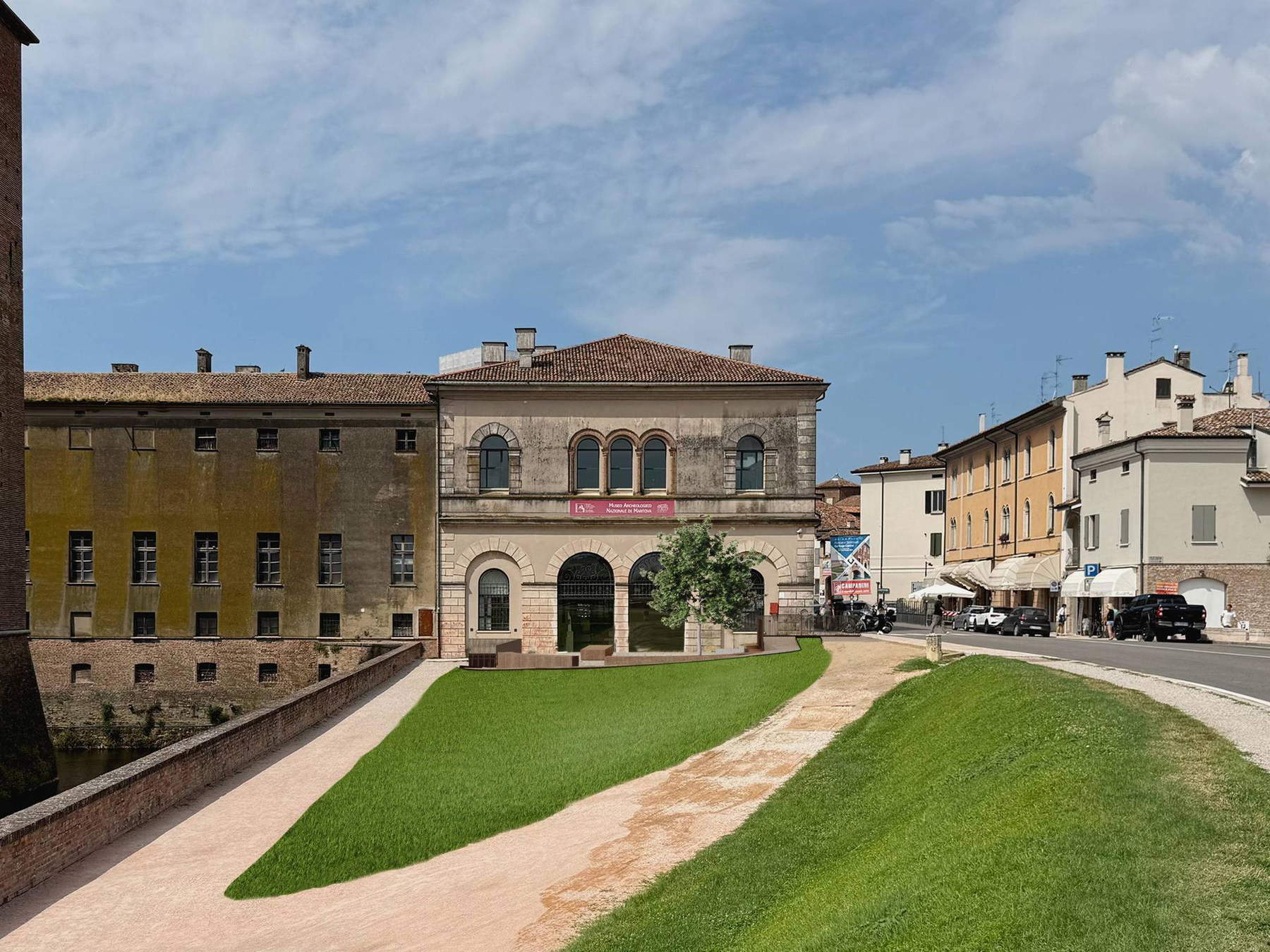
This initiative is part of a vision for cultural enhancement that goes beyond the mere preservation of historical and monumental heritage. In fact, the project aims to tangibly improve the conditions under which the community uses and understands these sites, balancing conservation needs with those of accessibility and usability. This principle is also grounded in the Code of Cultural Heritage and Landscape, Article 4 of which establishes that enhancement consists of carrying out functions and regulating activities aimed at promoting awareness of cultural heritage and ensuring the best conditions for its public use and enjoyment, including by people with disabilities, in order to promote cultural development. Enhancement also includes the promotion and support of cultural heritage conservation efforts.
One of the most significant aspects of the project concerns the relationship between public space and historical memory. Until the late 19th century, the area involved in the project was occupied by a portion of the last of the five Gonzaga theaters built in that area—namely, the theater designed by architect Giuseppe Piermarini. Archaeological surveys conducted in the early 2000s and subsequent historical studies have made it possible to recover the memory of this now-vanished building. It is precisely from this research that the design concept for the new urban layout takes shape. The geometry of the public space is, in fact, derived from the archaeological traces uncovered during the excavations and from preserved historical documentation, with the aim of evoking the ancient theater and providing citizens with a deeper understanding of an important phase in Mantua’s urban history.
The centerpiece of the project will be a square with a distinctive horseshoe shape. In fact, the new configuration echoes, in both position and dimensions, the stalls of the ancient neoclassical theater. This is not a physical reconstruction of the lost building, but rather a contemporary reinterpretation capable of making its presence perceptible through the design of the urban space.
The level of the new paving will coincide with that of the ground floor of the National Archaeological Museum. The new reception area will also be aligned with the museum’s main aisle, creating spatial continuity between the interior and exterior and serving as a natural extension of the building toward the city. This solution evokes the original layout that existed before the construction of the Mercato dei Bozzoli, when the theater was partially demolished and repurposed for a different function.
A particularly noteworthy aspect will be the preservation of visual continuity between the museum and the public space. Through the building’s large windows, it will be possible to maintain a visual connection with the Sarsinate Mausoleum, a funerary monument from the Augustan era originating in the Mantua area and now housed within the exhibition space. In this way, the project aims to create a constant dialogue between the museum and the urban environment, strengthening the relationship between archaeological heritage and public space. To enable the implementation of the new layout, modifications to the terrain will also be necessary. Minor earthworks are planned to accommodate the designed ramps, ensure continuity with the path running alongside the moat, and construct the new central plaza.
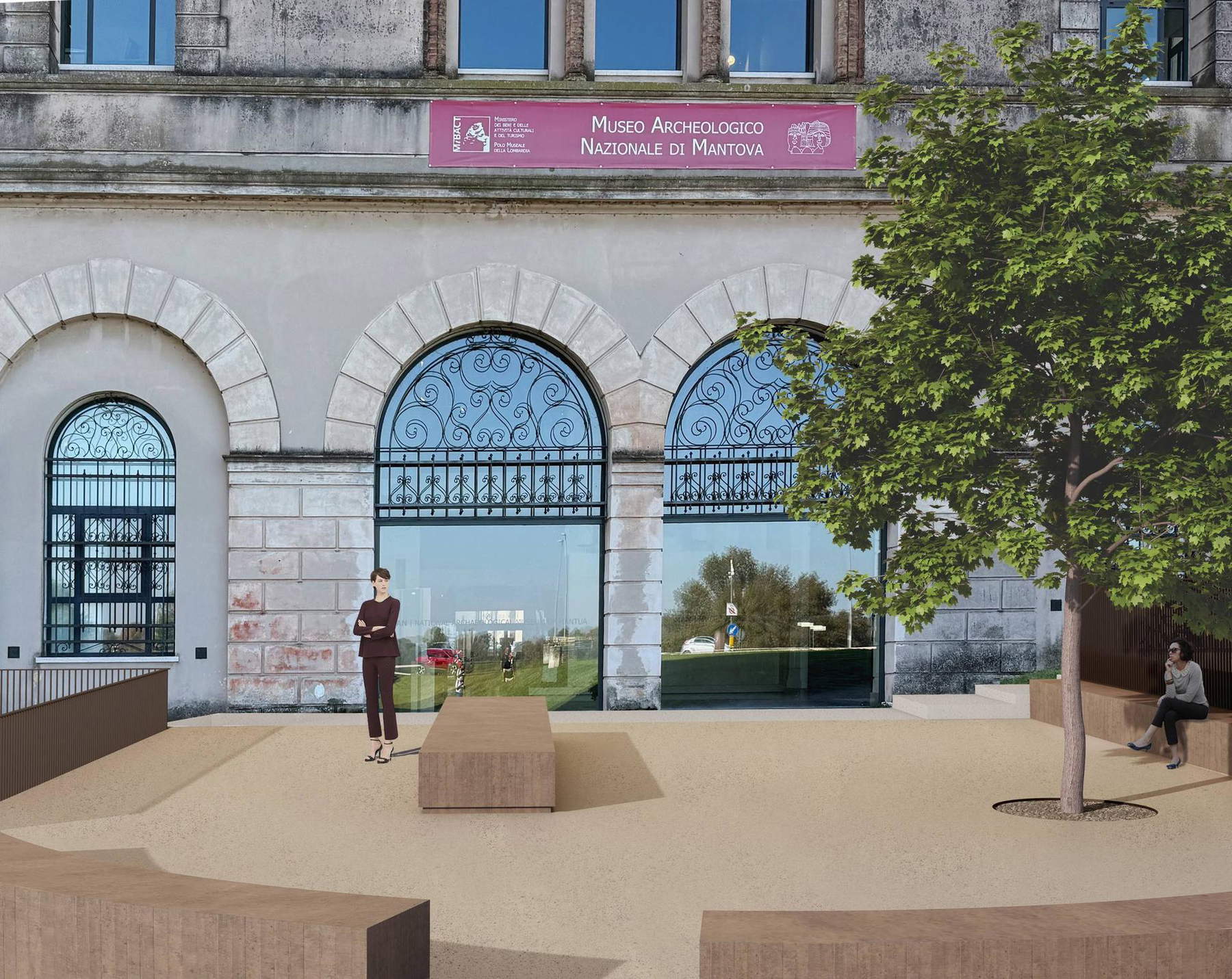
This space will feature ring-shaped seating integrated into the plaza’s design, a podium intended to house a work of art to be selected at a later date, and a tree of strong symbolic value. The choice fell on the beech tree, considered the quintessential symbol of Virgil’s *locus amoenus* and mentioned in the famous opening line of the first eclogue of the *Bucolics*: “Tityre, tu patulae recubans sub tegmine fagi...” The presence of the tree will help characterize the space as a place for gathering, resting, and contemplation, while also evoking one of the most profound cultural references in the literary tradition associated with the region. Particular attention was also paid to the materials. The proposed solutions were selected based on their compatibility with the monumental and landscape context. The pathways will be constructed using permeable materials, while the surfaces will be finished with calcestre. The new seats made of pigmented concrete will be integrated into the overall design of the area and will be accompanied by informational elements intended to guide visitors and help them learn about the site and its history.
The redevelopment of the area in front of the National Archaeological Museum is part of a broader enhancement strategy promoted by the Ducal Palace of Mantua. This strategy aims to strengthen the relationship between the museum and the city, interpreting cultural heritage not as an isolated element but as a living component of contemporary urban life. The goal is to forge an ever-closer bond between cultural institutions, public spaces, and the daily lives of citizens, fostering new ways of engaging with and participating in the cultural landscape.
The client and contracting authority for the project will be the Ducal Palace of Mantua. The project was initiated by Director Stefano L’Occaso and developed by the museum’s Architectural Projects Office. The role of Sole Project Manager has been entrusted to architect Andrea Palmieri, who worked in collaboration with architect Antonio Giovanni Mazzeri, engineer Fabrizio D’Amato, and archaeologist Mari Hirose. The detailed design and construction supervision, however, have been entrusted to Studio Archiplan, led by architects Diego Cisi and Stefano Gorni Silvestrini. As for the timeline, the work has yet to be put out to bid. According to projections, construction is expected to begin by fall 2026 and will take an estimated three months to complete. The area involved in the project will remain the property of the City of Mantua. The entire project is, in fact, part of an institutional collaboration between the municipal administration and Palazzo Ducale. It is also planned that, once the work is completed, the redeveloped space will be returned to the City for management and routine maintenance.
|
| Mantua: New Square in Front of the Archaeological Museum—Redevelopment Project Approved |

Warning: the translation into English of the original Italian article was created using automatic tools. We undertake to review all articles, but we do not guarantee the total absence of inaccuracies in the translation due to the program. You can find the original by clicking on the ITA button. If you find any mistake,please contact us.





























 IT
IT FR
FR DE
DE ES
ES CN
CN


