




MAXXI - Museo Nazionale delle Arti del XXI secolo in Rome enriches its public collection with an important acquisition: six large works by Giorgio Griffa, of monumental dimensions, representing fundamental stages of the painter’s artistic journey, from his beginnings in the 1970s to the early 2000s, testifying to the complex and articulated evolution of his pictorial research.
Internationally, his works are already held in important institutions, including the Centre Pompidou in Paris, the Tate Modern in London, the Centre d’Art Contemporain in Geneva, the Fundação de Serralves in Porto, the Dallas Museum of Art in the United States and the Obayashi Foundation in Japan. In Italy, in addition to MAXXI, the artist is represented in the collections of Castello di Rivoli, GAM in Turin, MACRO in Rome, Museo del Novecento and Gallerie d’Italia in Milan, and MART in Rovereto.
Among the six works entered at MAXXI, three belong to the historic Segni Primari (Primary Signs) cycle, developed between 1968 and the early 1970s, a crucial moment in which Griffa’s pictorial language took shape. This phase saw the emergence of characteristics that would remain central to later cycles: theabandonment of figuration, the use of elementary and universal signs, the freedom of the creative process, freed from rigid schemes, and the overcoming of the traditional hierarchy between artist and work. The canvas is no longer a simple support, but acquires autonomy; the frame is also abandoned, both for practical needs and to give the support more freedom. The choice of the “unfinished” also becomes fundamental, inspired by a sensibility close to Zen, to prevent the work from being perceived as finished and relegated to the past, instead leaving open the continuity of the painting in the present.
From these assumptions comes Horizontal Lines of 1973, characterized by an essential and rigorous sign, in which the simplicity of the lines is accompanied by the ample space left to the unprepared canvas, in this case clear and compact, which assumes a central role thanks to the presence of large unpainted areas. Similarly, Horizontal Signs of 1975 develops these investigations through softer and brighter, typically Mediterranean color tones applied on a darker and lighter canvas. The work recalls, in a larger and more varied version, a work from the same year preserved at the Tate Modern in London.
Horizontal Lines of 1976, on the other hand, introduces a significant variation: by modifying the thickness of the brush and the density of the color, Griffa opens up to a new expressive dimension with respect to the 1973 work. Viewed closely, the surface reveals a complex, almost fractal texture generated by the interaction between the watercolor and the canvas. In this dialogue, the active role of matter emerges, flanking the artist’s gesture, in line with a sensibility shared with the exponents of Arte Povera.
With Arabesco Doppio we enter the 1980s, in a context characterized by broad color fields (in this case pink, blue and yellow), which dialogue with signs charged with historical memory. The forms recall decorative and symbolic elements: from the angular strokes that evoke cuneiform writing and contemporary scientific notation, to the arabesque that interweaves a linear and a circular conception of time, to the “Greek” motif, which alludes to the cycle of day and night.
In the 1990s, with Triptych with Seven Lines, the dialogue between signs expands beyond the single canvas. The work develops as a system of relationships between three surfaces, united by a recurring module of seven red lines, ever-so-slightly different, flanked by different backgrounds and signs: a large pink area, curved purple lines, and thin blue strokes descending from above, creating a dynamic and fluid effect.
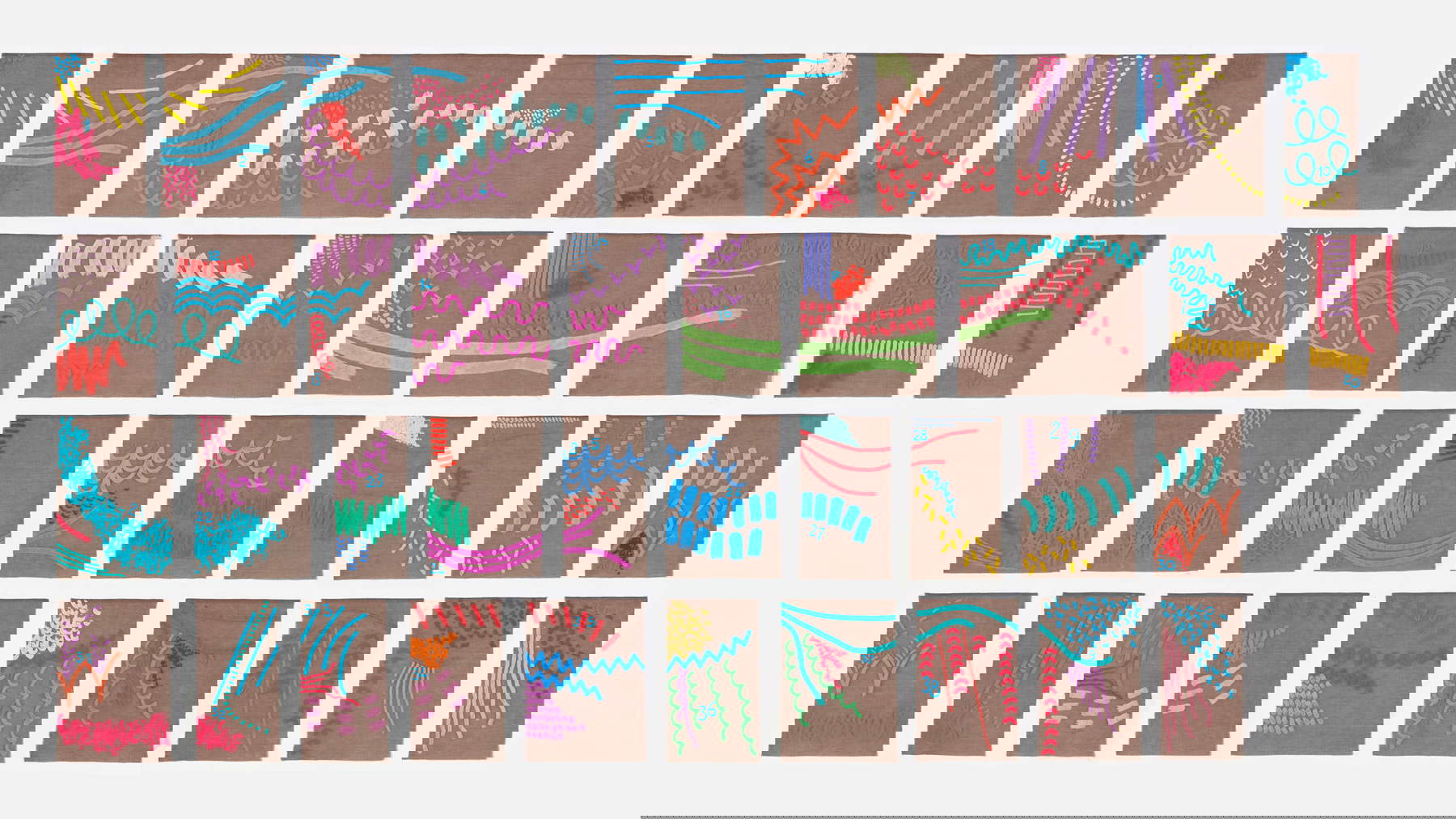
The exhibition concludes with Forty Canvases from 2001, a unique work that synthesizes the richness and complexity of Griffa’s language. Lines, curves, dots, arabesques and decorative motifs follow one another and intertwine crossing the different canvases, in a continuity that recalls the first signs traced by man in history. The painting process thus also becomes play and a celebration of creative energy. This vitality is also reflected in the great flexibility of the installation: the work can be arranged along a single line that crosses several walls, organized on several overlapping levels or articulated in different spaces, interrupting and resuming in successive environments. Like all Griffa’s production, it lends itself to ever-changing configurations, adapting to the context and establishing a continuous dialogue with the exhibition space and the viewer’s gaze.
|
| Six large works by Giorgio Griffa enter the collection of MAXXI in Rome |

Warning: the translation into English of the original Italian article was created using automatic tools. We undertake to review all articles, but we do not guarantee the total absence of inaccuracies in the translation due to the program. You can find the original by clicking on the ITA button. If you find any mistake,please contact us.



















 IT
IT FR
FR DE
DE ES
ES CN
CN


