





There is a profound distortion in the way we view things we do not know; it is present in our perspective on cultural heritage and even on human relationships: it is the tendency to distort their meaning and, above all—in the case of works of art (the central focus of our discussion)—to view them as objects of individual appropriation rather than as a common good. If, hypothetically, we were to draw a comparison: when we look at the night sky, we flatten the distances between the planets, ignoring that they belong to a single, vast system; and, in the same way, we view love as something that boils down to mere possession. Thus we wander obliviously, like satellites scattered throughout the universe, stumbling among things, no longer understanding their meaning. But in doing so, we risk on all fronts: we risk reducing love to mere possession and failing to grasp the profound meaning of a work of art, isolating it from the social fabric that gave it life, and reducing it to a commodity, a fetish, or the prey of the black market. The protection of cultural heritage, on the other hand, is an ethical act and a defining feature of civilization; it requires a broader vision—it is not merely a conservative measure, nor is it something confined to a narrow or solely private sphere.
Great thinkers and art historians—from Quatremère de Quincy to Roberto Longhi, from Bernard Berenson to Giulio Carlo Argan—have taught us that art springs from the same inspiration of sharing and historical testimony. However, precisely when the craving for possession takes hold, beauty ceases to be “search” and “revelation” and becomes booty or prey to the greed of traffickers and scoundrels. The consequences of looting and illicit trafficking do not affect only the object itself: they deprive the entire community of its memory. When an Apulian vase, a Magna Graecian artifact, or a Renaissance painting—such as Antonello da Messina’s stolen polyptych—is torn from its context, it is reduced to silent fragments. From Cicero’s denunciations of Verres’s greed to the Nazi looting and the recent losses documented in reports by the Carabinieri Command for the Protection of Cultural Heritage (TPC), history confirms just how tragically relevant the wound of looting remains today.
Faced with this “threat” of looting perpetrated against our cultural heritage, what remains to be done? Should we act as the Greeks did after Xerxes destroyed the Acropolis of Athens and launch another “Persian burial,” adapting it to all museums and churches, burying sculptures, paintings, and artifacts? Should we halt archaeological excavations and shut them down? Hide our treasures from view? Many distinguished scholars have long charted the course. We must increasingly instill in people’s consciousness—through research, exhibitions, and civic education—the true meaning of artistic heritage. Cultural heritage represents the very essence of our sense of identity, a true “school of citizenship,” as Salvatore Settis strongly argues. From Ennio Quirino Visconti, who was the first to argue that an artifact removed from its context loses its soul, to Alois Riegl, who denounced how illegal excavations permanently destroy historical value in the name of pure aesthetic profit, the path forward is the cultivation of civic consciousness. Take the example of Augusto Campana, who, in his diary *Le pietre di Rimini*, recorded daily how he managed to brave even the bombs of World War II to save the testimonies of the past.
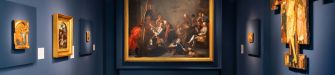
The issue of “stolen beauty” is so vast that it risks engulfing us as well. What else should we strive to do but recount, protect, and mend? A concrete form of redemption is possible. Archeologia Salvata demonstrates this . From Plunder to Memory, an exhibition on view at the “Vito Capialbi” National Archaeological Museum in the Castle of Vibo Valentia. The result of a joint effort between the Ministry of Culture, the Superintendence of Archaeology, Fine Arts, and Landscape for the Metropolitan City of Venice, and the Carabinieri TPC Command, the exhibition returns masterpieces seized from the black market to the public. Each piece on display is presented through a dual narrative: on the one hand, its ancient history (creation, ritual function, and context of origin); on the other, its complex contemporary story involving illegal excavations, trafficking on the international black market, judicial investigations, restoration efforts, and scientific restitution.
Taking center stage in the exhibition is a work of extraordinary value: a monumental Attic-Apulian volute krater decorated in red-figure style (4th century B.C.), imposing in its height of 150 centimeters and made unique by refined overpaintings in white and yellow. The ceramic’s iconographic program draws inspiration from the mastery of the Taranto workshops and unfolds on the vessel’s body mythological and ritual narratives of rare complexity: Side A depicts a solemn assembly of Olympian deities, with Zeus flanked by Athena, Ares, Aphrodite, and Eros, while the central register is animated by the frenetic dynamism of the quadrigas enacting the abduction of Persephone by Hades. Side B, on the other hand, is dominated by the depiction of the naiskos (a funerary aedicule of the Ionic order), around which rituals of offering to the deceased take place—a distinctive feature of the lavish burials of the Apulian elite.
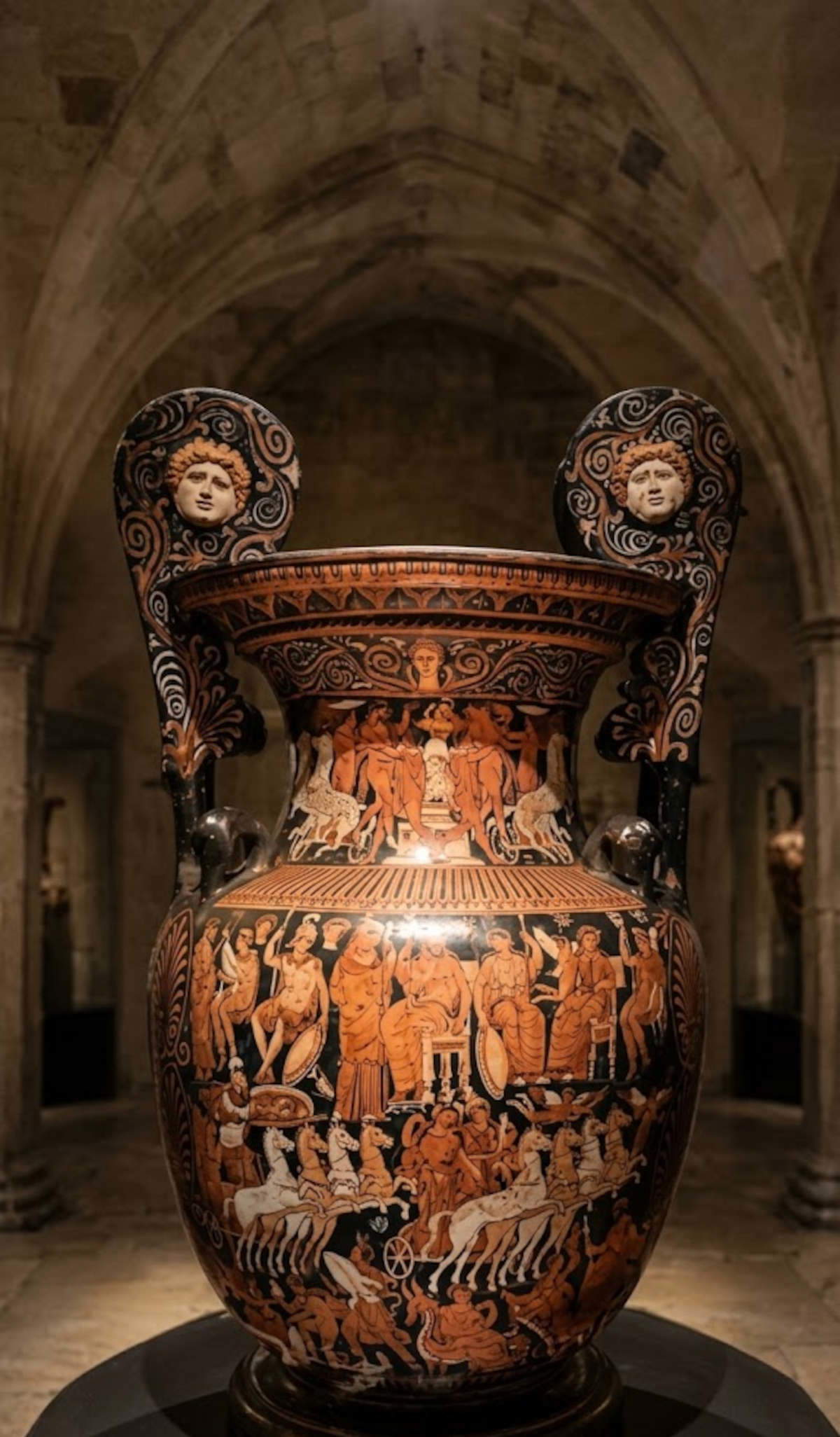
Eleven exquisitely crafted artifacts, acquired from a private collection in Venice, are displayed in perfect harmony with the krater. The collection includes a monumental red-figure hydria, a black-figure kylix, a finely decorated lekythos, a series of askoi (among which stand out a clay specimen in anthropomorphic form and a rare bronze one), a graceful Tanatrian-style figure, and a tiny lead kore.
“Archeologia Salvata,” Michele Mazza, director of the Archaeological Museum of Vibo Valentia, told us, “is an exhibition that, above all, highlights the value of preservation. The artifacts on display are not merely extraordinary testimonies to our past: they are cultural assets that, in many cases, have been saved from looting, illicit trafficking, and dispersal and that, thanks to the work of institutions and the Carabinieri of the Cultural Heritage Protection Unit, have been returned to the community. With this exhibition, we also wanted to further emphasize the role of the Vibo Valentia Museum as a museum dedicated to ‘preservation.’ It is no coincidence that the General Directorate, among various options, decided to send the seized artifacts from Venice right here to us. I also wanted to display alongside these artifacts—among which the monumental Apulian krater stands out— other treasures, both large and small, from the sacred site of Scrimbia—one of the archaeological sites most targeted by illicit activity—to demonstrate how, thanks to the joint efforts of the Cultural Heritage Protection Unit and the Superintendency, it has been possible to recover part of that immense archaeological heritage. We therefore also wanted to showcase what normally remains behind the scenes of a museum: territorial monitoring, investigations, seizures, recovery, study, and restoration. Protection, in fact, means preventing an artifact from being permanently separated from its history and context.”
“But protection,” he concludes, “only truly makes sense when it becomes promotion. A recovered artifact must not simply be returned to a storage facility: it must be studied, its story told, and made accessible once again. It is in the museum that that object regains its voice and once again becomes shared heritage, capable of fostering knowledge, identity, and awareness—and this can only happen by launching major projects that prioritize these objectives, as we have done with the Scrimbia 2026 project, whose initial findings were showcased in this exhibition. This exhibition therefore aims to convey a very simple message: defending our archaeological heritage means defending a part of our collective memory, because saving an artifact does not simply mean recovering an object—it means restoring a page of a community’s history to that community.”
Returning the krater and the other ancient artifacts to Vibo Valentia—home to one of Italy’s most important Magna Graecian collections—is a deliberate choice rooted in a shrewd cultural policy strategy. By avoiding the concentration of recovered artifacts solely in the major museums of Rome or Florence, the institutions have chosen to return the works to the regions that gave them birth. For this is the deepest wound: thefts and illegal excavations strip the works of their context; they rob us of our “memory.” Going back to the early 19th century—not coincidentally, when looting became more widespread— Quatremère de Quincy, in his “Lettres à Miranda,” opposed the Napoleonic plundering by reminding readers that works of art are inextricably linked to their place of origin: tearing them from their context meant depriving them of their voice, rendering them mute.
The Calabrian exhibition thus breaks the chain of what is unlawful, heals a wound, because rescuing a work from the oblivion of private collecting to return it to the community does not merely combat illegality but also opposes the lust for possession, which, in these terms, represents absolute evil.
Instead, art, just like love, is neither possessed nor stolen: it is shared and cherished. If looting, theft, and expropriation continue to persist, it is only because we have stopped recognizing our heritage and these works as our own. And when we forget how to love them, these works cease to shine, just like distant planets drifting in the void, outside their orbits.


The author of this article: Anna de Fazio Siciliano
Anna De Fazio Siciliano è una scrittrice, storica e critica d’arte, docente e redattrice specializzata nella comunicazione e nella divulgazione dell’arte. Nel corso della sua attività didattica ha insegnato Storia dell’arte antica e contemporanea, Estetica e Mercato dell’arte presso istituzioni accademiche. I suoi interessi comprendono la ricerca storico-artistica, la critica d’arte, la progettazione curatoriale e lo studio dei linguaggi dell’arte moderna e contemporanea. Durante il periodo di formazione presso la Galleria Borghese di Roma ha approfondito la diffusione del gusto egizio nell’arte italiana, a partire dalla decorazione della Sala Egizia del museo. A questo ambito di ricerca ha dedicato il volume Il gusto egizio, pubblicato da Pellegrini Editore. È autrice di saggi dedicati all’arte contemporanea e ai suoi protagonisti. La sua produzione comprende inoltre articoli, recensioni, interviste e testi critici per cataloghi e progetti espositivi. Recentemente il Direttore di Palazzo Madama di Torino, il Professore Giovanni Carlo Federico Villa ha presentato al Salone Internazionale del Libro di Torino il suo volume dedicato alla tutela del patrimonio, Diario di bordo Scoppa, Frammenti di un patrimonio perduto, edito da Gangemi International e impreziosito in quarta di copertina da un commento di Salvatore Settis. Ha collaborato sia con contributi online che su cartaceo con riviste specializzate quali «Exibart», «Art e Dossier», «Finestre sull’Arte», affrontando temi legati all’arte antica, moderna e contemporanea, alla tutela del patrimonio culturale e alla presenza femminile nella storia dell’arte. Nel 2015 ha fondato Artpressagency, realtà attiva nei settori dell’ufficio stampa, della comunicazione culturale, della critica d’arte e dell’editing. Attraverso questa attività ha collaborato con musei, fondazioni, archivi, istituzioni culturali, curatori e organizzazioni impegnate nella produzione e nella promozione di mostre ed eventi artistici. È stata inoltre membro del Comitato tecnico-scientifico degli Archives Legales Amedeo Modigliani, del FATA Museum e del GAL delle Terre Locridee dedicando la propria attività alla ricerca, alla comunicazione e alla valorizzazione della figura di Amedeo Modigliani e del patrimonio storico-artistico italiano.Warning: the translation into English of the original Italian article was created using automatic tools. We undertake to review all articles, but we do not guarantee the total absence of inaccuracies in the translation due to the program. You can find the original by clicking on the ITA button. If you find any mistake,please contact us.





















 IT
IT FR
FR DE
DE ES
ES CN
CN


