



by Redazione 27/05/2026



Categories: News / Disclaimer
In Milan, start of new conservation work on the famous Taurus in the Galleria Vittorio Emanuele II. The mosaic tiles, worn down by the scaramantic ritual of turning on the heel, will be replaced by a specialized restorer in front of passersby.
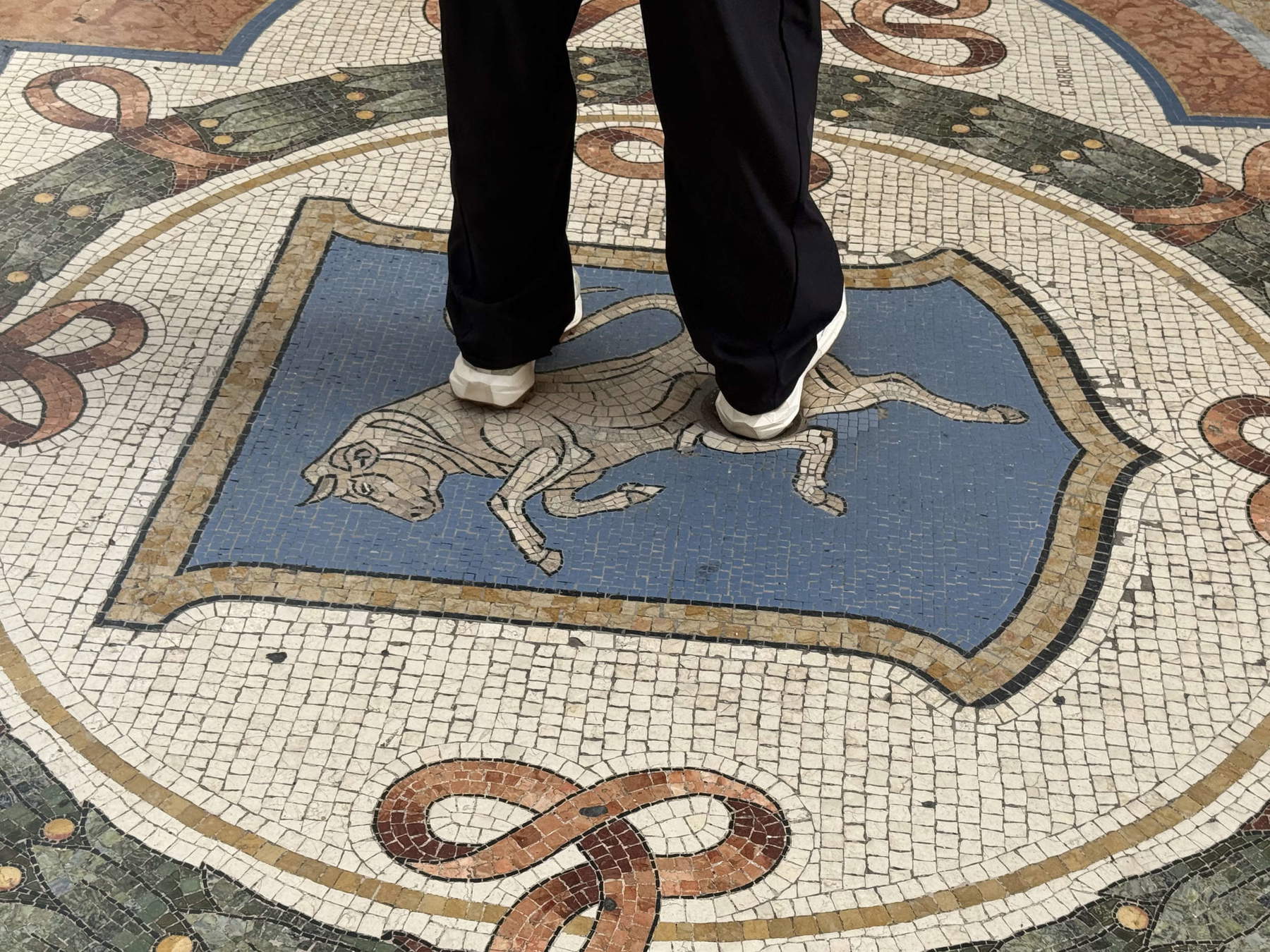
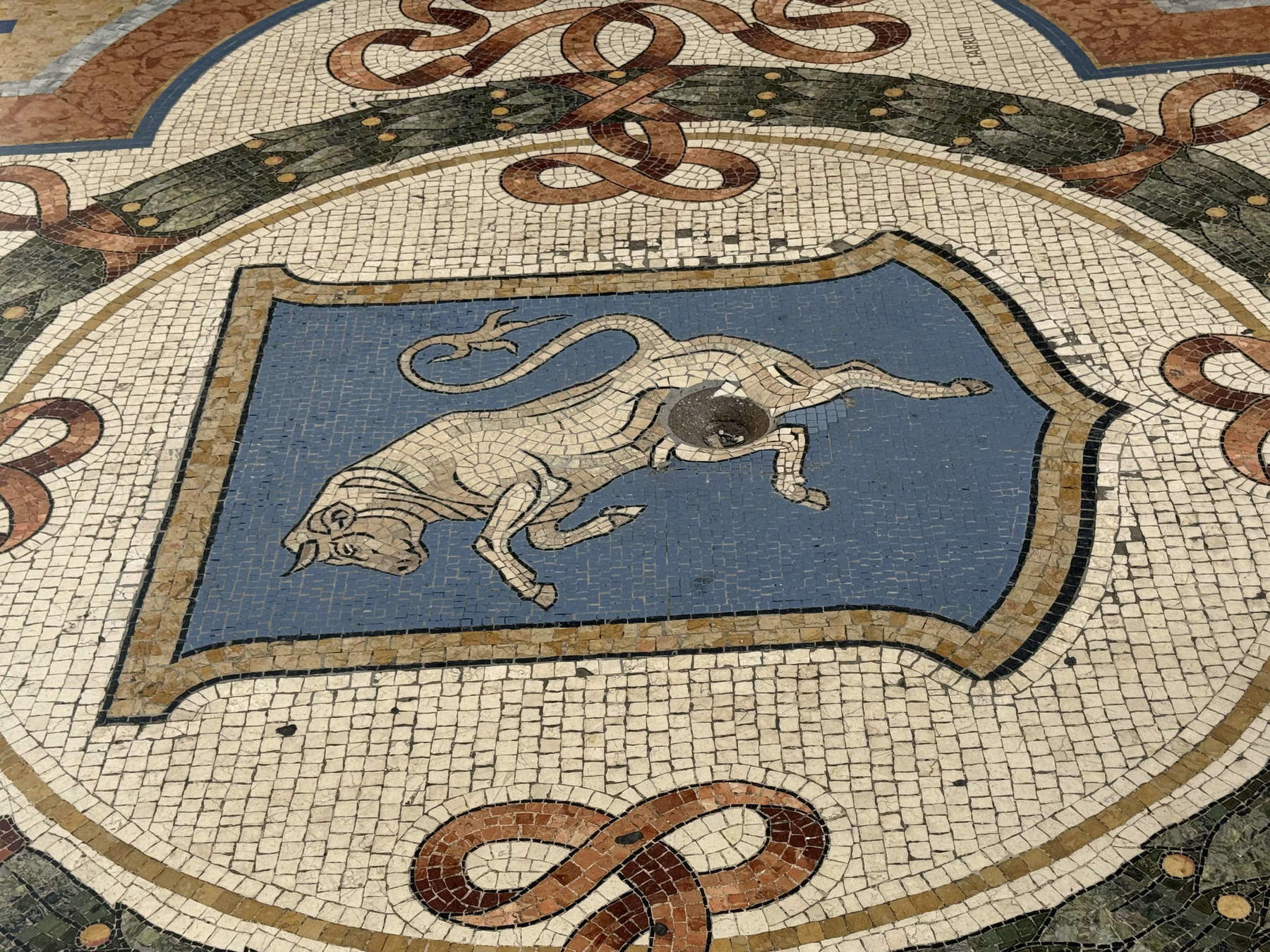
In Milan, the Rampant Bull of the Galleria Vittorio Emanuele II is returning to restoration. As of today, in fact, the famous floor mosaic kept in theGalleria’s Octagon, one of the most photographed and trodden symbols of Milan, is undergoing a new conservation intervention made necessary by thewear and tear caused by the continuous passage of visitors and tourists who every day perform the traditional ritual of turning on the heel. The most damaged spot is the one corresponding to the testicles of the heraldic animal depicted in the coat of arms of the city of Turin. Here, over the years, the repetition of the superstitious gesture has gradually worn away the pink mosaic tiles to the point of creating a small crater visible on the pavement surface. A deterioration now familiar to the Milanese and the millions of visitors who pass through the historic nineteenth-century gallery and which, periodically, requires extraordinary maintenance work.
The new restoration was announced by the City of Milan on May 27, 2026. Councillors Emmanuel Conte, delegate for State Property, and Marco Granelli, councillor for Public Works, stressed that the degradation is a direct consequence of the extraordinary popularity of the place and the ritual that has accompanied it for generations.


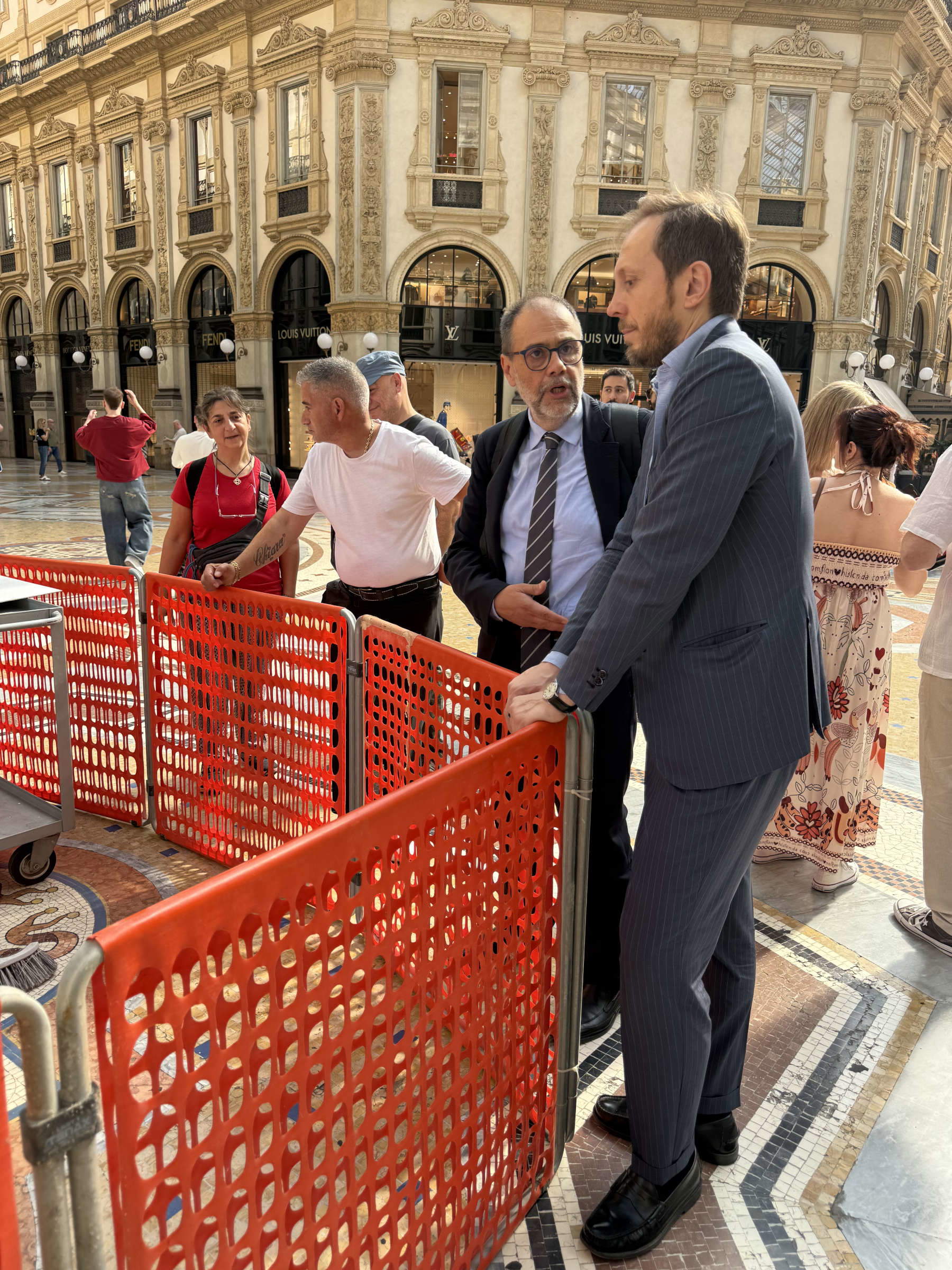
“Thousands of people a day, over the last two terms, have made the famous gesture of turning on their heel. The lucky spot in the Galleria has worn out over time,” the two aldermen explain, recalling that the last restoration was in 2017. “Therefore, the time has come to restore the mosaic of the Gallery to its original appearance, thanks to a handcrafted intervention. The Gallery is a living heritage, which can wear out precisely because it is loved and lived: we are taking care of it so that it will continue to be.”
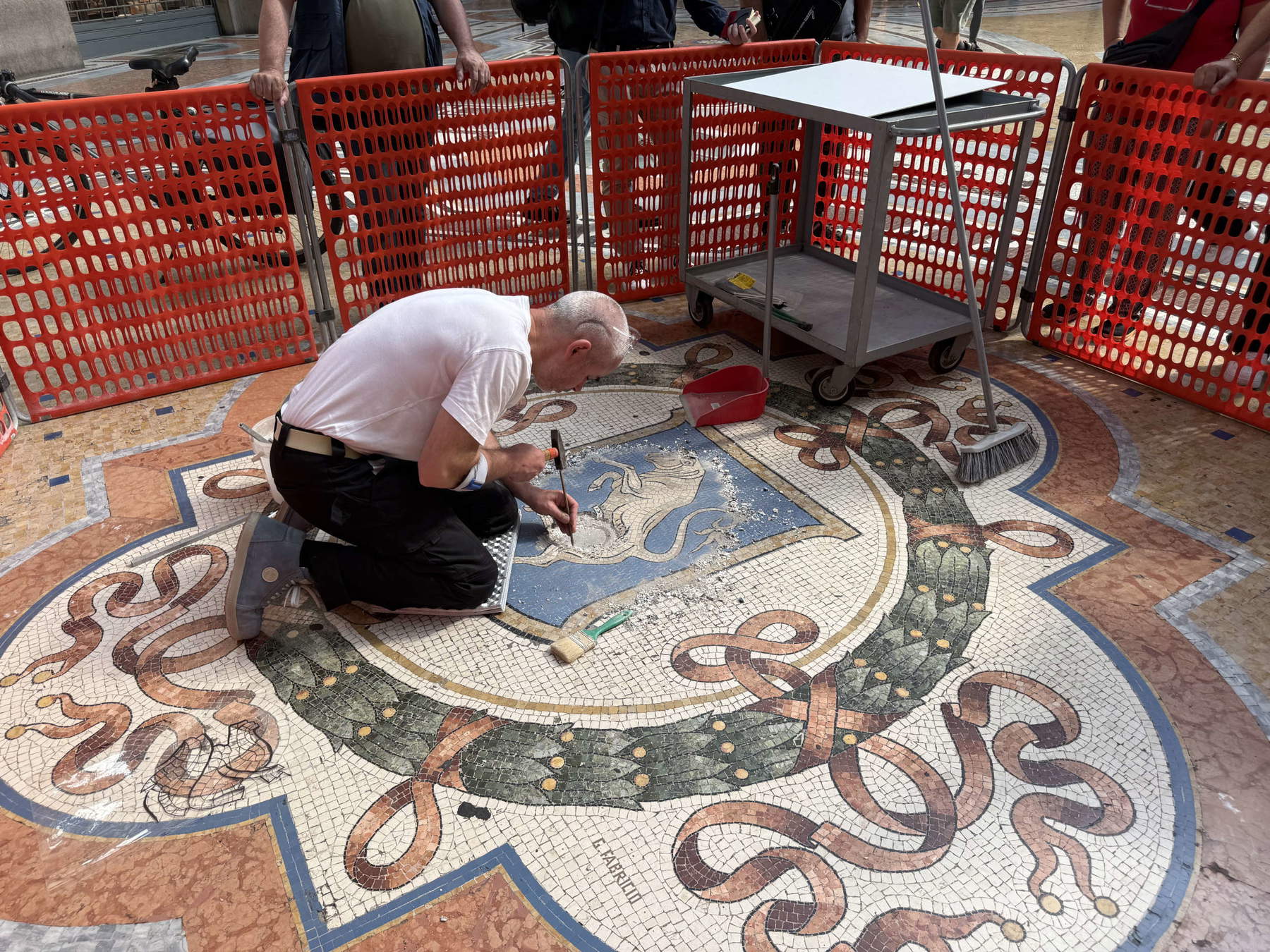
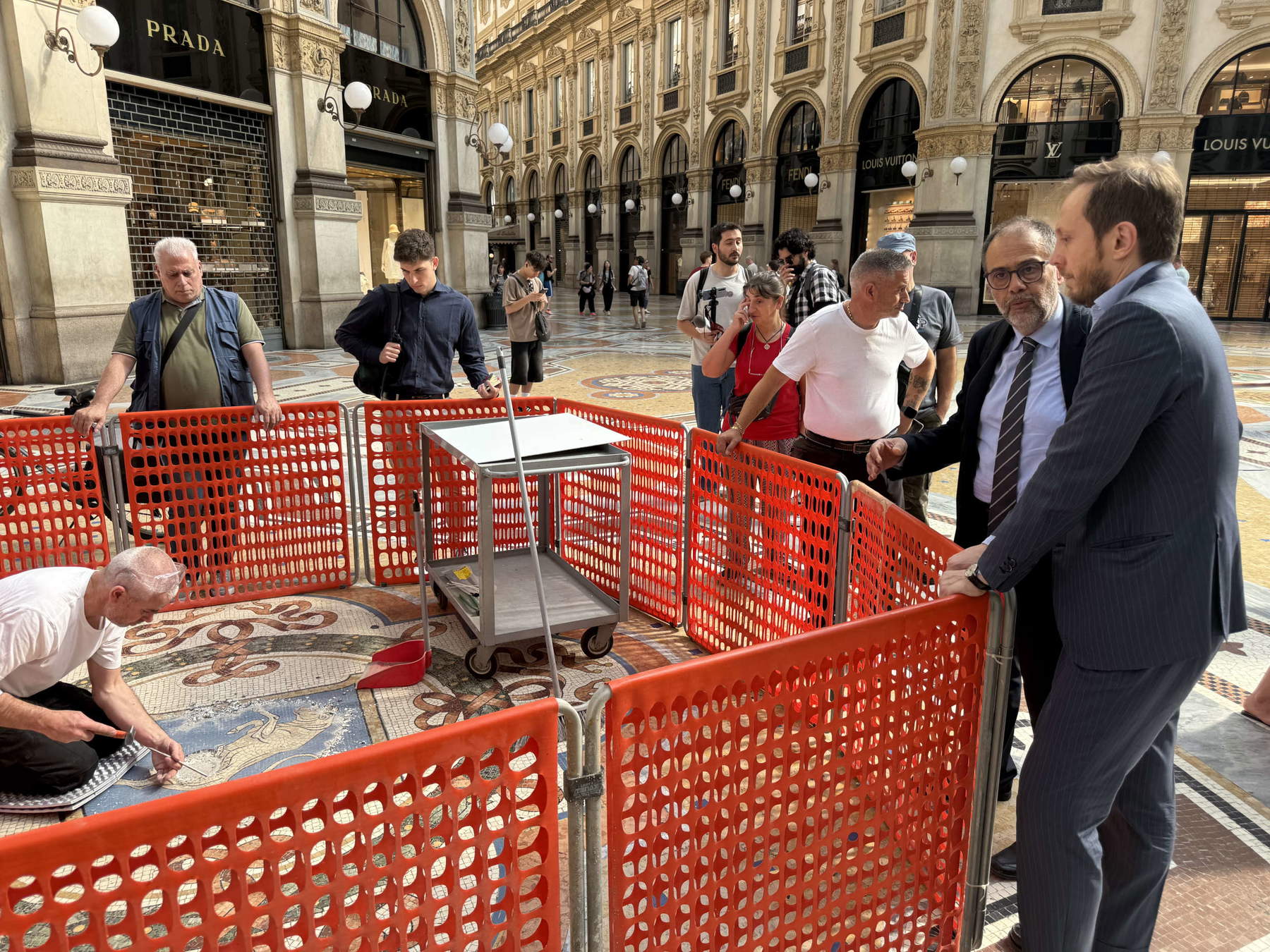
To enable the intervention, a small construction site has been set up around the mosaic, right in the heart of the Octagon of the Galleria Vittorio Emanuele II. The work will be carried out under the eyes of passersby and tourists, who will be able to directly observe the restoration operations entrusted to a craftsman specialized in the recomposition of historical mosaics. The construction site will remain active until Saturday morning.
Preliminary activities had already begun in the previous days. Since Monday, in fact, they had been proceeding with the manual preparation of the new tiles intended to replace the worn ones. The work was carried out faithfully following the original design of the mosaic, with the aim of preserving its aesthetic and historical authenticity. The actual intervention now enters the operational phase. The first planned operation involves the removal of the deteriorated parts of the mosaic to a depth of at least two and a half centimeters from the floor level. Once the deteriorated sections have been removed, restorers will proceed with the consolidation of the base and then the installation of new tiles. The work will be completed with grouting and smoothing operations, which are essential to even out the surface and restore continuity to the original image of the Taurus.
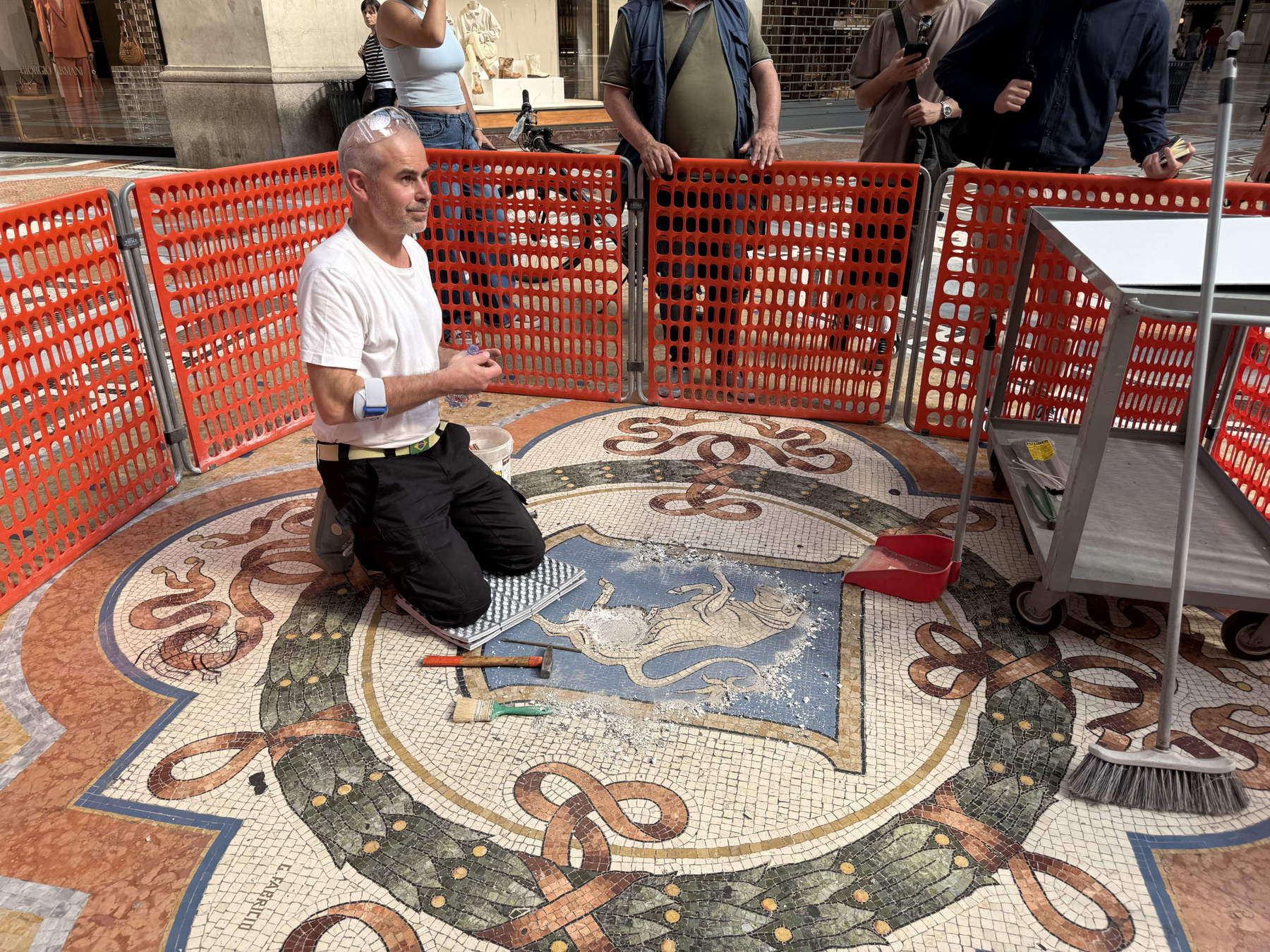
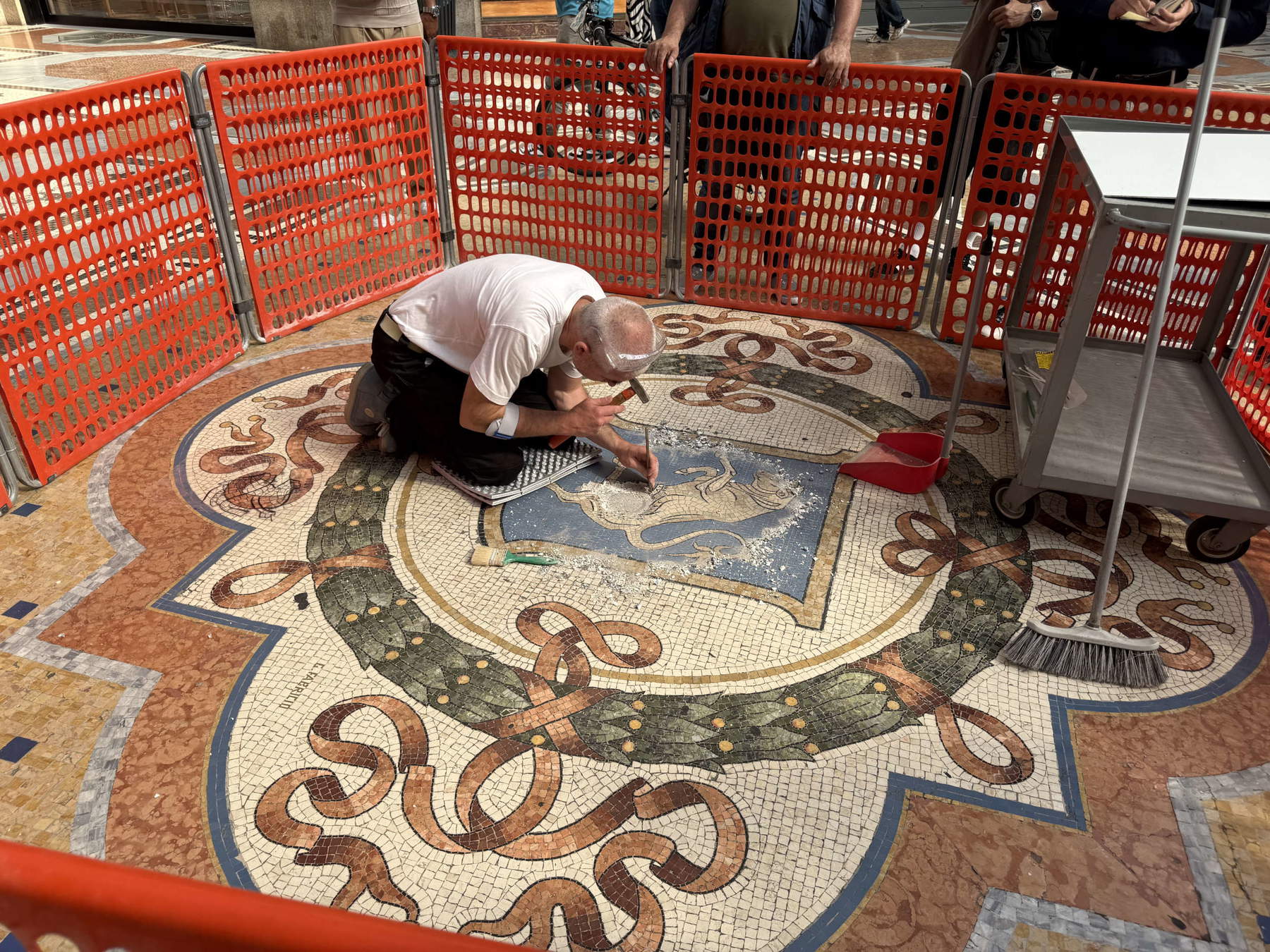
The City of Milan periodically intervenes on the mosaic precisely because of theexceptional consumption caused by the superstitious ritual of the giravolta. According to tradition, whoever rests his heel on the testicles of the Taurus and performs a complete rotation on himself would be destined to have good luck and return to the Lombard capital. This is a custom that today mainly involves tourists, but actually has its roots in the city’s history. The gesture was in fact already known in the 19th century and was part of the popular practices widespread among the Milanese of the time. Over the decades, the ritual has turned into one of the city’s most recognizable attractions, fueled by word of mouth, tourist guides and the growing international notoriety of the Galleria Vittorio Emanuele II.
Despite the folkloric nature of the custom, the continuous rubbing exerted by the shoes of thousands of people every day inevitably produces a progressive deterioration of the mosaic pavement. For this reason, Palazzo Marino schedules cyclical inspections and restorations. The last conservation work on the Taurus was in September 2017.
The mosaic represents one of the city coats of arms found in the flooring of the Gallery’s Octagon. The animal is depicted on a blue background within the emblem symbolizing Turin. The presence of the Turin coat of arms inside the Galleria Vittorio Emanuele II is not accidental and refers directly to the historical context in which the work was built. When the construction of the Gallery began, in fact, Turin was still the capital of the Kingdom of Italy. It was Victor Emmanuel II himself who laid the first stone of the building in 1865, sanctioning the start of one of the most ambitious urban and architectural projects of 19th-century Milan. The Galleria was born as a symbol of modernity and national unity, connecting Piazza Duomo to Piazza della Scala through an elegant covered space intended for commerce, sociality and city life.
Over time, the structure has become one of the country’s most famous monuments and a popular destination for international visitors. The daily passage of thousands of people makes constant maintenance inevitable, especially in the areas most exposed to wear and tear. In this sense, the Bull of the Gallery represents the most delicate point of the entire floor complex, precisely because of the particularity of the ritual that concerns it.
The intervention initiated in these days therefore aims not only to repair a material damage, but also to preserve a symbol deeply linked to the popular identity of the city. In fact, the turn on the Bull continues to be one of the most repeated and photographed gestures by visitors to Milan, a small collective ritual that spans eras and generations while keeping its charm intact.
|
| Milan, consumed by tourists the Bull of the Gallery: it is under restoration |
Warning: the translation into English of the original Italian article was created using automatic tools. We undertake to review all articles, but we do not guarantee the total absence of inaccuracies in the translation due to the program. You can find the original by clicking on the ITA button. If you find any mistake,please contact us.