





Following the debate that arose over the proposal to install a Bioclimatic Tree in Piazza dei Cinquecento in Rome, in front of Termini Station, the project’s designers—the architectural firm haascookzemmrich STUDIO2050— have issued a statement to clarify their position and explain the origins of the work, emphasizing that the idea developed over the past few months was conceived exclusively for St. Peter’s Square and cannot simply be transferred to another urban context without a thorough redesign.
According to the architects, the initiative was conceived for the Jubilee, drawing inspiration from a proposal put forward by Professor Wibke Mitterer of LUMSA University. The initial idea was to enhance the space at the entrance to St. Peter’s Square—left vacant by a building designed by Gian Lorenzo Bernini but never built—by placing an element there that would serve as a symbol of contemporary sustainable architecture. The goal was not only to evoke the great Baroque architect’s unfinished project but also to address the challenges posed by climate change by improving environmental comfort in one of the world’s most heavily visited squares. The project would, in fact, have introduced an additional climate-control function within a fully paved space, providing shade and cooling for visitors.
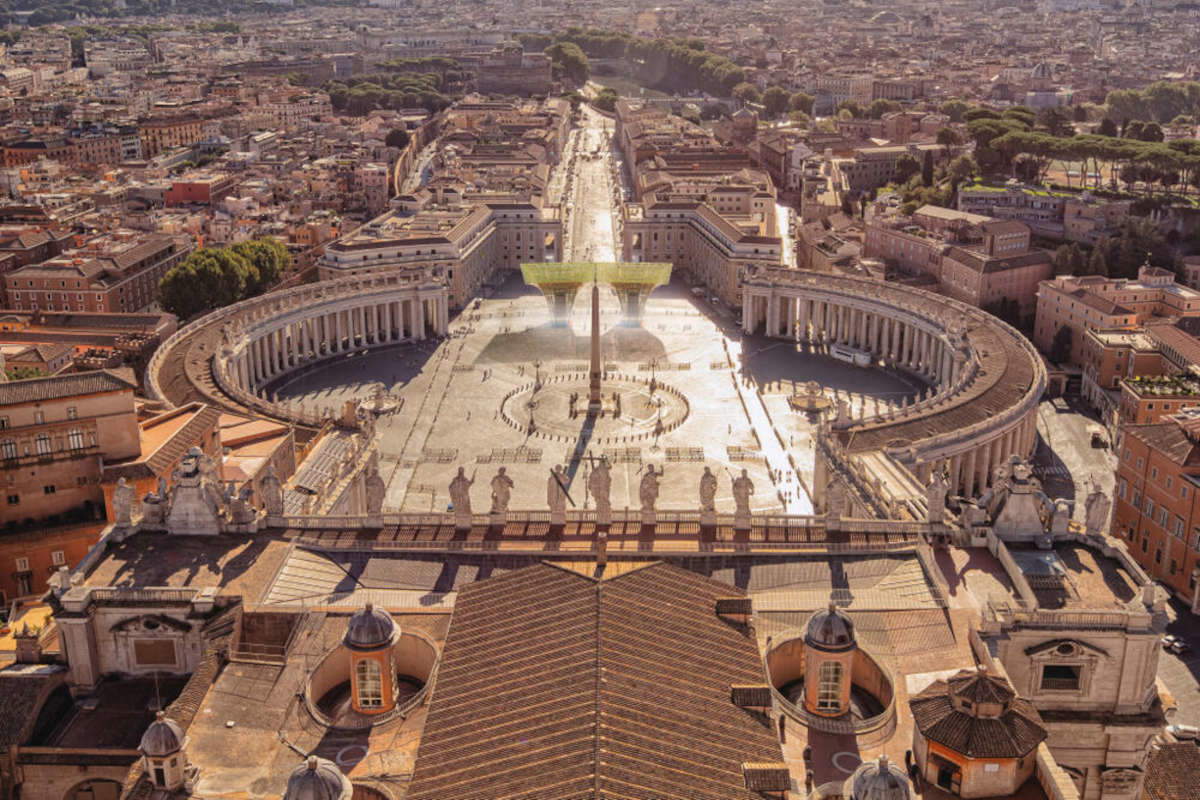
Based on these premises, haascookzemmrich STUDIO2050 developed an initial design proposal in collaboration with structural engineers from C4 Engineers and specialists from Transsolar Energietechnik. The concept called for a large entrance arch formed by two paired self-supporting bamboo structures, within which an evaporative cooling system would be installed to provide shade and lower the perceived temperature in the area leading to St. Peter’s Square.
In addition to its functional aspects, the project held strong symbolic significance. The structure, the designers explain, was conceived as a contemporary reinterpretation of the building designed by Bernini but never built. The proportions of the work were also defined in close relation to the square’s monumental context: the height of the inner arch was calibrated to frame the views toward St. Peter’s Basilica and its dome, while the overall height of the structure echoed that of Bernini’s famous porticoes.
“The architectural motif is therefore derived directly from the specific spatial and urban conditions of St. Peter’s Square,” explain the designers. “For this reason, we do not believe it is appropriate to relocate the designed sculpture to another site without a thorough review. In fact, our design team is convinced that architecture must always be developed based on the specific conditions of the site—a condition that would be lost with this relocation. And the principle that artificial shading and adiabatic cooling should not compete with natural trees and their climatic effect forms the basis of our design guidelines: wherever natural vegetation is possible, it is to be preferred. At the same time, urban spaces that are already impervious require different solutions. As a design team, we will therefore develop a variant suited to that context, one that allows for effective climate improvement and shading with minimal use of materials.”
The architects also reiterate a principle that guides their approach to the climate design of urban spaces. Artificial shading and adiabatic cooling systems, they assert, should not be viewed as competing with trees and their natural contribution to improving the urban microclimate. On the contrary, vegetation is always the preferred solution when conditions permit.
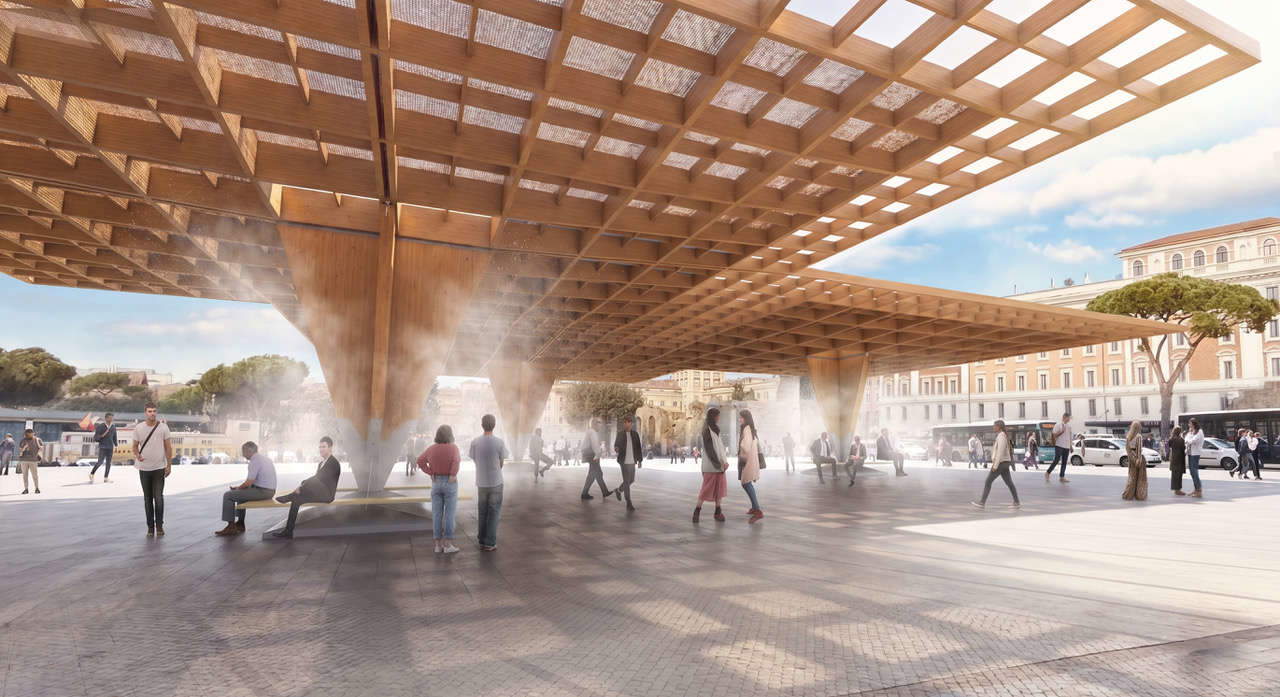
According to haascookzemmrich STUDIO2050, the priority must be to promote the presence of trees and natural greenery whenever possible. Technological solutions for cooling and shading, on the other hand, are justified primarily in urban spaces that are already completely impervious or in situations where planting trees is not feasible.
For this very reason, the design team has announced its intention to develop a new variant specifically tailored to the context of Piazza dei Cinquecento. The goal will be to identify a solution capable of improving the climatic conditions of the public space and providing shade through the minimal use of materials, adapting the design to the characteristics of the site rather than replicating the one developed for Piazza San Pietro.
The architects also clarify that, at present, there is no final design for either Piazza dei Cinquecento or, previously, for Piazza San Pietro. What has been presented to date was merely an initial architectural proposal, developed based on the guidelines provided by Professor Wibke Mitterer and intended to spark a design discussion.
The authors of the statement conclude that a final design can be developed only after a thorough analysis of the selected site and its specific environmental, urban planning, and functional conditions. Only through this process will it be possible to develop a solution that is consistent with the context and capable of effectively addressing both climatic requirements and the quality of public space.
|
| Rome, the creators of the Climate Tree: Piazza dei Cinquecento needs to be reimagined |

Warning: the translation into English of the original Italian article was created using automatic tools. We undertake to review all articles, but we do not guarantee the total absence of inaccuracies in the translation due to the program. You can find the original by clicking on the ITA button. If you find any mistake,please contact us.





























 IT
IT FR
FR DE
DE ES
ES CN
CN


