





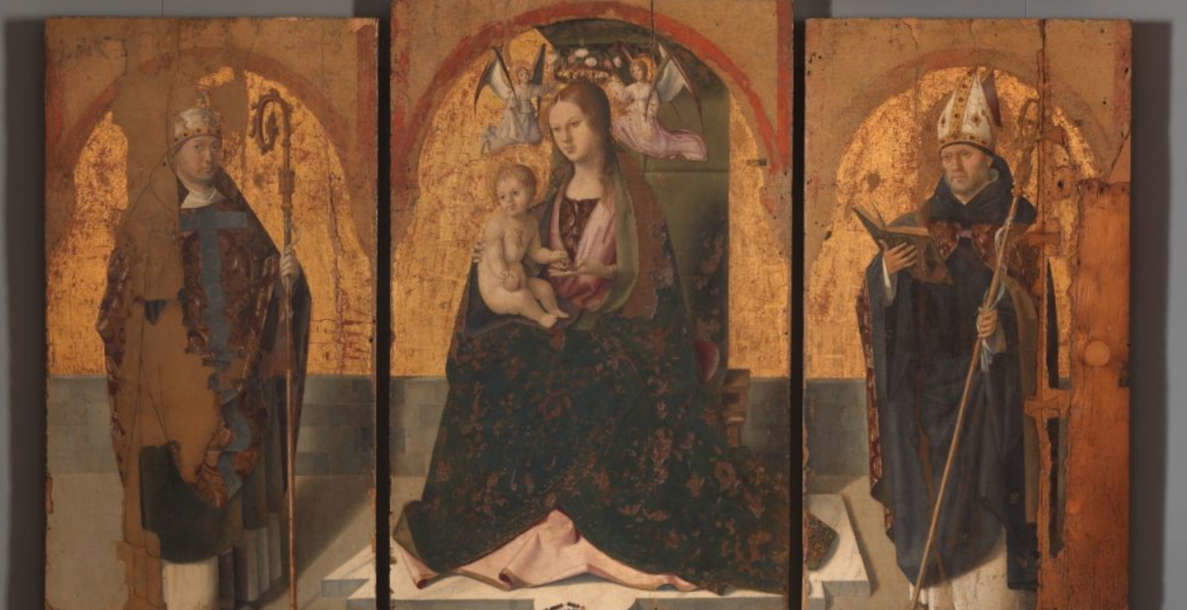
What do we know so far about the theft of Antonello da Messina’s panels from the “Maria Accascina” Regional Museum (MuMe) in Messina? Two panels were stolen from the museum: the central panel of the San Gregorio Polyptych, depicting the Madonna and Child Enthroned, and the opistograph panel (a double-sided panel, painted on both sides) featuring the Madonna and Child giving a blessing and a Franciscan in adoration on the front, and a Pietà on the back. As they fled, the thieves abandoned the two side panels of the polyptych, depicting Saints Gregory and Benedict, which have already been recovered by the authorities.
Early yesterday afternoon, the museum director, Marisa Mercurio, gave an interview to Sky Tg24 and Mediaset to reiterate that the museum was “fully operational in terms of alarms, security measures, and surveillance by the custodians” and that “it is absolutely not true that there were no security or surveillance measures in place.” When asked if no one had noticed anything, the director replied that the museum became aware of the theft later on, because “the police found two panels of the polyptych outside the museum’s perimeter, so they came to the museum to bring these two panels in.” One of the journalists asked how it was possible that, even with security guards present, no one had noticed anything, and Mercurio simply replied that “the judiciary and the relevant authorities are investigating this. We don’t know anything about the investigation yet.” The director also stated that she did not know whether the alarm had gone off properly: this aspect is also currently being examined by investigators. According to the director’s statements, four employees were present in the museum at the time of the theft. The theft was reportedly discovered by museum management around 9:50 p.m. on Saturday evening, when the police were already on the scene.
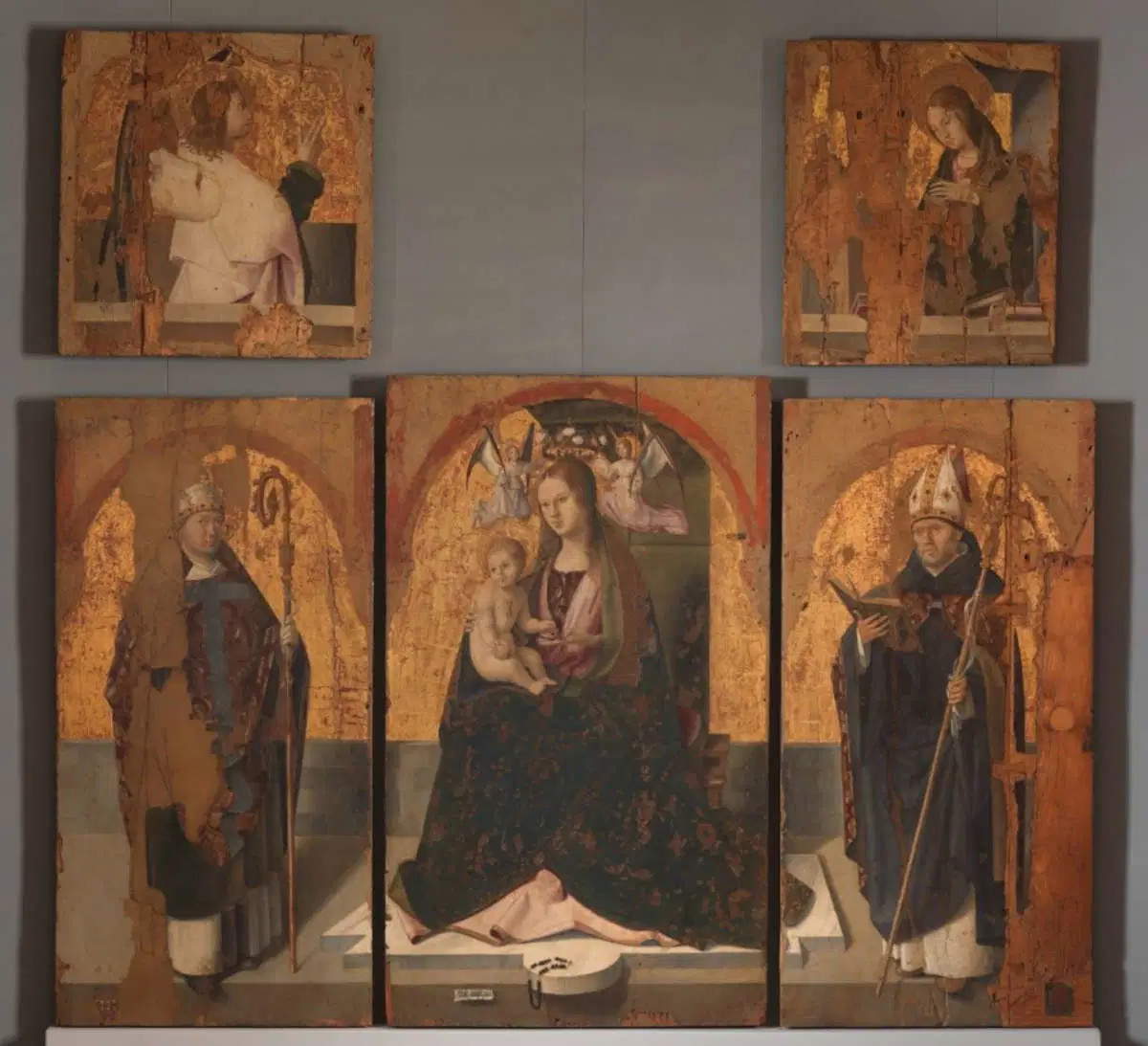
In a statement released Saturday morning, the president of the Sicilian Region, Renato Schifani, in addition to emphasizing that the Region is “already providing full cooperation to the judiciary and law enforcement, making available any information useful to the investigation,” wished to highlight a significant point: “It must be clarified that the museum’s alarm and video surveillance systems functioned properly. The video recordings and other data collected are already being reviewed by investigators and will help reconstruct the sequence of events and identify those responsible.” In short, according to statements by the director and the president, the theft appears to have taken place while the alarm systems were fully operational.
Meanwhile, the police have questioned the four security guards who were in the museum at the time of the theft (they had started their shift around 7:30 p.m.), all of whom reported that they did not notice anything out of the ordinary. According to investigators’ reconstruction of events, the thieves entered the museum by prying open the metal bars of the museum’s outer gate. The exact method by which they removed the panels will be examined in greater detail after reviewing the footage recorded by the museum’s internal security cameras, which has already been obtained by the prosecutor’s office. In the meantime, it can be confirmed that one of the two works—the double-sided panel—was inside a reinforced display case that was destroyed. The entire operation lasted a total of two or three minutes, and it was precisely the thieves’ speed that may have been decisive in the success of the theft. The thieves then, as mentioned, abandoned two panels of the polyptych, likely because they were too bulky (they are, in fact, medium-sized works on wood): left outside the museum, they were noticed by passersby, who raised the alarm and enabled the police to recover them. In this case, the footage recorded by the museum’s exterior security cameras will be useful in clarifying the details of the getaway and whether any vehicles were used. The Messina Public Prosecutor’s Office is handling the investigation and is proceeding against persons currently unknown for the crime of aggravated theft of works of art ( Article 518-bis, paragraph 2, of the Penal Code), with the investigation coordinated by Chief Prosecutor Antonio D’Amato and delegated to the police department’s mobile squad and the Carabinieri’s Cultural Heritage Protection Unit.


According to the local newspaper MessinaToday, the alarm reportedly went off as usual, but may have been mistaken for a false alarm: this is one of the hypotheses investigators are currently exploring. According to the newspaper, this detail emerged from initial interviews with staff and will be verified using the system’s data, security camera footage, and a reconstruction of the procedures followed on the evening of the theft. At this point, we can only speculate about the motives behind the theft, but what is certain is that these are unsellable works: they are, in fact, instantly recognizable pieces that cannot be sold on the art market under normal circumstances.
The National Association of Art Historians—AStArte—in a statement released yesterday afternoon, drew attention to staff training: “The central issue raised by AStArte lies in the mismatch between the required skills and the staff’s training. These staff members were not selected through competitive hiring processes designed specifically for the cultural heritage sector, nor have they received training commensurate with the sensitivity of the security duties required in a museum. In addition to the lack of specialization, there is the issue of staffing levels: the number of staff is often insufficient to meet the needs of the institutions. Confirmation of this managerial precariousness came a few months ago in a circular from the Regional Department of Cultural Heritage, which had to take urgent action regarding shift schedules precisely to try to address the serious difficulties in staffing the service.”
Meanwhile, industry associations are calling for more oversight and greater security. Italia Nostra Sicilia, in addition to describing the theft as “an extremely serious blow to Sicilian and national cultural heritage,” is demanding that security systems be strengthened at the museum and at all Sicilian cultural institutions: “Preservation cannot be limited to conservation, public access, and promotion: it must first and foremost ensure the concrete protection of the assets that belong to the community.” The same request comes from the “Lamba Doria” Cultural Association, which is calling for the establishment of a roundtable discussion between the regional government, the Department of Cultural Heritage, and national institutions to discuss staff increases, security, video surveillance, on-call protocols during nighttime hours, and the review of security plans for museums, archaeological sites, and cultural venues.
 |
| The Theft of Antonello da Messina: What We Know So Far |

Warning: the translation into English of the original Italian article was created using automatic tools. We undertake to review all articles, but we do not guarantee the total absence of inaccuracies in the translation due to the program. You can find the original by clicking on the ITA button. If you find any mistake,please contact us.
























 IT
IT FR
FR DE
DE ES
ES CN
CN


