





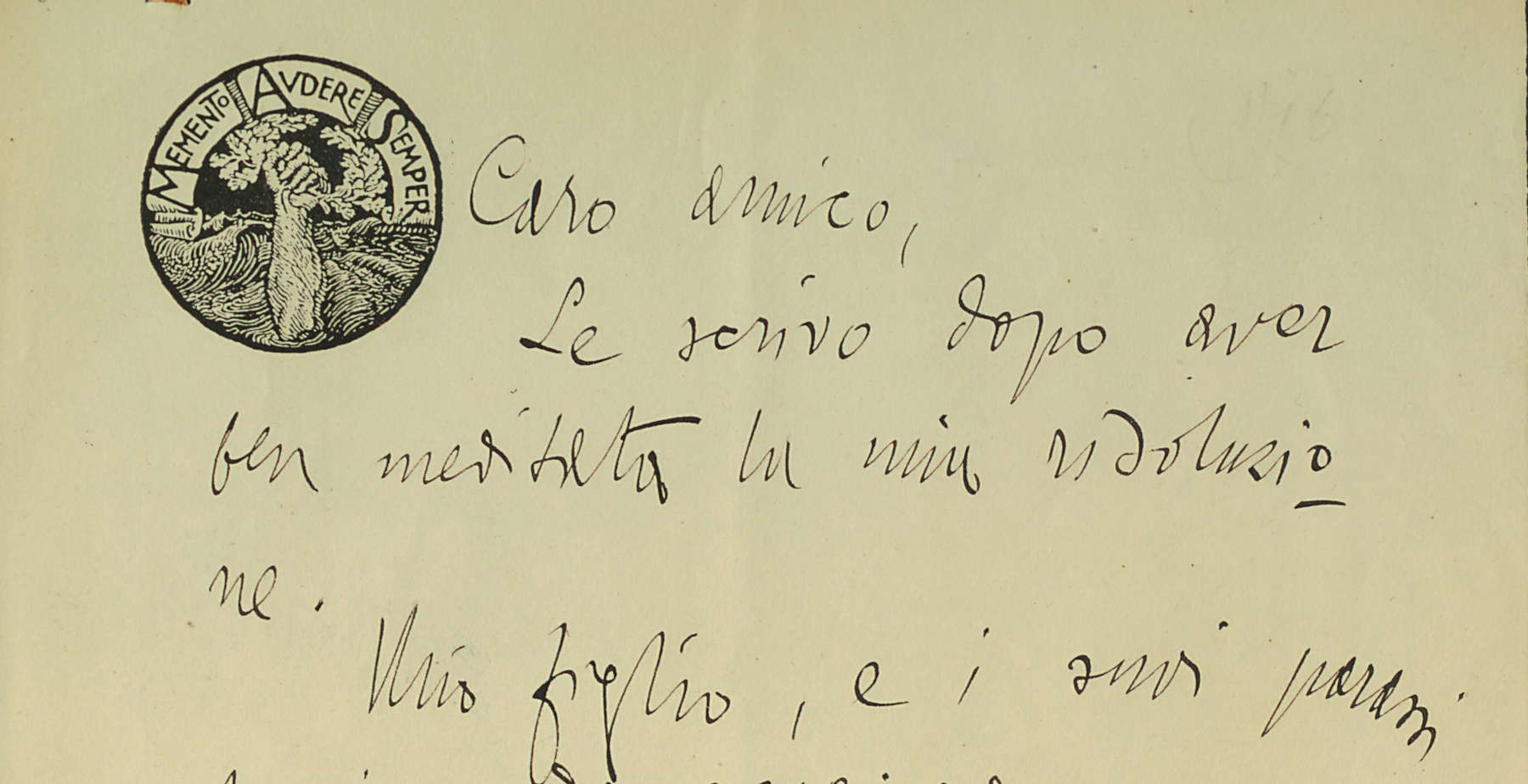
More than eighty handwritten documents, many of which were previously unknown to the general public, are now part of the Vittoriale degli Italiani’s collection. The announcement was made during the event “Omaggio a d’Annunzio nell’azzurro,” during which the president of the Vittoriale degli Italiani, Giordano Bruno Guerri, officially presented the acquisition of the correspondence between Gabriele d’Annunzio and Giovanni Rizzo, a key figure in the final years of the poet’s life. The transaction, finalized in June through the Finarte auction house, was made possible thanks to the collaboration of Fabio Massimo Bertolo, head of the Books, Autographs, and Prints Department. This acquisition is of particular significance for the history of the Vittoriale and, more generally, for studies on D’Annunzio, as it provides access to documentation that until now had remained in private hands.
The collection comprises a total of 83 handwritten documents, including letters, drafts, and autographed envelopes, amounting to over one hundred pages. A significant portion of the materials is unpublished and sheds light on previously little-known aspects of the relationship between d’Annunzio and Giovanni Rizzo, the police officer sent to the Vittoriale in 1923 with the official task of monitoring the poet. The acquired documentation represents a fundamental piece of the puzzle for reconstructing not only the history of the monumental complex in Gardone Riviera but also the network of personal and political relationships that characterized the final years of the “Vate’s” life. These documents, in fact, shed new light on the relationship between d’Annunzio and the Fascist regime, as well as revealing a series of details concerning his family and private life.
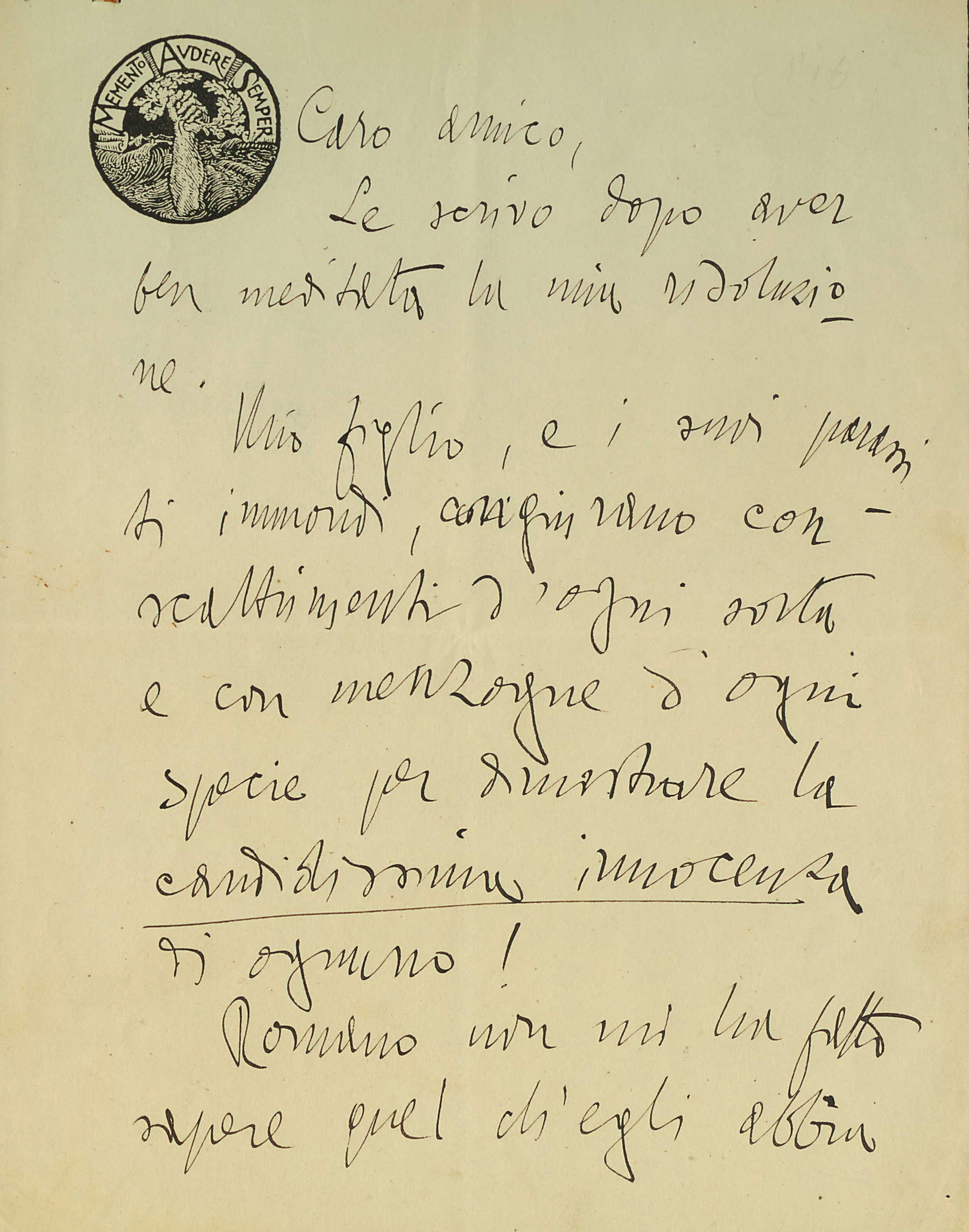
To understand the historical significance of the correspondence, we must go back to September 24, 1923, the date on which Giovanni Rizzo arrived at the Vittoriale. His assignment had been ordered by General Emilio De Bono, and the official had been formally tasked with investigating a jewelry theft. Behind that official mission, however, lay a very different objective. Rizzo had in fact been tasked with exercising constant surveillance over the poet, effectively becoming Benito Mussolini’s “watchful eye” within the Vittoriale.
What initially appeared to be a relationship based on surveillance and control, however, took on very different characteristics over time. Over the years, in fact, Giovanni Rizzo managed to win d’Annunzio’s trust to the point of becoming one of the people closest to the poet. From a mere official tasked with monitoring his activities, he gradually transformed into a trusted confidant, secretary, and, in some respects, even a friend. The letters now acquired by the Vittoriale offer a more nuanced and complex account than the one presented by Rizzo himself in his 1941 autobiography, *Diario di lotte e di poesia*. While that volume presented a specific portrayal of his relationship with the Vate, the original correspondence allows us to grasp nuances and dynamics that significantly enrich the historical picture.
Particularly significant is the way in which d’Annunzio describes his bond with Rizzo. In one of the letters, the poet goes so far as to define it as “much more delicate than love,” an expression that attests to the intensity of a relationship characterized by a strong emotional and psychological component. It was a unique, profound friendship—at times marked by moments of tension—in which their initial roles gradually reversed.
The regime’s inspector, in fact, became the person to whom d’Annunzio confided his doubts, fears, and anxieties. The letters reveal a man far removed from the public image of the poet-soldier, the hero of heroic deeds, and the orator capable of stirring the crowds. Instead, they reveal fragility, concerns, and reflections that belong to the most private dimension of his existence.
Among the most significant aspects of the collection are the pages dedicated to his relationship with Fascism and the gradual rifts that developed between the poet and the regime. The correspondence, in fact, offers direct accounts of the moments when d’Annunzio openly expressed his discontent with Mussolini, voicing harsh and critical judgments.
One of the most significant episodes concerns the failure to appoint certain figures particularly close to the poet—Ildebrando Pizzetti, Giuseppe Brunati, and Gian Francesco Malipiero—to the Accademia d’Italia. The decision caused deep disappointment in d’Annunzio, who interpreted that choice as a personal and political betrayal. In one of the letters contained in the archival collection, the Vate writes extremely harsh words directed at the head of government, stating that “The Prime Minister has failed not only in friendship but also in honor.”
This is a document of great historical interest because it offers an insider’s view of the tensions between two figures often portrayed in a simplified manner by historians. The letters reveal a relationship marked by misunderstandings, unmet expectations, and conflicts that emerge clearly in their private correspondence.
Alongside political considerations, the correspondence also offers a unique glimpse into d’Annunzio’s daily life. The letters paint a picture of a man grappling with family matters, personal problems, and concerns that rarely found their way into official documents. Particularly poignant are the references to his relationship with his son Gabriellino. No less significant are the references to the obsessions and superstitions that accompanied d’Annunzio in the final years of his life. The letters also address one of the central themes of d’Annunzio’s life: the construction of the Vittoriale.
The importance of the collection lies precisely in its ability to reveal a d’Annunzio different from the one known through public speeches and official writings. The letters, in fact, provide access to a more authentic and spontaneous dimension, in which the language appears less contrived and more in tune with the emotions of the moment. From this perspective, the correspondence represents a source of extraordinary interest not only for scholars of the “Vate” but also for those studying the political and cultural history of 20th-century Italy. The letters provide an insider’s view of the relationships between one of the leading figures of Italian cultural life and the political powers of the time. The acquisition announced by the Vittoriale thus takes on a significance that goes beyond simply enriching the archival collections of the Garda-based institution. The recovery of documents that had long remained in a private collection also helps prevent the risk of losing evidence that is essential for reconstructing d’Annunzio’s biography and the history of the Vittoriale.
 |
| The Vittoriale Acquires the Rizzo Correspondence: Over 80 Letters by d’Annunzio |

Warning: the translation into English of the original Italian article was created using automatic tools. We undertake to review all articles, but we do not guarantee the total absence of inaccuracies in the translation due to the program. You can find the original by clicking on the ITA button. If you find any mistake,please contact us.


























 IT
IT FR
FR DE
DE ES
ES CN
CN


