




by Federico Giannini, Ilaria Baratta 06/06/2026



Categories: Travel / Disclaimer
Born from the vision of Malatesta Novello and inaugurated in 1454, the Biblioteca Malatestiana in Cesena is the only example in the world of a humanistic convent library preserved in its entirety in building, furnishings and book heritage. It has been on the UNESCO Memory of the World Register since 2005. A journey inside this extraordinary building.

In 2003 a conference was held in Cesena celebrating the 550th anniversary of the opening of one of Italy’s most illustrious cultural jewels, the Biblioteca Malatestiana, inaugurated in 1454: the organizers decided to give that day of study a title, The Gift of Malatesta Novello, which was intended to pay tribute to the enlightened patron without whom the Library might never have been born, namely Domenico Malatesta (Brescia, 1418 - Cesena, 1465), who decided to take on the nickname “Novello” in 1433, when he became a Palatine knight as well as lord of Cesena. Malatesta Novello had a dream: to spread humanistic culture in his city and give luster and glory to his family through the arts. This was, in essence, what his brother Sigismondo Malatesta (Brescia, 1417 - Rimini, 1468) was about to do at exactly the same time with the Malatesta Temple in Rimini. So if his brother Sigismondo entrusted monumental architecture with the task of celebrating his own greatness, Malatesta Novello identified books and knowledge as the most effective means of leaving a lasting legacy.
And it was precisely in 1450, the year in which the Rimini temple was consecrated, that in Cesena Malatesta Novello began to take an interest in the plans of the friars of the convent of San Francesco, who about three years earlier had finally been able to begin work on a building that could preserve the volumes collected over more than two hundred years of presence in Cesena. In 1445, in fact, Pope Eugene IV had granted the friars that a bequest they had obtained, and which was supposed to be used to build a chapel inside the convent, should instead be earmarked for the construction of a library. In 1448 the presence in the city of the architect Matteo Nuti (Colfiorito, c. 1405 - Fano, 1470) was recorded, and a few years later he would place his name on the inscription commemorating the date of the end of the work: we can therefore assume, though without certainty, that the construction of the building had begun precisely around 1448. But without having objective evidence, there are instead those who think that work began in 1450, when Malatesta Novello’s interest became tangible: that year, the lord donated to the friars codices worth a total of five hundred florins, a considerable sum for a donation that marked Malatesta Novello’s entry into the enterprise.


The young lord of Cesena was among the most illustrious figures of the Romagna Renaissance. A member of the powerful Malatesta dynasty, which had extended its influence from Romagna to the Marches and Tuscany, Malatesta Novello ruled territories formally belonging to the Church State as papal vicar. A Captain of Arms of valor, he was forced to abandon his military career in 1447 because of the consequences of some wounds suffered during war campaigns. From that time he concentrated his energies on the administration of territories and the promotion of arts and culture. Together with his wife Violante da Montefeltro he created around him a court open to the ferments of humanism and established relations with the main Italian cultural centers.
The original idea for the library, however, did not come directly from him, although he was involved with certainty, as mentioned, in 1450. The design of the building was thus entrusted to Matteo Nuti, and the work was supervised by both the friars and the lord of Cesena: still today, wandering around the Library, we can detect the two souls of this place, that of the conventual tradition and that of Malatesta humanistic culture. Nuti is credited with the conception of a space that still surprises today for its harmony, balance and functionality.
After just two years of work, in 1452, the great hall of the Library was finished, and another two years were needed to arrange the volumes: on August 15, 1454, as is also recalled by the date engraved on the wooden door made by Cristoforo da San Giovanni in Persiceto, the Malatesta Library was solemnly inaugurated and opened to the public. Studies conducted in the mid-twentieth century found that the Biblioteca Malatestiana is one of the oldest civic libraries in the world (there are even those who consider it the first civic library ever): scholars of the time could therefore go here to borrow volumes from the library. There are also documents left that can testify that the Municipality of Cesena, especially when Malatesta Novello was alive, exercised tight control over everything that happened inside the library: the city authorities took care of the management of the book collections, saw to their expansion, checked loans, periodically verified that no books were missing, and chose the custodian, whose appointment was the responsibility of the city council. It was Malatesta Novello himself who had arranged for the city council to take charge, together with the monks, of the management of the library. This was a surprisingly modern decision that ensured constant protection of the heritage.
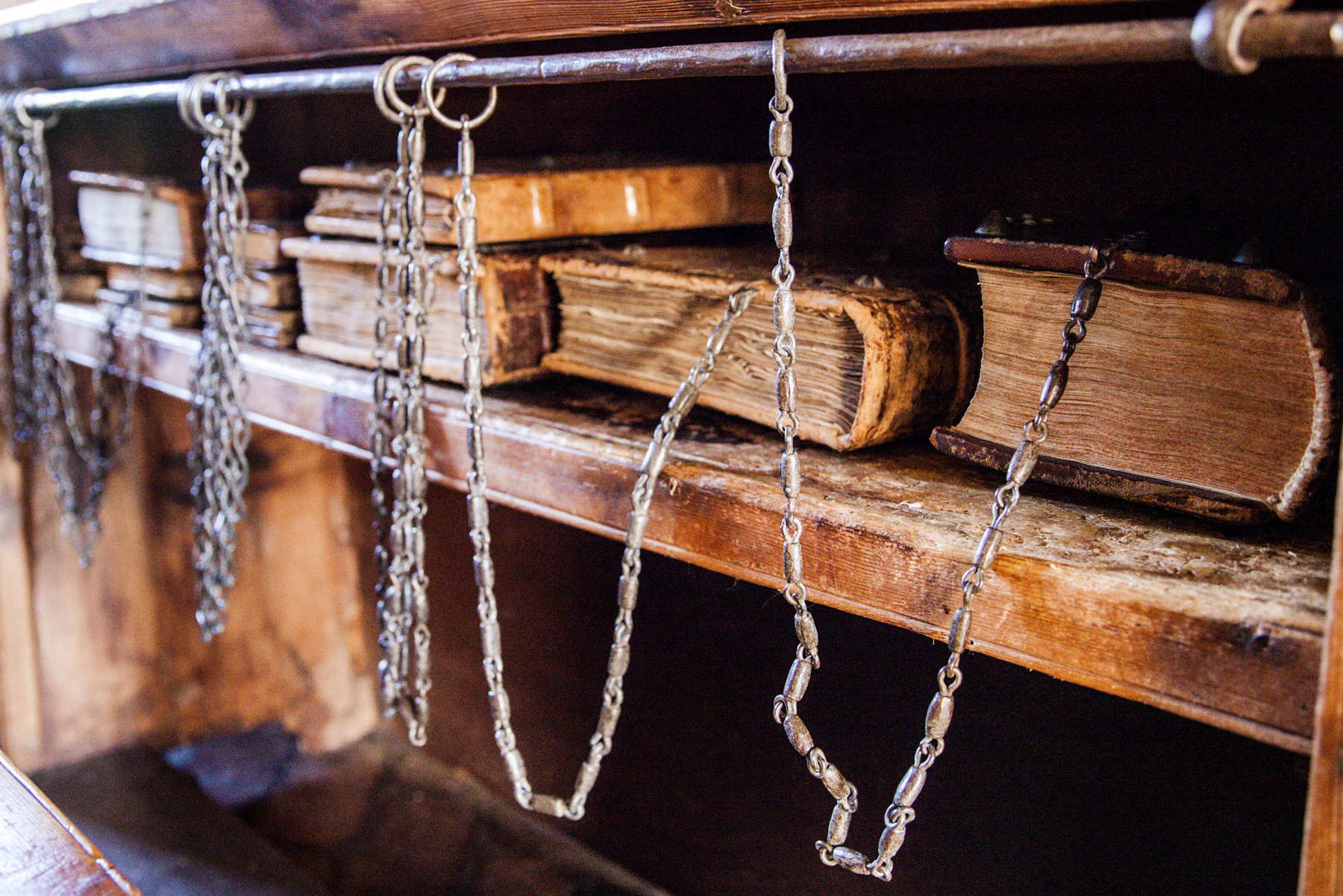
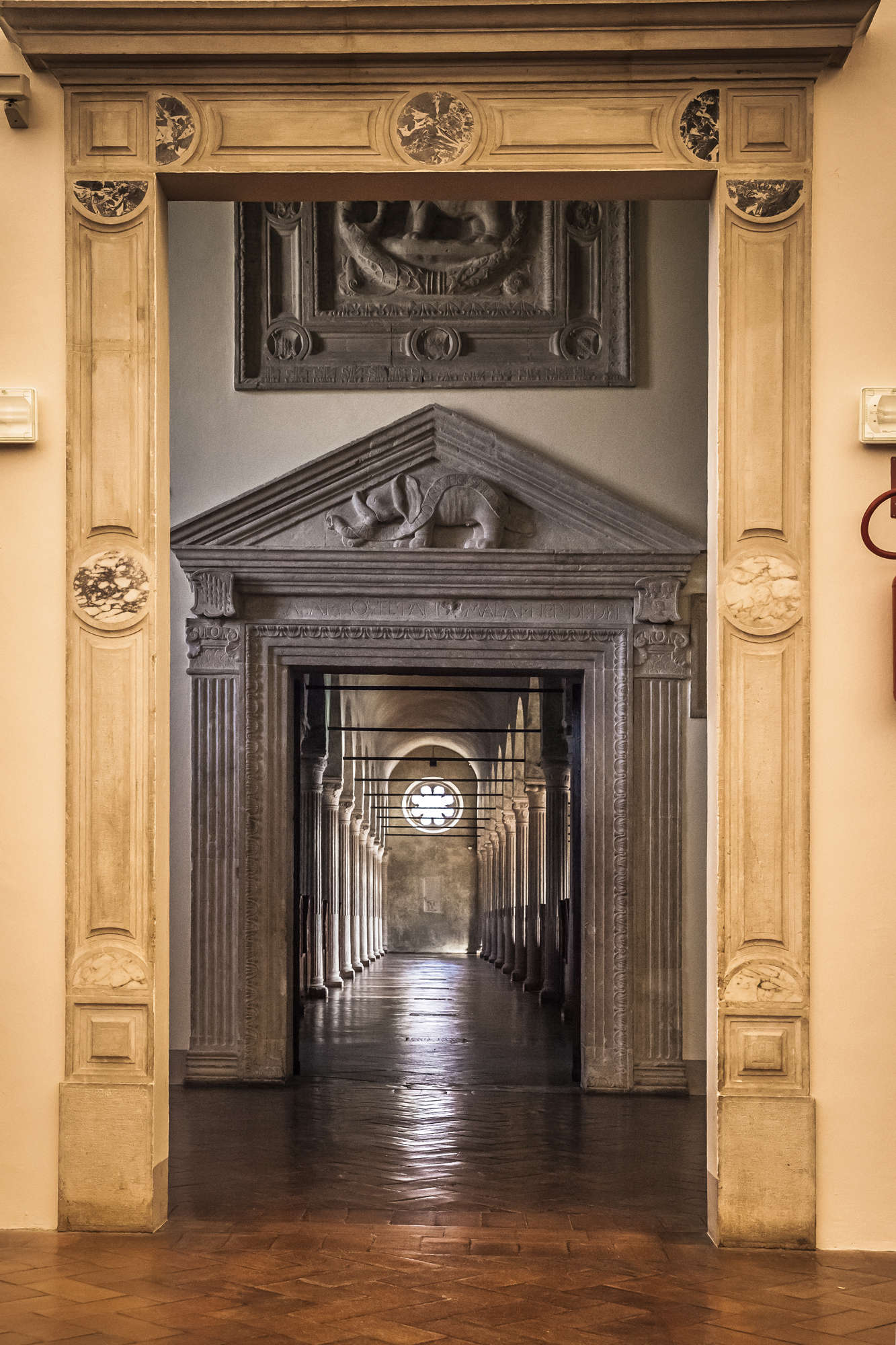
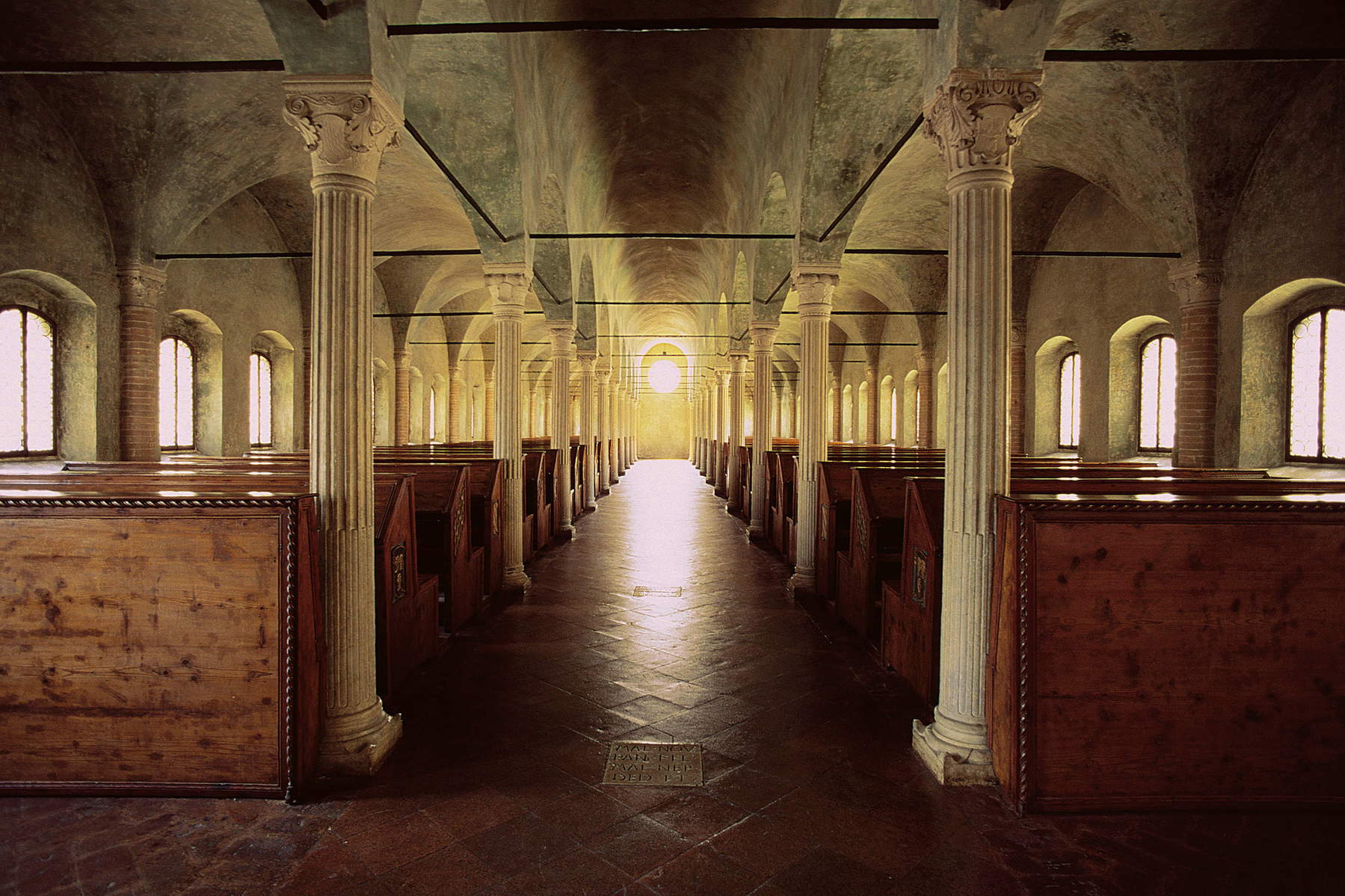
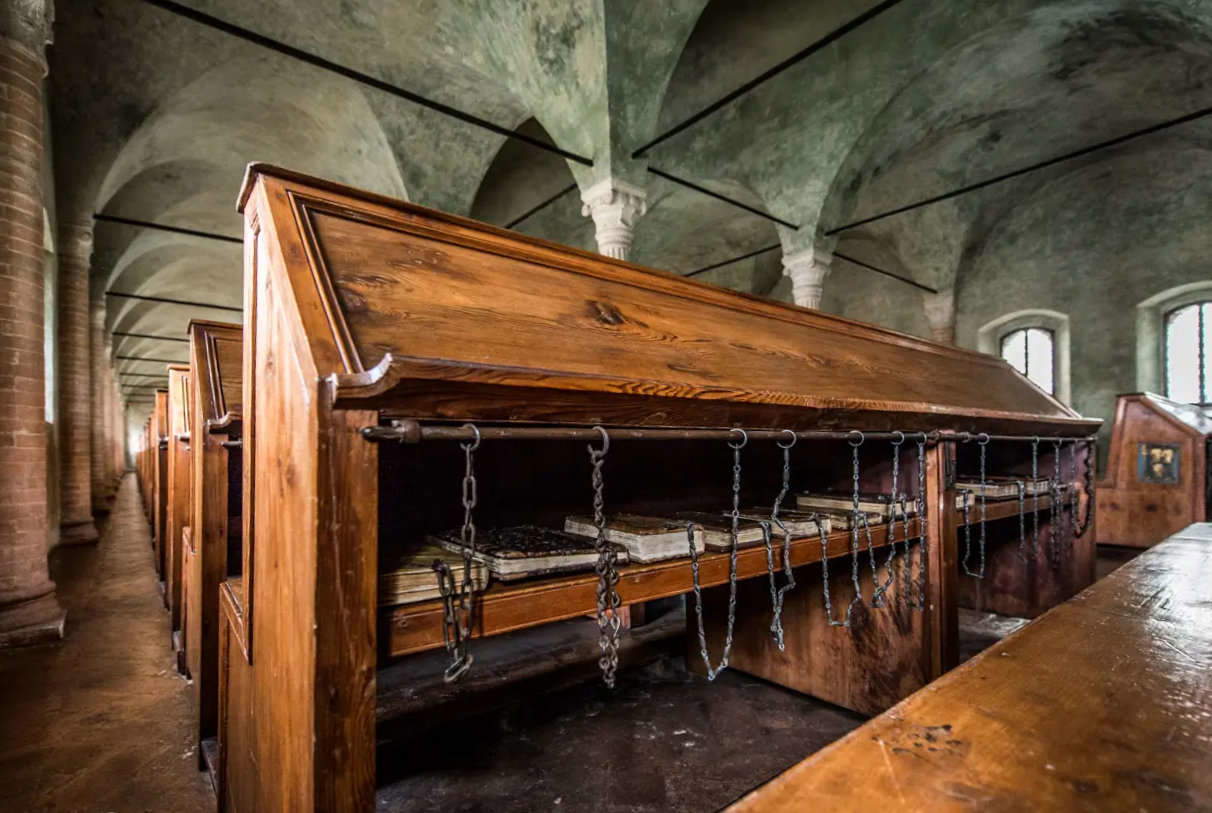
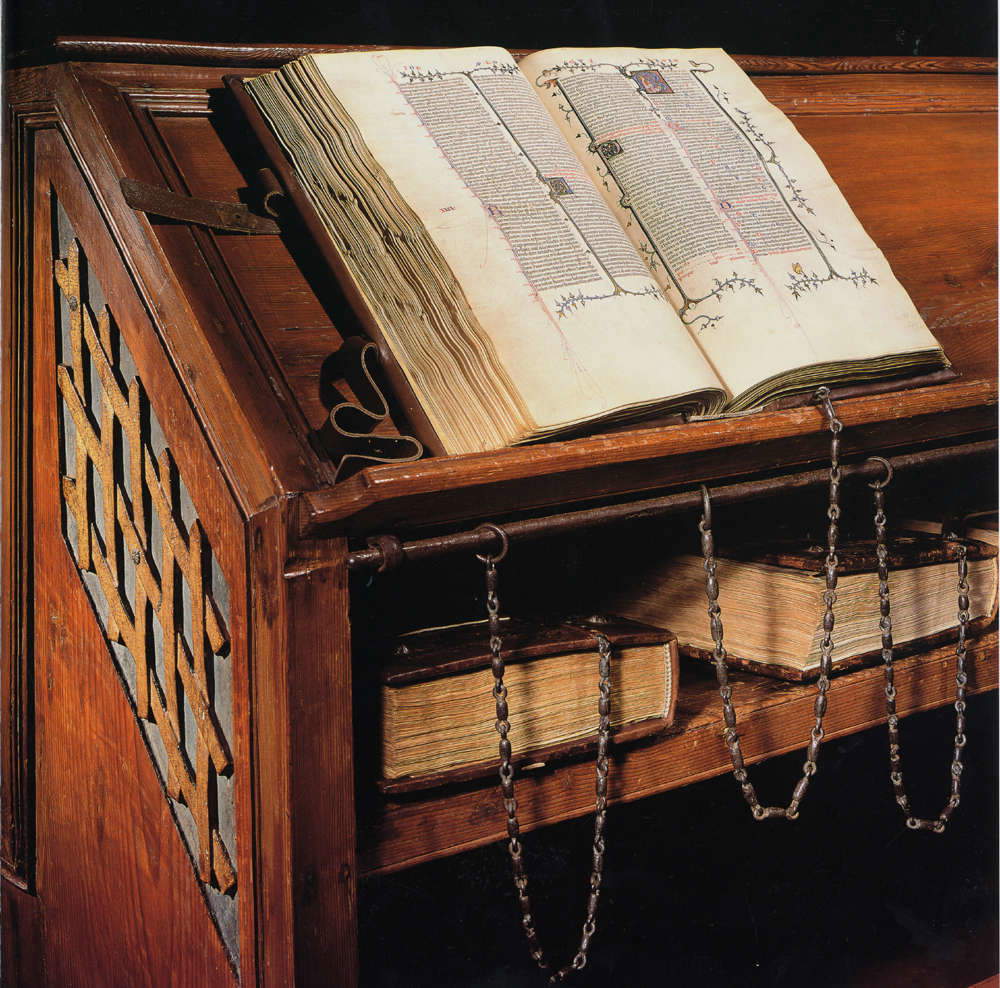
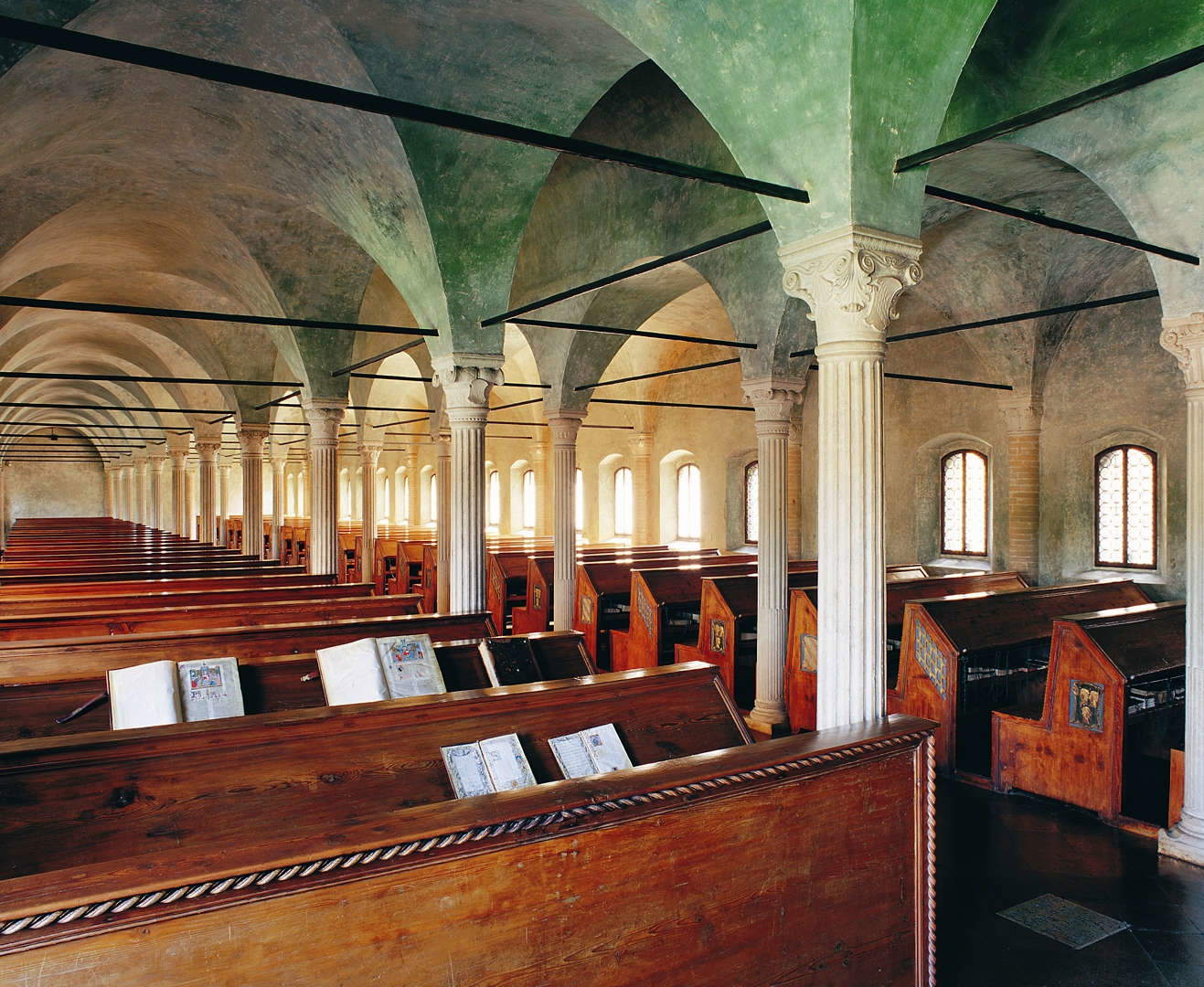
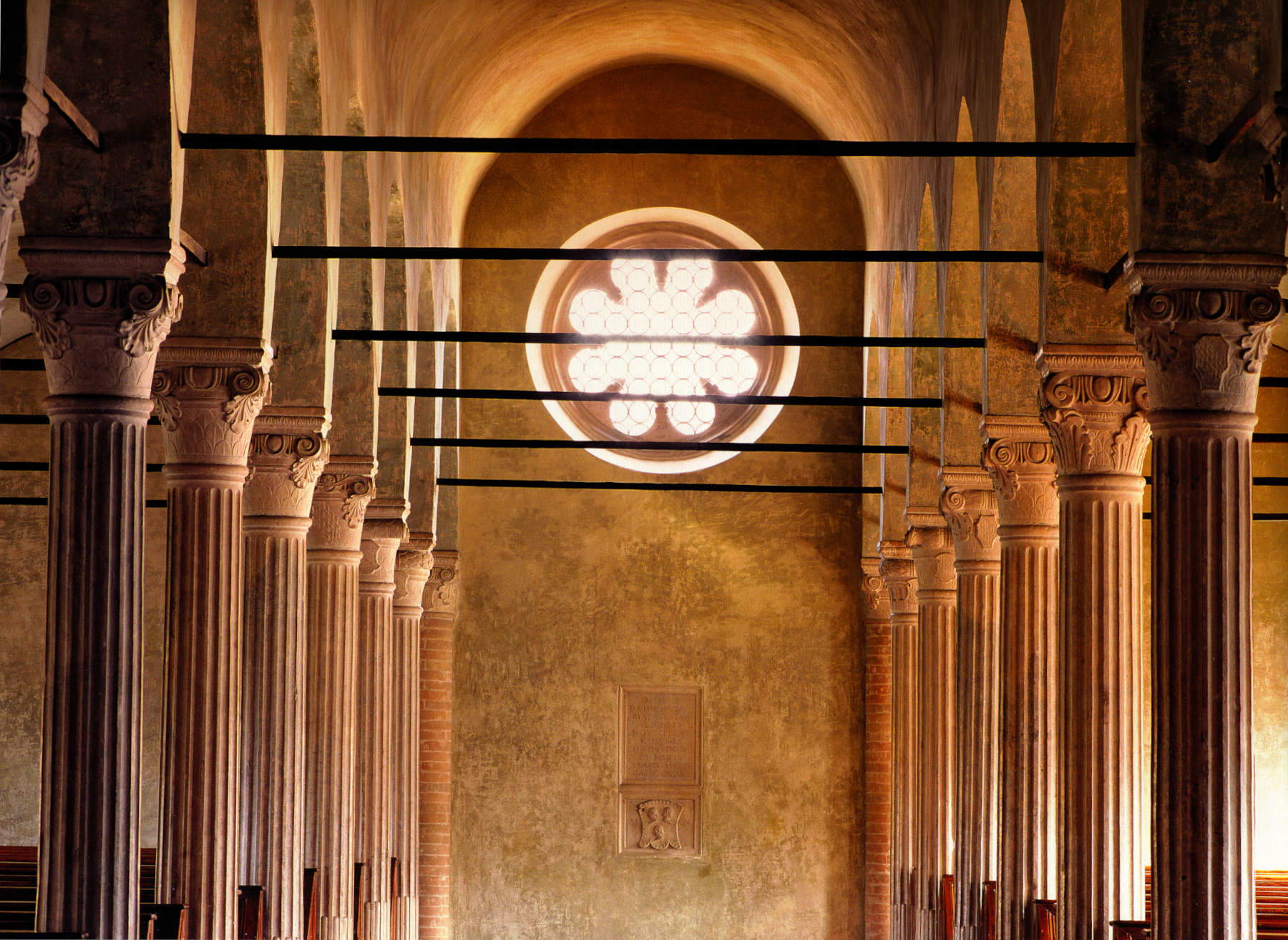
Malatesta Novello’s humanistic culture also explains the organization of spaces within the hall, now known as the “aula del Nuti,” named after the architect to whom the design is owed. Nuti conceived, probably drawing on the work of Leon Battista Alberti (particularly De re aedificatoria), an environment divided into three naves, as if it were a church, covering the side naves with cross vaults and the central one with a barrel vault. The environment was inspired by the first Renaissance library, the one designed by Michelozzo in 1444 for the convent of San Marco in Florence: the spaces are punctuated, in ever-constant geometric relationships, by the elegant fluted stone columns; light penetrates the aisles through a regular series of pointed-arch windows, two in each bay, while the central one receives instead the ’illumination from the large rose window located on the back wall, which allows the light to rest on the reading surface of the plutei, in pine wood benches on which the reader took his place and to which the volumes were secured by chains that served to prevent the books from being removed from the Library, or simply switched places, forcing the monks to have to relocate them. Even today it is still possible to observe the ancient volumes of the Malatesta Library where they were originally kept: the Libraria Domini, as the Malatesta Library was known in ancient times (the “Libreria del Signore,” or the Library of Malatesta Novello), is in fact the only monastic-humanist library in the world to have been preserved intact, both in the building, the furnishings and the book collection. An oculus, in the Gothic style, opens on the back wall, illuminating instead the nave, which is devoid of plutei as it was intended to allow access to the pews of the side aisles.
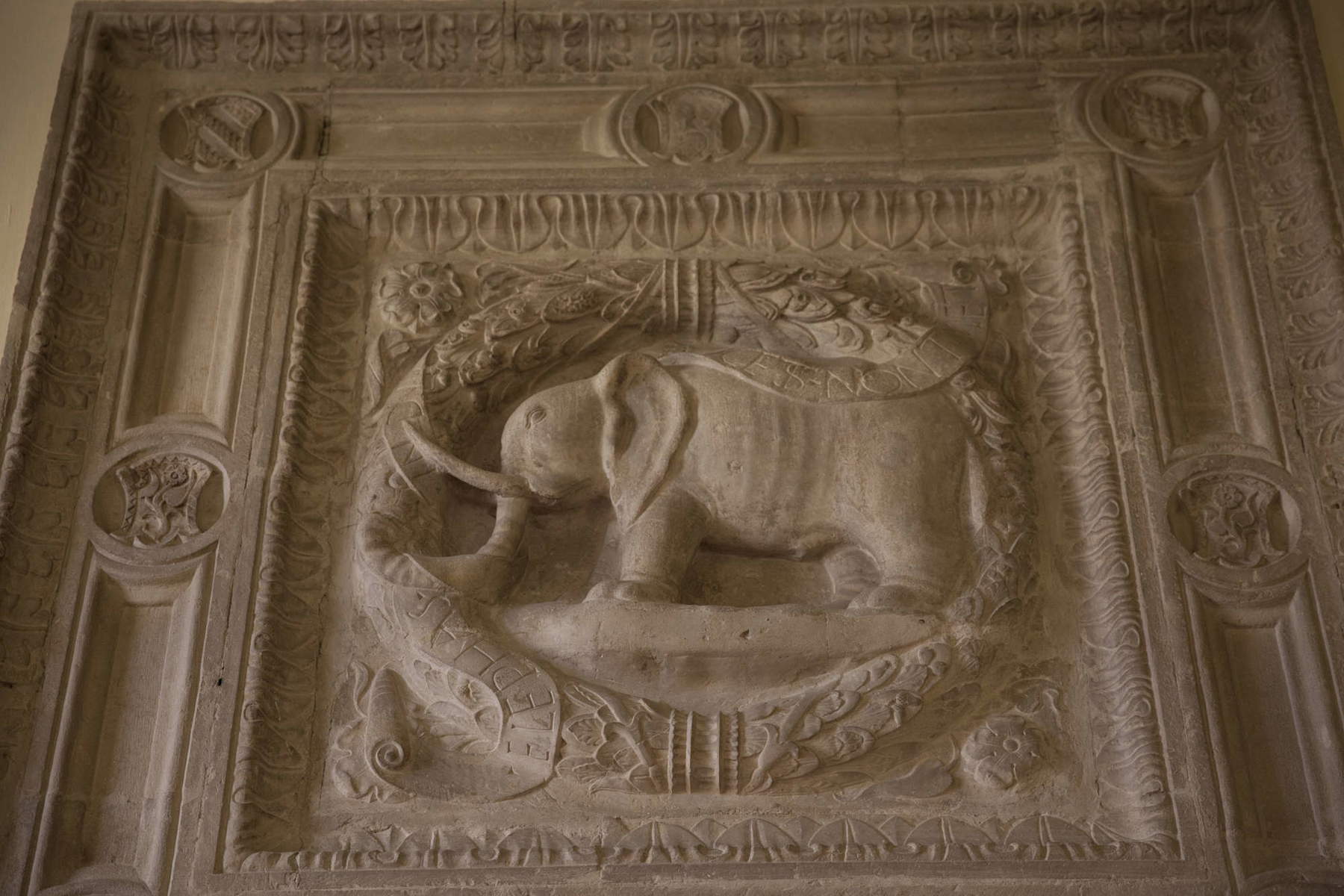
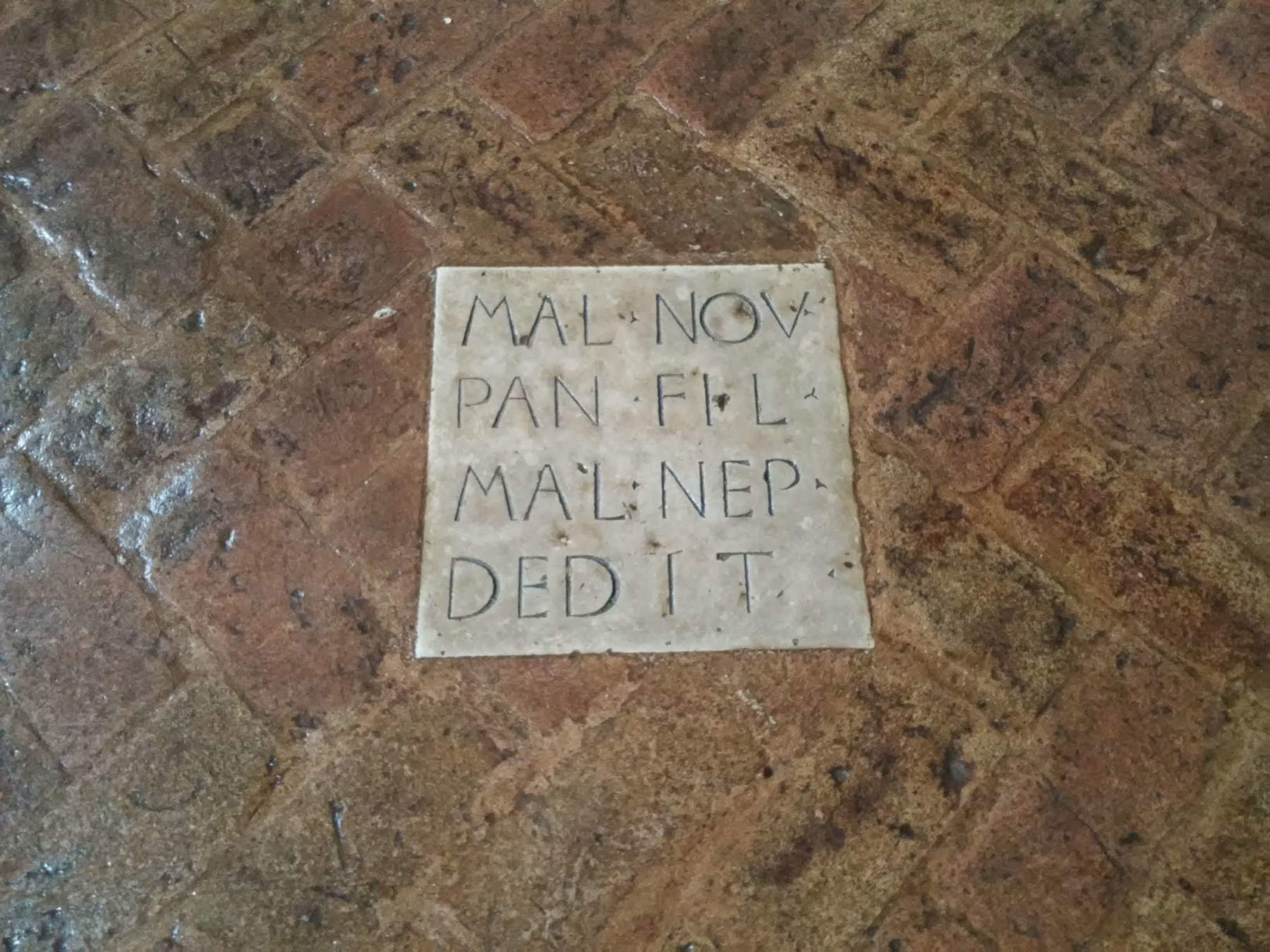
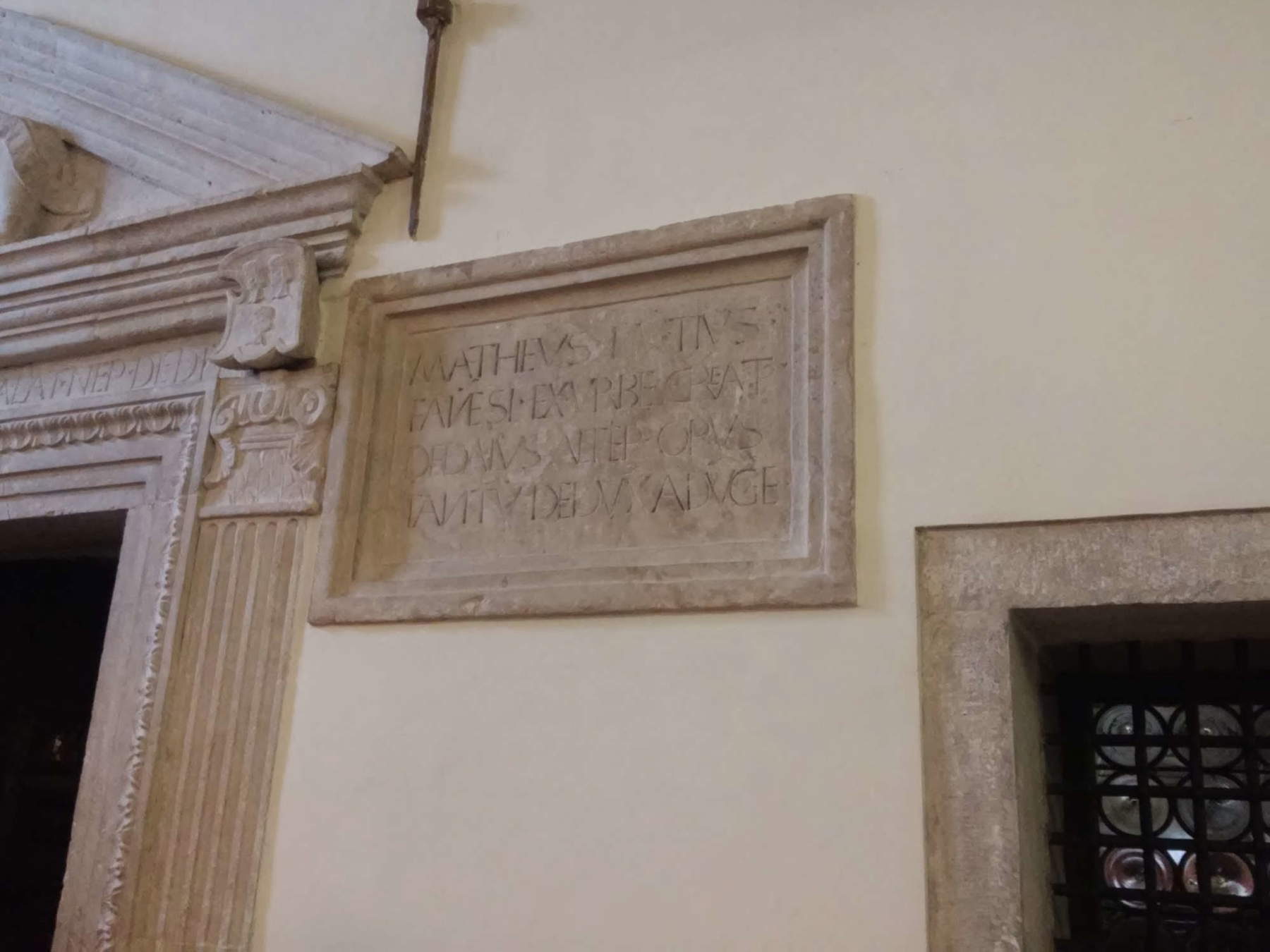
The decorative program also reflects the identity of the Malatesta family. The entrance portal, made of local stone, greets visitors with theelephant, one of the best-known Malatesta symbols, accompanied by the cartouche with the motto Elephas indus culices non timet, “the Indian elephant does not fear mosquitoes,” an exhortation meant to emphasize how magnanimous people did not have to worry about petty hostilities. Next to the portal, a plaque hands down the name of the architect, who unassumingly compared himself to the mythical Daedalus, builder of the Labyrinth of Crete: MCCCCLII Matheus Nutius Fanensi ex urbe creatus Dedalus alter opus tantum deduxit ad unguem, (“In the year 1452 Matteo Nuti, born in the city of Fano, as a new Daedalus brought to completion so great a work.”). On the floor and lintel of the portal, an additional plaque recalls the name of the gentleman who donated the Library to Cesena: Mal. Nov. Pan. Fil. Mal. Nep. Dedit, (“Malatesta Novello, son of Pandolfo and grandson of Malatesta, donated”). Everywhere the symbols of the family radiate: the three-headed enterprise, the dog rose, the enterprise of the Malatesta fence of Cesena, a symbol of strength but also an allusion to the Library itself, since the colors of the Malatesta fence (white, red and green: the colors of the theological virtues) recall those of the Library (the white of the columns, the red of the terracotta used for the flooring, the green of the walls and ceiling).
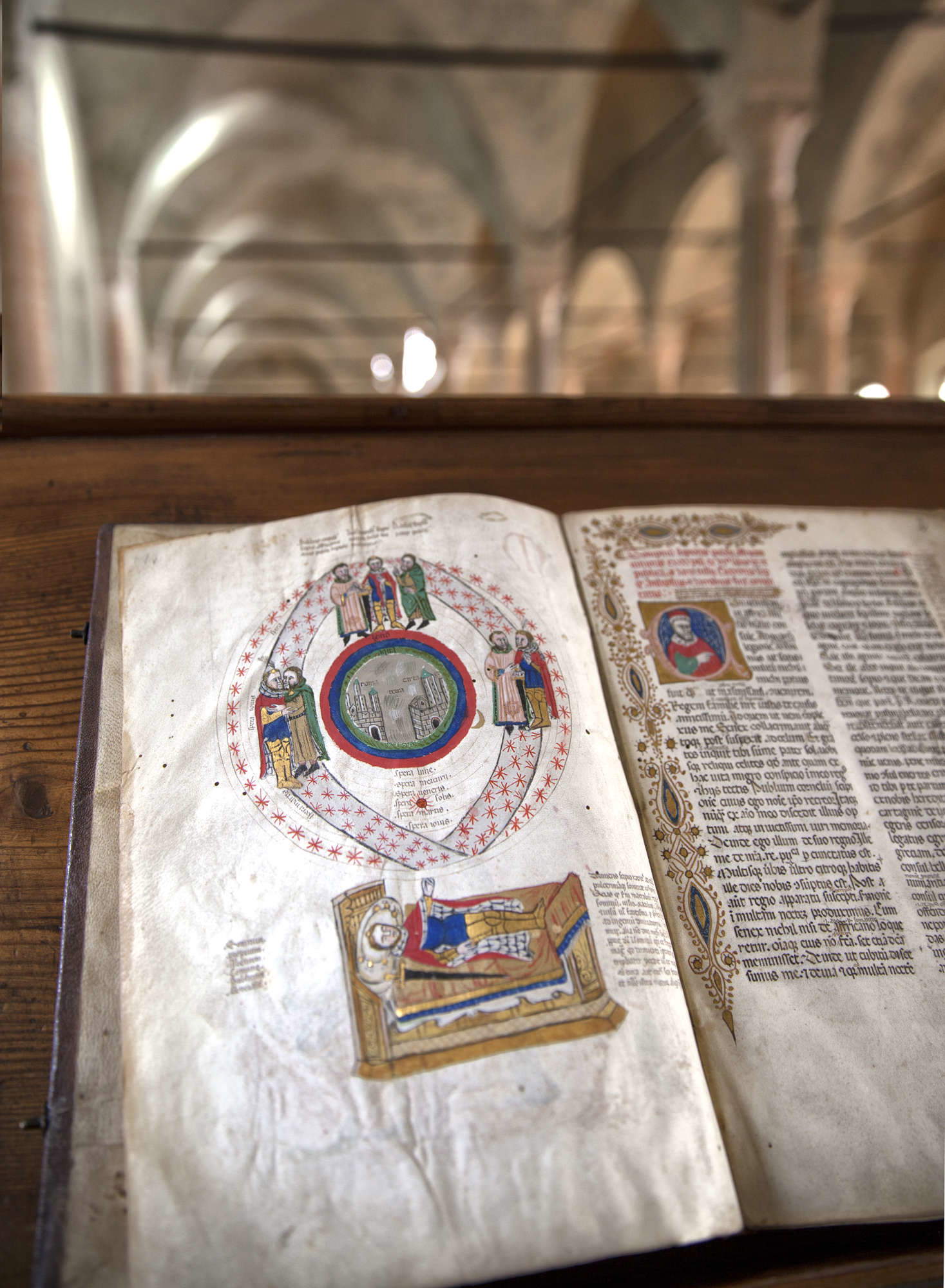
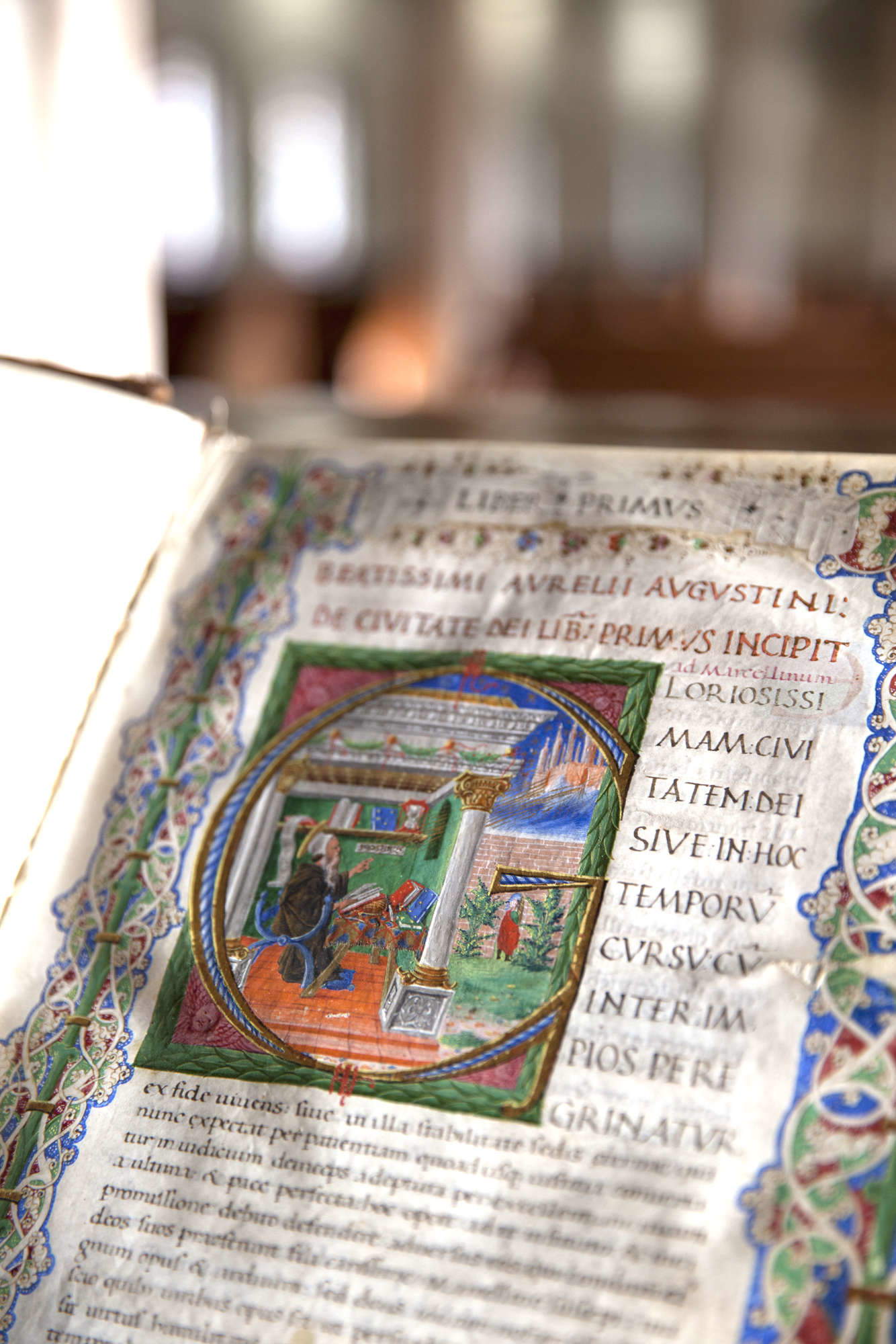
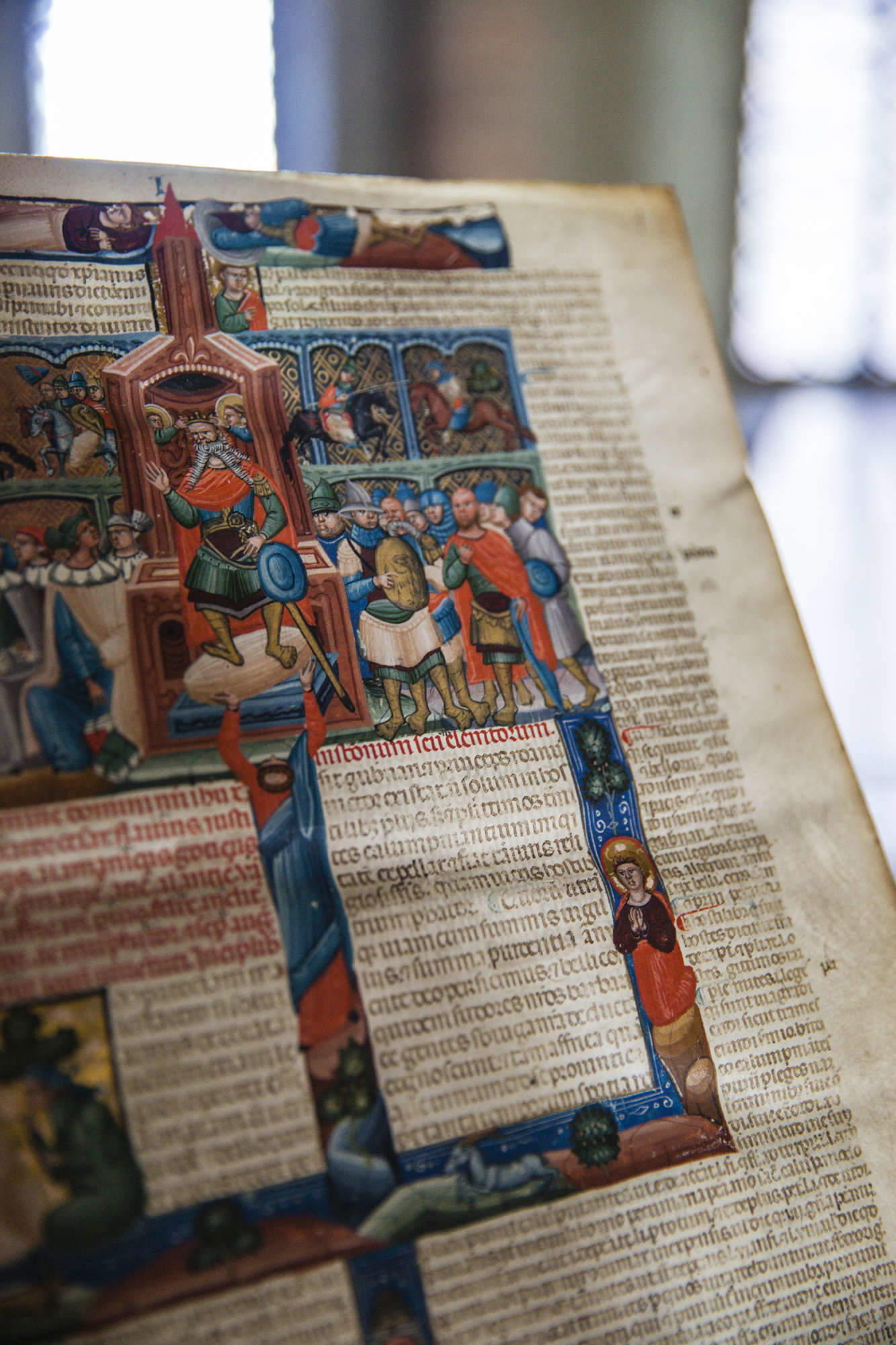
If the building represents a masterpiece of Renaissance architecture, the library holdings constitute its most precious treasure. The collection includes 343 manuscripts, many of them illuminated with extraordinary refinement. The collection of manuscripts returns the image of a library deeply rooted in humanistic culture: in fact, alongside the religious texts coexist the authors of classical antiquity, the works of the Fathers of the Church, scientific writings and evidence of the new intellectual currents of the 15th century. Works of philosophy, theology, medicine, and science find their place at the Malatestiana. And then books on history, a subject of which the lord of Cesena was a great enthusiast, classical Greek and Latin authors (Pliny, Plutarch, Livy, Cicero), Hebrew codices, and works by contemporary humanists. In order to equip the library with an adequate collection, Malatesta Novello also promoted the creation of a specialized scribal office. In about twenty years of activity, before the invention of printing made their work obsolete, Cesena’s amanuenses produced over one hundred and twenty codices. The manuscripts commissioned directly by the lord were then joined by those purchased on the book market and those from the monastic collection. Particularly significant are the fourteen Greek codices, probably purchased in Constantinople, the seven Hebrew codices and the numerous volumes donated by the Rimini physician Giovanni di Marco, a passionate collector who collaborated with the lord of Cesena. Over the centuries the collection was also enriched with a number of printed volumes dedicated to Cesena authors.
More than five centuries after its inauguration, the Biblioteca Malatestiana continues to represent one of the most extraordinary places of European culture. Malatesta Novello’s dream has not merely survived the passage of time: it has come down to the present day almost unchanged. To enter the Nuti Hall is still to experience firsthand that Renaissance project that saw knowledge as a tool for civic and collective growth. This, perhaps, is the greatest emotion that one feels when visiting this place, a perfectly preserved historical environment, enveloped in the same light that flickered on the pages of the codices leafed through by ancient visitors.
It is not surprising then that in 2005 UNESCO decided to include it in the Memory of the World Register, making it the first Italian library to enter the prestigious list of documentary assets considered fundamental to the history of humanity. A recognition that definitively consecrated the universal value of a place born from the convergence of the cultural ambition of a Renaissance lord and the educational project of a religious community. Its exceptional preservation has allowed it to cross time without losing its original identity, so much so that it is considered the only example in the world of a conventual humanist library that has come down to the present day perfectly intact in its building, furnishings and library equipment. The perfect preservation of the building, furnishings and book collection, due also to the deep connection of the people of Cesena with their culture and history, makes the Malatestiana a unique case in the world. But its value goes beyond material exceptionality. Indeed, the library continues to bear witness to how culture can become a shared heritage, a living memory and a tool for building the future. This is the most authentic legacy left by Malatesta Novello to his city and to the whole world.
Warning: the translation into English of the original Italian article was created using automatic tools. We undertake to review all articles, but we do not guarantee the total absence of inaccuracies in the translation due to the program. You can find the original by clicking on the ITA button. If you find any mistake,please contact us.