





A calendar carved in stone that accompanies visitors along the succession of the seasons, telling the story of man’s work, his relationship with nature and the passage of time. It is the cycle of the Months that decorates the frieze arranged on the portico of the Cathedral of San Martino in Lucca, one of the most significant medieval sculptural complexes in Tuscany, created during the 13th century and attributed to the Master of San Martino, an artist of Lombard origins documented between 1265 and 1290. The work, executed between 1200 and 1249, constitutes a calendar in full, a calendar in which each month of the year finds representation through the activities considered most characteristic of the period. Marking the passage of time are not only agricultural work and daily occupations, but also the signs of the zodiac, included as a symbolic and astronomical reference within the decorative program.
Originally, the frieze was characterized by vivid polychromy, which helped make the carved narrative even more legible and evocative. Although the passage of the centuries has erased much of the original coloring, some traces are still visible today and testify to the richness of color that must have characterized the entire complex. The cycle of the Months, therefore, represents not only an important artistic document, but also a valuable record of medieval society and its economic organization. Indeed, the carved scenes show the activities that punctuated the agricultural year and ensured the survival of rural communities. Through the images it is possible to follow the rhythm of the seasons and understand the deep connection that united man to the land, as well as to the products of the land, the food of the time.
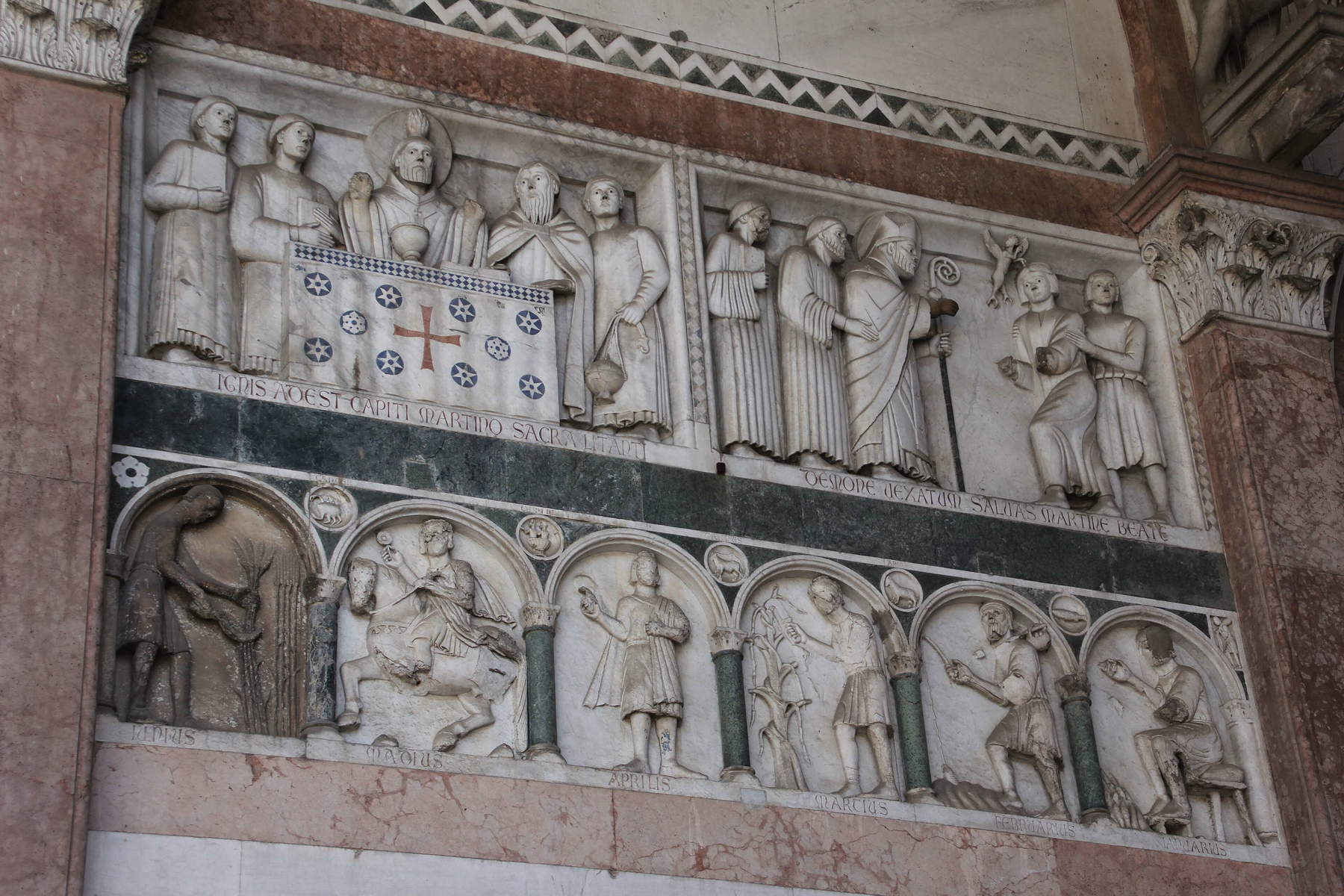
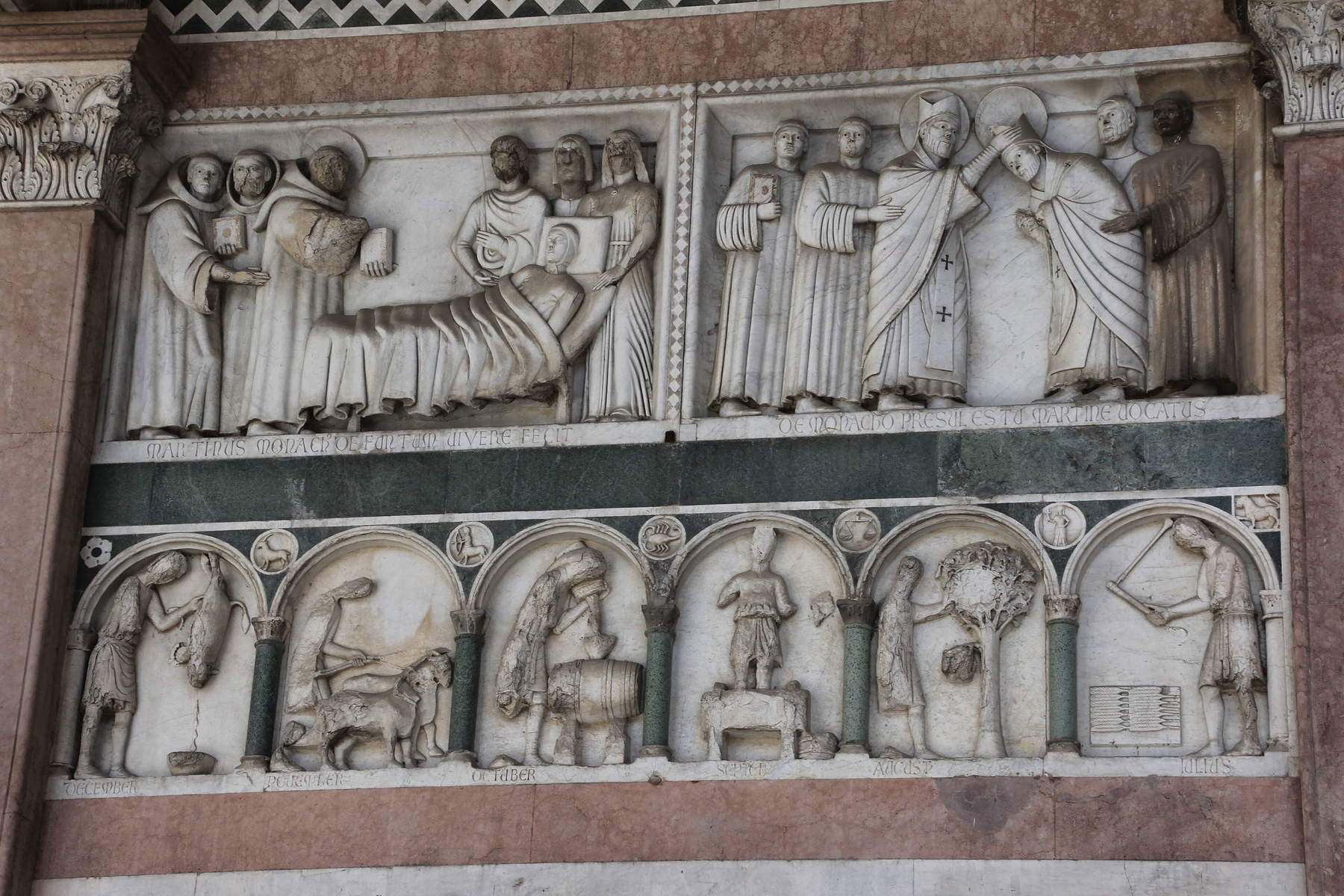
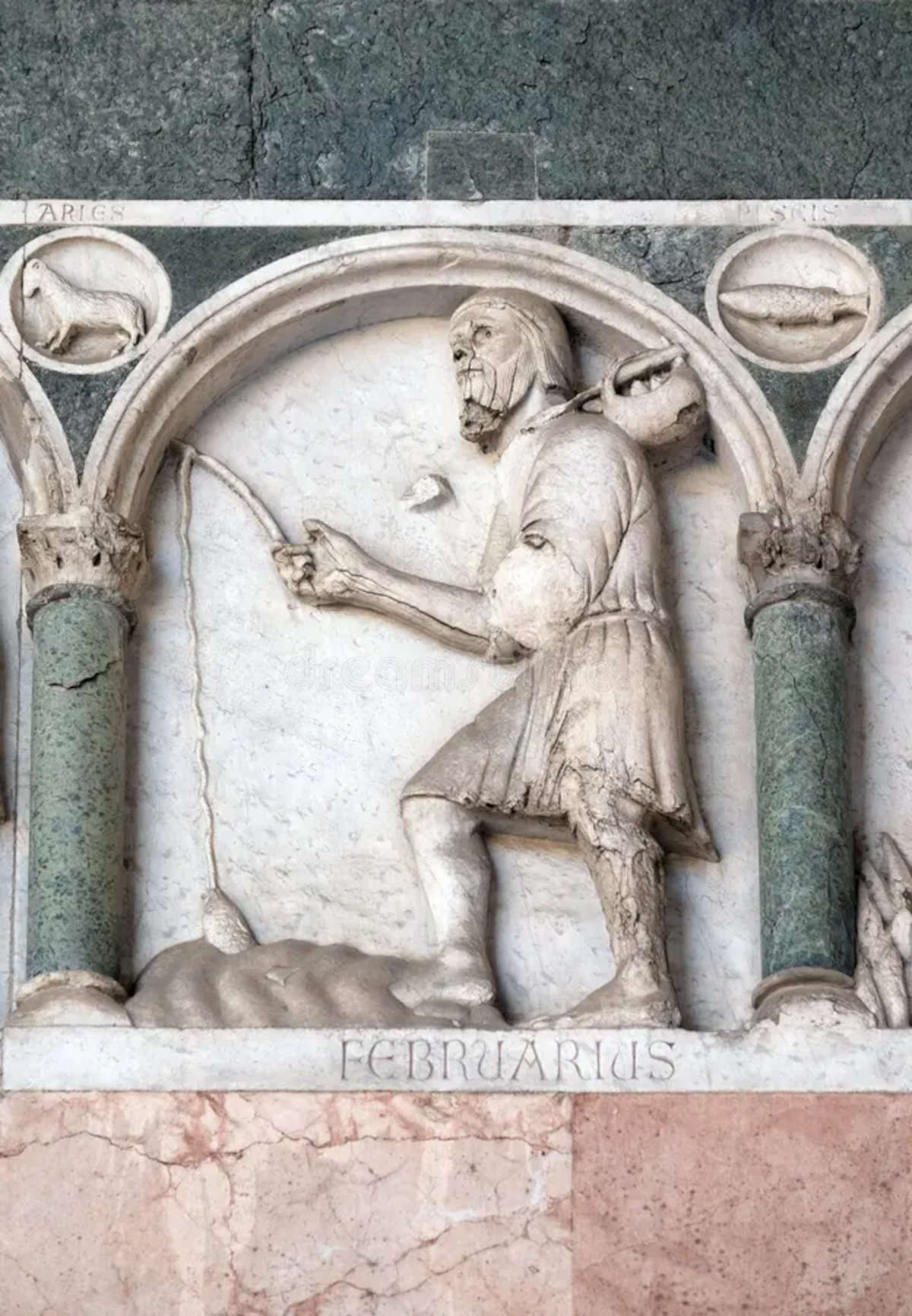
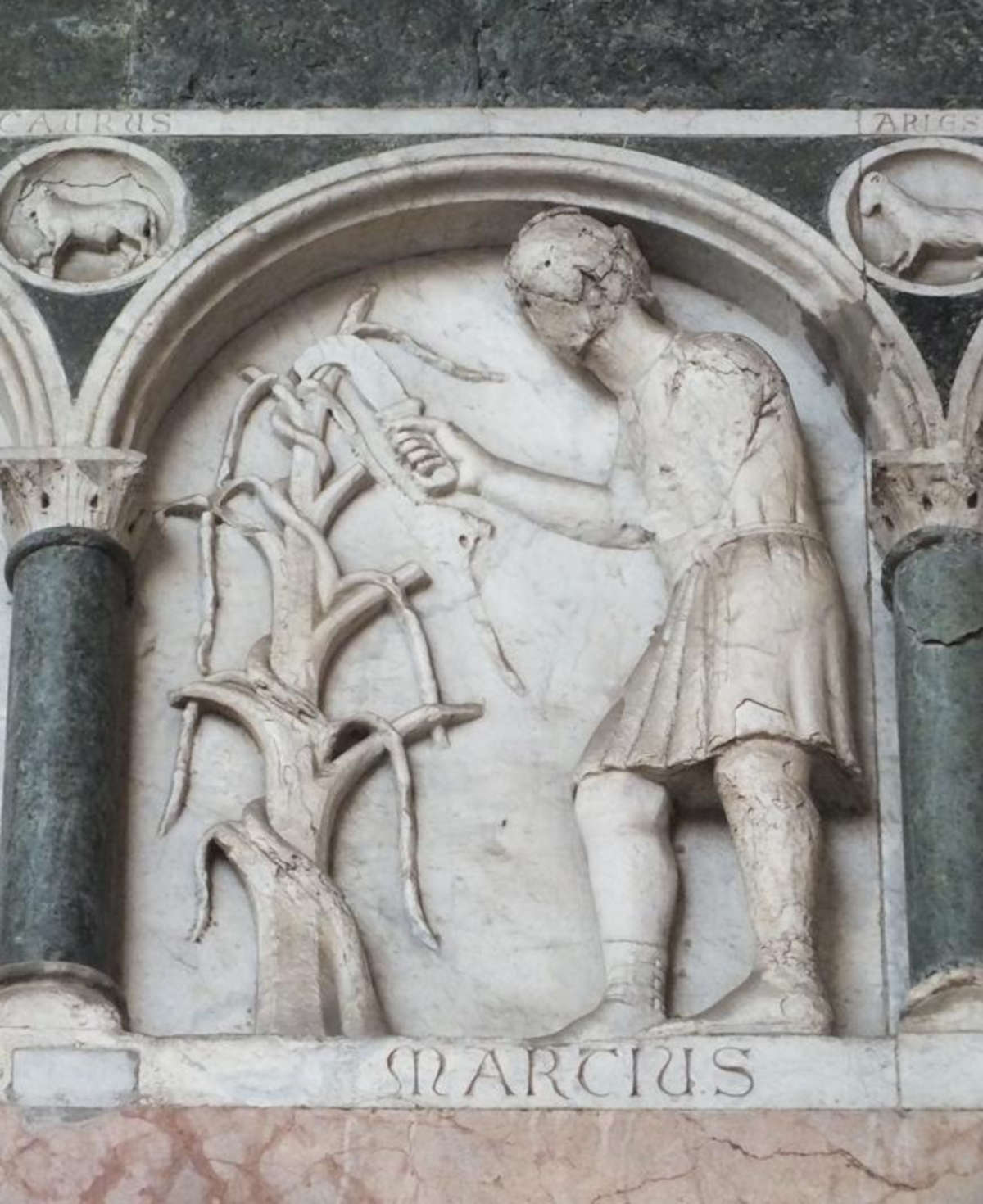
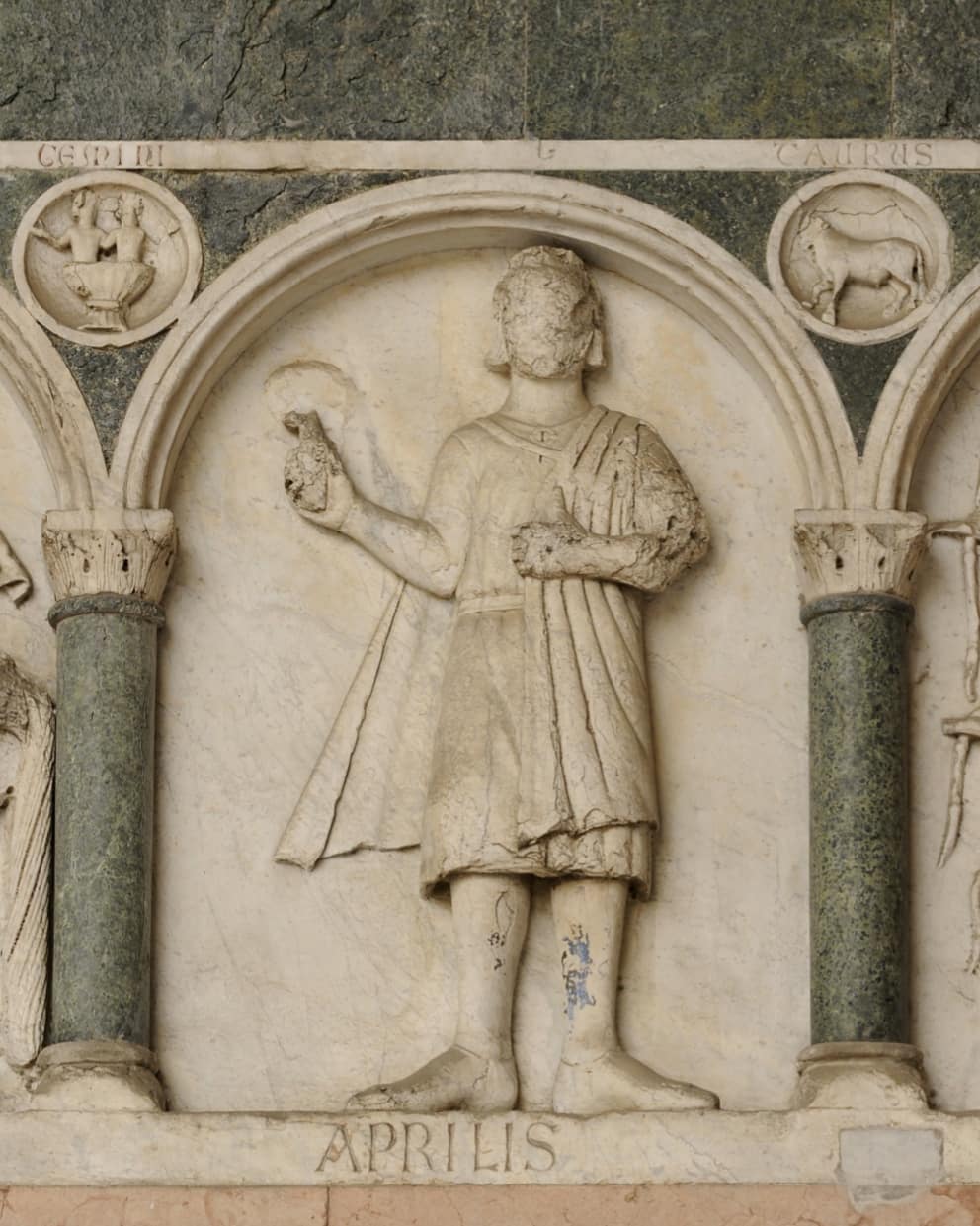
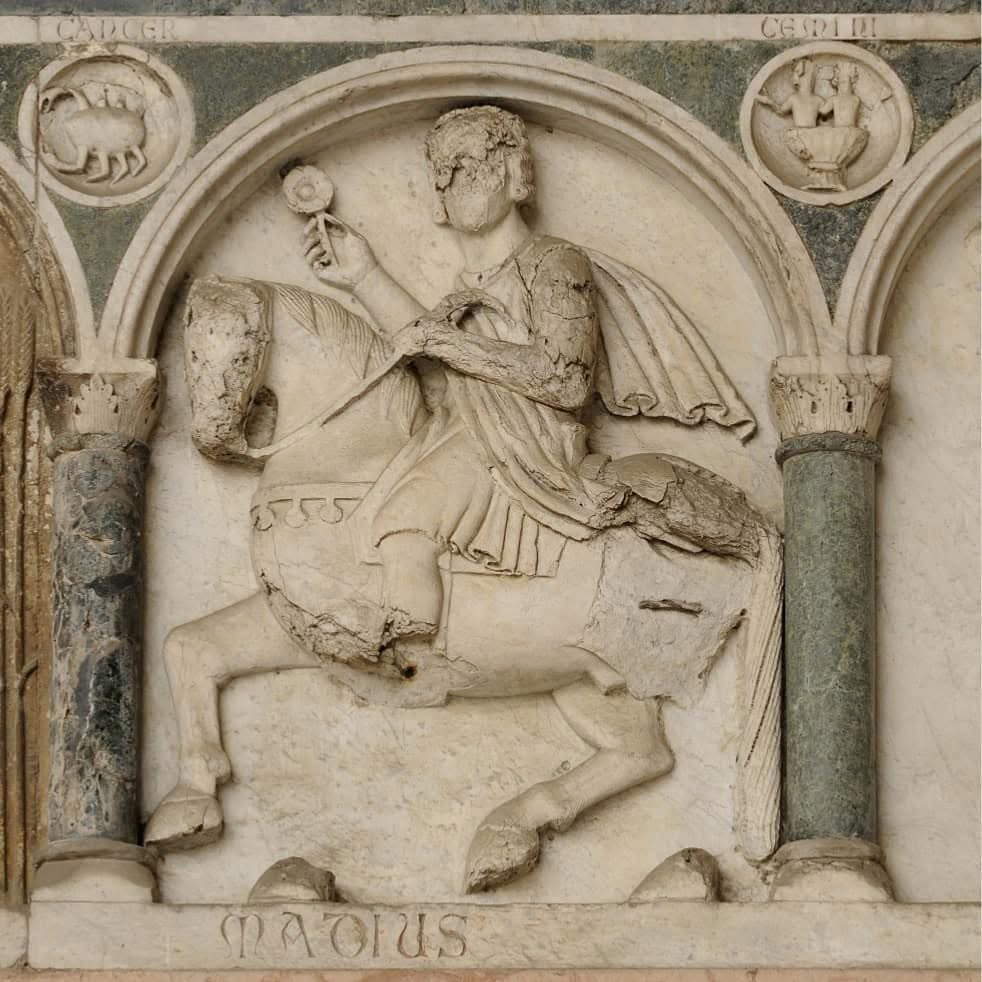
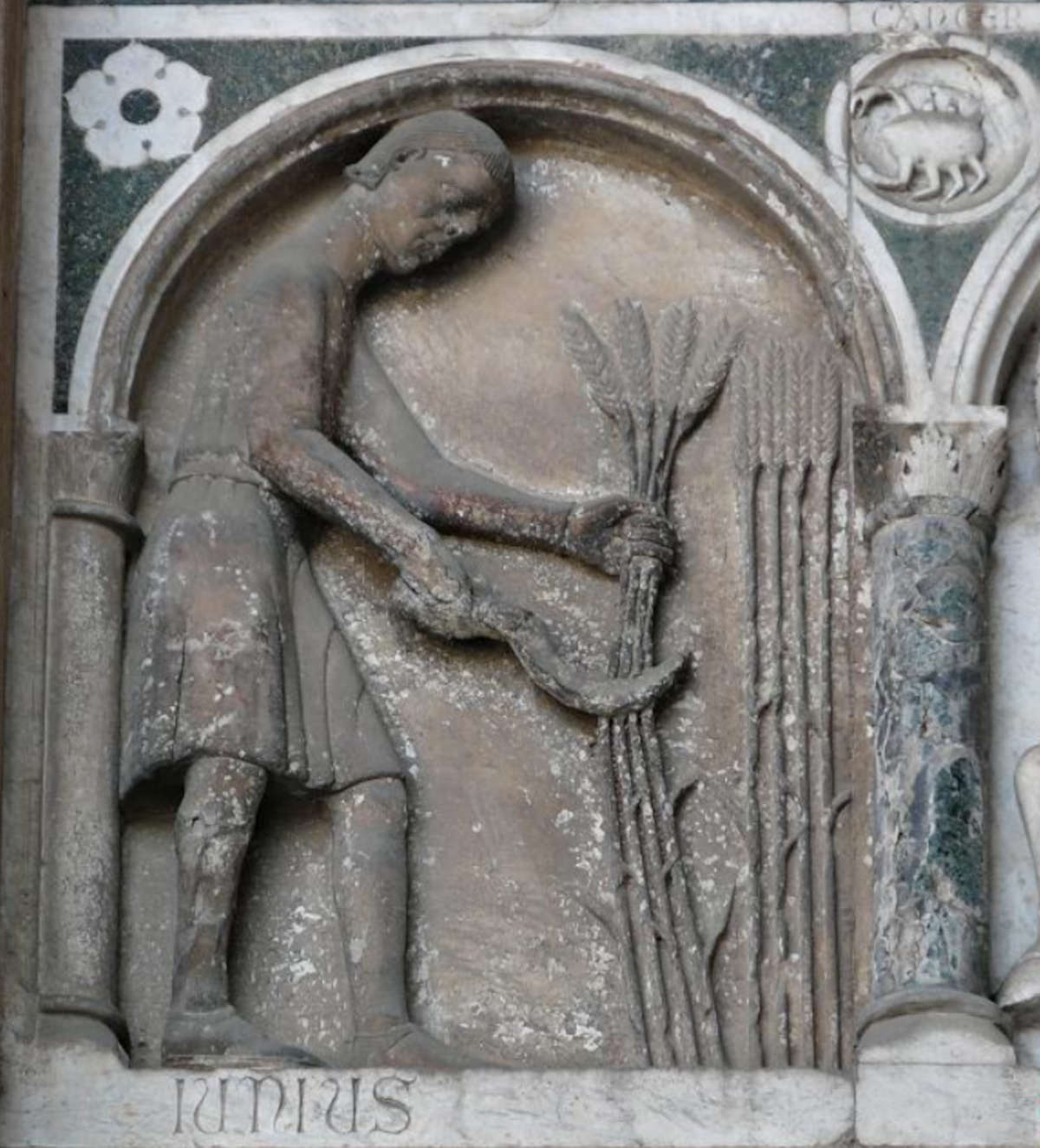
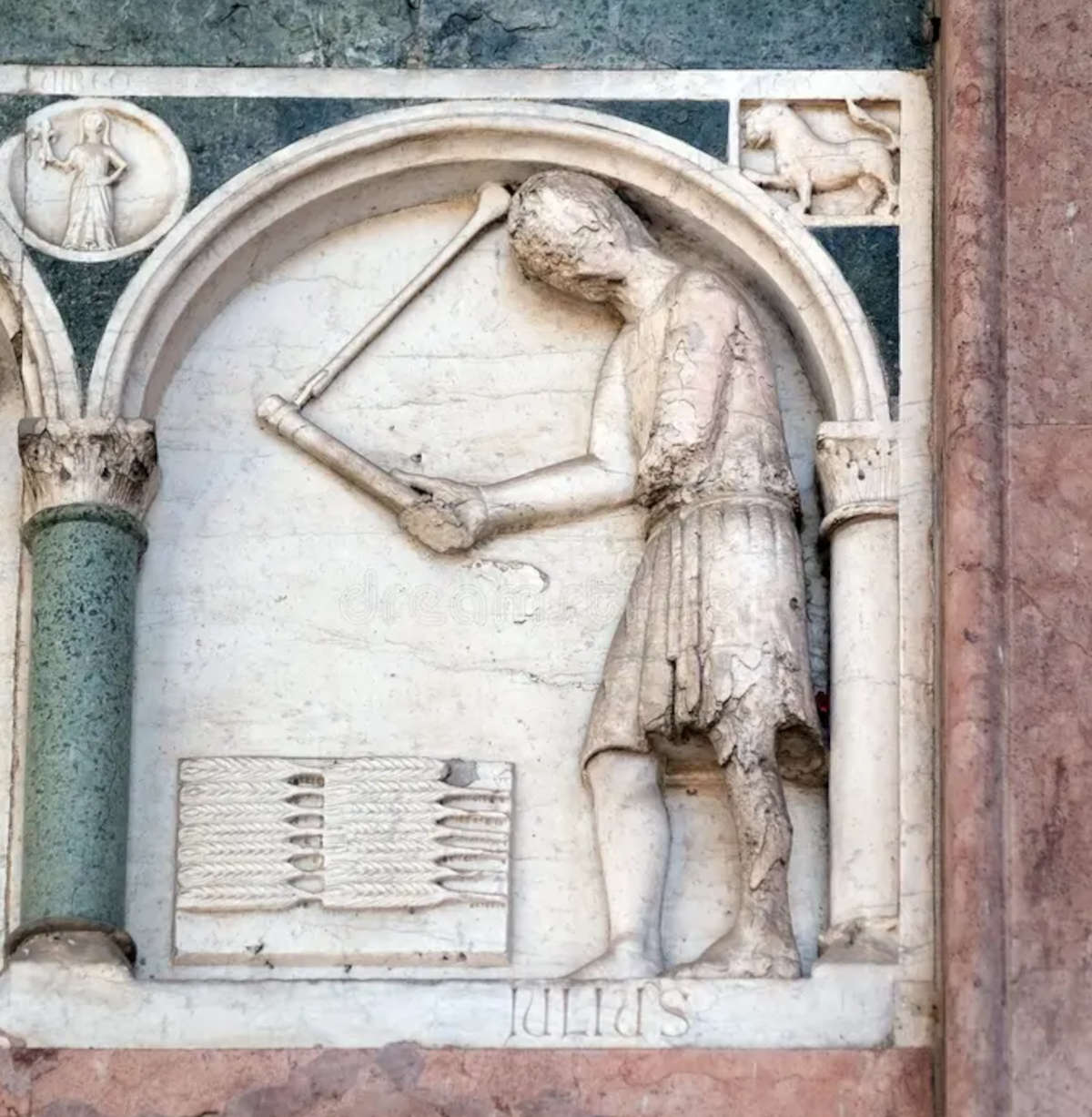
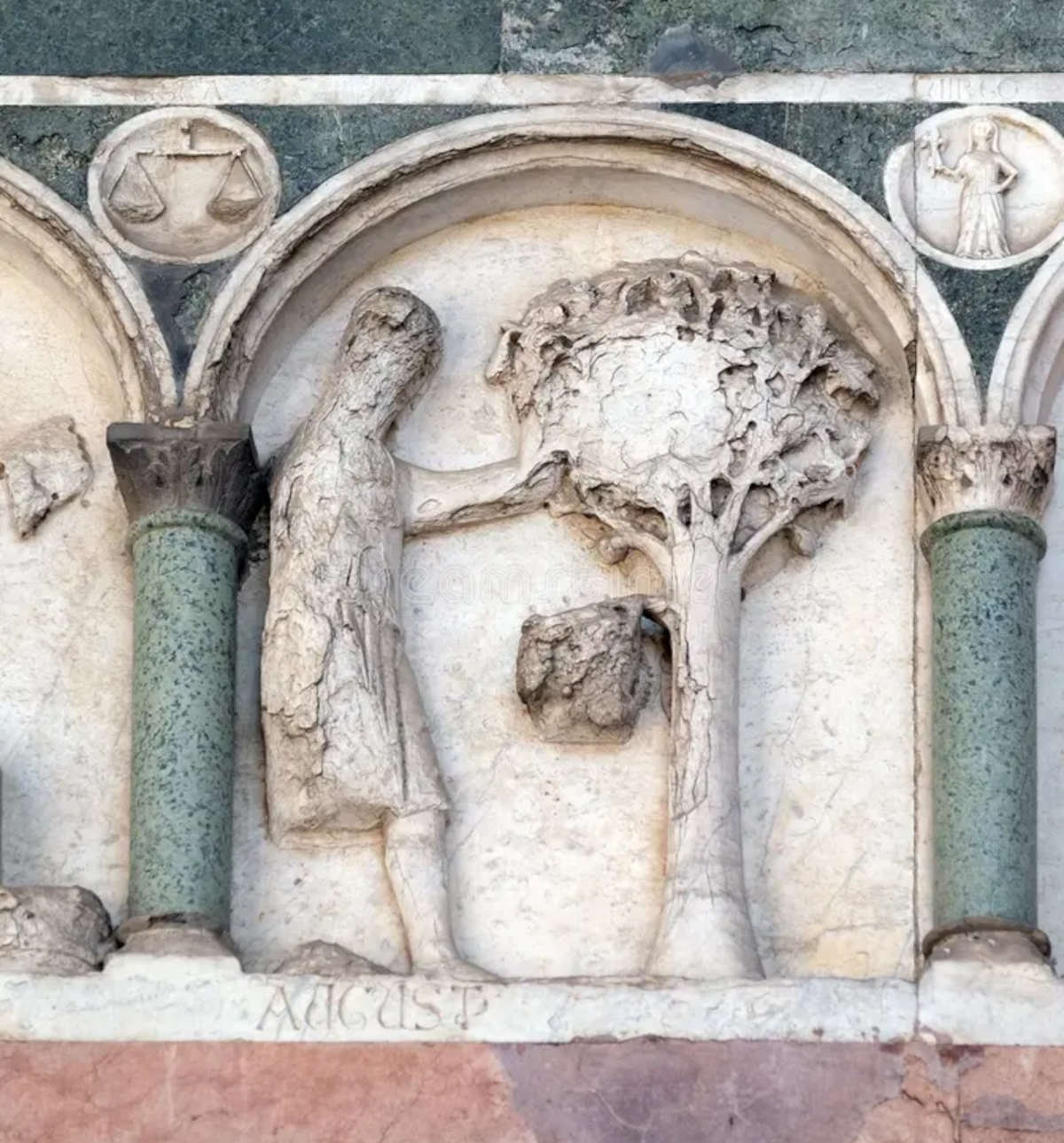
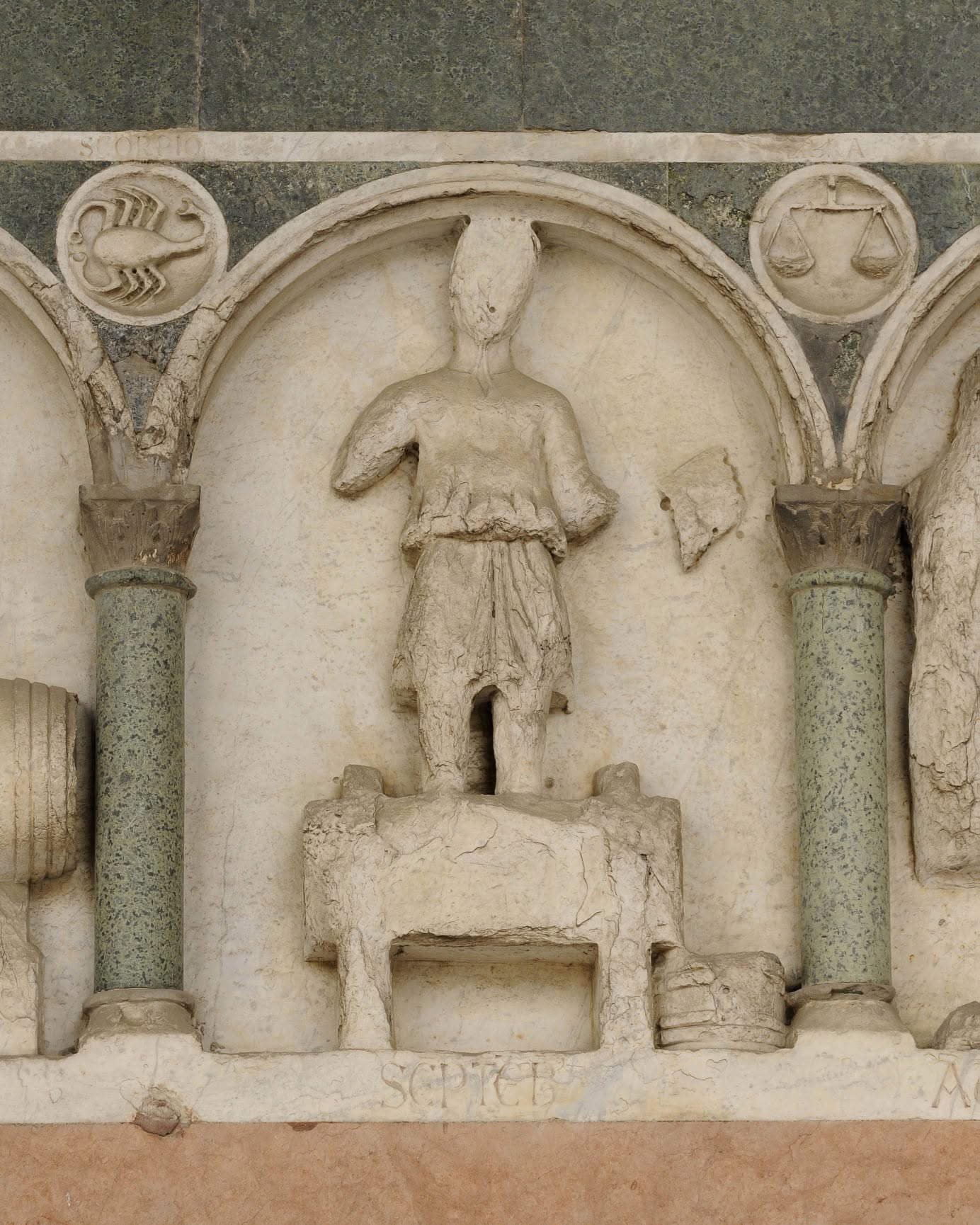
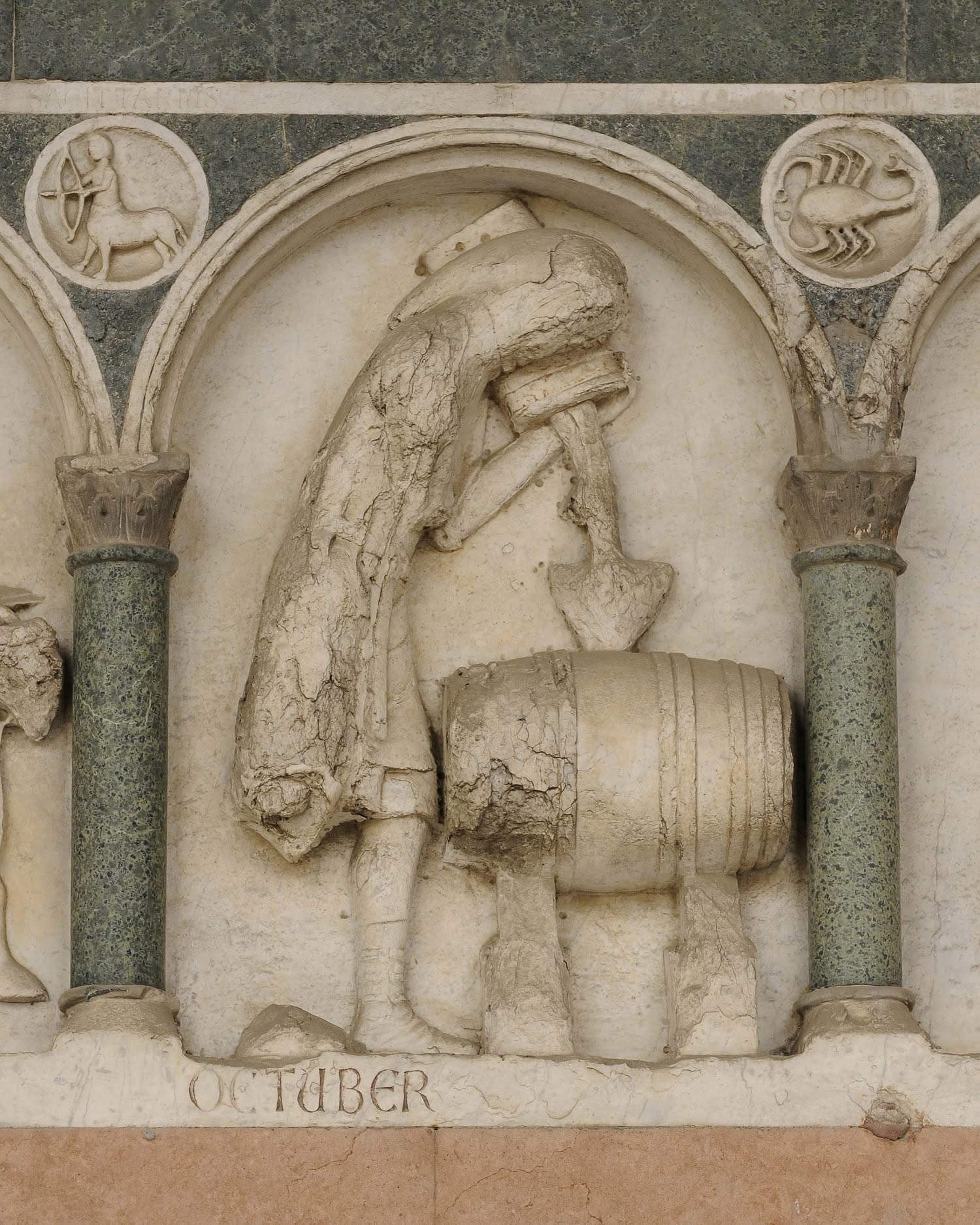
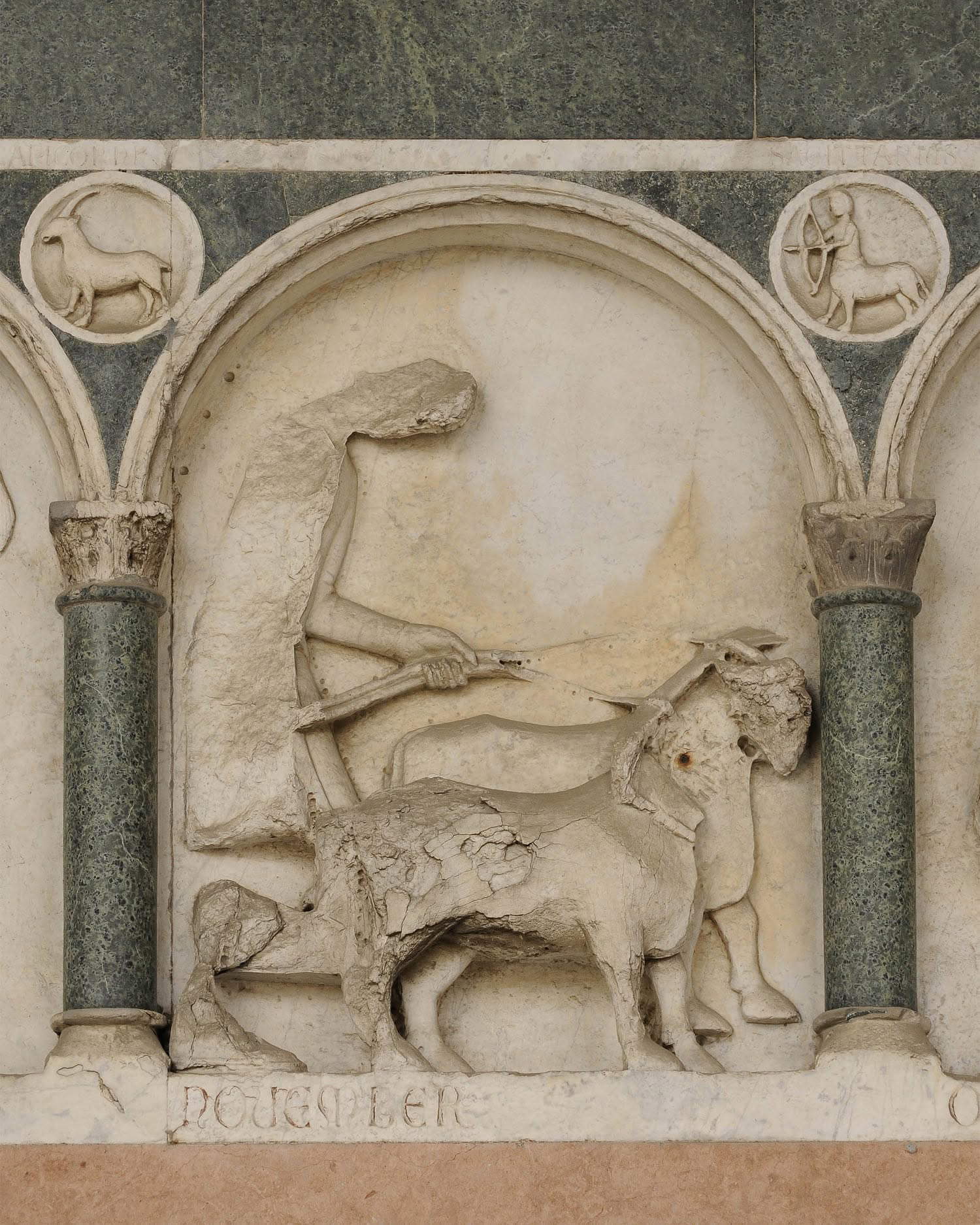
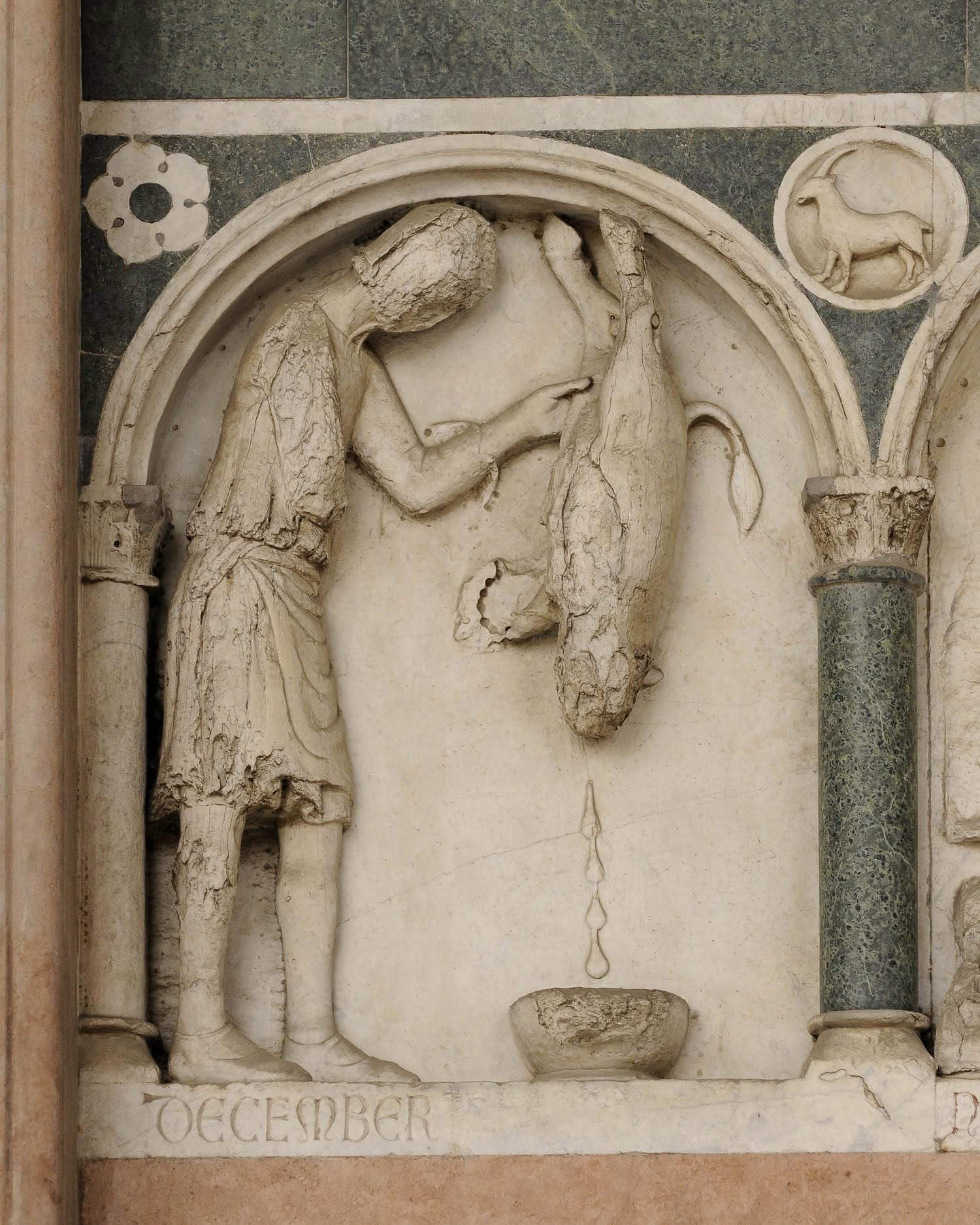
The reliefs decorate the plinth of the overlying Stories of St. Martin and form a continuous narrative sequence. Beginning from the right, one recognizes the month of January, depicted warming himself by the fire, alluding to the farmer who, during the cold season, can do nothing but stay inside his house and live off what he has gathered during the warm months. In February, the cold eases a little and people can finally go outside: so here is a man, with a fishing pole, intent on fishing (the relief reminds us that, in these parts, fishing has always been an important source of livelihood). In March, the farmer has already returned to the fields and is busy pruning the vines, while in April he is intent on sowing seeds (in fact, we see him with a bag in his hand as he is scattering seeds, although the relief with the passage of time has become a little damaged). May deviates a little from this narrative: the month is in fact represented by a knight with a flower in his hand: this is an allusion to the Virgin, since May is the month of Our Lady, but the flower also symbolizes the rose, which blooms in late spring. We then come to June, when the farmer begins to reap the fruits of the labor of the first months of the year: so here is a man busy during the harvest, we see him mowing wheat. July, on the other hand, is represented by a farmer caught while he is beating the ears of corn to get the grain from which he will then obtain flour. We then move on to August, the month in which fruit is harvested: the farmer is thus engaged in this activity. In September, on the other hand, the narrative of wine begins: it is the first month of the grape harvest and therefore comes a farmer depicted crushing grapes to obtain must. In October, the farmer is intent on decanting the wine into barrels. We return to the land with the month of November: we are now in sight of winter, no more fruit is harvested from the fields, and the farmer is depicted with the ox in the act of plowing the land to prepare the field for winter rest. Finally, December is represented by a man who is slaughtering a pig, a traditional activity in the month when the fields are snowed in: from that pig he will make Christmas lunch.
The figures of the months are set within a succession of elegant small arches supported by small columns. At the impost points of the arches are small medallions containing the corresponding zodiac symbols, while below each figure is engraved the name of the month represented. Above each arch, on the other hand, appears the name of the relevant zodiac constellation. In this way, the earthly and celestial calendars merge into a single symbolic narrative linking human labor to thecosmic order. For the month of January, for example, the sign of Aquarius is depicted, confirming the constant dialogue between the practical dimension of daily activities and the larger dimension of the medieval universe, in which the movement of the stars was perceived as an integral part of the scanning of time.
Among the most interesting depictions emerges the one dedicated to the month of March. After January and February, months associated with winter and the suspension of agricultural activities, the scene changes dramatically. With the arrival of spring, man returns to the care of the land and crops. March is in fact represented through the figure of a farmer engaged in pruning vines with a billhook. The relief also offers valuable evidence of medieval agricultural techniques. The vine is in fact depicted as it clings with its shoots to the trunk of a tree, according to a practice that has essentially disappeared today but was widespread in the past and known by the name of “married vine.” The image thus returns not only a symbolic representation of the month, but also a concrete documentation of the agronomic knowledge and cultivation methods adopted in the Middle Ages.
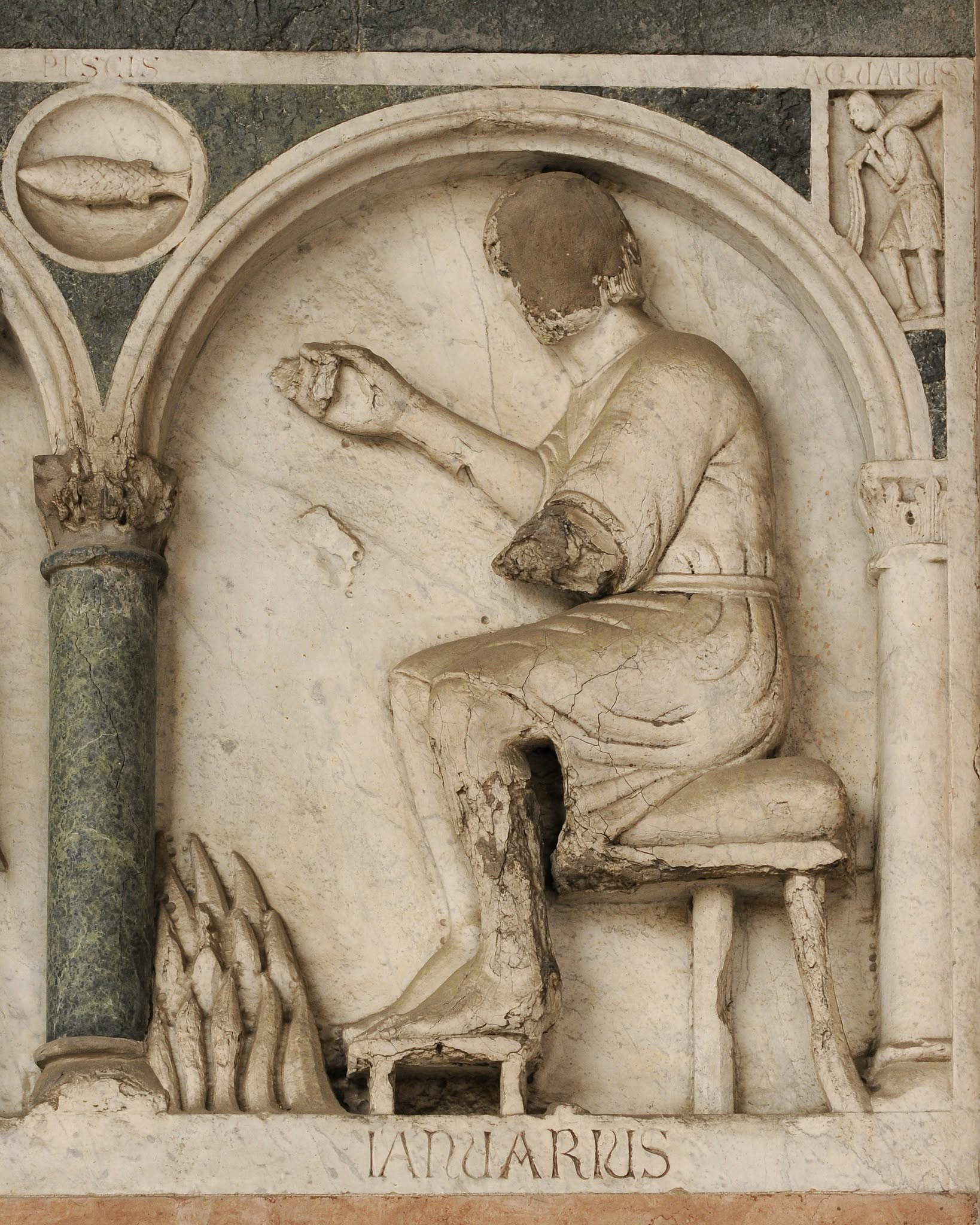
The iconographic choice made by the sculptors of Lucca appears particularly significant when compared with other medieval representations of the same month. In numerous figurative cycles, in fact, March is personified as a warrior, a symbol connected to the season favorable to military campaigns or to the classical tradition of the god Mars. An example of this interpretation can be observed, again in Lucca, in the baptismal font of the basilica of San Frediano. Here in the cathedral, however, the reference to agricultural work replaces the more cultured and allegorical one, favoring a reading immediately understandable to the population of the time and closely linked to the daily life of the community. One could then mention, among the most significant scenes, that of the month of November, which effectively represents the sowing period. A man drives the plow pulled by oxen through the fields, offering one of the most emblematic images of medieval agricultural work. But the entire cycle can be said to fully restore the centrality of rural activities and their fundamental role in the organization of collective life.
From the art-historical point of view, the cycle of the Months has provoked numerous attributive debates over time. Indeed, scholars have formulated different hypotheses about the author or authors of the work. Part of the late nineteenth-early twentieth-century criticism, represented by scholars from the German area such as August Schmarsow and later Walter Biehl, attributed both the cycle of the Months and the overlying Stories of St. Martin to the same artist who authored the sculptural group depicting St. Martin and the Pauper. On the other hand, the position of Adolfo Venturi was different, who, at the beginning of the twentieth century, assigned these reliefs to Guidetto, the master from Como to whom we owe important interventions in the cathedral facade. Later Pietro Toesca proposed a different interpretation, relating the cycle of the Months and the Stories of St. Martin to the scenes dedicated to the life of St. Regulus and attributing the complex to a single author identified as the “Master of the Stories of St. Martin and Regulus.”
However, the discussion did not end with this proposal. In 1928, Mario Salmi returned to distinguish the different hands present in the complex, recognizing in the Months the work of a sculptor considered simpler and influenced by the reliefs of the Pisa Baptistery. Despite the different interpretations, more recent studies have highlighted the close stylistic affinities between the cycle of the Months and the Stories of St. Martin. It is precisely for this reason that contemporary critics, particularly through the studies of Clara Baracchini and Antonino Caleca in 1973, have identified the hand of the so-called Master of St. Martin in both series. This would be a sculptor trained in the Lombard and Antelamic tradition, capable, however, of assimilating during his stay in Tuscany a more balanced and sober language. Some scholars have also proposed identifying him with that “Lombardus” mentioned in documents as “operarius et magister Sancti Martini.”
The importance of the Cycle of the Months fits within the broader artistic heritage guarded by Lucca’s cathedral. In fact, the Cathedral of St. Martin represents the main center of the city’s spirituality and one of the most significant stops along the Via Francigena, the great pilgrimage route that connected northern Europe to Rome in the Middle Ages. The building’s origins date back to the 6th century, when St. Frediano, a bishop from Ireland, promoted its foundation. By the 8th century, the church had already assumed the role of the city’s cathedral, replacing the very ancient basilica of Saints John and Reparata.
The Romanesque facade constitutes one of the most characteristic elements of the monument. Immediately striking is its asymmetry, due to the presence of the pre-existing bell tower, which made it necessary to reduce the size of one of the arcades of the portico. Here, starting in 1204, Guidetto da Como created the famous overlapping loggets supported by carved and historiated small columns. The ensemble is further enriched by the two-tone marble inlays that help define the unmistakable image of the facade.
The three portals are framed by a decorative apparatus of extraordinary richness. In addition to the cycle of the Months and the Stories of St. Martin, visitors can admire two masterpieces by Nicola Pisano: the Deposition and the architrave with scenes of the Annunciation, the Nativity and the Adoration of the Magi. Also on the pillar adjacent to the bell tower is the famous sculpture of the labyrinth, a symbol deeply linked to the theme of pilgrimage and therefore widespread in several churches located along the route of the Via Francigena.
In recent years, the atrium of the cathedral has undergone major restoration work that has enabled a deeper understanding of the monument and the preservation of its sculptural heritage. In this context, the cycle of the Months preserves its narrative capacity intact. Its figures, engaged in the activities that mark the agricultural year, continue to speak to the contemporary visitor and restore the sense of a civilization that measured time by observing the sky, working the land and entrusting art with the task of handing down its memory.

Warning: the translation into English of the original Italian article was created using automatic tools. We undertake to review all articles, but we do not guarantee the total absence of inaccuracies in the translation due to the program. You can find the original by clicking on the ITA button. If you find any mistake,please contact us.






















 IT
IT FR
FR DE
DE ES
ES CN
CN


