




There are artists who construct images, and others who push them to the point where they cease to be containable, recognizable, or stable. Giuditta Branconi’s work occupies this zone of tension, where painting does not organize the visible but rather challenges it, accumulating and layering it until it nearly collapses in on itself. Entering her universe means confronting a surface that refuses to be dominated, a visual field in which every element seems to act simultaneously, without hierarchies, without a definitive center.
Born in Sant’Omero (Teramo) in 1998, Giuditta Branconi belongs to that generation of artists who have reclaimed the medium of painting with avoracious, anti-academic freedom . Trained at both the Brera Academy of Fine Arts in Milan and the Academy of Fine Arts in Urbino, her practice has been nourished by a hybrid imagination, capable of blending the solidity of the Italian painting tradition with pop influences, the aesthetics of cartoons, and the visual overabundance of the digital age.
The exhibition *Cannon Fodder*, presented at the Maramotti Collection, represents a decisive moment in this exploration. The title immediately introduces a dimension of exposure and vulnerability: “cannon fodder” is not merely a symbolic reference but a condition that permeates the entire body of work. The images that populate the works do not present themselves as complete figures, but appear fragmented, incorporated into a visual fabric that absorbs and transforms them. Painting thus becomes a site of pressure, a space in which signs and references thicken until they produce an almost physical saturation.
This saturation is neither random nor decorative. It is the result of a deliberate process in which Branconi challengesthe very idea of composition. Her works do not seek balance; they do not organize space according to an orderly logic. On the contrary, they construct a field in which everything coexists: images drawn from different eras and contexts, symbols, fragments, words, and graphic signs. Nineteenth-century engravings can coexist with elements of contemporary visual culture, ornamental motifs with anatomical references, and icons with seemingly marginal details. Nothing is subordinated; nothing is fixed.
This absence of hierarchy produces a form of vision that cannot be immediate. The gaze finds no point of rest; it is forced to move, to return, to lose itself. Every attempt at a linear reading is interrupted, fragmented, and recomposed elsewhere. The image does not present itself as a unified whole, but as an open, traversable system.
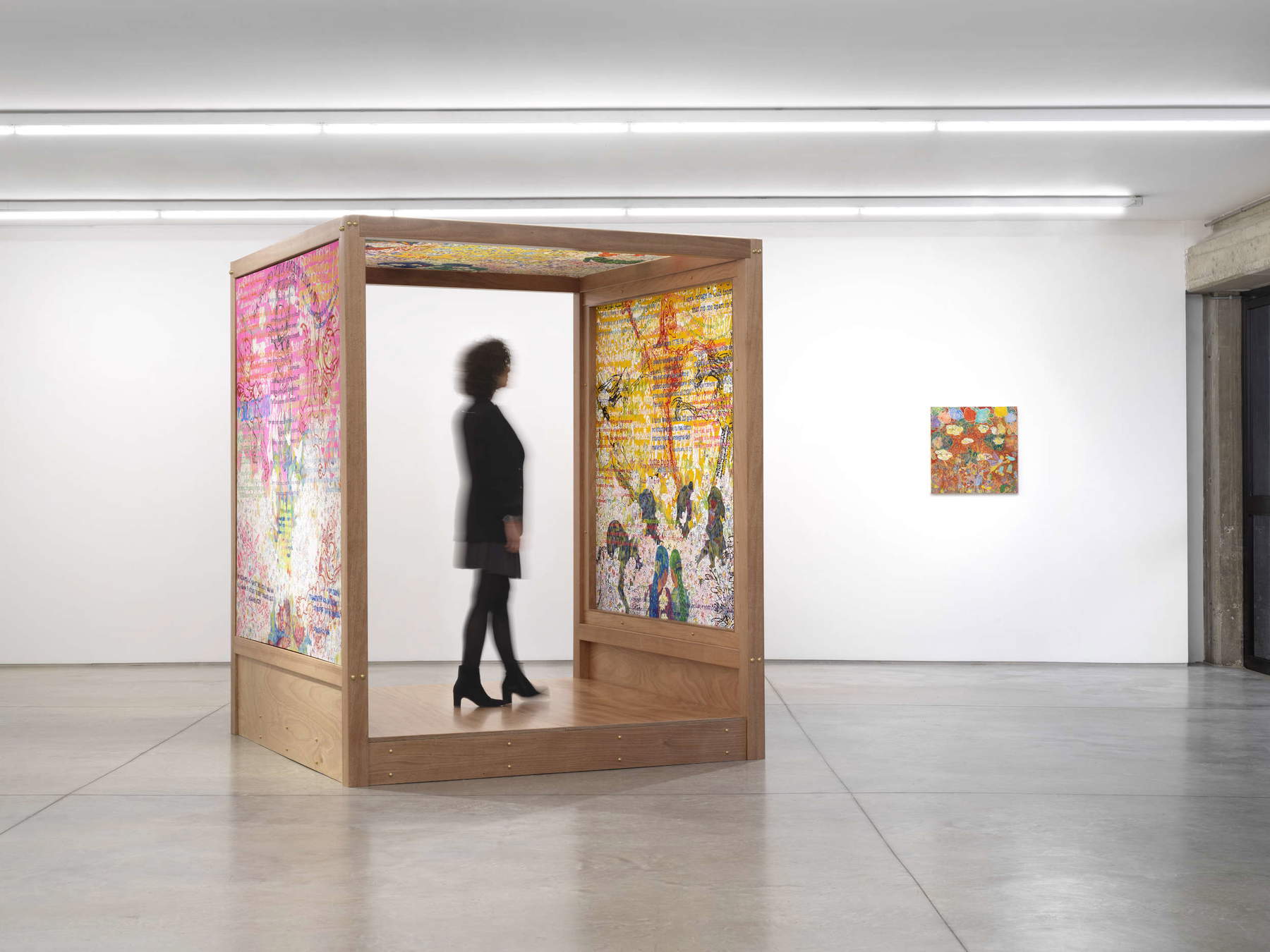
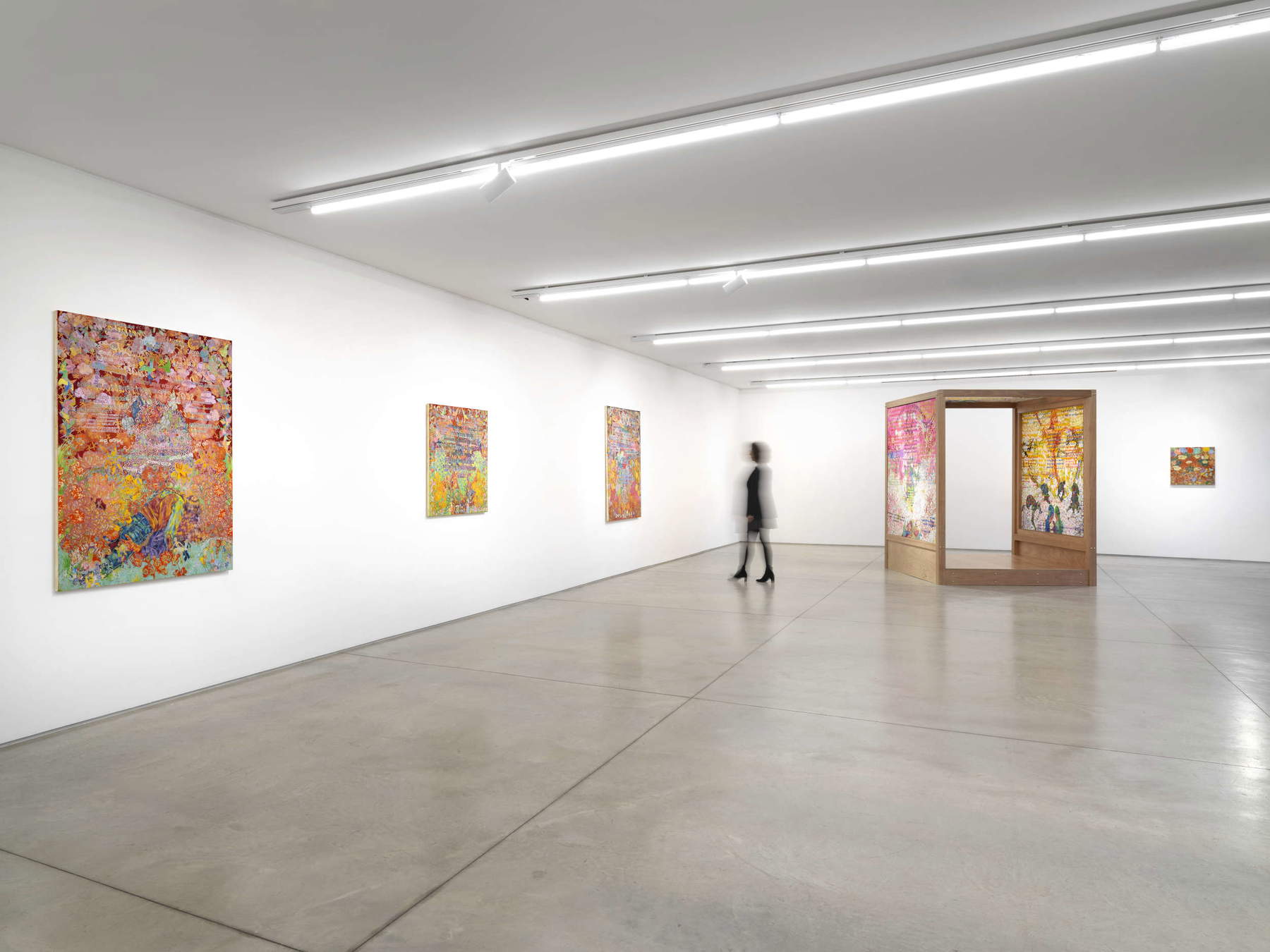
Added to this iconographic complexity is a profound reflection on the very nature of painting. Branconi’s canvases are not simply flat surfaces; they are often thin, painted on both sides, and designed to be viewed from multiple perspectives. The front and back lose their traditional distinction, becoming parts of a single visual organism. This implies a radical transformation of the experience: one no longer views the work from a fixed position, but moves through it, circles around it, and explores it in space.
In the central installation of *Cannon Fodder*, conceived as a three-dimensional structure, this logic is particularly evident. The audience can physically enter the work, move around inside it, and lose the distance that normally separates the viewer from the image; here, painting ceases to be an object to be contemplated and becomes an environment to be experienced—a space that envelops the body and alters one’s perception.
Within this space, language also plays a fundamental role. The texts that appear in the works do not function as captions or commentary; rather, they emerge as visual elements in their own right, an integral part of the composition. They intertwine with the images, interrupt them, and pass through them. Different languages, different typefaces, and fragments of sentences coexist without forming a linear narrative. Reading becomes fragmentary and discontinuous, much like the experience of viewing the images.
This overlapping of languages produces a complex form of visual writing, in which seeing and reading coincide. The work cannot be deciphered in a single, unambiguous way; every attempt at interpretation remains partial, open, and provisional, and meaning emerges from an interweaving of elements that do not settle into a fixed form.
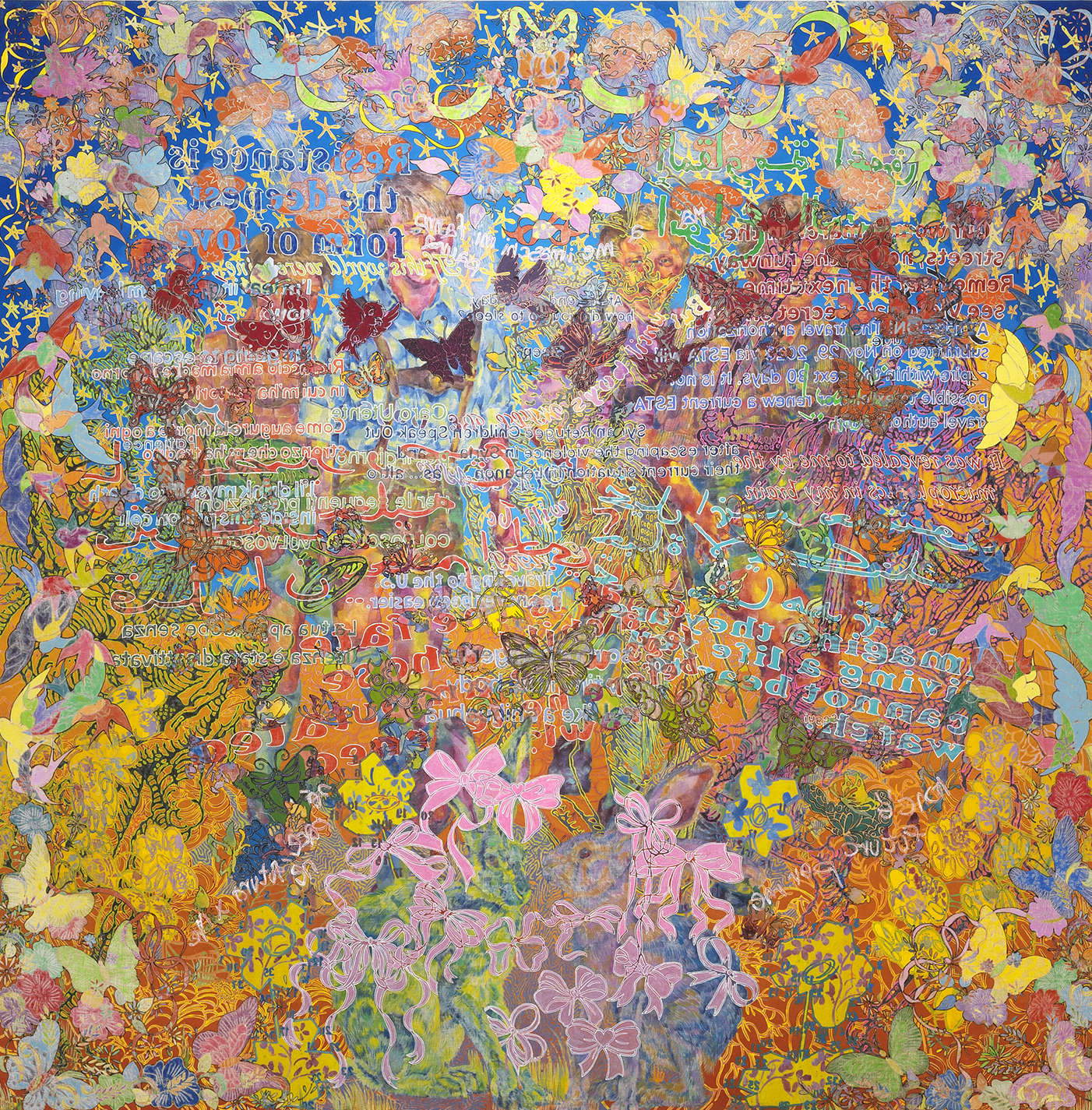
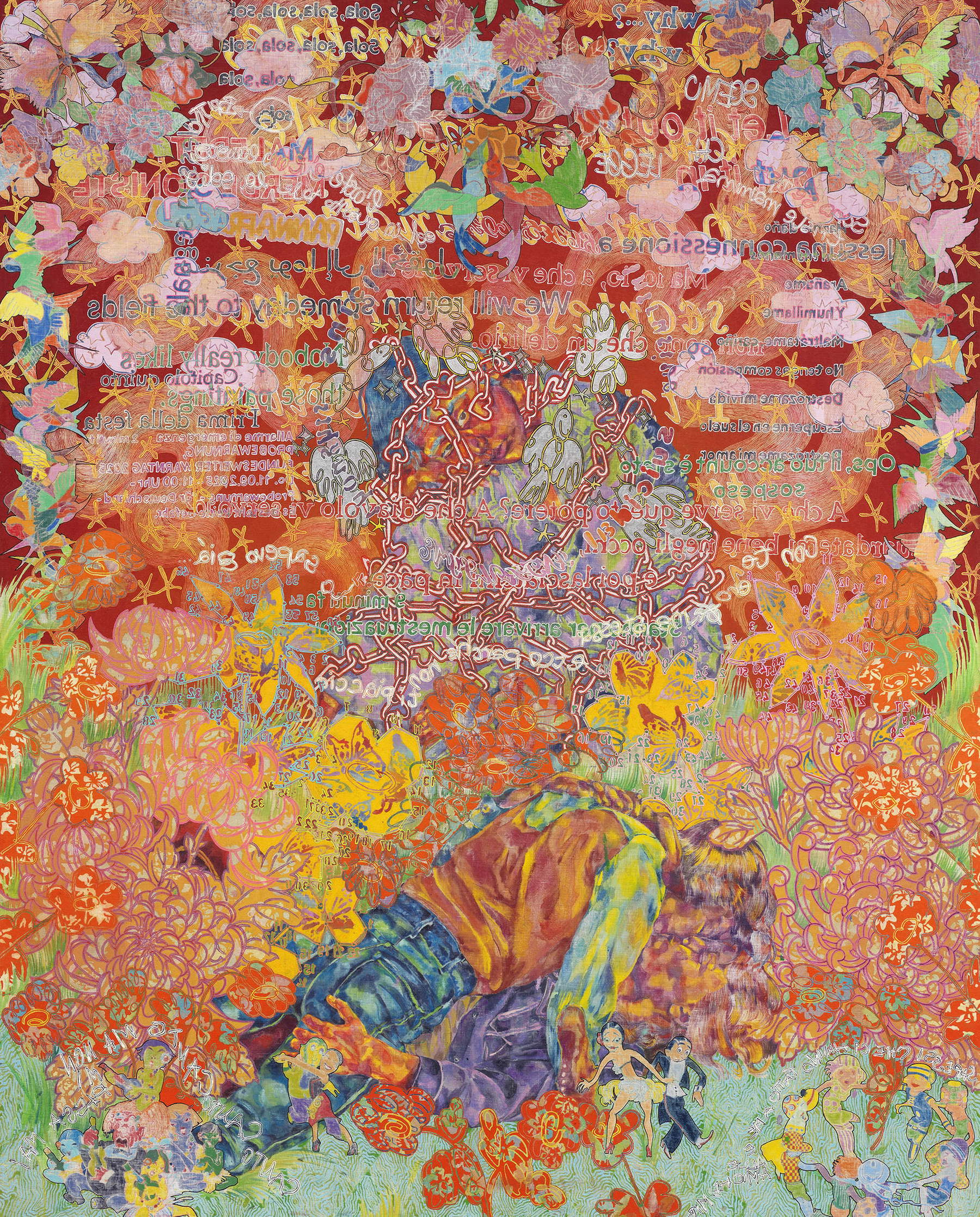
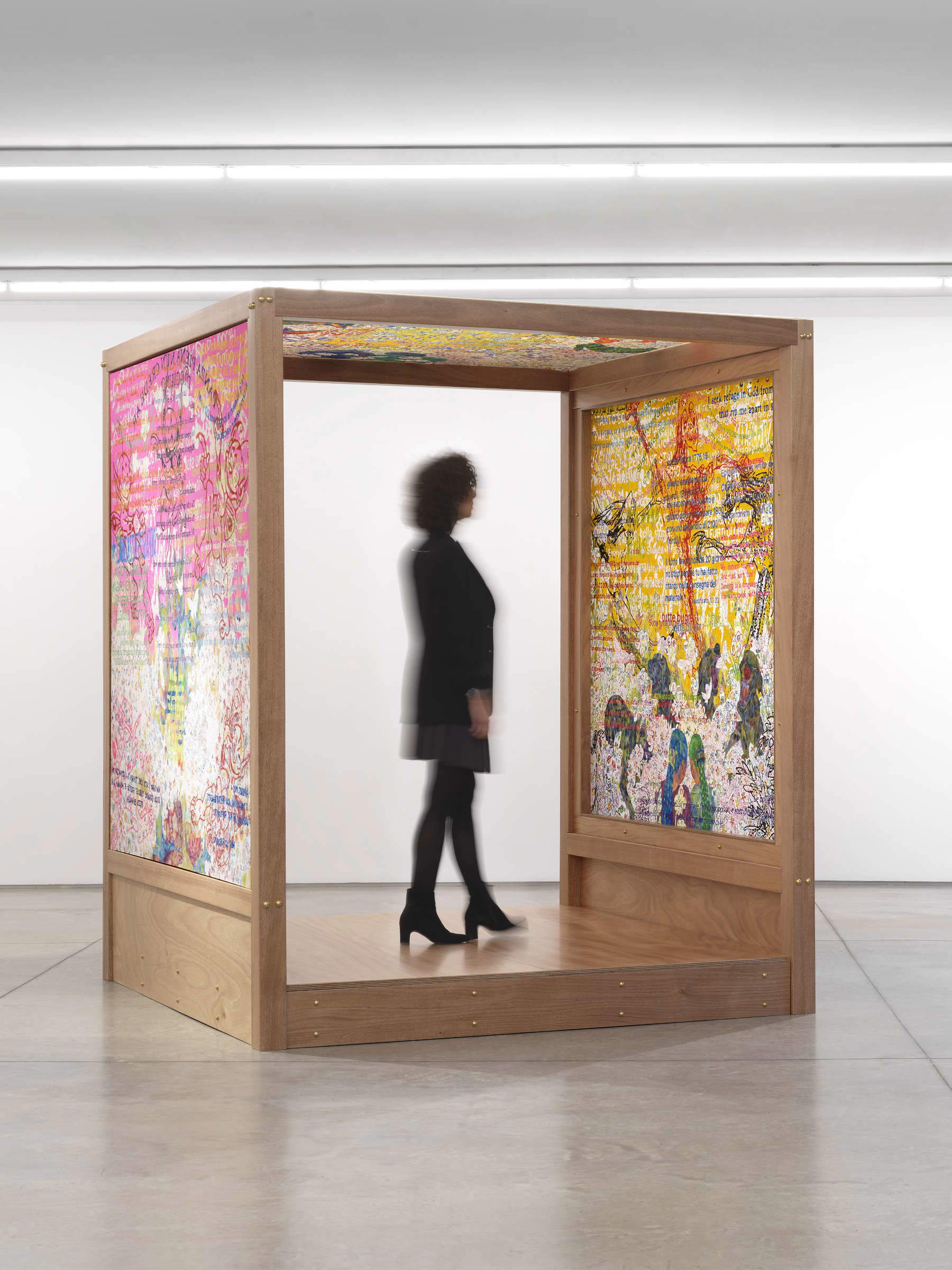
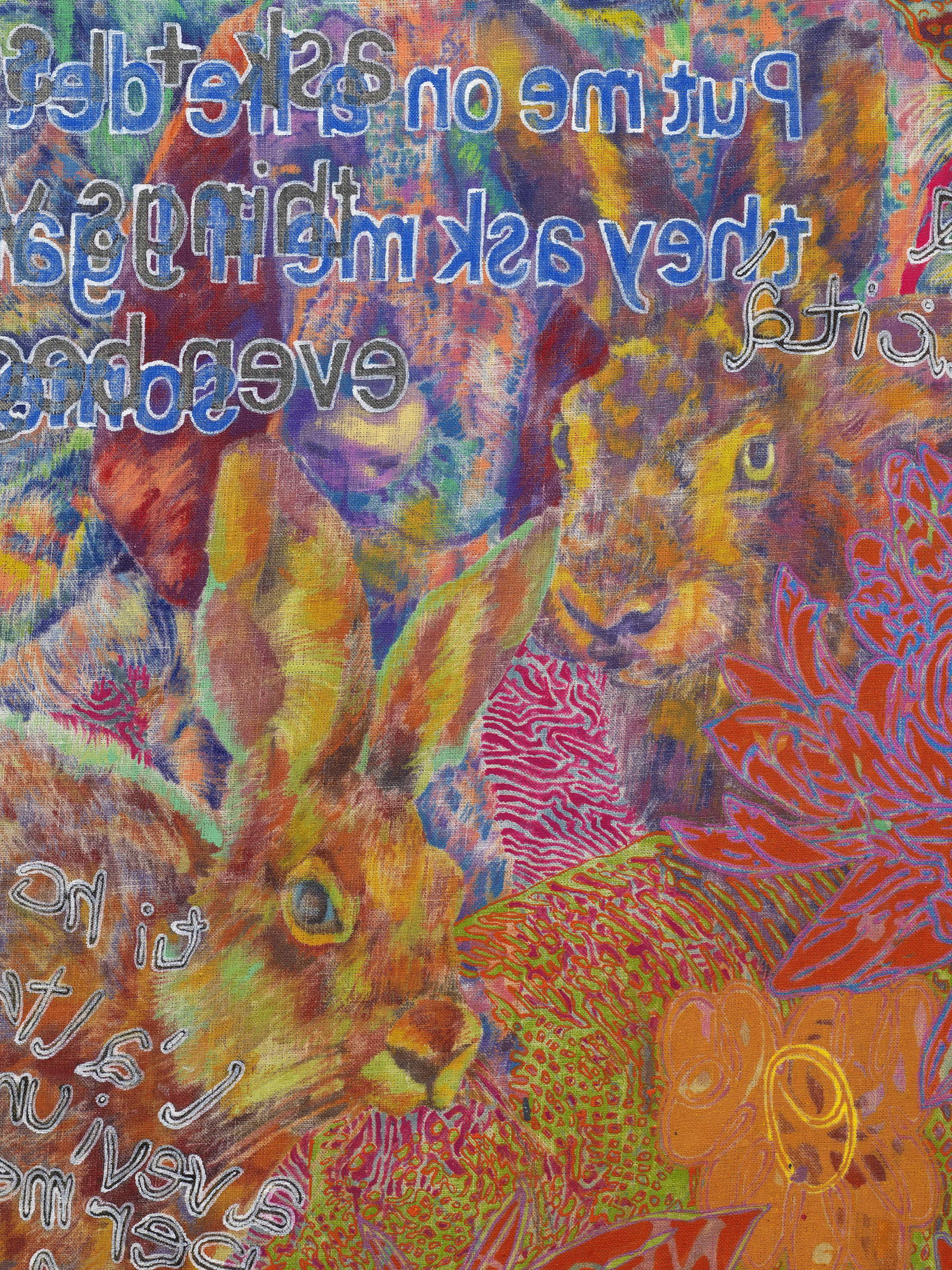
There is a tension towardexcess in all of this that permeates every level of the work. The surfaces are dense, saturated, devoid of empty spaces. Every space is occupied; every portion of the canvas seems crisscrossed by marks. This energy has been described as “explosive,” and it is not hard to see why: the works do not simply exist but seem to expand beyond their own boundaries, as if the painting could not be contained.
In a visual context dominated by simplification, immediate clarity, and rapid consumption, Branconi constructs images that resist, that cannot be reduced, and do not lend themselves to quick consumption. They require time, attention, and a willingness to linger within their complexity. Looking at these works means accepting a state of instability. There is no center, no hierarchy, no definitive form. The gaze must relinquish control; it must adapt to a different logic, one closer to flow than to structure. The image cannot be fully grasped; instead, it continues to elude us, to reopen itself, and to generate new connections.
In this sense, Giuditta Branconi’s work appears profoundly contemporary. Not because it represents the present, but because it brings to light its deepest dynamics: accumulation, superimposition, the loss of linearity, and the difficulty of establishing a stable order. Painting becomes the space where these tensions emerge most clearly, without being simplified.
The images clash, intertwine, and contradict one another, and from this conflict there arises not a synthesis, but a state of continuous openness. Each element remains in relation to the others, without ever becoming definitively fixed. And perhaps it is precisely here that Branconi’s work finds its most precise form: in this ability to keep the tension open, to not resolve, to not close. Painting never becomes a stable image, but remains a visible process, an accumulation in progress, an explosion that never runs out.

The author of this article: Federica Schneck
Federica Schneck, classe 1996, è una giornalista specializzata in arte contemporanea. Laureata in Storia dell'arte contemporanea presso l'Università di Pisa, il suo lavoro nasce da una profonda fascinazione per il modo in cui le pratiche artistiche operano all’interno, e in contrapposizione, alle strutture sociali e politiche del nostro tempo. Si occupa delle trasformazioni del sistema dell'arte contemporanea, del dialogo tra ricerche emergenti e patrimonio culturale, del mercato, delle istituzioni e delle fiere internazionali. Alla scrittura giornalistica affianca quella critica, con testi per artisti, gallerie e collezioni private.Warning: the translation into English of the original Italian article was created using automatic tools. We undertake to review all articles, but we do not guarantee the total absence of inaccuracies in the translation due to the program. You can find the original by clicking on the ITA button. If you find any mistake,please contact us.
















 IT
IT FR
FR DE
DE ES
ES CN
CN


