





The concept of “maritime republics” is of relatively recent invention , a formulation owed to a Swiss historian named Jean-Charles-Léonard Simonde de Sismondi and in particular to his Histoire des républiques italiennes du moyen âge, which delivered to posterity an expression as fortunate as it was, as it would later turn out, problematic. It was not the first nor would it be the last time that historiography found itself forging a new vocabulary to describe an ancient phenomenon: it had already happened with “absolute monarchies,” with “feudalism,” with “Roman-Barbarian kingdoms,” for example. These were all concepts coined from scratch, never used in the eras they were supposed to describe, and yet necessary to focus on historical realities that only a later, distanced gaze could finally illuminate in their entirety. The case of the maritime republics is no exception, but has characteristics of its own, a tumultuous and in many ways surprising trajectory that is worth retracing from the beginning.
Sismondi was one of those nineteenth-century European intellectuals in love with Italy with that passionate and somewhat mythologizing passion that belongs to those who observe from the outside. In his work, published between 1807 and 1818, he used the term republic to designate in a broad sense the free Italian commune, that extraordinary experience of urban self-government that had characterized the peninsula in the late Middle Ages. Within this communal universe, the Swiss historian identified some cities that had distinguished themselves by a particular vocation: that of seafaring. Cities that had built their greatness on water, on overseas trade, on naval expansion. These were, in Sismondi’s thinking, the maritime republics. The concept, however, was not yet fully defined, not fully in focus. It lacked the sharpness of contours that only time and later elaborations would be able to impart. But the spark was lit, and the fire would burn for a long time.
There was, however, in Sismondi’s judgment an important distinction, almost an implicit hierarchy of civic values, that would weigh on the concept’s later fortunes. In the pages of the Swiss historian, the maritime republics appeared as entities fundamentally engaged in fighting each other over issues of commercial expansion, hegemony in markets, and control of routes. The free communes, on the other hand, had fought together against the Empire, courageously defending their autonomy and freedom. It was a distinction that placed the maritime cities in an ambiguous position: unquestioned protagonists of medieval Italian history, to be sure, but animated by a mercantile selfishness that made them less heroic, less communitarian, less suited to embody the values of a nation in the making. “The Risorgimento, in fact,” explains historian Ermanno Orlando in his book Le repubbliche marinare, “looked with detachment and a certain suspicion at Italy’s maritime cities: there was no room in its rhetoric for realities that were too busy building spaces for action and hegemony outside their patriotic borders and therefore unable to contribute to the common narrative of an Italy struggling for independence and for the realization of a state and cultural unity.” The maritime cities seemed too caught up in their own affairs, too dedicated to trade and commercial rivalries, to be able to serve as a mirror to a nation that was laboriously building its own unified identity. The Risorgimento narrative needed collective heroes, communities that had fought for independence and unity, not enterprising and warlike merchants who had made the Mediterranean their own private backyard. And so, for a few decades, the Sismondian concept remained in a gray area, neither entirely forgotten nor fully valued.
It was with the birth of the unified state that things began to change, albeit slowly and still uncertainly. Turning the tiller was a historian of Italy’s nascent navy, Camillo Manfroni, who in the late nineteenth century turned his attention not so much to the republican dimension, which was, moreover, incompatible with a young monarchy such as the Italian one, thus not to the political dimension, but, if anything, to the maritime dimension. Manfroni in particular highlighted the essentially commercial and military characters of these entities, the power of their navies, and their ability to project strength and influence in the Mediterranean basin. It was a not inconsiderable change of perspective: the maritime republics were beginning to lose their flavor of constitutional and political experience to acquire the more robust contours of naval powers, of forerunners of that thalassocracy that the new Italy was to claim as its natural inheritance.
But the real quantum leap, the full maturation of the canon, occurred in another political season, that of firstliberal Italy and thenfascist Italy, when it began, Orlando explains, “to elaborate a conscious and then increasingly aggressive policy of Mediterranean power and colonial conquest that the processes of elaboration of the canon came to full maturation. The notion of maritime republics was now fully cleared through customs and could be legitimately declined both to emphasize their historical function in an imperialist key and to celebrate their splendor and colonizing mission within the Mediterranean. On the contrary, the maritime cities had become the natural link between imperial Rome, whose inheritance it was intended to pick up, fully espousing its thalassocratic dimension, and the destiny of colonial power that fascism was sewing onto itself. No wonder, then, that the regime drew heavily on the memory of the maritime republics, making it a powerful tool of propaganda and ideological elaboration.”
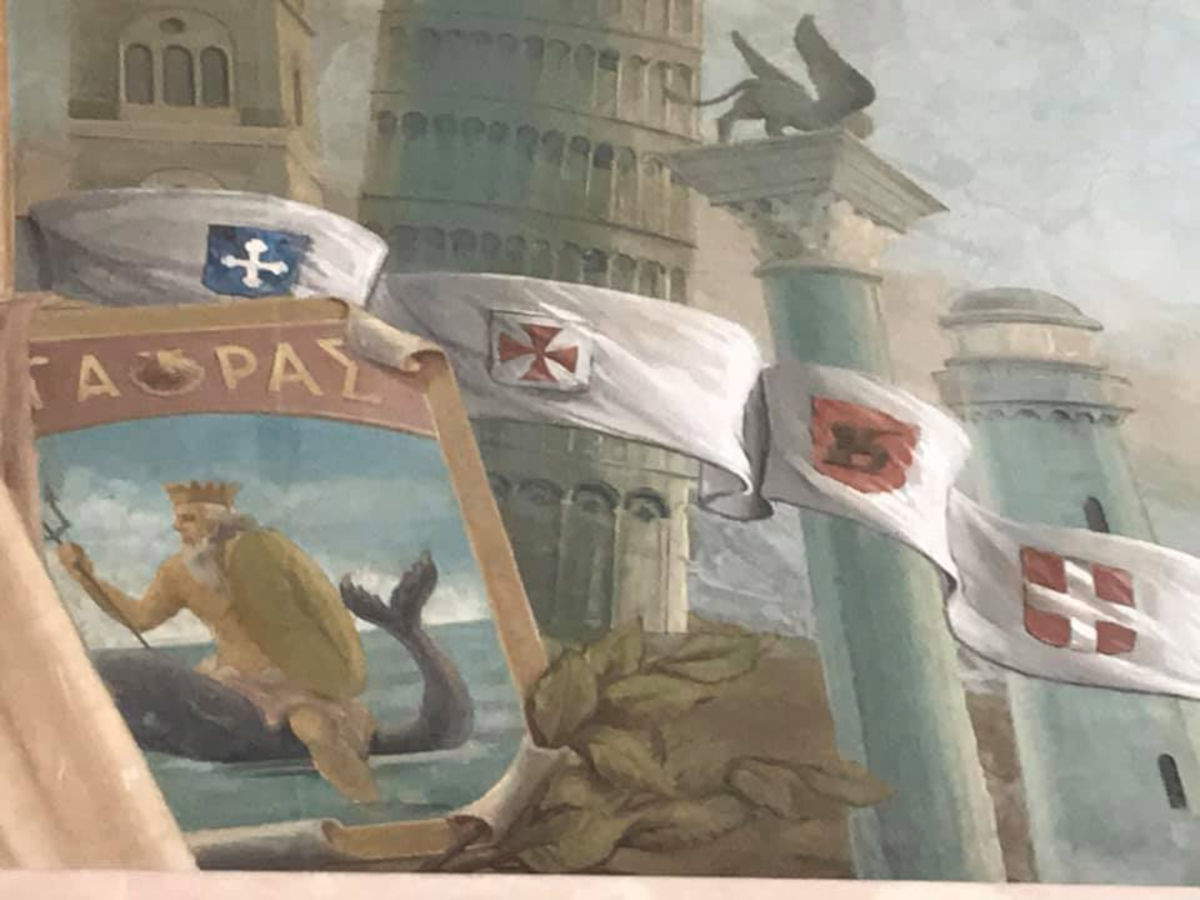
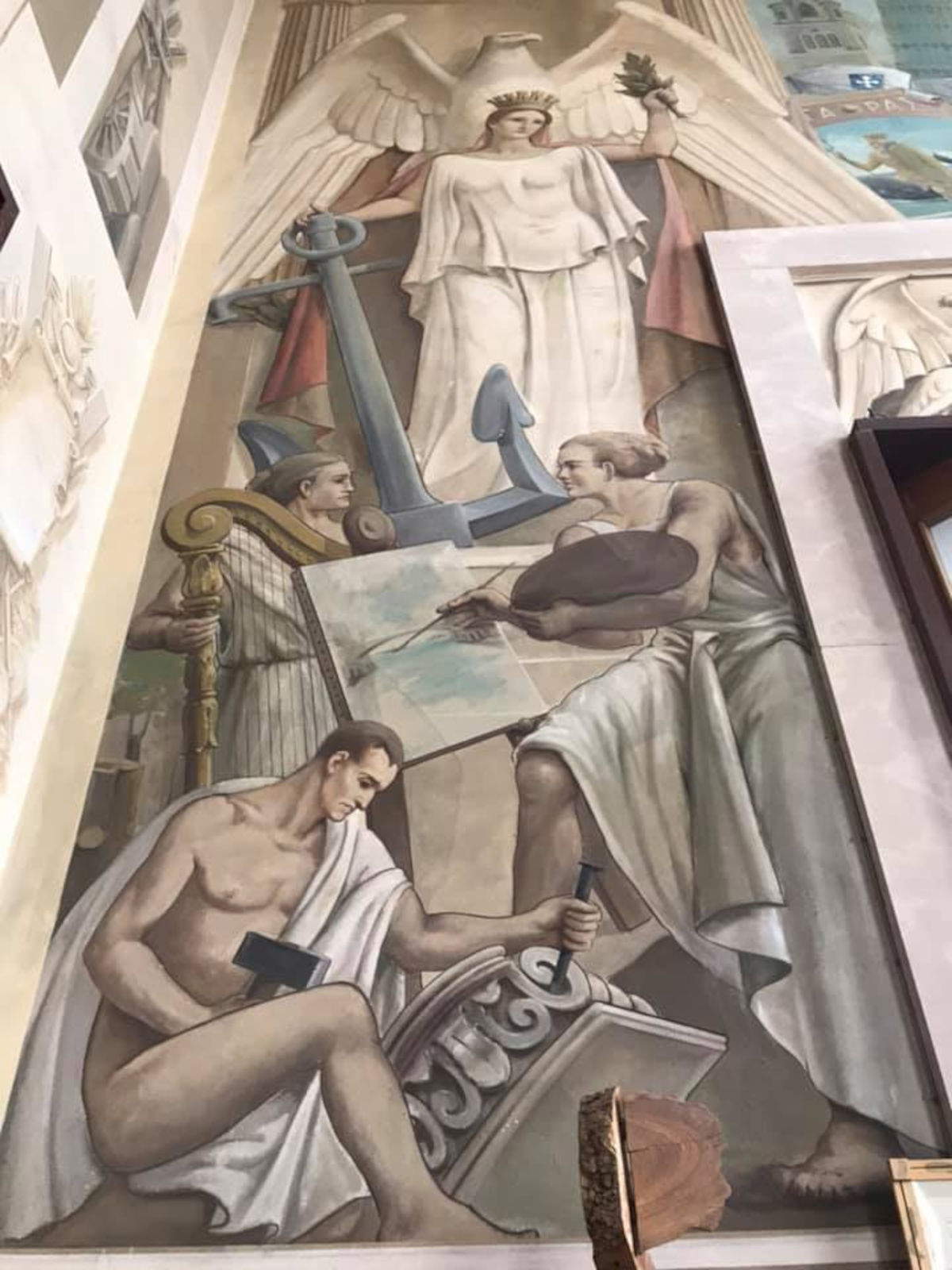
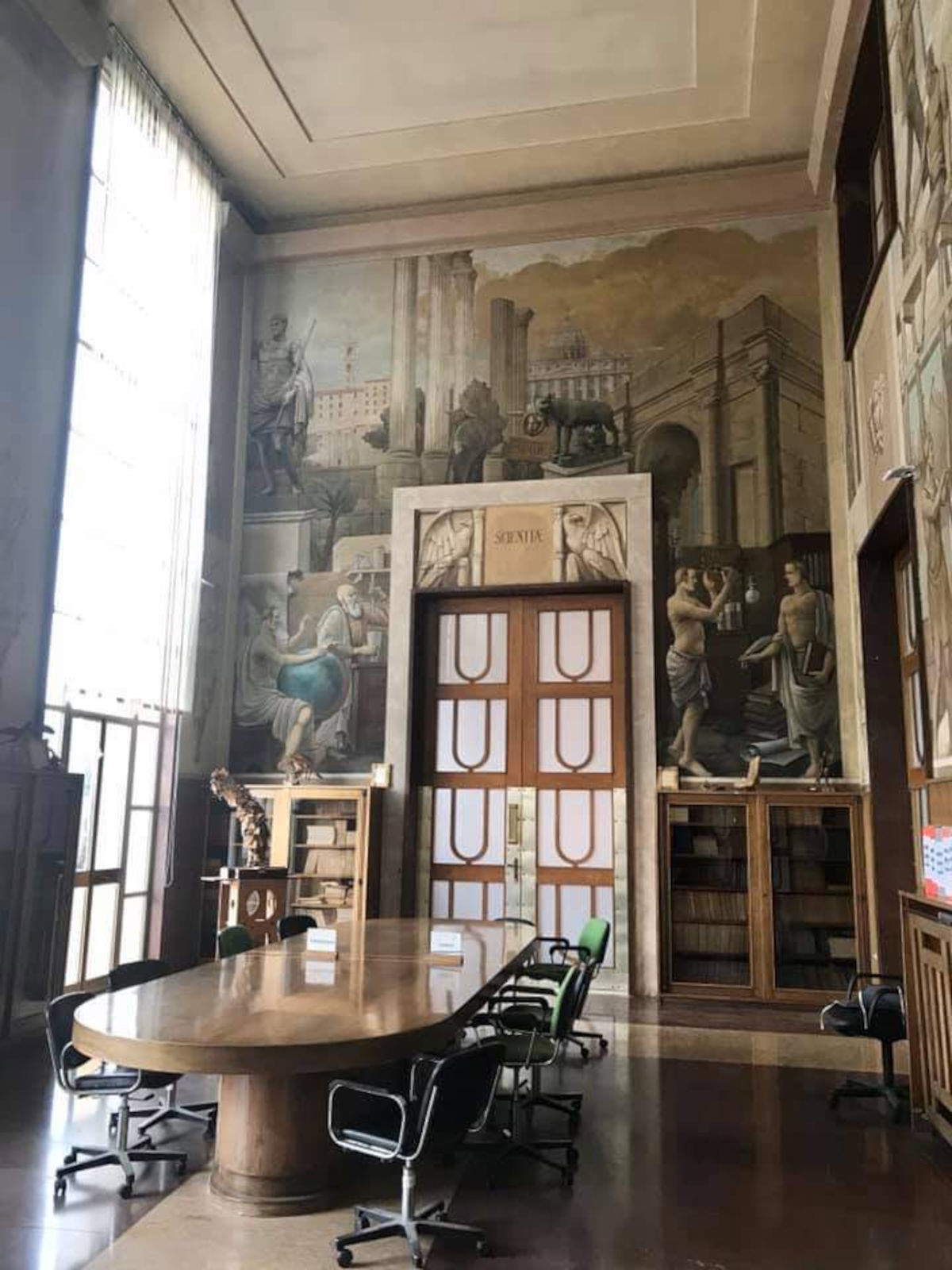
Fascism could present itself as the legitimate heir of that tradition, the continuer of the civilizing work that the maritime republics had begun in the Middle Ages. It is no coincidence, then, that precisely in those years the concept found its most conspicuous iconographic incarnations in buildings of the regime. In Taranto, in 1937, the Casa del Fascio designed by Cesare Bazzani was inaugurated, one of the best-preserved buildings of its kind to date. Its recently restored reception hall constitutes a true visual compendium of Fascist mythology: a concentration of symbols of the supposed military power, genius and industriousness of the Italian people. The frescoes were executed by Mario Prayer (Turin, 1887 - Rome, 1859), a painter who trained at the Academy of Fine Arts in Venice and then moved to Apulia, where he had established himself both in monumental painting in the institutional sphere and in the decoration of private residences. The city of Taranto was represented in the frescoes together with the four maritime republics, in a composition that said much about the symbolic meaning attributed to that presence. Taranto, a seafaring city par excellence, home to one of the most important naval bases on the peninsula, found its historical legitimacy in its juxtaposition with Amalfi, Pisa, Genoa and Venice, that is, the four “canonical” republics, so to speak so to speak, later entering the Italian Navy’s flag after the war, and depicted with their symbols (Amalfi’s Cathedral Bell Tower, Pisa’s Tower, St. Mark’s Lion column, and Genoa’s Lantern) and coats of arms (albeit with the colors not accurate: the coat of arms of Genoa, for example, is depicted with a white cross on a red field, when it should be the reverse, and the same goes for the coat of arms of Pisa). The walls of the room recounted the arts, crafts, and sciences, as well as Italian military exploits, from World War I to the Buccari hoax to D’Annunzio’s flight over Vienna. In this choral fresco of Italian greatness, the maritime republics occupied a place of honor, as distant roots of a power that the fascist present was charged with bringing to light.
A similar argument applies to the Hall of the Maritime Republics in the Palazzo Chigi, whose history is particularly revealing. The palace, which would become the seat of the Italian government only in 1961, had been purchased by the state in 1918 and had been used as the headquarters of the Ministry of the Colonies. The new occupants had not merely moved their offices there: they had wanted to imprint on the building strong signs of their own presence and institutional mission. This was already an established practice in the history of architecture and art: appropriating a space through images, redefining its meaning through decoration. In the room that opens up the stairs to the Chigiana Library, already adorned with an elegant grisaille decoration in 18th-century taste, the Ministry of the Colonies had four large coats of arms of the maritime republics made. From that time on, that room took the name Hall of the Maritime Republics, a designation that has remained in use to this day. The coats of arms of Venice, Genoa, Pisa, and Amalfi stood out in the vault, visible to those who ascended to the library, in a context that mixed the elegant decorative legacy of the eighteenth century with the new colonial and imperial symbolism of the postwar period (the Maritime Republics, in this context, would symbolize the projection of Italy on the sea). The message was clear: modern Italy had deep and glorious roots, reaching back to the peninsula’s seafaring Middle Ages.
But how had it been determined that there were exactly four maritime republics, namely Amalfi, Genoa, Pisa and Venice? The question is less obvious than it might seem. The process of selection and canonization was long, bumpy and not without resistance. Decisive in this regard was a publication by Captain Umberto Moretti, to whom the Royal Navy had entrusted the task of writing the maritime history of Amalfi in 1904. The volume came out with a title that was already a manifesto: The First Maritime Republic of Italy. This was not just an editorial choice: it was a claim, a formal inclusion of Amalfi in the list of maritime cities that counted. Prior to that moment, the Campania town had remained on the margins of the various lists that historians were composing, in what had already shaped up as a debate over the number and composition of the group. Amalfi’s presence also had a not insignificant geographic and symbolic significance: it balanced toward the south of the country a list that would otherwise have been unbalanced toward the center-north, with Genoa, Pisa and Venice taking the lion’s share. In the 1930s, aided by the growing ideological pressure of the regime, the shortlist was finally consolidated: Amalfi, Pisa, Genoa and Venice. Four cities, four histories, four coats of arms.
The final consecration came in 1941, when those coats of arms were included in theheraldic emblem of the Regia Marina. It was a gesture that sanctioned, at the level of widespread visual culture, the composition and meaning of the canon. The ensign, approved at the height of the war but not officially adopted until 1947, represented a watershed in the history of the concept of “maritime republics.” From then on, the four maritime republics were not only a historiographical idea but also a visible, reproducible, instantly recognizable symbol. The navy flag carried the weight of that history and, at the same time, solidified it in the collective imagination. In 1955, almost as if to complete the path of mythmaking, the four cities represented in the flag gave birth to the Regatta of the Ancient Maritime Republics, which would transform the historiographical canon into spectacle, into re-enactment, into community identity lived and celebrated every year.
Yet just as the concept was consolidating its hold on the popular imagination, professional historians were beginning to distance themselves from it. “In the immediate postwar period, in a cultural climate of accentuated ’defascistization’ and the overcoming of all imperialist rhetoric,” Orlando writes, “the scientific-divulgative production, moreover very prolific and qualified on the subject - in little more than of a decade, from 1951 to 1963, had appeared the important syntheses of Marcantonio Bragadin, Arsenio Frugoni and Armando Lodolini -, had proceeded to deconstruct the myth of the republics, whose glory was no longer pursued, but rather their history was, if anything, to be restored, weighing for each the role they had played in the long and complex Mediterranean affair. Deprived of any ideological and propagandistic charge, even the historiographical canon had been invested with significant and growing criticism. To its disadvantage played that initial terminological forcing, which had lumped together under the same expression - republic - four realities that were inhomogeneous among themselves and difficult to bring back to unity under the constitutional aspect.”
It was Arsenio Frugoni who gave the sharpest formulation of the problem, with a critical brutality that had the virtue of clarity: one should say “maritime cities,” rather than republics, because they did not all have republican regimes. If the term republic was improper, if the four cities could not be lumped together under this label without obvious forcing, then the whole conceptual framework lost its solidity. And, once this premise was accepted, the question of number became irrelevant: why stop at four? Why not include other cities that had had a similar maritime vocation, such as Noli, Ancona, Gaeta? Not surprisingly, in later works the republics multiplied, until there were ten in Lodolini’s contribution.
Almost two centuries after its invention, the Seismondian concept thus showed all its fragilities. Born as a happy intuition, grown through the embrace of nationalism and colonialism, enriched and deformed by fascist rhetoric, the canon of maritime republics was now facing the harsh judgment of professional historiography. But the general public had not followed this critical trajectory. For ordinary people, for the citizen gazing at the navy flag, for the tourist attending the regatta, the maritime republics remained, and still remain, a vivid, immediate, fascination-laden concept. Amalfi, Pisa, Genoa and Venice continued (and continue) to evoke a glorious past, an Italy capable of dominating the seas and building civilizations on the waters. That of the maritime republics is, and still is today, a powerful narrative, capable of surviving its own contradictions.

Warning: the translation into English of the original Italian article was created using automatic tools. We undertake to review all articles, but we do not guarantee the total absence of inaccuracies in the translation due to the program. You can find the original by clicking on the ITA button. If you find any mistake,please contact us.





























 IT
IT FR
FR DE
DE ES
ES CN
CN


