





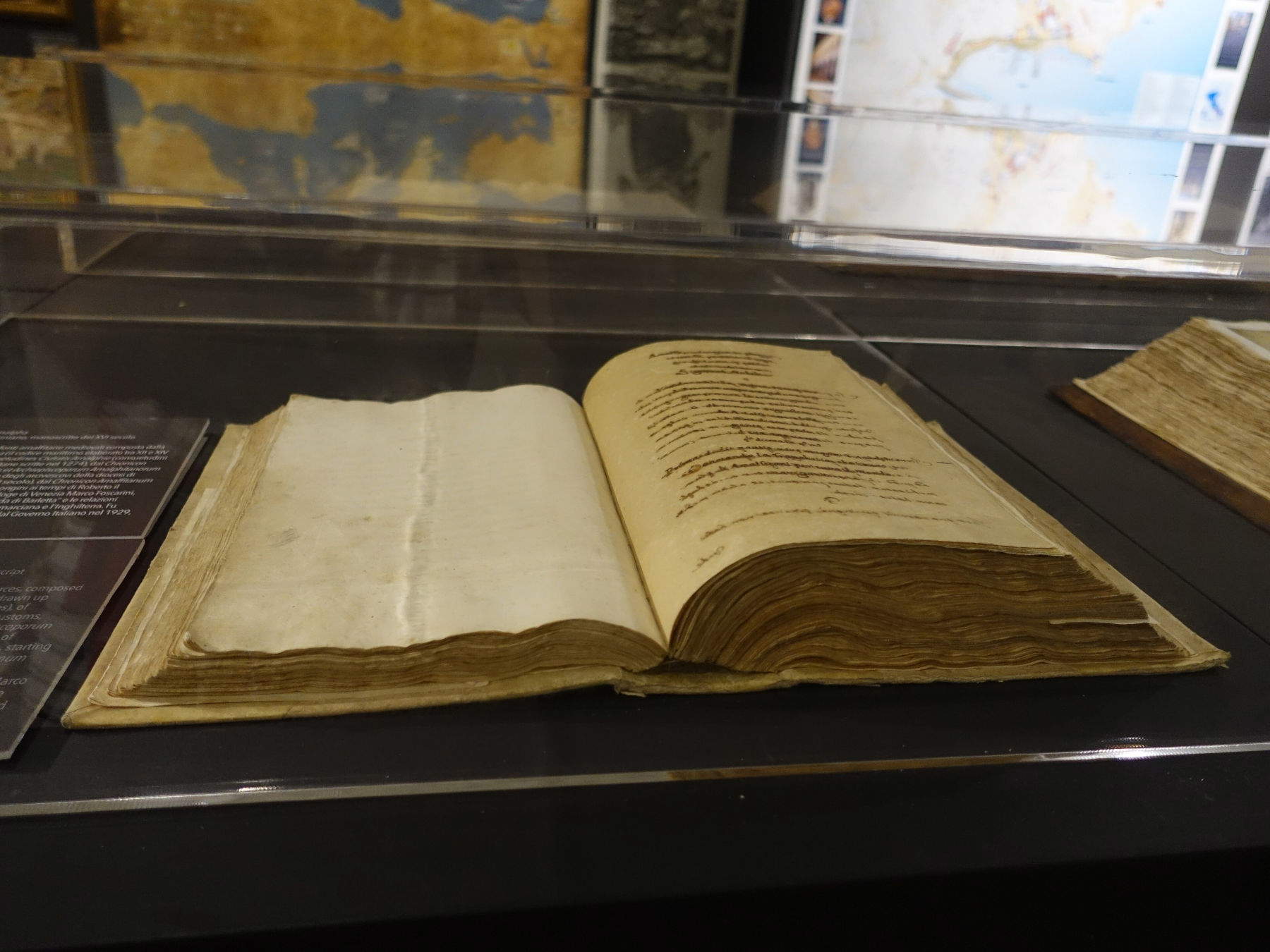
In the history of the Mediterranean, the sea at some point stopped being just a physical space to be crossed and became something more complex: a theater of economic relations, of agreements, of disputes, of shared risks. A place, therefore, to be normed. And the oldest Italian attestation to date known of this attempt to normalize the sea has a name: Tabula de Amalpha. The Tavole Amalfitane, in their original Latin title Capitula et ordinationes Curiae Maritimae nobilis civitatis Amalphe and representing the oldest Italian maritime statute and one of the founding documents of the law of the sea in the West.
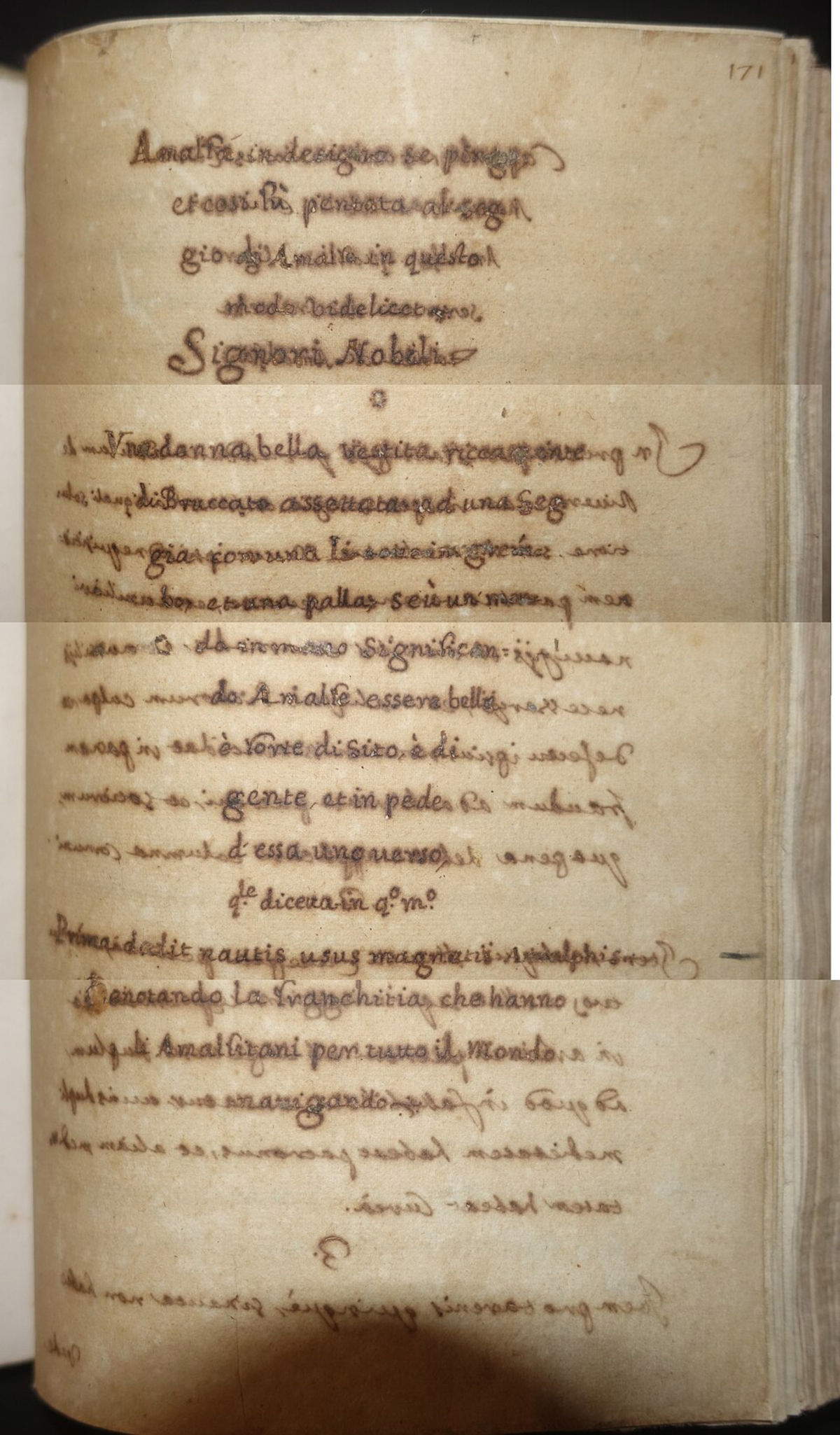
The history of this text is as fascinating as it is troubled. There is no original: the version that has come down to us is the result of manuscript transcriptions commissioned over the centuries by Amalfitan nobles, copies of copies of a document that probably had neither the form nor the pretension to be a law in the technical sense of the term, but nevertheless ended up regulating the lives of sailors, merchants, shipowners and captains throughout the Mediterranean for about five centuries. The text consists of 66 articles, called chapters. The first twenty-one, written in Latin, form the oldest core and can be dated to the 11th and 12th centuries; they had been written by the Sea Consuls of Amalfi. The other forty-five, in vernacular Italian, were added later, in the 13th and 14th centuries, following the increasingly articulated needs of an expanding maritime trade. This linguistic stratification is not a marginal detail: it reflects the transition from a legal culture still tied to the Latin of the Roman and ecclesiastical tradition to a language closer to the concrete operations of merchants, a vernacular capable of describing contracts, risks and obligations with the precision that daily practice required.
To understand the historical significance of the Amalfitan Tables, it is necessary to place them in the broader context of the history of maritime law. When there were no codes, maritime trade relations were governed by customs, habits, and unwritten practices. The need to fix these behaviors in writing arose when the economy stopped being predominantly agricultural and began to transform into a commercial economy, using the sea as the main route of exchange between peoples. Where there is trade, there is risk of overpowering, and where there is risk of overpowering, sooner or later law is born.
The great legacy to which the Amalfitan Tables draw is that of the Lex Rhodia, the first collection of maritime laws and customs, dating back to the fifth century B.C. and handed down by the Romans, whose principles were later taken up and reworked by medieval lawmakers, varying in form but not in substance. These principles found their most organic arrangement in Justinian’s Digest, and from there they entered the Amalfi legal tradition. The Tabula was not, strictly speaking, a codification of general principles or abstract concepts: rather, it was a collection of concrete answers to concrete situations, a repertoire of practical solutions to the problems that medieval navigation posed on a daily basis.
“Such usages,” writes scholar Paola Avallone, “dictated everything that concerned and affected navigation: disputes, the price of freights, the obligations of the captain and sailors, compensation in case of loss of goods, maritime exchange, profit sharing, compensation for sea risks, breakdowns, rigging, abandonment of the vessel and goods in case of danger, and formed an integral part of the legal system of the ancient Maritime Republic.” They were, in other words, all the situations that could arise during a commercial sea voyage, from the moment of departure until eventual shipwreck. The Tabula formed an integral part of the legal system of the ancient Maritime Republic of Amalfi, and through the Maritime Curia, where magistrates administered the justice of the sea and where a notarial apparatus was set up for the drafting of maritime-commercial contracts and the registration of seafaring companies, its provisions came to life in actual cases.
Two institutions in particular emerge from the text as the pillars of the entire legal construction: the commenda and the column. The commenda was a form of commercial partnership between two parties, a partner who provided the money needed for the enterprise and paid the crew by risking his own capital, and a traveling partner who owned the ship and was in charge of procuring the profit, of which he retained a quarter by giving the rest to the capitalist. The column, on the other hand, was a more complex instrument designed for people who did not have sufficient resources to build a ship themselves. Several individuals would enter into a partnership to procure one, sharing risks and profits.
These were not always and necessarily people of modest means: among the “charatists” (this was the name given to the partners who held shares in the ship) were often merchants, notaries, and wealthy people who sought riskier but potentially more profitable investments than buying shares in public debt. The column involved more parties than the commenda: the charter members, who could choose to travel or not, the captain, the crew, and the merchants who loaded the goods. Underlying it all was the pooling of risks. And it is here that we grasp one of the most interesting aspects of the Amalfitan legal system: in this era the insurance contract did not yet exist. Risks were shared precisely through the column contract, and it was not until the modern age, in the context of contracts of carriage, that a specific share began to be provided for to insure against risks.
The story of the rediscovery of the text is itself a compelling one, intertwined with the great European libraries, Venetian doges and controversies among legal historians. The Tabula was found in 1843 in the imperial library in Vienna, within the so-called Codex Foscariniano, a 16th-century manuscript formerly belonging to the Venetian doge Marco Foscarini and transferred to the Austrian capital in 1727. The discovery was made public through a publication in 1843, and the text was edited the following year. The Tabula thus emerged from obscurity after centuries of oblivion.
The discovery represented, as has been written by scholar Antonio Guarino, a resounding snub for the great French maritime law historian Jean-Marie Pardessus, author of a fundamental collection of maritime laws prior to the 18th century. Pardessus, in his chapter on maritime law in the Two Sicilies, had expressly denied that the Tabula ever existed, branding as unreliable the references to it made by the sixteenth-century jurist Marino Freccia in his work De sub feudis. Pardessus’ argument was simple: if such an important legislative text really existed and was used throughout the kingdom, how come no one was talking about it? How come the collections of Pragmatics and laws from the Swabian and Angevin periods made no mention of it? How was it possible that the research of such a meticulous scholar as himself had found no trace of it? The Amalfi Table, the great Frenchman had concluded, was nothing but a fable.
The 1843 discovery resoundingly disproved this position. The Tabula existed, it was tangible, it could be studied. In 1864 Paul Laband produced the first and most accurate critical review of it. This opened a debate about the real nature and scope of the document. For there was something in the objections of the eminent French historian that the finding failed to demolish completely: that the Tabulae Amalfitane did not have the character of law in the strict sense.
And in fact the Tabula de Amalpha, on critical examination, never had the character of a true law in the technical sense: it was rather a collection of jurisprudential and customary maxims of various epochs and derivations, preserved and handed down in manuscript form in the narrow Amalfi environment. The very heading of the Foscarinian Codex is revealing: it defines the document as Capitula et ordinationes Curiae Maritimae nobilis civitatis Amalphae, that is, as a collection of rules of judgment arising not from laws enacted by a sovereign authority, but from customs and practices followed by the Amalfi Maritime Court. The term tabula, which in Roman and medieval times could denote legislative texts, seems to be used here in the older sense of a public roll on which magistrates displayed their rules of judgment so that anyone with an interest could know them in advance.
Yet this downsizing does not detract from the document’s extraordinary value. On the contrary, in some ways it enriches it with a different and in many ways deeper meaning. The Tabula was not a law imposed from above; it was something more organic, more alive: the centuries-long sedimentation of a practice of navigators and merchants, of men who had learned to come to terms with the sea and its unpredictability, and had turned this experience into a system of shared rules. “This leads us to venture,” Paola Avallone argues, “that the Amalfitan text presents a closer relevance to modern maritime clausolari, developed at the initiative of the traders in the sector, rather than to the current codification of the sector, the result of the birth of the modern state. That of the Tabula, which also influenced the drafting of other medieval maritime statutes such as those of Pisa, Genoa and Catalonia, became ’living law,’ applied in the courts and curia during the subsequent Norman rule and later also in the Kingdom of Naples.” Its reach, therefore, went far beyond the cliffs of the Amalfi coast. Its historical importance was such that it contributed to the formation of uniform maritime legislation in all Mediterranean coastal states, including the Arab ones.
The historical parabola of the document is equally instructive. In the fifteenth and sixteenth centuries, when printing became widespread in Italy, the Tabula was never published in print: an unmistakable sign that by that time it was devoid of immediate practical relevance, overtaken by more comprehensive and organic collections of customs from the Mediterranean basin.
In 1927 the original manuscript, after years in which its existence had been debated and denied, was ceded by Austria to Italy. Two years later, in 1929, it was Mussolini who purchased the entire Foscarini Codex and donated it to Amalfi. In 1934 the recovery of the work was celebrated with various initiatives promoted by the Neapolitan Italian Committee of the Italian Association of Maritime Law. The document is still kept in the Municipality of Amalfi. Since December 2010, a copy of the code, drafted in the 17th century, has been transferred to the newly established Museum of the Compass and the Maritime Duchy of Amalfi, set up in the ancient Arsenal of the Republic, which is itself a monument to the maritime power that Amalfi achieved in its golden age.
The history of maritime law is, after all, the history of how human societies have tried to bring order to a space that is by nature chaotic and unpredictable. The sea recognizes no boundaries, respects no agreements, bends to no hierarchies. Yet humans have continued to ply it, to trade, to take risks. And to do so sustainably, to build lasting economic relationships across the water, they needed rules. The Amalfitan Tables are one of those rules. Not a law imposed by a ruler, but a system born of practice, sedimented over the centuries, transmitted from hand to hand in precious manuscripts that passed through imperial libraries and dogal collections before returning to the city that generated them.
There is, moreover, a sentence in the Consuetudines civitatis Amalfie, the rules of Amalfitan civil law that accompany the Tabula in the Foscarinian Codex, that is interesting for understanding this mentality. It states, with some boldness, that the law is undoubtedly authoritative, but that a good custom is even more authoritative, to such an extent that before it the law itself must be silent. In Latin, with that conciseness that Roman law knew how to achieve, “lex est sanctio sancta, bona tamen consuetudo est sanctio sanctior, eo quod ubi consuetudo loquitur lex tacet.” This is, perhaps, the most profound philosophy that the Amalfitan Tables convey to us through the centuries: that the most living law does not arise by imposition, but by the shared practice of those who work, trade, and navigate and, in doing so, learn to live with others.

Warning: the translation into English of the original Italian article was created using automatic tools. We undertake to review all articles, but we do not guarantee the total absence of inaccuracies in the translation due to the program. You can find the original by clicking on the ITA button. If you find any mistake,please contact us.





























 IT
IT FR
FR DE
DE ES
ES CN
CN


