





After more than eighty years of absence and twelve years spent in judicial custody, Moretto ’s Faith (Alessandro Bonvicino; Brescia, c. 1498 - 1554) finally returns to public view. From May 2026 and until 2027 the work will be on display on the second floor of the Diocesan Museum of Brescia, alongside another famous masterpiece by the artist, the Madonna and Child in Glory, Saint John the Evangelist, Blessed Lorenzo Giustiniani, and the allegory of Divine Wisdom, known as “The Wisdom.” It is a return that closes one of the most controversial and rocambolic events related to Brescia’s artistic heritage of the 20th century, which began during World War II and ended only after a long investigative and scientific work.
The public presentation of the affair is scheduled for Thursday, June 18, 2026 at 5 p.m. Coordinated by a head of the Carabinieri’s Cultural Heritage Protection Unit in Monza, speakers will include Marco Gargano, professor of Physics for life sciences, the environment and cultural heritage at the University of Milan and author of the scientific report on the work; art historian Mario Marubbi, author of the historical-artistic report; and Laura Sala of the Soprintendenza Archeologia Belle Arti e Paesaggio for the provinces of Bergamo and Brescia. Bringing greetings from the bishop will be Monsignor Raffaele Maiolini, episcopal vicar for Culture.
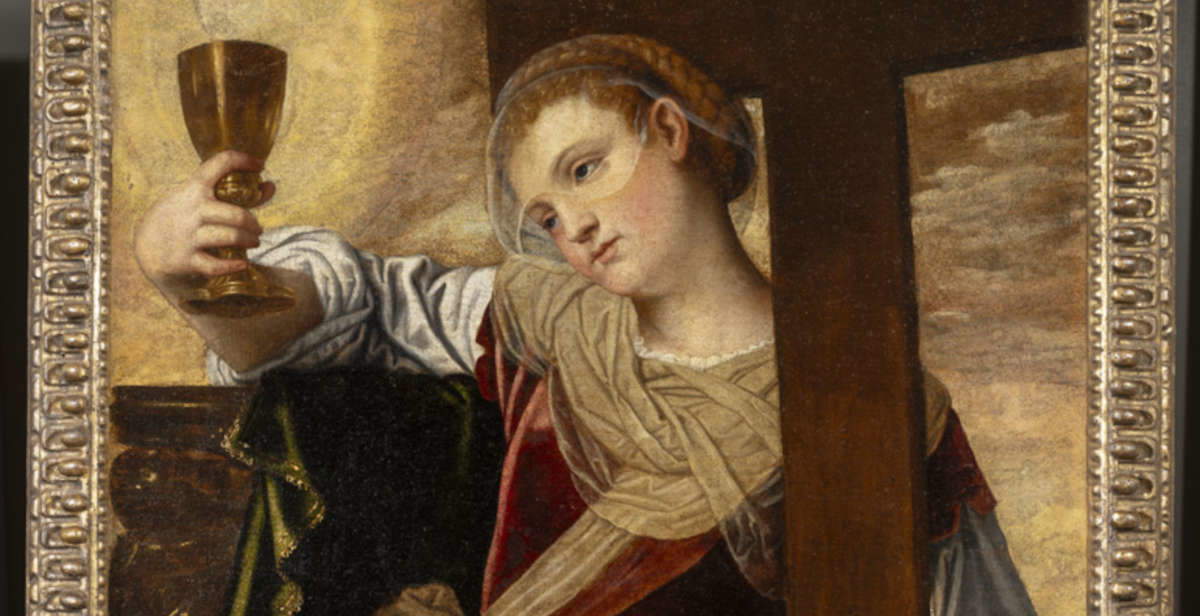
The work, an oil on canvas from 1550 measuring 102 by 79.5 centimeters, belongs to the late phase of Moretto’s production. The painting depicts the allegory of Faith and is one of the most significant versions of a subject that the artist developed several times throughout his activity. Today the public will once again be able to admire its refined pictorial quality, made evident by the softness of the flesh tones, the skillful modulation of light and shadow, and the extraordinary ability to render different textural textures. Indeed, in the velvety draperies, the transparent veils, the wood of the cross and the crystal of the chalice, the technical mastery of the Brescian painter emerges, capable of sculpting the figures through tones, halftones and darker gradations of color.
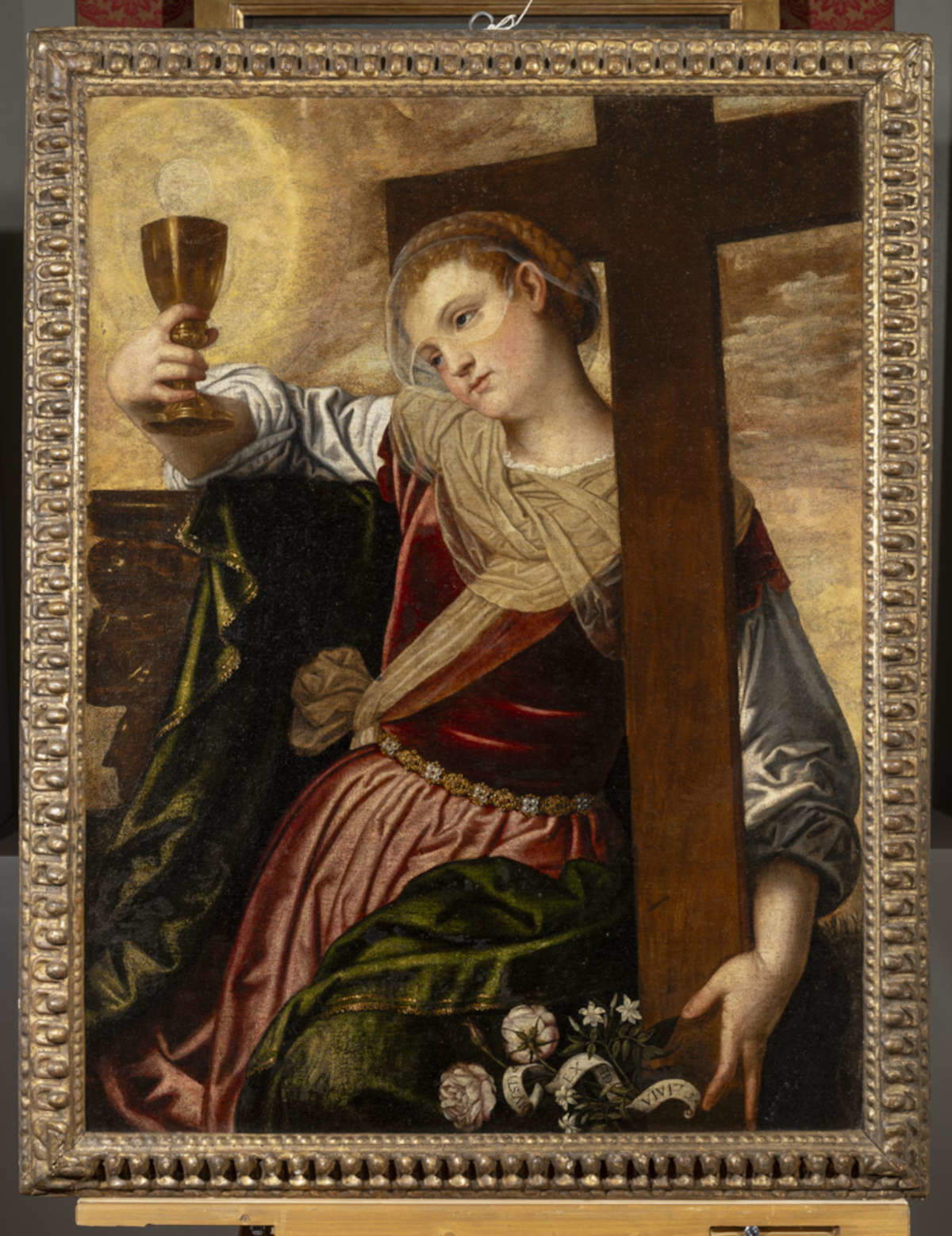
The work’s history, however, spans decades of mysteries, omissions and changes of hands. Until 1944 the Faith was kept in the parish church of Santa Maria in Valverde, in the village of Padernello, in the Brescia area. According to historical reconstructions, the painting was located in the chapel of the baptismal font. At the end of the war, however, the canvas was illicitly given away by the then parish priest with the aim of financing the construction of the parish oratory. To prevent the theft from being immediately discovered, the original was replaced with a copy made by Giambattista Bertelli, a painter and restorer from Verolanuova.
For decades the work’s disappearance remained essentially ignored. The turning point came in the early 2000s, when some members of the “Friends of the Castle” association found a small image depicting the painting inside the Padernello castle. On the card clearly appeared the inscription “The Faith, parish of Padernello.” That documentary find proved that at least one of the six depictions of the Faith attributed to Moretto had actually adorned the village church. From there a new season of study and investigation began.
In 2008, the Nymphe Castello di Padernello Foundation promoted the exhibition Moretto, The Faith, the Return, organized over the Easter period. The exhibition presented one of the six known versions of the work created by the painter around the mid-sixteenth century and helped rekindle attention to the missing painting. It was precisely from the catalog of that exhibition that the Carabinieri of the Nucleo Tutela Patrimonio Culturale in Monza were able to develop the investigation that within a few months led to the identification of the original work.
The investigative reconstructions made it possible to follow the path taken by the painting after it left the parish. From the hands of the parish priest, in fact, the Faith would have come to the former praetor of Verolanuova, who later sold it to an antiquarian. From there the work passed to a private Brescian businessman and collector, in whose home it was finally found and seized by Carabinieri of the Nucleo Tutela Patrimonio Culturale of Monza in 2014.
Crucial to the confirmation of the authenticity were scientific investigations conducted in the Applied General Physics archaeometry laboratory of the State University of Milan. Indeed, the analyses allowed the painting to be attributed with certainty to the hand of Moretto, putting an end to doubts and consolidating the historical and artistic value of the recovered work. After the judicial seizure, the canvas was transferred to the warehouses of the Diocesan Museum of Brescia, where it remained for twelve years, until the release from seizure that has now allowed its return to public enjoyment.
From an artistic point of view, the Faith represents one of the finest examples of Moretto’s allegorical production. Several replicas and variants exist of the composition, some made with the workshop’s intervention, as well as copies that testify to the subject’s wide iconographic fortune. The female figure is constructed according to a complex diagonal setting that generates a sense of controlled instability. Indeed, the body appears unbalanced in relation to the point of observation, while the shoulders placed at different heights suggest the effort required to simultaneously support the cross and the chalice, the two central symbols of the Christian faith. The painter’s attention also focuses on the material rendering of the surfaces. The color layering constantly changes texture to render the velvet of clothing, the lightness of veils, the solidity of wood and the transparency of crystal. It is a painting constructed through layers of light and shadow, capable of giving monumentality to the figure without sacrificing formal elegance.
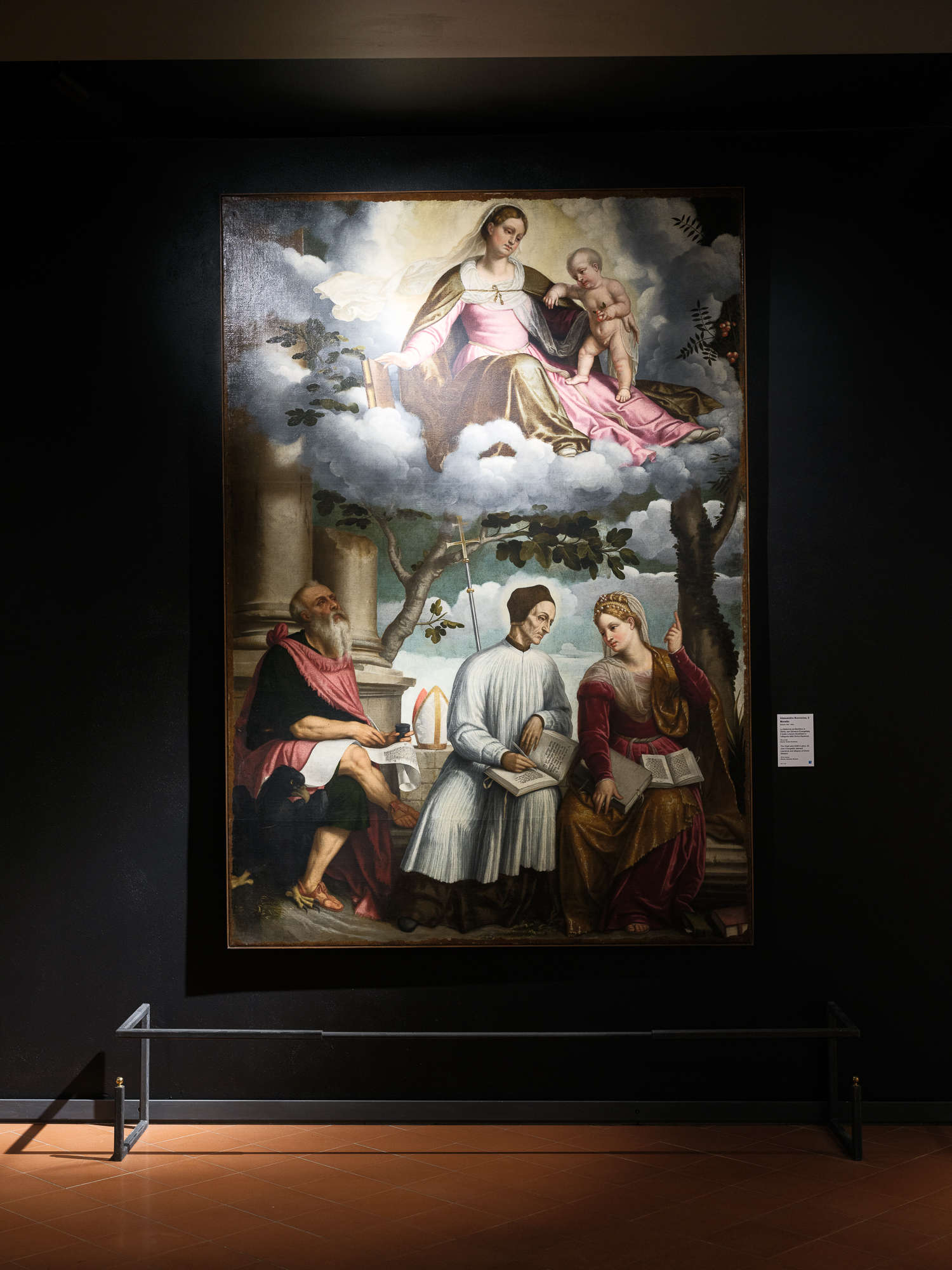
The return of the work to the Diocesan Museum also offers the possibility of a direct comparison with Wisdom, another large canvas by Moretto already preserved in the same location. Indeed, the dialogue between the two works makes it possible to grasp the similarities that have led scholars to hypothesize the repeated use of preparatory cartoons by the artist and his workshop in the creation of the allegorical female figures of the late production.
Similarities emerge especially in the physiognomic features. The recumbent faces, the cut of the eyes, the line of the mouth and the design of the nose show a strong consonance between the figure of Faith and that of Divine Wisdom. The latter is depicted pointing to the Virgin as Sedes Sapientiae, according to a complex symbolic and doctrinal elaboration. Both figures appear richly dressed and ornate, testifying to Moretto’s progressive stylistic evolution toward a more cultured and erudite painting, in which allegorical meaning prevails over the direct realism of his early works.
This trend, scholars point out, reflects a widespread orientation in Brescian figurative culture of the mid-sixteenth century, traversed by the search for increasingly sophisticated symbolic themes and doctrinal references. The possible commissioning of the work also fits into this cultural context. According to what Valerio Guazzoni reports in the essay Moretto and the Veil of Faith. Path in the Fortune of an Allegorical Theme from 2013, various hypotheses have been advanced about the involvement of members of the Martinengo family, ancient feudal lords of Padernello. Among the names that have emerged are those of Leonardo Martinengo and especially Girolamo Martinengo, who was documented in relations with Moretto as early as 1543, on the occasion of the decoration of the so-called Salotto delle Dame at Palazzo Martinengo in Brescia.
The exhibition of Faith thus takes on a significance that goes beyond the mere recovery of a work of art. Indeed, the return of the painting gives back to the community an important fragment of its cultural and religious memory, bringing to light a complex page in the history of Italian artistic heritage.
 |
| Brescia, Moretto's Faith returns to view more than 80 years after theft |

Warning: the translation into English of the original Italian article was created using automatic tools. We undertake to review all articles, but we do not guarantee the total absence of inaccuracies in the translation due to the program. You can find the original by clicking on the ITA button. If you find any mistake,please contact us.


























 IT
IT FR
FR DE
DE ES
ES CN
CN


