





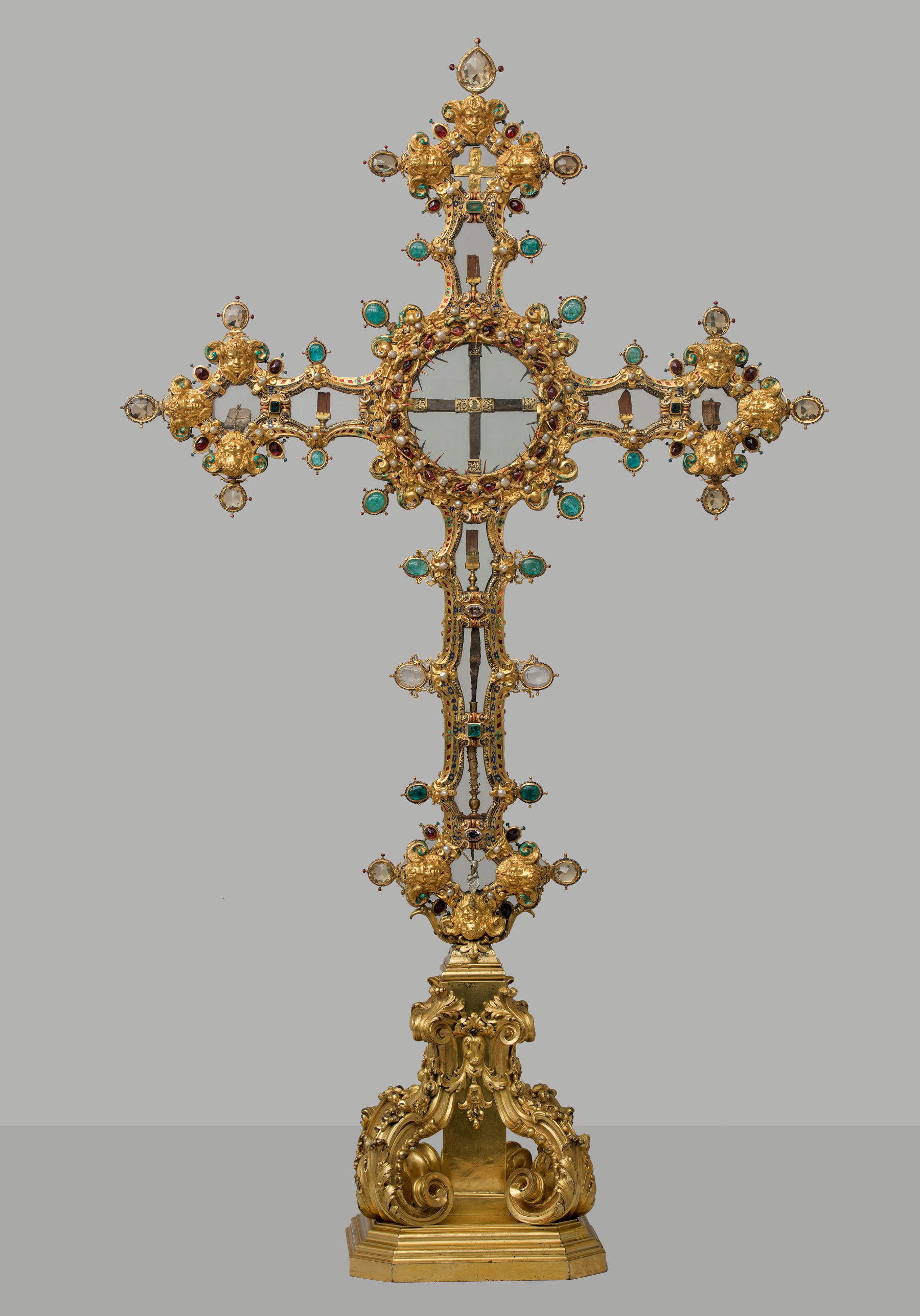
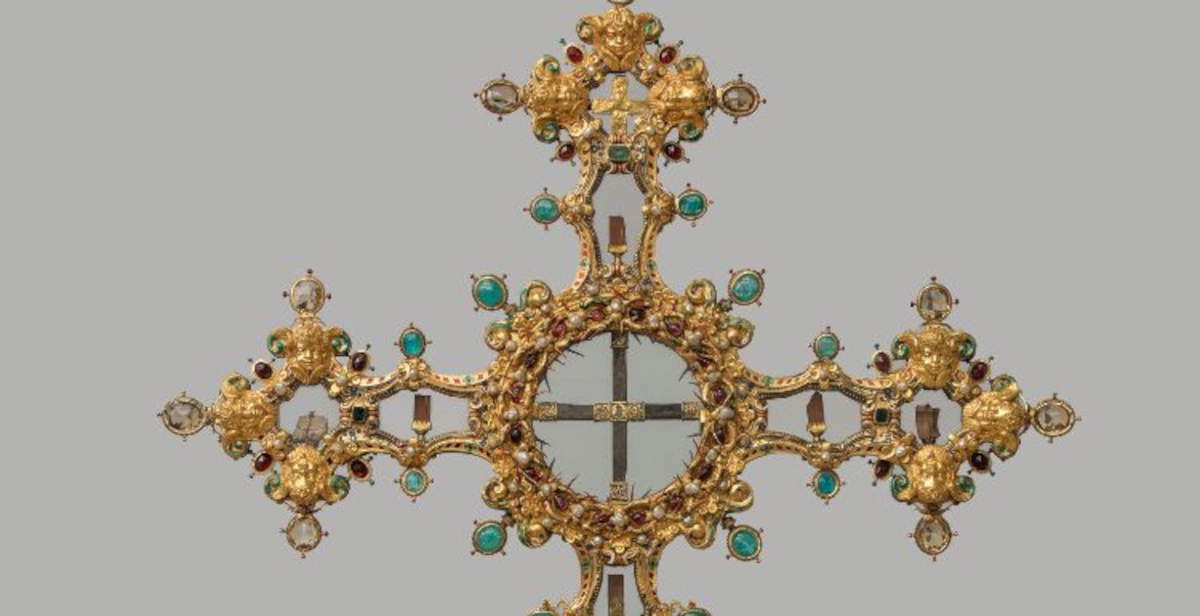
The Reliquary Cross of the Passion, also known as the Grand Duchess Cross, is back on public view at the Museo dell’Opera del Duomo in Florence after a restoration completed in 2025. The work, made of gold and decorated with a vast array of precious gems, underwent a restoration entrusted by the Opera di Santa Maria del Fiore to theOpificio delle Pietre Dure in Florence. The results of the intervention will be presented on June 4 during a study day entitled The Reliquary Cross of the Passion of the Opera del Duomo, scheduled at the Antica Canonica in Piazza San Giovanni 7, with free admission from 9:45 a.m. to 3:30 p.m.
The restoration has led to a revised identification of one of the central stones in the work. The large gemstone, believed until now to be a topaz of India, has been identified as a very pure quartz. The finding alters one of the established interpretations of the reliquary’s material history and is part of a reinterpretation of the techniques and materials used in its making.
The Passion Reliquary Cross is one of the main objects of sacred goldsmithing preserved in the Florentine museum. Its history is closely linked to the Medici commission: in fact, it was commissioned by Grand Duke Cosimo II de’ Medici and his consort Maria Magdalena of Austria to hold the relics of the Passion of Jesus Christ preserved in Florence Cathedral. The choice of gems and the quality of execution hark directly back to the context of the grand ducal workshops, where the object was conceived as part of a program to represent power and dynastic devotion.
The work is also inspired by the famous Florentine diamond, a stone belonging to the Medici family. The diamond, purchased by Ferdinand I de’ Medici on October 12, 1601 in its rough state and later inherited by Cosimo II, was entrusted to Pompeo Studentoli, a Venetian goldsmith active in the Grand Ducal workshops in Tuscany, to be cut and then given to Maria Magdalena of Austria. It is precisely to this model that the large central gem of the Cross, now identified as quartz, refers.
The reference to the Florentine diamond takes on added significance in light of a recent incident. The diamond, long considered missing, was traced to a vault in Canada last year in an investigation made public by The New York Times after more than a century of absence from documentary sources and the market. The discovery has reopened the debate about the circulation of Medici gems and their symbolic role in court culture.
The Cross, also known as the stauroteca (from the Greek stauros, meaning cross, and theke meaning collection, collection), has a Latin cross structure and holds within it relics related to the Passion of Christ. These include a fragment of the Cross and a small filigreed gold cross containing additional fragments of the Passion. According to tradition, these relics were supposedly ransomed in 1454 by Marcus Chestialselim, domestikos of the last emperor of the East, and transferred to Florence after the fall of Constantinople in 1453. Archbishop Saint Antoninus would then carry the stauroteca in procession on August 13, 1455.
Late sixteenth-century documentation, recalled in Alessandro Bicchi’s studies, testifies to a long history of interventions on the object. Within a century of its first placement, the reliquary was already in such a condition that it required restoration, documented in 1565, 1591, 1616 and 1618. The latter phase included the decision of the grand ducal couple to commission a new stauroteca, deemed more appropriate to the dignity of worship and dynastic representation.
The new cross was entrusted to court goldsmith Cosimo Merlini the Elder, active between 1580 and 1641. As early as 1615 the grand dukes had begun consideration of replacing the ancient reliquary. The work was completed in 1618 and is attested in the Medici wardrobe inventory of September 14 of that year. On September 18, 1619, the Opera Workers of Santa Maria del Fiore deliberated a mass of thanksgiving for the gift received, thus marking the official entry of the stauroteca into the cathedral’s ceremonial.
From a technical point of view, the Cross is made of embossed and chiseled gold, with cast elements, hot and cold polychrome enamels. The decorative apparatus includes a significant number of gemstones, many of which have been preserved to this day: 120 scaramish pearls, 32 garnets, 6 faceted emeralds, 4 amethysts, 2 aquamarines, 11 quartz, 2 chalcedony, and 14 cabochon emeralds. In the filigreed gold cross, 8 round pearls, 2 garnets and 2 sapphires are added. The later base was made in the 18th century by goldsmith Bernardo Holzmann and is made of cast, chiseled and gilded bronze.
 |
| Florence, Passion Reliquary Cross restored: new discoveries |

Warning: the translation into English of the original Italian article was created using automatic tools. We undertake to review all articles, but we do not guarantee the total absence of inaccuracies in the translation due to the program. You can find the original by clicking on the ITA button. If you find any mistake,please contact us.





















 IT
IT FR
FR DE
DE ES
ES CN
CN