





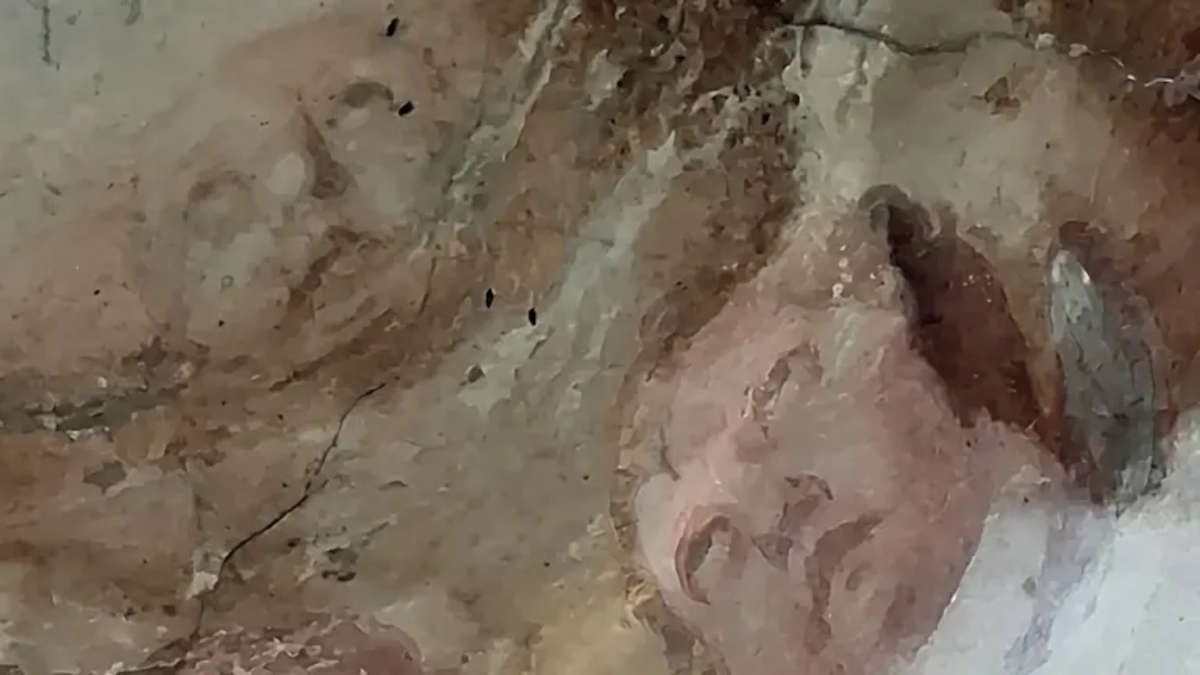
A discovery destined to reignite the debate on one of the most fascinating enigmas of Baroque art in Romagna comes from the heart of Forlì Cathedral , and Il Resto del Carlino reports on it in an article signed by Sofia Nardi. During recent restoration work, new investigations suggest the possible presence of unpublished frescoes hidden under the current decoration of the dome, which can be traced back to one of the greatest artists of the seventeenth century, Guido Cagnacci. The research, conducted by art historian Massimo Pulini together with Arianna Bargellini, is based on a cross-analysis of documentary sources and direct inspections carried out during the restoration work. Preliminary results open up a scenario that has so far only been hypothesized: significant traces of the original decoration, which was never completed, may survive under the present pictorial layers.
To understand the extent of the discovery, it is necessary to go back to the 1740s, at the height of the Baroque season, now also at the center of the city’s cultural programming with a major exhibition at the San Domenico Museum(here is our review). At that time Cagnacci was commissioned to decorate the Chapel of the Madonna del Fuoco inside the Cathedral. The artist made some important canvases and started the project for the decoration of the dome, but was unable to complete it. The continuation of the work was entrusted decades later to Carlo Cignani, who intervened substantially by not only completing the decoration but also modifying the internal architectural structure. Among the most notable interventions were the lowering of the dome and the renunciation of an original light opening, elements that helped redefine the overall appearance of the space.
The reasons for the interruption of Cagnacci’s work have long remained shrouded in uncertainty. The hypotheses put forward by scholars over the centuries have ranged from technical difficulties related to the complexity of the fresco to the artist’s personal problems and the loss of decisive political and religious support. In those years, in fact, the commissioner Clemente Merlini also passed away, a circumstance that may have affected the continuation of the project.
The new investigations seem to offer a different key, however. According to the findings of the inspections, particularly in the area of the lantern, elements attributable to an earlier decorative phase than the one currently visible would have been identified. These include traces of frescoes and ornamental details such as heads of angels, which according to Pulini and Bargellini could belong precisely to Cagnacci’s initial intervention.
These are, at the moment, preliminary evidences that need further verification. The scholars stress that only future more in-depth restorations and the use of advanced survey technologies will be able to definitively confirm the presence of the paintings and clarify the sequence of artistic interventions that have been stratified over the centuries. Among the hypotheses under study is a video inspection of the interior spaces of the structure, which could allow for the exploration of inaccessible areas and the collection of new data.
If confirmed, the discovery would have a significant impact. Restoring visibility, even partial visibility, to an unpublished work by Cagnacci would mean enriching the knowledge of an artist already the subject of important studies and exhibition initiatives, such as the exhibition dedicated to him in 2008 at the San Domenico complex.
The new acquisitions will be officially presented by Pulini himself during a public conference scheduled for Friday at 6 p.m. right inside the cathedral. The meeting is part of the exhibition Protagonists of the Baroque. Itineraries in the Churches of Forli, promoted by the Diocese, and will provide an opportunity to take stock of the state of research and future prospects.
The theme also takes on special importance in view of the celebrations of the 600th anniversary of the miracle of Our Lady of Fire, scheduled for 2028. This is the context for the restoration work currently taking place on the cathedral, work also made necessary for anti-seismic adaptation and aimed at returning the building to its full splendor on the occasion of its sixth centenary.
A first phase of the work, funded through the National Recovery and Resilience Plan, is expected to be completed in the coming months. It is thanks to this construction site that it has been possible to start the investigations that now open up new research perspectives. The cathedral, therefore, is not only the subject of a conservative intervention, but is confirmed as a place still capable of returning unprecedented elements of its history.
|
| Forlì, there are hidden frescoes in the cathedral, possibly the work of Guido Cagnacci |

Warning: the translation into English of the original Italian article was created using automatic tools. We undertake to review all articles, but we do not guarantee the total absence of inaccuracies in the translation due to the program. You can find the original by clicking on the ITA button. If you find any mistake,please contact us.

























 IT
IT FR
FR DE
DE ES
ES CN
CN


