





Greece returned 48 archaeological artifacts to Cyprus today.The meeting marking the handover of the valuable material was held today at the Cyprus Museum, on the occasion of the informal Council of Culture Ministers of the European Union in Nicosia, and featured Greece’s Minister of Culture, Lina Mendoni, and Cyprus’ Deputy Minister of Culture, Lina Kassianidou. The redelivered artifacts come from the collection of Ambassador Christos Zacharakis and represent outstanding examples of Cypriot culture. They cover a wide chronological span, from the Early Bronze Age to the Middle Ages. After the collector’s death, his heirs had taken immediate steps to hand over all the artifacts in his collection to the Greek state, with the sole purpose of investigating their provenance and returning them to their place of origin.
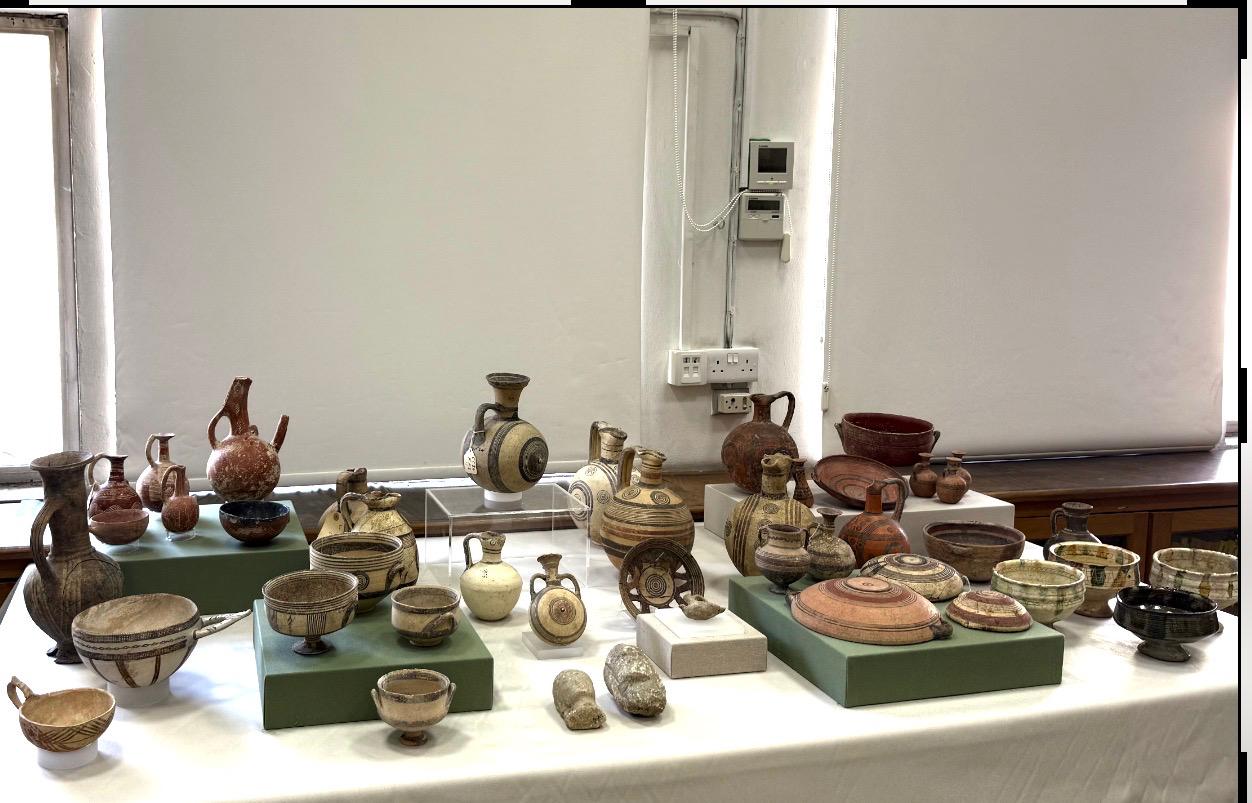
Minister Mendoni, in her speech during the handover ceremony, said, “Today we are returning 48 archaeological artifacts of Cypriot culture to Cyprus, to the place that created them. It is a great joy and emotion for us to welcome foreign archaeological artifacts to our country. However, it is an equally great joy for us to return archaeological artifacts to the country where they belong. Because this is right and ethical. And this joy and emotion becomes even greater because we are repatriating archaeological finds to Cyprus. The Deputy Minister of Culture has succeeded in achieving the important goals that the EU member states had set for themselves. One of the issues that she rightly decided to highlight during the Cyprus presidency is that of the illicit trade in cultural property. Tomorrow we will have the opportunity within the Council to discuss once again this issue that is of concern to all of us, but it is of particular concern to countries like Cyprus and Greece. Greece, in line with the principles of the 1970 UNESCO International Convention, is systematically and with particular dedication committed to restoring, as far as possible, its own cultural heritage, but also to contribute to the restoration of the heritage of other states and to the preservation of the historical memory of every people. Because the preservation of cultural heritage is only achieved through cooperation, mutual assistance and mutual understanding among peoples and states. I would like to hope that others will follow this example. Let them proceed with the voluntary return of archaeological artifacts to the countries they belong to, to the peoples who created them and whose cultural identity they are an integral part of.”
Deputy Minister of Culture Lina Kassianidou stressed, “The return of these antiquities is not simply a cooperation between the competent authorities of Cyprus and Greece, or a further part of the bilateral agreement we signed with the Minister of Culture of the Hellenic Republic a year and a half ago, and which we are implementing in many ways. It is, above all, a tangible example of how the protection of cultural heritage and the right of societies to keep alive their relationship with history, memory, and identity are realized in practice. For countries like Cyprus and Greece, this discussion is of particular importance and gravity. Both countries possess priceless cultural heritage. Both have suffered, in different ways and at different times, loss and deprivation, and are demanding the return of their cultural assets. Our struggle is common and inextricably linked to our commitment to preserve our historical memory and roots. The Republic of Cyprus recently had the opportunity, in the context of UNESCO’s work in Paris, to reaffirm its firm support for Greece on the issue of returning the Parthenon sculptures to their rightful place. This position is not simply an expression of solidarity, but an expression of our common principle: cultural goods acquire meaning and value when they are in a substantial relationship with the place, its people and its history.”
|
| Greece returns 48 archaeological finds to Cyprus |

Warning: the translation into English of the original Italian article was created using automatic tools. We undertake to review all articles, but we do not guarantee the total absence of inaccuracies in the translation due to the program. You can find the original by clicking on the ITA button. If you find any mistake,please contact us.























 IT
IT FR
FR DE
DE ES
ES CN
CN


