





After a seven-year absence,India returns to the Venice Art Biennale with a project that focuses on memory, belonging, diaspora and transformation. The Pavilion of India at the 61st International Art Exhibition of the Venice Biennale presents Geographies of Distance: remembering home, an exhibition curated by Amin Jaffer and hosted in the Isolotto spaces at the Arsenale. The exhibition, sponsored by the Ministry of Culture of the Government of India in collaboration with the Nita Mukesh Ambani Cultural Centre and Serendipity Arts, brings together five major contemporary artists from different regions of the country-Bala (Alwar Balasubramaniam; 1971), Ranjani Shettar (1977), Sumakshi Singh (1980), Skarma Sonam Tashi (1997) and Asim Waqif (1978). Through new monumental works and an articulated performance program spread throughout Venice, the project addresses the meaning of the word “home” in a world marked by accelerated change, continuous mobility and profound social and economic transformations.
The entire Pavilion unfolds as a meditation on memory and change in dialogue with the overall theme of Biennale 2026, In Minor Keys. The underlying idea is that, for those who experience geographical distance, migration or transformation, home stops being just a stable physical place and becomes a portable condition made of memories, materials, rituals and personal mythologies. The project starts from the observation that contemporary India is going through a phase of very rapid transformation. Economic and technological growth, urban sprawl, neighborhood renewal, and intensifying domestic and international migration are redefining the relationship of individuals to places of origin. Vertically and horizontally expanding cities, villages encompassed by urban development, new ways of working and constant displacement are changing not only the physical landscape but also the very sense of belonging. In this context, the India Pavilion offers a reflection on what it means today to “feel at home” when the places of childhood are far away, transformed or even disappeared. The works of the artists involved address this question through materials deeply rooted in the Indian cultural tradition: earth, thread, natural fibers, bamboo and papier-mâché become tools to narrate the fragility of memory and the need to continuously reconstruct the sense of belonging.
According to curator Amin Jaffer, the concept of home no longer coincides with an unchanging physical space, but with an idea continually reconstructed through remembrance, manual labor and the preservation of cultural practices. The exhibition also stems from a personal reflection of the curator himself, who was born in Rwanda into an Indian family that emigrated in the 19th century. Jaffer recounts how the relationship with India was built through family stories, mental images and rituals passed down through time rather than through a constant physical presence.
The exhibition also emphasizes the historical role of the Indian diaspora. Indeed, the movement of people from the subcontinent to other regions of the world is not a recent phenomenon. The earliest evidence of Indian communities abroad dates as far back as the third millennium B.C., with documented presences in Mesopotamian cities. Over the centuries, trade networks, migrations and cultural exchanges have brought Indian communities to Africa, the Middle East, Southeast Asia, Europe and the Americas, keeping alive the link with the country of origin through memory, faith, cultural practices and family relationships. Today, Indians inhabit multiple “homes” simultaneously: physical, spiritual, remembered or imagined. It is in this multiple dimension that Geographies of Distance: remembering home fits, transforming the Pavilion into a space for collective reflection on the evolution of the concept of belonging.
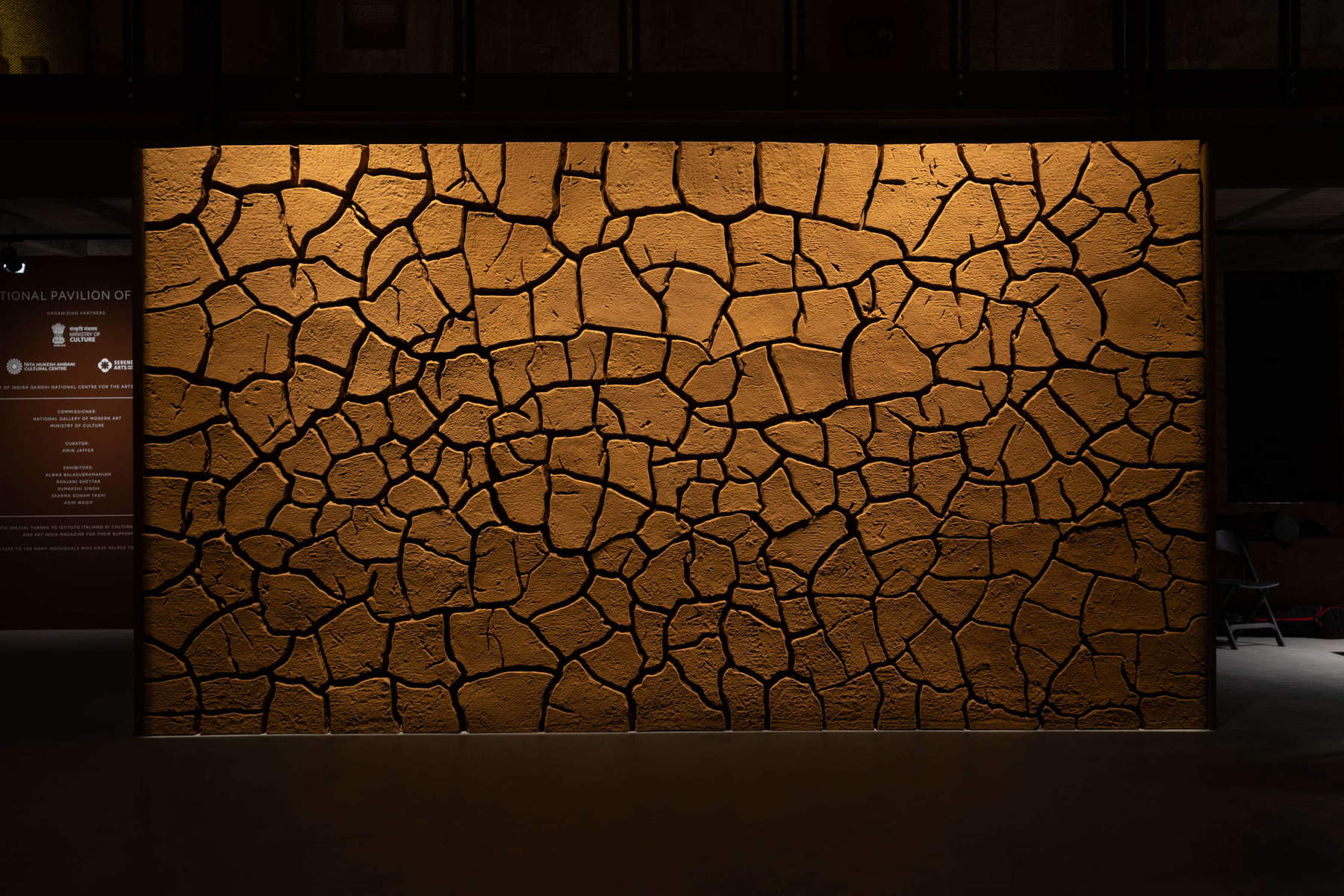
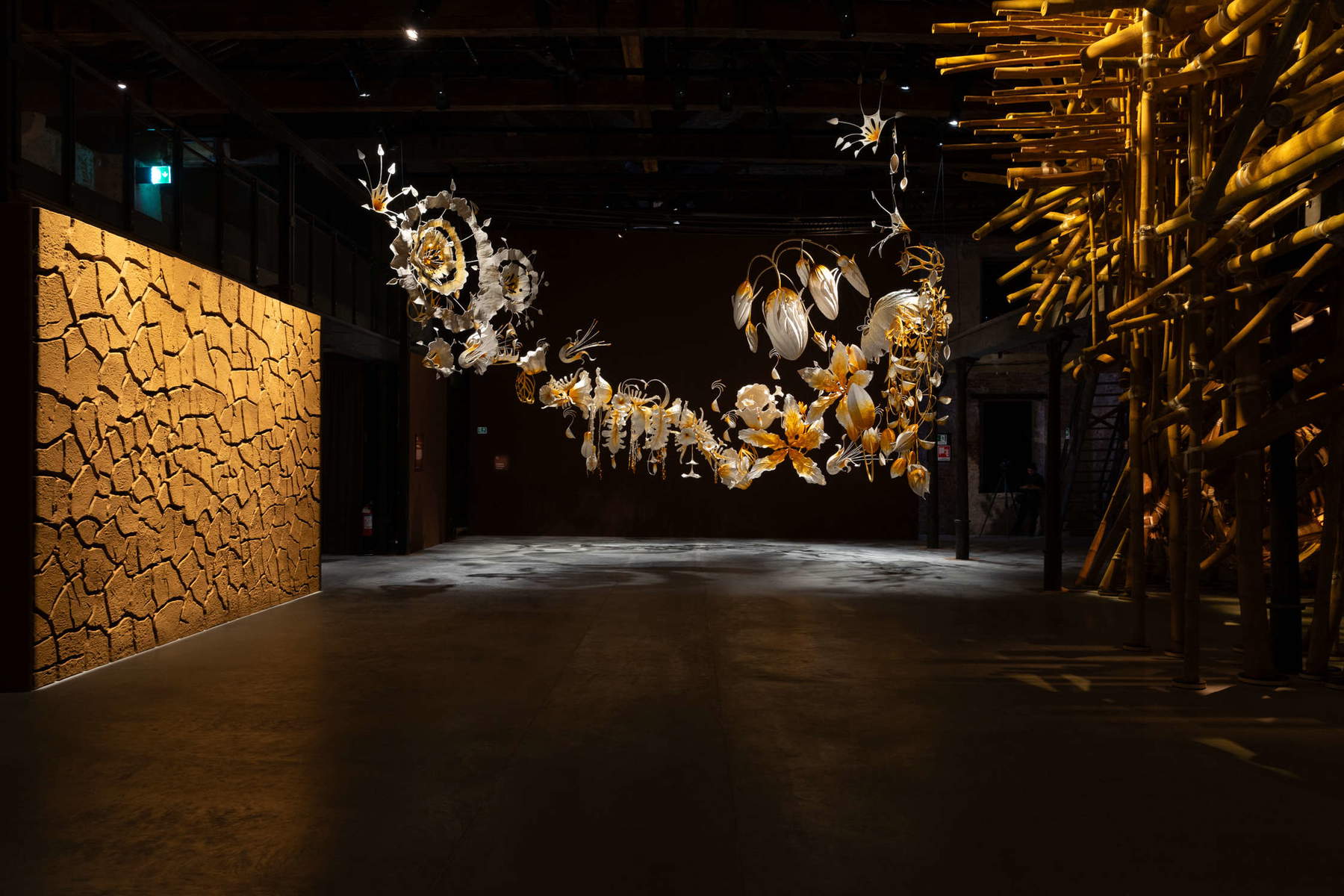
Within the Pavilion, home appears fragmented, suspended, vulnerable or incomplete. It is never presented as a final object, but as a continuous process of construction, repair and reinvention. A condition meant to reflect the precariousness of the present and the need to actively preserve memory and identity. The works of the five artists develop this reflection through different languages and materials. Alwar Balasubramaniam works directly with the land of rural Tamil Nadu, the region where the artist lives and works. For Venice he presents two large sculptural panels made from local soil marked by natural cracks and fractures produced by drying and the action of time. The surfaces become material evidence of erosion, transformation and resistance.
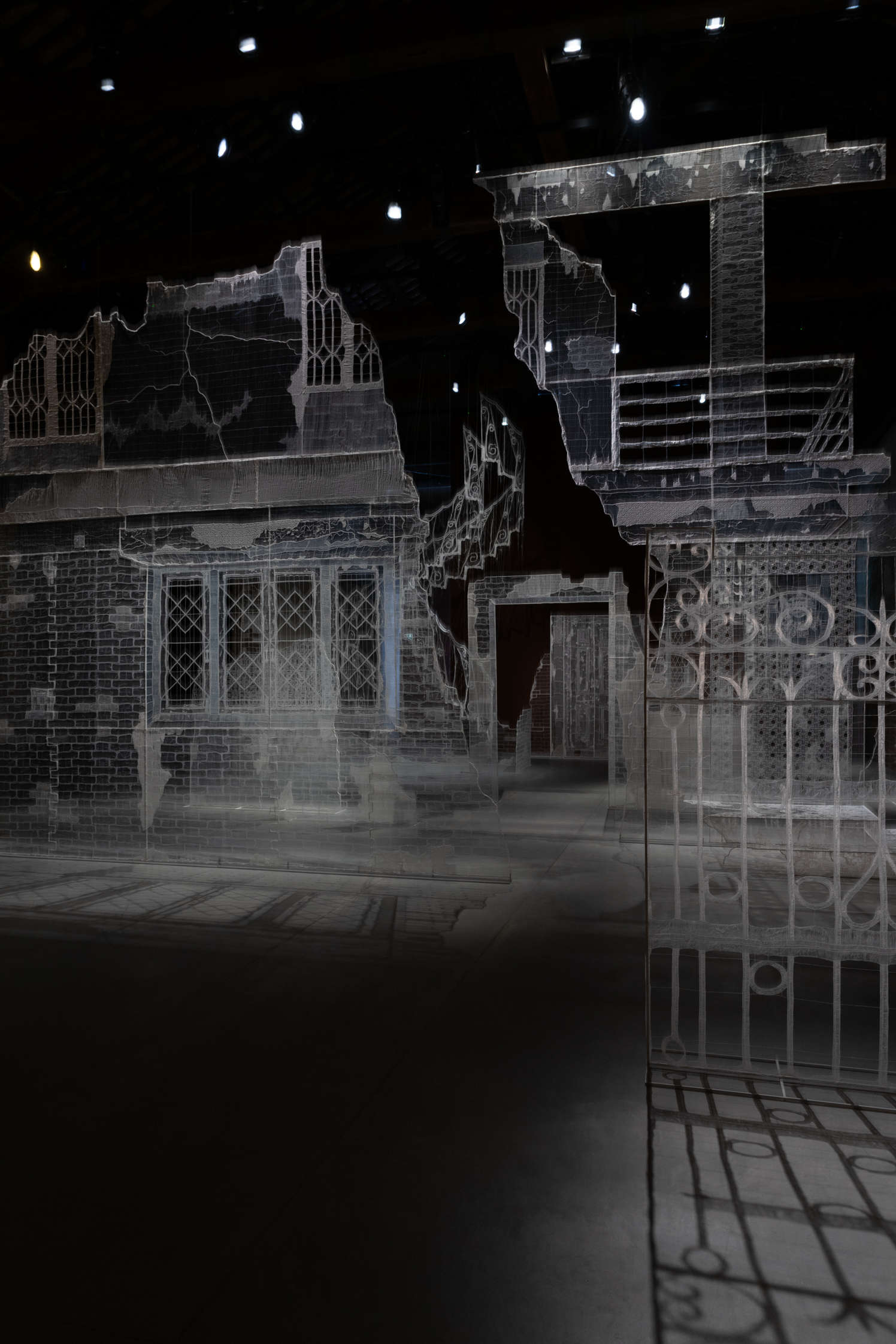
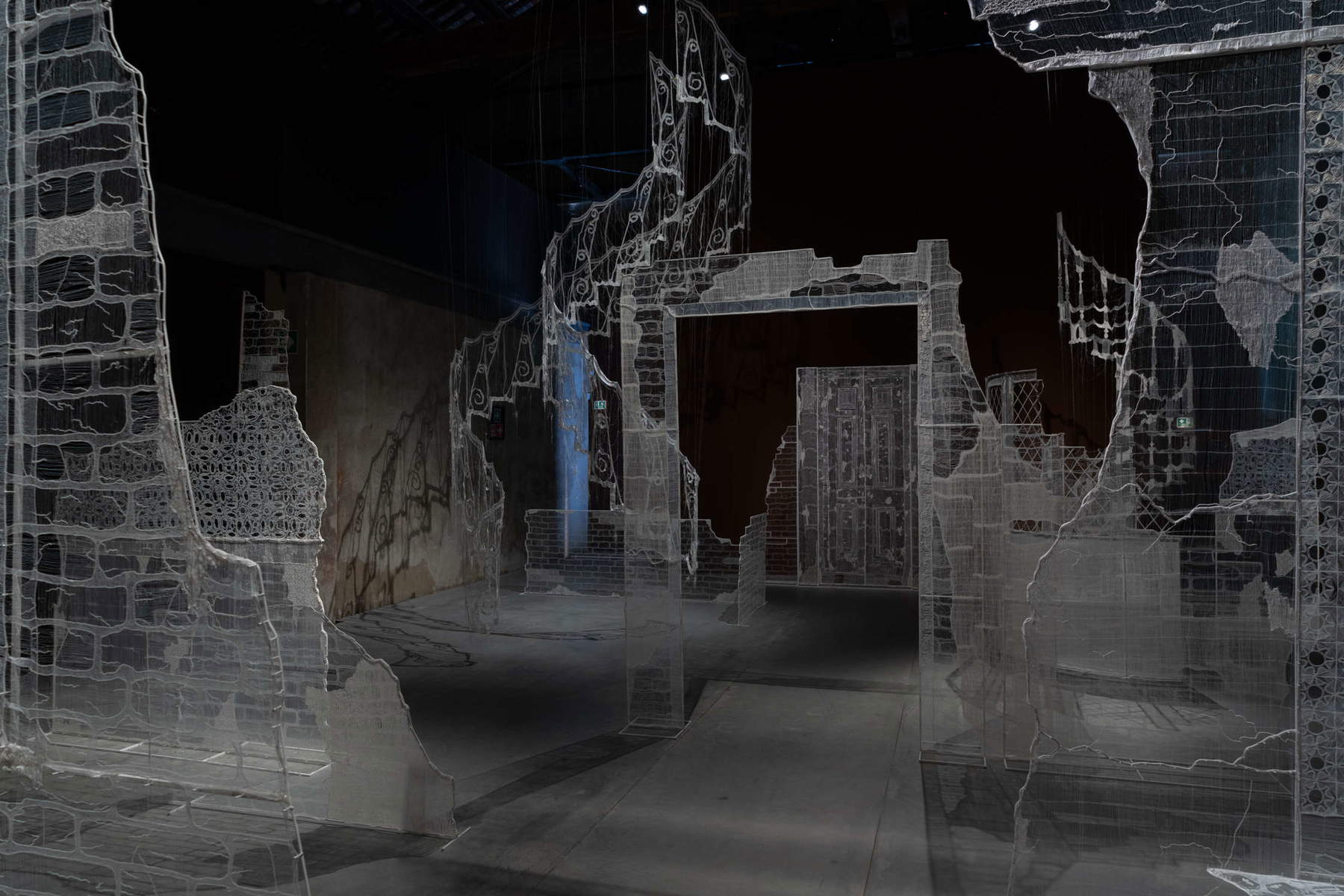
If Bala starts from the ground beneath his feet, Sumakshi Singh works instead onabsence. The artist reconstructs a life-size demolished family home in New Delhi using thread and embroidery. Instead of solid walls appear light lines, suspended structures that evoke a ghostly presence. The house exists only in memory and in the gesture of reconstruction. Embroidery, deeply rooted in Indian domestic and craft traditions, also takes on an affective and generational value here. Indeed, Singh links her work to the women of her family, who embroidered together as a shared practice of relationship and transmission. In a society where urban redevelopment continually erases spaces and neighborhoods, the work becomes a gesture of resistance against the disappearance of places.
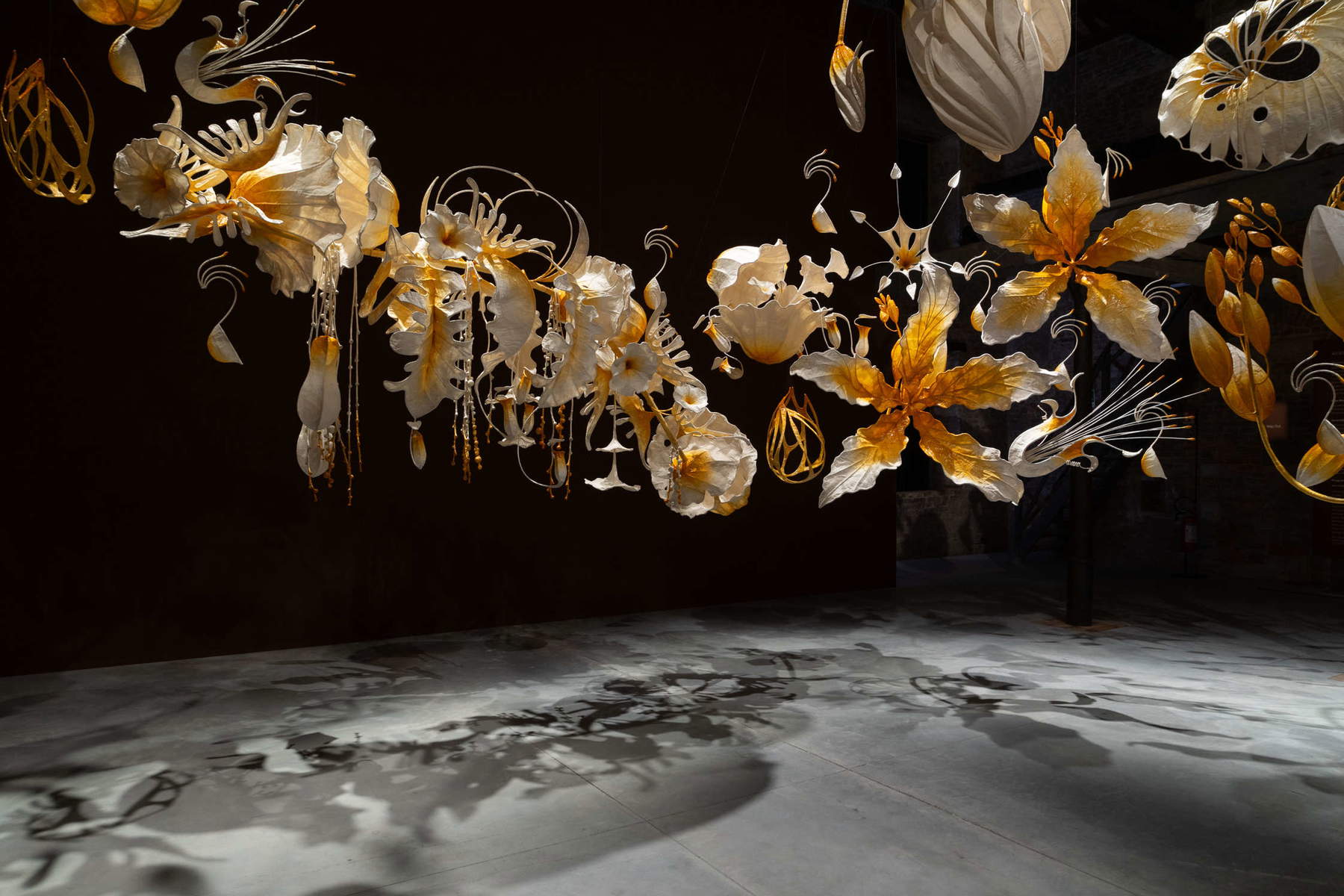
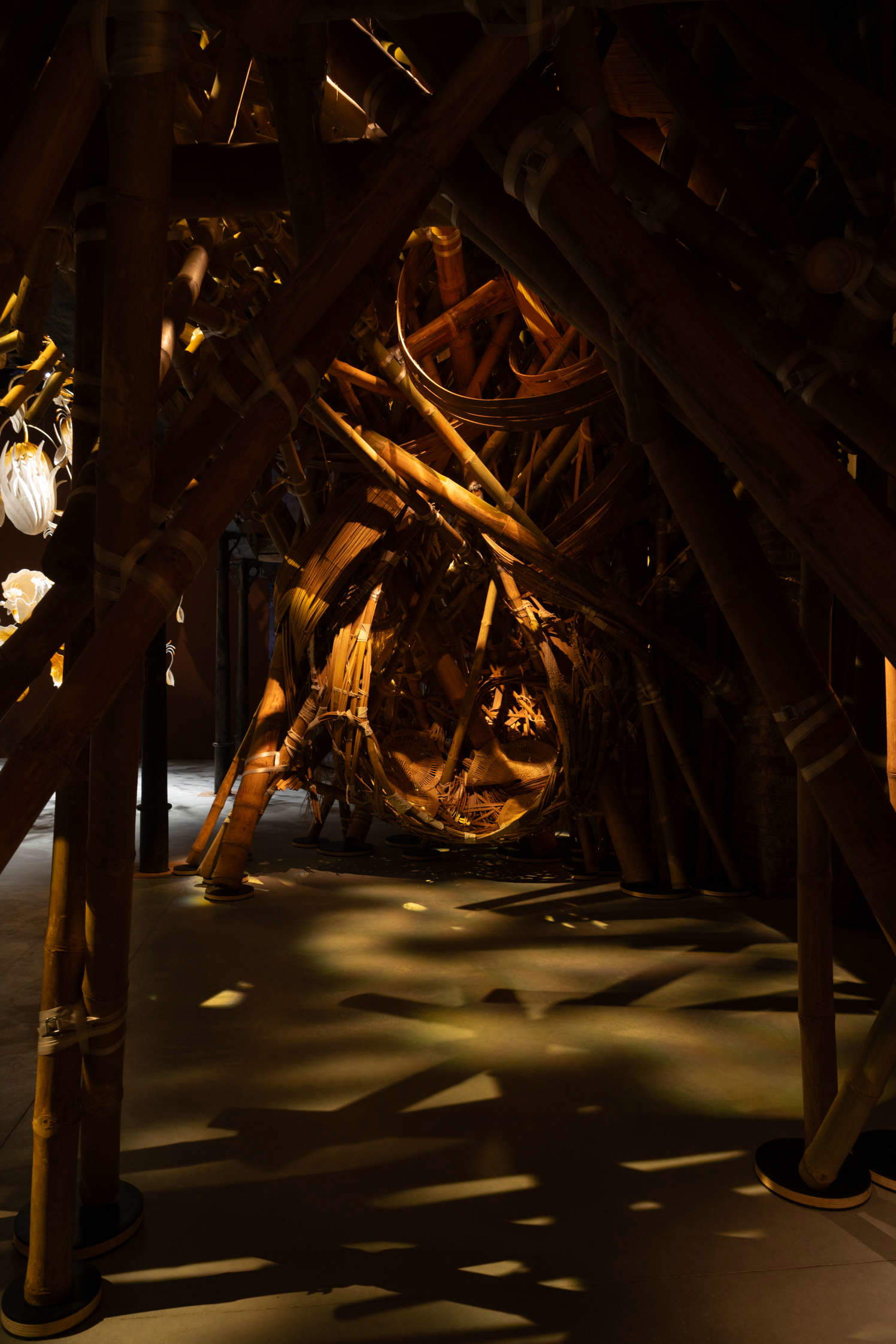
Ranjani Shettar also addresses the theme of memory through manual labor and relationship with nature. Her suspended installations, inspired by flowers and organic growth processes, seem to defy gravity and invite the audience to move within a conceptual garden-like space. Flowers and gardens occupy a central role in Indian domestic and spiritual culture, linked as much to religious devotion as to daily rituals and family celebrations. Shettar translates these references into slow and patient sculpture, built through manual processes that oppose the speed of contemporary industrial production. In his works, the home becomes a rhythm of care, repetition and attention, almost like the elaborate preparation of a traditional meal.
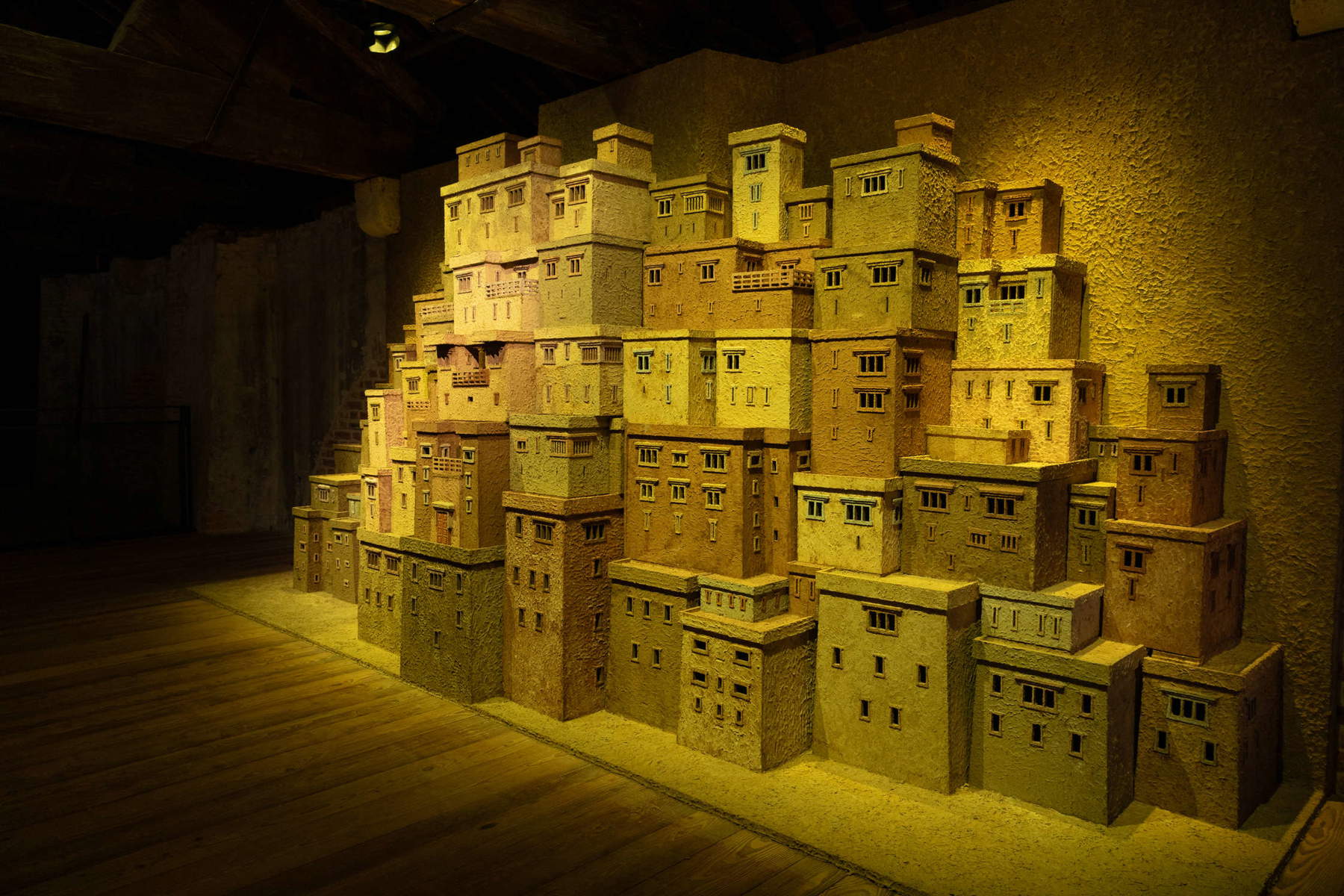
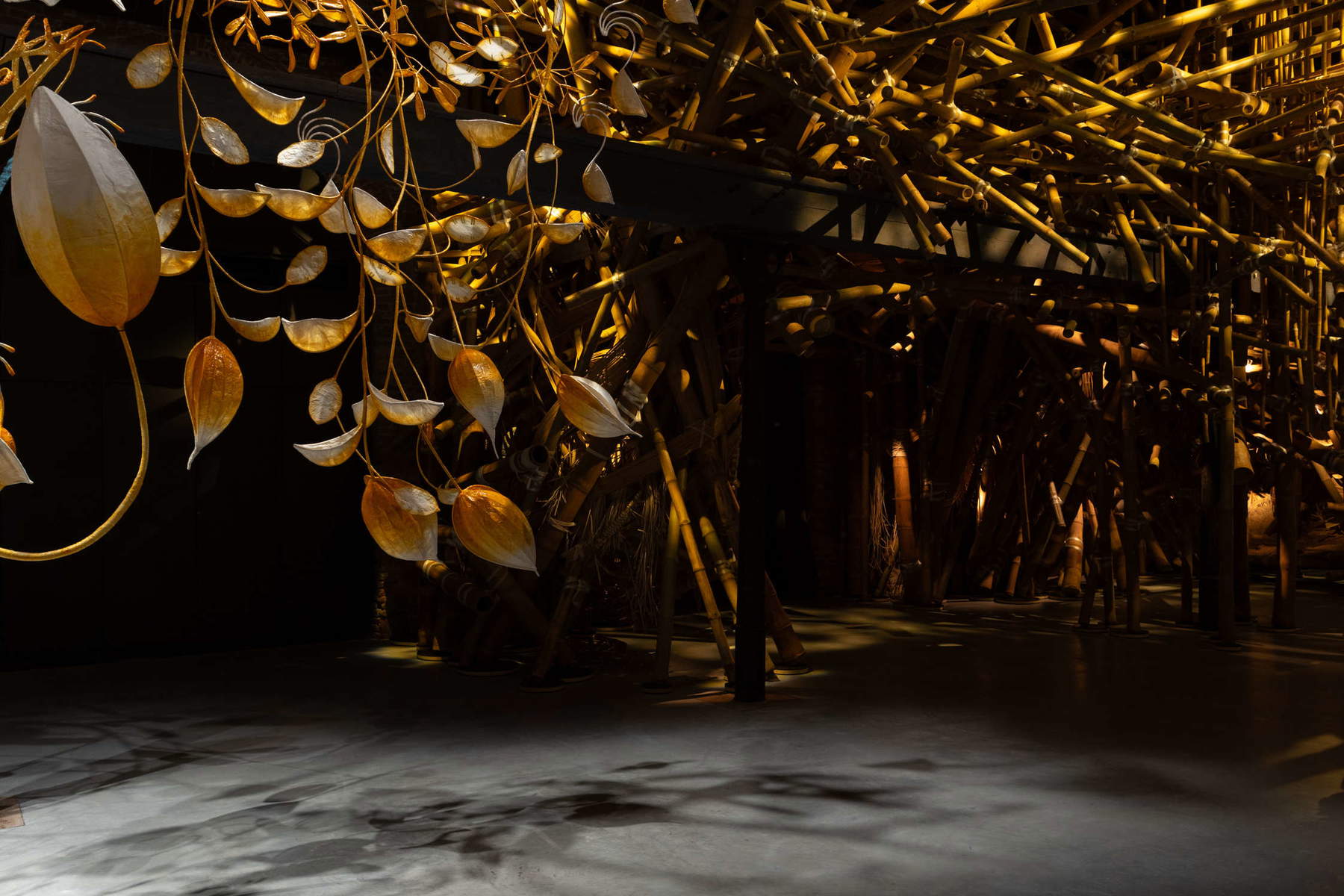
In contrast, Skarma Sonam Tashi ’s work brings attention back to the traditional architecture of Ladakh and the threats posed by new construction technologies. Using papier-mâché, a fragile and lightweight material, the artist creates forms that evoke Himalayan dwellings built historically in close relationship to the environment and climate. Ladakh’s traditional architecture, based on unfired earth, thick walls and compact structures, is gradually disappearing under the pressure of new building patterns and industrial materials. Tashi’s works appear delicate and temporary, but they hold the weight of cultural memory and raise urgent questions about the sustainability and continuity of local communities.
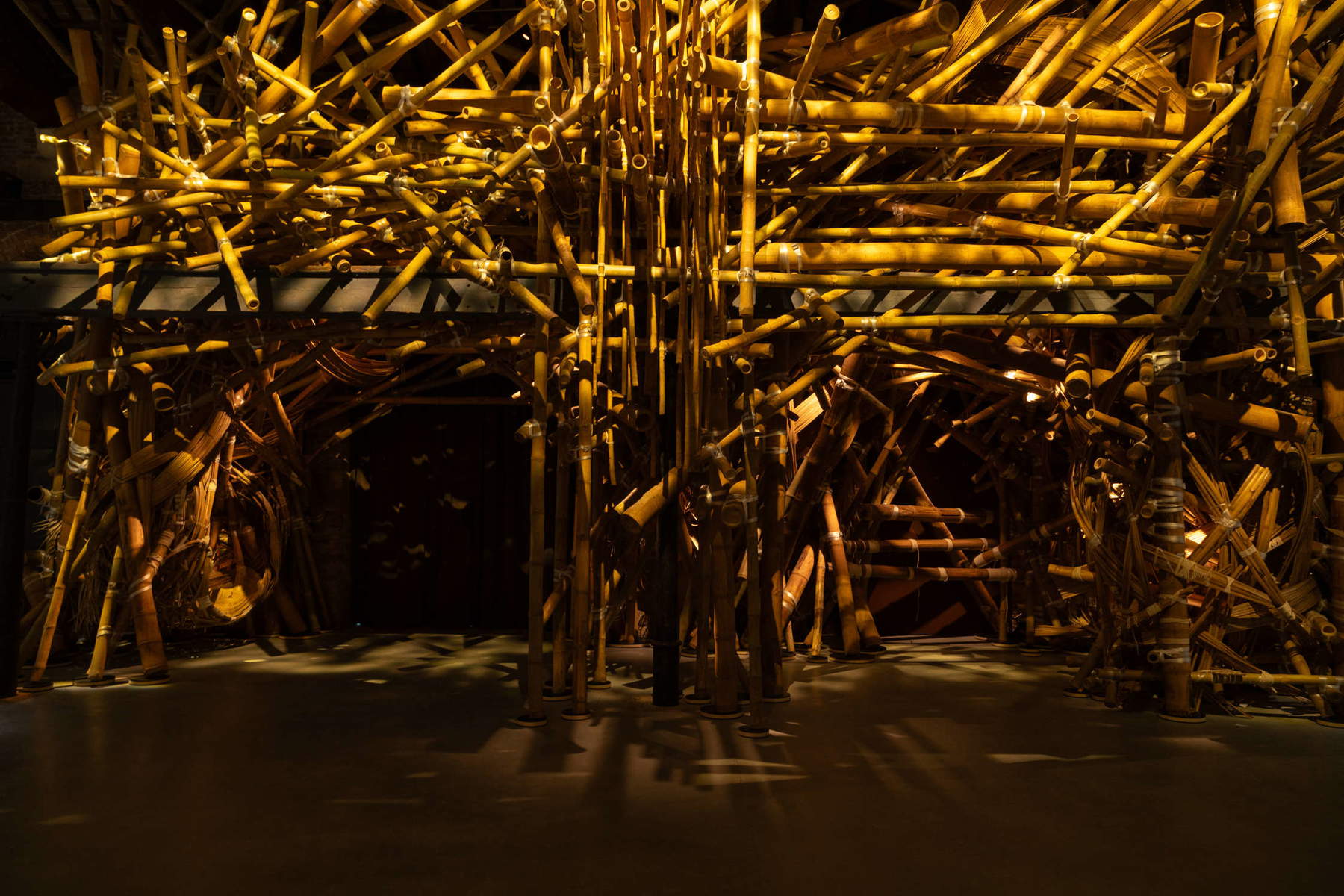
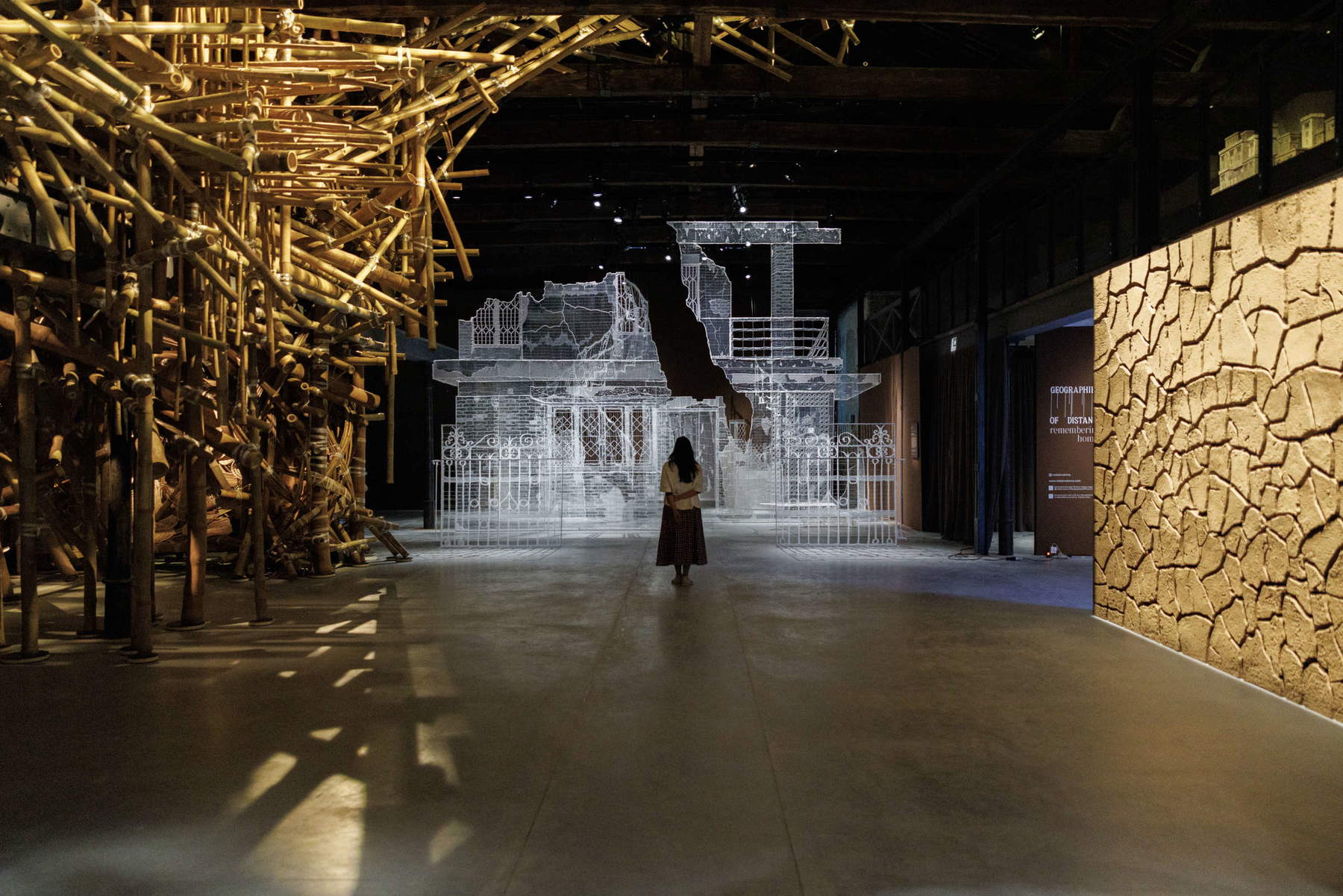
Introducing a more explicitly urban dimension, on the other hand, is Asim Waqif, who creates a large bamboo installation inspired by the scaffolding found on construction sites in contemporary Indian cities. Flexible, temporary and continuously reconfigured structures that support buildings under construction while remaining almost invisible in official architectural narratives. Bamboo, a material historically used in India for dwellings, musical instruments, tools and ritual objects, becomes a metaphor for adaptability and transformation. Waqif’s installation suggests a city in perpetual construction, where change appears inevitable and continuous. Alongside the Pavilion’s more fragile works, its structures almost take on the role of an invasive force that accompanies and at the same time threatens the collective past.
The exhibition project is accompanied by an extensive performance program produced by Serendipity Arts and distributed between May and November 2026. Music, storytelling, movement and interdisciplinary interventions will activate not only the Pavilion but the entire city of Venice through site-specific events inspired by the theme “In Minor Keys” and Indian cultural traditions.
During the inaugural week, the program includes a series of performances directed by composer and percussionist Bickram Ghosh, a leading figure in contemporary Indian classical music. Events take place at different venues around the city and even on the water, starting at the Rialto Market. The schedule includes “Currents of Return” on May 6, appointments at the Golden Tree Foundation on May 7, “Sangam: A Tapestry of Voices” at Palazzo Diedo on May 8 and “Home and Beyond” on May 9 again at the Rialto Market.
|
| India returns to the Venice Biennale with an exhibition on memory and the idea of home |

Warning: the translation into English of the original Italian article was created using automatic tools. We undertake to review all articles, but we do not guarantee the total absence of inaccuracies in the translation due to the program. You can find the original by clicking on the ITA button. If you find any mistake,please contact us.


























 IT
IT FR
FR DE
DE ES
ES CN
CN