





Kurdish-Turkish artist Ahmet Güneştekin returns to Italy with a new solo exhibition, following his recent show at the National Gallery of Modern and Contemporary Art in Rome. Entitled Sessizlik / Silence and curated by Sergio Risaliti, the exhibition, which can be visited from May 6 to Nov. 1, 2026, coincides with the launch of the activities cultural activities of the Güneştekin Foundation at Palazzo Gradenigo in the Castello district of Venice, which was purchased and underwent two years of restoration by the artist.
The exhibition unfolds as a complex device between sculptures and paintings, distributed among the ground floor, second floor and outdoor spaces of the palace. It features eleven bronze sculptures and as many oil paintings, previously unseen works made in Güneştekin’s workshops in Istanbul. The sculptures, large in size up to more than three meters in height, are conceived as site-specific works and depict a diverse community of people in different poses. At the entrance of the building, a female figure greets visitors, recalling the ancient decorations of facades and noble palaces.
Many of the sculptures depict workers, wearing construction clothes and holding tools, whose physiognomies are inspired by the workers involved in the palace’s restoration. Some appear tired or absorbed, confused among the people moving through the halls. Other figures hold objects important to the artist, such as animals or skulls, symbolic elements also present in the paintings, creating a sense of temporal suspension between past and future. Other figures portray anonymous visitors mingling with the audience, in a play of glances between art and life. One sculpture sitting on the ground highlights sloth or indifference, contrasted with the active presence of the other figures.
“With this spirit,” explains exhibition curator Sergio Risaliti, “Güneştekin gathers the scraps and ruins of ancient civilizations, cares for the fragments and remains, listens to the subdued voice of the people, that of communities, with the desire to mend fractures and process wounds caused by History and Power.”
“In silence I listen to lost voices, I collect invisible memories and broken fragments,” said the artist, “art is not mere aesthetics, but an attempt to heal wounds and leave a note to the future. From my Kurdish identity, from the losses experienced by my family and my people, from the silence of those who have lost their homes and their language, I have learned that art speaks above all where words do not reach. Sometimes it is the light, sometimes the weight of bronze, sometimes the emptiness itself. Each of these is a different language of silence. With my ’silence’ I try to make visible the memory, resistance and rebirth that resonate there. My art was born with the decision to listen to forgotten or suppressed voices and vocabularies, to recover fragments to found new worlds and new communities.”
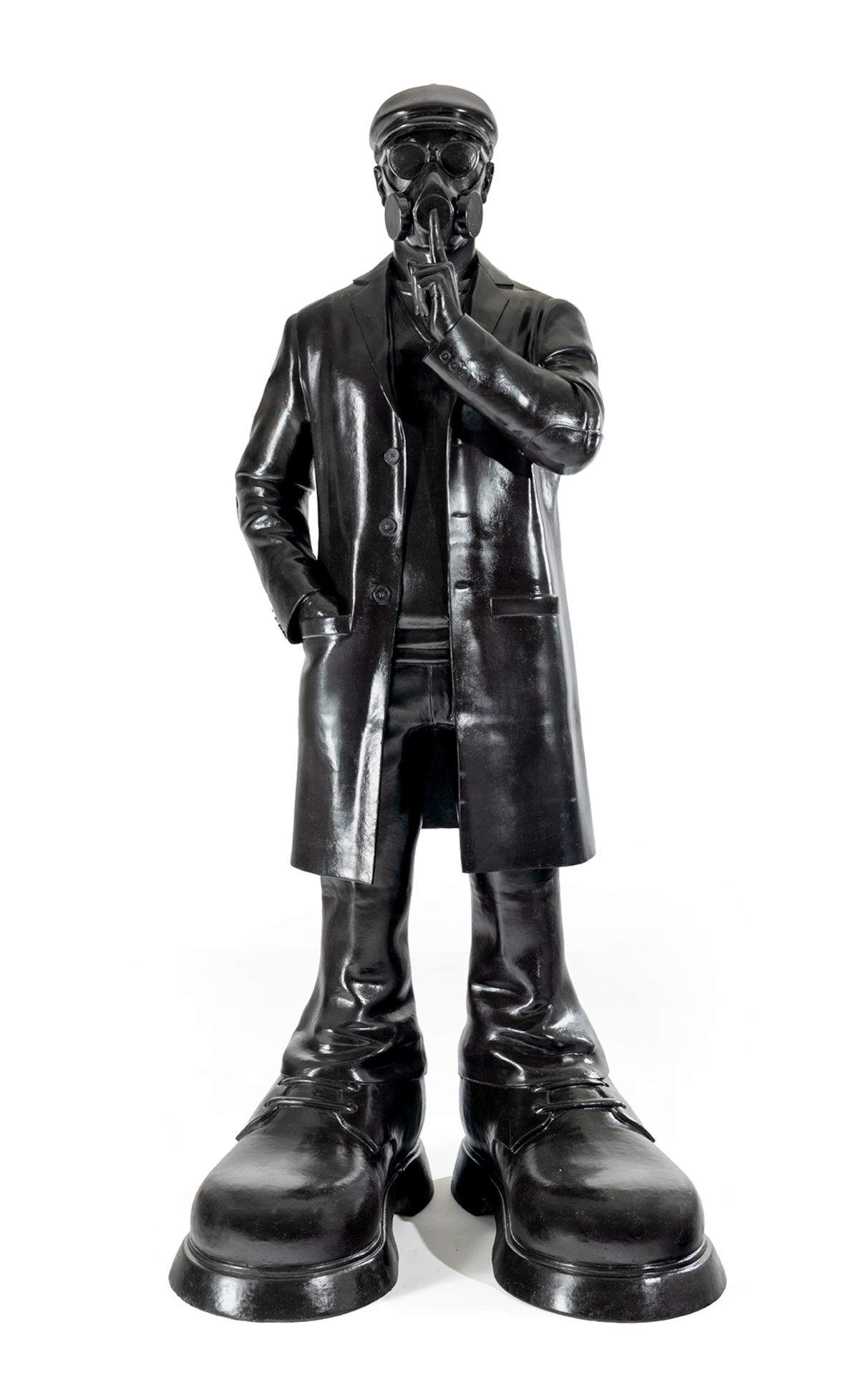
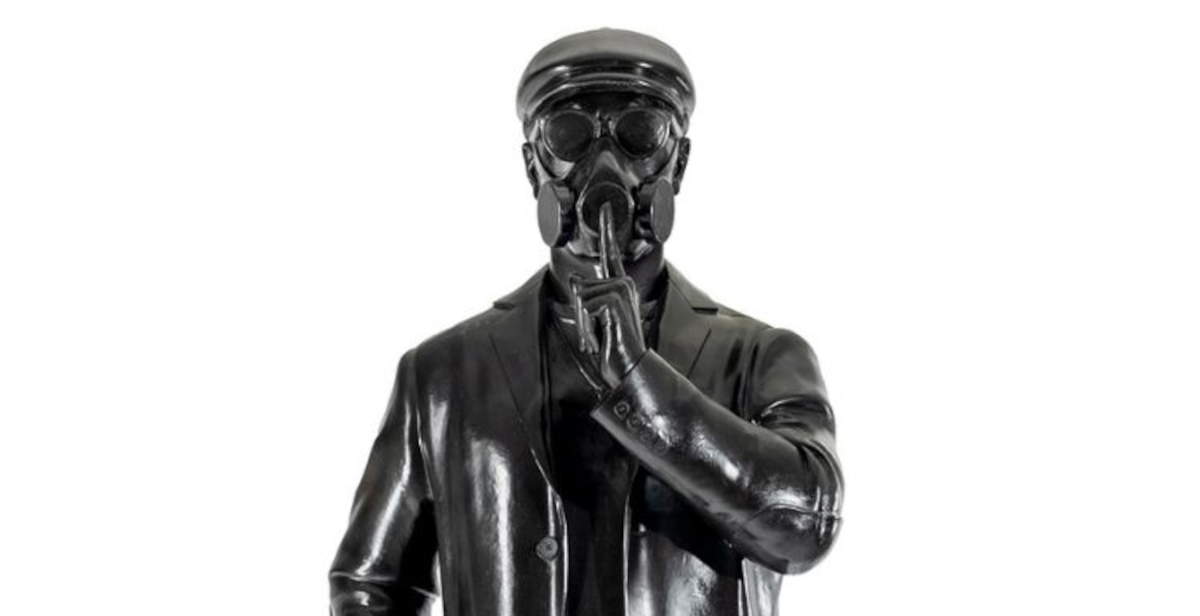
On the ground floor is a sculpture over two meters tall:Güneştekin’s self-portrait. The figure invites silence, with the typical gesture of the god Harpocrates, separating external confusion from the contemplation required inside the palace. Silence takes on multiple meanings: it is a call for concentration, for listening to those who suffer or are silenced, and it represents the condition of peoples deprived of their language and culture. Among the works on display is a reference to the Alphabet Sarcophagi, already presented in Rome and part of GNAMC’s permanent collection.
Alongside the sculptures, eleven large paintings made in oil on canvas and other materials show a visual language that combines abstract and geometric elements with symbols of ancient Mediterranean and Mesopotamian civilizations. The paint surface is worked through a method that segments the oil color with small strokes, creating a luminous vibration that lends depth and musicality to the work. Restored doors from Anatolian markets and villages are integrated in the center of the paintings, decorated with floral and geometric motifs and embellished with mythological figures, deities and symbolic creatures such as the Arabian phoenix or peacocks, serving the function of interweaving different times and geographies.
Bronze figures dialogue with doors and paintings, merging the surreal plane with the abstract and metaphysical. The staging creates a shared universe between sculpture and painting, reality and abstraction, social and transcendental dimensions. The iconographic syncretism, combined with the plurality of techniques, also takes on a political significance, suggesting coexistence and dialogue between peoples and communities. Sessizlik / Silence brings together the main themes of Güneştekin’s production of the past three decades: memory and reminiscence as tools of resilience and rebirth, interweaving Mediterranean and Anatolian myths, marginal stories and ancient symbols, fables, melodies of the oppressed and fugitives, chronicles of resistance, rituals and fantasies. The works foster a confrontation between the individual and the vicissitudes of societies, placing memories and emotions in the collective memory and cultural heritage of ancient civilizations, inviting shared participation.
On the occasion of the exhibition, the first two restored floors of Palazzo Gradenigo can be visited. Work on the five floors, led by Studio Torsello, will continue until 2026, with final opening planned for 2027 as the Italian headquarters of the Güneştekin Foundation. The foundation’s program includes exhibition events and international exchanges in the field of interdisciplinary education, with the goal of transforming the building into a new hub for contemporary arts in Venice. The exhibition is supported by Yıldız Holding and realized in collaboration with 21Art Gallery.
 |
| Venice, Ahmet Güneştekin on display with "Sessizlik / Silence" at Palazzo Gradenigo |

Warning: the translation into English of the original Italian article was created using automatic tools. We undertake to review all articles, but we do not guarantee the total absence of inaccuracies in the translation due to the program. You can find the original by clicking on the ITA button. If you find any mistake,please contact us.


















 IT
IT FR
FR DE
DE ES
ES CN
CN


