



by Ilaria Baratta 15/07/2026



Categories: Exhibition reviews / Disclaimer
Nearly one hundred models and some of his most famous installations on display in Venice, in the halls of Palazzo Manfrin, illustrate how Anish Kapoor’s works come to life and how scale, material, and perception change. A review by Ilaria Baratta.
How big can an idea be? The mind can give birth to something infinitesimally small as well as something infinitesimally large. Even the most monumental work ever created can always be infinitely larger in concept, so that the idea itself manages to be even greater and even more powerful than its actual realization. Even though it may be found drawn or reproduced on a small scale—in a model, a scale model, or even on a sheet of paper. It is precisely this the most unexpected surprise of Anish Kapoor’s exhibition, organized by Lisson Gallery, which occupies the halls of Palazzo Manfrin in Venice—home to the artist’s foundation—through August 9, 2026, in conjunction with the 61st International Exhibition ofArt of the Venice Biennale: in addition to a rich selection of some of the most famous monumental works by the British artist of Indian origin (Mumbai, 1954), approximately one hundred projects spanning the last fifty years of his career are on display here. The result is not only an exhibition of his large-scale installations that transform space and alter our visual perception, but above all an exhibition exploring the genesis of the ideas behind his works, where the coexistence of completed installations and projects—both realized and unrealized—creates a dialogue between the most spectacular Kapoor of major exhibitions and the “studio” Kapoor. It is important to bear in mind, however, that at the heart of it all lies the power of the idea, even when the work is never ultimately realized.
Underlying the mirrored surfaces that invert our image, the concavities that alter our perception of space, the void evoked by Vantablack, and all those works that transform architecture and the way we view and relate to it, there are always projects, models, sketches, and simple materials with which the artist attempts to give form to an intuition.


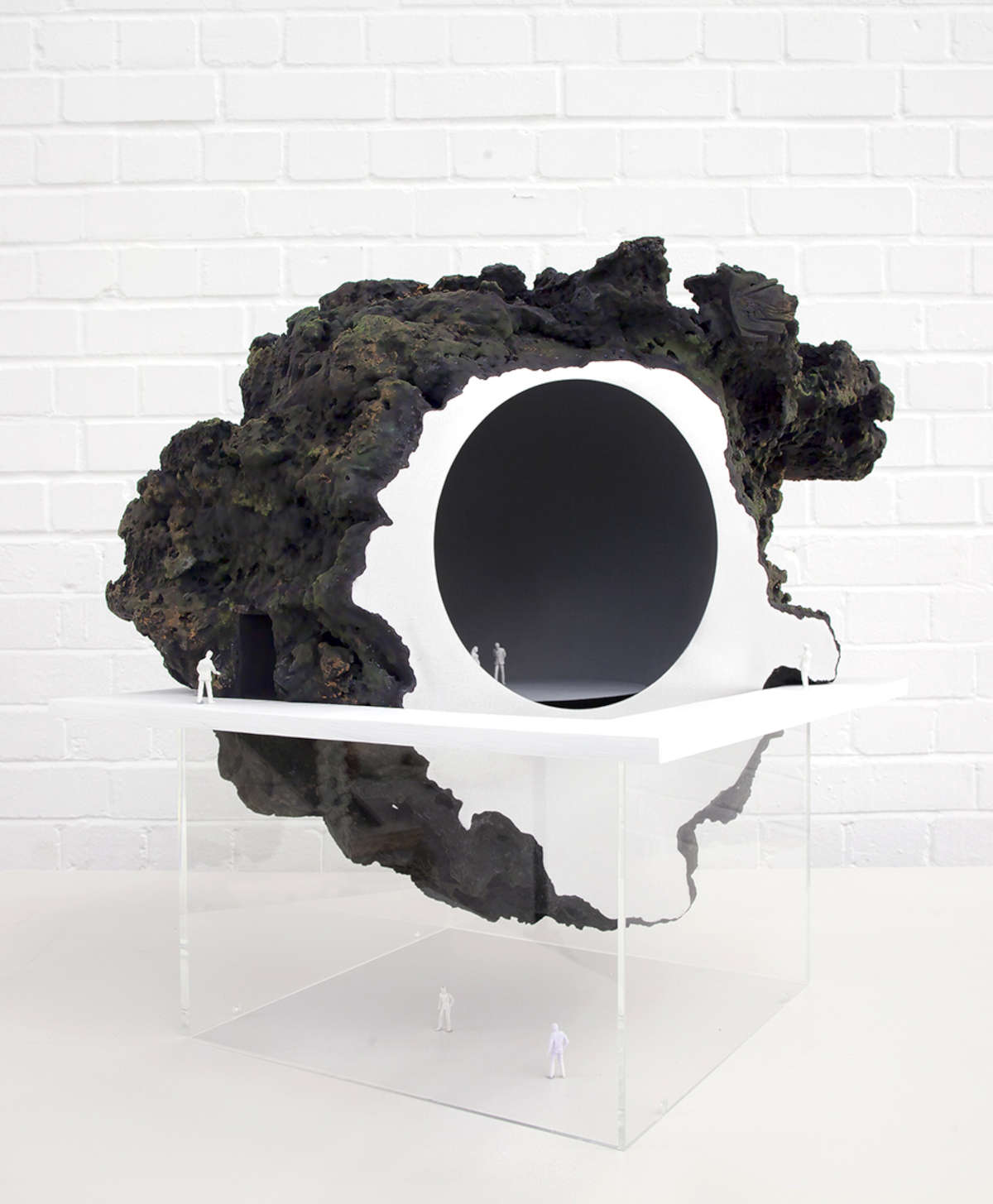
The centerpiece of the Venice exhibition is therefore the models, arranged across several rooms, on the first floor of the building, around which visitors are invited to linger and observe them from every angle, as it is possible to get a 360-degree view by walking completely around the flat surfaces (tables or floor stands) on which they rest. One is struck first and foremost by the extraordinary variety of the designs and the prolific nature of the artist’s imagination, capable of creating concave and convex forms, forms within other forms, protrusions, curves, lacerations, glossy and porous forms—black, red, earth-toned—as well as resting and suspended forms, and three-dimensional shapes that invite viewers to peer inside them, all within the most varied contexts. Among the models on display are the Meteorites, the Leviathan,the Holocaust Memorial, No Place, In Out, Earth Cinema, the Sky Garden, In The Shadow of the Tree and the Knot of the Earth VIII, and the Kissing Bridge. And it is at this point that a reflection arises: the models before us are not mere miniatures of a future or unrealized monumental work, but are the pure expression of an idea—the pure expression of the artist’s creativity. The work, in its model form, already exists. It exists, even if the large-scale work is never actually built.
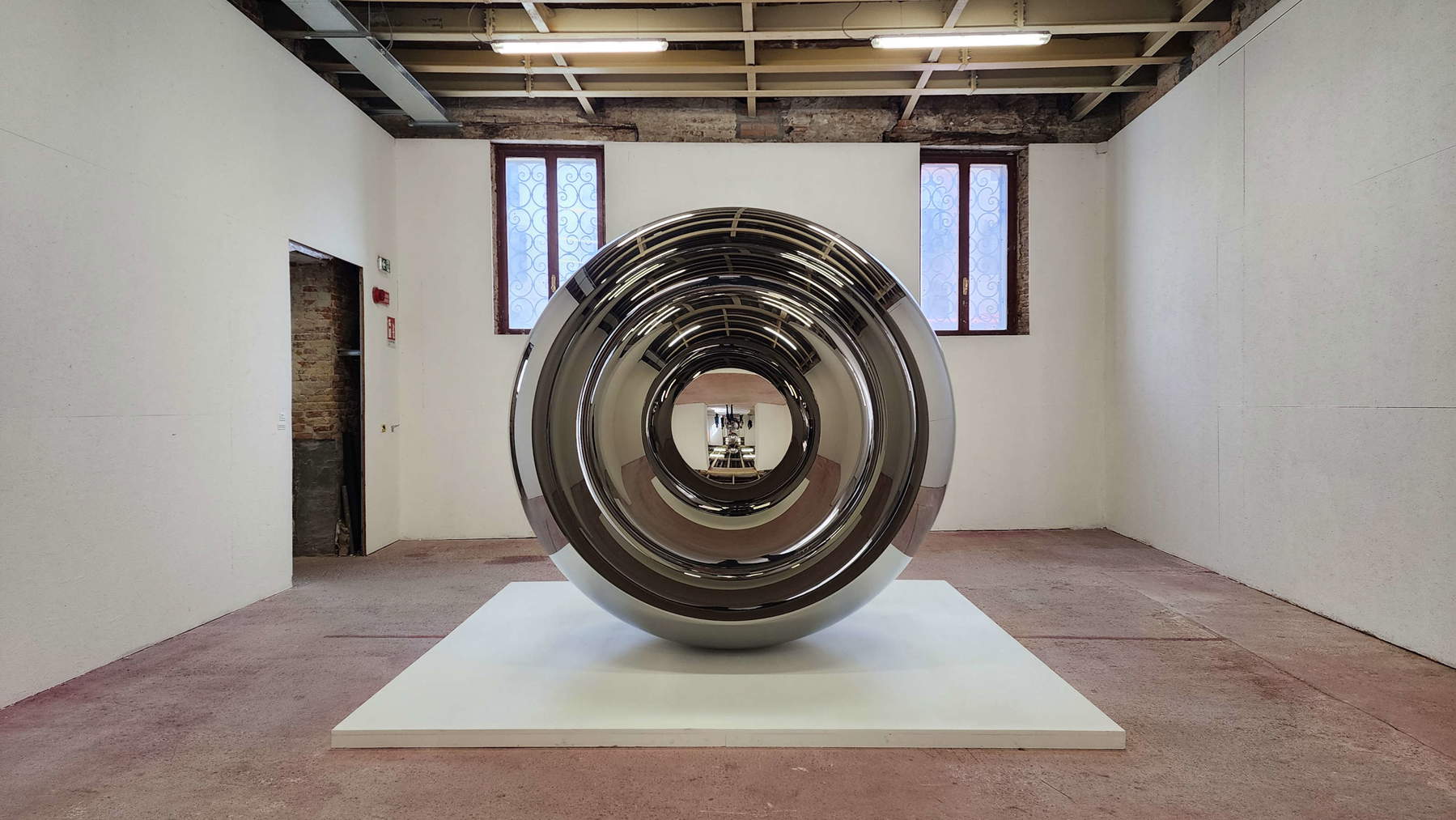
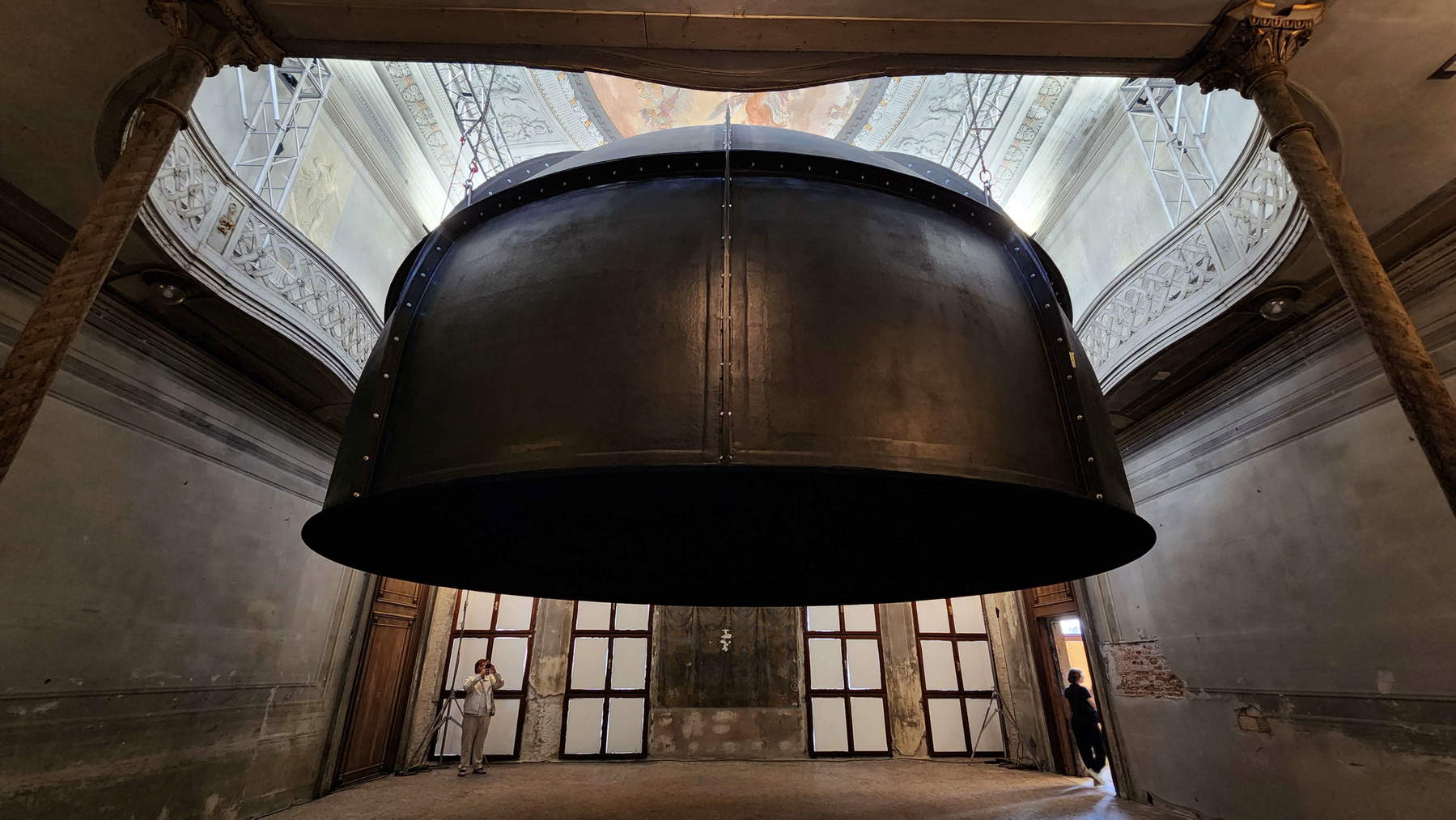
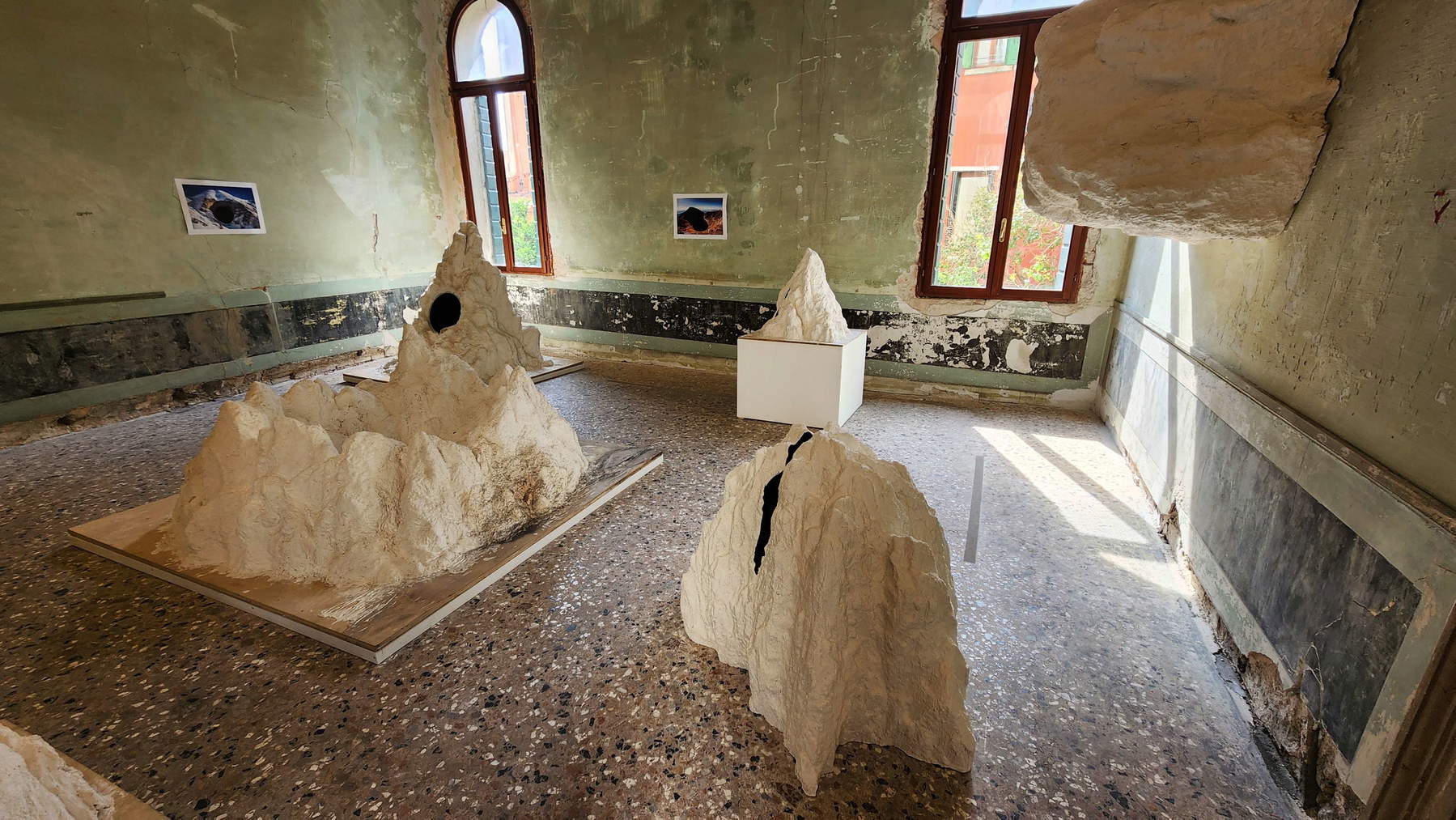
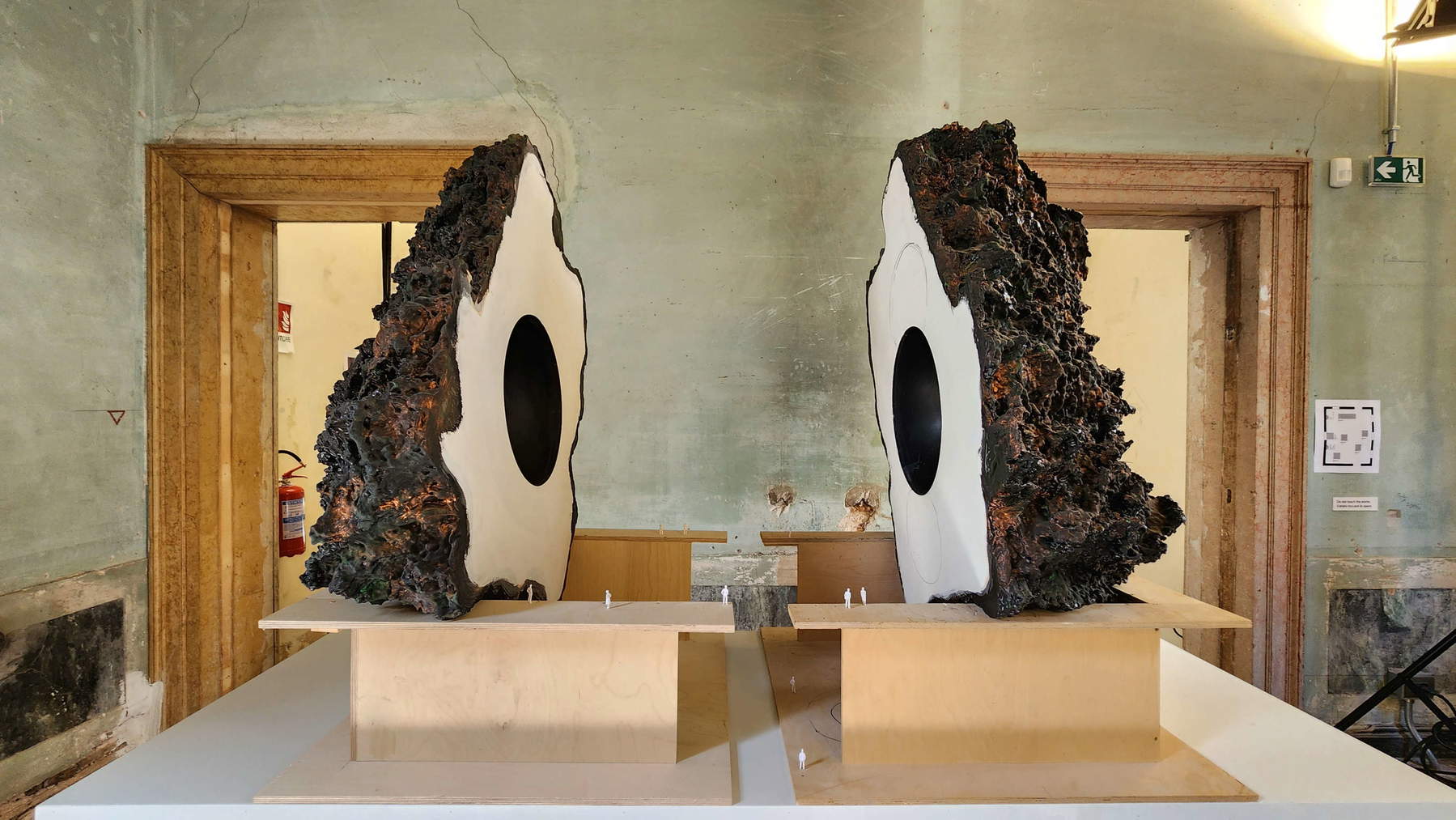
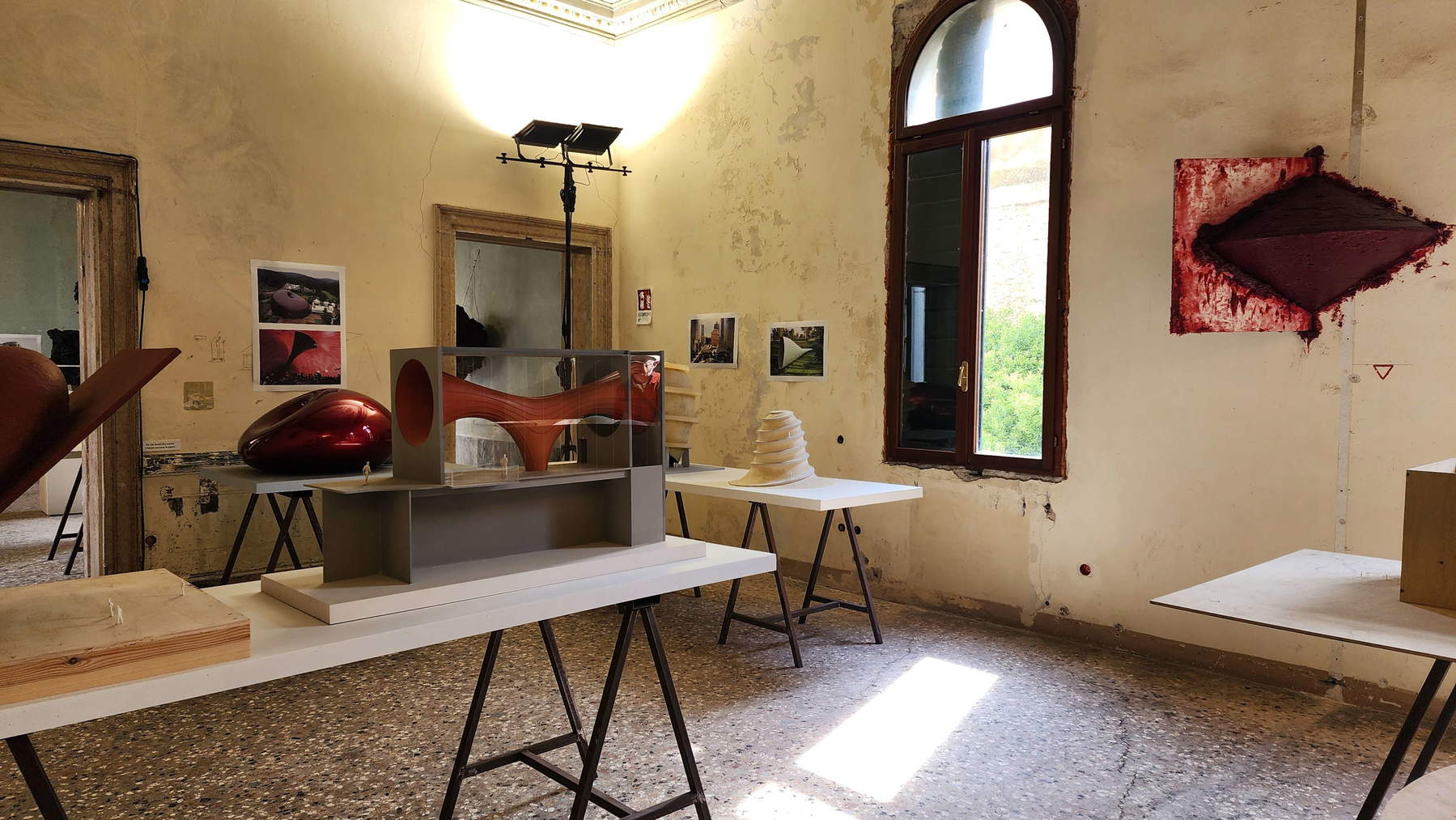
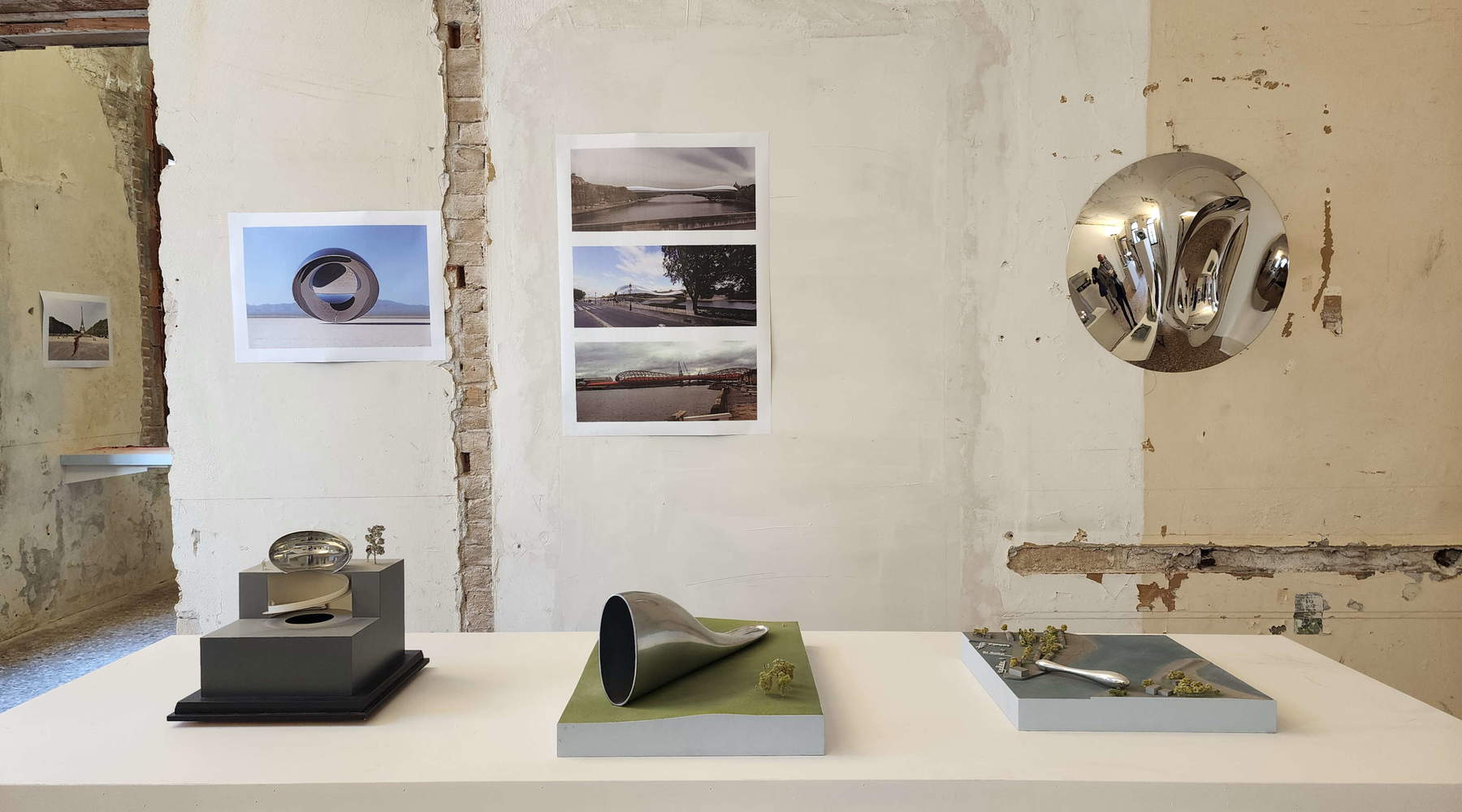
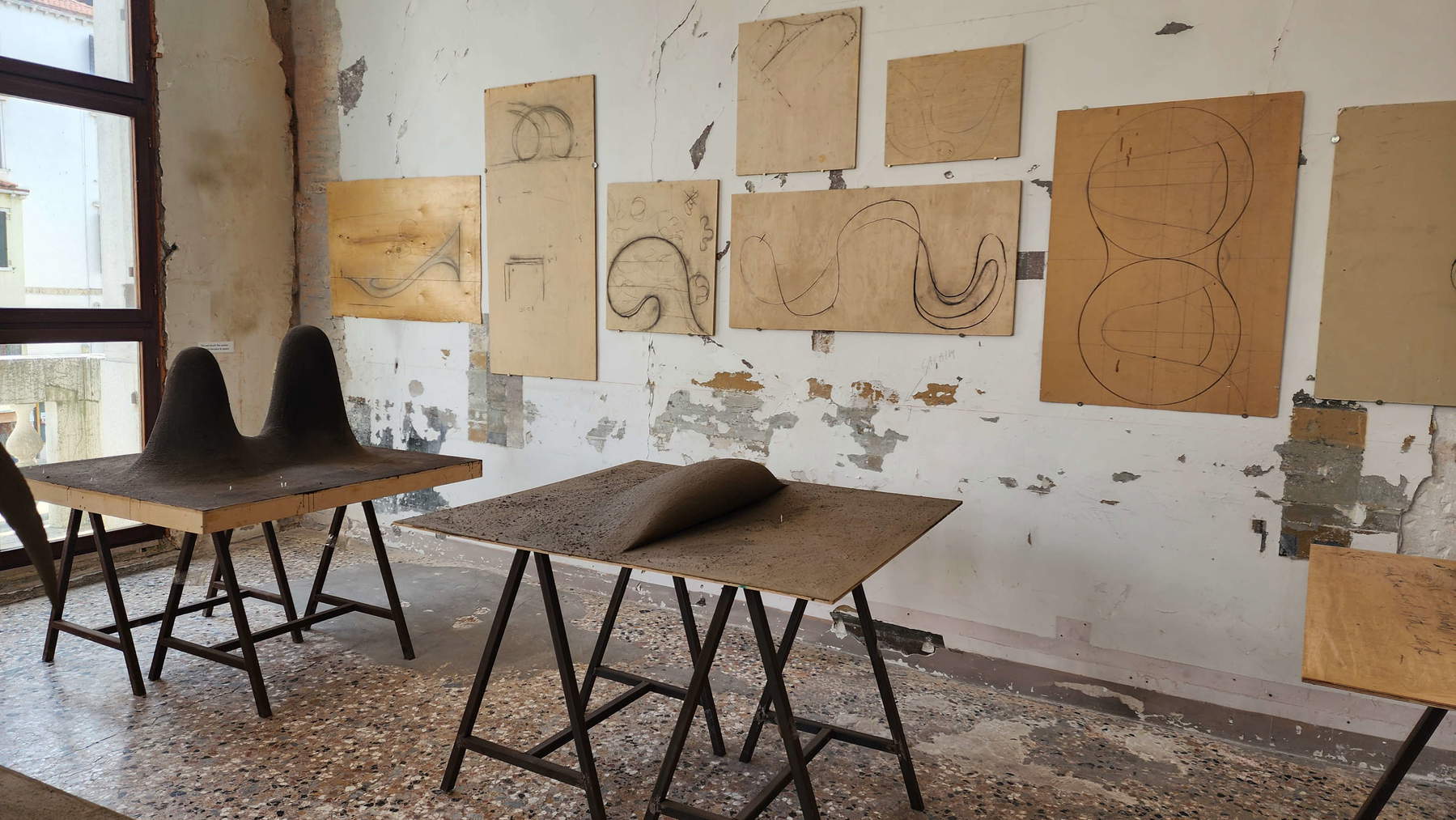
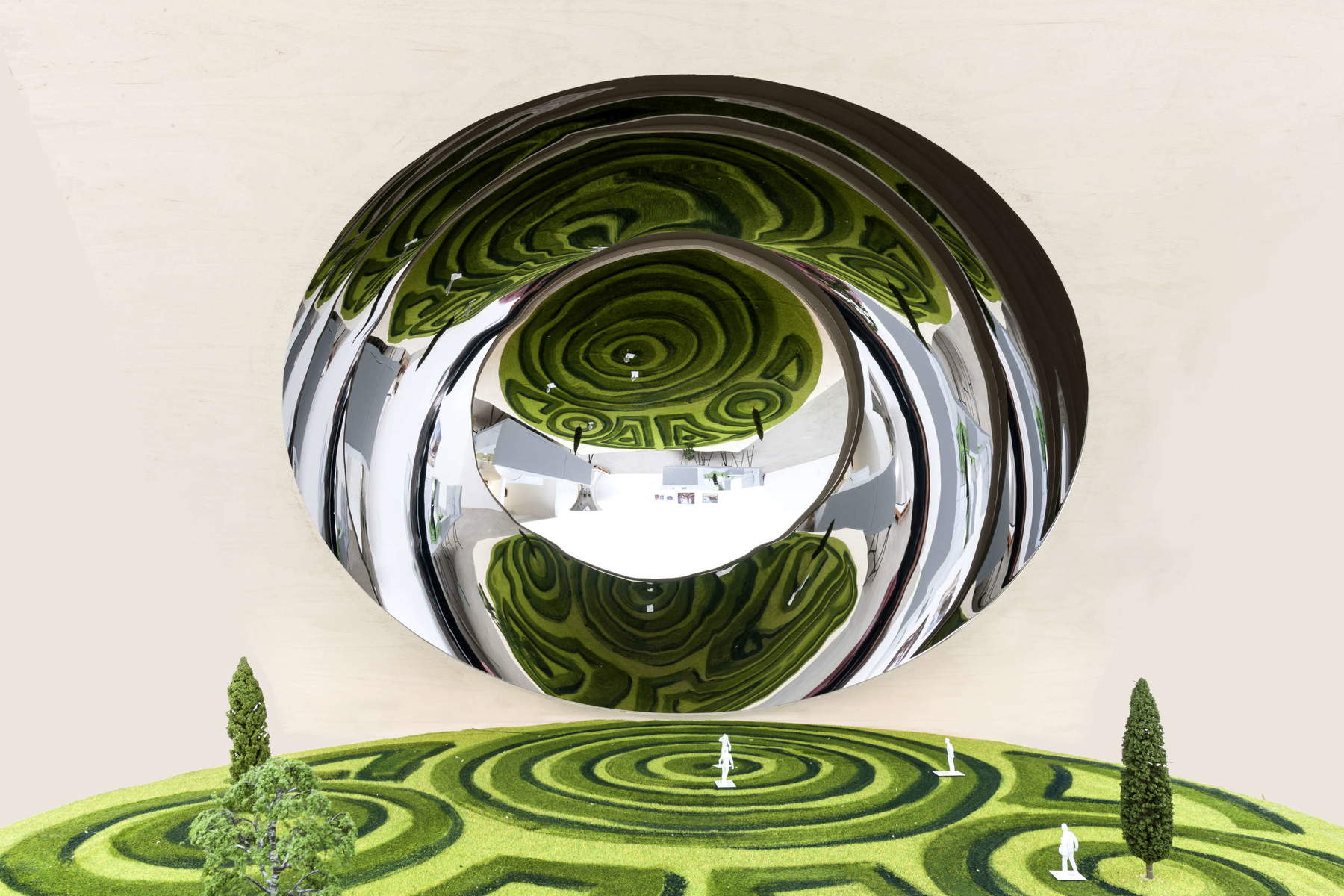
With the completion of these monumental installations, Kapoor takes another step forward: the artist does not merely transfer the models developed in his studio to a large scale; rather, what occurs is a change in scale of the original idea. The transition from model to monumental work is therefore not merely a matter of size: when an idea grows in scale, the way it relates to the viewer, to the architecture, and to the space that houses it changes profoundly. The work acquires a new presence that engages the viewer in a perceptual and bodily experience. In this sense, therefore, it can be said that monumental installations, compared to models designed in the studio, are not simply their translation into larger dimensions, but rather ideas that have changed scale and that, precisely through this transformation, have taken on new spatial, perceptual, and conceptual properties. Upon careful observation of these models, it also becomes clear that the disorientation caused by some of them is the result of a deliberate and precise design intended to guide perception and influence the way we relate to what lies before us. The void is designed,the illusion is designed, and even the sense of wonder one feels is designed. For example, it is impossible not to feel a sense of wonder in the exhibition when observing—especially from below—the monumental *At the Edge of the World*, made of fiberglass and black pigment, eight meters in diameter, suspended from the frescoed ceiling of the building, against which it stands in stark contrast. The perception is that of being very small in comparison to this large dome looming overhead: it is a clear example of what was stated a few lines above regarding how profoundly the way the viewer relates to the work changes when the scale is altered. As well as how the space that houses it is transformed.
While Kapoor is known for transforming and creating new spaces, the choice of material with which the artist designs and creates his works also merits consideration: the material, in fact, becomes an integral part of the work’s meaning and the space it generates. The pigment seems to permeate and engulf the space, as in *Blood in the Sky*, a new red work by Kapoor exhibited here for the occasion that takes over an entire room; polished, mirror-likestainless steel, on the other hand, produces the opposite effect, as it reflects the surrounding environment but renders it distorted and unstable, inverting images and perspectives and directly engaging the viewer—as one can personally experience when standing before the various Untitled works.
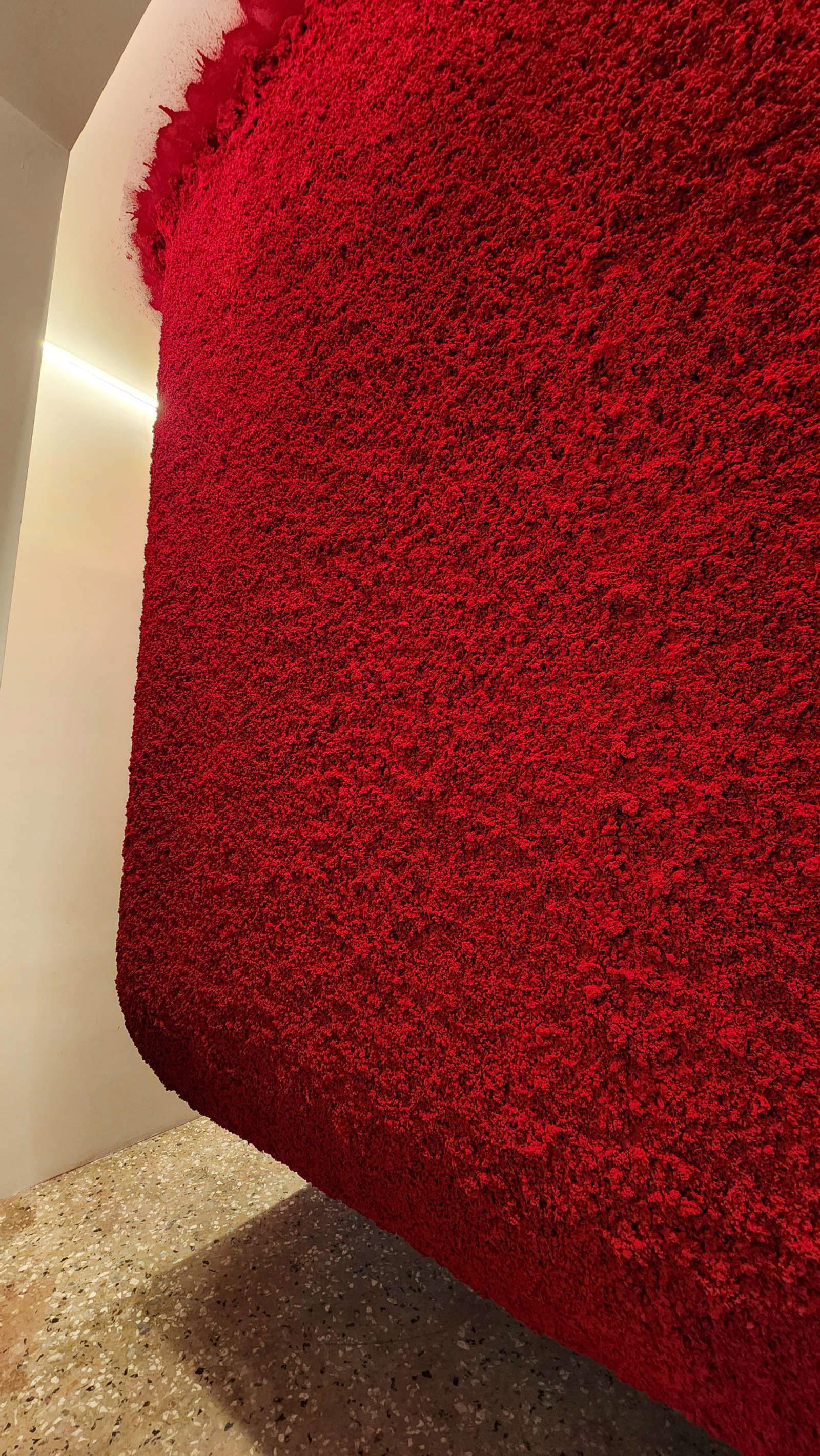
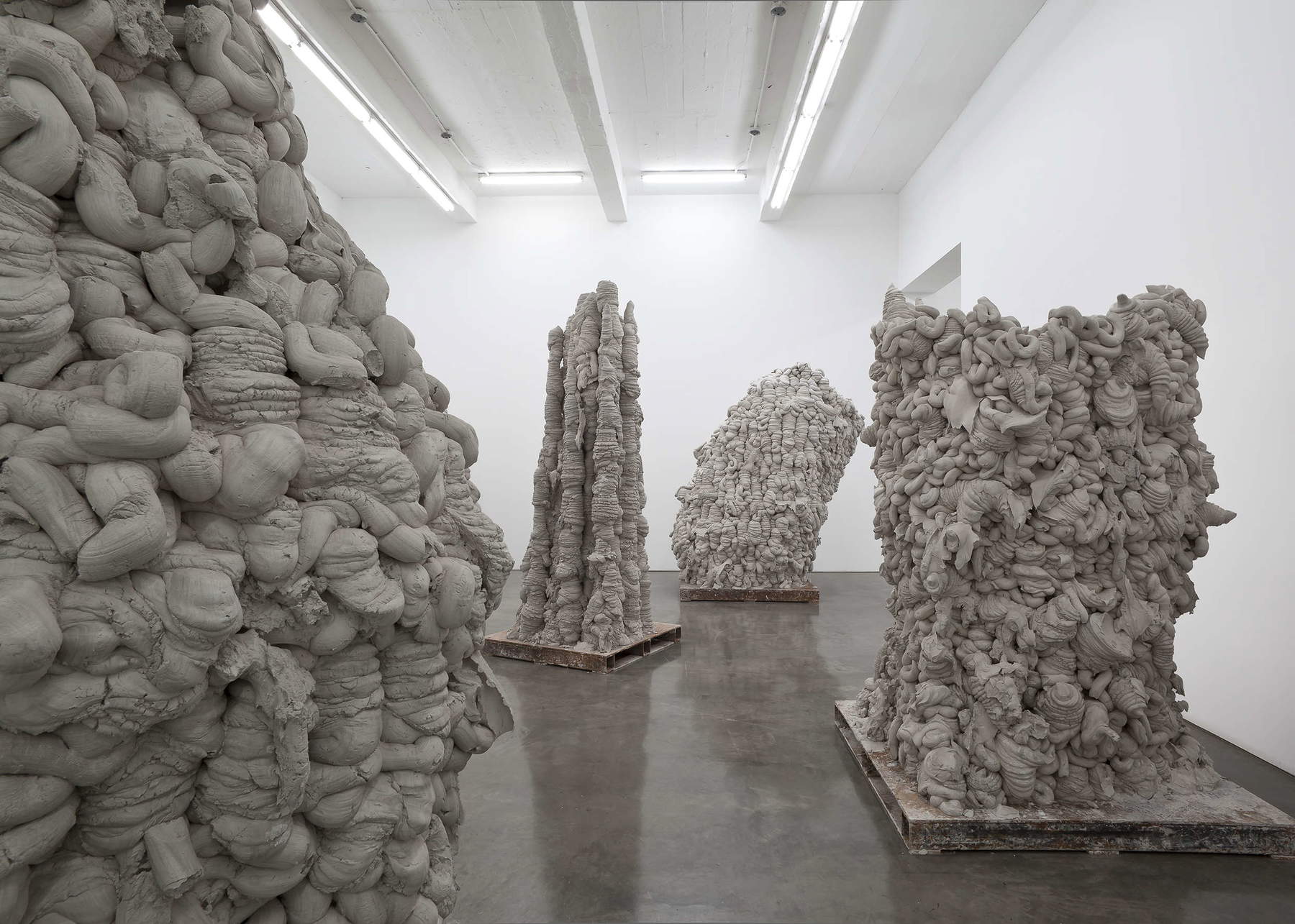
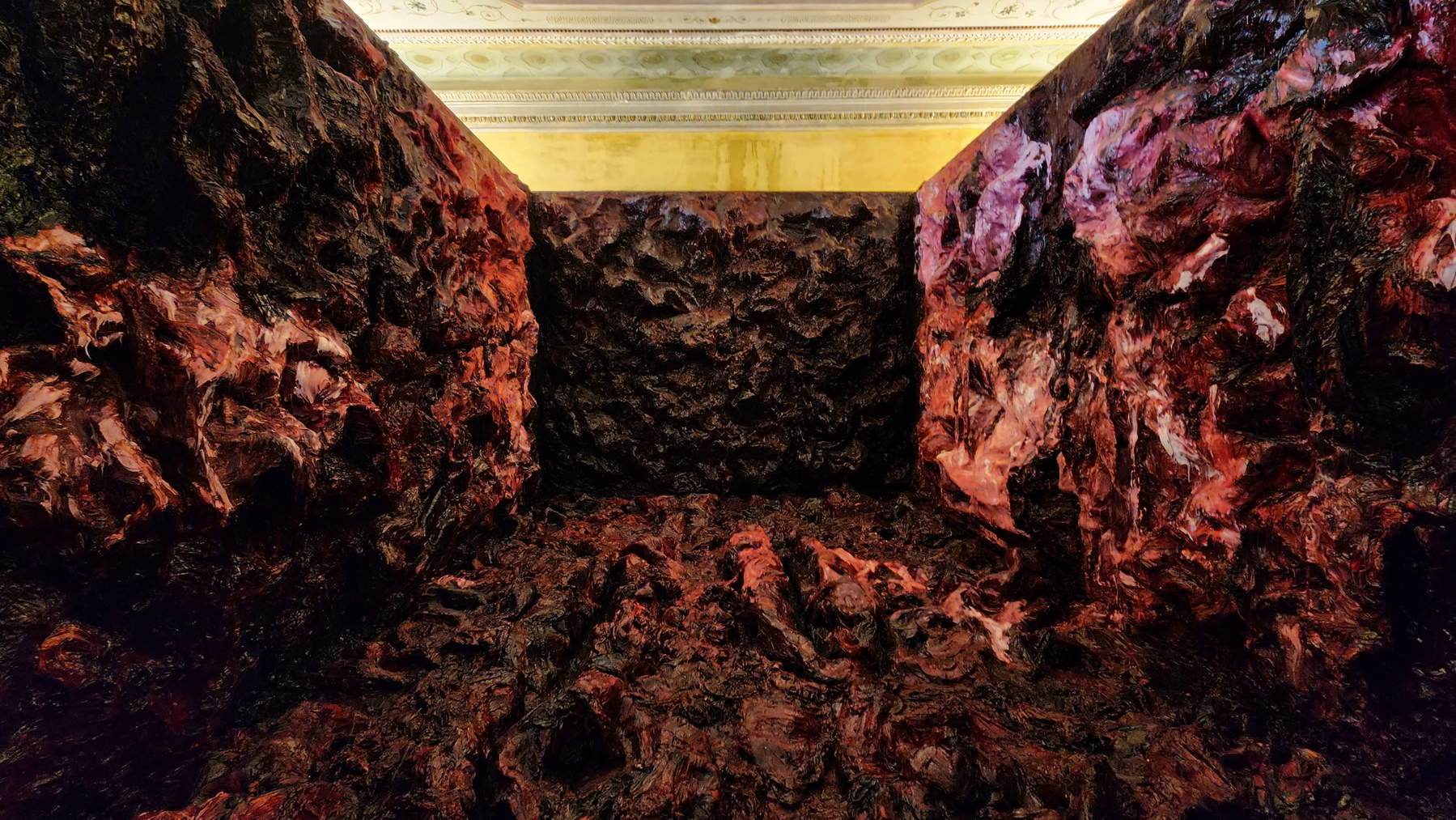
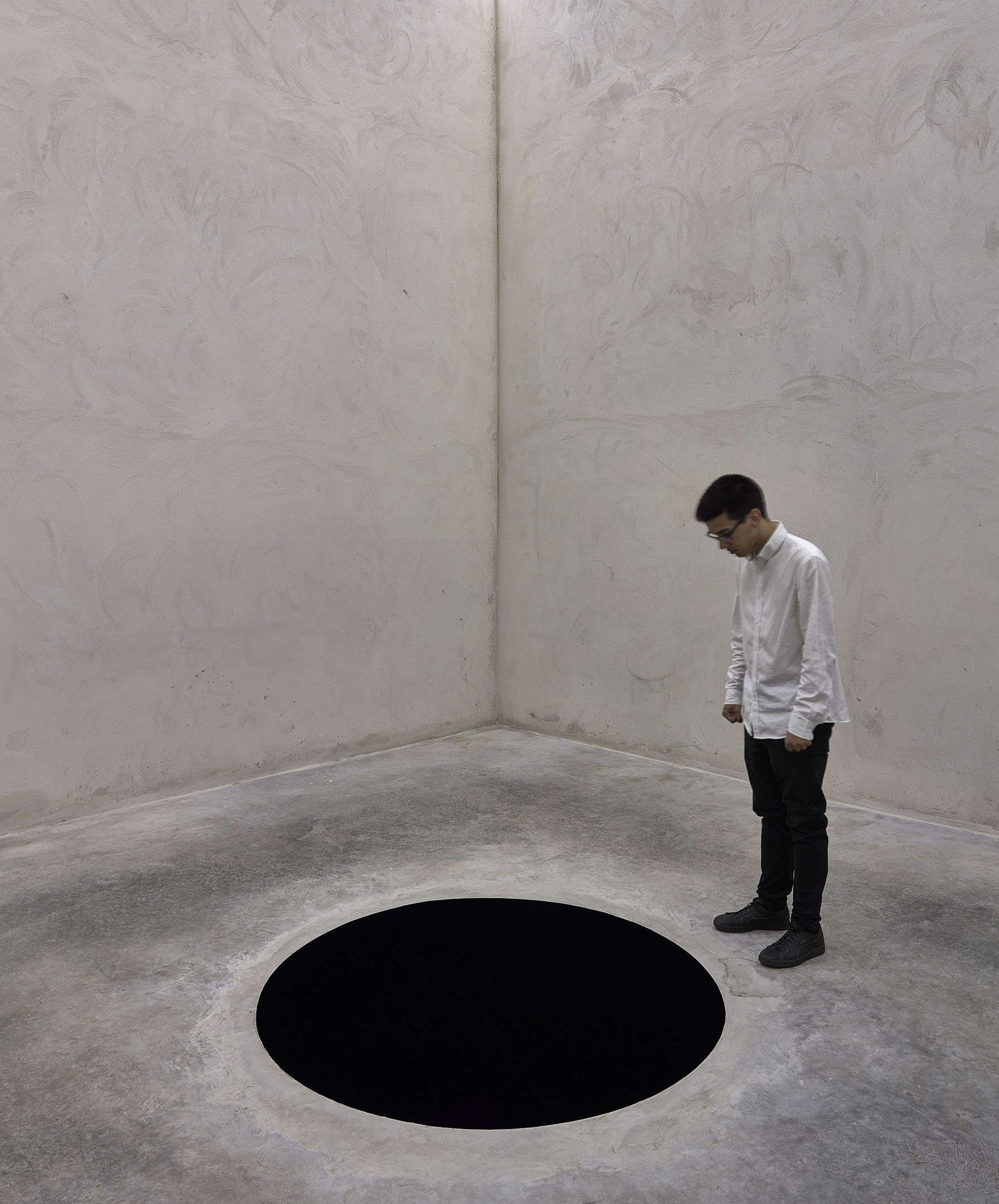
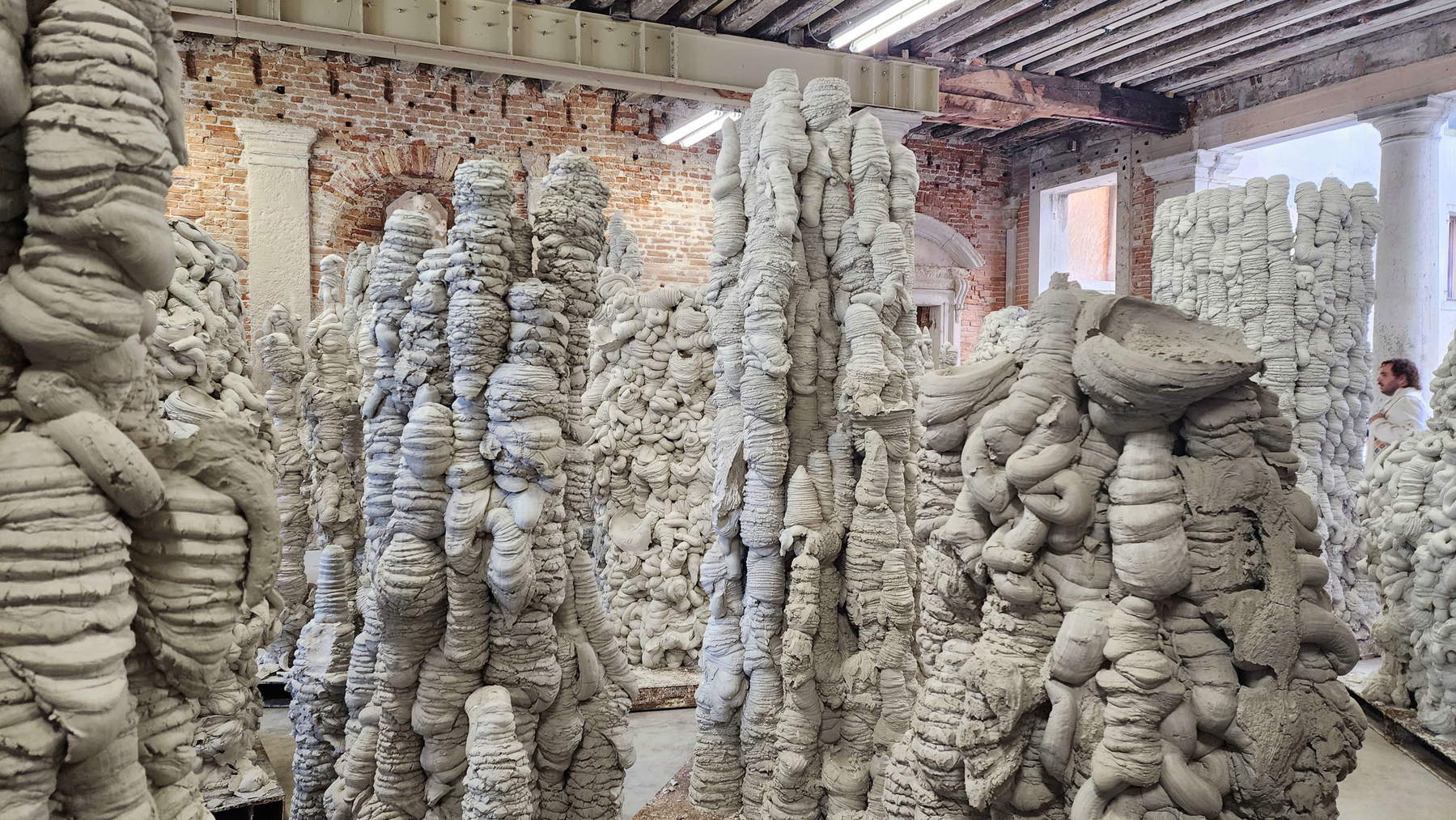
Concrete gives form to an almost organic material, as if it were living matter in constant transformation, and it is with this material that the installation welcoming visitors at the exhibition’s entrance was created: Ga Gu Ma, upward-reaching structures composed of forms reminiscent of both industrial production and biological processes—hybrid and ambiguous forms that evoke a grotesque and scatological imagery. Silicone , on the other hand, offers Kapoor the opportunity to transcend the traditional boundaries of painting, transforming it into a three-dimensional and almost carnal environment, as can be seen in *Ocean of Maternal Beginning*, a sort of room in which the walls and floor possess their own corporeality and carnality, further evoked by the bright red color. Finally, Vantablack— the absolute black capable of almost completely absorbing light—represents the extreme point of his exploration of the void: in fact, it feels as though one is sinking into an abyss when looking at *Descent into Limbo*, one of his most famous works, which evokes a true threshold between the sensation of plummeting into the void, into darkness, and the security of being in a museum setting, within four walls. Matter thus becomes a tool for altering the perception of space, and the large-scale works and installations on display bear witness to this.
One of Anish Kapoor’s greatest abilities—if not his most fundamental one—is to create new worlds and new spaces through his works; but he also has the ability to destabilize the viewer’s perception, challenging the concept of the object through, for example, the play of mirrors, the sensation of emptiness, surfaces reminiscent of the interior of the human body, and by focusing attention on what the artist defines as the “non-object”—that is, “objects in which things are not what they initially appear to be.”
In this exhibition—on the occasion of which Palazzo Manfrin, the headquarters of the Kapoor Foundation, was opened to the public for the second time (one will recall the major retrospective dedicated to the artist in 2022, staged at the two venues of the Gallerie dell’Accademia and Palazzo Manfrin)— all the fundamental concepts of Kapoor’s work are present: emptiness, matter, the relationship between the body and architecture, the transformation of space and perception, and the non-object. The models, however, are the true focal point: ideas that the artist has given form to and that already possess their own autonomy. Potentially, they could be as vast as infinity; all that remains is to choose the right scale for them.
Warning: the translation into English of the original Italian article was created using automatic tools. We undertake to review all articles, but we do not guarantee the total absence of inaccuracies in the translation due to the program. You can find the original by clicking on the ITA button. If you find any mistake,please contact us.