



by Francesca Anita Gigli 02/06/2026



Categories: Exhibition reviews / Disclaimer
After nearly a century without a proper monographic exhibition, the Fondazione Ragghianti's retrospective on Emilio Malerba in Lucca restores the profile of one of the forgotten protagonists of the Italian twentieth century. Francesca Anita Gigli's review.


The fingers press on the keys with an almost painful subtlety. One seems to feel them as they rest on the black and white of the piano with a precise and obsessive tension, as if each phalanx must learn obedience even before the sound. In that slight and severe pressure, Bambine, or Little Girls at the Piano, reveals a history of practice, exercise, obsessive repetition and order as daily toil of the body, as discipline of gesture and as patient construction of a form capable of containing emotion and giving it structure.

It was 1924 when Emilio Malerba painted this work, exhibited in the same year at the Venice Biennale in the room of the six painters of the twentieth century, where the group, presented by Margherita Sarfatti, officially established itself on the Italian art scene. Within that context, the piano becomes the concrete place of an education in form; the space in which the body is trained in measure, rhythm, composure and mastery. The musical lesson also becomes a lesson in painting, a silent declaration of a poetics according to which all naturalness comes from control and all grace from a long, arduous coexistence with the rule.


Later, however, for years that work existed almost only as a small black-and-white photograph, one of those catalog images that one looks at trying to imagine everything that is missing: the color, the actual size, the skin of the painting, the distance between the bodies, the weight of the air around the figures. Girls at the Piano seemed consigned to that particular form of absence in which works continue to be named and mentioned, but without offering their bodies to the gaze any longer. Seeing him live today, at the Fondazione Ragghianti, at the exhibition Emilio Malerba (1878-1926). From the Beginnings to the Novecento Italiano, produces for this a material emotion: those fingers that had remained imprisoned in the mute grain of reproduction return to really press on the keys. Curator Paolo Bolpagni recounts that the work resurfaced almost accidentally during preparatory research for the exhibition, kept within a private inheritance line that never really entered the market circuit: via Magenta, the home of the current owner’s grandfather. Not a painting continually rearranged, framed, “updated” by collector’s taste, but a work that remained within the concrete continuity of domestic life. And this is a feeling that runs through a good part of the exhibition: that of entering inside a time capsule in which the frames, the accretions of matter, the period photographs, the documents, everything seems to have preserved the breath of a twentieth century still close to its origin.


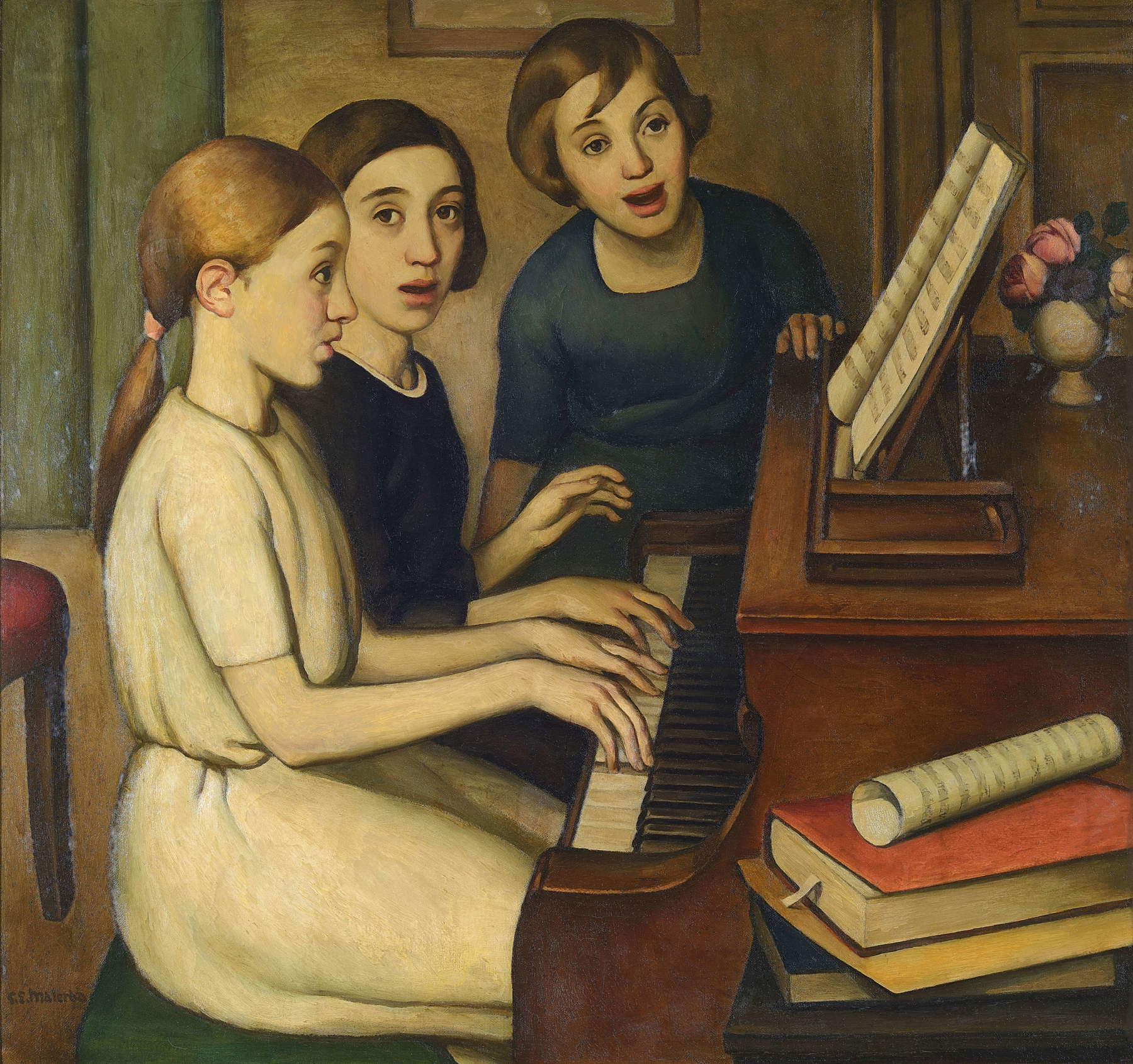
Even the title itself turns out to be a bit of a deception: Bambine, but there are two girls. The central figure is Menni’s son, a comrade-in-arms of Malerba during the war, and his presence opens a more intimate fissure in the painting, as if he were a private memory surfaced within the severity of the composition. The scene moves away from the simple tenderness of learning and is charged with a deeper feeling: friendship, remembrance, the survival of affections within the form, the way a personal affair enters painting held between a hand and a note yet to be played. The return to order also comes through here, through this obsession with craft and discipline that precedes the completed image.
And it is impressive to think that a monographic exhibition devoted exclusively to Malerba had been missing since 1931, since the commemorative organized at the Galleria del Milione in Milan a few years after the artist’s death. Ninety-five years of exhibition absence for a painter who, as curators Bolpagni and Elena Pontiggia recall, was by no means a minor figure. On the contrary, in the early years of the Italian Novecento group he was one of the best known names, so much so that he himself introduced many fellow artists to Galleria Pesaro, a central place in the Milan art scene of those years. Then something came to a halt. His early death in 1926, the relatively small production due to the meticulous slowness of his work, the dispersion of his works in private collections that almost never passed on the market, end up turning him, not too slowly, into a blurred presence. Even biographical data become uncertain: wrong dates, name confusion, inaccurate cataloguing.
That is why the choice to open the exhibition with documents, letters, photographs and with the artist’s original passport takes on a value at once philological and almost political. Before painting and before Novecentist genealogies, the path restores to Emilio Malerba the primary certainty of the name, date and administrative body of his existence. Emilio Malerba, born in 1878, and not simply “Gianni Emilio,” a stage name adopted for a few years and then slipped in later reconstructions until the contours of his identity were blurred, in a time when every correctable piece of information and every biography appears exposed to the risk of manipulation and simplification, even a passport becomes a critical document: the material evidence of a life, its own little paper trail, and the fixed point from which to begin again to look at an artist who has remained out of focus for too long. Returning Malerba to history also means recomposing the registry before the myth and the concreteness of an existence before its transformation into a historiographical case.
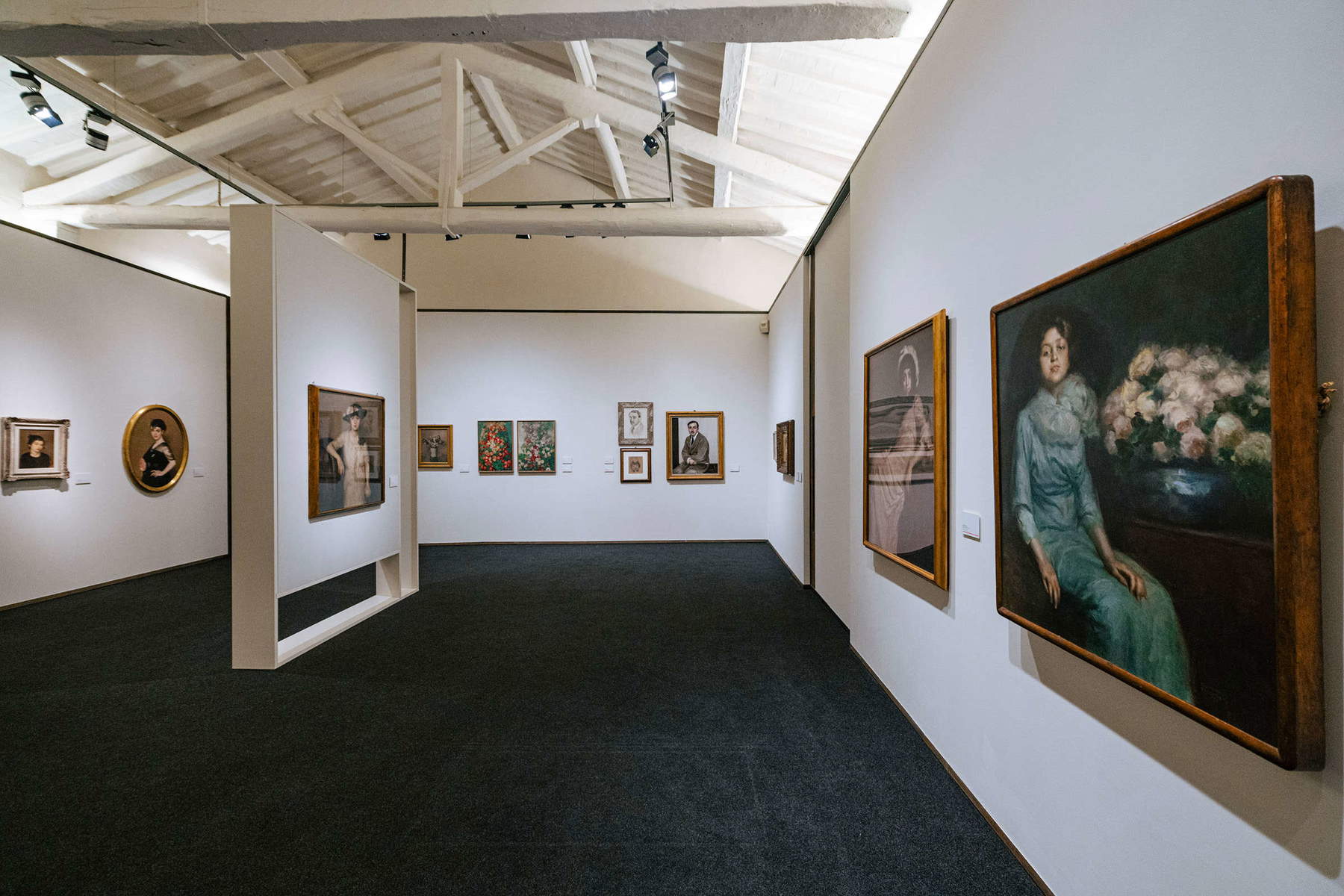
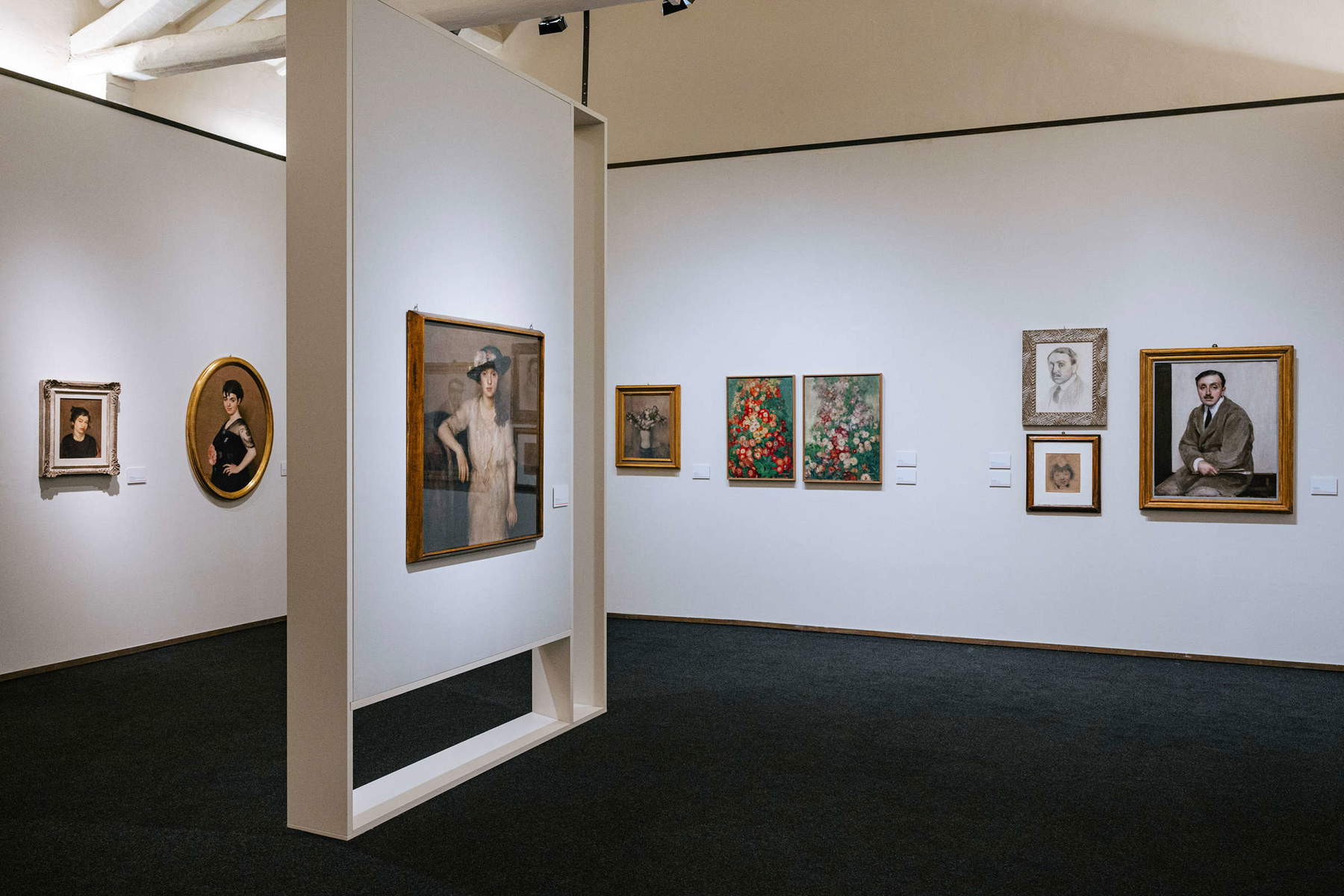
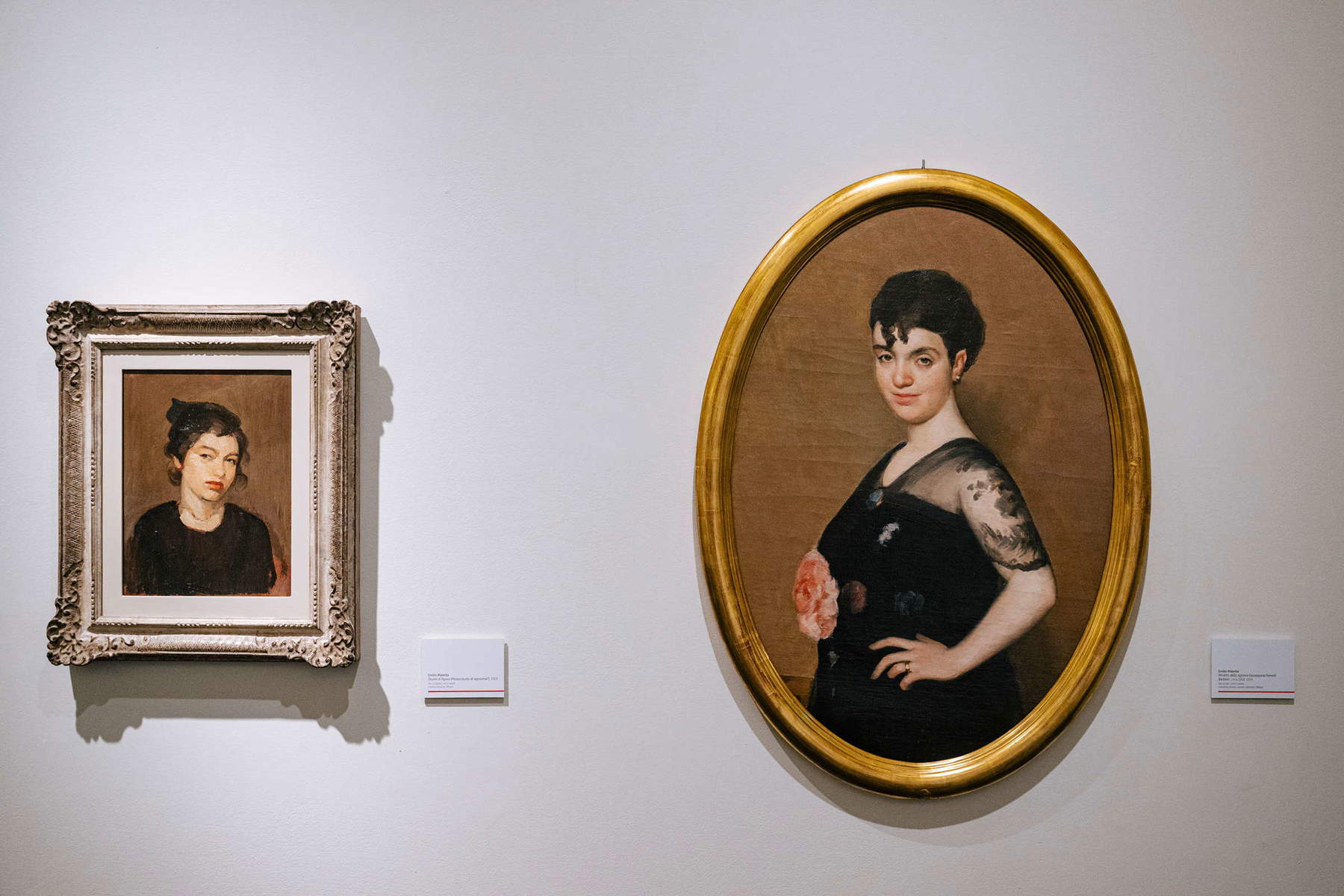
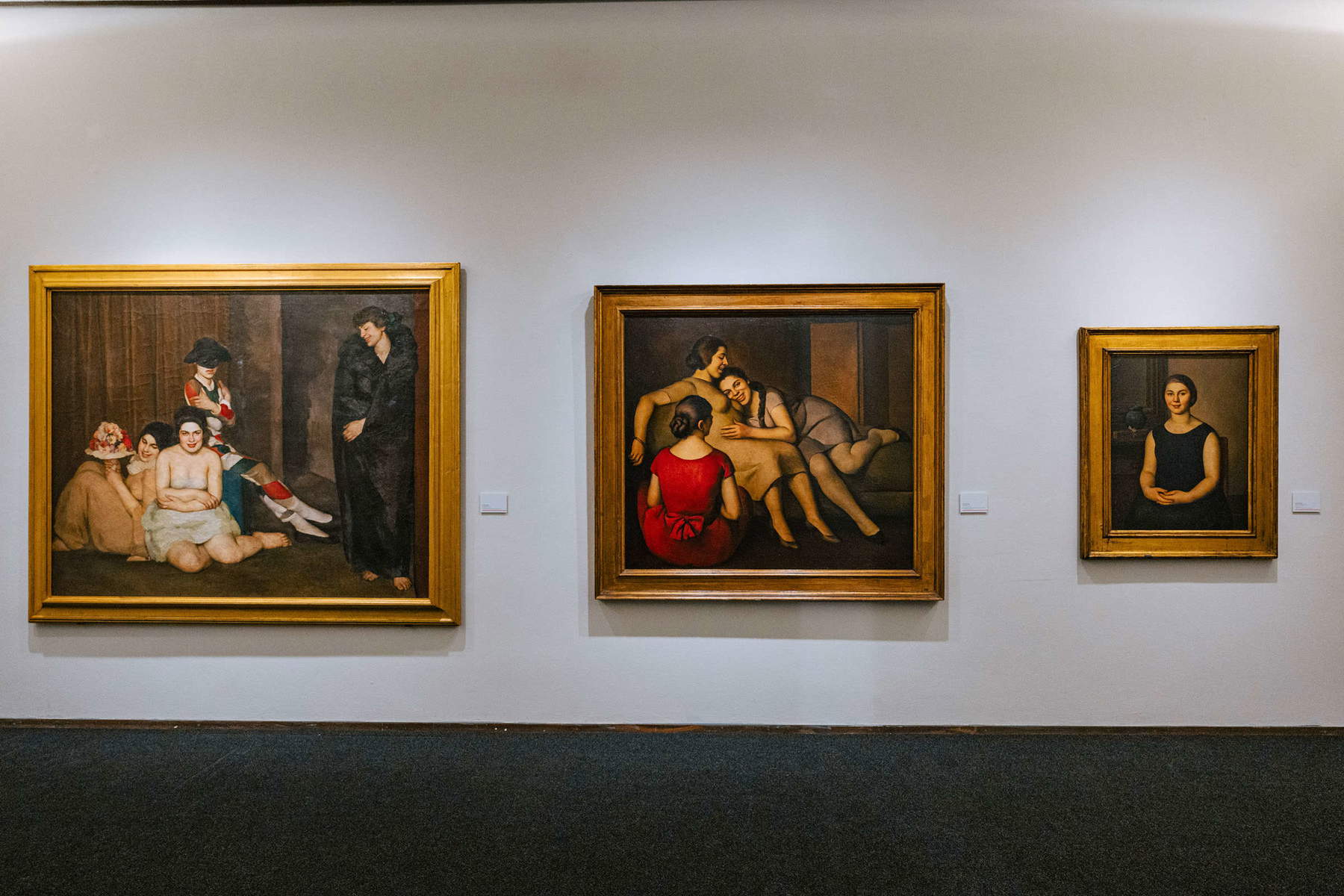
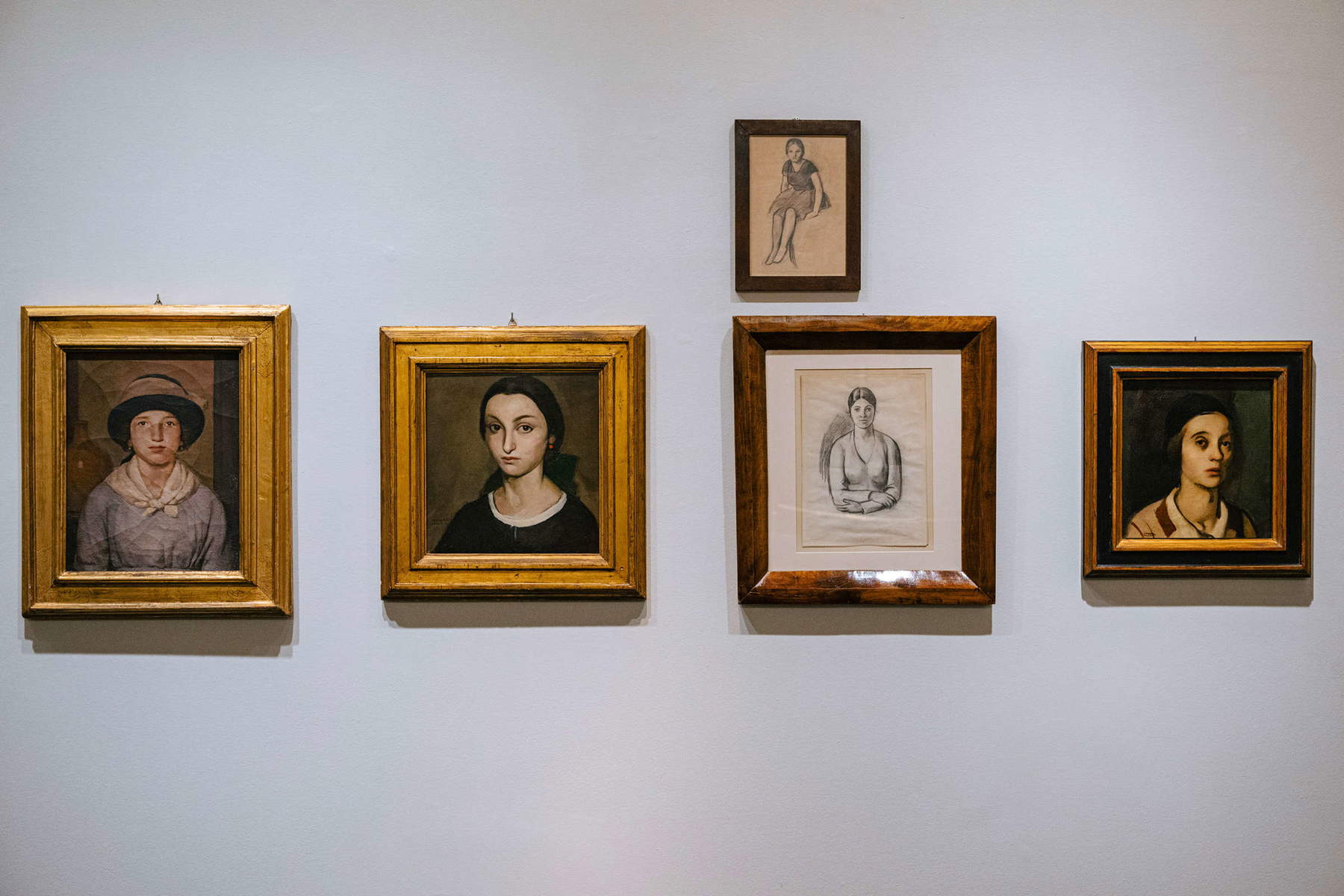
The merit of the retrospective lies precisely in this measure. The itinerary avoids the devout rhetoric of the forgotten artist, that sort of secular chapel in which rediscoveries often end up stuffed between regret and elegy, while at the Fondazione Ragghianti, Malerba is instead put back into motion. The chronological scanning, limpid without becoming scholastic, allows us to follow a surprisingly mobile author, traversed by different influences and capable of assimilating them within a personal quest, without ever reducing himself to derivation or reflection.
The exhibition also rightly devotes attention to photographic practice. The shots preserved in the Malerba archive, some of which are reproduced in the catalog, show how the artist often resorted to the photographic image as an instrument of study. The case of Menni’s son, who returns in different works, clarifies how much his work arose from a complex relationship between document and pictorial construction. Photography allows him to fix the real and then transfigure it and to preserve a pose in order to subject it to the slow discipline of painting. In an artist so obsessed with craft, this transition is crucial because the photographic datum provides the first hook, then painting transforms it into mental form and, finally, structure.
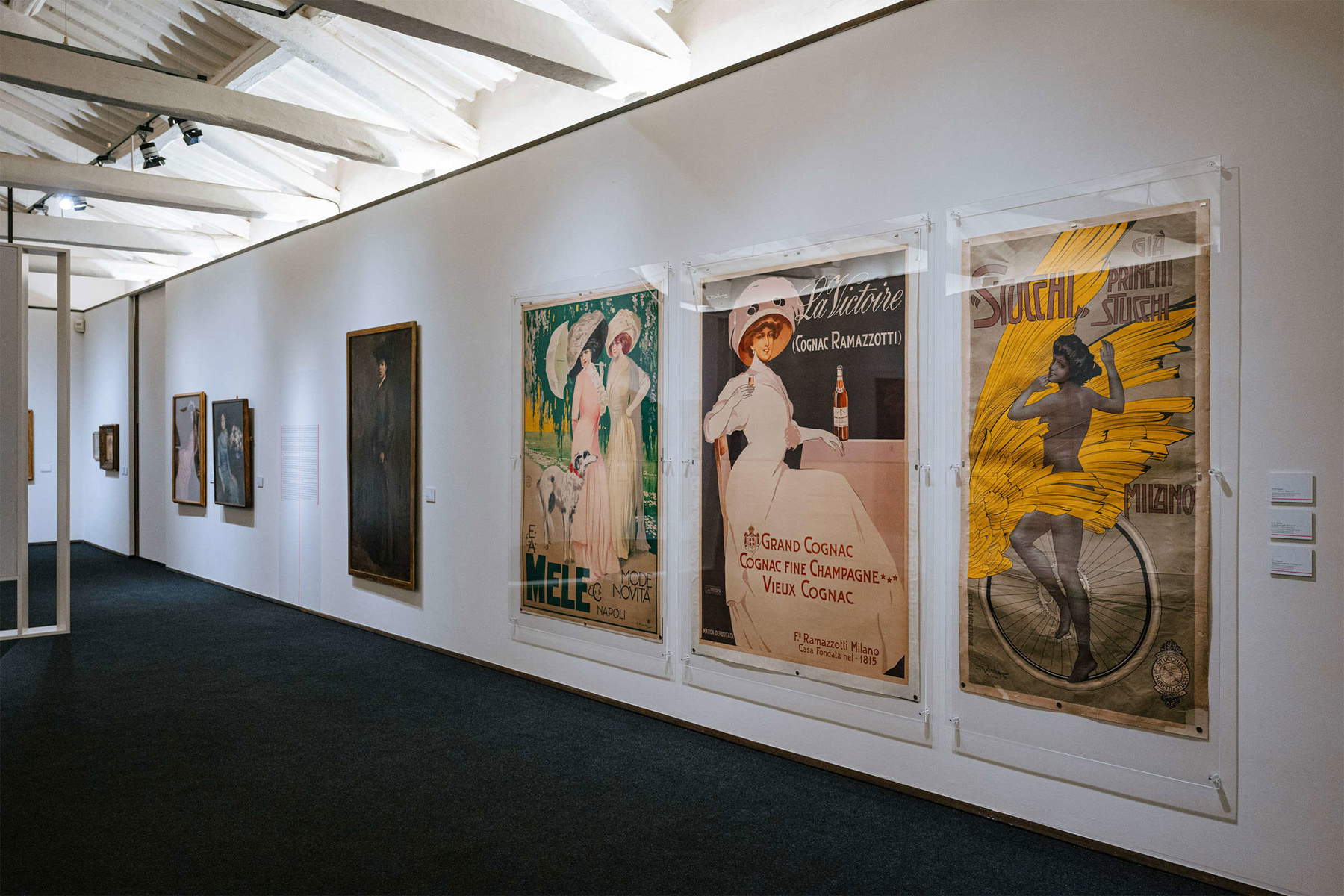
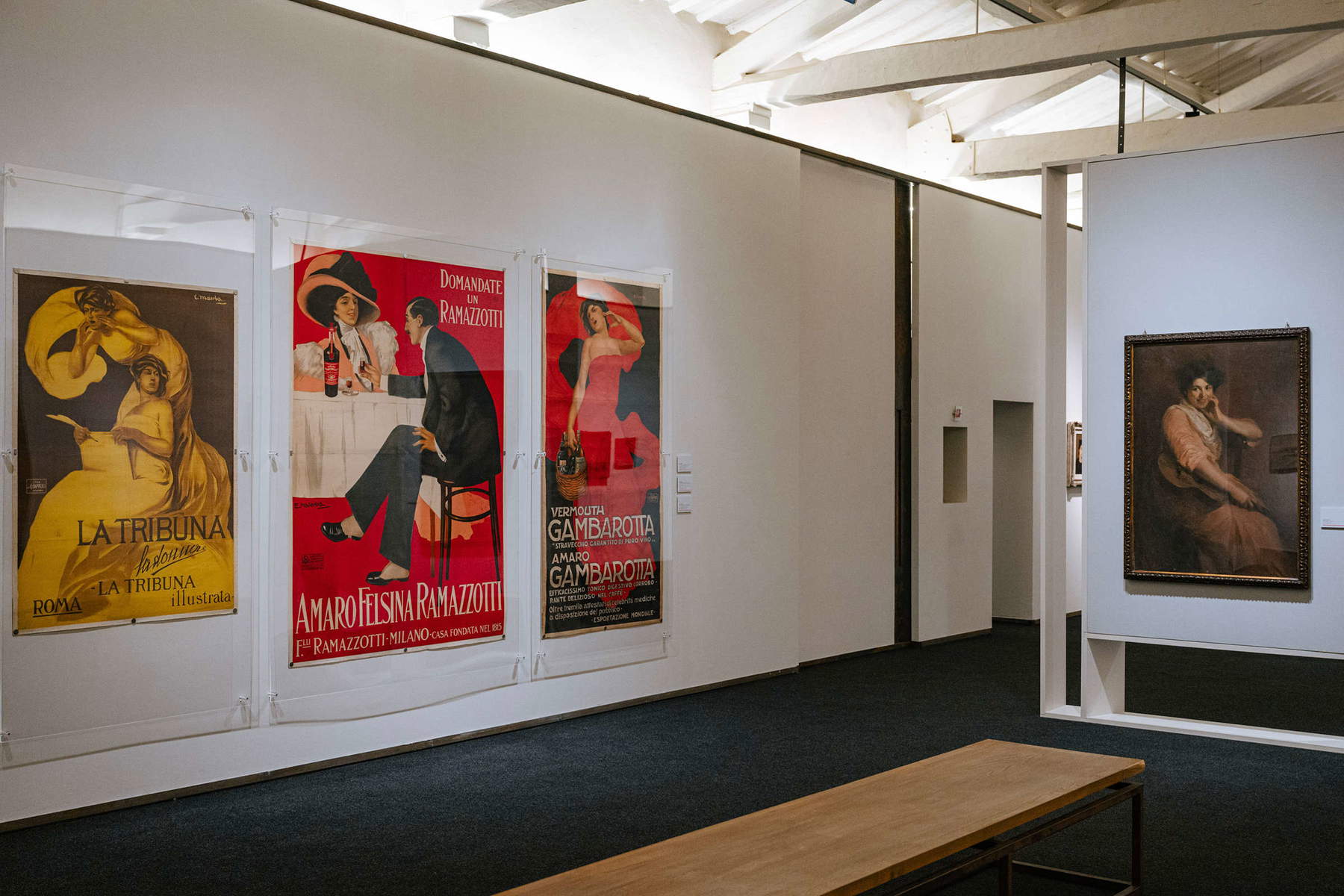
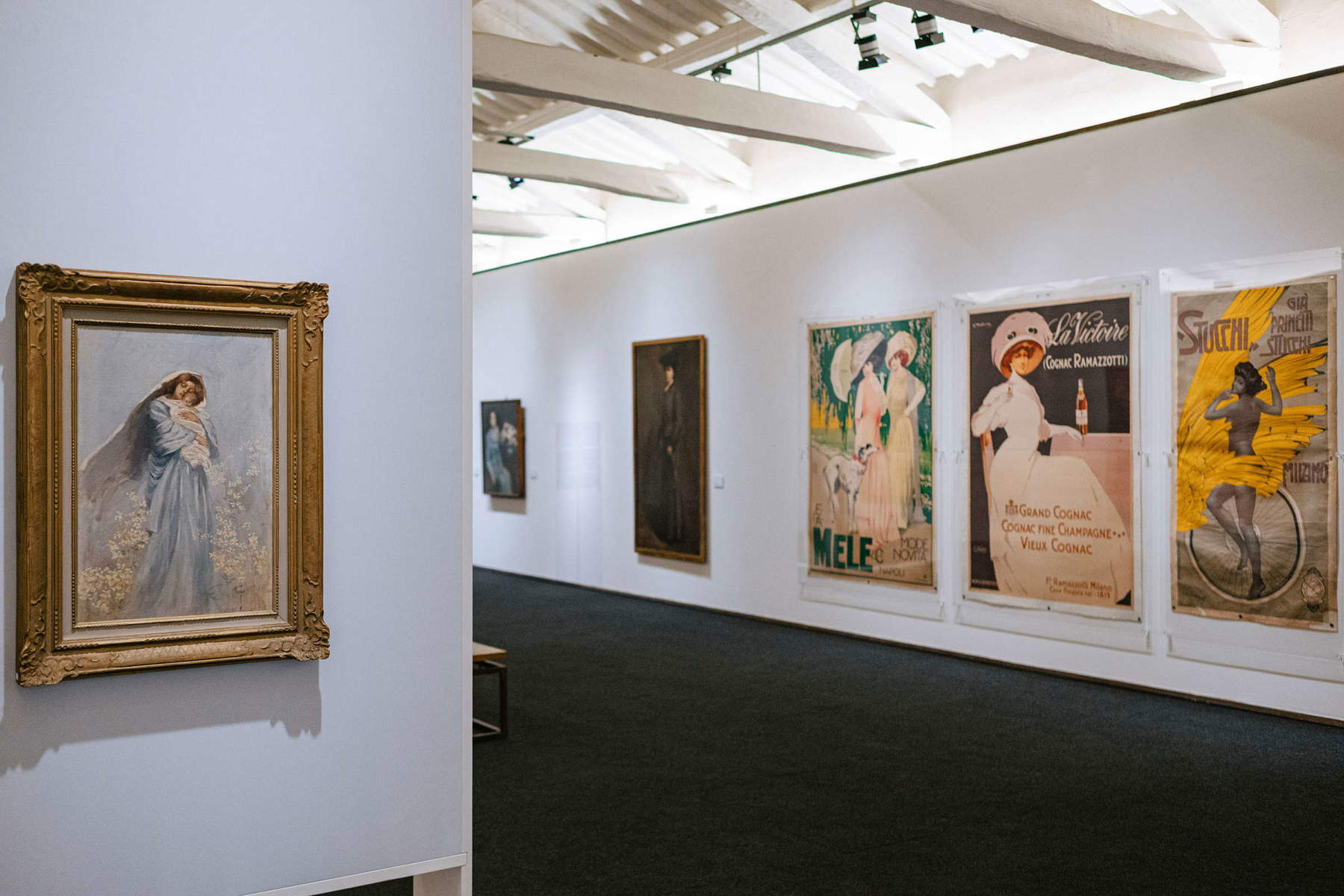
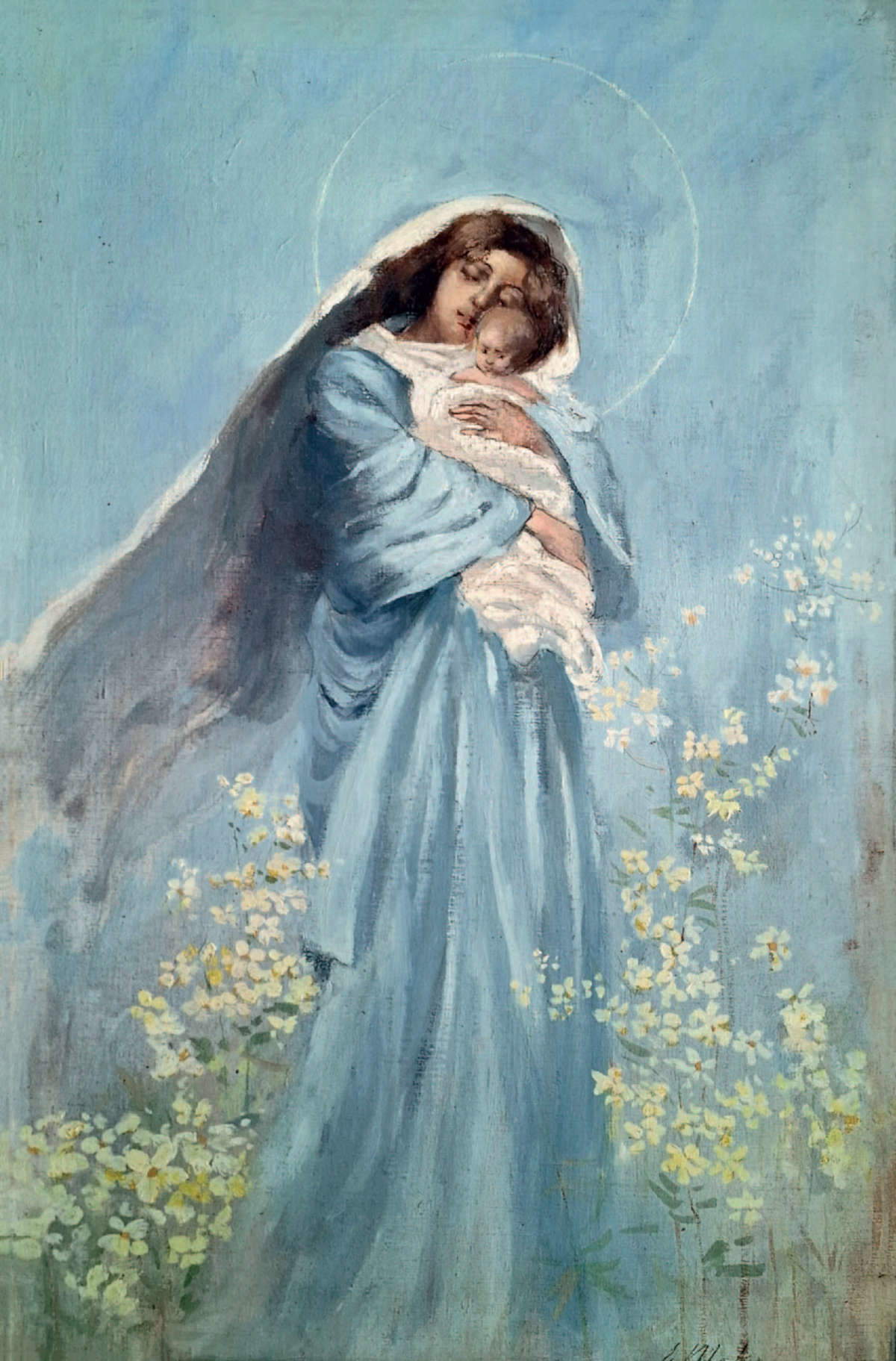
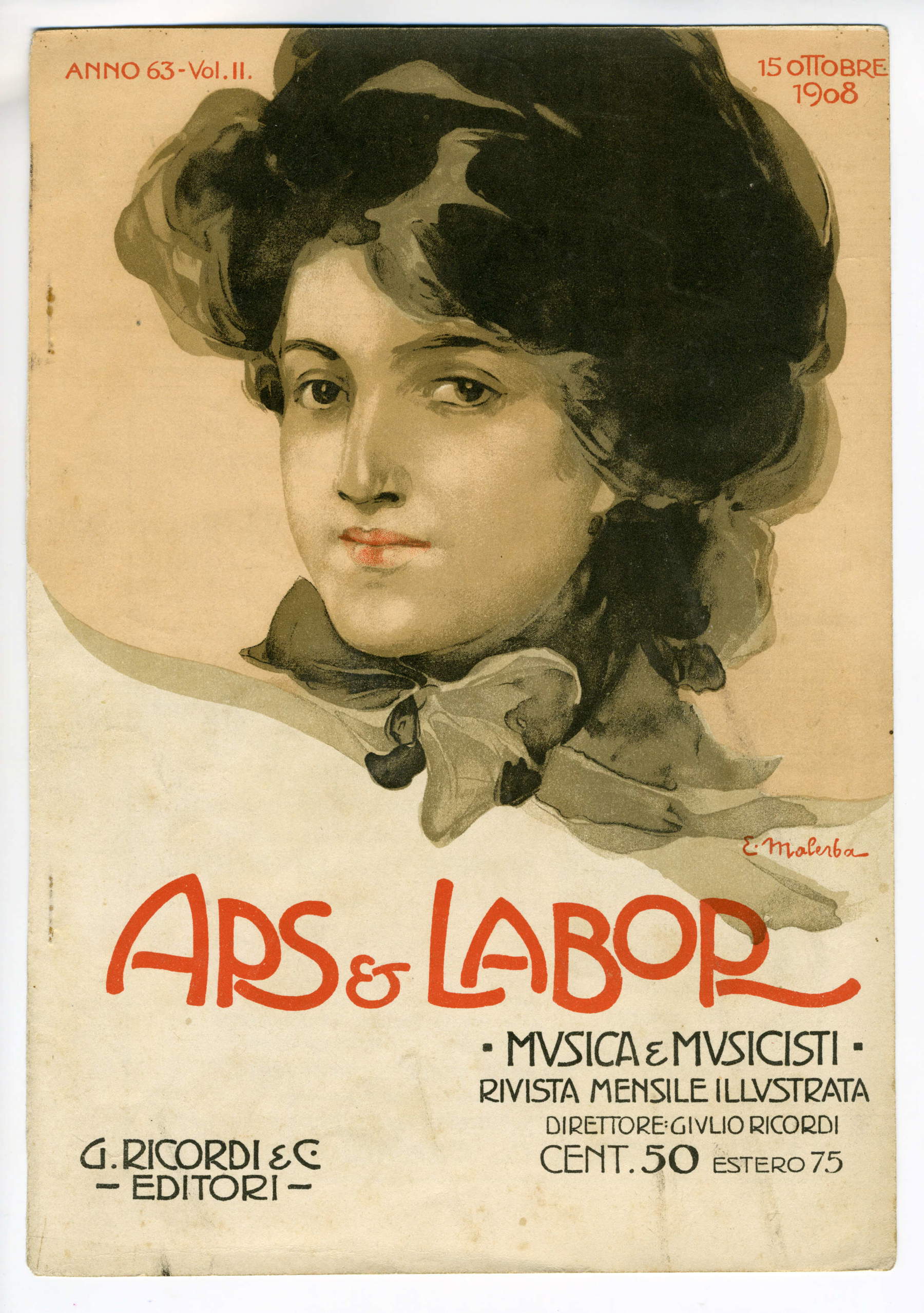
The first rooms tell of a Malerba still close to Lombard Scapigliatura, Mentessi, and the symbolism of Previati and Alciati; the Madonna and Child of 1900 retains that spiritual and atmospheric turn-of-the-century vibration, that luminous and collected material in which the figure seems to surface rather than impose itself. Then, almost immediately, the path opens up the more modern fault line of advertising posters, that is, that area of his production where the image enters the urban and commercial world of the early twentieth century and Malerba demonstrates that he also knows how to transform visual communication into a small psychological scene. And it is here that the exhibition restores full dignity to Malerba’s graphic production, too often considered marginal compared to painting. Instead, the posters for Amaro Ramazzotti, for Stucchi bicycles, and for commercial firms of the time show an artist already fully aware of his own language. Even in advertising he tells of human relationships. For the real center of Malerba’s art is never things, but what happens silently between people. He is an artist of feelings, but of subterranean and subcutaneous feelings. And all the rooms seem built precisely to demonstrate this continuity. From the earliest works to those of the 1920s, Malerba builds a small world of minute feelings, of hesitations, shyness, barely surfaced resentments, restrained smiles, domestic melancholy and tenderness without emphasis. InGrandmother’s Name Day, first exhibited in Milan in 1910, a little girl brings a bouquet of flowers to her grandmother on the day of the anniversary; everything, on the surface, should belong to the grammar of family celebration or affectionate ritual, and instead the scene is shot through with a subtle gravity and melancholy. The old woman remains outside the picture, invisible, but her absence occupies the entire image. Illness, old age, perhaps the perception of a close leave-taking, come through the granddaughter’s expression, through that melancholy gaze that transforms a gesture of homage into a small affective revelation. Malerba thus narrates the scene, avoiding the illustrated anecdote and entrusting everything to a childlike face already crossed by an awareness greater than its age.
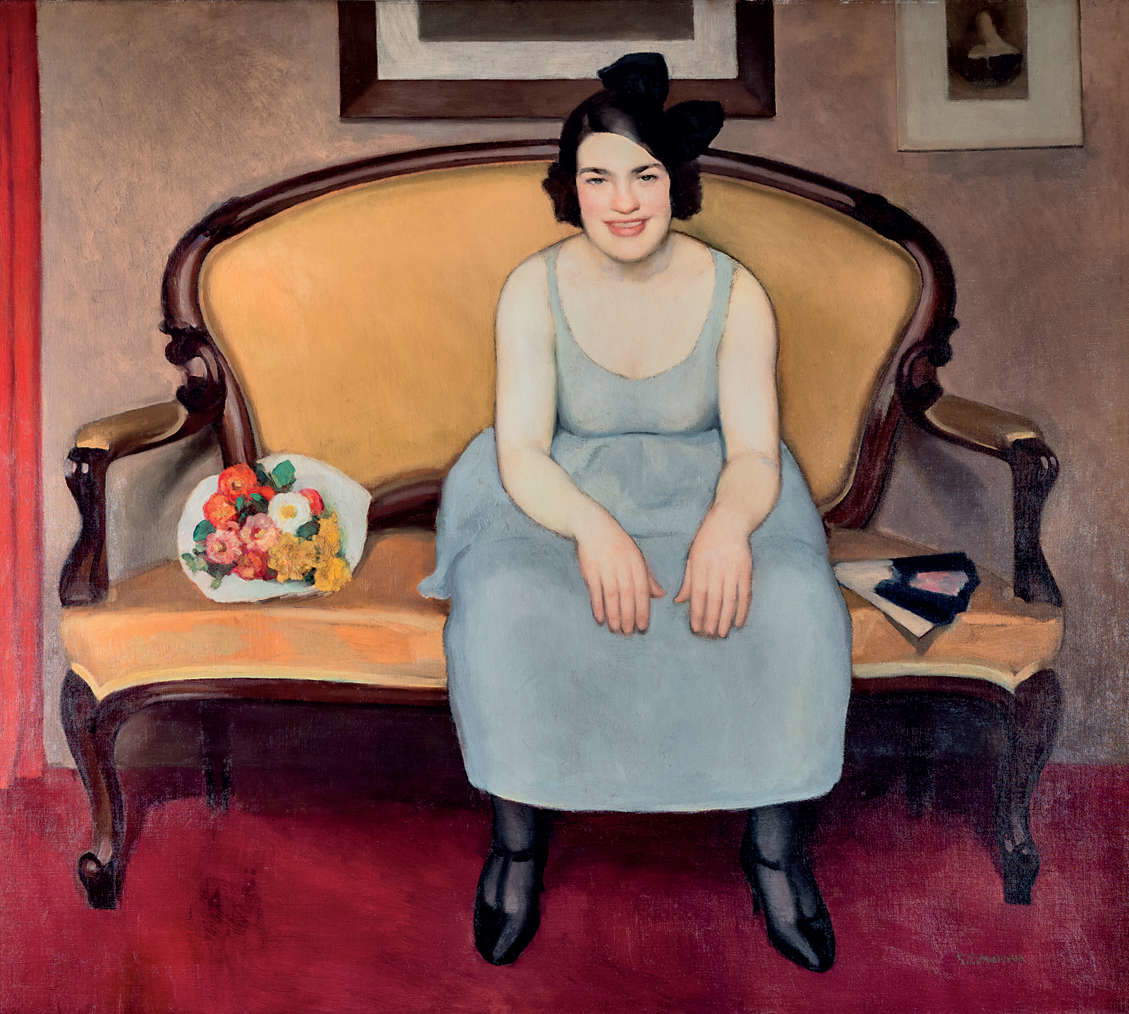
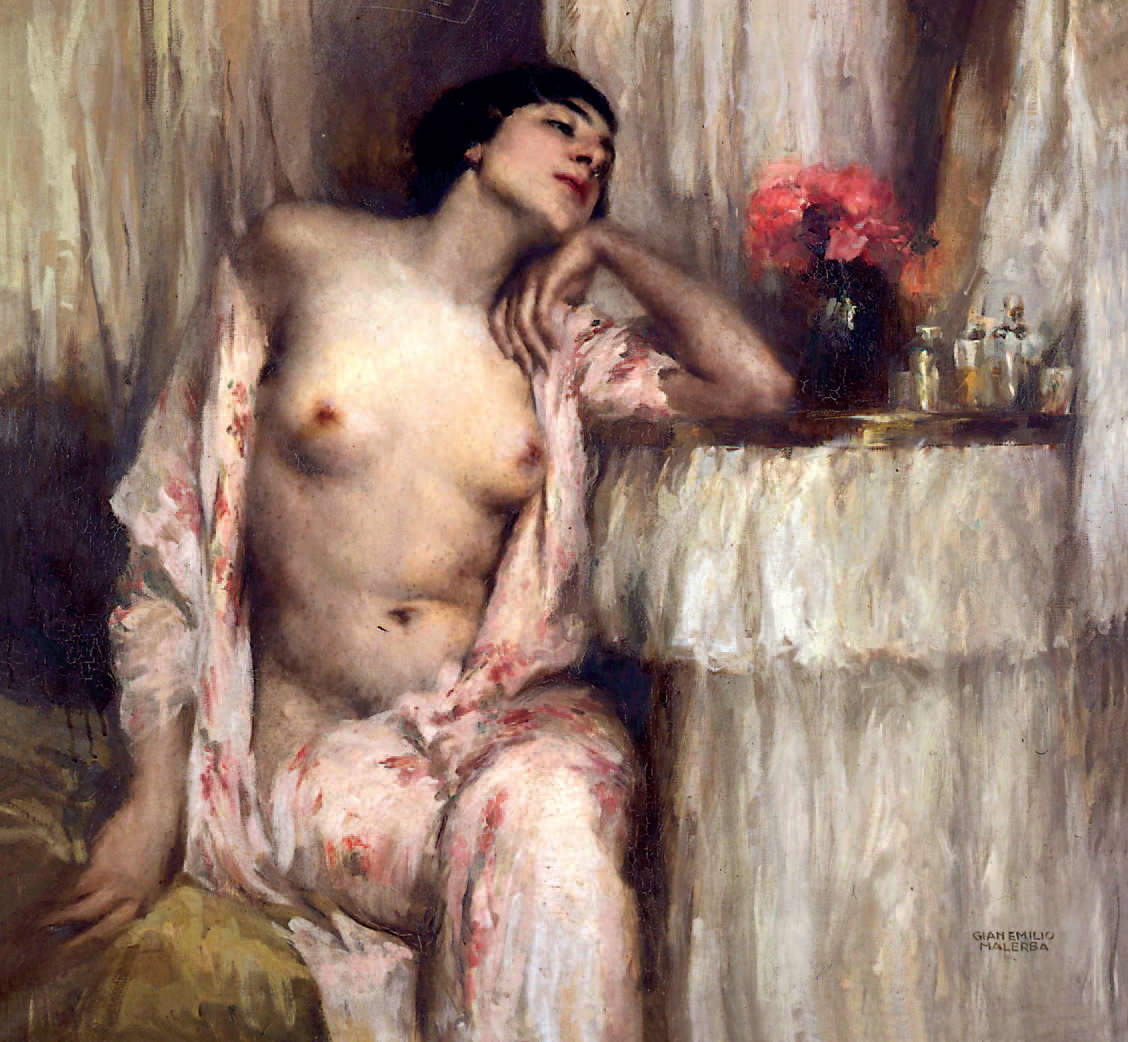
Even the relationship with the Italian twentieth century, addressed in the room devoted to fellow artists such as Mario Sironi, Ubaldo Oppi, Achille Funi and Anselmo Bucci, is finally removed from the scholastic reading of the “return to order.” For an artist like Malerba, who came from late-naturalist and symbolist experiences, the twentieth century did not represent a return to the past, but an advance. A conquest of modernity different from that of the avant-garde, but no less radical. Not the modernity of noise and speed, but that of synthesis and craft. Where Sironi seeks the moral mass of form and Oppi tends toward a more crystalline sharpness, Malerba maintains a restless quality, a kind of restrained vibration that prevents his figures from turning into emblems. Even when he takes the composition toward the most severe synthesis, there remains in him a psychological matter that pulses under the control of the line. His adherence to the twentieth century was a desire to give order to that which, by its nature, escapes order, that is, the fragility and imperceptible oscillation of states of mind. It is within this tension that works such as Femmina volgo, painted in 1920, one of the canvases that mark the clearest transition toward a painting constructed through simplified masses and bold color arrangements, should be read. The figure, abandoned in a tired and almost undone pose, occupies space with a heaviness far removed from the polished and decorative femininity of certain coeval worldly painting. The flowers and the fan remain at the margins, objects now useless, remnants of a code of grace that the woman seems to have laid beside her with a kind of physical indifference. Behind her, the portrait of a noblewoman introduces a subtle and cruel confrontation between aristocratic image and popular body, between social representation and carnal presence. The figure painted on the wall belongs to the domain of elegance, while the seated woman belongs to the weight of the body, to weariness. Even the color, with those yellow accords then foreign to the Lombard tradition, acts as a harsh, almost acid note, which unhinges the composure of the whole and restores an unexpected strength to the figure. Malerba here appears most modern precisely because he avoids any gesture of ostentatious modernity. He works by internal imbalance and controlled dissonance.
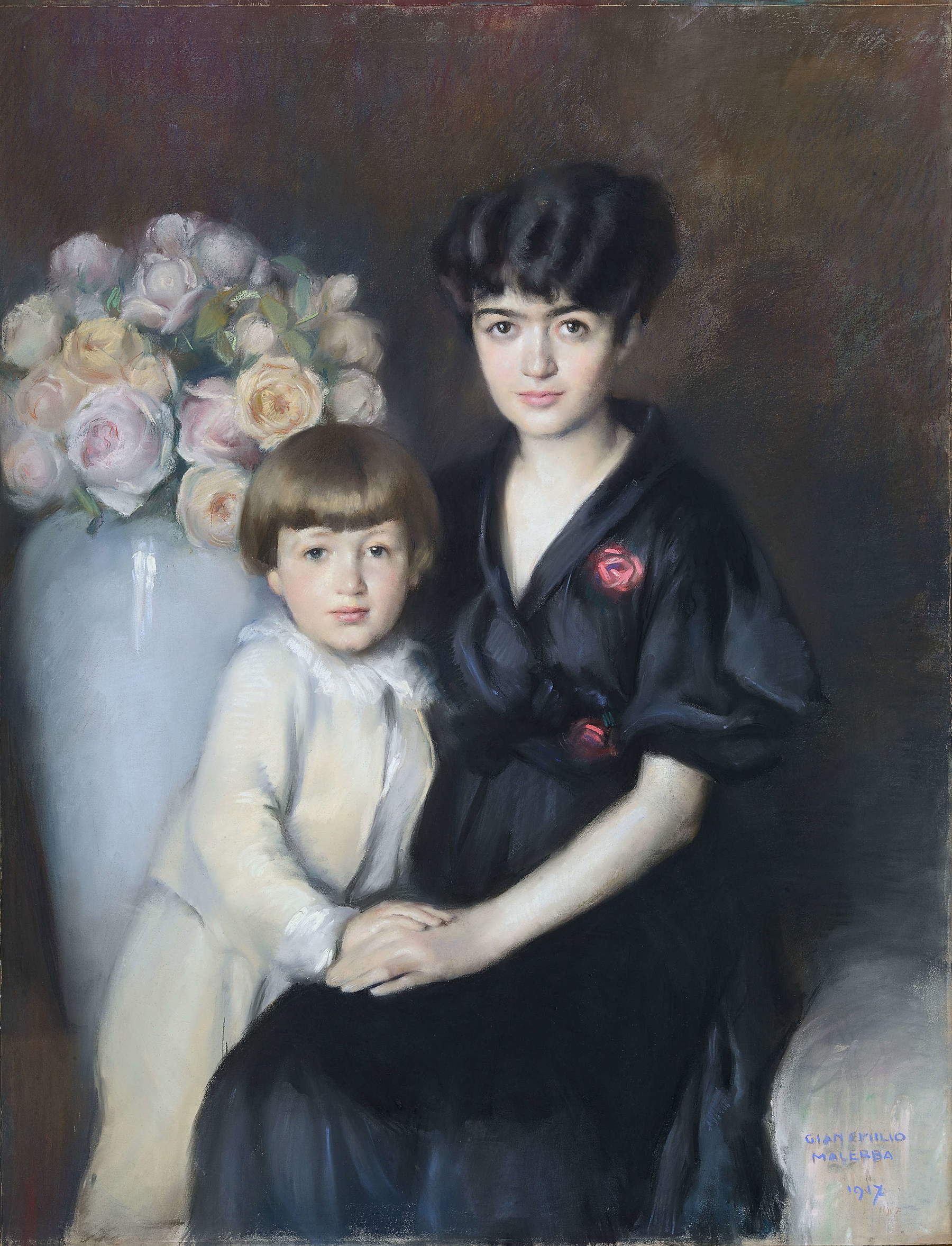
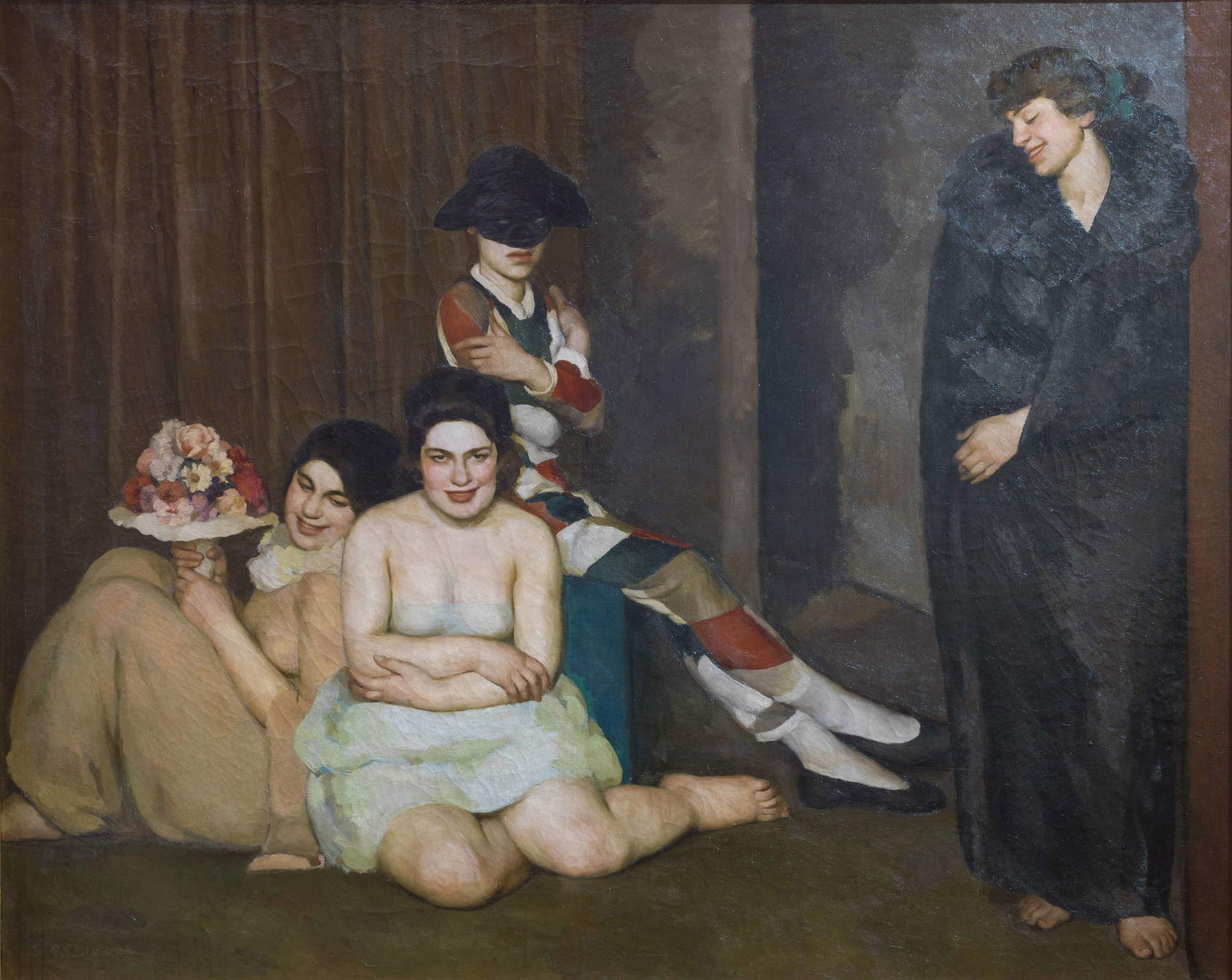
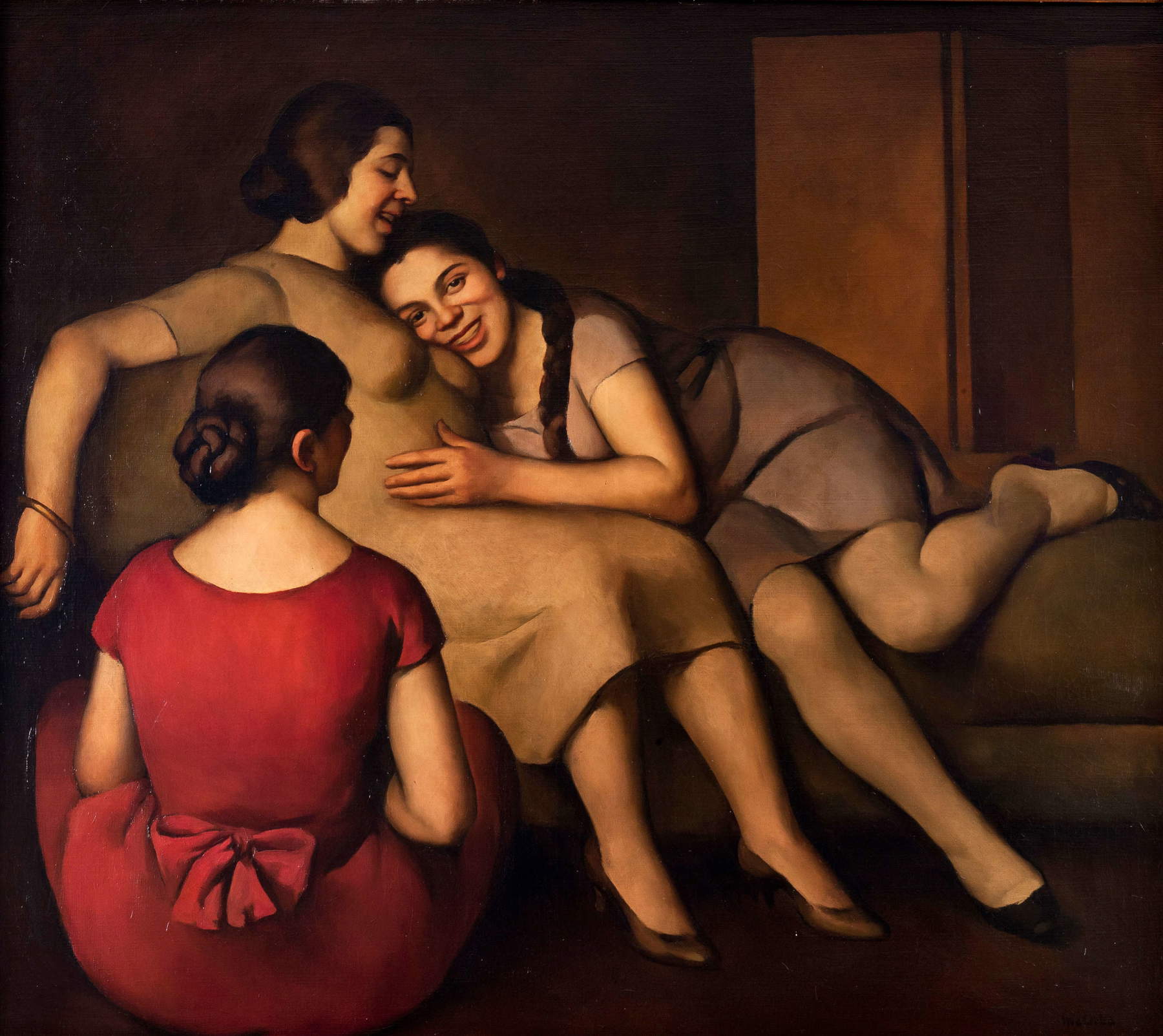
In later works the relationship with the ancient becomes more evident and at the same time more ambiguous. In The Masks, of 1922, the theatrical theme could easily slip into artifice and the complacency of disguise; instead Malerba brings it within a domestic and private dimension. The figures seem like friends; they are bodies playing at entering a role, barefoot, imperfect creatures trying on the mask, continually allowing glimpses of the person beneath the costume. Theater, then, becomes a device that reveals more than it conceals. His Harlequin carries with him an almost 15th-century echo, in the profile, in the construction of the head, in the firmness of the pose, yet those dark circles, those marked marks, that modern hardness of the face break all archaeological temptation. The ancient becomes structure and formal memory, but the modern enters, once again, through the wound of the gaze. Among the highest works of this season are also The Friends, or The Sisters, where compositional solidity openly dialogues with a Giottesque memory. The figure from behind in the foreground has an almost architectural plastic compactness; her body, seen from behind, closes and at once opens the scene, creating a threshold through which the viewer enters a small gynoecium of confidences.
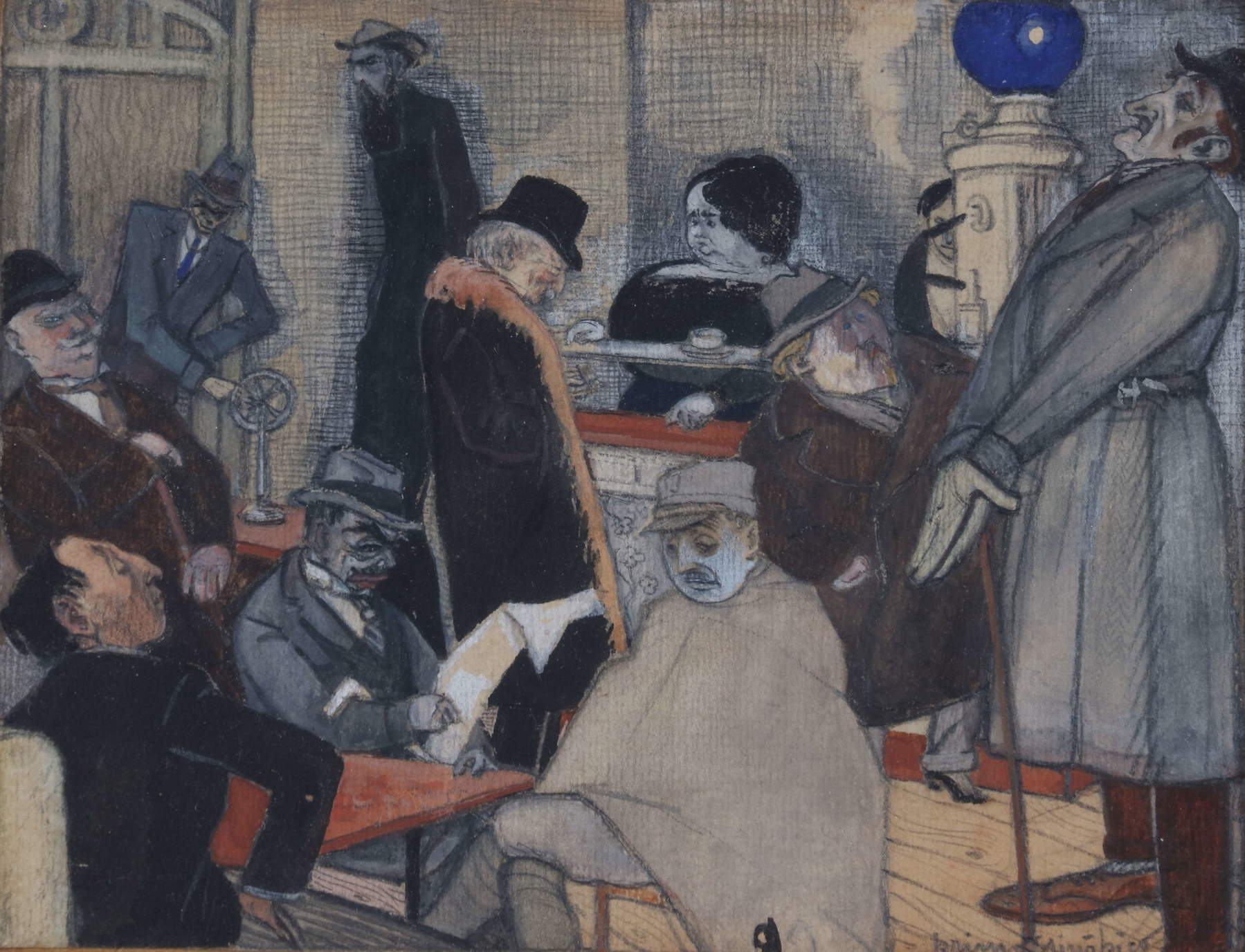
![Emilio Malerba, Amaro Felsina Ramazzotti (s.d. [first fifteen years of the 20th century]; photomechanical reproduction on paper, 198.9 × 139.6 cm; Treviso, Museo Nazionale Collezione Salce)](https://cdn.finestresullarte.info/rivista/immagini/2026/3541/emilio-malerba-domandate-un-ramazzotti.jpg "Emilio Malerba, Amaro Felsina Ramazzotti (s.d. [first fifteen years of the 20th century]; photomechanical reproduction on paper, 198.9 × 139.6 cm; Treviso, Museo Nazionale Collezione Salce)")
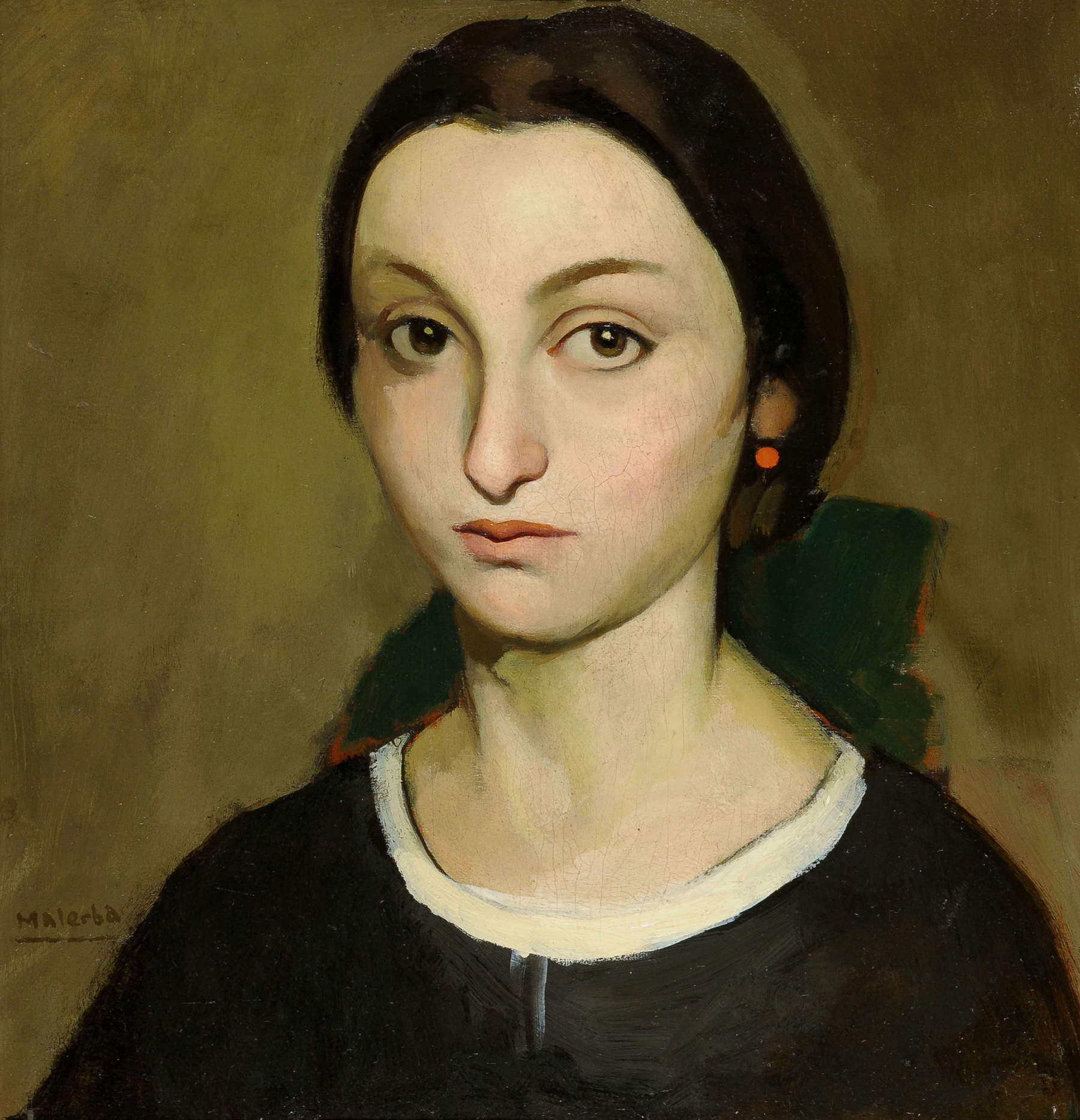
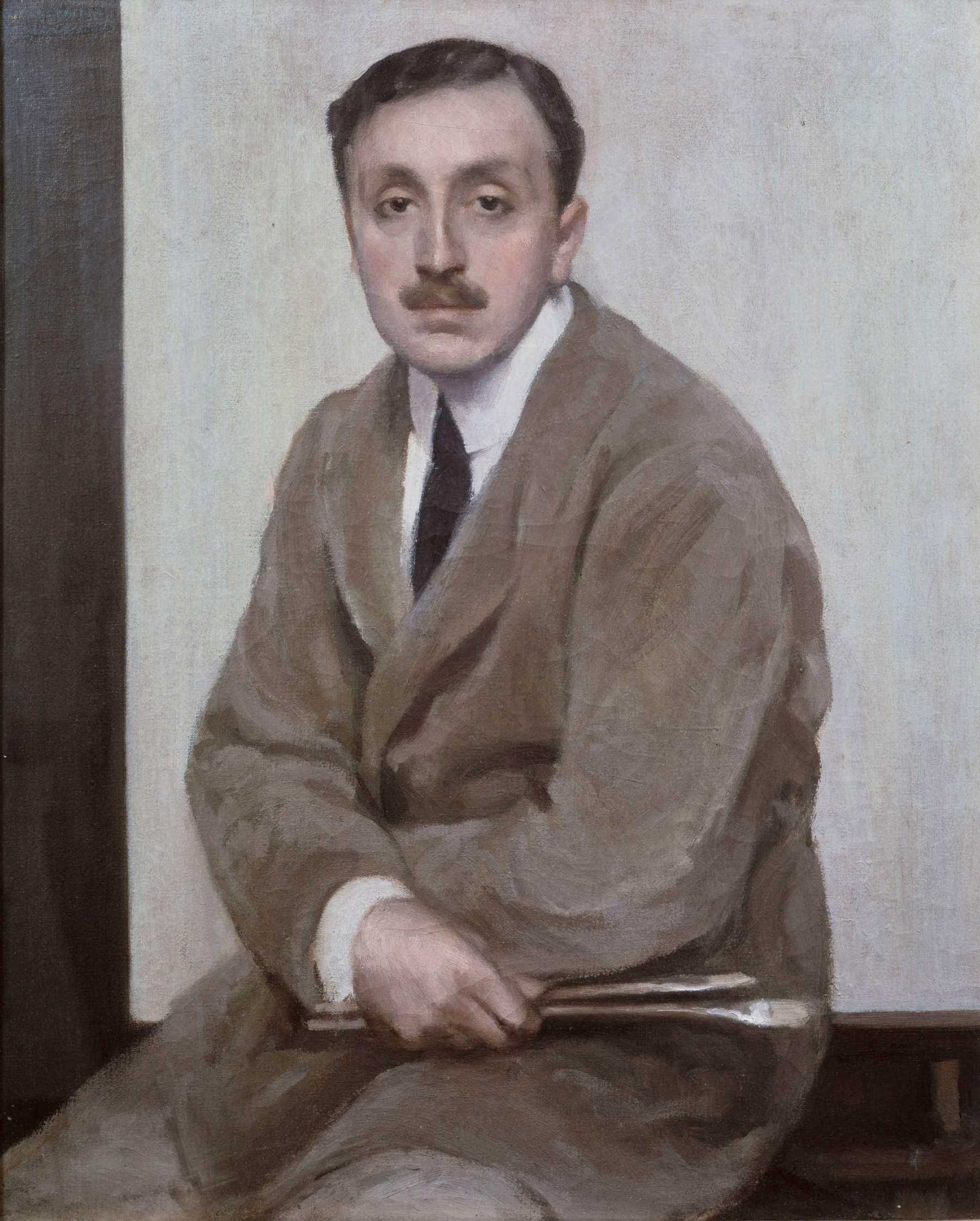
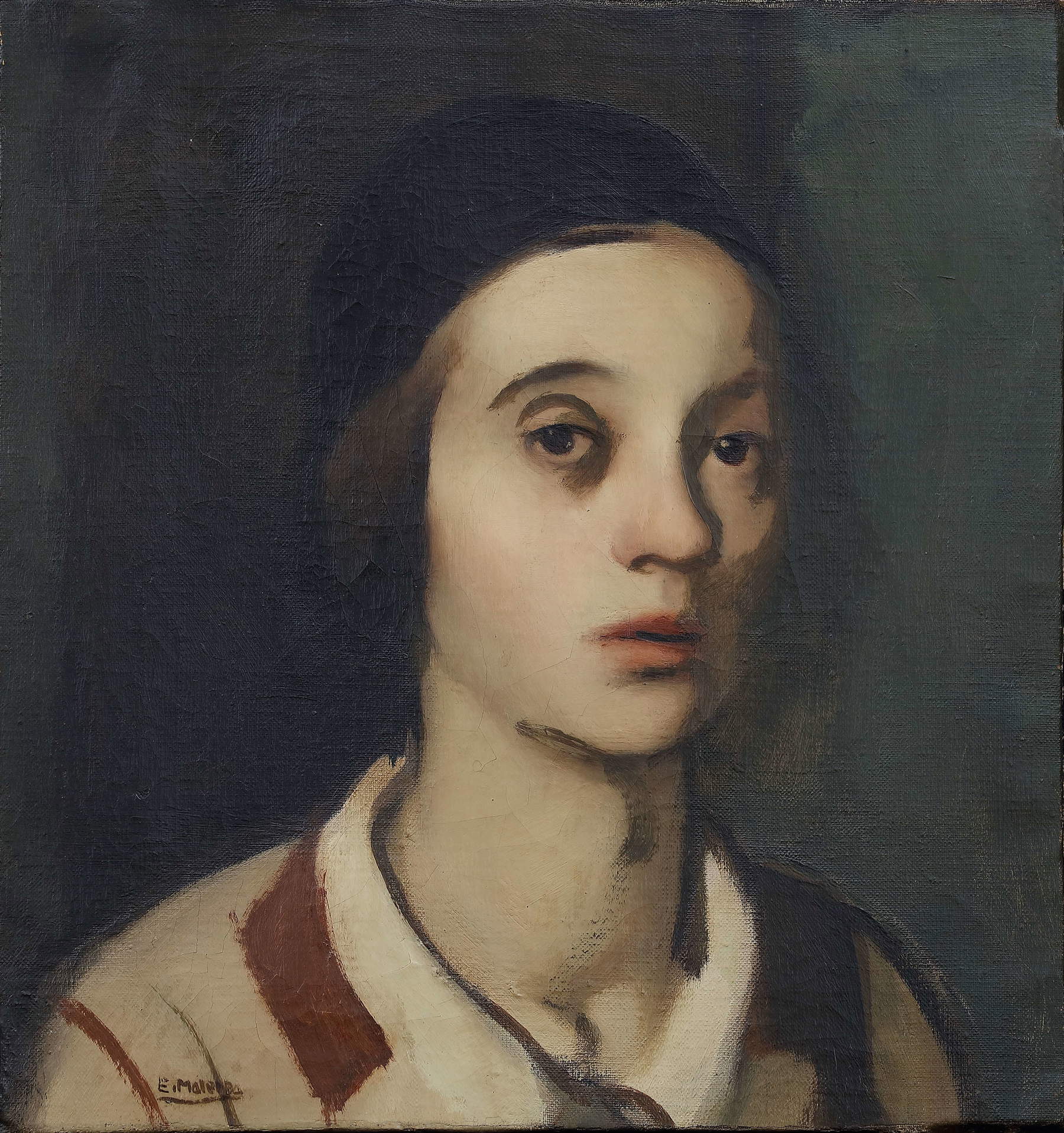
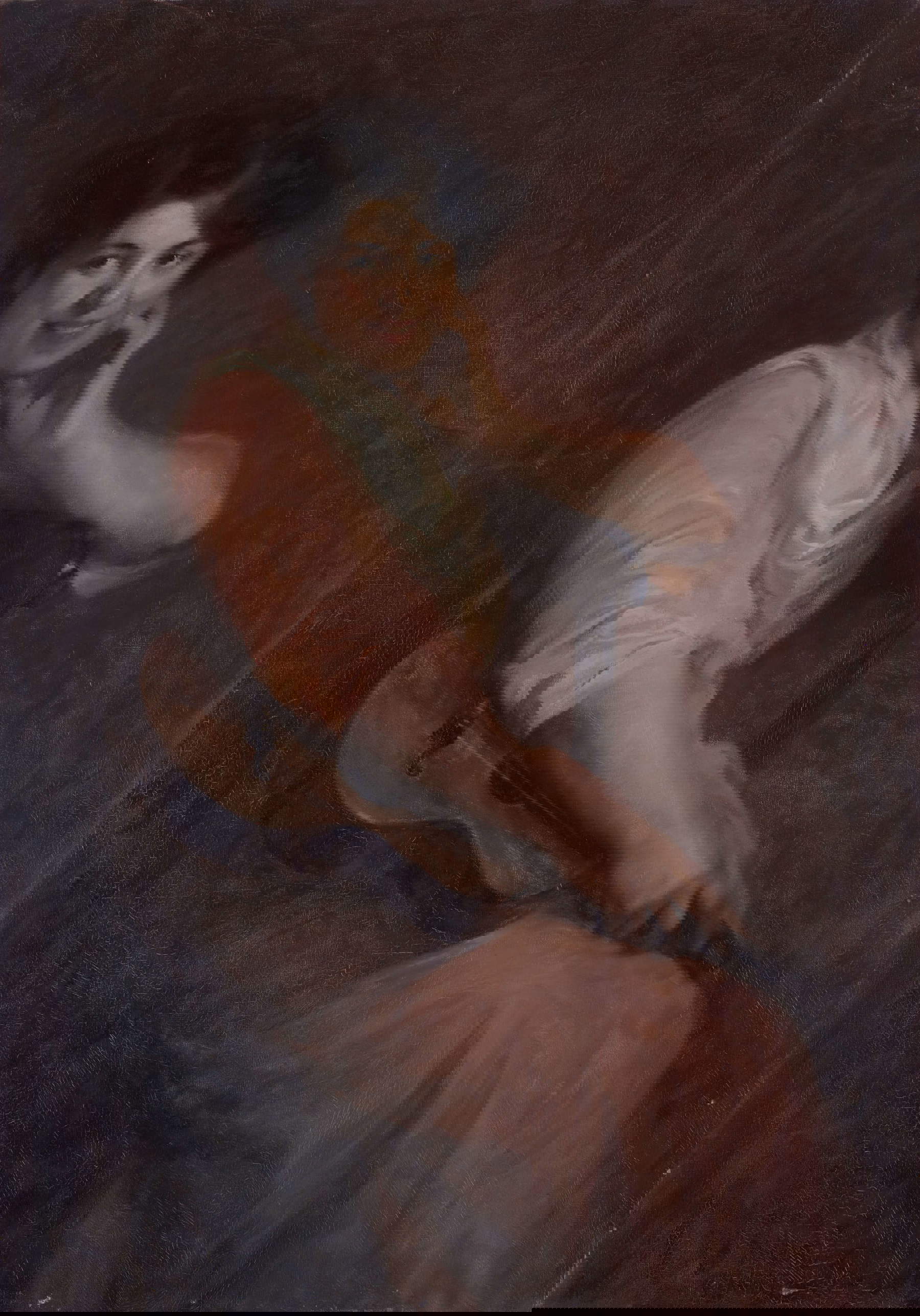
Going backward through the rooms, one encounters a Malerba who arrives at the twentieth century after crossing many languages and consuming them from within. The works of the 1920s, so still, so guarded, so seemingly pacified, have behind them a more mobile, more vaporous season, more linked to the late scapigliatura, to the Lombard painting of the end of the century. It is there that Intermezzo, painted between 1910 and 1911 and reemerging in the Lucca exhibition after a long absence from the public gaze, becomes a necessary passage. The work, presented at the 1911 International Exhibition in Rome and then exhibited again at the 1931 posthumous exhibition at the Galleria del Milione, depicts Amalia, the artist’s wife, with a guitar in her hands: a domestic, collected, seemingly simple scene, which, however, already clarifies the artist’s way of transforming private life into a pictorial device. The slight incongruity of the pose makes the work all the more interesting, because the music already becomes an interruption here, a way of studying the light on the forearm, on the folds of the robe, in the hollow of the hand, on the barely noticeable smile of a figure caught at the moment when something, perhaps an entrance into the room, perhaps a voice, perhaps the painter himself, suspends the gesture. Intermezzo thus contains in a still soft form, still imbued with late nineteenth-century atmosphericity, what would later become one of Malerba’s most recognizable qualities: the ability not to paint the event, but its reverberation. Amalia is not stared at as she plays, but as the gesture loses its function and becomes pure psychology. The guitar is silent. The figure comes alive through a pause. And this pause, rather than the musical theme, becomes the real subject of the painting. Malerba entrusts everything to a minimal exchange of glances, to a hand brushing the face, to a trickle of light that bathes the fringe and makes the eyes shine, to a domestic complicity that enters the painting without turning into anecdote. From such a work one also better understands the strength of The Black Hat, exhibited at the Brera National Fine Arts Exhibition in the fall of 1912 and the first work by Malerba to receive official recognition, which made it enter the king’s collections at the Quirinale. It is an important moment, because it inaugurates the season of the artist’s first public successes: in 1913 would come the Premio Canonica with Donna alla toilette, in 1916 the Gold Medal of the Ministry of Education with Pietà.
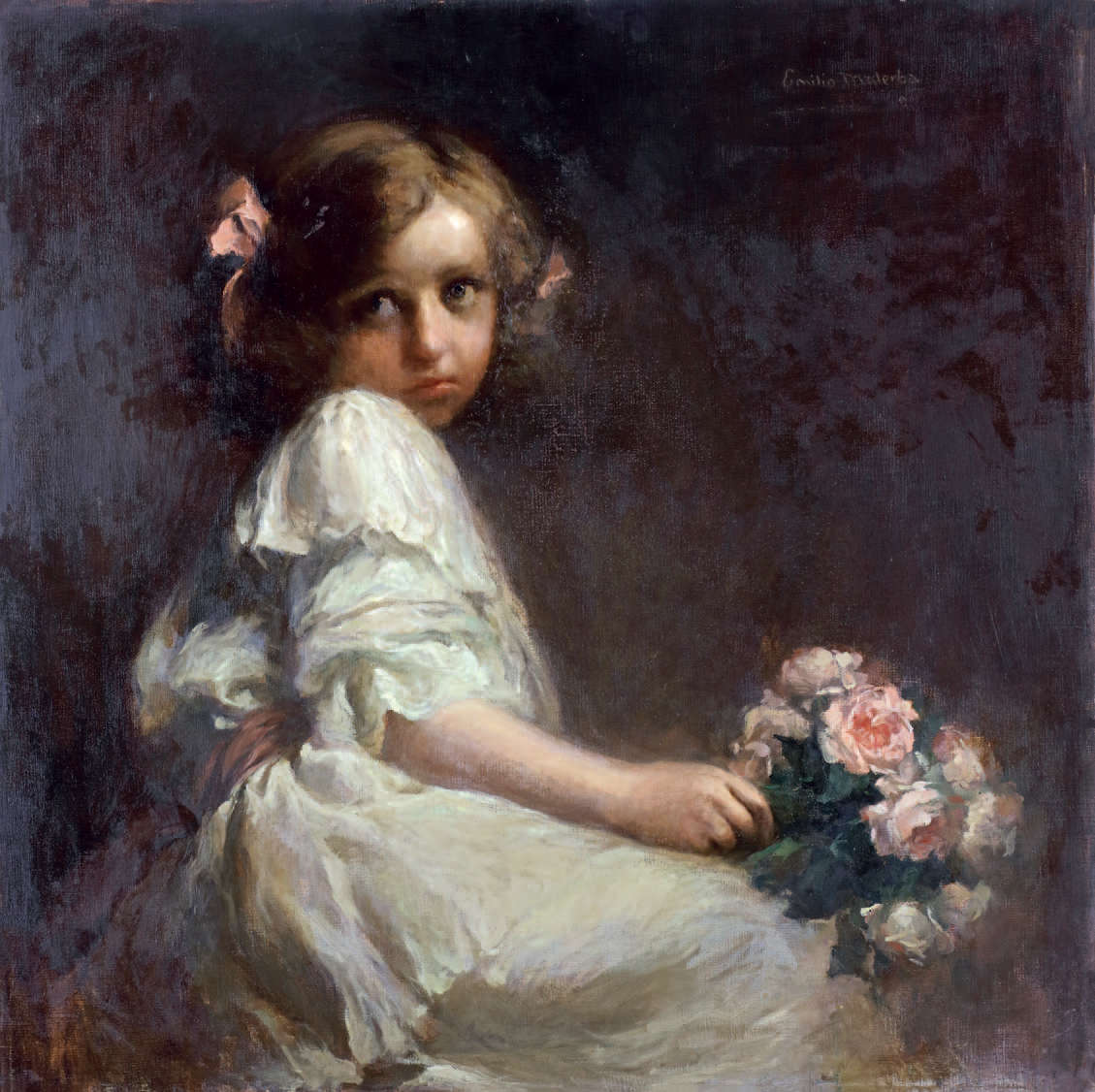
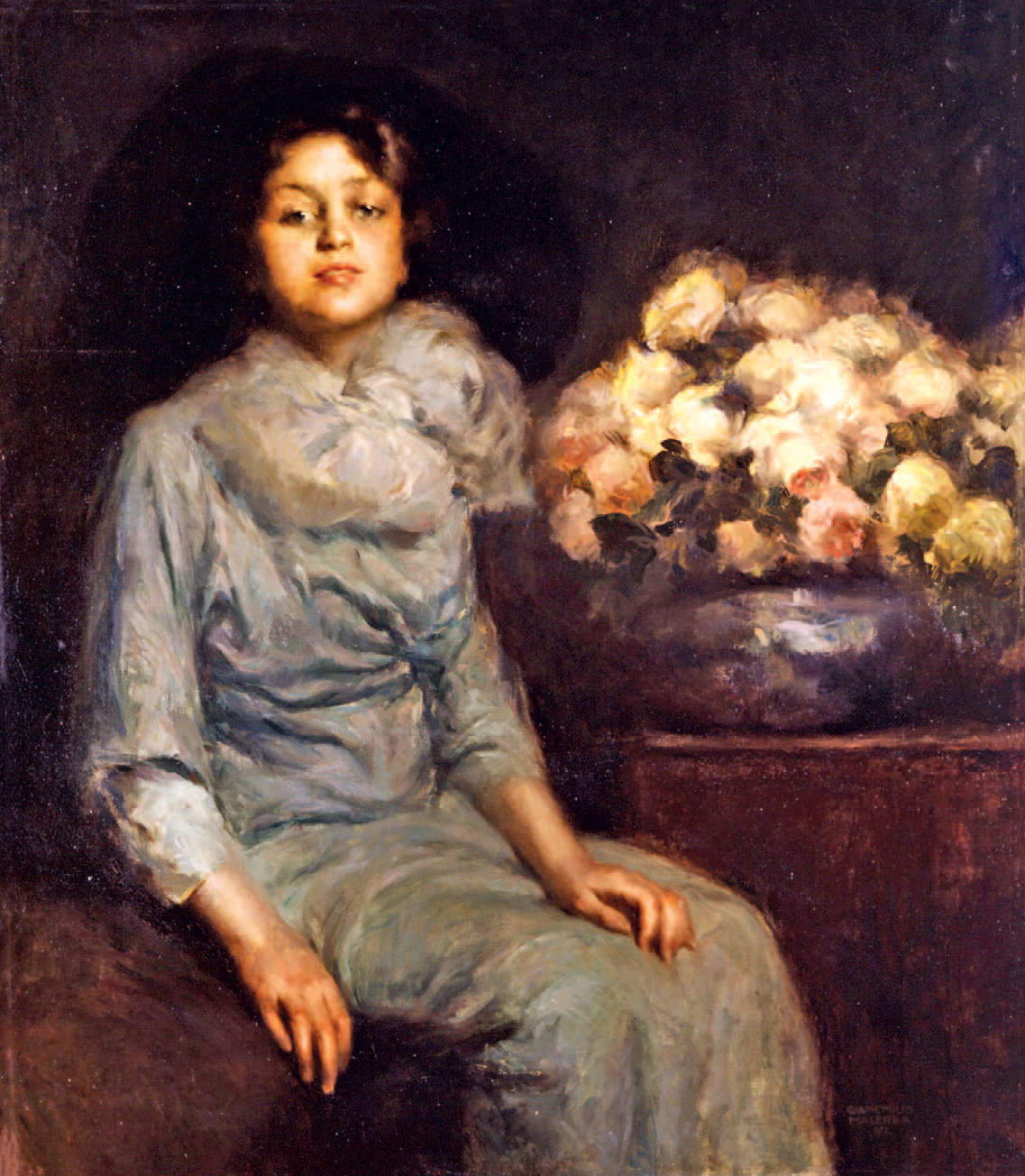
The black hat echoes some of the compositional elements ofOnomastico della nonna, but the melancholy child of 1910, with her foreboding of death, seems here to be transformed into a more self-conscious adolescent, already introduced into the social theater of appearance. The little hat, almost absent from view, paradoxically becomes the psychological center of the image: it can barely be seen, because Malerba deliberately accentuates the darkness of the background and the blackness of the headgear, but this very subtraction makes it more important. The hat acts as a sign of passage, as a small certificate of entry into the adult world, as an element of charm and as a fragile weapon of seduction in a society in which a woman’s value was measured primarily by external criteria, accessories, decorum, poise, and controlled grace. The adolescent looks with a pride mixed with hesitation: she is no longer the child of theOnomastic, but she does not yet possess the full confidence of the adult woman. She stands at that unstable threshold that Malerba loved more than anything else, for there identity is trembling. The light and vaporous brushstrokes, close to Ambrogio Alciati especially in the rose petals, give the subject matter a fragile, almost evanescent texture; the dress and the flowers seem to be made of the same substance, as if the girl were emerging from a zone of delicate and precarious light, ready to vanish as soon as the gaze moves. The following year, with Woman at the Toilet, Malerba tackled a theme beloved by modern painting and particularly by the Impressionists, who found in it the opportunity to study noncanonical poses. At the 1913 Brera National Exhibition, the Premio Canonica was destined precisely for “a half-figure of a woman at the toilet,” and Malerba responded with a work that possessed a more overt sensuality, perhaps even a certain swooning, as if the painter yielded for a moment to the languor of the pose. The woman lets herself be looked at, and the toilette, which might belong to the register of private gesture, becomes a scene of exposure. The body, rather than collected in its intimacy, is delivered to the gaze, while the pose mirrors Previati’s melodramatic Cleopatra, published in Vita d’Arte in March 1913. In Previati’s model, the pathos belonged to the tragedy of the Egyptian queen close to suicide; in Malerba, transferred to a young woman caught in the moment of dressing, that same accent produces a more problematic languor, almost disproportionate to the subject, and it is precisely this disproportion that makes the work interesting within the path: it shows a Malerba still attracted to the sentimental rhetoric of the late 20th century, but already capable of redeeming it through chromatic wisdom, through the contrast of whites, pinks, veils, glass and flowers
The historical-critical path proposed by this very interesting retrospective also insists on the tremendous brevity of his career. After 1924, Malerba kept moving and searching. The trip to Paris in 1925 assumes an important role precisely because it seems to open a new possibility for a painting less sealed and more immediate in matter. The unfinished work of a female figure, executed after that experience and left precisely without end, ideally closes the trajectory with a power that is unbearable. Somarè in this regard recalls, “In his studio in Via Carroccio, over which the dust of absence was spread, lay by the easel a broadly sketched figure, loose and decisive. I thought, with a grip on my heart, that that posthumous work attested as the resumption of a rediscovered spontaneity forever interrupted by death.”
The brushstroke appears looser, the margins more mobile, the construction less locked in severity. It is a work that seems to look beyond Malerba, toward a phase the artist was just beginning to glimpse. Then comes the illness. In 1926 he dies, and the affair comes to a halt while the language was still changing, and this interruption weighs on the entire exhibition like a cold current under the terse surface of the setting. This is precisely why the retrospective at the Ragghianti Foundation takes on a value that goes beyond individual compensation. Returning Malerba also means correcting a laziness of the critical gaze toward the Italian twentieth century, because for too long the narrative of that season has remained a prisoner of comfortable formulas such as avant-garde versus return to order, modernity versus tradition, noise versus silence, rupture versus craft. Malerba forces this map to become more complex. His modernity comes through control and sensitivity, through the ancient and the photographic, through craft and emotion, through the figure and its psychological crack. It lies in the ability to paint a face as a mental place and a domestic scene as a minimal theater of feelings. And so those fingers suspended above the piano, encountered at the end of the path, become the very symbol of the exhibition: hands that study, hands that build. Hands that remained for almost a century outside the great public narrative of Italian art and that today, finally, return to occupy the place they deserve.
Warning: the translation into English of the original Italian article was created using automatic tools. We undertake to review all articles, but we do not guarantee the total absence of inaccuracies in the translation due to the program. You can find the original by clicking on the ITA button. If you find any mistake,please contact us.